Showing posts sorted by relevance for query benjaminson. Sort by date Show all posts

Monday, March 27, 2023

PROFILE: Walter Hill (as Known by Kittson County Locals...)


  • Trish: Walter talked James J. into getting the first car the family had in 1905, but managed to wreck it by 1907.

  • He got married in 1908, and he was put in charge of the Northcote farm in 1910, so I'll go with that...


    • Jim Benjaminson:

    • Time line - Walter got married in 1908, his wife is in the car. He wrecked the first car by 1907...(wonder what it was???)

    • So my guess-timate on the car at 1906-1908 wasn't too far off. I'll do a little research on the early Packard's to see if

    • I can determine an exact year.


  • Jim Benjaminson:

  • Searching information on Minnesota license plates - the plate has to be a multi-year 1912 plate which had dark letters on

  • a silver background. The plates were good for three years so was valid 1912-1913-1914. All the earlier plates had dark

  • background colors.


    • Steve Hannah:

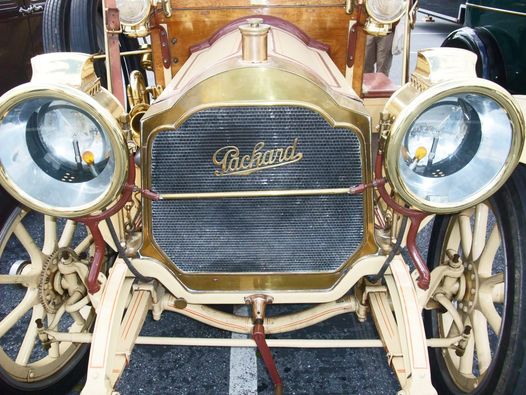
    • But is it a Packard? The radiator emblem was always Packard written at a slant. Everything else is very similar to

    • a Model 30 Runabout.

    • No photo description available.


    • Steve Hannah:

    • I will agree with a 1910-1911 Packard Model 30 Runabout. The only thing is the radiator emblem. Did Hill have

    • a Vanity emblem made? Money was no issue. I can't find a close match to that emblem shape.

    • May be an image of 6 people and outdoors


    • Steve Hannah:

    • Windshield, top, headlights removed.


    • Jim Benjaminson:

    • I was wondering if it might be an emblem for a fraternal order or auto club or ???? Front fender on the Hill car

    • seems a little flatter but that could have been a running change or model year change...


  • Steve Hannah:

  • Walter loved speed, it is said his interests were tilted away from farming toward race cars. I' trying to identify the steamer

  • but they all look alike. I counted around 50 horses though.


    • Jim Benjaminson:

    • This looks like it might be a source - I contacted the library as I couldn't get any access to the Motor Vehicle and

    • Driver License Registration Records, 1909-1921 Register of motor vehicles (1909-1914, with indexes), automobile

    • license applications (1921), chauffeur’s record (1909-1911), and motorcycle registration record (1909-ca. 1913).

    • MNHS call number: See the finding aid in the library (Secretary of State: Motor Vehicle Division).


    • Steve Hannah

    • There is so much I could find out if the Gale Library wasn't 300 miles away. Keep scanning folks!


  • Bernie: my Great Uncle George Hugill played base ball with Walter and said he would chase rabbits in a white

  • Stuz Bearcat. But that was 60 years later so maybe it was a Packard


  • Jim Benjaminson:

  • Does anybody know if early Minnesota license registrations exist for these years?

  • Jim Benjaminson:

  • Probably a 1912 model - later than I first thought.1912, not much if any difference. 60 HP but Hill had a mechanic who could make it


  • Bernie Streed: My Great Uncle George Hugill was a contemporary friend of Walter Hill. What a character. During a

  • winter storm he started telling me stories of how they would chase rabbits across plowed frozen fields with a white

  • Stuz Bearcat convertible. He also told me he would order hand made oak barrels from Italy. Then he would stock the

  • milking barns with long horn steers. They would lock horns in the narrow milking stalls. The barns were state of the art

  • for the day, built with tile walls and sloping floors so manure could be flushed down trenches in the floor into the river

  • below. Basically the bored millionaire would roll these oak barrels down the center of the barn agitating the long horn

  • steers so they would kick the barrels to pieces. He and George would do this for hours till the barrels were gone. The

  • whole farm was meant to get James J Hill's playboy youngest son out of St Paul to reform him.

Bernie:  These are my memories of Uncle George's visit. My mom, Amelia Streed, took her Aunt Amelia Diamond Hugill into town for an event at the Presbyterian church but they didn't want George to be alone in a storm so i sat with him. He started talking about his youth.. great stories. This was probably around 1968 or before. So I would have been in 8th grade maybe.

Trish: Walter Hill was a goer, or "someone vibrant for life." He hunted from his car, raced his draft horses in the streets of St. Vincent, and drank mightily. Before the fall harvest, he used to attach a hay-rack to the back of his car and go to Bronson, Minn., searching for labor. Men eager for jobs climbed onto the hay-rack and Hill drove them home in his usual manner. By the time he got back to the farm, there would be only one man left - the rest had jumped out along the way in fear for their lives.

Bernie: lol I can believe that. I know my Grandpa Bernhard Streed drove one of the steam tractors. He said he started in the dark of morning and made one swath to the Red River and back before sunset.

Keith Finney: I believe it was Byron or Marva that told me that he would go into Canada up by Tolstoi and get hired men. He would drive fast across the rough prairie and some would fall off on the way. Thus the illegal aliens that worked on the farm

Georgine Cleem Whalen: Thank you Trish for this wonderful information on Walter Hill and some of his escapades I see in one of the links that he passed in 1944 in the West which would have been during the time my Grandpa was working for him on the ranch he owned there in 1932. It became the Bishop Ranch in the 40's and I still remember them letting us swim in the pool as my mother worked for doc Bishop. It is not there anymore but they do have a street named Bishop place where this ranch set. I was wondering if Walter returned to Minnesota after my Grandpa Borgeson went to work for the shipyards along with his sons.

Trish this is how we 'Borgeson' family ended up in California. James Hill bought a horse ranch for Walter and my Grandpa Eric Borgeson went with him to work this ranch and property in 1932. The rest of the story is amazing how the whole family (13) left Mn. in a Franklin car and went west

I do not remember the name. I only remember after it became Bishop Ranch. I think my Mother said it was a horse ranch and her dad (Eric Borgeson) worked for Walter Hill and came to California in 1932. He sent for my grandma later and that's another wonderful story and they lived in the old red house there in Midway City, Ca. When my parents went to California in about 1942 sometime I was still the baby. We stayed at the old red house in the middle of a field just behind where the Hill place would have been. Shortly after my grandparents bought a place in Anaheim (this is where I lose track of Walter Hill about 1943/44) and my parents stayed at the old red house which was then bought my Hap Post who my dad worked for. We lived there till I was in high school when the property was sold by the Post Brothers. I digress here, the horse ranch that Walter Hill bought would be off Bolsa in Midway City, maybe considered Westminster at that time. I do remember this property as I got older. Walter Hill brought my grandpa a big old green rocking chair that is still in the family that all of us remember him rocking away in. Grandpa did change jobs at this time and I always wondered what happened to Walter Hill.


Going through picture albums and saw this paragraph in an article about midway city california and walter and james hill. I remember this hotel well on the cutoff there as our family knew the hokes well but never knew that walter hill had a hand in the start of that... From: “James J. Hill Banished his Errant Son to Kittson County” by Ruth Hammond - Walter Hill was a "a goer, or someone vibrant for life," Hanson said. He hunted from his car, raced his draft horses in the streets of St. Vincent, and drank mightily. Before the fall harvest, he used to attach a hay-rack to the back of his car and go to Bronson, Minn., searching for labor. Men eager for jobs climbed onto the hay-rack and Hill drove them home in his usual manner. "By the time he got back to the farm, there would be only one man left," Hanson said. The rest had jumped out along the way in fear for their lives.

Monday, October 16, 2017

Pembina County at 150: Historical Automobile Dealers


Where Have All The Car Dealers Gone?
by Jim Benjaminson


Gregory Ford's announcement last week that they are giving up their Ford Motor Company franchise after 58 years of sales brings to a close a long history of Ford sales in Cavalier —stretching all the way back to 1906. As Gregory's fold their tent for new car sales, Pembina County is left with just two automobile retailers – Soeby Motors (also Ford dealers) in Walhalla and the recently opened Birchwood Motors (GM dealers) in Cavalier.

Several years ago, the late Maxine (Fiedler) Least approached me during the annual Pioneer Machinery Show at the Pembina County Museum and asked if I had ever compiled a list of the implement dealers that had done business in Pembina County. Maxine's father was one of the principals in Fiedler & Moe, a John Deere agency in Cavalier. I had to admit that I hadn't but since our conversation I've made it a practice to note the names of various automobile and implement dealers—a random collection of notes that is far from complete – but continues to grow. The automobile and farm equipment business has changed over these past 111 years. In the old days nearly every community had an “agent” selling the latest car or tractor of some sort. In memory of Maxine and all those who have been involved in selling cars, trucks, tractors and motorcycles here is an incomplete history.


Pembina County's first Ford agency was granted to James Lang of Cavalier in 1906. His appointment named him “agent for Pembina County”. The first Fords sold, three identical 14-horsepower Model N “Light Tourings” arrived by rail in Cavalier that March and were sold to merchants D. E. Schweitzer, Charles Burgess and banker Ed Stong. They were not, however, the first automobiles sold in Cavalier but were the seventh, eighth and ninth automobiles in the city. Two years later (the same year the Model T Ford debuted) Lang and business partner Thomas G. McConnell formed the “Cavalier Garage & Automobile Company”, doing business out of a large brick building on the corner of East Main and Division Streets. Their business announcement stated they would continue selling Fords and “other favorite autos” in addition to handling “auto fixtures and supplies” and “do all kinds of repairing” plus add an “auto livery business”.

James Lang has the distinction of placing the first ad for an automobile in the Cavalier Chronicle in the June 26, 1908 issue. Found on page 4 the ad featured a line drawing of two Ford runabouts – the ad ran for the next six issues without change. Lang also gets credit for placing the second automobile ad in the paper, beginning with the March 19, 1909 issue, advertising both a $500 Maxwell and an $850 Ford, this ad running for twelve weeks. Lang was a busy man as he, along with partner George Horn, started the Cavalier electric light plant. By 1916 the local Ford dealership was taken over by G. A. Westline and Peter Freschett. Two years later Westline and Freschett were out of the Ford business, being replaced by Akra's Thorwaldson Brothers who would run the business until the mid 1930's, Westline took on the Essex line in 1919 while Freschette later picked up Pontiac and Oakland.
Trivia [answers at bottom]
  • How many automobiles were in Cavalier in 1905?
  • What year did the new hotel in Glasston open? 
  • What year did Cavalier remove the hitching posts from Main Street?
Following the end of World War Two S & T Motors opened a Ford agency in Cavalier on September 18, 1946. Owned by Bob Tomlinson of Devils Lake and Clarence Smerud of Minneapolis, a new brick building was built to house their facilities. Tomlinson soon left the business which operated until 1958 when Mr. Smerud passed away unexpectedly. The agency was then sold to Oliver Gregory who took over the business April 1st, 1959. A new dealership facility was built on the south of edge of Cavalier, opening in 1962 where the business is still located.

Soeby Ford of Walhalla, which can proudly claim the distinction of being the oldest dealership in Pembina County traces its roots back to 1926 when C. K. Soeby acquired the Oakland and Pontiac car and International truck franchise. C. K. Soeby became a Ford dealer in 1930, passing the business along to his son Jack in 1948 who in turn passed it on to his sons in 1986. Another long time Walhalla dealer was A. O. Tetrault, whose Walhalla Motor Company held the Ford franchise in 1926, a year that would see a first in the delivery of new Fords when the first load of “completely built up” Ford cars arrived—previously dealers had to install items such as lights, wheels, tires and fenders before delivery could be made to a retail customer.

Harold Morrison and Freeman Levi built a new building “two blocks south of the post office” under the name of Cavalier Implement, selling Case farm equipment in May of 1944. By 1952 they added the Pontiac and Willys line of automobiles using the business name Cavalier Motor & Implement. Discontinuing selling farm equipment and moving to a new location on the west edge of Cavalier the new building was lost to fire Christmas Eve, 1959. Rebuilding on the same spot and re-named Cavalier Motors, it had the distinction of being named “Studebaker's newest dealer” in 1960. The business, which continued to sell Pontiac, was sold to Olson Motors in 1962. Down the street, Page Oil Company, which had been selling Oldsmobiles since 1941, took on the Rambler line in time to introduce the 1959 models.

Like S & T Motors several other dealerships were opened in Cavalier following WWII. Melsted-Olson Motors built a new brick building one block further south of the new S & T building, selling Chevrolet cars and trucks as well as Massey-Harris farm equipment. Kuball & Andrews, which had been in operation since before the war (Ole Andrews having been a Chrysler dealer since 1927), continued to sell Dodge and Plymouth cars in addition to Lehr's “Big Boy” tractors. Utilizing a Chrysler engine, Dodge truck 5-speed transmission and 2 speed differential, the “Big Boy” sold for $2,136 in 1948 and had a “road gear” good for 22 miles per hour. Letzring Motor & Implement which had previously sold Hudson and Terraplanes in Neche was also selling Chrysler products along with Allis-Chalmers tractors in Cavalier. Kuball's sold the Dodge-Plymouth agency to Erwin Herzog in May of 1956. Twenty years later Erwin sold the business to his son Tim, who later sold the business to Swanson Motors in September of 1999. Jack McPherson began selling Kaiser automobiles in 1950 and its companion compact car Henry J in 1952. A post war start-up company, Kaiser-Fraser dealers also included Andre Gratton at Walhalla and Hughes & Shaver at St. Thomas.


Auto and implement dealers weren't just centered in the larger towns of the county. Robert Halcrow, whose address was Nowesta, was an agent for the Lambert automobile in 1913; he is noted as having “brought a cow to town in a box wagon behind his auto”. It's claimed he made the eleven mile trip to town “in one hour and went home considerably faster”. In later years Halcrow Ford would be one of Drayton's leading automobile dealers. Drayton's early pioneer car dealer R. J. Moore began handling the E-M-F line in 1912 - named after the three principals of the company, Everitt, Metzger and Flanders - detractors claimed the initials stood for “Every Man's Failure” or “Every Morning Fixit”. It was later absorbed by Studebaker.

Over at Hamilton C. A. Morton's Auto Livery advertised they were agents for the Vulcan, Buick and Marathon brands and had “one 25-horsepower Marathon touring car used a little for demonstrating which will sell at a nice reduction." Any of the cars on hand could be bought “on one years time with first-class security at 7 percent interest.” By 1921 E. K. Evenson was selling Fords at both Hamilton and Neche. H. C. Thomson of Bowesmont was also selling the popular Ford line. George Paxman had been the Hamilton Ford agent as well as the Overland and Willys-Knight dealer. A disastrous fire July 7, 1918 destroyed the Paxman building but 5 new Overland cars were saved. At Hensel, H. J. Norman & Son were also selling Fords while Graham & Ross sold Republic trucks. In later years Frank Gillis would handle the International line in Hensel, eventually selling out to Art Anderson. Other International dealers included Glenn Morrison in Cavalier, and Neche Farm Equipment in that city.

Crystal's Bradley & Hunter were sales agent for the Racine, Wisconsin built Mitchell in 1912 while the Crystal Auto Company was selling Hudsons by the car load, adding the Studebaker line in 1917 and Essex, Overland and Willys Knight two years later. A man by the name of Bymaster later took over the Crystal Mitchell agency. G. G. Thompson of Pembina was also selling Mitchell's in 1912, with his territory carrying over to St. Vincent, Minnesota. By 1915 Thompson was a Maxwell dealer. At Mountain S. F. Steinolfson was selling Ford's while G. M. Benjaminson (his name was always misspelled as C. M. Benjaminson in newspaper ads) was selling Pontiac's and Oakland's in Gardar. Peter Freschette, earlier Cavalier's Ford dealer also took on the Pontiac-Oakland line in 1927.

As small town America dwindled several dealerships continued to run successful businesses. Louis Byron Motors sold Pontiacs after the war and were long-time Chrysler-Plymouth dealers in Mountain. Likewise, Dietrich Motors in Crystal sold DeSoto's and Plymouths while Christopher Motors at Pembina, which dated back to the 1920's sold Chevrolets well into the 1960's.

Among the more noted implement dealers have been Cavalier's Fiedler & Moe (John-Deere), Pembina's Meagher Brothers (Massey-Harris), Glenn Morrison (International Harvester), Hamilton's Frank White & Ernest Einarson (Minneapolis-Moline), and J. J. Myers, Mountain (Holt combines).

At least three Pembina County residents saw the demand for motorcycles, with B. S. Thorwaldson of Akra (a partner in Thorwaldson Brothers at Cavalier) selling the 11-horsepower Harley-Davidson Twin, Martin Brothers of Hamilton handling the Indian line (ride it to work and ride it for fun) and Svold's August Vivatson offering Wagner Motorcycles at prices ranging from $160 to $200.

There was always something special about going to “show day” - when the new models were introduced to the public. Coffee, doughnuts, trinkets, colorful brochures and new cars. What could be better? Sadly there's not as many places to go anymore.

Trivia answers

5

1904

1905

Sunday, January 01, 2012

Port of St. Vincent: Welcome to America

Originally issued in 1888, this is an 1891 copy of a
Declaration of Intention
  [Courtesy:  Jim Benjaminson]

This Declaration of Intention certificate is for Magnus Benjaminson.  He emigrated from Iceland in 1886, and arrived in the United States via the Port of St. Vincent.

Many entered the United States via the Port of St. Vincent from Canada, and still more came across the young territory of Minnesota from the South by train, wagon, and even steamship. Some stayed, most left.  St. Vincent was a crossroads just like her sister city Pembina was before her.

New York had Ellis Island, Kittson County had St. Vincent!

Monday, March 28, 2016

Six Shots in the Night


Huron City (1883 Plat Map) Source:  HistoricMapWorks.com
I've written about Huron City a few times here before; and of course Charles Walker wrote about it, making it come alive, in his books Sheriff Charley Brown, and Bordertowns.  This time, I'm sharing another essay about it written by Jim Benjaminson, that was recently featured in the Pembina Historical Society newsletter.

Huron City is long gone now, but once it was a lively conclave nestled along the border...
_______________

Since the earliest days of settlement in what would become Pembina County, many little communities sprang up over the years, many have totally disappeared. Communities such as Hyde Park, Bruce, and Tyner have all but disappeared – leaving behind only the graveyards holding the remains of those early pioneers. Other communities such as Svold, Hallson and Leyden still have a presence, if you know where to look.

During the course of the past years, I’ve given several presentations and each time I’ve asked those in attendance, “Do you know where Huron City was?” Only one person – Ken Gardner – ever raised his hand to reply in the affirmative. Although most of its history has been lost to time, Huron City played a role in Pembina County’s history – most of it, not for the better.

Huron City, Pembina County, Dakota Territory, was located in the extreme northeast corner of the county tucked against the International Boundary to the north, adjoining the Hudson’s Bay company town of West Lynn and the Red River to the east, about two miles north of Pembina.

Newspaper ad for the Half Way House hotel in Huron City
Located on property owned by James H. White, the town-site of Huron City was platted prior to a public auction held September 4, 1879. Advertisements promoting the land sale touted the fact Huron City would be the “terminus of the St. Paul, Minneapolis, and Manitoba Railroad and the Manitoba Southern Railroad”, as well as being located on the main wagon road from Winnipeg where a new “International Bridge” would be built, connecting the two railroads.

The fledgling city already boasted Jim White’s saloon. The saloon was unique in that the building actually straddled the border – a red line painted on the floor indicated whether you were on the Canadian side of the border or the U.S. It was here that a Texas train robber was employed as a bartender – an outlaw who would die in a shoot-out in the Pembina post office in November of 1878 while resisting arrest by a deputy U.S. Marshal, who also died as a result of the affair.

White offered “100 business and residential lots – with no use restrictions”. Sale terms included cash payment of 10% of the sale price the day of the sale, with an additional 40% due within one week. The remaining balance could be paid off within one year at “normal rates”. Paying cash for the entire amount the day of the sale got the buyer a 10% discount. The Pembina Pioneer reported sales were good.

Closeup of Huron City platted streets; note 'Wharf St' in NE part of map...
Unlike many of the previously mentioned neighborhood communities, Huron City was platted into lots and streets – Anna Street, Elizabeth Street, Matheson Street, Huron Street and May Street running at an angle (southwest to northeast) with cross streets of First Street, 2nd Street, Third, Fourth and Fifth Streets (only 2nd street was marked with a numerical number, others were spelled out in full) and Wharf Street – leading to the river and presumably a river boat landing.

Article in the October 20, 1892
edition of the
Winnipeg Tribune
In addition to White’s saloon, Dan Rogers was the proprietor of the International Hotel, which along with an attached residence, burned to the ground September 4, 1885. For the “sporting crowd”, there were also two houses of ill-repute, one run by Pearl Gould, the other by Nellie Dunn1. Both establishments closed their doors after an incident the night of October 19, 1892 when a party of men from Emerson attempted to enter Pearl Gould’s but were refused entry. Pearl and her “soiled doves” retreated to the safety of Nellie’s, where the same parties were also refused entry. During the ensuing fracas, an Emerson hotel keeper named John Wagner was shot and killed.

Nellie Dunn was arrested and brought before a Grand Jury at Pembina. Although there was some question as to whether Nellie had actually fired the fatal shot, the jury determined Wagner’s death was justifiable homicide due to threats he had made to harm Nellie. Following the not guilty verdict, Nellie, Pearl and the other “ladies of the evening” were advised it might be advisable for them to return to Canada. Local papers remarked that the Gould name was “more than familiar” to law enforcement in Pembina County.

Although little more is known about Huron City, it remains a unique experiment is establishing a thriving community. Within a few square miles of land encompassing what is now North Dakota, Minnesota, and Manitoba, seven communities were established - Pembina, Huron City, West Lynn, Emerson, St. Vincent, Noyes, and Interapolis. Six had established residences and businesses; five still exist.

Interapolis, Minnesota, which would have been directly across the Red River from Huron City, never materialized. Huron City, Pembina County, Dakota Territory is unique in that it was documented in Pembina County Atlas’ as late as 1909, long after it had faded away to nothing more than a fleeting memory.

1 - A sidelight to the Nellie Dunn story. After she was "invited" to leave the U.S., she ended up in Spokane, Washington, in February 1893; still plying her trade, where she "shot and killed her boyfriend". The locals weren't as understanding as Pembina -- they took Nellie out and lynched her.

UPDATE 13 August 2020:  From fellow local historian and author, Jim Benjaminson, "...the story I did on Huron City - about Nellie Dunn being hung in Spokane, Washington is false. Nellie 'removed' to Winnipeg after the affair in Huron City and continued to work as a prostitute. The story of her hanging came from an eastern Canadian newspaper...I found Winnipeg papers that made mention of her after the date of the supposed hanging."

Wednesday, May 17, 2006

The Hartzell-Bascom Murder Trial

Actual Photograph taken during the Hartzell-Bascom Murder Trial, with Judge Pollock presiding...
I came across the photograph above when I reviewed the Barry Collection from the SHSND recently. I was intrigued because it was labeled a scene from the "Hartzell-Bascom murder trial in Pembina Court"...I couldn't find anything out about it at first. Then I ran across a fascinating mention of Hartzell when researching at the North Dakota Supreme Court website. Ultimately, it was that source that tracked down the following mentions of the trial in a paper of that time. Please note that these are transcribed from scans of the original newspaper articles, and some words were truncated so I made my best guess as to the original word, and when that wasn't possible, I added dashes to indicate 'unknown'...

[Bismarck Daily Tribune August 22, 1904]
APPLY FOR HABEAS CORPUS
Application will be made to Chief Newton C. Young of the supreme court for an order admitting L.S. Hertzell(sic) and E.T. Bascom to bail. The two men are attorneys located at N and are accused of murder in in the third degree for the killing of Byron Stoddard a neighbor, on July 7th.

Judge Kneeshaw of the district court denied a motion made to admit the two men to bail, and they have been in custody in the county jail at Langdon ever since the afternoon of the shooting.

Application to the supreme court for an order of on bail will be on the ground that Stoddard had frequently threatened to kill both of the accused men on sight, that he had made these threats openly and that they had been communicated to both Hertzell and Bascom. These points are set forth in the application in the testimony of Mrs. Cora Stewart and Mrs. Bascom, who feared the threats made by the man who was killed on July 7th.

While Stoddard was very unpopular at Langdon, where he had lived less than two years, there is a strong feeling against the young men. Hertzell shot and killed Stoddard during a dispute over a certain fence and road and Bascom was with him at the time.
[Bismarck Daily Tribune April 27, 1905]
Judge Fisk and States Attorney Price have refused to sign the petition of S. L. Hartzell, convicted of the murder of Byron Stoddard at Langdon and sentenced to five years in the penitentiary. Petition is being circulated by E. T. Bascom, business partner of Hartzell, and the grounds stated are that Hartzell has been sufficiently punished for his crime. It would seem to the lay observer that five years imprisonment is a light sentence for homicide where the particulars were such that any conviction at all was had. Hartzell has been in the penitentiary only a few months, and if guilty at all the statement that he had been sufficiently punished seems hardly well-founded. The fact that the trial judge and prosecuting attorney had refused to sign the petition would indicate that the application is not such a one as the board of pardons is likely to look upon with favor.
[Bismarck Daily Tribune Monday July 11, 1904 – Front Page]
FARMER-LAWYER MURDER IN LANGDON
Murder Reported From Langdon Where One Farmer Shoots and Another Farmer Dies
Byron Stoddard aged 26 years, a --ing a mile from Langdon, North Dakota and instantly killed by S.L. Hartzell, an attorney. Mrs. Stoddard and their daughter witnessed the killing from their buggy nearby. Mr. Bascom, the business partner of Hartzell, was also a witness of the shooting.

Stoddard and the firm of Hartzell & Bascom owned adjoining farms, a fence dividing the properties. There was some trouble over a roadway, making it necessary to cross some of the ---d in leaving the Stoddard Saturday afternoon Mr. Stoddard accompanied by his wife and they drove toward Langdon and --o crossed the land owned by -- of lawyers. Mr. Stoddard had a pair of plyers with him and --ved some wires in order to obtain crossing. After driving through the opening he got out of the buggy and repaired the fence, and --- engaged the lawyers drove --utombile. There were some --ssed; between Hartzell and Stoddard, and raising a shotgun to his shoulder Hartzell fired at Stoddard --ge of gunshot took effect. Stoddard died almost instantly. To a suggestion that he be taken to a hospital he said, "Take me home..." which were the last words he spoke. Hartzell claims that Stoddard pointed at him and that he fired the gun in self defense. Mrs. Stoddard denies this and says her husband had no revolver with him, that it was lying in the bottom of --. It was found that two bullets had penetrated Stoddard’s --en had had considerable -- is claimed, and at one time Hartzell is said to have induced Mrs. Stoddard to agree to start an action for divorce against her husband but it is claimed that the action was not started.

Hartzell was given a preliminary hearing and was held to the district court on the charge of murder in the first degree. Stoddard and Hartzell both moved to Langdon about two years ago from Blue Earth county, Minnesota.
[Bismarck Daily Tribune Monday, November 6th 1905]
Seeks a Pardon – Application has been filed with the board of pardons for the pardon of Seth Leslie Hartzell, who was convicted of manslaughter in the Pembina county district court January 25 last and sentenced by Judge Fisk of Grand Forks to five years in the penitentiary. The application will be considered at a meeting of the board of pardons to be held at Bismarck on December 2. Hartzell, a member of the law firm of Hartzell & Bascom at Langdon, shot and killed Byron Stoddard, a farmer living near Langdon in July of last year.
[Bismarck Daily Tribune December 5th 1907]
HARTZELL PARDON DENIED BY BOARD
---
Young Lawyer Who Took the
Law Into His Own Hands
---
Sympathy For Aged Father
Insufficient To Overcome
Duty to Society
---

The State Board of Pardons has again denied the application of Seth L. Hartzell for a pardon.

Hartzell is a young lawyer, formerly a student at the state law school at Grand Forks and a graduate of that institution. He took a homestead in Cavalier county and after some difficulties with Byron Stoddard, a neighboring homesteader, shot and killed Stoddard, while the latter was on the way to town with his wife.

The trouble that led to the shooting was due to the breaking down of part of a fence by Stoddard. It was claimed for Hartzell that Stoddard was a bad man and that the shooting was done in self-defense. Nevertheless, Hartzell was convicted of manslaughter and sentenced to five years in the Penitentiary.

Hartzell’s father has been a persistent applicant for his son’s pardon. He is an aged man with much love for his son and has been a pathetic figure at sessions of the state board for several years. The board has usually taken the position that no facts had been presented to justify them in overturning The action of the jury that tried Hartzell and fixed the degree of his guilt.
Trivia:

Regarding ND vs Seth Leslie Hartzell and Edward T. Bascom (initially charged with first degree murder of Byron U. Stoddard, with a shotgun), trial was in Pembina because defendants petitioned for change of venue, feeling certain individuals with undue influence would cause prejudice and make a fair trail impossible in the county they were in. Bascom claimed, in a Petition to be Discharged from Custody, that any action against Stoddard was self-defense, that he was in the act of drawing a loaded revolver.

Judge Charles Fisk was the judge in the Hartzell-only trial (Hartzell and Bascom were tried separately...) Jury returned a verdict of guilty of manslaughter in 3rd degree (five year sentence...)

Judge Charles Pollock was the judge in the Bascom-only trial; Bascom was found not guilty on February 21, 1905...


Hartzell Trial, Judge Fisk presiding.
[Click to see full-size, for more detail]
Photo Courtesy:  Jim Benjaminson
Some additional information about the trial, shared by Jim Benjaminson:

Readers of Pembina County Historical Society's "Heritage '76" history book may recall a photo showing the court room in the old courthouse when it was still located in Pembina.  That photo showed a shackled man sitting before a judge and jury and was identified only as a murder case, with no names connected to the photo.  A closer comparison to this photo is in order, also taken at the old court house in Pembina in the same time period but with different jurors and court officers.

Daniel Flanagan was from Crystal and traveled to Pembina to serve on the jury (he's in the front row, second from the right) on the Hartzell murder trail in January of 1905. The Crystal Call newspaper said he had stayed at Pembina for two weeks until the trial was completed.

S.H. Hartzell was an attorney from Langdon who had shot and killed a neighbor, Byron Stoddard, over a trespassing dispute in July of 1904. Hartzell and his law partner, E. T. Bascom (some spelled the name Bascombe), owned property about one mile west of Langdon. The previous fall a threshing engine had broken through a bridge on the property line south of the farm owned by Hartzell and Bascom. The bridge was not going to be rebuilt which rendered the roadway impassible. The day of the murder, Hartzell and Bascombe were at the sight when Stoddard showed up, taking his wife and daughter in a buggy to Langdon for the circus. According to the newspaper story, Stoddard had a wire cutter and was proceeding to cut the fence when Hartzell forbade him to proceed. When Stoddard persisted, Hartzell produced a shotgun and gunned him down.

Both Hartzell and Bascombe were charged with murder in the first degree and jailed on July 7, 1904 where they remained until trial, being refused bail by Judge Kneeshaw. Appealing Kneeshaw's refusal of bail to the North Dakota Supreme Court, the court ruled for the judge. A change of venue moved the trial from Langdon to Pembina, Judge Fisk of Grand Forks being assigned to hear the case.

Hartzell was found guilty and sentenced to five years in the state pen, the charge reduced to manslaughter (although he was released early). Bascombe, in a second trial held in February 1905, was acquitted as he had been nothing more than a witness to the entire affair.

Tuesday, August 30, 2011

Justice in Old Pembina

The story I'm about to share has been shared here before.  While the first version was full of character (based on solid research), this one has  more background as well as details regarding the final showdown, written by one of our area's premier local historians...
An outlaw from an infamous gang.  A U.S. Marshall on his trail all the way from Texas.  Their paths meet in Pembina on a cold November day in 1878...

by
James Benjaminson
           
Sam Bass gang - Sam in back, on
left; in front, the Collins bros.
William is on left, Joel on right.
[circa 1877]
In the annals of western outlawry, certain names have been etched into the American psyche – names such as Jesse and Frank James, the Younger Brothers, Billy the Kid, Black Bart and Sam Bass, just to name a few.  For the most part, their villainous exploits took place in parts of the country far remote from rural North Dakota.  The closest any of them got to North Dakota was the James Gangs ill-fated attempt at robbing the bank in Northfield, Minnesota and the Bass gangs robbing of seven stage coaches in the Black Hills of South Dakota.  Still, the effect of one outlaw’s exploits rippled to the tiny town of Pembina, Dakota Territory in 1878.

Sam Bass was a young Texas outlaw who headquartered himself in Denton, Texas.  Teamed up with the outlaw Joel Collins and four others, the Bass gang staged the largest train robbery in U.S. history (at the time) when they held up the Union Pacific railroad at a tiny watering hole called Big Springs, Nebraska on the evening of September 18, 1877.  Although Bass was considered leader of the gang, law enforcement claimed Joel Collins was the brains of the outfit.  The gang rode into the stop over, made hostages of the station master and several others in the vicinity, cut the telegraph lines and waited.  When the train pulled in for water, one gang member swung himself into the cab of the locomotive and took the engineer and fireman hostage while the others headed for the baggage car.

When they rode off into the night, the gang had relieved the railroad of $60,000 in freshly minted 1877 twenty dollar gold pieces.  Dividing up the treasure, each man had 500 gold coins in his possession – about 35 pounds of gold per gang member.  The group split into three groups of two men, each heading in a different direction.   Word spread fast about the robbery and law enforcement swooped in on the area.  One of the gang members disappeared and was never heard of again (many assumed he had gone to Canada).  Joel Collins and his partner didn’t fare as well, being intercepted by a posse within days.  After a brief shoot-out, both outlaws were dead and $20,000 of the gold coins were recovered. 

Bass and his partner figured two lone riders would be suspicious so they acquired a buggy, stashed the coins under the seat and rode blissfully by the bands of law officers they encountered.  Returning to Denton, Bass enjoyed the high life, spending freely and enjoying a local sort of hero worship.  He had plenty of friends to warn him of approaching trouble and knowing the area like the back of his hand, he could easily hide from pursuers.  Living the high life the money soon ran out and Bass returned to his old ways.  Organizing a new gang, he returned to robbing trains.  Only this time he chose to hit the local railroads – his gang robbing four trains in quick succession within a 25 mile radius of his base of operation.  It was at this point the locals turned on him and his gang.  For seven weeks, the gang was pursued by a company of Texas Rangers, U.S. Marshals and local law enforcement, all to no avail (although an accomplice, “Arkansas” Johnson, was killed in a skirmish from which the rest of the gang escaped).

Bass’ downfall came at the hands of a spy that infiltrated the gang – and by gang member Jim Murphy who betrayed him in exchange for having charges dropped against himself and his father.  The fatal day came when the gang rode into Round Rock, Texas intent on robbing the local bank.  Laying in wait were the Texas Rangers and local law enforcement.  In a brief bloody shootout, one deputy sheriff was killed as was one of the outlaws.  Bass himself was wounded but managed to clamber onto to his horse and ride away.  The trailing posse found him the next day, lying under a tree, still alive but mortally wounded.  Death came to Sam Bass July 21, 1878 – it was his 27th birthday.

Of the participants in the April 10th train robbery at Mesquite, Texas, six of the eight robbers had either been killed or were in prison by the time of Bass’ death.  The robbery had netted each of the bandits the paltry sum of $23 each!  One of the gang – William Collins, was arrested days after the robbery and taken to Austin to stand trial.  He was moved to the jail in Dallas in June where a family friend posted a $15,000 bond to secure his appearance in court—a date he did not intend to keep.

A brother to outlaw Joel Collins who had participated in the earlier Big Springs train robbery, William Collins jumped bail and headed north, roaming across several states before eventually ending up in Pembina, Dakota Territory working as a bartender in Jim White’s saloon, a unique watering hole that straddled the border.  A red stripe painted on the floor designated which country a patron was in – the saloon on the U.S. side of the line, with the kitchen and sitting room on the Canadian side.  Known to the locals as William Gale, Collins befriended a local man, Robert Ewing, finally telling Ewing his real name and confiding he had a wife living in Dallas.  Gale/Collins asked Ewing to write her a letter, which apparently Ewing did.  One can only speculate but it is assumed authorities were watching her mail.  It wasn’t long before a deputy U.S. marshal arrived in Pembina looking for Collins.