Showing posts sorted by date for query St. Vincent School. Sort by relevance Show all posts

Monday, March 27, 2023

PROFILE: Walter Hill (as Known by Kittson County Locals...)


  • Trish: Walter talked James J. into getting the first car the family had in 1905, but managed to wreck it by 1907.

  • He got married in 1908, and he was put in charge of the Northcote farm in 1910, so I'll go with that...


    • Jim Benjaminson:

    • Time line - Walter got married in 1908, his wife is in the car. He wrecked the first car by 1907...(wonder what it was???)

    • So my guess-timate on the car at 1906-1908 wasn't too far off. I'll do a little research on the early Packard's to see if

    • I can determine an exact year.


  • Jim Benjaminson:

  • Searching information on Minnesota license plates - the plate has to be a multi-year 1912 plate which had dark letters on

  • a silver background. The plates were good for three years so was valid 1912-1913-1914. All the earlier plates had dark

  • background colors.


    • Steve Hannah:

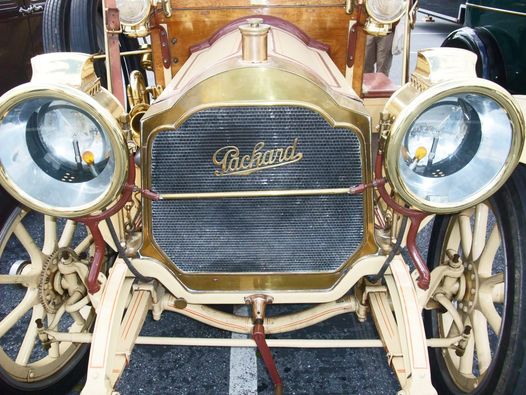
    • But is it a Packard? The radiator emblem was always Packard written at a slant. Everything else is very similar to

    • a Model 30 Runabout.

    • No photo description available.


    • Steve Hannah:

    • I will agree with a 1910-1911 Packard Model 30 Runabout. The only thing is the radiator emblem. Did Hill have

    • a Vanity emblem made? Money was no issue. I can't find a close match to that emblem shape.

    • May be an image of 6 people and outdoors


    • Steve Hannah:

    • Windshield, top, headlights removed.


    • Jim Benjaminson:

    • I was wondering if it might be an emblem for a fraternal order or auto club or ???? Front fender on the Hill car

    • seems a little flatter but that could have been a running change or model year change...


  • Steve Hannah:

  • Walter loved speed, it is said his interests were tilted away from farming toward race cars. I' trying to identify the steamer

  • but they all look alike. I counted around 50 horses though.


    • Jim Benjaminson:

    • This looks like it might be a source - I contacted the library as I couldn't get any access to the Motor Vehicle and

    • Driver License Registration Records, 1909-1921 Register of motor vehicles (1909-1914, with indexes), automobile

    • license applications (1921), chauffeur’s record (1909-1911), and motorcycle registration record (1909-ca. 1913).

    • MNHS call number: See the finding aid in the library (Secretary of State: Motor Vehicle Division).


    • Steve Hannah

    • There is so much I could find out if the Gale Library wasn't 300 miles away. Keep scanning folks!


  • Bernie: my Great Uncle George Hugill played base ball with Walter and said he would chase rabbits in a white

  • Stuz Bearcat. But that was 60 years later so maybe it was a Packard


  • Jim Benjaminson:

  • Does anybody know if early Minnesota license registrations exist for these years?

  • Jim Benjaminson:

  • Probably a 1912 model - later than I first thought.1912, not much if any difference. 60 HP but Hill had a mechanic who could make it


  • Bernie Streed: My Great Uncle George Hugill was a contemporary friend of Walter Hill. What a character. During a

  • winter storm he started telling me stories of how they would chase rabbits across plowed frozen fields with a white

  • Stuz Bearcat convertible. He also told me he would order hand made oak barrels from Italy. Then he would stock the

  • milking barns with long horn steers. They would lock horns in the narrow milking stalls. The barns were state of the art

  • for the day, built with tile walls and sloping floors so manure could be flushed down trenches in the floor into the river

  • below. Basically the bored millionaire would roll these oak barrels down the center of the barn agitating the long horn

  • steers so they would kick the barrels to pieces. He and George would do this for hours till the barrels were gone. The

  • whole farm was meant to get James J Hill's playboy youngest son out of St Paul to reform him.


Bernie:  These are my memories of Uncle George's visit. My mom, Amelia Streed, took her Aunt Amelia Diamond Hugill into town for an event at the Presbyterian church but they didn't want George to be alone in a storm so i sat with him. He started talking about his youth.. great stories. This was probably around 1968 or before. So I would have been in 8th grade maybe.

Trish: Walter Hill was a goer, or "someone vibrant for life." He hunted from his car, raced his draft horses in the streets of St. Vincent, and drank mightily. Before the fall harvest, he used to attach a hay-rack to the back of his car and go to Bronson, Minn., searching for labor. Men eager for jobs climbed onto the hay-rack and Hill drove them home in his usual manner. By the time he got back to the farm, there would be only one man left - the rest had jumped out along the way in fear for their lives.

Bernie: lol I can believe that. I know my Grandpa Bernhard Streed drove one of the steam tractors. He said he started in the dark of morning and made one swath to the Red River and back before sunset.

Keith Finney: I believe it was Byron or Marva that told me that he would go into Canada up by Tolstoi and get hired men. He would drive fast across the rough prairie and some would fall off on the way. Thus the illegal aliens that worked on the farm

Georgine Cleem Whalen: Thank you Trish for this wonderful information on Walter Hill and some of his escapades I see in one of the links that he passed in 1944 in the West which would have been during the time my Grandpa was working for him on the ranch he owned there in 1932. It became the Bishop Ranch in the 40's and I still remember them letting us swim in the pool as my mother worked for doc Bishop. It is not there anymore but they do have a street named Bishop place where this ranch set. I was wondering if Walter returned to Minnesota after my Grandpa Borgeson went to work for the shipyards along with his sons.

Trish this is how we 'Borgeson' family ended up in California. James Hill bought a horse ranch for Walter and my Grandpa Eric Borgeson went with him to work this ranch and property in 1932. The rest of the story is amazing how the whole family (13) left Mn. in a Franklin car and went west

I do not remember the name. I only remember after it became Bishop Ranch. I think my Mother said it was a horse ranch and her dad (Eric Borgeson) worked for Walter Hill and came to California in 1932. He sent for my grandma later and that's another wonderful story and they lived in the old red house there in Midway City, Ca. When my parents went to California in about 1942 sometime I was still the baby. We stayed at the old red house in the middle of a field just behind where the Hill place would have been. Shortly after my grandparents bought a place in Anaheim (this is where I lose track of Walter Hill about 1943/44) and my parents stayed at the old red house which was then bought my Hap Post who my dad worked for. We lived there till I was in high school when the property was sold by the Post Brothers. I digress here, the horse ranch that Walter Hill bought would be off Bolsa in Midway City, maybe considered Westminster at that time. I do remember this property as I got older. Walter Hill brought my grandpa a big old green rocking chair that is still in the family that all of us remember him rocking away in. Grandpa did change jobs at this time and I always wondered what happened to Walter Hill.


Going through picture albums and saw this paragraph in an article about midway city california and walter and james hill. I remember this hotel well on the cutoff there as our family knew the hokes well but never knew that walter hill had a hand in the start of that... From: “James J. Hill Banished his Errant Son to Kittson County” by Ruth Hammond - Walter Hill was a "a goer, or someone vibrant for life," Hanson said. He hunted from his car, raced his draft horses in the streets of St. Vincent, and drank mightily. Before the fall harvest, he used to attach a hay-rack to the back of his car and go to Bronson, Minn., searching for labor. Men eager for jobs climbed onto the hay-rack and Hill drove them home in his usual manner. "By the time he got back to the farm, there would be only one man left," Hanson said. The rest had jumped out along the way in fear for their lives.

Wednesday, December 21, 2022

Christmas Sunday School Memories

Shared by Lori Wood Goertzen:

This photo was a Christmas gift from my favorite Sunday school teacher, Clara Loer. 

Left to right: Debbie Dykhuis, Danny Hodgson, Marilyn Loge, Anita Calkins and myself.

This was taken on the front steps of the old St. Vincent Evangelical Free Church.

Monday, November 18, 2019

Junction Drive Inn


These are photographs from the Larson Family Collection. Before there was an Interstate Drive-In (just west of the old KCND-TV building in Pembina), the Larson family started their drive-in business on the Minnesota side, at the (St. Vincent) Junction.

It was a much smaller affair, but much loved in its time. So much so, they had to build a larger one. It was right around the time that I-29 was being built, and the Larson family wisely thought it might be a great location for the new Drive-In. My older sisters Sharon and Betty Short were among the many young ladies who worked there in high school as waitresses...

Tuesday, July 10, 2018

Water Cooler VII: School Memories - Bullying

Humboldt-St. Vincent School, like any other school, had its share of bullying and bullies...

Michael Rustad: I remember when Dave Boatz sang the Beatle's song, "He is a real nowhere man." He adapted it to Walter Petruska. "He's a real no-hair man!" Dave was a comedic genius. When we were altar boys together, he did his best to get me to laugh at the most inopportune times. He would have a running commentary on the qualities of the tongues at communion time. When Mrs. Friebohl (Grandma) and Toots Ryan went for communion, he had me in stitches with his descriptions!

Dave was never mean-spirited but did these pranks always in a spirit of fun. Ok, he went a step too far in dropping cherry bombs in the boy's toilet or putting Elmer's Glue in Martha Roberts lotion bottle. Martha would often use moisturizing cream and then wipe with her hanky She did this by habit not realizing that Dave had substituted glue for lotion! The class did not dare laugh, but did after class. He would also pick vegetables and flowers from neighbor's gardens and then with his angelic smile try to sell them back! I can tell you so many stories about Dave. Dave had a moral compass in always sticking up for any person with a handicap,. His brother Stevie was profoundly developmentally undeveloped and I think that his love for his brother was key in being empathetic. Randy Younggren, who as deaf and had difficulty speaking, was a case in point. Dave was so good to Randy and he had Randy drive out to our farm on his motorcycle nearly every evening. He was just happy to see us and it did not matter whether he could not speak many words.

Steve Ritter: No Way! Dave never did any of those things! Lol! Dave is one of the best...He has a heart of Gold!

Michael Rustad: I also think that Velma Isely did a great deal to stand up for those being bullied. There was bullying in Humboldt. When we moved to the farm when I was 7, I had to ride the bus and it was an ordeal. They took my stocking hat, did not leave a seat open, etc. It was relentless until around 6th grade. I could name each of the bullies and some were older girls with no moral compass.

Trish Short Lewis: You are so right, Mike. I was bullied a LOT by both peers and older kids, when I was little and up until junior high. My mom went to bat for me, but she also told me to ignore them, which was very hard but I did it so they had no satisfaction. To cope, I withdrew into myself, humming tunes, saying words or phrases over and over, closed my eyes, plugged my ears, read books, etc.

Michael Rustad: Our school bus was parked outside the Post Office and everyone was picking on Barbara Norberg. Mrs. Isely boarded the bus and essentially told everyone how ashamed she was and gave a long speech about compassion. She eluded authority and people stopped bullying her after she deboarded the bus and were off to Lake Bronson. I remember well how I dreaded the bus because Tony and I were bullied.

Steve Ritter: I think when we're young we all say things a little quickly. I am certainly not innocent. Sometimes it's a misunderstanding between young kids. Sometimes the physical side is how many of us have learned to deal with issues. I know that some of the meanest things I've heard came out of the mouth. I remember recesses when I was young being tormented by older kids. Being dogpiled and being on the bottom of several. It was not as much fun as people would think. I finally stood up and took on one of these people. I knew it would let my parents down if I got into a fight because my father and mother didn't believe in physical violence of any kind. But I'd had enough. I did get in trouble and was grounded for a period of time. but no one bothered me again. No one dogpiled me again. It's too bad people treat others in a negative fashion but sometimes and for whatever reason it happens. Most of the time it happens just straight out of ignorance and sometimes pain. Mrs Isley was a wonderful person!!

Trish Short Lewis: I agree with *most* of what you say, but I also think some people are just plain mean. Many who are mean got it from their role models, i.e., their parents. Either their parents are authoritarian, or abusive, or both. I wasn't perfect - I was a chatty girl who never knew enough to keep her mouth shut sometimes (not always) and that would get me in 'trouble' - it wasn't being mean, it was being inappropriate, interruptive, and/or loud. I definitely feel that is a LOT different than saying unkind and downright mean things to someone, or physically hurting someone, etc. That's a horse of another color entirely. So the bullying I and others suffered was mean and wrong. Period.

Monday, July 09, 2018

PROFILE: Captain John A. Vanstrum

I present to you, one of St. Vincent's early pioneers - John A. Vanstrum. A veteran of the Civil War, he became very civic-minded, serving the town and later Kittson County, in many positions. One of his longest-held was as Sheriff.  Serving at roughly the same time, he was Sheriff Charley Brown's counterpart across the river!

Captain John A. Vanstrum, register of deeds for Kittson county for the past decade, a pioneer citizen of the great northwest and a valiant soldier of the Civil War, is now a resident of Hallock, Minnesota, where he enjoys the esteem and confidence of a wide circle of friends and admirers. His portrait [seen here on right], will be appreciated by his host of friends. Captain Vanstrum was born in the province Gustaf and Elizabeth Vanstrum. The parents died in Sweden, their native land. Captain Vanstrum received but a limited education in his boyhood, having to assist his father in a paper mill from his tenth to his sixteenth year. On June 22, 1855, in company with about two hundred emigrants, he left his native land, sailing from Gutenberg on the vessel Ann Washburn, commanded by Captain Winchell. The vessel was heavily laden with Swedish iron for Boston merchants. He arrived in Boston harbor August 6, 1855, and proceeded to Chicago, thence to Batavia, Illinois, where he spent the winter of 1855-6, working for his board and attending school. In September, 1856, he went to Minnesota, via Dunleith, now East Dubuque, Illinois, thence up the Mississippi river, and located at Redwing. Minnesota, where he engaged as clerk in a store.

At the breaking out of the Civil war Captain Vanstrum was residing at Redwing, Minnesota. He immediately offered his services and assisted the late Colonel H. Mattson in recruiting Company D, Third Minnesota Volunteer Infantry, and was mustered into service in October, 1861 at Fort Snelling. The Captain went to Chisago county, Minnesota. where he raised some thirty volunteers (Swedish) for Company D. These men he transported in wagons all the way from what was then known as Center City via Taylor's Falls, Marine Mills and Stillwater, through St. Paul to Fort Snelling, where they arrived October 18, 1861, and on the following day were mustered into service. Captain Vanstrum was appointed sergeant of Company D in October 1861, was promoted to second lieutenant March 30, 1862, first lieutenant May 30. 1862, and Captain of Company D August 2. 1862. He re-enlisted with the same company as a veteran, under the veteran enlistment act, at Little Rock, Arkansas, early in January, 1864. He was honorably discharged with his regiment at Fort Snelling September 17, 1865. His record in war, as it has continued to be, is that of a brave and fearless defender of the Union and the old flag. In 1879 Captain Vanstrum went to Kittson county, Minnesota, and located at St. Vincent, where he was postmaster from 1879 until 1885. In the latter year he resigned his office and during that period the post office at St. Vincent was of more than ordinary importance. It was the international exchange office for all registered mail matter passing between the United States and the northwest Canadian provinces. All registered letters are re-registered at the St. Vincent office. From 1879 to 1885 this office ranked third in volume of registered mail from Minnesota.

Captain Vanstrum was sheriff of Kittson county from the date of its organization, April 8, 1879, to January, 1889, and is at present register of deeds of said county, having held that position continuously since the fall of 1891. Politically the Captain is an uncompromising Republican. He is a member of the I.O.O.F., and is one of the representative men and pioneers of the northwest. (International Order of Odd Fellows)

Source:  Collections of the State Historical Society of North Dakota, Vol. IV (1913)

Thursday, July 05, 2018

History of the Kittson County Bench & Bar

"The term was finished in two and a half days, and the balance of last day, awaiting the arrival of the train south, was spent fishing by the court and attorneys, after each catching his own frogs for bait. To the younger members of the bar it was rather an amusing circumstance to see Judge Stearns, then well up in years and of a very dignified and patriarchal appearance, lay aside his judicial dignity and pursue the diminutive amphibians with an agility which surprised them all."
And such were the salad days of early Kittson County law!

To learn more about it, read on...
_______________________

Bench and Bar of Kittson County
By Peter H. Konzen

Foreword by
Douglas A. Hedin, Editor
Minnesota Legal History Project (April 2008)

The article that follows is a highly personalized history of the bench and bar of Kittson County written by Peter Henry Konzen, a prominent attorney. After devoting two pages to early terms of the district court, Konzen announces that he will avoid “the monotony of legal routine” by describing two amusing trials—the prosecution of Kate Rafferty before Ozora P. Stearns, a legendary judge of northern Minnesota, in 1883, and a civil suit for damages for the killing of a dog, in which he represented the plaintiff, in 1888. Konzen’s client was awarded an amount somewhat less than he sought.

In the style of most county legal histories of this period (it was published in 1909), Konzen includes biographical sketches of eight lawyers who practiced in the county, the longest being of himself. Apparently finding the opportunity irresistible, he wrote, Mr. Konzen is recognized as one of the ablest and most prominent attorneys north of Crookston, and during his residence at Hallock has amassed a snug little fortune, besides building up a professional and business reputation of which he may well be proud. He has helped in an eminent degree to shape the destiny of his city, and when the history of Kittson shall be written he will appear as one of its most conspicuous figures.

There is an ironical footnote to this flattering self-portrait. Konzen died on July 15, 1935, twenty-six years after the publication of his article on the county bench and bar. His death was headlined on the front page of the Kittson County Enterprise on July 17, 1935. The newspaper described not only Konzen’s final days but also, under the subheading “Biography,” his youth, education and early years in the county. Almost all of that “biography” was taken verbatim from Konzen’s earlier self-portrait. Thus Peter Henry Konzen was placed in the unusual position of writing much of his own obituary.

Passes To His Eternal Reward
Peter Konzen, Pioneer and Highly
Respected Citizen Passes Away
After Long and Useful Service
to City and Community

Peter H. Konzen
Today Hallock mourns the passing of one of her most outstanding venerable citizens and townsmen. Peter H. Konzen, who died at his home in this city on Monday, July 15th at the age of 78 years, one month and 18 days—he has gone his reward. Hallock never had a finer citizen and more devoted father.

Quiet, unpretentious, wonderfully human and amazingly competent, he represented the best that a city can expect from its citizens. His more than half a century of life in our city was a precious gift to his fellows. He had done much good and was ready day or night to serve the needs of anyone who called on him. He never made any fuss about living—he just lived, which is a priceless legacy to those of us who are inclined to philosophize.

He was a man of quiet, retiring disposition and minded his own business, both with reference to himself and others. In his youth, he was of good physique, but of late years had suffered afflictions incidental to advanced years, which at times confined him to his bed and home. About a week before his death he again became afflicted and gradually and slowly sank, growing weaker and weaker, with but little pain until about three days before his death when he became overcome with chills. At the last, however, death came peacefully and quietly, and while apparently in sleep, his breath came slower and slower, until the last. All of his family were at his bedside excepting a daughter, Mrs. F. V. King, who in a race with death across the continent failed to arrive in time to see her father alive. During his final illness he was watched over by members of his family and friends and a special nurse.

The funeral services were held from St. John’s Episcopal church Wednesday afternoon with Rev. S. J. Hedlund officiating. The cortege was the largest ever gathered in Hallock, which testified to the high esteem in which the deceased was held in the community. The active pallbearers were members of the Kittson County Bar Association of which the deceased, was a member. They were: A. D. Bornemann, Wm. L. Peterson, J. E. Sundberg, C. J. Hemmingson, John Matt Brendal, Lyman Brink. The honorary bearers were twenty pioneer citizens of the town. The district bar association also sent delegates to attend the funeral. These were: L. S. Miller, Martin O’Brien, Wm. P. Murphy, W. E. Rowe, F. A. Grady, Crookston; H. O. Chommie, C. M. Bishop, Theodore Quale, Thief River Falls; Judge B. B. Brett, W. O. Braggans, Oscar Knutson and Rasmus Hage, Warren.

The remains were laid to rest in the family lot at Greenwood cemetery, beside those of his wife who preceded him in death several years ago, and thus has passed away another of our old timers—they are passing away and soon only their memories will be left. May they all leave as pleasant recollections as does our friend and venerable townsman—God rest his gallant soul.

Biography

Peter H. Konzen was one of the pioneers of Kittson county, having located here in the spring of 1881, when a young man of 24 years. He was born on the 27th of May, 1857, in Chickasaw county, Iowa, on a farm now embracing the site of the village of Lowler. His parents emigrated from Germany in 1852 and the following year located on the farm upon which deceased was born. He was the third child of a family of five, all of whom have since passed away, excepting one, Mrs. Kate Buchholz living at Forest City, Ia. He was educated in the public schools of Lawler, afterwards attending an academy at Bradford in that county and completing his education at the University of Iowa City and at Boyleer’s Mercantile College at Keokuk, Iowa. His boyhood life was spent upon the farm until the age of 17 when he began teaching while completing his education.

In 1878 he began the study of law, first in the office of Judge H. H. Potter at New Hampton and afterwards under the direction of John R. Geeting, a gentlemen who later rose to considerable distinction as a criminal lawyer in the city of Chicago. Mr. Konzen first came to Minnesota in 1879 and entered the law office of a Mr. Parker at Sleepy Eye, where he remained until the fall of that year when he again returned to Iowa to enter the newspaper business, editing the Lowler Herald until the spring of 1881, when he sold out and returned to Minnesota and locating at Hallock, then a hamlet numbering not more than half a dozen buildings, where he opened a law office, and in the words of the immortal Horace Greely, “grew up with the country.”

In the fall of 1881 Mr. Konzen was elected superintendent of schools for Kittson County which position he held for several years, having been three times re-elected. He had since held various public offices, as County Attorney, president of the Kittson County Agriculture Society and in 1898 was the Republican nominee for member of the state legislature. Although defeated by the tide of populism at that time, he received a creditable vote and conducted a model campaign. In 1916 he was again the nominee for his party for member of the state legislature and this time was elected by a comfortable majority. Mr. Konzen was one of the most progressive and public-spirited citizens in Kittson county. He was for many years a member of the Hallock school board, and it was chiefly owing to his push and perseverance that this thriving little city can now boast of a high school second to none in the state. Mr. Konzen was elected mayor of Hallock in 1897 and held the office for a dozen or more consecutive years to the eminent satisfaction of her people. He had also served as a member of the state drainage board, probate judge and in his time had filled various town and village offices, so that he had helped in an eminent degree to shape the destiny of his beloved city and community.

During his early career in Hallock, he was associated in the law business with W. H. Alley, now deceased, and in 1901 Mr. Konzen and J. D. Henry formed a co-partnership for the purpose of conducting a real estate, loans, insurance and collection business in connection with the law business. Mr. Henry is not a lawyer but handled the insurance, loans, collection and real estate business of the firm and was very successful, especially in the sale of real estate. Konzen’s article appeared first on pages 944 to 951 of the second volume of History of the Red River Valley. It has been reformatted. Page breaks have been added. His spelling and punctuation have not been changed.

Bench and Bar of Kittson County
From:

IN
HISTORY
OF
THE RED RIVER
VALLEY
PAST AND PRESENT


Including an Account of the Counties, Cities, Towns
Villages of the Valley from the Time
of Their First Settlement and
Formation
BY VARIOUS WRITERS
IN TWO VOLUMES
VOLUME II
__________________

ILLUSTRATED
__________________

HERALD PRINTING COMPANY
GRAND FORKS
C. F. COOPER & COMPANY
CHICAGO
1909

Bench and Bar of Kittson County.
By P. H. Konzen.


Tuesday, September 26, 2017

Pembina County at 150: The Painter & the Pugilist


Jim Benjaminson is a local historian from Pembina County, North Dakota.  This year is the sesquicentennial of Pembina County, and in celebration of that, Jim has been writing a column for the Pembina New Era entitled, "Pembina County at 150".  The column has been running a few months now, and recently I invited Jim to serialize his fascinating history columns here on the blog. He graciously agreed.  This is the first one...


The Painter & the Pugilist: Two Former County Residents You've Probably Never Heard Of

Simply put, Birdeen Gibson was an artist. Born in Oregon in 1913 but growing up in Neche, the daughter of Augusta “Gussie” (Hughes) Gibson graduated in a class of 21 from Neche High School in the spring of 1931. Times were tough and jobs were scarce but Birdeen managed to make a little money by making sketches using India ink on white paper. Her favorite subjects – Lincoln and sailing ships. A March 1934 family letter told of her selling “the largest size (4x5) for 35 cents” , with smaller drawings selling for 25 or 30 cents. It was mentioned “she's sold 18 now.”

Unable to afford to go to college, her art work came to the attention of Dr. Ernie Coon of the University of North Dakota. In a February 28, 1934 letter Birdeen wrote Dr. Coon's wife, Jennie, stating “I want to let you know how greatly I appreciate your taking an interest in me”. Dr. Coon had spoken with a UND art professor who said he felt there was a possibility of getting her “a CWA job”. Skilled as a typist and in shorthand, Birdeen owned a typewriter (which had been purchased for her by her mother), skills that would soon prove to come in handy. She continued “I have entered two different art contests conducted by the Federal Art School in Minneapolis. Both times I received a part scholarship but the entire course is too expensive for me, so I have been unable to take advantage of it.” Another portion of her letter mentioned the ink drawings she had been selling and thanked the Coons for their interest in her.

Birdeen's sister Sally wrote the Coons that “Birdeen is certainly a nice girl in every way. She's quiet, but once you get to know her, she's very likeable”.

Sorority Girl - Delta Phi Delta
Birdeen Gibson's school portrait

[UND/1939]
By September 1934, Birdeen, along with her mother and brother Ray, traveled to Minneapolis where Birdeen would continue on to Waterloo, Iowa. She had been told “there was a man there giving lessons on painting—a professor—who wanted to see what talent she had before he would accept her as a student”. That man was Count Odon de Szaak of Pest, Hungary. How much time Birdeen spent with him is unknown. Birdeen enrolled in the art program at UND working for “room and board” doing “Federal work, getting an education and her living besides” utilizing her typing and shorthand skills. She would graduate from the University with the spring class of 1939.

A photograph—and picture she painted of herself—graced the front page of the Dakota Student (UND) newspaper of April 28, 1939. The caption read “Birdeen Gibson saw herself as others see her when in eight hours before a mirror she made this self-portrait. Produced in her home in Neche, N.D., this painting is but one of a series of her works, some of which have been on exhibition in London and Paris. A senior, majoring in art, Miss Gibson has studied under the famed Count Odon de Szaak of Des Moines, Iowa.” The 1940 census records that she was working as a secretary in Neche. When her brother left for the West Coast to work for Boeing, she apparently moved west as well. Little is known of her activities except that she married a man named Donald Cisney on July 22, 1950. Birdeen had no children and passed away at the age of 66 August 30, 1979.

Although her name may not be well known, as least one of her paintings is. She is one of many artists who have painted “Christ Knocking on the Door”. An Internet search reveals many different versions, yet none of Birdeen's were found during research for this story. There are at least three of her “Christ Knocking on the Door” paintings in the immediate area. One is displayed in the dining area of the Cavalier Methodist “Chocolate” Church. Another hangs in the sanctuary of Drayton's Methodist Episcopal Church—a church built of Drayton produced brick in 1905 that also has a unique “disappearing” wall. A third painting hangs in the Presbyterian Church at Calvin, North Dakota.

How many other similar paintings exist is unknown. Do any of her sketches still exist? And what other works of art did she produce during her lifetime? Truly a woman of mystery!

Our second subject is also a man of mystery – much more so than Birdeen Gibson. James Barry claimed to have been born in St. Vincent, Minnesota but called Drayton home. Or was he born in Culbertson, Montana – or did he live in Chicago, East Grand Forks or Petaluma, California? Perhaps we should mention that Jim Barry wasn't his real name. At various times in his life he claimed his real name was Louis Edgar Rogers; at other times it was Hugh Edgar Rogers. And his birth date – was it August 12, 1886 – or August 7, 1887 or August 10, 1887? At one point in an interview that appeared in the Bismarck Tribune May 28, 1916, he claimed “Jim Barry isn't my name at all, and I'm not Italian as everyone believes. My real name is Hugh Edgar Rogers. My father was Jarvis A. Rogers, from County Antrim, Belfast. My mother was a full-blooded Sioux Indian (there are claims she was French-Canadian Metis). They've always said I was from Chicago, when, as a matter of fact, I've hardly ever been there over night. I lived at Drayton, N.D., with my folks, including six other brothers. I'm the youngest and the smallest of them all.”

One thing we know for sure, his father's name was Rogers although he was known simply as “Rog” to most people. And he had been a mail carrier between Grand Forks and Pembina from 1868-71, carrying the mail by sleigh, dogs or on foot during the dead of winter.

Louis Edgar Rogers, aka Jim Barry (1910)
So who is this man of mystery with so many different names and birth dates? A criminal hiding from the law? A man on the run from alimony and child support payments? No – Jim Barry was a pugilist – a prize fighter of some renown.  A man who was the last of the bare knuckle fighters, who John L. Sullivan claimed would one day be heavyweight champion of the world. And he probably would have succeeded had it not been for his battles with gambling, drugs and booze. Sullivan himself was a well-known rounder who took Barry under his wing, teaching him his “tricks” in the ring. There were times when Sullivan's partying “required” him to pawn a championship belt studded with hundreds of diamonds, a belt estimated to be worth $10,000 in the late 1880's. At one point, the belt was rumored to be in Jim Barry's possession when it “disappeared”, not to be found until after Barry's death – minus its diamonds. It's reported that the belt is now owned by the Smithsonian.

Weighing in at 192 pounds and standing 5 feet 10 3/4” tall, Jim Barry had a 42 inch chest and a reach of 73 1/2”. Making his professional debut April 4, 1904, Barry won 25 matches, 18 by knock outs, lost 24 matches, 10 by being knocked out and fought to a draw in 5 matches. A formidable opponent, the Los Angeles Herald in its November 6, 1908 issue reported Barry was scheduled to go 10 rounds with Joe Flynn. Barry, who outweighed Flynn by 20 pounds, placed a $200 bet against Flynn's $160 that he would win the match. The Tonopah, Nevada Daily Bonanza reported “Jim Barry of Chicago had the better of a 10 round bout with Jim Flynn of Pueblo before the Pacific Athletic Club tonight. Barry showed fine form and landed terrible blows to Flynn's body and jaw throughout but was unable to stop the fireman.”

Calling Barry and Al (the California Hercules) Kaufman the “mastodons of pugilism” the L.A. Herald commented in its December 27, 1908 issue that “no human being can stand up under the best punch (that) Barry or Kaufmann is capable of handing out.” In a run-up match as contenders for the world's heavyweight title Kaufman knocked out Barry in the 39th round of a scheduled 45-round fight.

Eyeing the world championship, Denver's Franklin's Paper of October 9, 1909 reported “Jack Johnson the world's champion pugilist, intends to make a grand cleanup of the heavyweights before he meets Jim Jeffries, Stanley Ketchel in October, Al Kaufman (the California Hercules) and “Philadelphia Jack” O'Brien in a return engagement.” The article continued “Jim Barry, the Chicago Slugger, who has been hurling challenges right and left, may also be taken on by the champion”. The same paper in its November 27th edition, reported Johnson defeated Tommy Burns in 12 rounds for the world title. He fought Kaufmann, O'Brien, Barry and Ketchel and “a few others” for the world's title which he now holds. Among that list of fighters was Sam Langford, a Negro many white fighters refused to go up against because of the “color barrier”. Langford held the middleweight crown after defeating all other middleweights when Papke refused to fight him before moving into the heavyweight ranks.

Sam Langford and Jim Barry had a longtime relationship, Barry not being stopped by the color of a man's skin. The two first paired off in September of 1907, fighting each other 16 times, their last match taking place in March of 1913 in Australia, with Langford defeating Barry each time although two matches were called as a draw. Both the Tacoma, Washington Times and Chicago's Day Book reported on the March 1913 fight, the Times terse two sentence article reading “Sam Langford won from Jim Barry in one round. We should worry.” The Day Book's article gave a few more details - “Sam Langford, the Negro heavyweight, knocked out Jim Barry of Chicago in the first round at Brisbane, Australia.”

Traveling to Australia for a series of five fights in 1912 for promoter Hugh McIntosh of Sydney, Jim Barry defeated Bill Lang, former heavyweight champion of Australia in one round; it would be his only Australian win. On the return trip home, Barry was arrested when the S.S. Zealandia docked in Vancouver, British Columbia. Charged with assault it was reported Barry had “lost at cards and then started a rough house.”

The March 15, 1913 fight with Sam Langford brought a temporary halt to Barry's boxing career – he wouldn't return to the ring again until June 30, 1916. Little is known of his activities during that time period except for discovery of an “emergency passport” issued by the U.S. Embassy in London. In it Barry claimed to have left the United States in December of 1912—the December 10th Tacoma Times reported him “visiting in Tacoma” having recently returned from “the Antipodes and is now ready to meet anybody in the ring.” His “visit” to Tacoma was to act as referee at a “smoker”. Three months later he would fight Langford in Australia. How or why he ended up in England is unknown. It is known Barry entered a New York hospital upon his return to the U.S. for treatment for cocaine addiction —at the time cocaine and other hard drugs were legal to possess and use.

The Ogden, Utah Standard of May 8, 1916 revealed “Jim Barry, who was a worry to all the heavyweights 5 or 6 years ago, is now planning a return to the fight game. Barry has the reputation of having fought Sam Langford with varying results, 16 different times. He is now in training earnestly and thinks he will soon be in trim to cross bats with Coffey, Al Weinert or Moran.”. On June 6th Barry stepped into the ring against “Battling” Lavinsky – and lost. He would go up against “Sailor Jack” Carroll in July, Jim Smith in August and Billy Miske in September. All with the same dreadful results.

His final fight came in March of 1917, against another black fighter, Sam McVea. Only this fight would take place in Colon, Panama. Stepping into the ring with McVea March 11th, he was “floored for the count” in the sixth round. The next days Panama Star & Herald had a different story to reveal about Jim Barry. Barry had been shot and killed in the Lobby Hotel in Colon by a gambler known as C. Jerrett, aka “Tex” Martin.

According to news reports “Martin accosted Barry in the Lobby Hotel bar and Barry pushed him back, saying he didn't want anything to do with him. (There had been an altercation between them in Panama City the previous day, stemming from a disagreement over a gambling debt.) Martin then pulled a Colt 44 and shot Barry three times. Barry staggered out of the bar and fell dead. Martin was quickly arrested after the shooting and later stood trial for murder. Apparently it was found that Martin had been threatened by Barry, was acting in self-defense, and was released”. Martin was later reported to have been killed in San Antonio, Texas.

Thus ended the career of Jim Barry, aka Louis Rogers, aka Hugh Rogers. Find-a-Grave lists him being buried in the Drayton Cemetery. Cemetery records compiled by the Red River Valley Historical Society do not list any Rogers or Jim Barry as being buried anywhere in Pembina County. Even in death, Jim Barry is still a man of mystery.

Pembina County Trivia
  1. Who was the first recorded farmer in what is now Pembina County?
  2. Where was this farm located?
  3. What year was the O’Brien Hotel in Neche built?
Answers
  1. The first known farmer in what is now Pembina County was Charles Bottineau.
  2. Bottineau's farm was located on land now farmed by the Horsley Family of Neche.
  3. The O'Brien Hotel in Neche was built in 1895 at a cost of $14,000. It’s known today as the L&M Bar.  

Thursday, February 02, 2017

StVHS Sports: 1927/28

Vintage St. Vincent High School pennant from 1920s

[Guest article by Michael Rustad, originally from nearby Humboldt, MN]

In the summer of 1999, my daughter Erica and I visited the town of St. Vincent.

There is no longer a bridge connecting the central business districts of Pembina, North Dakota and St. Vincent. The old bridge connecting the towns that I remember as a child has long been dismantled. The places that I remember in St. Vincent have long since closed. Short's Cafe, Sylvester's Store, the Curling Rink, St. Ann's Catholic Church, and the St. Vincent Fairgrounds. The curling rink is now neglected and in state of decay. The Church is a private residence. The St. Vincent School, too, is in a state of benign neglect. The school is in disrepair and the fire escape slide detached.

It was difficult for me to explain to my daughter that St. Vincent was once a bustling community. We attended catechism each summer in the basement of St. Ann's Catholic Church. We had a large number of ball games in the yard outside the church which is now overgrown and marred by abandoned cars. When my sister and I visited the Kittson County Museum in Lake Bronson, I was amazed to find some high school yearbooks [called Borderlines] from St. Vincent High School. St. Vincent High School closed in the late 1930s and never reopened. Instead, it eventually consolidated its school district with Humboldt from 1957 to 1991.
[Note from Trish:  In-between StVHS closing and St. Vincent consolidating with Humboldt, students had the choice of attending Pembina High School, or other schools in Kittson County like Hallock...]
It was an unexpected joy to find yearbooks from the St. Vincent High School from the 1920s. This was a yearbook from a small town in NW Minnesota prior to the Depression. High school life in St. Vincent was marked by lots of school spirit judging from the many activities. St. Vincent fielded a football team, basketball team, hockey team, track team and baseball team in [school year] 1927/28.

"If you could walk or run, you were in the starting line-up."