Showing posts sorted by date for query turner. Sort by relevance Show all posts

Thursday, March 16, 2017

Frederick A. Bailey: An NWMP 'Original'

Sgt. Fred Bailey
[Source:  RCMP Veterans Association,
Vancouver Division]

Let me introduce you to an ordinary man who happened to make a bit of local history by just doing what many in his day did - living life, making choices, taking risks.  

"This I believe is the diary of Frederick Bagley when he enlisted in the North-West Mounted Police as a trumpeteer at 15 years of age; They left Fort Dufferin in 1874 to secure the Medicine Line!" 
- J. Rempel

I will be sharing portions of that diary here on this blog at a later time. But for now, let us learn a bit about Sub-Constable Fred Bagley, Trumpeteer ...


According to a fascinating online biography (which I quote here in-full since so many such pages seem to disappear):
Fred Bagley’s musical talents and leadership provided a major contribution to the Force and to the communities he served in.

With regarding setting records, he was first in the following areas: 
a) being the youngest member to be sworn into the Force; 
b) first Trumpeteer in the Force; 
c) present to guard and witness the first person to be hung in the North-West Territories at Fort Saskatchewan; and 
d) first member to lead a musical performance before Royalty.

Thursday, May 29, 2014

Water Cooler III: Further Down Memory Lane


This time, the water cooler chatter turned to our neighboring town - and good friends - Humboldt, MN.

Michael Rustad My Mother, Pat Carrigan Rustad, would have been 88 today. She died in 1989 at age 63.

Dan Ducharme So young

Cleo Bee Jones For sure, way too young

Donald Reese I think your dad was one of my closest friends.  I think he passed haway younger than that. I don't remember at what age...

Michael Rustad Dad passed away in 1986 at age 63.

Connie Lang Fowler I've already passed my mother's death by 16 years as well and all of the above died young as they say!

Maury Finney She and your Pop were super people!!! Great Humboldt memories!!

Michael Rustad Dad loved everyone in Humboldt. I remember him taking me to hear your Mom play the piano in the town hall. We actually had pretty vibrant town hall parties where everyone danced, roller-skated, played basketball. I think my Dad was just in love with Humboldt and everyone in the community. In all of his years, I never once ever heard him say anything remotely negative about anyone. Think the best of people was his watchword or his motto.

Cleo Bee Jones Sounds right...the more one thinks about it all, up there, the more one misses that way of life, my eyes leak so much when I remember all the people, friends, relatives, and just the life style and all...

Michael Rustad I was speaking last night with Aunt Norma and she told me that they would clear out the living room and have a house party with 50 or more. Everyone brought food and BYOB. She said she misses those house parties and where you can talk to your neighbor.

Maury Finney I really think when and where we grow up, we are so influenced by the community around us...Your mom and dad along with so many in Humboldt mentored a positive attitude and kindness. We were so fortunate to get our start there.

Donald Reese You're on-the-job education in a little community like Humboldt, including the surrounding farmers, really could be used for a foundation for your future,  I remember being interviewed at my workplace for an apprenticeship in maintenance job and was asked where I got my mechanic ability; my response was you don't grow up on a farm in Minnesota without knowing which end of the wrench to use. I got the job.

Saturday, November 02, 2013

One of Our Own

"Music bubbles out of me..."
[Poster created by Nancy Ansari]

Cleo Bee [Wang] Jones is a St. Vincent native.  Cleo's grandmother was a Lang, and her mother was a Turner. The Langs and Turners, much like the Gambles, left big footprints on St. Vincent and its history.  In her own right, Cleo became more than the little village could contain.  Rightly so, she went out into the bigger world and shared her gift - her "Great Voice"...

[The following is an excerpt from a 2012 APG article]

Cleo Bee has something to look forward to: On Sept. 9, 2012 she will be inducted into the South Dakota Country Music Hall of Fame. This will be her second such honor — she was inducted into the Minnesota Rock and County Hall of Fame in 2007.

Cleo, 72, was born in St. Vincent, Minn. (population 64) and sang all over the country before she moved to Hayward with her husband, when he retired in 2006. She has a voice and a talent — and most of all, a love for song.

Her gift became apparent in second grade when her teacher asked the class if they knew what a four-leaf clover was. Before anyone could answer, Cleo stood up and said it was a song. Then she sang “I’m Looking Over a Four-Leaf Clover.”

“I sang and they clapped and that’s all it took to start the whole thing,” said Cleo, who has never had a voice lesson in her life.

In high school she sang in a dance band, recalling Bill Haley’s “Rock Around the Clock” and Jerry Lee Lewis’ “Whole Lotta Shakin’ Goin’ On.” But she said she was most influenced by the powerful voices of Kay Starr and Mahalia Jackson, before rock ‘n roll arrived on the music scene.

Also while in high school, she said she was snuck in the back door of the Eagles Club to perform onstage with a group that was there from Arkansas. She was 16.

Cleo won a talent contest that year and went to New York City to audition for the Ted Mack Amateur Hour. Her two aunts traveled with her. There were about 500 contestants, she said, and she waited for hours before it was her turn to get onstage where she sang “Mr. Wonderful” and “On the Street Where You Live.”

“I didn’t make the cut that night,” she said, but shortly thereafter she won third place in the 1957-58 finals Amateur Show sponsored by the Associated Canadian Travelers and held in Winnipeg, Manitoba. Cleo said she was the only winner from the U.S.

Cleo married, had two daughters and moved to Minneapolis, where she soon became a popular singer.

Her big break came in 1968 when she joined the Sherwin Linton Show, entertaining in ballrooms, nightclubs, lounges and touring the country in the band bus. The Golden Nugget in Las Vegas was often their venue.

Cleo said that over the years she worked with George Jones, Tammy Wynette, Dottie West, George Hamilton, Tex Ritter and Buck Owens.

In 1977 Cleo wrote a song and sang some of her favorites, along with duets with Linton, on a cassette, which was later released on CD. Some of the selections were recorded live at the South Dakota State Penitentiary on Aug. 9, 1971.

When she left the Sherwin Linton Show, tired of the travel, Cleo became the featured singer at Louie’s Inn in Dresser, Wis., and the house band was soon named “The Honeycomb.”

“No more buses but we sometimes performed six nights a week,” she said.

Cleo kept that pace for four years and then remarried and moved to Rochester, Minn. She stopped singing in 1980 and said she missed it terribly.

“It was horrifying. I would sing in the car on long trips, in the house, anyplace — it drove my husband nuts,” she said.

Twenty years later she performed again with the Sherwin Linton Show and repeated those performances a few times in cities in Minnesota and North Dakota.

Cleo Bee, as she is today...
She said one of her most memorable performances was at her mother’s memorial service which was scheduled on Sept. 11, 2001, the day terrorists attacked New York City and the Twin Towers fell.

“Mom wanted me to sing at her funeral, and after all that had happened that day, I sang ‘America the Beautiful.’ There wasn't a dry eye in the place,” she said.

Cleo still sings locally. She has guested with “Molly and the Danger Band,” has sung at the Stone Lake Cranberry Luncheon and the Hayward High School 50th Reunion with some members of The Honeycomb.

Music has made her life rich, she said, through travel and meeting wonderful people.

“Music and opportunities — that’s who I was and who I am. Music bubbles out of me,” she said.

Sunday, May 19, 2013

A Tale of Two School Buildings

St. Vincent (left) & Orleans (right):  Built using same plans...?
School districts were especially numerous in the early history of Minnesota, and were much smaller than the township - often within the 26 square miles there would often be a half dozen or more.

Such was not the case in sparsely-populated Kittson County, however.

Stats for St. Vincent:
  • St. Vincent's first school board was organized on January 7, 1880.
  • The first schools in the county were on or near the St.Vincent village. 
  • One of the first teachers was Eliza Moore, who taught all eight grades in a little one room school on the west end of St. Vincent. 
  • The final St. Vincent school - located conveniently in the center of town - was built in 1903 (Orleans school was built in 1905).
[Click to enlarge & read details]

From my research it appears that schools like these were very common in smaller communities, and many were built across the country in the early 1900s.  Some were two-story, two-room, while others like those above were two-story, four-room.  You could buy standard plans, and have local carpenters, like St. Vincent's Ed Cameron and Al Fitzpatrick, build it for you.


Sources:

Sunday, February 24, 2013

Past Resident Memories: John Stranger

John Stranger - Back row, middle


A MEMOIR OF A LIFE, FOR BETTER OR WORSE
By John A. Stranger

CHAPTER ONE
Beginnings

This all begins in a small town in Minnesota during the 40's when growing up was a struggle without all the things a boy wants and dreams about. Outdoor toilets and dressing behind the oil burner turned up full blast where my brother (4 yrs. Younger) and I learned to dress very fast during the cold Minnesota winters.

My brother was a great kid even though we would have our brotherly confrontations. We had a younger sister too and she learned to hold her own with us boys. Our parents were very strict on almost everything that they thought was for our best interests even though we tried to disagree with our parents at times but trying to obey seemed better than a beating, (most we probably had coming).

Sunday, November 04, 2012

Solitary House in the Woods

Is this house the oldest surviving home in St. Vincent...?

This house, located all by itself in a woods that covers its entire block, is just west of the St. Vincent School.  To be a bit more specific, it's near the southwest corner of the block.  I went by that house hundreds of times when I lived in St. Vincent growing up.  It was near the corner of our own road going north, and as long as I can remember, no one lived there.

I wondered who had built it, why no one lived there now, and why that particular block of land was never cleared or anyone else built on it.

As I prepared for the St. Vincent town reunion earlier this year, I was making new connections with people who have old connections with the town itself through the St. Vincent Memories' Facebook page.  I learned  new things from them about the town.  This very house came up in conversation, and I attempted to find out something definitive.

Who lived here?
This is what I was able to find out, mostly in this one, long thread:

Sunday, July 08, 2012

Memories: Alan E. Wilwand

As a youngster growing up in Pembina, I had a second town - St. Vincent.

Wallace & Matilda Cameron's
Home during 1950 flood

[Photo:  Turner Family Collection]
My grandparents, Wallace and Matilda Cameron lived there.  I was crossing that old Red River bridge whenever I got the chance.  I loved my grandparents.  Grandma made the greatest date-filled cookies!  The house where they lived was north of Short's Cafe.  The house is gone now, but the memories linger on.  My grandmother was a seamstress and speculator.  She gave me the deeds to about half of the places that she had bought in St. Vincent.  Who knows?  I may own half of the town!

After WW II, my Uncle Ralph (Ike) Cameron worked at Short's Cafe.  He would give me those double ice cream cones, one side vanilla and the other cohcolate or strawberry, heaping the helpings.  Ma Short was taking a big loss on ice cream with those!

If walls could talk:  the
St. Vincent jail today...
I remember so many things about St. Vincent.  My Grandfather was the town constable.  I believe the old jail is still standing.  He gave me the big lock and key for it.  He also gave me the pair of handcuffs that he used.  I donated his daily log that he carried in his breast pocket, to the Kittson County Museum in Lake Bronson.  That diary saved his life the time that he was shot.  I believe the museum also has one of my paintings that I did of the old fire hall.  I remember the fire hall well.  This is where he set up his office once in awhile.  The depot that was established in 1878 was close by.  My grandparents' big barn floated down the Red River in the flood of 1948.

Saturday, May 26, 2012

Curling Memories

Curling stone (or rock)
used in St. Vincent rink

[Courtesy:  Matt Cleem]

The curling rock (or stone) at left was recently shared on the St. Vincent Town Reunion Facebook page.  It brought out many memories from people who had grown up in and around St. Vincent, and had a connection to the St. Vincent Curling Rink...

Cleo Bee (Lang) Jones - I recall going to the St.Vincent curling rink with my uncle Laurence Turner when I was pretty young...

Trish Short Lewis - I was in the rink only a few times, saw a few older people curling.  I don't know if they ever had a warming house portion of the rink, but when I was there, it was always freezing on the bleachers in the front area, so I'd usually beat a fast path back to Grandma's house a block away...

Phil "Jack" Gooselaw - This we called a curling "rock" and may be one of the ones we used during the late 50's at the St. Vincent curling rink. My dad Manuel, Uncle Lewis Gooselaw, Dave Gooselaw and I had a curling team the last couple winters I was there prior to my graduation from high school (1960) and going into the Navy. As an aside, I was in the Navy for 2 weeks when I rcvd news that Dad had had a heart attack and passed away while throwing one of these rocks in a game (Feb. 1960)...

Delphine (Beaudette) Mundorf - Our Grandpa (Trish) use to curl. His team made it in the winning bracket and they came to Bemidji one year. I was so proud to watch my Grandpa curling. So exciting. I was quite young when Grandpa curled in Bemidji. I think they won and went on to state but not sure about that. Just know it was so exciting to watch him out there on the rink. I don't even remember for sure if he was the stone thrower or if he was one of the sweepers. But I think he threw the stone. I might have been around 12 then so would have been around 1950.

Judy (Turner) Ziesman - I remember when your dad passed away. I was pretty little, but I remember standing outside your house and talking to Denise and Debbie while everyone was in the house. Back then they would have the viewing at the house. I don't know how long after our family bought and moved into your house. My mom and dad always talked highly of Manuel [Gooselaw]. Sadly a few years later my dad passed away also. I think my dad was at the rink when your dad had his heart attack. I spent a lot of time at the rink.  I had my first lesson on that rink, they made it look so easy....little did I know!

Keith Finney - I remember the first time I curled. Herb Easter had a conflict so he could not curl one night. He gave me his shoes, broom and gloves and sent me to the rink. Almost put the rock through the end first time I delivered a rock. Herb forgot to give me instructions. :)

Dorothy (Giffen) Barber - I will never forget that night. Don was curling and saw Manuel when he threw the rock and slumped on the ice. He came home and told me about it. It was such a sad time.

Jake Rempel from Halbstadt, Manitoba shared: The Emerson Curling Club used to borrow the Rocks from St Vincent when they still had bonspiels in the shating rink in Emerson (right after New Year's). Lawrence Calder liked to tell the story of crossing the Border and as it happened an American from farther South was at the Customs and asked what they were? Curling Rocks. "What is Curling" It’s a game – you throw them 160 ft and see who can get them closest to the centre to win the game ! "Wow ! I would like to see the people that throw them!"

Betty (Short) Thorsvig had fond memories of hanging out in the rink; Jamie (Rustad) Meagher thinks her father also curled there.

Sunday, March 04, 2012

Interview: Beth Lapp

Elizabeth Lapp in 1948
[Courtesy:  Digital Archive, UMC
Thanks to Kristine Baldwin Ohmann, who facilitated our get together, I interviewed one of the oldest living natives (and a resident) of St. Vincent last weekend.

Elizabeth Lapp, better known as Beth, was raised in St. Vincent.  Her parents, Richard (Dick) and Lillian Lapp, met in 1926 when her mother came to town to teach at the school. Dick's parents were early settlers of St. Vincent, arriving in 1879 from Canada.

I share with you here the interview in its entirety, as it happened.  As you will read, there are a lot of clues for further stories, which I intend to explore in future posts...

1. Her earliest memory is of getting ill and vomiting on her workbook at school. In those days, you only got one workbook to use for your schoolwork, so she was mortified. She was sitting near chalkboard at the time. Her teacher was Miss Penovich.

2. Some of her other teachers were: Elaine Bergh, Gunda Hanson, Mrs. Isley, and Mrs. Monte(gue) Clinton.

3. The year she had Mrs. Clinton, “we didn’t learn anything”. Math and Science were "sacrificed for art". All she remembers is Mrs. Clinton having the class place chairs facing west and looking out towards Christ Church and drawing what they saw…

4. When it came time to go to high school, students during her time had three choices: Hallock, Pembina, or Crookston. Hallock and Pembina were public school (free) while Crookston was a boarding school and charged tuition. This was during the 1940’s and into the 1950’s.

Northwest School of Agriculture Crookston MN
[Photo Courtesy Digital Archive, UMC]
5. Crookston was called the ‘Ag School’. It's actual name was the Northwest School of Agriculture.  Several area natives attended it, including Beth and her siblings.

Thursday, March 01, 2012

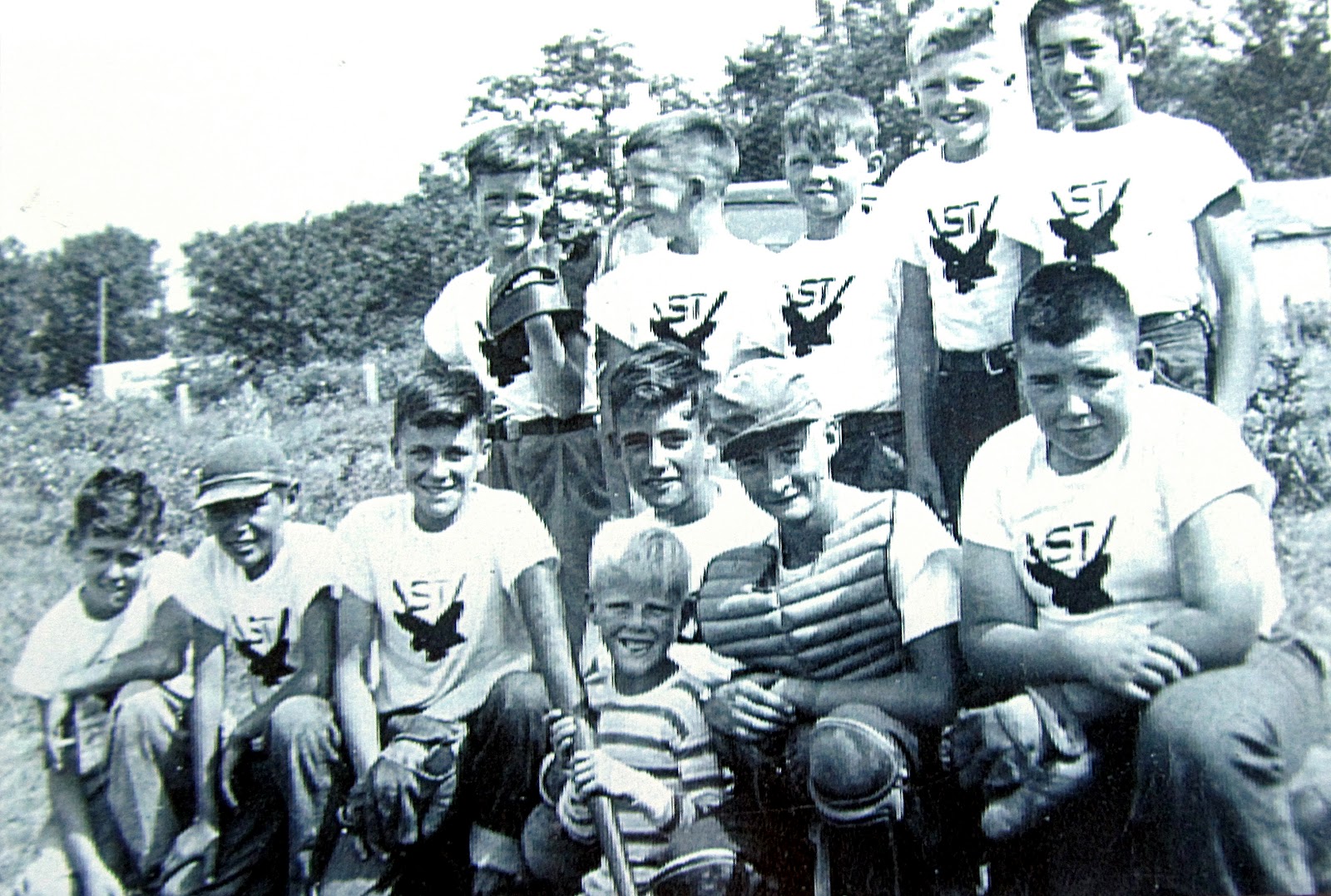
1948 Boys Baseball

St. Vincent Boys Baseball Team (1948)
[Photo Courtesy:  Margaret Gooselaw Cleem]
On February 25, 2012, I had the privilege to sit down with Elizabeth Lapp.  Kristine Baldwin Ohmann drove down from  St. Vincent with Beth so we could spend some time together, gathering stories about St. Vincent.  I'll eventually share the results of that interview here, but in the meantime, a little sample...

The photo above was among the photographs and other ephemera Kris and Beth brought with them, from Beth's collection as well as from Margaret Gooselaw Cleem.  The photo had four individuals identified, but the rest were not known.  After putting it out on the Humboldt-St. Vincent Facebook page, Perm Diamond responded:
Talked to Bob Cameron today about the baseball picture.  Back Row:  Dick Cleem, Jimmie Wold, John Stranger, Dick Lapp, Harold Rutherford.  Front Row:  Bob Parenteau, Maurice Godon, Sam Lapp, Merlyn Dewing, Bob Cameron (Catcher), Bob Hughes, with Bob Turner (Bat Boy) in front of them... 


I noticed the boys logo had something the girls didn't - a bird.  I learned that in 1948, an area Eagles Club sponsored them -  thus the eagles on the logo.

Sunday, May 22, 2011

Mike's Memories: Town Ball

After the First World War, Manitoba became a preferred destination for barnstorming  ball teams from the United States. All professionals, these American teams would roll through towns and villages throughout the province playing local amateur and semi-pro squads and often, the barnstormers got themselves whupped.

From:  Home Run

My earliest memories were going to baseball games on hot summer evenings. My home town of Humboldt, Minnesota had first rate baseball teams in the 1920s and 1930s. The entire town would follow the town ball team.

The early teams featured the Diamond brothers: Levi, Herb, and Ikey. Lomas Matthews was another legendary track star and baseball player who hailed from Humboldt. Happy Chandler, later to become the baseball commissioner and Senator from Kentucky played one summer for Humboldt.

Another early legendary player from the Humboldt team was Cal Farley who, like most of the other ball players on the 1910 team, was also interested in track and wrestling and went on to form Cal Farley's Boys Ranch in Texas. The U.S. Government honored him by printing a U.S. stamp named for him. The 1920 team also shows many of the players.

During the late 1940s and early 1950s, Humboldt had an excellent travelling team.

My Dad played first base and my Uncle Burton Turner was a pitcher. Burton's father, Ernest Turner, was a legendary pitcher. Many of the stories of early Humboldt baseball are well documented on this web site.

Who was the greatest player in Kittson County History? Some might say Ernie Turner, Happy Chandler, the Diamond boys, or Clarence Beck. [Note from Trish:  And don't forget Eli Gooselaw...] We don't have videos and it is impossible to compare players across generations. My candidate for player of the Millennium for the County is Humboldt's own native son, Scott Matthew.

Monday, April 25, 2011

Reminiscing

In photo (l to r): Uncle Charlie (Cresien) & Aunt Norma (Carrigan); a very young
Mike Rustad held by his father Alfred "Rusty" Rustad with his wife, Patricia
(Carrigan); and Aunt Virginia (Carrigan) with Uncle Al (Alfred Ducharme)
"This picture was taken right outside of our house in Humboldt.  We 
lived in town and my Dad worked on my Grandfather's farm.  We moved 
from Humboldt when I was 7 years old.  I was the first grandchild on 
both sides of the family - Rustad and Carrigan.  At about that age, 
I would entertain the residents of Grandma Carrigan's rest home in 
East Grand Forks, Minnesota.  I still seem to like the center stage!" 
- Mike Rustad
Michael Rustad - What I remember most is that there were no vacation days when you had cows. I was fairly young around 7 or 8 when I was given the responsibility to change the bedding for the cows and it was always dark when I had to open up the barn door--which was sometimes frozen! Did you find it a relief of sorts to move into the town when your parents ran the cafe? I envied the town kids--Lofbergs, Boatzes, etc.

Keith Finney 1 - Funny thing Mike. I used to go out to the Stewart's to help with chores. I remember Glen walking out to the farm north of Humboldt many days. That brings up a memory. Jay Hoglin and I had skiied out to Grandpa and Grandma Turner's farm one Sunday. We were hunting rabbits. We took supplies so we could melt snow and make some soup while we were out there. I remember it being a pretty nice winter day. It soon started to snow real hard so we started making our way back to Humboldt. We got back to Diamond's farm and started following the railroad track south. We had our hands full of skis, guns and supplies. We had the wind at our backs so we were staying warm. We had just passed the Stewart farm and still could not see the lights of Humboldt as it was storming so bad. Then the surprise! Bang! I bumped right into Ben2 who was walking the tracks out to his farm to do chores. It surprised us all and when we all regained our composure we went our merry ways. One thing I remember was Ben was wearing a mackinaw which was wide open. (not buttoned), He was only wearing one glove as he had one off to carry his Lucky Strike. He was a hardy man. We then made our way home to our worried families and a warm home. Just another day in Humboldt.

1 - Keith is my second cousin once removed - his grandmother Mary Fitzpatrick Finney was my grandfather Sheldon Albert Fitzpatrick's sister.

2 - Ben was the nickname for Glen Stewart; sometimes he was called Big Ben...

Thursday, March 03, 2011

Pembina vs. Fargo

Competition for political and economic power between the emerging territorial cities was common in the early days, even between Pembina and Fargo...
The first active politics, in the way of a spirited clashing of interests, occurred in 1872, when old Pembina and youthful Fargo locked horns, as it were, in a contest for supremacy. A term of the United States court was held at Pembina in June, presided over by Judge French1, and in order to secure the necessary jurymen almost the entire northern part of the territory was thoroughly combed. After exhausting the Pembina and St. Joe settlements, drafts were made at Grand Forks, Goose River, Elm River, Fargo, and Richville. Every available man was utilized for the grand and petit panels, and the work of subpoenaing them was no small task. 
Jud LaMoure was deputy United States Marshal, and upon him devolved the selection and notification of the jurors. During this process, when LaMoure visited every settlement in the northern section, it developed that the deputy marshal had something else on his program besides the business of subpoenaing jurors. The first to scent the alleged "darkey in the wood pile" was the coterie of live-wires at Fargo, led by S. G. Roberts, G. I. Keeney, John Haggart, Captain Egbert, and others. 

Saturday, December 04, 2010

March 1941 Blizzard Revisited

Coverage of 1941 Blizzard in Minnesota & North Dakota
[WILMINGTON MORNING STAR, North Carolina, March 17, 1941]
Last year I wrote about the 'Ides of March' blizzard of 1941, sharing a story that a reader of this blog sent me of his memories of that event.

Now, in the course of my new job, a patron shared with me that a book had been written about the blizzard.  In the book, there are several references to local/regional stories of people touched by that storm, including the following two stories...

Sunday, May 02, 2010

In Memoriam: Helen Tri

Today, a woman who touched many lives in my hometown area will be remembered at a memorial service, ironically in my new hometown of Thief River Falls. Her name was Helen Tri.

Helen was many things in life, including a teacher. She taught many people through the years, including my two older sisters. She also taught Mike Rustad, who has not only been a friend to this blog but encouraged me to start it in the first place. Mike wrote this to say about Helen's passing...
About ten years ago Dotty Boatz, a former Humboldt resident recommended that I place a call to Helen. I have known Helen all of my life. In my early childhood, she was our neighbor and I spent countless hours in the Tri yard along with many other Humboldt kids. Everyone was welcome at the Tri house and there was nothing that pleased Helen more than to have a pack of kids playing in the yard or large sand box. When we lived in town, Helen was right across the alley from us, a next door neighbor. Our other neighbors were the Dockens, the Diamonds, and the Turner/Hatherlies. Dotty thought that Helen might enjoy a call from me and I was reluctant to call after not being in touch for decades. I finally did make that call to Helen and kept in touch with her via email for a number of years on a weekly basis. Helen rarely emailed me but she seemed to enjoy hearing about all of the news I could muster from Humboldt. I learned a great deal from Helen as she had a unique perspective on Humboldt from the late 1930s. She taught both my Dad and Uncle Einar and has memories of my Dad as being a good student.

Helen had a deep affinity and interest in Sweden as her father was from Malmo which is a major city in Southern Sweden close to my Lund University, where I've taught in the summers for many years. Each summer when I visited Lund she would remind me to send her a post card from Malmo. She would enjoy hearing about Sweden and its very strong family structure and government. Helen was a voracious reader well into her late 80s and was well informed and very opinionated. I enjoyed her opinions because they were well reasoned and backed by data though sometimes we disagreed. She was a good listener and enjoyed debate and discussion. Helen experienced great adversity during periods of her life. She lost her Mother and was raised by Gottfrid, her father. I think this experience of being so responsible led her to have an independent personality and character.

Helen was born in 1915. She was a young girl at the infancy of aviation. In May of 1927, Charles Lindbergh made his famous solo flight across the ocean in May of 1927. We all remember film clips of Lindbergh's parade in New York where he was greeted by millions. Helen reminded me that Lindbergh toured the U.S. that summer. Here's the story Helen told me and I find it emblematic of her personality marked by great determination. She was only twelve years old and decided she wanted to see Lindbergh. She went to the local library and found addresses for hotels, book, and paid for a hotel in San Francisco. She traveled alone to San Francisco by railroad. When she arrived at the hotel, the clerk was reluctant to admit her--a twelve year old. Helen did not back down and said a contract was a contract. She told the clerk that she paid for the room and was entitled to it. She was able to see Lindbergh pass by in the parade. I asked Helen many details about the trip and they every detail fit. I do not doubt Helen but the image of a twelve year old taking a trip alone from Minneapolis to San Francisco and back is daunting.

As her obituary indicates, she was a graduate of one of the finest universities in the United States, Gustavus Adolphus College. As in Helen's day, this college was rigorous and drew good Lutherans from a Scandinavian background. Helen graduated from college thanks again to her determination. She worked at a large number of jobs. She told me about her academic success while working at a number of jobs. She remembered courses in sociology as being formative for her. I think Helen also studied political science and philosophy judging from her sophisticated understanding of the American polity. Helen gave me a window onto the world of my hometown of Humboldt Minnesota that stretches from the 1930s to the 1960s.

Throughout her life she had a deep love of Humboldt and its residents. She had plans to travel to Humboldt in the summer of 2007 but was to ill to travel. I am sorry that she did not make the trip because she would have so enjoyed it and seeing Humboldt in its glory. She loved hearing any news of the Baldwins, Boatzes, and my family, the Rustads. I learned that she was great friends with Marion Brown. Helen and Marion came to Humboldt around the same time as young teachers. She and Quint (as she called him) would double date with Don and Marion Brown. She loved Humboldt right from the beginning even though it was certainly less settled than the Twin Cities of Minnesota. She mentioned to me how much she enjoyed Grandma Bockwitz and was great friends with the Virgil Bockwitz family.

Humboldt was a close knit community in the late thirties and early forties. Baseball was important to the town. She remembers my Dad and Uncle Burton Turner playing for the Humboldt team and other area teams. She remembered when Herb Diamond and his brothers were still active in baseball.

Helen had a memory that was legendary and it was not just a past memory. Helen and I would talk about present day events as much as the past and her comments on present day events were just as sharpened. Helen and Quint started a bee business and began mailing specialty honeys all over the world. She was very proud that she sent honey back to Sweden and Germany. Quint's family was German and thus the new country was replenishing the old. Helen was one of those rare persons who continued to grow and develop throughout her life. She overcome a great deal of adversity losing her husband at such a young age, but she truly was Mother Courage!

I have so many memories of Helen and prefer to think of her tending her garden. Helen was a great gardener and my Mother was not. I remember her helping my Mother plan her garden. So, that is how I will remember Helen tending her garden. I feel very privileged to have known Helen Marie Tri.
Mike told me many times I should talk with Helen about her memories. I always meant to, but now I will never have the chance. Let that be a lesson to anyone reading this - don't put off talking to your older relatives and friends while you still have the chance!

Monday, March 08, 2010

BORDERTOWNS: A Review

I'm about to post the next chapter of BORDERTOWNS, but before I do, I'd like to share a review of the book by James McClelland.

James, a retired school teacher who is passionate about local history, lives in Emerson, Manitoba. Over the years his knowledge of local history has resulted in several articles, historical essays, and TV documentaries that reflect the pioneering spirit of the Red River Valley...

Border Towns
Charles H. Walker
PublishAmerica 2009

Border Towns was the last novel written by local author Charles (Chuck) Walker. A life time resident of Pembina, North Dakota, Chuck held a deep passion for and knowledge of the local history of the area. This extended to both Canada and the United States. Border Towns reveal both that passion and that knowledge. Chuck passed away soon after Border Towns was released in 2009.Seldom are actual small towns used as settings for novels. Settings are usually fictionalized. They combine the various elements of real life but are constructed to meet the author’s requirements for authenticity. It is therefore somewhat unique that Charles Walker’s Border Towns, is set in three historically accurate existing small towns. Set during the late 1870’s Walker presents a realistic and historically accurate depiction of life along the Canada / United States border when settlers were moving into the area. Emerson, Manitoba, St. Vincent, Minnesota and Pembina, Dakota Territory, are the setting for story that is played out on backdrop of the building of the railway between Winnipeg, Manitoba and Minneapolis, Minnesota. Border Towns is also the account of the McLaren family who saw little future in farming in Eastern Canada and arrive at the border in 1878 to take advantage of the better opportunities offered in the west. They arrive at the same time as large numbers of railway construction workers, “opportunists, and ne’er-do-wells”. The frontier towns are booming and the McLarens soon are challenged not only by their new physical surroundings but also by some of the individuals they encounter. Although opportunities abound the life is raw and fraught with danger and violence.

While Walker presents the grittiness of these times he also reveals the expectations and zeal of the people and the beauty and power of the prairie landscape
. His dialogue is rich with the style of the times, including words no longer in common parlance.
They slept on the floor of Germaine’s cabin and woke in the morning to find a strong northwest wind with new-falling snow.

The mush Germaine fried for their breakfast was scorched, adding to the foul odor of the cabin. A near whiteout storm was whipping up, forcing the men to hurriedly pack up their furs and saddle-up. While saddling the horses and putting the packs on the mule, Ian glanced out of the open-sided lean-to at the blowing snow.

"It’s going to be a humdinger, Pete."
Similarly, great care was taken in his accurate description of the local scene.
The main street, of Pembina seemed bleak when they reached the west riverbank. Two teams with bobsleighs were parked just ahead, on the right, and two saddle horses stood at the rack in front of the Brown and Kabernagle Saloon.

Kirby joked, “Cripes, you could shoot a cannon down Cavalier Street and hardly hit a thing.”
Because of Walker’s profound knowledge of the local history many historical events abound. The arrival of the first train at the border is an example.
The entire countryside was anxious to be at the Emerson depot to greet the first train from St.Paul.

“Ian got off work at six this morning…He’ll join us in Emerson…it’s a pity we all can’t go to Roseau Crossing to see the spike driving ceremony…”

It was nearly noon before the two buggies crossed the International boundary and proceeded north along Emerson’s Main Street…on Church Street, they noticed each hitch rail…was occupied by riding horses or teams. The saloons were evidently doing a good business, due to the crowds…The stop in Emerson was brief; with a sudden surge of power the high driving wheels of engine slipped momentarily, then slowed to seize the rails…as the train moved north to the ceremony planned at Roseau.
Local readers will recognize other historical characters and places that are woven into the fabric of the novel. Readers anxious for realistic details of local history will find themselves searching for the particulars of localities and events that Walker describes.

Border Towns is an easy read and as one moves toward the climax it becomes a fascinating page turner. Border Towns is available from the publisher or online from Barnes and Noble.

Tuesday, October 20, 2009

BORDERTOWNS: Chapter 11

Although there was only a slight breeze that morning, the previous days storm had cast several large drifts across the road to the fort. Ian’s horse disliked the deep drifts and instinctively began leaping into them, the plunging almost dislodging him. The extreme cold brought tears to his eyes and he could feel the skin on his face tighten. Once again he found himself knotting his scarf tightly around his high collar. He could feel the warmth and strength of his horse under him, causing him to tighten his legs against the animal. Entering the fort gate, he turned toward the headquarters building.

Concerned about leaving his gelding in the wind, he was agreeably surprised to find the entrance side of the building in the lee, sheltered from the now increasing northern gusts. After wrapping the reins around the tie rack, he stopped momentarily to examine the mercury thermometer mounted outside the door. It confirmed his estimate of the extreme cold, for it indicated -36 degrees. He felt a personal satisfaction, for he had guessed it to be nearly -40 degrees below zero.

Opening the heavy door, he found Kirby conversing with an officer seated at a desk. A corporal, evidently the Charge of Quarters, sat by a heavy sheet-iron stove. He cast a brief glance at Ian, then he turned back to his book. The seated lieutenant arose hastily and greeted him with a smile. “So you’re Mary McLaren’s brother. Kirby tells me you witnessed the hangings yesterday. I’m Shawn Kirkpatrick.” He advanced to shake Ian’s hand.

“He’s her brother, that’s for sure.” Kirby was smiling. “He was an unwilling spectator at the action yesterday, so I wanted Captain Collins to hear his version. It’s my mess. I should have left some of my troopers with that bunch.”

Kirkpatrick sympathized, “I’d probably have done just as you. There was no way you could have anticipated the result.”

“I still blame myself,” Kirby said, and then he turned to Ian. “Might as well get it over with.” Beckoning with his finger, he advanced to the captain’s door. Ian followed. A brief knock brought the response, “Come in!”

Captain Collins was gazing out of a partially frosted window as they entered; he was leaning forward almost to the glass, evidently watching something of interest outside. He finally broke away and faced the two men. As Kirby introduced Ian, the captain began to smile.

“I met your parents and your sister at the Christmas Ball. They seem determined to settle in our country.”

“Yes, my father has filed on a homestead in Minnesota across the river from the fort. I couldn’t file; I’ve another year to go. I’m hoping to buy two quarters from the Saint Paul and Pacific Railroad when they put their acreage on the block.”

“I’m told they will begin selling soon, possibly when the road reaches the border. Please take a seat and tell me just what transpired yesterday. I understand you accompanied the men who hung those horse thieves.” He moved to his desk and sat down, indicating to Ian to sit opposite. Kirby was left standing on tenterhooks.

Ian related how he and Pete had met the posse, and then backtracked to show Kirby where they had seen the fugitives. He described the actions of the fort teamsters and the town men. “I don’t want to be the cause of trouble. Back in Ontario a horse thief would face the whipping post or a jail sentence, but not be hung.”

“Yes, but in the past it’s been considered a capital offense, especially in the Southwest. Now, it’s a penitentiary offense if convicted by a court. I’m responsible for bringing law and order to this section of the Dakotas, with the assistance of the sheriff and federal marshals of course. This business of men taking the law into their own hands has to be stopped.” Turning to Kirby, he chided, “At least now you’ve learned not to put too much trust in civilians. Sad, too, for now I’ll have to fire that man, Murphy. He’s only been on the job a few days; still, I’ll not have my officer’s orders disregarded.”

He suddenly arose, facing Kirby, his expression hardening. “Mr! Have Kirkpatrick bring the fort teamsters to my office at eleven o’clock this morning. I want you to see Sheriff Brown at Pembina immediately and give him an account of yesterday. I can do nothing about those town ruffians; I have no authority over them. In fact, I doubt Brown can take any action against them either. There were just too many men involved. However, if any of our teamsters are ever involved in anything as dastardly in the future, I’ll replace them all.” He stepped forward and opened the door of his office, effectively dismissing them.

Kirkpatrick looked up apprehensively as they approached his desk. Kirby shook his head negatively. “Status quo. Guess I’m off the hook. The captain wants you to have the teamsters in his office by eleven this morning. They’ll get a chewing! I’m ordered to go to town and inform the sheriff of the affair.”

“I’ll bet Sheriff Brown has already heard all of the gory details. Exciting news travels fast.” Kirkpatrick seemed positive.

Kirby turned to Ian with a wry smile. “Thanks to you, I’ve gotten off pretty easy. The captain is not always this generous. Want some company on your ride back to town? It’ll just take a few minutes to have my horse brought around.” He motioned to the Charge of Quarters, who reluctantly arose, put on his coat and slipped out the door.

“Sure! I’ve never been to the Brown and Kabernagle store, but I’ve met Charley. He seems a solid sort.”

“Yup, he soldiered for years, finally resigning from the Army two years ago to run for the office of sheriff. He enlisted in the war at the age of sixteen.” Reflectively he added, “It was quite common for youngsters to enlist in those days; there was so much poverty. Then, too, of course, youngsters joined for the excitement.”

The main street of Pembina seemed bleak when they reached the west riverbank. Two teams with bobsleighs were parked just ahead, on the right, and two saddle horses stood at the rack in front of the saloon.

Kirby joked, “Cripes, you could shoot a cannon down Cavalier Street and hardly hit a thing.”

Ian agreed, “It’s mighty cold for a Tuesday – guess everyone is staying where it’s warm.”

Just inside the door two men were playing billiards. Ian recognized one of the men as Turner, the land agent from St. Vincent. His pool opponent was a stranger. Further back, at another table, Brown was casually practicing pool by himself. Ian immediately became aware of the strong odor of tobacco smoke and sour beer in the room.

Seeing Kirby and Ian, Charley laid his cue on the table. Turning to his partner behind the bar, he remarked, “Mighty easy life in the Army these days, John. Looks like Kirby sets his own hours.”

Kirby smiled resignedly at Ian. “He’s just jealous of West-Pointers. He thinks we have it too easy.”

“’Spose you’ve come to tell me all about your exciting chase of yesterday.” Charley sprawled into a worn chair, indicating to the others to take a seat. “So those bastards from town pulled a sandy on you. I’ve heard most of the story. It’s a sorry mess, but not a total loss. It’s saved me a cold trip to Detroit with two prisoners.” A lazy smile appeared on his face.

Kirby spoke up. “Ian and his man were along with the bunch but didn’t participate. He can give you the details.”

“Don’t really need any,” Charley said morosely. “It was those two damn troublemakers, Murphy and Brogan. Hell, I guessed that when I heard the news. Murphy is an unknown. He has been around for months and was just hired at the fort lately, or so I’ve been told. Brogan, on the other hand has a depraved streak in him. He’s a congenital liar and a thief, the type to put the boots to a man when he’s down. Someone will kill him someday and I’ll have to make an arrest.” He laughed aloud and shook his head. “I’d hate to have to do that!”

“Speak of the devil!” Turner exclaimed, as he glanced out the large front window. “Here he comes now -- and with some of his bully boys.” He casually turned back to the table and took up his stance to shoot, pretending to be unaware of the men approaching the door.

A sudden cold draft rolled into the room as the door opened long seconds to admit several men, led by Brogan. It was evident from their loose swagger that all had been carousing elsewhere in the town. The devil-may-care looks on their faces indicated they were trouble.

“Set up whiskey, Kabernagle! I’m buying!” The loud, harsh voice was Brogan’s.

Kabernagle cast a warning glance at Brown as the men bellied up to the bar. Placing a glass in front of each, he began pouring generous measures. The unruly, unbridled remarks made by the men as they picked up their drinks confirmed Ian’s belief that their entry into the bar was planned.

Brogan finally turned his back to the bar and studied Kirby. “What are you doing here, soldier boy? Crying to the sheriff about your failure yesterday?” He smirked. “I see you’ve got that gutless McLaren with you, too.”

Ian tensed at the words and he could see Kirby’s sudden anger. Both Kirby and he jumped to their feet at the challenge.

Charley knew that Kirby, as an Army officer, could not be embroiled in fisticuffs with a civilian. He spoke up sarcastically from his chair, “Brogan, why don’t you take your friends to some other saloon? You know damn well you’re not welcome here.”

Brogan snorted, “It’s a public place and we’ll drink wherever we please.”

“True, But keep your mouth off of my customers or get out!”

“You’re just a civilian in here. If you’ll take off the badge, I’ll show you who’s the best man!”

“That ties it!” Charley glanced toward Ian and Kirby.

He stood slowly, removing his vest; then, unhooking the badge from his shirt pocket, tossed it to Kabernagle.

“John,” he addressed his partner without taking his eyes off Brogan, “See that we’re not disturbed.” Walking around the pool table, he faced Brogan squarely.

Kabernagle leaned down behind the bar and came up with a sawed-off double-barrel shotgun. The two large side hammers made ominous clicks as he thumbed them back. He smiled grimly as he said, “You won’t be, Charley!”

Before Brogan could react to the bartender’s surprise move, Charley slapped his face resoundingly, twice, forehand and backhand. They were hard, slamming slaps, making Ian almost wince.

For a short second Brogan stood in shock. Then, with a wild roar of rage, the huge man charged Charley. Ian was amazed to see the sheriff step nimbly aside, and then land a punishing blow to Brogan’s kidneys. The blow had sufficient force to swing his opponent off balance. He spun sideways into the wall, facing toward Ian and Kirby. Recovering his balance, he turned to charge Charley again, his huge arms and ball-like fists swinging wildly. It was then Ian gained an insight into Brown’s boxing ability, as he administered further punishment to Brogan with ease. What blows the sheriff received seemed to roll off his shoulders. Although he was a powerful man, Brogan seemed clumsy and uncoordinated. Seeing his awkwardness, Ian felt that even he might hold his own with Brogan.

Slowly Charley backed his opponent around the billiard table, forcing Turner and his friend who were standing between the window and the pool table, to give ground. Finally Brogan’s back was to the low-cased front window, the sill only knee high. When Brogan felt the sill against the back of his left leg he momentarily glanced down. It was then the sledge hammer blow caught him square on the chin, the driving force throwing him off balance and back through the wide front window. The cross frame supporting the four large glass panes bulged outward, then collapsed, the glass shattering into large shards, most falling outside.

Dropping his arms to his sides, Charley stared out the window at the unconscious Brogan lying in the snow. Two of the horses outside had pulled back on tied reins and were acting up.
The men at the bar stood in shock at Brogan’s total collapse. One man, his leg cocked on the brass rail, had unconsciously tilted his glass of whiskey and the liquid was dribbling onto the floor.

Turner walked questioningly to the glassless opening to observe the unconscious Brogan. Then he turned to the men at the bar. “Begad! You’d better get your friend over to the hotel. He’s bleeding badly. He’ll need some patching up.”

Brogan’s friends silently filed out of the bar to gather around him. With sullen glances toward Brown, who watched from the broken window, they lifted the unconscious man and carried him past the corner, headed north.

Charley turned to Kabernagel, who had already disposed of the shotgun. “Your turn to fix the window, John. I fixed the last one.”

Kabernagle looked at him accusingly. “Like hell you did. You hired Sam to do it and I had to pay half the bill.” He filled a shot glass with whiskey. Reaching out, he offered it to his partner. “Here! You’ve earned it! That’s the quickest I’ve ever seen you put a man away.”

Both Ian and Kirby had remained speechless during the brief altercation. Finally Ian volunteered, “I’ll pay for the window; that show was worth it.”

“No, you won’t!” Kabernagle was smiling. “Charley broke it fair and square. We’ll foot the bill.” He turned to his partner. “Cripes, Charley! Get the tarp from the back room, and don’t forget the hammer and nails. Judas, we’ll freeze before we get that damn hole plugged.”

Ian and Kirby held the tarp over the opening while Charley nailed it into place. Even so, the room had cooled almost to the outside temperature. After the last nail had been driven, Kirby remarked, “You haven’t lot your touch, Charley.” He pondered aloud, “It’s funny that Brogan hasn’t heard about your boxing prowess from the old timers at the fort.” Turning to Ian, he added, “I’ve had men out there tell me that Charley was hell on wheels with his fists. Why, he held the bare knuckles championship of the regiment back when he was a sergeant.”

Charley looked at Kirby soberly. “Flattery won’t get you a free drink in here, Kirby.”

The lieutenant smiled as he reached for his coat. “Can’t drink anyway. I’m still on duty.” He turned to Ian. “I’ve got to get back to the fort; I’m Officer of the Day until midnight.”

Ian approached the bar as Kirby left. Holding out his hand to Kabernagel, he said, “Charley didn’t introduce us properly. I’m Ian McLaren from Emerson —- soon to be from St. Vincent, I hope.”

Kabernagle switched the bar rag to his left hand to shake. He smiled. “Just call me John.” He nodded toward the tarp. “Don’t think this happens every day. Why, it’s been nearly a year since Charley threw the last bum out.”

“Were you really prepared to use that shotgun?” Ian was curious.

“Hell! It hasn’t been loaded for years. Good convincer, though.” Kabernagle winked, “Don’t tell on me.”

Charley grimaced. “He lies a little bit, too. That gun is loaded for bear.” He began racking the pool balls on a table. “Come on, Ian. I’ll play you a game of rotation, we’d better light some lamps though.”

“I’ve watched, but I’ve never played pool. You’ll have to show me how.”

Charley looked at him suspiciously, then he finally shrugged. “Your education is sadly lacking; but nothing’s for free. It’s going to cost you five cents for every game you lose. He pinned on his badge and shrugged into his vest, pausing momentarily to check his watch. “We’ll play until noon. By that time John should have the bar set up for lunch.” Slyly he looked toward his partner. “Hopefully, that is.”

Kabernagel shook his head dourly at the remark.

Late that evening a dejected Eck Murphy walked into the bar of Smith’s Hotel in St. Vincent. The stale, beer-charged atmosphere did nothing to reduce the pain behind his eyes. A loud voice came from the back of the room. “What in hell are you doing over here, Murphy?”

The words snapped him out of his trance and he grinned foolishly as he advanced toward Brogan and his companions.

Wouldn’t you like to know? Why, hell, I’m a man of leisure now.” His attempt at a light bravado failed; it was obvious he was bitter.

“I take it, then, that you’ve been canned,” Brogan questioned.

“That pious son-of-a-bitch Collins fired me —- told me I had no respect for military discipline.”

“Should have slugged him,” Brogan grunted.

“Yah, and spend a month in the fort guardhouse, probably get the hell beat out of me too. I’m not that much of a fool.”

“Well, now that you’ve got time on your hands, you can buy us all a drink. You can still come back to the Crossing and bunk down with us for the remainder of the winter. That is, if you can grubstake yourself and helps out with the booze supply. ‘Course you’ll have to take your usual turn with an axe, getting firewood.” He turned to smile at his cronies seated at the table.

Murphy’s eyes suddenly seized upon Brogan’s face and neck. “Lordy, what happened to you? Your face looks like hell! Where did’ja get all those bandages on your neck and cheek?”

Brogan looked sheepish and evasive. “Fell through a window in Pembina this morning. Had a run-in with the sheriff."

Murphy, although a powerful man, knew of Brogan’s uncontrollable temper. He deemed it prudent not to ask more. Finally, he said reluctantly, “I’ve enough coin to carry me most of the winter. I should be able to get back on with the C.P.R. in the spring.” He looked toward the bartender. “Give us a bottle of your best whisky. Mind now, none of that rotgut you peddle.”

Smith, the hotel owner, gave Murphy a hard look. “All the booze I sell is good booze. Keep it peaceful and you can continue your drinking until you leave.”

Brogan became hostile. “And what if we aren’t peaceful?”

“If it comes to that, someone is going to get hurt, maybe killed.” Smith seemed unperturbed.

Murphy snorted. “There are six of us.”

The bartender’s right hand lifted from behind the bar; he leveled a long-barreled revolver at Murphy. “Yes, and there are six in this Colt. Even if you are lucky enough to kill me, you’ll end up dancing at the end of a rope, same as those breeds you hung.”

The two men sobered when they realized the barman wouldn’t back down. Looking at the faces of other bar patrons around the room they saw nothing but hostility. Brogan finally turned to Murphy, pointing to an empty chair. “Come on; sit down.” Casting a side glance toward the hotel owner, who was still pointing the gun, he said, “Hell, we was only funnin’. We’re not looking for trouble.”

Smith gave him a disgusted look. “Sure, I knew you were joking.” Under his breath, he said, “Like hell!”

Immediately after the bartender brought the bottle to their table, the group began to exchange talk in a furtive manner. Brogan said threateningly, “I’m going to get even with Brown, McLaren and that damned lieutenant from the fort. We’ve got to find out more about them.” He puzzled, “Wonder where McLaren came from?”

One of the men spoke up. “He’s from some farm just east of Orillia, along the railroad line. I heard him and his pa talking about it last fall when we graded that stretch north of Emerson.” He looked at Brogan, “You ought to know, you were our crew foreman.” He laughed. “You rode that young fellow pretty hard.”

Murphy leaned forward, suddenly interested. “So, he’s from the Orillia area, eh? Just east?” He looked thoughtful; memories were coming back of the bridge and the young black-haired girl he had caught there. Then he had been struck from behind by someone. Sudden confusion came; something exists here that I don’t understand. Then he slipped out of his near trance.

He teased Brogan, “You might need help with that young McLaren, he’ll be tough to handle. Not hard to find him, though. You just have to pick the time and place.”

“I’ll get him,” promised Brogan. “That Ralston fellow from the fort, he’ll be hard to corral. He’s always with others, hardly ever alone.”

Another of the men spoke up. “He’s chasing that good-looking, black-haired sister of McLaren’s. You should be able to come up with something on that. How about the sheriff? He’s damned dangerous.”

At the mention of the black-haired girl, the voice began again, flowing through Murphy’s head. Remember! Remember! Then suddenly he did remember, but it was of the girl he saw in front of the saloon last winter, the one he stopped, the one who looked familiar. Shaking his head, he pushed away the pulsing memory and said to Brogan, “Brown checks the downtown streets of Pembina nearly every night around midnight. Lots of opportunity to knock him off then.”

Brogan looked startled. “Hell, I just want to beat the hell out of him, not kill him. I’m not a cold-blooded murderer.”

“You have to take your chances—never know how it’ll turn out.” Murphy grinned as he exchanged looks with the others sitting at the table. Then, there it was! The pain began to throb behind his eyes again. The torment seemed to be of something missing, a vital link. He rubbed his temples in an effort to assuage the pain.

Brogan spoke up. “Got a headache? Hell, you need another shot, that’s all.”

Wednesday, September 23, 2009

Smithsonian First Postal Object

The man standing to the left of the open door is Charles Turner Cavileer. One of the two women to the right of
the door is probably 
his wife, Isabel; the other woman and the tall man may be two of his five living children.
A history of the region published during the elder Cavileer’s lifetime called him “the father of Pembina” and “the oldest living settler of that locality,” adding that “he was a regular correspondent to the Smithsonian Institute.” It is likely, then, that the postmaster sent the photograph to us from his own post office. It was received in 1882, making it the first postal object added to the Smithsonian’s collection.

From Object of the Month, National Postal Museum, Smithsonian Institution

Thursday, June 04, 2009

Bordertowns: Chapter 4

Dear Readers:

The chapter you are about to read, is very special. Once you read it, you'll understand. It is full of details of what life would have been like in our area 130+ years ago. But it gets better. Not only does the author draw a vivid picture of what life was like, but he brings it alive with amazing characterizations of the very kind of individuals that created our communities. They could be our grandparents, or great grandparents. Read on, and lose yourself in the next chapter of Bordertowns, by the one and only Charles Walker...
____________________

The next morning Patrick and Ian applied for work at the railroad contractor's shanty, and were hired to start work at seven o'clock the following morning. The job called for a ten-hour day and a six-day week, scraping dirt from either side of the survey stakes to build up the right-of-way for the rails. Each man was to receive $1.50 per day, but as Patrick furnished his own team, he was to receive an extra $2.00 each day.

That same afternoon Ian and Patrick purchased a sulky plow at the Ashdown Hardware and successfully dickered for three mules and their harness at Vance's Livery in Emerson. Ian's selection of a riding horse took more time, seeing they had to attend the corral at West Lynne to make that purchase. With his father's guidance, Ian selected a nearly coal-black gelding, a bit over four years of age, standing nearly fifteen hands.

At first, both Patrick and Maggy felt like strangers while attending the Presbyterian Church service. Reverend John Scott put them at ease with his comment after the service. "It seems strange we Presbyterians have to hold our service in the Baptist Church, but it's only temporary, until we can build. Why, the younger members are already planning a concert to raise money for an organ." He leaned to Maggy's ear and whispered, "Some of the elders don't approve, but I do like music."

Maggy grinned conspiratively, "More power to them. Pastor, and I like music too!"

That Sunday afternoon Patrick and Ian assisted Jerold in striking off furrows on the new land in Minnesota. One week later, Jerold completed plowing slightly more than the required ten acres. He also plowed a good-sized garden by their tent, which Maggy and Mary hoed fine and seeded to vegetables.

Inexperienced at letter writing, Maggy determined to write Patrick's father and mother, outlining their present situation. When she finished the letter she was dissatisfied, for it seemed dull and commonplace.
Emerson
June 22, l877

Dear Father and Mother,

We made the trip in only eight days and had no trouble. All people we contacted were helpful. People are different here! Our total cost was $105 for the boat. $70 was for our passage and $35 for the team and wagons. We were four days and nights until arriving in Duluth and were fortunate in getting a small cabin. The boys slept outside for the weather was good.

We are living in Canada along the line fence that separates us from the state of Minnesota. It is only a short walk to the Red River where the steamboats run every day, and the fishing is good, if you have the time. We see the United States soldiers from the fort for they often ride along their side of the fence. They are friendly, and wave to us, especially to Mary!

Pat got two quarters of land in Minnesota and Jerold broke ten acres on it this past week. We wouldn't have had to do anything to it this year, but we are hurrying.

Everyone gets a town lot in Emerson for free. It is to encourage people to build here. There are settlers here from Orillia and Beaverton, Irishers and lots of Scots. You have never seen such soil! Anything will grow!

Mary is well thought of and boys and men come by often. She is to begin teaching at the school. The people here are different, and you are treated nasty like in dirty Orillia. We hope to build a house before fall, and then, when we move to the land in the States, sell it.

The nearest post office is at the Hudson Bay post at West Lynne, just across the river, to the west.

Hope this finds you in the best of health. Write soon.

Maggy
Maggy and Mary had little idle time. They were up at dawn to feed the men, then after tending to household chores, worked in their two huge gardens. Their vegetable plots required constant weeding for the native grasses were difficult to eradicate. They had acquired the second garden, planted mostly to potatoes, when Patrick found a house for rent. When a month passed and no word came from Patrick's father and mother, Maggy began to worry. With Mary's help she composed a second letter:
Emerson
July the 26, l877

Dear Father and Mother,

Why haven't you answered the letter I wrote to you a few days after our arrival here? We have been expecting a letter every day, and are worried. We are all well, but uneasy about you.

Nothing could induce us to leave this area. This is the best country we've ever seen! We rented a house for the remainder of the summer and for the winter. (Instead of building) The owner left a large garden, mostly planted to potatoes. The rent is $25 for each three months.

Food prices seem high at present. Flour is from $2.50 to $3.00 a hundred, eight pounds of sugar for $1.00, tea the same as there, butter 16 cents a pound, eggs 15 cents a dozen, and cordwood $3.00 a cord. The wood comes in four-foot lengths, either oak or ash.

Patrick and Ian are working for the C.P.R. contractors, grading roadbed. The people here call the Canadian Pacific Railway the C.P.R. Jerold is now working in the brickyard, getting a dollar and a quarter a day. Mary is teaching at the school and I am holding everything together.

Mr. Nash, the lawyer at the Canadian Registry office, says I am eligible, the same as the men, for a land grant in Minnesota. He seems to know much about the land on the States' side. There is a quarter near the border not spoken for. Patrick will see to it, but says it is quite far away, to the east. I will have to go with him to sign the papers. Jerold says he will plow the necessary five acres, but it's too late to crop it this year.

We bought a new stove for $20; it holds enough wood to last all night. Furniture is high here, so much so that we do without. We have not even a chair, but have made benches.

The land is so rich. Why people in Orillia with their big gardens would get l00 bushels of potatoes if here. Most families have only two cows and a garden, yet they live well. Our cabbage plants are growing fast and strawberries and raspberries are plentiful. Small Mike made himself four dollars picking raspberries and selling them for 25 cents a quart. We stayed too long in Orillia!

Already we have four churches, two taverns, four stores, a Masonic Lodge and an Orange Lodge. There is nothing we want that we can't get in this town. We are getting two railways next year, the C.P.R. from Winnipeg and the St. Paul and Pacific that Jim Hill is building from Crookston. They are to connect here. It is told a big railway yard is to be built in St. Vincent, just two miles south of us. They have already cleared the land for it.

Steamboats plying between Winnipeg and Fisher's landing stop here, usually four boats each day. We could have driven our team and wagon overland from Crookston, but the riverboat was quicker. Fishing is good in the river and the Indians and breeds are anxious to sell us fish.

The oats Jerold planted on the acres he plowed are already showing well. We will cut it for winter hay as Patrick plans on buying two or three cows before the winter sets...
After completing her second letter to Patrick's father and mother, Maggy's days seemed to fly by. The land agent, Alex Turner1, helped her secure 160 acres of Minnesota land in her name, although the quarter was several miles to the east. At the time Patrick remarked that it was too far away, but the agent suggested, "Hang onto it, and prove up each year. Eventually someone will come along and offer you a good price."

It took her only a few weeks to realize that heritage seemed to enter into the world of success. Although the Irish outnumbered the Scots in Emerson, Maggy noted the Scots worked and saved. The Irish, on the other hand, seemed content to hang around the local taverns, singing and brawling, constantly arguing about religion.

Maggy rightly guessed Mary's growing listlessness was due to her lack of a letter from Robert; each day her daughter asked about the mail. Gradually her expectations faded and she seemed to withdraw within herself, seldom speaking unless spoken to. Then, in her obvious loneliness, whenever possible she began to meet the steamboats traveling south.

Her days had been full until mid-July when school was dismissed for the summer. Now she was worrying herself sick because of Robert's lack of communication. He had made her feel so special and she had enjoyed feelings she'd never felt before. As each day passed, another small doubt entered her mind and her imagination ran wild. Had he been sincere in what he said, or was it his manner with every girl? Certainly he had met many other attractive women in Ottawa, Montreal and Quebec. Also, he apparently came from a moneyed and well-placed family. Had she been just another conquest? Was she to have her hopes dashed? She pondered, 'Why can't I just forget him and get on with my life?'

It was the last day of July when Mary chanced to meet the Ashdown wagon returning from West Lynne. The driver pulled his rig over and called, "You're Mary McLaren, aren't you? I've a letter addressed to you; it's from Winnipeg."

Sorting through a box beside him, he added, "Mr. Winkler of our store asked me to pick up the Emerson mail while on my delivery. It's foolishness to continue this driving across the river to the Hudson's Bay Post to get the mail. We need a post office in Emerson."

She felt a wild surge of excitement as he handed her the letter. Then, as the man drove on, she hastily tore open the missive. Strange sensations overwhelmed her, almost to the point of breathlessness as she withdrew the several pages. Nagging doubts that had accumulated miraculously vanished as she opened the folds.
Cross Lake, Manitoba,
July 18, l877

Dearest Mary,

I was hired by the C.P.R. contractor the day of my arrival in Winnipeg and left the next morning for the east. Surveys were run here years ago but no one really considered the difficulty of the swamps and muskeg. As fast as we build a roadbed it disappears, literally sinking out of sight. It is there at nightfall, but gone the next morning, as if swallowed by magic. Everyone is frustrated to see thousands upon thousands of tons of gravel and rock sink out of sight into an apparently bottomless swamp. We are working between Cross Lake and Rat Portage now, plagued by mosquitoes. Fortunately, the black flies are dwindling, their season nearly past.

The corruption, nepotism and favoritism of the contractors and their political friends are beyond belief. I believe much of the money appropriated for the railway is pocketed. (Please do not mention it further, for my opinion could cost me my job.) Best I not complain, for the final surveying is not difficult. Oh, I take my turn at cutting brush as do the rodmen and chainmen, but I don't have to do really heavy labor. Yet, I have a problem leveling a transit while standing chest deep in water. My hands and feet look like prunes at night. It's no wonder the workers take to drink. Keeping the men sober is a monumental task.

Our men are Irish, Scots, French-Canadians, Americans, Icelanders, Swedes, Norwegians, English, Mennonites, Breeds and other races, all struggling to put through the roadbed. I fear it will be three or four years before the final steel will be laid.

My pay is now $60 a month; I've proven myself. My supervisor is named Armstrong; he is a fellow surveyor, an exceptional man.

Darling, I will see you sometime this winter when work slows down. Just now there are no other qualified surveyors available. We are all working long hours; night finds me too exhausted to do else..."
She was impatient to get to their personal relationship. She gasped when she came upon the first part:
"I wrote my parents about meeting you, and of your gentleness and beauty. Oh yes, and of my plans for you. They support me, even though I disappointed them by moving west."
Deeper into the letter, she felt her face warming and found herself actually blushing at his exciting prose. After reading the letter a second time, she carefully refolded the pages into the envelope, and then tucked it into her dress, tight against her breast. Walking back home, she felt a wondrous sensation. Hers was a kingdom of dreams and bliss. Most of the first portion of the letter she would disclose to her folks, but the latter pages would remain her delicious secret.

Finally a letter arrived from Patrick's father and mother. Maggy's mind was eased. The pages passed from hand to hand until they were limp and wrinkled. After a long morning spent working in the garden, she sat down to answer.
Emerson
July 30, 1877

Dear Father and Mother,

We received your letter today and were glad to hear of your being well, as this leaves us enjoying the same blessing. It has been so long that we had nearly given up on you.

Emerson is still our home and we will winter here. Pat plans to build on our farm in Minnesota next summer, that is, if he can find the time. Both he and Ian are working long hours for the C.P.R. Next summer they will lay the sleepers and steel rails. (The wood cross ties under the rails are called sleepers by the crews here.) Hopefully the trains will run by late fall of '78. Work on the other side of the line from Warren, Minnesota, to St. Vincent seems slow. Still it is said that end of the line will be completed first. Of course it was already graded to Warren, Minnesota in '72, so they haven't as far to go. When the road is finished to Winnipeg, it's expected that hordes of settlers will come from the east and Europe. Most of the land hereabouts in Minnesota is taken, except for what the St. Paul and Pacific Railroad owns, and is to sell in the future. And that is a great amount of land!

Jerold works for McRae and Ferguson, who own the brick factory. He has just turned 14 years. We depend upon him as much as we do Pat and Ian. He is almost as tall as Pat and still growing, very muscular and strong. I believe he will outstrip both Pat and Ian.

I am proud of our family and especially proud of Ian. He helped keep the wolf away while we were in Orillia, and now he is his own man. He plans on buying land when the railroad sells, for he does not qualify for a grant due to his age. Pat will help Jerold get land at the same time. Both of our older boys have grown to be courteous and kind men, no drinkers. Yet, neither will accept any abuse. The town girls are after Ian, but he seems to have no favorite.

Pat purchased three fine cows just yesterday; two are milking and one is to calf in September. This is free-range country, meaning cattle can roam anywhere, but if they get into someone's garden or crops, they can be seized until damages are paid. Mike is now our herder, with Mary to assist. Jerold will cut the oats on our acreage as soon as it gets high enough for hay. It was seeded very late. Oh, you can get thousands of tons of prairie hay if you wish. All you have to do is cut and stack it. Hay is everywhere.

There is a great demand for milk, butter and vegetables. We plan on more cattle when we move to the farm. The half-breeds are the only ones selling garden stock; nobody else has time. Of course most families have small gardens for the table.

The climate here in summer is the same as back home. Our garden is flourishing, as the Lord has been generous with rain. You've never seen better potatoes or cabbages. There are fine cows here, brought up from the south. Food prices are dropping, flour $2.50 per hundred, sugar 10 pounds for a dollar and the best beef steak only 10 cents a pound. We have a new gristmill, another tavern, three blacksmith shops and six new stores. Most of our wash water comes from the Red River, hauled by cart. Mary and I save the soft rain water from the roof to wash our hair.

Mike has a pet baby badger that Jerold found in the field. It follows Mike everywhere like a puppy dog and does not bite. In fact, except for its waddling action, it acts almost like a dog.

Now is my sad, or rather good news. You are the first to know. I am three months along with a baby. Foolish me, thinking there would be no more. I haven't had the courage to tell Pat yet, but perhaps tonight. He is working such long hours and so hard I dread breaking the news. I know he didn't plan on any more children.

Don't throw away your spare looms. If you come here I might make some rag carpets.

Maggy
Patrick found the first few days of walking behind his team and handling the heavy horse scraper trying. Glancing toward Ian, he saw no slackness there. Although his body glistened with sweat, his son handled his team and scraper with ease. Ian's long, muscular legs and effortless stride made the work look easy.

Lordy, Patrick thought, it's simple for a young man! I ache in every joint. Still, I'm glad we left Orillia. Why, Maggy took to this move without a complaint, and not a murmur from either Jerold or Mary. Even small Mike thought the trip was a lark. He twisted his shoulders to slip his sweat-soaked shirt from under his armpits where it was binding.

Though he longed for a smoke, the two horses demanded his full attention. Slapping the reins on the rumps of his team, he encouraged them to climb the embankment. Suddenly the scent of his own perspiration reached his nostrils and he realized how rank he smelled. A little like a polecat, he thought. Yet, two more years of picking up extra work and we'll be independent -- then to hell with the railroad!

Already he could vision golden wheat, chest high, each head holding sixty kernels. And now the railroad was being built just in time to haul future wheat crops to the mills in St. Paul.

At noon he joined Ian for their sandwiches and cold tea. Many of the men carried only large pails of beer made at the West Lynne Brewery. It was strong and cheap, costing only fifteen cents for a six-quart pail.

"Long morning," he commented to Ian.

"A longer afternoon coming." Ian's face bore a wry grin. "Trouble is, this long day leaves us little time to work on the land."

"Jerold is keeping up."

"Pa, we can't push too much on him. He's just turned fourteen." Then he said morosely, "I hope the foreman will give me another team soon. The horses I'm driving are old and played out. I hate to force these old plugs beyond their strength."

A man resting nearby spoke up. "That boss is a miserable bastard. He won't give you anything. Seems all he wants is to work us from can see, to can't see. Hell, if his head was full of gunpowder and he had a match, he couldn't even blow his nose."

Another man broke in, "That crooked-necked whore's son hates himself!"

Patrick made no comment because their foreman was new on the job, having come down from Winnipeg. The man was huge, with a dour look that brooked no sass. He walked with a swagger, was curt with the crew and did no work himself. His only effort was to shout and curse at the men as he sat on an unused scraper, his jaw busy with a cud of tobacco. His neck deformity added to his formidable appearance.

"Time! Time! Back to work!" The cry came along the line.

As Ian stood and turned toward his team, he said, "Pa, I'll be late to supper tonight. Look at this," he added ruefully. As he held up one boot, the sole dropped limply. "Have to get new boots. Can't use these any longer."

"Stay away from the girls!" Patrick joshed as he arose.

Looking back over his shoulder, Ian grinned.

Ian was absent when they sat to the table that evening. When the last platter of food was placed and Maggy and Mary sat down, Patrick offered a short grace. Maggy glanced around, and then said nervously, "Before we eat, I have an announcement to make. I'm going to have a young one this winter."

For seconds there was a total silence. Then Patrick broke into loud laughter. Mary and the two boys were stunned and looked at their Father as if he had gone mad. Shocked at his action, Maggy stormed, "And what are you laughing at, you bloody clown?"

"Faith now!" He began to wipe his eyes. "I wondered how long it would take you to tell me. My gosh, Maggy, did you think you could hide that from me when we sleep together every night?"

Relief soared through her like a cooling breeze. "Then you're not disappointed?"

He smiled as he looked around at the others. "Why no, 'Course you're getting a bit long in the tooth to have another, but we'll manage." Suddenly he was serious. "We'll have to take mighty good care of you."

She protested, "I'm as strong as a horse. There's naught wrong with me."

As Jerold and Mike began to smile, Mary broke in, "Oh, Mother, a sister I hope!"

"Naw, I want a brother!" Mike spoke up forcefully. Jerold stood, walked over to his nother, and bent to kiss her cheek. Then he said quietly, "Congratulations are in order, Mother. We'll be happy, boy or girl."

1 - Alexander Turner (as the majority of the characters in Chuck's stories are) was a very real person who settled, lived, and died in St. Vincent. Alex was born February 14, 1832 in Tweed, Berwickshire, Scotland4, and died September 21, 1917 in St. Vincent, Kittson Co., Minnesota. He married Margaret Purvis February 23, 1849 in Bunkle & Preston, Berwickshire, Scotland. She was born July 16, 1827 in Berwickshire,Scotland, and died July 18, 1905 in Kittson Co., Minnesota.

An article in the St. Vincent New Era on October 5, 1917 reads:

Mr. Alexander Turner died at his home in this village and 5 o'clock, on Friday, Sept. 21st, 1917, age 85 years, 7 months, and 7 days. Deceased was born in Berwickshire, Scotland. He immigrated the Eastern Canada in 1851 and came to the
United States in 1867. He lived in Goodhue County, Minnesota, for several years prior to his coming to this section in 1876. Deceased was one of the first settlers in this part of Kittson County. What is now the Blair farm was his homestead. In the seventies and early eighties, Mr. Turner acted as homestead locator for those seeking government land in this section. In 1909, he moved into this village to enjoy the fruits of his many years of hard labor. He was a man of strong convictions, candid, outspoken, fearless and honorable. He was a big factor in the development of this section in the early days, being closely identified by public affairs and a hard worker in securing homesteads for any who were seeking land homes. He was the father of seven children, six of whom are living, viz: Robert John, William and James Turner of St. Vincent and Alexander and David Turner of Emerson, and Mrs. C.E. Johnson of Ellsworth. Wisconsin. One daughter Jessie, died while yet a child. The funeral service was held at the residence in this village, at 2 P.M. Sunday. The Rev. Avlward of the Emerson Presbyterian church, in charge. The remains were interred in the Emerson cemetery beside those of his wife, who preceded him several years.

More About Alexander Turner:
Burial: September 25, 1917, Emerson, Manitoba, Canada
Cause of Death: General Exhaustion
Occupation: Farmer, land assessor
Politics: Republican
Religion: Presbyterian
Residence: 1910, St. Vincent Twp, Kittson, Minnesota