Saturday, March 18, 2006

Treasure Trove Uncovered...

I spent Friday morning at the Institute for Regional Studies doing research, taking a vacation day to do so. Call me crazy, but I love research, especially concerning family history, and history about my town.

I came away with lots of new information which I'll be sharing in the upcoming weeks, but the most exciting pieces I came across, were items I didn't even know existed, and those I must say are the best to find!

The first one was an interview done in 1955 of my great uncle Richard Fitzpatrick, which was part of a series of interviews done of people who had once worked on large farms in my hometown area at the turn of the last century. The interviews are only identified as being done in 1955 by an L. Sackett. Included in my uncle's interview are fascinating tidbits about life on the big farms back then, and he also refers to my own grandfather, Albert Fitzpatrick, as very nice surprise! I also found out information about the Ahles and Finney families from this series of interviews, which I will share here later.

The best discovery of all, however, was of a packet of letters from members of the Gamble family. To give you a taste of the kind of information contained in these letters, I share the example below - please note that I copy it as it was transcribed, with little to no punctuation - from examples of handwriting my own grandmother left me, this was not an uncommon way for people to write letters years ago, especially those with little education...
St. Vincent
March the 28th

Dear Father & Mother we received your letter and we were glad to hear that you were well as this leaves us all well at present it has been very cold all winter but it is getting nice wether noe we wil soon have plowing wether there is not a day but there is a train full of people coming this week there was fifteen hundred there never was such emagration as there will be this sumer places that nobody wanted look at us taken up now around us is better settled than canada we were allways in hopes that you would have come up this spring the place next to us was vacent but it is gone now nobody around us knew about it we could have got it for yous but we could not pay it ourselves we want to not advise any of you to come for fear of getting blamed some might like it and others mightent but there is one thing none of us would go back to any part of canada if we got two thousand dollers left in our hand we would not take it we think of starting a dairy we could sell all the milk we could take to the town at ten cents a quart yous that is so good at raising vegetables you could make a fortune heare nobody but the half-breeds raise any to sell the farmers all goe in for the wheat the man next to us Mr. Trail will have a whole section six hundred ackres in wheat this summer he intends breaking up a good bit [word illegible] Aleck has charg of the coal house where the engens get there coal he gets thirty five dollars a month it is about ten minutes walk from our house you know our lot joins the lot where the town is built and the railroad company buildings is oppiset our house there bees fire engines in the round house at once every one of the children can tell the name of the engine as far as they can see them it is espected that St. Vincent is going to be boss city of the North west it is telling emerson there is a elevator that holds sicty thousand bushels of wheat the children all goes to school Alick is one of the trustees and they hired a canadian master to teach we have called teh baby Samuel Moses he looks just like Willie a big fat boy We offerred seventy dollers for two cows last week we have to they will salve in May supposing yous want to come and take up land and make improvements you cant make money that way There is plenty making a good living that way lizy is to be at home and she write to maggie herself write soon our house cost us three hundred dollars lumber is very dear here Charlie sold out for three hundred dollers and he is drunk every day he bought a yolk of oxen and they later died he is a [word illegible] we can go out and shoot a dosen of prairy chicans any da for our dinner and they are fat the children would all like yours to be here Alice said she would granie her hen and Willie would draw her wash with the oxen no more at present

Mary Ann Gamble

Steamboating on the Red

Click to enlarge...
While steamboats have been mentioned in passing on this site, today I'd like to concentrate on the steamboats themselves. To make it a little easier for me (time is pressing in on me from all sides), I shall give you several snapshots rather than a running narrative...

Prior to steamboats, Euro-American explorers and traders introduced other vessel types to the Minnesota area as early as 1700. A French expedition under Pierre Charles Le Sueur arrived that year with a longboat, or felucca, from the Lower Mississippi Valley. In the late 1700s, Hudson's Bay Company traders plied the Red River with York boats at least as far up as Pembina.


1859-1871 was called the steamboat era. The Anson Northup was the first steamboat on the Red River in 1859. Four additional boats were built between 1871 and 1874. Steamboating on the Red River lasted approximately 53 years, with steamboats carrying a variety of trade good on the Red River between the Selkirk Colony and Georgetown. The last steamboat sank at Grand Forks in 1912...Eventually, steamboats couldn't compete with the much faster and cheaper railroad which reached Moorhead in 1871. By the turn of the century, steamboats were all but extinct on the Red River of the North.


Thursday, March 09, 2006

St. Vincent Oral History

Swan Anderson would get fan mail from people far and wide that had once lived in St. Vincent and the surrounding area, generated from his newspaper columns for the Enterprise, and even from his toll-free phone number into his home (another story for another time). Swan kept sharing history even when he was in the nursing home. And thank goodness he did.

Speaking of fan mail, let me share with you a letter Swan received from the LeMasuriers of Ontario, California; as many reading this may remember, the LeMasurier family lived in St. Vincent at one time (to be honest, I am unsure if any of the family may still be in the area...) This letter shares some more history about St. Vincent and the railroads. Please note that the story told in the letter is second-hand, being told to the LeMasurier family by George (aka "Shorty") and Bessie Cowan. That does not make it any less true, but I wanted to be sure everyone knows the chain of how the story came to us. Read on...

Before the turn of the century and when the railroad from Winnipeg east wasn't finished, St. Vincent was a booming railroad town. The round house was out by Lake Stella* and had a turntable to turn the engines around. The long depot in St. Vincent housed the Customs and Immigration offices. There was also a Signal House. In 1901 William LeMasurier bought it** and moved it to his farm north of St. Vincent. He and his bride, the former Maggie Easter, started housekeeping there in 1902. The land north of St. Vincent and west of the Emerson road was all railroad land. Phillip LeMasurier bought some and later sold it to his sons, William and Arthur. John and George Cowan bought some, also Mose Parenteau and Austin Griffith. The railroad reserved a right-of-way along the top of the river bank. Bessie Cowan told me at one time the railroad had planned to build a bridge across the Red River on Shorty's land.

The Great Northern Hotel was a three-story building with a ballroom on the third floor. Bessie Cowan gave us a picture of it and we left it with the Pembina Museum*** when we left St. Vincent. When the hotel was torn down, the attached section that was the kitchen was bought by the Russells and made into their home. Later, Harold Easton bought it and finally Milton Gregoire bought it and tore it down, and built what is now known as the Nellie Blair house.

There was a strip of land from the Red River to the Emerson road, 137 acres in the Village of St. Vincent on its north side. Austin Griffith bought the 36 acres next to the Emerson road and Charlie LeMasurier bought the rest from Peter Monro. Harris remembers when Charlie had a lot cleared along the river. The man doing the work used oxen. Mrs. Morrow, who lived in St. Vincent, used to pick roots and would give Harris fifty cents to haul a load to town for her.
* - Ah, yes...Lake Stella...supposedly a man-made Lake, but by whom, and why? Does anyone know out there? If so, please let me know!
** - Didn't St. Vincent have a depot after 1901? Mmmm...now I shall have to research this to find out if it did or not; to be honest, I never knew when the depot was no longer in operation, but always assumed it was around longer than 1901.
*** - I am in the process of tracking this photo down, and will definitely share it here when I do...

Saturday, March 04, 2006

Swan Anderson

When you're growing up, you take a lot of things for granted. You don't think about how the place you live and the people you come to know may be quite different from what other people know. You don't realize that the people you pass every day, talk to now and then, all have stories and lives that you only touch on, but go much deeper. Time passes, and unless someone writes memories down, they leave us and it's like they were never here.

Swan Anderson was one of those people. He lived, and died, and I passed him by without realizing who he really was, but now I'm beginning to.

When I was growing up, my Dad would mention Mr. Anderson once and awhile. It was in a casual way, about ordinary events of our lives that involved him in some way. The particular way Mr. Anderson intersected our lives though was because he had a skill my Dad both admired and needed, that of being an inventive man with mechanical skill.

My parents grew up in a time and place where self-sufficiency was necessary. If you couldn't do it yourself, then someone else in the community could.

An example: We had a septic tank system for our sewer needs, and Dad relied on Swan's ability to create a small pump engine that he could hook up to hoses on both ends, one going into an access pipe into the ground, the other leading across the pasture to an old, unused dugout where the excess waste would be stored.

Recently I once again stumbled onto new and unexpected information about St. Vincent when searching the Internet. A post about a booklet by Ethel Thorlacius caught my eye because it mentioned Swan Anderson. I contacted Ethel and obtained a copy of that booklet, entitled Old Days, Old Ways...In Northwestern Minnesota. In the 1980's while working as the Activities Director for the nursing home in Hallock, Swan reached out to her for help to record his memories of area history. Thanks heavens that between the two of them they were able to do it! Oral history, while prone to errors of memory that we all have, is reliable to a large degree. It is a starting point, and a crucial piece of building the past.

Below are some examples of Swan's memories; I will be posting more of them as time allows...
The St. Vincent Cemetery is not the first cemetery in St. Vincent...It was a cemetery that was started in 1897 as the (original) cemetery in St. Vincent was completely underwater during the flood of that year. So they buried them out in the front lawn of the Griffin home and this is where they are yet. The first death was a young girl of the Maxill family...

The bridge across the Red River (at Pembina/St. VIncent), as I remember it, was a floating type and held in the river by a cable stretched across the banks. There was also a pulley that ran along the cable. They would turn the units so that the water would push it across the river; something like sails on a boat. When we got to the other side, they would tie it up to the bank, anchor it, and you would drive off on the bank and go on up. They would wait there until others came to cross the river and bring a load over, or go and get the parties from the other side. Later on the pontoon was built solid across the river so that it was all a continuous bridge, but it was actually still a floating type of bridge. To go across, if you happened to go too fast, you could see the sections buckle in front of you, so that they could level off with your vehicle as you crossed.

Thursday, March 02, 2006

Kittson County Enterprise - Special Edition (1935)

Click to see larger version of this image
In 1935, the Kittson County Enterprise published a special anniversary edition of the newspaper. It celebrated the growth in the area's towns that the paper had been witness to in that time frame.

The edition was chock full of photographs of early pioneers and towns, sketches of the oldest settlement St. Vincent and it's neighbor Pembina as they were known to early inhabitants, and articles outlining village histories and county events. Throughout the paper were stories about the amazing people who created our towns and farms we came to know and love.

My mother had a copy of this paper I used to look at with amazement, but ignorance, when a young girl; the copy, unfortunately, has been lost in recent years. However, I was able to track down a copy at the Northwest Minnesota History Center at Minnesota State University in Moorhead recently. I took a vacation day this week just to spend it in the center to conduct research for this website...not to mention I enjoy research of this nature immensely.

But back to the subject at hand. This is an excerpt from an article about St. Vincent itself, which I found quite amusing, for reasons I shall explain below...
"...St. Vincent today is a village rich in tradition and historic incidents. While little attempt has been made to probe for details of the rugged history of the community, it is probable that within the next ten years interest in local history will result in an ambitious effort to assemble and preserve major facts of the record of the region from distant exploration to the present..."
Mmmmm....where have I heard that concept before...Mmmmm...

Saturday, February 25, 2006

Searching this Site

Search to your heart's delight!
Just a short announcement, dear readers...

If you'd like to take a shortcut in locating information on this website, rather than scanning all the archives (links to the archives are on the sidebar on the right), I have added a feature for your convenience. It is located on the bottom of the main page if you scroll down...

Thursday, February 23, 2006

From Trails to Interstates

This year is the 50th anniversary of "the greatest public works project in history", the Interstate Highway System, of which I-29 goes right past St. Vincent/Pembina.

But before Interstate 29, there was Highway 75...

According to this reference, Highway 75 was built based on the original oxcart trails coming through the St. Vincent/Pembina area, branching out through Kittson County where primitive roads were already being built as locals best could put them together.

Despite what the reference further contends regarding a "good roads act" in 1913, official references say that the Federal Aid Road Act wasn't passed until 1916. The nation's leaders on the federal and state level could plainly see that to meet economic/transportation growing demands, it was an absolute necessity to provide good infrastructure.

We've come a long way, Baby...

St. Vincent School Alumnus Remembers...

Alberta Fitzpatrick, on her way to Nursing School...
As a result of yesterday's post about the St. Vincent School, and the snapshot of the 1925/26 7th & 8th grade classes, I received this feedback from an alumnus from that photo, Alberta Fitzpatrick, via her daughter (and my cousin) Delphine:

Mom for one thing knew everyone whose name I mentioned and said she could just see the Gamble farm in her mind. It appears that the people in the picture correspond to the names as listed. For one thing Jean Gamble and Mom are in the right places with the names. She identified Eileen Twamley and Fred Stranger and they too were in the right places as per the names listed below the photo. So I am inclinded to believe the names and photos of each are in the correct order from left to right row by row.

She did however make a few changes in that the one listed as Jean Scott her name isn't Jean but Jane. Brock Perry isn't Brock but Brooks. As soon as she said Brooks Perry I remembered her talking about him over the years. Brooks Perry's dad [Gale Perry] was the St. Vincent Postmaster. Norton DeFrances' Dad [Roy DeFrance] was editor and owner of the St. Vincent Herald [later named the St. Vincent New Era...] Grandpa and several other men use to gather in front of the Herald every day and gossip with each other.

Mom's class started out with 18 students and had they stayed together would have been the largest class to graduate St. Vincent. I earlier [wrote] that the class transferred to Hallock but I was wrong the class transferred to Pembina thus why they had to pay tuition. Going from Minn. to N.D. Grandpa and Grandma Fitzpatrick, the Smith family, and the Strangers couldn't afford that tuition so those kids weren't going to finish school. One morning Mom came downstairs to find Grandma crying. When she asked her why, Grandma who only had a 3rd grade education told Mom because if she would have had the opportunity to graduate she would have done so and Mom was throwing that chance away. Mom said if it meant that much she would go back and graduate. She contacted Fred Stranger and John and Allen Smith and asked them if they would go back to school. They all agreed so they met at the school the next morning at 9am and walked into Professor Vick's class. Mom said Professor Vick was so happy to see them he cried. He told them all at the end of the year that if any of them wanted to further their education he would pay for their college. According to Mom Fred Stranger and the Smith boys did go on to college on Professor Vicks' help. Mom went on to Nurses training which was free so she needed no help. In fact when Mom went to Nurses training it was a working school as well as classes so she not only did not have to pay to become a nurse she got paid $12 a month for nursing.

Others of the DeFrances family (not in the picture) were Gladys amd Marjorie*. She also talked about Mae Gamble who Mom knew well but also not in the picture as she was in a higher class. She knew every name I mentioned but before she could remember much her mind would cloud over again and then I would show her the picture once again to see if she could see it better so as to identify people and she then would tell me yet another story.

* I spoke with Marjorie DeFrance on the telephone about 6 weeks ago. We made tentative plans to meet at her Pembina home when she returns from the southwest where she winters, so we can go through her father's papers and photos, much of which covers not only the DeFrance family, but touches on the history of St. Vincent, Pembina, and the St. Vincent/Pembina New Era...

Wednesday, February 22, 2006

School Days

Click for larger version

This is a snapshot taken during the school year 1925/26, of the 7th & 8th grade classes, on the steps of the St. Vincent School.


Names of students in photograph are:

Jean Gamble (far left, front row), Jean Fleming, Vera Rustad, and Alberta Fitzpatrick *(far right, front row)
Jane Scott, Eileen Twamley, Fred Stranger
Clarence Dorian, Warren Griffith, Dan Hutchins, Raymond Scrimshaw
Neill "Bo" Gamble (Jean's brother), Allen Smith
Merlin Twamley, Norton DeFrance, James Bernath, Brooks Perry, Manuel Gooselaw
Cecil & John Smith


The photo was shared with me by Barbara (Maloney) Sitar. Her mother was Margaret "Jean" (Gamble) Maloney; Jean's parents were William Gamble and Lillie Maud (Griffith) Gamble. Through her grandmother, Barbara is therefore also related to the Griffith family. Both the Gambles and Griffiths were early settlers to the town.

Barbara shared this with me...

My mother was born in 1914, attended school and church [in St. Vincent.] Her mother, Lillie Maud Griffith Gamble died when my mom was around 14 years old. At some point after that, my grandfather moved from the farm in St. Vincent to Hallock where they lived. I think he lost the farm and took a job with the railroad.


* Alberta, otherwise known as Pat, is my mother Harriet's older sister, and my aunt...

Tuesday, February 21, 2006

Famous Local Natives: AUSTIN BRIGGS

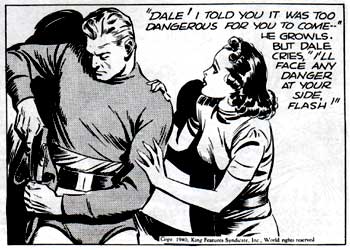
When I was growing up, my mother would sometimes mischieviously refer to my father as "Flash", or "Flash Gordon". Upon questioning them about this, I learned it was a nickname my Dad had picked up many years ago as a young man. At that time, Flash Gordon was a popular movie serial, as well as a newspaper comic strip, one of the 'funnies' as my Dad would say. I recently learned that an area native was closely linked to Dad's moniker.

Austin Briggs (listed here and here as having been "...born in Humboldt, Minnesota"), was apparently a native of our area who later moved and grew up in Detroit, moving as an adult to New York City to pursue illustration art*. It was here where he eventually met and began working with Flash Gordon's creator, Alex Raymond. According to Comiclopedia, he created the daily Flash (uncredited), and drew Secret Agent X-9.

My Dad loved the funnies, and passed that love onto me. Interesting that there is another connection from back home...

* He was well thought of as an illustrative artist by many...