Sunday, May 05, 2013

Mystery: Progress...!

Although I have not obtained a photograph of the mysterious
Mrs. Rasche yet, I did come across one of her children in a
Maryland history book; The two young ladies sitting were born
in Kittson County.  
 [Source: Western Maryland Historical Library]

Recently, I challenged the readers of this blog to help solve a mystery.

While I waited for responses, I dug around online.  First I learned that a  Henry and Katherine Rasche -  mentioned in an old newspaper article as attending a Kittson County funeral - were not just visiting.  Although from Maryland, they had moved for a time and had lived in Kennedy, Minnesota.   I then found a name attached to some genealogy records, and contacted that person, only to learn that he was their grandson.  William Owen Treacy  shared that "...My grandmother, Katherine Rowan Rasche, did indeed live in Kittson County, Minnesota in the 1890s and she was a prolific music composer, poet and artist. I have a number of her compositions but sadly, no St.  Vincent March. She had a number of her compositions copyrighted and were published and sold nationally, so you may wish to try searching that avenue.  Also, you may wish to explore the local newspaper archives as i know that the local paper(s) frequently published articles about her and her works.  Lots of luck. Let me know if you meet with any success."

I had not received any responses to my solicitation on this blog, so my next step was to take my new information and post it on the St. Vincent Memories Facebook group page.  Marcy Johnson, responded, saying, "There was an Oakland Hotel in Kennedy with Mrs. McKee as the manager listed as one of the businesses in 1900. I found this in the Kennedy Centennial History book from 1989..."

Shortly after Marcy responded, William Treacy send me more information concerning his grandmother, including a biography he had written about her.  Within that biography, it mentions why they moved to Minnesota in the first place, and why they eventually returned:

Tuesday, April 16, 2013

Honored


I am truly honored to have been selected today as one of 2013's Top 40 Genealogy Blogs by Family Tree Magazine.

St. Vincent Memories was chosen in the "Story Time" category, which is most appropriate.  I loved how they had "...looked for those sites that deliver a dividend to readers...of sharing a quest to part the curtains of the past."  One of the main reasons I write this blog is to impart forgotten history to those that have roots here, and to share our little corner of the world with those that don't.

Thank you, Family Tree Magazine, for recognizing the special place (and special people) that St. Vincent was, and is.

Thursday, April 04, 2013

Mrs. Rasche & the St. Vincent March

Example of another March
written by Mrs. Rasche

[Source:  Library of Congress]


I put to you, dear Reader, a St. Vincent MYSTERY to solve!

Published in the St. Vincent New Era in 1890, is the following news:
Mrs. Rasche, the celebrated Musical composer done St. Vincent the honor of composing a march, entitled "The St. Vincent March" as a souvenir of the Fair of 18901, and done the editor of the ERA the honor of dedicating it to him for which favors St. Vincent and us are enthusiastically grateful.
As you can imagine, to read that an actual musical composition was written for and about St. Vincent is an exciting and unexpected discovery in my ongoing research about my hometown.  Who was this Mrs. Rasche?  Why did she feel compelled to write the piece for this event?  Was the 'Fair of 1890' a special fair moreso than other years?  It is possible that she was just helping the town by being so civic-minded.  It was still trying to grow.  All we have is speculation - I would like to find out the story behind the story!2


What we have found out so far:

Sunday, March 24, 2013

1857 Incorporation

As I have earlier hypothesized when discussing St. Vincent's earlier incorporation (the first of two), it appears I was right -  it was most definitely linked to Minnesota's "impending statehood"...
Impending statehood stirred speculative interest in the future of the area's northwestern reaches. That interest was reflected in the 1857 sessions of the legislature, where a remarkable number of acts benefiting the Red River area were passed.

Among the 49 towns incorporated during the extra session alone, seven were located in the valley. One of them, St. Vincent, was situated on the Red River just south of the international border. For it the legislature chartered a ferry and authorized the construction of a branch railroad1 as well as telegraph lines to terminate there. Although it was located on land that still belonged to the Ojibwe, a St. Paul firm sent Charles W. Iddings2 to St. Vincent in the summer of 1857 to survey the new town site along with that of Pembina on the opposite shore of the Red. By February 1858, the two towns had been platted with streets named for well-known fur traders and legislators.

- Minnesota's Boundary With Canada: Its Evolution Since 1783, by William E. Lass
Sewall & Iddings 1860 Map
[Copyrighted 1857]

1 - May 22, 1857, the Territory accepted the grant and conferred it upon the Minnesota and Pacific Railroad Company.  Breckenridge, at the mouth of the Sioux Wood River, and St. Vincent, on the Red River of the North, were designated as the western termini of the main and branch lines respectively (Law of Minnesota, Minnesota Territorial Legislature extra session 1857, p.3)  The Minnesota & Pacific Railroad Company was one of four such companies created to take advantage of the eventual  federal land grant act. It eventually reorganized as the St. Paul & Pacific Railroad Company, which in turn became part of James J. Hill's Great Northern Railway Company. 

2 - Charles W. Iddings was a surveyor living over the post office in St. Paul in 1856. After the Densmore expedition he was associated with Joseph S. Sewall of St. Paul, the engineer who built the Wabasha Street bridge. During this connection the two men published a map of Minnesota which is known as the Sewall and Iddings map of 1860.

Sunday, March 17, 2013

Mystery Woman

These two photos were taken in the same general area of St. Vincent, around the same general time period (early 1900s). There appears to be one or more areas used for pasture and/or gardening/orchards in the central part of town just off of the main road. In both photographs, you can see the St. Vincent School in the background. The photo below features my grandmother and great grandmother (both Fitzpatrick). The photo above is a mystery on who it is. I have scanned it large, so if you want to try identifying the woman, click on it to see it full-screen. I'd appreciate any assistance you can give on who she is - even guesses are welcome!

NOTE: A working theory I have about these is, they may have been taken on the same day, by the same person. They both feature women working, and both feature a bit of humour. The mystery woman looks like she was trying to say don't take my picture by leaning back with her hand in front. Regarding the broom - one thing they sometimes used old, worn-down brooms like this one appears to be, was to use outdoors for things like brushing dirt off shoes and boots. Maybe she was trying to do that when the paparazzi caught her!

Saturday, March 09, 2013

River Cities in Cahoots

Having had its own County Seat stolen - and for other more practical
reasons - St. Vincent came to the support of its neighbor across the river

St. Vincent Saloons To Help Pembina Fight

Red river bridges and St. Vincent beer couldn't 
stop the court house from coming to Cavalier...

Some time since, rumor was set afloat that the saloons of St. Vincent, Minn. -  which have for many years been receiving large profit on account of the Pembina county seat being located in Pembina -  would put up the money needed to aid Pembina in making her fight against county seat removal. Not much evidence was given this rumor at the outset, but later developments would seem to indicate that there is probably truth in the same.

In its issue of last Friday (June 3rd) the St. Vincent New Era says:
That excellent daily journal, the Grand Forks Herald, has printed lately some very interesting articles about the county seat fight now on between Cavalier and Pembina which are read and pondered over here.
In another place in the same issue of the New Era, the editor of that paper jumps into the county seat fight in Pembina’s interest as follows:
The county seat battle among our neighbors across the river, is not only interesting, but also something fierce. The Cavalier crowd have let it be known that they are long in finances, having, it is reported, 1,500 dollars subscribed, to be spent where it will do the most good, and have also let it be known that they are ridiculously short in common sense, by committing a blunder which in a county seat scrap as well as in politics, is worse than a crime, by bragging that three towns, settled almost exclusively by Icelanders, they are sure of 96 percent of the votes, and in another township, similarly settled every voter signed their petition except one, an absentee.
In gazing enraptured and abstractly at those four townships, the Cavalier blunderbuss schemers have overlooked a fact, that a majority of the citizens of Pembina county are either of French, German, Canadian, Scotch, Irish, English or U.S. birth, and when the Cavalier bunglers have rubbed it into the people of Pembina county, that they propose to rule that county by the vote of four Icelandic towns they may afterward mortgage their city for what it will being, add the proceeds to their “reptile fund, blow it all in, and then would not be within a rifle shot distance of beating Pembina, at the show down”.
Now what do you think of that for an exhibition of pure, unadulterated newspaper gall?

Sunday, February 24, 2013

Past Resident Memories: John Stranger

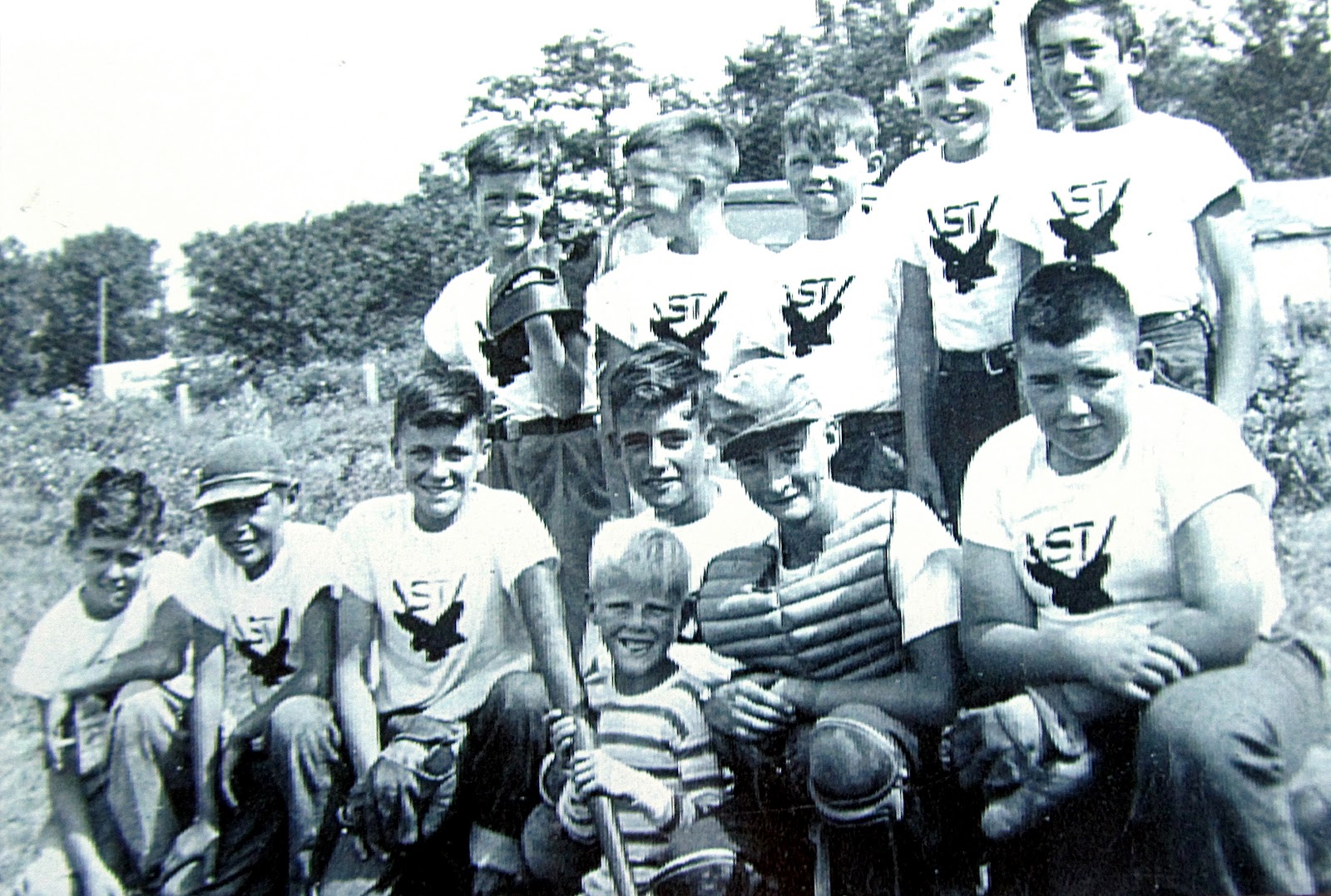
John Stranger - Back row, middle


A MEMOIR OF A LIFE, FOR BETTER OR WORSE
By John A. Stranger

CHAPTER ONE
Beginnings

This all begins in a small town in Minnesota during the 40's when growing up was a struggle without all the things a boy wants and dreams about. Outdoor toilets and dressing behind the oil burner turned up full blast where my brother (4 yrs. Younger) and I learned to dress very fast during the cold Minnesota winters.

My brother was a great kid even though we would have our brotherly confrontations. We had a younger sister too and she learned to hold her own with us boys. Our parents were very strict on almost everything that they thought was for our best interests even though we tried to disagree with our parents at times but trying to obey seemed better than a beating, (most we probably had coming).

Wednesday, January 02, 2013

Emerson Minister Goes to War


The article below shares a typical yet extraordinary story of one WWI veteran.  His name was Amos Mayse, and among the many things he did in his life, it included being a Minister of God in Emerson, Manitoba.  Read about his story below...
The last veterans of the First World War — friend and foe alike — have now joined their slain comrades from the Ypres Salient, Regina Trench, Vimy Ridge, Polygon Wood and Coronel and a thousand other far-flung battlefields. 
And increasingly, the grey-headed ranks of the Second World War also depart to join the fading divisions that preceded them. 
So Remembrance Day becomes increasingly important. It keeps us from forgetting who we are — and why. 
Yet one of the things that is sometimes easy to overlook amid the stirring music, the flights of warplanes, the firing of volleys, the spit-and-polish drill and the official laying of wreaths is that among all the things that war entails, all war is always about families. 
It is from families that the warriors come. It is families that bear their loss, or worse, that carry the wreckage when broken warriors return. It is families that suffer and it is in families that the most important and intimate remembrances are cherished. 
So here’s one family’s war story.

Thursday, December 27, 2012

PROFILE: Lapp General Store


A new general store.  Short sales people on the street showing off the latest .22 rifles.  Wide new sidewalks all along Pacific Avenue's north side through the entire town.  Yep, St. Vincent was on a roll in 1912...
One of the best historical essays is all about the history of this store - HIGHLY recommended reading!
Lapp General Store circa 1912, brand spanking new!
[Lapp Family Photo Collection, Courtesy Beth Lapp]
Winnie & Dick Lapp packing heat in front of the family's store
[Lapp Family Photo Collection, Courtesy Beth Lapp]

Richard Lapp:  Ready, Aim...Fire?
[Lapp Family Photo Collection, Courtesy Beth Lapp]
Interior of General Store - Lapp Family Can be seen in back;
Click on photo to see larger version and greater detail

[Lapp Family Photo Collection, Courtesy Beth Lapp]

Sunday, December 09, 2012

Early Hallock "Bird's Eye View" Map

[Click to Enlarge and See Details]

This postcard shows a depiction of Hallock by an unknown artist, date also unknown.  From the lack of buildings, as well as the presence of the Hotel Hallock1, it is definitely an early rendition of the town.

It is fascinating to see more of the original layout, helping the viewer to see how the town developed.  It also leads to questions such as, why does the town have a mostly classic grid layout, yet there is one road on the north side of town coming at an angle?

The main street of the town is Atlantic Avenue.  If you look at the image enlarged, you'll see in the middle of that street, right after the 'Ave', a depiction of a wagon heading north.  Just above that, to the east, is a large, two-story building.  Could this be the same building that Bakken's Boots occupies today?  If so, it would make it one of the oldest buildings still in existence in Hallock.

In the image, to the far east on Hallock Avenue, is an
impressive, possibly brick building - the old Courthouse? 
In the middle of the town, between Pacific and Atlantic, is the railway depot.

1 - The Hotel Hallock was quite the swanky sportsman's retreat. Mr. Hallock built it to have running water/bathrooms on every floor, speaking tubes, a barbershop, gun rooms, kennel rooms for the guests' hunting dogs, etc.