Friday, March 31, 2006

Winnipeg Girl Retraces Roots in N.D.

Herald photo by Mike Mohaupt
From the Fargo Forum/AP...
PEMBINA, N.D. - A Canadian television show that has children traveling the world to track down their French roots brought a 14-year-old Winnipeg girl to this northeastern North Dakota city.

Kali Moberg is a descendant of Antoine Gingras, a historic 19th century trader who built a chain of outposts throughout the region and later became a well-known political leader in the Minnesota Territory.

"I hadn't known much about him," Moberg said. "So that is why I'm doing this challenge, so I can learn more about him."

Moberg played herself in an episode for the show "La Quete" - or "The Quest" - which is set to begin airing next fall in Quebec and on cable across Canada. A film crew from Montreal set up in the Pembina State Museum, with the actors around the replica of an ox cart, which was used years ago to transport goods in the Red River Valley.

Moberg and her schoolmate, Prudence Etkin, 13, put on old-fashioned dresses and asked questions of Moberg's ancestor, who was played by Virgil Benoit. The University of North Dakota language professor has portrayed Gingras for a decade in Pembina.

Gingras, who was born in Sault Ste. Marie, Ontario, in 1821, became a leader in the Metis community. Metis were the descendants of French-Canadian fur trappers and American Indian women.

A trading post Gingras established near Walhalla has been turned into a state historic site.

"Gingras' life was very hidden," Benoit said. "He was not a straightforward person; he was an entrepreneur. He was very organized, and very generous to civic development."

"La Quete" will include 26 episodes featuring Canadian children tracking down their French roots all over the world, said researcher Caroline Bacle.

"One will be filmed in Holland, one in Morocco," she said.

The show is being produced for Television Franco Ontarienne, part of the Canadian government's support for the arts that celebrate French-speaking culture.
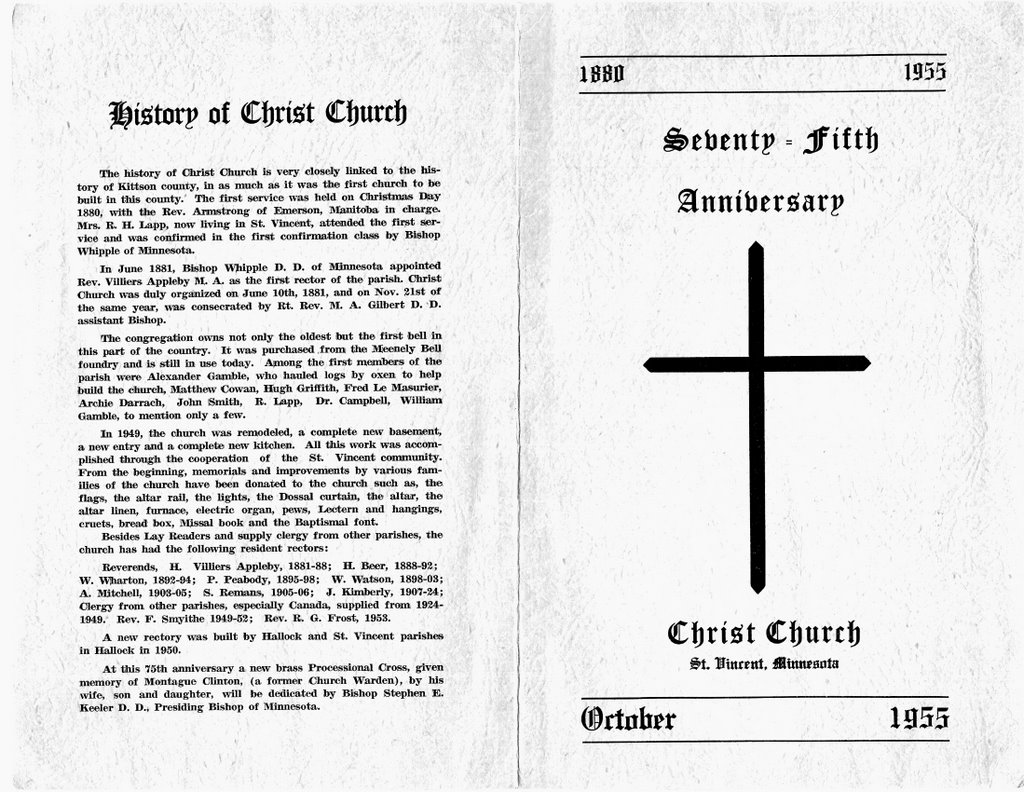
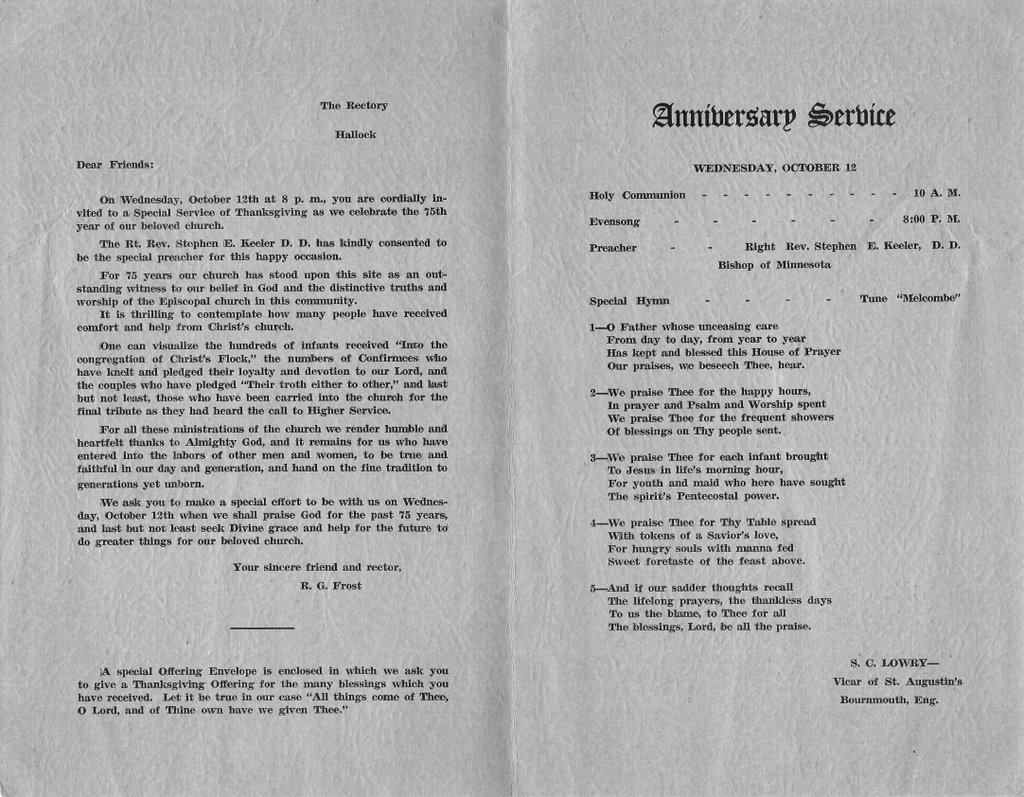
Christ Church Beginnings...


From Barbara Sitar, Gamble family decendent...
In the history of [St. Vincent's Christ] Church, it is listed that Alexander Gamble (my great grandfather) hauled logs by oxen to help build the church. Matthew Cowan, Hugh Griffith (another relative), Fred Le Masurier, Archie Darrach, John Smith, Richard Lapp (another relative), Dr. Campbell, William Gamble (my grandfather) were some of the first members.
Prior to the parish being organized and affiliated with the Episcopal Diocese of Minnesota in 1882, it was actually built beginning in 1880, and the very first services were held on Christmas day, 1880.

Thursday, March 30, 2006

How the Gamble Letters were Found

Today I received an email from a decendent of Mary Ann Gamble, the woman who wrote these letters; the email was from her great, great granddaughter, Lori(Kohut)Bianco.

Lori has this to say, including how the original letters were found...
My uncle forwarded your blog link to me a few weeks ago when you published the photo of the St. Vincent school children. I checked back today & was thrilled to see you have found the Gamble family letters. I'm Neill "Bo" Gamble's granddaughter (William Gamble's great-granddaughter & Mary Ann Neill Gamble's great-great granddaughter...)

Beaverton [one of the towns mentioned in the letters that the Gambles had moved from...] is only about an hour from where I now live & we've been there a few times. Margaret Neill, the "Maggie" referred to in the letters, lived alone there after the death of her parents until she died in 1949 & is buried in the cemetery in the yard of "the Old Stone Church" (St. Andrew's). When we first visited Beaverton in 1984, people still remembered Maggie Neill & the house she lived in had only been torn down a few years previously. She died a spinster, & as we understand it, my grandfather's cousin, Warren Griffith (son of Jane/Jenny), went there after her death & rescued the letters from the trash heap. Unfortunately, we do not have much contact with the Griffith side of the family (it's possible you know them better than we do!), so we do not know whether they are still in possession of the originals.

Your theory that the Gambles were of "Irish stock, if not native, then one generation removed at most" is correct -- both Mary Ann & Alexander Gamble were born in Ireland, but (from what little we know), they emigrated to Scotland (exactly when, we do not know). There are references in the letters to "Dundee" & one of my mother's cousins found Mary Ann & Alexander's marriage certificate from there. From Canadian census records, I've determined that Elizabeth, the oldest daughter, was apparently born in Scotland, but Alex Jr., the oldest son, was born in New York State. The rest of the children (including my great-grandfather) were born in Beaverton, except for Sammy, the youngest, born in St. Vincent. There are various family stories/theories about how the family came to be in New York, one being that Alex (and possibly his brothers -- there is a reference in one of the letters to "sister Ellen in Philadelphia") came to America at the time of the civil war to weave cloth for uniforms for Union soldiers.

The links you've added to explain the various references are fascinating. The one about Hamilton House, in particular -- I had no idea it was in England. Re: the Orange Lodge, my mother has Alexander Gamble's Orange Lodge songbook (!) from the 1860s, it's quite a read!! My grandfather told me he used to have his sash too, but unfortunately it has disappeared.

Your blog is a treasure in itself. I'll continue to read it with interest.
I thank Lori for the kind compliments. I feel privileged to be learning from this project, and am thankful to be able to share it with others, especially those that have roots from our area...

Gamble Letter #4

Before I share the next letter, I need to preface it with a disclaimer...

After reviewing the letters, and placing them in the best chronological order I can make out, it appears that some of the letters only have months and days on the header, so year is unknown. I am fairly certain that they should be very close to accurate. That said, anyone is free to correct me - I want to know if there is a mistake.

Now, on to the next letter...

Emerson
Febury the 18th, 1878

Dear father and mother Wee got your letter and was glad to hear of yous being weel as this leaves us all at present We have had a lovely winter hear it is very healthy hear there the winter here is so far a head of ontario winters people will never be a judge of any place till they go and see for them selves I thought it would be something dredful but we never seen as good a winter in ontario* from the winter set in till now there has been now chage Never any thaw clear and bright all the time you never told us if you got the news paper we sent yous we want to send more if we thought you wanted to get them there is too printed here the land that Alick took up before I come we sold our claim to William Dure Dures brother in the fall for a hundred Dollers it was to far away So we watched our chance and has got a place withen one hours walk of emerson right alongside of the station house the terning of the saint Pauls and pacific railway it is called the new town of Saint Vincent Saint Vincent you will see it mentioned in the papers everyone thought it was taken up years ago by a french man so Alick thought he would writer about it for fun so the goverment sent us the papers for it right of and as quick as Mr. Nash our lawer heart we got it he give Alick money on the spot to put a house on it before we got the house finished we were offered one thousand dollers for it Nash saes it is well worth too thousand dollers as it stands there is any amount of wood close by and a lake runs along the bottom and any one coming from canida stops right at our door so you will say like the rest we hit it that time there has been [word illegible] going up here all the winter the children is all going to school they are in the second book there is thousands coming from all parts here if McPheren ever comes here his Galiep wount be of any use to him let us know how every thing is going an who is in the new house if you could get anything decent for them you ought to let them slide Beverton is a far forgotten place on the globe.

* Historically, that winter was "...the 'Year Without a Winter'...El Nino-induced extraordinarily mild winter...Mildest December in history...Near record warmest February and March..." - Source: Historical Climate Database @ the University of Minnesota

Wednesday, March 29, 2006

Seen From the Outside

According to Joseph Howard (Strange Empire: Louis Riel and the Metis People):
"There, on the shores of the sea of grass, these men from the north and those from the St. Lawrence built a town which they called Pembina. The name, originally Pambian, was a French rendering of a Cree-Chippewa term for the high-bush cranbery, but it also meant 'sanctified bread' because the berries were used in pemmican which was blessed by the priest.

Pembina still exists as a sleepy border village in North Dakota. It was an inhabited place in 1780 and thus is the oldest community in the American Northwest. But it has been neglected in all save the local histories, and somewhat neglected even there because so much has happened that not even the oldest residents could ever recall it all. Few Pembina residents ever knew, for instance, that the first white children in the American or Canadian Northwest were born there. There were two, born in the same week; the parents of one came from Hudson's Bay, those of the other entered the country by the St. Lawrence. And Americans may find it odd that this American town was the first prairie headquarters of the thoroughly British Hudson's Bay Company, that it once was owned by a Scottish earl [Earl of Selkirk], and that it once was peopled almost entirely by German and Swiss mercenaries, veterans of some dog-eared European war.

But those distinctions are less important to us than some others. Pembina, a log cabin village, was the first capital of a new race, the Metis or Red River half-breeds of the Northwest--in so far as a people who always shunned settlements could be said to have had a capital. It was the principal seat of their church, established in 1818 and served by a bishop whose diocesan boundaries (ignoring such political fictions as the forty-ninth parallel) were officially the Great Lakes, the North Pole, and the Pacific."

Tuesday, March 28, 2006

Town Play

School play performed in Reid Hall [St. Vincent, MN - Early 1900s]

This image was found during a Gamble family reunion that took place in Hallock and St. Vincent in 2002. As outlined in a Kittson County Enterprise article about the reunion, it was found at Christ Church in St. Vincent during the reunion while family members were on a tour of past family homes and other meaningful places in St. Vincent. A cousin took a digital photo of the original photograph, and that's what we see here...

It captures a moment in early St. Vincent history,the cast of a local play. We don't know the play performed, nor the context. We can only speculate at this point. Perhaps it was a community hall play, or maybe even a high school production. I have later learned that the location was Reid Hall in St. Vincent.

Here are the cast members we know, from handwriting left on the print itself:

Back Row: William Ahles (3), Harry Davis (4) and Rube Smith (7)
Front Row: Montague Clinton (1), William Gamble (2), Samuel Gamble (3), William Gamble (5 - is this ANOTHER William Gamble, or...?), Chris Theodorf (6)

Out of the 16 cast members, we only know half of their names, and of those 8, we're not sure if we have the positions right since the writing is not consistent. Anyone that can help us name individuals, or make corrections on placement, please leave a comment here, or contact me directly...

Monday, March 27, 2006

Gamble Letter #3

Shuttles used in weaving...
I have developed a theory about the spelling in the letters. The individuals writing them, mostly Mary Ann, but not solely, obviously had some limited education. My theory is that the spelling reflects their native speech patterns, namely they were of Irish stock, if not native, then one generation removed at most. Ireland is mentioned in the letter in this post, and note the spelling of cheap, as 'chape', which phonetically would be how cheap would sound to someone of that extraction...
Emerson, Manitoba
November 12th, 1878


Dear father and Mother we received your letter to Night as was glad to hear of your being well as this leves us enjoying the same blessing We had give up all hopes of getting a letter from yous we are all glad we came hear we like it well we Dont see much Diference in the climet People can Plough yet we are living in the town of emerson it is on the banks of the red river just at the boundry line between Maniboa and the united states in three minutes I could be in Manisota or Decota taritory we cary our washing water out of red river we had flags flying yesterday rejoicing on account of the train coming in to emerson youc an get on the train at Beaverton ane come here in three or four Days all by rail the Amaricans built the railway from fishers landing to emerson this summer we are with in five minutes walk of the station the children is all gowing to school the are right beside the School house we have all got our Photographs taken to send to yous we will send them in separate envelopes we will send them in 2 or 3 days after this letter the crops harvested very good although there was a great gale of rain you never saw such fine Potatoes and Cabbage is as good as you ever saw them in Ireland and for hay you Can Mow all you want thousands of tons if you wish raising cattle Pays best you never saw better cows in your life then is here you can buy every thing hear as chape as in beaverton flour 2.50 per hundred lbs Potates 20 to 25 cents and you could cary them on your arm they are as big as your boot and no bugs ten lbs of shugar for one Doller best beef Stake 10 cents par lb. Stoves chaper than in Beaverton wood is five Dollers Per cord we have only bought one cord since we came when slaying comes it will be for 300 dollers per cord we have a New grint Mill have 3 large taverns, 4 churches orange Lodge 3 blacksmiths shops Six Stores we have all been very busy since we came hear alisa is at home now his Mother and him gets more than they can Do in the house Alisa is going to write to Maggy soon I bought Alick a new fiddle at 3.50 ellin and jane is lerning fast each of them said a Piece at the Mathedist Concert Willie is a great bugger he fights often with little boys but wins every time Alick says billey will be far better Man than him Alice wants me to tell Grany and Gran and Magey his little niece this it is first whan I staped on the stage my heart want Pitapat for fear the gentleman would say look at the little dunce We are all glad we got blaar of the weaving but keep the reeds and shuttles safe as we might want to weave reg carpets if you ever come hear bring a iron head for the beam and for the Bloth beam we got some breaking Done on our claim but Sold My improvements and has taken up 160 acres in Minasota in the states I got good wood on it [several pages missing]

Sunday, March 26, 2006

Gamble Letter #2

Click to see larger version...
While the Gambles eventually settled in St. Vincent, as the summer progressed in 1878, the family continued to live at Emerson for the time being.

Read about their daily life, and how history intersected that life for one brief moment...

Emerson
July the 22, 1877


Dear father and Mother if yous are Alive and there yet I want to know Why you did not answer our letter I Wrote to you the day after we landed here and has been watching Day after day and still no letter if you expected of letter every day and dit not get it wouldent yous be uneasy we are all well and I am afraid to hope yous are the same as I know there is something the matter or you would have wrote be fore this We all like here splendid nothing would induce us to go back this is in my estamation the best country we have ever been in [6 lines cut out] there was a man had a garden planted with potatoes and we bought them. We gave him twenty five dollers for three months of the house and the garden house rent is very high here flouer is from to and a half to three dollers a hundred 8 pound of sugar for a doller tea the same as there butter fifteen cents a pound eggs fifteen cents a dosen cord wood three dollers a cord fourt feet oak and bech Alick is working in a brick yard at one doller and twenty five cents a day and little Alick is worth about 50 cents a day doing messages Eliza is hired at 8 dollers a month and [5 lines cut out] things is Deer here but if you Do any thing for them you are wel paid there is plenty of work here for any one thats willing to work We paid twenty six dollers for a stove furniture is very high here We could not give the price for it so we do with out We have not even a chair we got benches made people here with a garden the sise of yours in Beverton takes from eighty and a hundred bushels of potatos of it the best land in thorah couldent be compared to this they most of them has a Coupple of cans and a garden adn they can live comfortable I am glad we came here We were to long about Beaverton there is four churches too taverns four stores it is as big as Beaverton was when we went to it I get wood handerer for the fire not I could there I would register this then to make sure you will get it and I will wait patently for an answer this is the place to rais cabbages and all kind of vegetbles the strawbery was as plenty as the raspberrys there alick Made four dollers selling them at twenty five cents a quart there is to railways coming in here next spring emerson is on the banks of the red river and plenty of fish in it for them that has time to catch them there calles fourt boats there every day coming and going from fishers landing to Winipeg sitting bull that we used to read about bees in with his men in the village often dressed up with fethers and bead and furrs and has a war dance* befor the stars right in the street this is the truth I have been telling you so you may rely on it

Mary Ann
* It's quite likely it was actually the Ghost Dance being done...

Thursday, March 23, 2006

Gamble Letter #1

Click to see Duluth around the time the Gambles passed through it...There are a couple of letters prior to 1878. They are when the Gambles are just arriving in the area; as stated before, I'll be transcribing the letters 'as is', meaning as written, mistakes and all...


Emerson
Friday, June 2, 1877

Dear father and Mother We landed hear on yestarday at three aclack Thursday so that you see we were one week it was thursday we left your place and thursday we came heare We had no Delay At all I got the boat on Friday after I left you at arillia for Duluth I got our passage for sixty Dollers it wantd have been seventy only I pleaded poverty I told them I would have to go home agin but they would not hear of that We were four days and four nights on the boat till we got to duluth and that was only half way this is going to be a grand country yet there is as good accomodation here as in toronto and as good buildings I like the apperance of everything heare Alick is much thought of heare there is lots of fish in the read river the place where we are living is only a rifle shot from read river Where the steamers runs thats down the street and up the street about the same Distance is the states with the line fence between Canada and it minsata the states soldirs rids past the door every day We are going to get five acers breaked on our place next week We could take up land for you three hundred and forty ackers by paying thirty Dollars that is not the land but office fees and you get a printed recept and you need not do any thing on it for one year every one gets a town lot here for nothing to build on the people says you would have more off one half ackere here than you would of to acckers there you never seen such land in your life the best on Walles farm could not be [?] to it it is like a onion bed that was manured for years Alick went to see Corrigan when he was in winnipeg and he is as comfortable and better of as he was in thora girls is very much thought of here not like dirty Beaverton I think any one that would mind themselves they could get along here they are a different clas of people here We waunt to go on our own place till next spring and then it will be ready for crop We ill get a lot and build a house on it and then rent it when we go on the land in a few years from now the land will be scarse as in thorah but any body that had about five hundread Dollers they could get good chances I am telling you the truth I had not much time to see any thing yet but I can tell you more the next time Alick had to go to help a man or he would have wrote so that is the reason I done it we new yous would be uneasy about us Write when you ge tthis and let us know what they said when they found we were away everyone used us well on the way there was men at every stoping place to look after us I took a room on the Collingwood boat the children would not get along on deck I paid five dollers for it with good beds in it We were four days on it and to the train and the rest on read river I could never begin to tell yous all I seen the grandist sights ever you seen mounten as high ten of the hamilton house we seen the Deers runing wild on the moution Alick wants you to keep the reels and shuttles an cabins for him people tells him if he could manufacture cloth he would make a fortune the children joins us in sending their kind love to maggy and granny Alice wants all the time to go home to gran she likes him Best

We will send you More Particulars Next time

Maryann Gamble
Hamilton House (Beaverton, ON)
[Click to Enlarge]