Showing posts sorted by relevance for query William Moorhead. Sort by date Show all posts

Friday, February 06, 2009

Profile: William H. Moorhead

William MoorheadThis is William Henry Moorhead of Pembina. He was known to be, among other things, a land speculator and an undertaker.  Why the text says he died in 1871, I cannot explain, but according to all sources, he did not die until 1897.

Sometimes referred to as "Highwater Bill" - according to the Chuck Walker's family oral history, because "...during one of the floods a wager was made between some men...Bill Moorhead drove a board in the water with a knot hole and said, 'The water will come up and run through the hole.' He won and later it was said that he came back after dark and drove the board deeper..."

Oh, dear...well, gossip aside, I rather like his moniker however he came by it, cheating or legitimate!

William Henry married Lizzie La Verea, a French Canadian, of North Dakota, where he was employed by the Hudson Bay Company, later owning a large tract of land and an undertaking establishment at Pembina, N. Dak.; the town of Moorhead, was named for him. He died July 3, 1897. His children were: James, Stanley, Shepley, Mary, Delia, and one or two who died in infancy.

Mr. LaFromboise says the men prominent in making Walhalla are Father Belcourt, John Meger, Joseph Rolette, William Moorhead, and Charlie Bottineau. William Moorhead was the first whiteman that he remembers at Walhalla Dak. Territrory. Mr. Moorhead and Jim McIntosh another white man came about the same time, this was about 1863. Jim McIntosh was later killed by Indians while he was carrying mail from Devils Lake South west to another post. A lady named Mrs. Reed was one of the first white women in Walhalla. - From the Early History of North Dakota

He was born at Freeport, PA Sept. 20th, 1833, and died at Pembina, July 3rd, 1897. He came to St. Paul in 1852, and arrived at Pembina, Aug. 20, 1856, with the Red River Carts, bringing supplies from St. Paul. With him came Antoine Girard and Lucien Geroux. He was in partnership at St. Joseph with Joseph Lemae, and after the latter’s death, he returned to Pembina.

Moorhead was one of the early settlers of Pembina, N.D., who had traveled in Roseau County before the white settlement. Two of his sons settled on what is known as the Northwest Angle of Lake of the Woods. Moorhead told J.W. Durham that Roseau County was the greatest. From Minnesota's Last Frontier

Tuesday, August 30, 2011

Justice in Old Pembina

The story I'm about to share has been shared here before.  While the first version was full of character (based on solid research), this one has  more background as well as details regarding the final showdown, written by one of our area's premier local historians...
An outlaw from an infamous gang.  A U.S. Marshall on his trail all the way from Texas.  Their paths meet in Pembina on a cold November day in 1878...

by
James Benjaminson
           
Sam Bass gang - Sam in back, on
left; in front, the Collins bros.
William is on left, Joel on right.
[circa 1877]
In the annals of western outlawry, certain names have been etched into the American psyche – names such as Jesse and Frank James, the Younger Brothers, Billy the Kid, Black Bart and Sam Bass, just to name a few.  For the most part, their villainous exploits took place in parts of the country far remote from rural North Dakota.  The closest any of them got to North Dakota was the James Gangs ill-fated attempt at robbing the bank in Northfield, Minnesota and the Bass gangs robbing of seven stage coaches in the Black Hills of South Dakota.  Still, the effect of one outlaw’s exploits rippled to the tiny town of Pembina, Dakota Territory in 1878.

Sam Bass was a young Texas outlaw who headquartered himself in Denton, Texas.  Teamed up with the outlaw Joel Collins and four others, the Bass gang staged the largest train robbery in U.S. history (at the time) when they held up the Union Pacific railroad at a tiny watering hole called Big Springs, Nebraska on the evening of September 18, 1877.  Although Bass was considered leader of the gang, law enforcement claimed Joel Collins was the brains of the outfit.  The gang rode into the stop over, made hostages of the station master and several others in the vicinity, cut the telegraph lines and waited.  When the train pulled in for water, one gang member swung himself into the cab of the locomotive and took the engineer and fireman hostage while the others headed for the baggage car.

When they rode off into the night, the gang had relieved the railroad of $60,000 in freshly minted 1877 twenty dollar gold pieces.  Dividing up the treasure, each man had 500 gold coins in his possession – about 35 pounds of gold per gang member.  The group split into three groups of two men, each heading in a different direction.   Word spread fast about the robbery and law enforcement swooped in on the area.  One of the gang members disappeared and was never heard of again (many assumed he had gone to Canada).  Joel Collins and his partner didn’t fare as well, being intercepted by a posse within days.  After a brief shoot-out, both outlaws were dead and $20,000 of the gold coins were recovered. 

Bass and his partner figured two lone riders would be suspicious so they acquired a buggy, stashed the coins under the seat and rode blissfully by the bands of law officers they encountered.  Returning to Denton, Bass enjoyed the high life, spending freely and enjoying a local sort of hero worship.  He had plenty of friends to warn him of approaching trouble and knowing the area like the back of his hand, he could easily hide from pursuers.  Living the high life the money soon ran out and Bass returned to his old ways.  Organizing a new gang, he returned to robbing trains.  Only this time he chose to hit the local railroads – his gang robbing four trains in quick succession within a 25 mile radius of his base of operation.  It was at this point the locals turned on him and his gang.  For seven weeks, the gang was pursued by a company of Texas Rangers, U.S. Marshals and local law enforcement, all to no avail (although an accomplice, “Arkansas” Johnson, was killed in a skirmish from which the rest of the gang escaped).

Bass’ downfall came at the hands of a spy that infiltrated the gang – and by gang member Jim Murphy who betrayed him in exchange for having charges dropped against himself and his father.  The fatal day came when the gang rode into Round Rock, Texas intent on robbing the local bank.  Laying in wait were the Texas Rangers and local law enforcement.  In a brief bloody shootout, one deputy sheriff was killed as was one of the outlaws.  Bass himself was wounded but managed to clamber onto to his horse and ride away.  The trailing posse found him the next day, lying under a tree, still alive but mortally wounded.  Death came to Sam Bass July 21, 1878 – it was his 27th birthday.

Of the participants in the April 10th train robbery at Mesquite, Texas, six of the eight robbers had either been killed or were in prison by the time of Bass’ death.  The robbery had netted each of the bandits the paltry sum of $23 each!  One of the gang – William Collins, was arrested days after the robbery and taken to Austin to stand trial.  He was moved to the jail in Dallas in June where a family friend posted a $15,000 bond to secure his appearance in court—a date he did not intend to keep.

A brother to outlaw Joel Collins who had participated in the earlier Big Springs train robbery, William Collins jumped bail and headed north, roaming across several states before eventually ending up in Pembina, Dakota Territory working as a bartender in Jim White’s saloon, a unique watering hole that straddled the border.  A red stripe painted on the floor designated which country a patron was in – the saloon on the U.S. side of the line, with the kitchen and sitting room on the Canadian side.  Known to the locals as William Gale, Collins befriended a local man, Robert Ewing, finally telling Ewing his real name and confiding he had a wife living in Dallas.  Gale/Collins asked Ewing to write her a letter, which apparently Ewing did.  One can only speculate but it is assumed authorities were watching her mail.  It wasn’t long before a deputy U.S. marshal arrived in Pembina looking for Collins.

Wednesday, September 09, 2015

Obituary: William H. Moorhead


Apprentice Carpenter. Land Agent. Indian Trader. Trading Post Clerk. Buffalo Hunter. Undertaker. Farmer. Tavern Keeper.

Below is the obituary of an extraordinary man, one of our area's true pioneers.  I have left all the spelling as it appeared in the original article of the newspaper just as I found them, to give you a flavor of how common it was.  Some of the errors may have been due to misspellings or incorrect typesetting, but just as often there was no consistent agreed-upon spelling conventions for some words - Sometimes they just had to make their best guess!

PIONEER DEAD
William H. Moorhead Died Yesterday Morning at His Home In Pembina.
HAD BEEN ILL SIX MONTHS
And Underwent a Surgical Operation Here About Two Weeks Ago
Mr. Moorhead was One of the leading Characters in the Early Settlement of the Valley and was a Typical Frontiersman —"High Water Bill" was the Name by which He was Best Known— The Funeral Occurs Tomorrow.
Pembina, N.D., July 3.—(Herald Special)— William H. Moorhead, better known during later years as "High Water Bill," died at his home in this city this morning, after an illness extending more or less over the past six months. This sobriquet he gained by his numerous prophecies as to just how high the water in the Red river would rise each year, and, be it said, his predictions were usually not far astray. As an incident in this line - it is said that this spring, before the snow melted, as he was lying in his bed on the lower floor of his house talking "high water" to a visitor, he reached down about half way on one of his bed posts and said. "You'll see the water up to this spot when the snow melts," and his prediction was verified. He refused to be carried upstairs until the water came in on the floor.
Floods had been known to fill the Red River Valley with snowmelt runoff. The earliest pioneers remembered the flood of 1861. That spring, the Red River Valley was under so much water that it was called the “largest body of fresh water in the world” – for a few weeks, anyway.   -   North Dakota Studies, FLOODS
Wm. H. Moorhead was born in Freeport, Pa., Sept. 26, 1832. He left Pittsburgh where he received a common school education, April 1, 1852, and arrived in St. Paul, a month later, where he worked at his trade—that of a carpenter—for two years.

The summer of '54 and the following winter he spent at Sauk Rapids trading with the Winnebagos, when they were removed to Blue Earth county. He then returned to St. Paul and organized a company to lay out paper townsites in northern Minnesota and Red River Valley.

In August, '57, he came to Pembina in company with Joe Rolette to build a store building for a trading post for St. Paul parties. He completed the building and remained as clerk to February, '58, when he made a trip to St. Paul with a dog train, not seeing a single house between the two points. He returned to Pembina soon after, having some fearful blizzard experiences on the way.

On June 8th of the same year he left Pembina on a buffalo hunt and returned in August with 15 Red river carts laden with furs, hides and Pemican.

After the high water of '61 which was the flood, according to his tell, he moved out to Walhalla. Here he lived on very friendly terms with the Indians until hostilities broke out which ended in the Minnesota massacre and because he refused to sell ammunition to the hostiles, he had to leave. He moved near Devils Lake and pursued his trading.

In 1862 he married Lizzie Rivier, who with her five children still survives him. About this time he moved to Pembina, where he has since resided.

Source:  Google Books
Mr. Moorhead has long enjoyed the distinction of being the second oldest white settler in the valley. Hon. Chas. Cavileer, of this city, being the oldest having come in 1841. When the Historical society of North Dakota was created in 1895, Gov. Allin appointed Mr. Moorhead a member of it and he has collected considerable information for it since.

Mr. Moorhead was a typical frontiersman and a general favorite. The history of the Red River Valley would be far from complete without an interesting reference to a man who was known far and wide for his genial good nature, and interesting stories of the pioneer's life in the northwest.

Mr. Moorhead has been a member for years of Pembina lodge No. 2, A. F. and A. M., and the funeral, which will take place Monday afternoon at 4 o'clock, will be under the auspices of that order.

[July 04, 1897, Grand Forks Herald]

Monday, November 28, 2005

St. Vincent Boom Times, Part I

Old Times In The Red River Valley: St. Vincent, "Uncle John," The Pacific Hotel, "Col. Flake," Boom and Bust
By George B. Elliott

No. 5
The Northwestern Farmer and Breeder
20 September 1886

"The Valley of Eden" had its Tapley "who was always jolly under difficulties, but it was left to the Red River Valley to have a man who was "the same" no matter whose lot was "criss-cornered," or whose stake was pulled up. Uncle John Stewart is a type of a New Englander not often found in frost-bound latitudes. In the palmy days of '74 Uncle John was proprietor of the Exchange Hotel, Winnipeg, in which city he still has many warm friends.

The same fatality which drove many thousands to California in '49 induced Uncle John to erect the Pacific Hotel in what was then thought to be the coming Frisco of the Northwest - St. Vincent.

A man was found who could demonstrate to a certainty that what Helena was to Montana so would be St. Vincent to Minnesota. The Gamaliel who instilled this enthusiasm into the hearts of even old timers was "Colonel" Fiske, who on the completion of the St. Paul & Manitoba road to the International boundary line, was placed in charge of the town to "boom it or bust."

The road was completed early in the fall of 1878, and the scale of the boom which followed, though not such as occurred in the "Valley of Eden," was nevertheless the sliding variety.

Uncle John Stewart went into the middle of a poplar brush and cut out two lots on which he erected his Pacific Hotel. Jim White, who subsequently ran Huron City "for all it was worth," had declared that in '71 he had paddled all over St. Vincent in a dugout and shot ducks where the depot was located. Mac Cavileer corroborated this statement and produced a doubled barrel shotgun in order to relieve any one of any unnecessary doubts. Daniel Brawley, whose name must always be identified with that of St. Vincent, emphatically maintained that St. Vincent was "booming." Even when cross questioned by a citizen of Pembina, who invariably objected to the great future which was the alleged destiny of St. Vincent, Brawley would remark that it was "booming nevertheless."

The railway people, however, played sad pranks with St. Vincent. They scattered the place all over like sage brush on an Arizona cattle range. They put the depot in one place, they ran a spur down to the river, and the inhabitants were informed that sometime in the near future they would build a jetty at the end of the spur, and Mr. William Moorhead, of Pembina, waggishly observed that they would eventually extend the jetty across the river and thus have a bridge. Then by way of variety the same railway company located their engine house about half a mile from the town. Then half way to Emerson they built another depot - a kind of an opposition establishment - and then about half a mile further east, in another direction, they built a section house. They scattered their buildings around promiscuously, expecting to see the town fill up in a hurry, but the town never filled up. It was attacked early - - in the first stage of its career, and it never rallied. Col. Fiske had build a ditch to drain a swamp which covered half the neighborhood, but the swamp after bestowing a portion of its contents into the ditch refused to part with the major portion of its contents. Still those who located at St. Vincent were there to stay; they had stout hearts, and it was not their fault if the place did not come up to the original anticipations.

There is no western town without its redeeming features, and when railway magnates induce people to locate at their terminal towns, they should stay with the people and not leave them to their fate. "Conductor, throw this town overboard, we've got to build another further on."

Nothing shocks your staid man from the East, more than the odd fashion the Western people have of living in tents and shacks, and then pulling up stakes and going off further west. The eastern man's momentum has been of the slow description; he cannot move fast at first, even if you kick him; his joins are stiff, and how can you expect him to move with the celerity of a western rustler? When he locates it is like the dump of a pile-driver, he makes an impression on the soil and there wants to remain and conduct matters in the old fashioned way, but the western man cannot allow such foggyism, and the eastern individual soon discovers that he must do likewise or be "a bump on a log." If he has snap he does "likewise;" if has not he remains as a surveyor's mark, sure to be found around the same old spot many years afterward.

The life incident to a new town in the west is real and earnest. Such activity as might have been observed about St. Vincent in the palmy days of its career was of the western type. Like Moorhead to Fargo, it defied its neighbor across the river, but the old inhabitants of Pembina shook their heads ominously. Mr. Moorhead would vary the occasional solemnity by observing that "he did not think it was fair to attack a place because it was hard to see." But when Col. Fiske undertook to interrupt the ferry and thus cut off communication with Pembina, Mr. Moorhead remarked that it was a "territorial offense" to interrupt communication across a navigable stream, and so Col Fiske was foiled, pending the question as to which side of the river was the stronger. It was not long before the people of the territorial town found that even a territory has rights, and so they continued to vindicate them.

For a long time St. Vincent bore the unequal struggle, first against the railway company then against Pembina; the latter, of course, being its natural rival. But between the contending forces from a thriving, ambitious town it was "flattened out" until natural growth would assist it. It was not without its virtues, and like many a railway terminus, its promoters were promised a great deal and the promises were not kept.

The price of lots went down from considerable to nothing. The town site company expended a good deal of money in making improvements "but the west side always" seems to have a withering effect on the right bank of the Red.

One of the incidents connected with the early history of St. Vincent was the celebration of the arrival of the first train. That was a glorious occasion! There was no dearth of champagne on the occasion either. There was a happy time for it really meant through trains to Winnipeg from the far East.. Many of the chief actors in that scene are gone - - among the number poor Brawley, "the member for St. Vincent" who certainly believed that some day his town would rival St. Paul.

The illustration shows the Pacific Hotel with Uncle John Stewart at the door, in his good, old fashioned way.

Many an interesting anecdote "Uncle John" is able to tell, for he has handled the ribbons in his time as a stage, and he can tell his story with a dry humor that is inimitable. A warm heart and a kind and hospitable landlord is "Uncle John" to all.

Friday, August 08, 2014

News from the Past V: Brown & Moorhead

Pembina Pioneer Express masthead
[Courtesy:  Pembina County Historical Society]
Jim Benjaminson recently shared some excerpts from old local papers.  There is a reference to Sheriff Charley Brown in one story, and in another we even find out the likely reason for a well-known local man's nickname...
Northern Express – Drayton (R.H. Young, Editor; Weekly, published on Fridays - $2 per year)
December 9, 1881 Vol. 1 No. 1 is the first issue
(Becomes the Pioneer Express April 20, 1883 at Vol. 3 No. 38)
____________________ 
December 23, 1881 Vol. 1 No. 3 
The train loaded with some $2,000 worth of goods which Ricard Bros. sent out from here the 7th to Turtle Mountains was captured by Indians and half-breeds at or near Pembina mountains. The Indians claim the land as their own, and say that no one has the right to cross it, and therefore appropriated the goods to their own use. Sheriff Brown of Pembina was out there yesterday and found most of the goods, but could not get them as they refused to give them up. They were too many for him, so he returned for help. We understand he has gone out today with a squad of soldiers from Fort Pembina. We will give full particulars tomorrow. – Independent (Emerson, Manitoba) 
February 10, 1882 Vol. 1 No. 10 
Announcement – We announce this week our intention to remove the Northern Express to Pembina, at which place the next issue will be published. (page 1) 
February 24, 1882 Vol. 1 No. 12 
Amongst many drawbacks and inconveniences incidental to the removal of our business and the enlargement of our paper we lay before our readers this week as good a paper as we can under the circumstances.

Townsite Auction Bill
March 24, 1882 Vol. 1 No. 16 
[Indian Title to Dakota Lands – page 1]
The St. Vincent townsite company have sold their interest in that town to a Winnipeg syndicate. St. Vincent has invested $200 in a hook and ladder truck with other fire apparatus. This is a wise move which should be a reminder to this town of its duty in the promises. Of course when Pembina takes hold it will be on a larger scale. 
March 31, 1882 Vol. 1 No. 17 
Quite a number of our citizens went over to St. Vincent on Tuesday evening to attend the auction sale of town lots.

April 21, 1882 Vol 1. No. 20 
The unmistakable double-toned whistle of the steamer Selkirk was heard on Tuesday evening for the first time this season. Passengers from various points on the river improved the opportunity of making a business trip to Town and taking in interesting features of the flood along the way.

The Selkirk has had a lively business the last two days carrying freight across from St. Vincent.
The ice made a new door into the engine room of the St.Vincent elevator last Sunday. At St. Vincent the situation is becoming somewhat unpleasant. Several of the streets are covered with water. Around the Northern Hotel it is nearly a foot deep, but the higher portion of town is dry yet. 
April 28, 1882 Vol. 1 No. 21 
Moorhead has had several bets at stake including a town lot and a suit of clothes, that the water would not rise to the level of his saloon floor. He has won the bets with just a quarter of an inch to spare. 

Now we know how William Moorhead got his nickname, “High Water Bill”...!

Friday, April 03, 2009

Passing Through

Many people passed through our area, on their way to somewhere else, during the years of early settlement. It is rare to find documentation of such, but below is one...
John H Atchison was born March 23, 1845, near Kelso, Roxburghshire, Scotland. His father was a laboring man who found it hard times to provide for his growing family. Roxburghshire, which is near the border, is a splendid agricultural country. From Kelso, England could be seen any day. Mr. Atchison had an uncle George Atchison, who lived in Stratford, Ontario. One day a stranger appeared in Roxburghshire. He wore a fur coat and a great fur cap. Such garments had never before been seen in that part of Scotland. The Stranger proved to be the uncle from America. He advised his relations to come to America, "where there was free land and a prospect of a home." The advice was taken, and in June, 1862, Mr. Atchison, together with his father, Mother, and brother, left Scotland for the promised land. The went from their home by train to Liverpool, where they took passage to Quebec on the sailing vessel William Rathbone. The captain was part owner of the vessel, and this was his twenty-sixth trip to Quebec. He brought emigrants to America, and returned to England with a cargo of Canadian lumber.

The emigrants were five weeks and three days in passage. One day when a light breeze was blowing, a three-massed schooner passed merrily by the William Rathbone. Later in the day when the wind had risen almost to a gale, they in turn passed the schooner, and cheered lustily. Another day towards the end of voyage, it took the William Rathbone tow days to get past Belle Isle in the St. Lawrence river because of lack of wind and the strong adverse current of the river. The family first went to Stratford, Ontario. Mr. Atchison's father did not like the timber land around Lake Huron that was then open to settlement, and took no claim until he did so in North Dakota.

For seven years Mr. Atchison worked as an ordinary workman on the Grand Trunk Railway, and received $1.10 per day. During this time he married a girl of English parentage. He lived in Georgetown, Ontario, until he came to the United States. In 1874 great changes were made on the Grand Trunk system. large numbers of men were being discharged. As he, too, was likely to be discharged at any time, he decided to stop working on the railroad and take up land in the newly opened west.

At Sault Ste. Marie Mr. Atchison, together with his wife and two small children, boarded a steamboat with the intention of getting off at Port Arthur and going overland to Manitoba. Of this boatload of emigrants, all but the family of Mr. Atchison and a French family did so. They, however, decided to go to Duluth, and thence by rail to Moorhead, Minnesota, because the great crowds made overland transportation extremely difficult. At Moorhead they waited two and one-half days for a boat. The trip to Winnipeg occupied seven and one-half days. Although Mrs. Atchison was in Winnipeg three weeks, none of the emigrants who were to come by the overland route were ever seen by her. While on the Red River at about five o'clock one morning, Mr. Atchison went ashore to buy milk at a nearby farm house. At about ten o'clock that day, after going quite steadily since starting, the boat stopped, and again he went ashore to buy milk at a farm house. The same woman that he had met in the morning came to the door. He said, "I declare, you look just like the woman I met this morning!" Her reply relieved him. "And you are the same man," she said. "You are not the only one to be fooled in that way." The boat had been all the morning going around a large bend in the river.

On arriving at Winnipeg he left his wife and children and went land seeking. He was gone three weeks, but saw no land in Canada that suited him. In July, 1874, he pre-empted land three and one-fourth miles south of the line. It was near Smuggler's Point, and not far from Neche. At Pembina as a boat loaded with land seekers arrived from Moorhead, a man with a revolver in each hand said, "Now, watch!" and began shooting into the air and into the ground. This frightened the people so that none of them would land in the states. On this boat Mr. Atchison returned to Winnipeg for his family. On coming back to Pembina two days later, July 6, 1874, he found the town full of frightened and excited people - the people feared a Massacre (one that came to be known as the Delorme Massacre had occurred the day before on July 5, 1874...) Shortly after they came to Pembina, Mrs. Atchison kept house for Judson LaMoure for two or three weeks.

The Atchison family saw fifty Red River carts come into Pembina with buffalo hides, the best of which sold for $4.50. The spring of 1880 the Mennonites settled the Canadian land near the border. They made dugouts for houses. In the following spring their homes were flooded, and an epidemic of scarlet fever and typhoid fever broke out. The Canadian government then forced them to build above ground.

In the spring of 1876 or 1877 Mr. Atchison commuted his claim, and he made a trip to Fargo, then going by stage. He saw nineteen binders at work on a Dalrymple farm. His trip, which cost him $30, was taken at the advice of a neighboring farmer in Pembina county by the name of Joe Brown. Mr. Atchison had $200 in gold. One dollar in gold brought $1.15 in silver. So he went to a bank in Fargo and exchanged his gold for silver on basis. Then with $230 thus gotten, he bought Agricultural College scrip at 65 cents on the dollar. He then used the scrip at face value to pay for his land.

Mr. Atchison decided to leave Pembina county in 1880. He thought that stock raising would be more profitable than farming, for the price of stock was high. A cow brought from $30 to $50. He sold his land to a Mennonite for $1,200. Mr. Atchison relates how some men in the real estate business in Pembina county induced several of the Mennonites to buy timber land south of the line at a high price, and then when the Mennonites attempted to take their timber across the boundary, were not allowed to with paying heavy duty. The result was that all the Mennonites soon sold the land in Pembina county at a loss to the real estate men who had sold it to them.

With stock raising in view, Mr. Atchison chose land near that of his friend, Alexander Saunders. He paid $70 for Frank Axtell's squatter's right. Mr. Atchison then returned to Pembina and got a team and plow for breaking. In the fall he brought his family and goods to his new home. He came with eighteen head of cattle. He had some difficulty on this journey, for it snowed, and the prairie south of the Goose River had been burned over.

As these early settlers were near the mail route that ran from Valley City to Lee, Mr. Saunders suggested that Mr. Atchison apply for an office. The application was made, and October 24, 1881, the post office of Gallatin was started, with Mr. Atchison as the first post master.

At first they paid the carrier to stop for the mail, but after six months he was obligated to bring the mail. For several years after the railroad came to Cooperstown the mail was carried from Valley City, and later from Cooperstown. The number of persons who got their mail at the Gallatin post office steadily decreased until the rural free delivery displaced the country office. It was discontinued July 14, 1905.
From: State Historical Society - North Dakota Vol. 2 (Porterville File)

Thursday, November 25, 2010

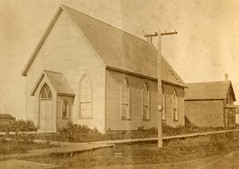
Church in a Saloon


Presbyterian Church, Pembina, N.D.
(Circa 1900-1909)
- Photo Courtesy:
State Historical Society of North Dakota
Before there was a Presbyterian Church in Pembina, a Presbyterian minister held services in what many would consider a highly unusual place - a local saloon.  However, I think Jesus would approve - he always did like going to where the regular people hung out...

Tuesday, December 16, 2008

Smugglers Pointe

SmugglersSmugglers Pointe: This was a famous pioneer locale on the trail between Pembina and Walhalla in Section 29-164-53, Felson Township one mile northeast of Neche. It was the only point where the heavily wooded valley of the Pembina River straddled the border with Canada, and therefore offered smugglers a natural cover to perform their affairs. William H. Moorhead operated a store and tavern here 1864-1878 (Source: North Dakota Place Names, Page 180)

...Which is interesting since the same William Moorhead was at one point the local official whose job it was to stop smuggling. Can anyone say "conflict of interest" here?!

Friday, March 16, 2007

Profile: William Ash - In His Own Words

From left to right is William S. Ash, William H. Ash and William Ash all of rural St. Vincent, MN. Photo taken in 1933
I was born January 15, 1869, north of Toronto, Canada, of German parents who came to Canada as young children in the early 1850s from Alsace-Lorraine.

We came to Minnesota by boat by way of Georgian Bay and Lake Superior to Duluth in June 1879. We took the Northern Pacific from Duluth to Glyndon, and the Great Northern (which was then called the St. Paul, Minneapolis, and Manitoba) to Emerson, Manitoba, Canada. The present Great Northern connected with the Canadian Pacific R.R. at Emerson as of December 1878. The CPR built from Winnipeg to the border and the GN from Crookston, Minnesota to the same place. The CPR had its supplies shipped down the Red River from Fisher's Landing and Moorhead. The railroads and steamboats used wood for fuel at that time. Wood for the railroads was cut in shorter than cordwood lengths by horse-powered tread mills.

Father bought a Homesteader's title in St. Vincent Township of 160 acres. He made the transfer at Crookston, Minnesota June 25, 1879 and also received his first citizenship paperwork then.

The first night on the farm the family of nine found shelter in a house 14' x 24' with only one strip of tar paper left on the roof and an old-fashioned umbrella against a downpour of rain. The house was built of one-ply of lumber on the outside. Father shingled it and sealed up the room inside with paper and boards. He built a ladder up the wall into the loft above where our bed was made on the ceiling between the joists. The joists were 4 feet apart. My three brothers and I slept there foot to foot and if we raised up suddenly we bumped our heads.
Father also made a bed, table and benches from lumber. The cloth ticks were stuffed with prairie hay. These were the mattresses. By the second winter Father had built a log addition to the house. The boys had double bunk beds and a stove to keep warm.

After getting settled in the new home, it was a short time before Mother was able to bake bread. My brothers and I carried bread from Emerson in a basket across the prairie for five miles. I was then 10 years old. Later, from our first garden, I carried surplus vegetables to Emerson and sold them.

I can distinctly remember hearing the evening salute of the cannon fired at Fort Pembina.

The first hay Father cut with a scythe was a mixture of wild vetsch and red top grass the tallest of which was waist high. Father purchased a team of oxen while he held the plow [Note from Trish - not sure what that last sentence means...]

Later in 1882, Father traded the oxen and $160 for a team of mules. That year spring was very late. On April 11 Father and I drove several miles east with a sleigh to get a load of wood. We crossed the old Winnipeg to St. Paul trail that day.

Our first crop of about 25 acres was cut by cradle and threshed by horse-powered thresher. Later we used twine binders and the grain was threshed from stacks with steam-threshing outfits.

These in turn were followed by gasoline-powered machines. Now everything is handled with combines (some tractor-drawn and others self-propelled...)

The first threshing machines were equipped with straw carriers instead of blowers. Straw wanted for the barns had to be stacked by hand as it came from the carrier. Straw not wanted was bucked away from the machines to be burned) with a bucking pole and two horses driven by boys.

The threshing crews of early days were composed of 20-25 men working from 6 in the morning til 8 at night or later. Supper came after the machine stopped. No, 6 or 7 men take off the crop with combines. Meals are served in the field. Work stops when the dew falls. Dishes for the mean are washed not long before dark.

I purchased my first farm in 1895 and am still living on it.

[Written circa 1933]

Friday, May 08, 2015

Final Resting Places: Brown & Kabernagle

Sheriff Charley Brown's grave site is in the north section of the Pembina Cemetery;  his stone reads:
Charles J. Brown
Oct 4, 1884
Aged 39 years
Sgt. Co. I 20th U.S. Infantry

I took this photo when surveying for BillionGraves
Charley sadly had a short, yet amazing life...
Another smaller foot stone acknowledges his service 
as a soldier in the Civil War, but it doesn't attest to 
his time as a POW in Andersonville... 


Buried in the same section is Charley's business partner:

John Kabernagle
Born
Jan 8, 1853
Died
Dec 20, 1893
Aged
40 Yrs, 11 Mos,
& 17 Dys

It's sad that both John - friend and business partner to Charley
Brown - died young around the same age as Charley did...
Another old-timer that was well-known for his many services rendered the town - and his colorful character - is in the SW section of the cemetery:
Who Settled in Dakota 1867
Died July 9, 1897
63 yr 10 mo 17 d
One of our area's true pioneers - Land Agent, Indian 
Trader, Trading Post Clerk, Buffalo Hunter, 
Undertaker, Farmer, and Flood Prognosticator... 
Charley's grave is also marked with a G.A.R. star,
signifying him as a Union veteran of the Civil War. 

Monday, November 01, 2010

1870 Fort Pembina Census

The images below are from the 1870 Fort Pembina census. There are several familiar names in the census - Joseph Rolette, Norman Kittson, William Moorhead, Nelson E. Nelson, and even Charley Brown (although for some strange reason it has him listed as coming from Germany - sure, it could be another Charley Brown, but somehow, I doubt it very much...) That mystery aside, it's a fascinating window into the diversity of individuals making up the fort, from the ethnicities to the types of support personnel helping to assist, work with, and care for the soldiers (housekeepers, sutters, doctors, hunters, translators, scouts, etc.)

Wednesday, November 26, 2008

Maggie's Book: Part I

Back in August, I wrote that once Gamble descendent Alice had time to scan her ancestor's scrapbook (known as the 'Maggie Book'1) - then donate it - she would share with me copies of the pages I had told her I'd like.

Recently I received those copies, and here is the first example...

PEMBINA, N.D.,
FRIDAY,
APRIL 23, 1897


THE FLOOD
_______________

An Awful Storm on Easter Sun-
day Adds Horror and Makes
Havoc to the Already
Distressed.
_______________


The flood has kept rising slowly and steadily since our last week's report. On Wednesday morning it came to a standstill, and has fallen about two inches up to to-day noon, (Friday,) and it is hoped that the high water mark of this year has been reached, being about thirteen or fourteen inches above the flood of 1882, a total rise of 42 feet 4 1/2 inches. Here in the city, between the railroad and river, there are yet about a dozen dwelling houses with dry floors. West of the track it is still quite dry and most of the houses in that locality are dry. The stores on the west side of Cavileer street are as yet all right. Some of them however had their floors just on a level with the water, and two or three inches of a rise would make considerable trouble for a good many folks. The Winchester House is still high and dry and the Pembina House is above the level and while the Headquarters is a little moist down stairs yet is doing business just the same. Quite a number of families have gone to the hotels to stay during "the unpleasantness." Most of our towns people however are living "high" but though somewhat elevated have no disposition to look down on more fortunate or unfortunate people. Full preparations were made and as everybody was prepared, the only result to most people is considerable inconvenience for a time. Our people are taking the matter philosophically and are and have been this week taking active steps to aid others, whose troubles are real misfortunes, and whose losses involve nearly all they possess. Of course the general hope is that we have seen the worst and that the waters will speedily retire to their natural bounds.

THE STORM

If the flood had come no higher than in 1882 and the weather remained pleasant, the flood of 1897 would not have been a very serious affair except in some few cases. But most people had made 1882 the extreme possible limit and thought of no danger of anything above that. But the water not only came above that, but the severe wind and storm of Easter Sunday passed over miles of water, raising great waves which beat down houses and barns and sent others floating to distant places.

No tongue can speak the horrors and terrors suffered by many families, by women and children, who were exposed to the pitiless storm and the relentless waves, miles from land. The mariner in his ship has a chance to fight for his life; good seamanship and hard work and he may or can weather the gale, but these poor wretches huddled in rickety buildings, rocking in winds and waves, helpless as babes, without fire, with the spray freezing in fantastic shapes where it fell. Oh! the horror of it.

A few houses in this city were somewhat exposed and the inmates were somewhat frightened, but the railroad grade, the numerous sidewalks staked down, and the surrounding timber broke the force of the sea and wind to most of the houses. At the grade the sight was like the sea shore in a storm. The spray from the waves dashed as high as the tops of the telegraph poles and one side of the grade was badly washed away. One side of the front of William Moorhead's undertaking building was torn off by the force of the wind. One of T.L. Price's large windows was blown in and a section of the shingles on the Episcopal church was ripped off. Fortunately a large proportion of the sidewalks had been staked before the storm and most of it remains in position. Perhaps no one in town had more trouble on their hands on Sunday than Charley Atkinson and his men. Mr. Atkinson had a herd of cattle for shipment about 125 in number. He had driven them to the western part of town beyond the depot but they had no shelter except that they were behind a barn and some hay stacks. It was found impossible to get there from town by boat and Mr. Atkinson made several trips on horse-back through the icy water and waves, the spray freezing on his horse as he went. The cattle came out without loss, and have been driven to Neche for shipment to-morrow.

Gisli Gislason, an Icelandic carpenter, about six in the morning Sunday, saw two boats get loose from Mr. Oliver's hotel in South Pembina; with two other men he followed in a large boat to bring them back. They found themselves drifting before the wind in the middle of the river, with waves mountain high, and in spite of their best efforts they drifted up the river, and landed on the roof of a submerged house on the river bank nearly opposite Fort Pembina. Only a small portion of the house was above water, and there the three remained until Sunday evening, ready at any moment to make a jump for the boat, if the house toppled over. They got to the Fort that evening and arrived back next morning, just as searching parties were starting out for them. Although they suffered seriously with cold yet they were all right next day.

It was very hard work and attended with some danger to navigate the icy sidewalks, and an "alpen stock" was almost absolutely necessary to prevent being blown into the water. Our sidewalks and crossings though generally well staked were badly scattered in some parts of town, by the storm, and it will be no small expense to put our sidewalks and bridges in shape again. A peculiar incident of the storm was the sudden fall of the water. Beginning about 7 o'clock Sunday morning the water fell over an inch an hour for five or six hours, and continued until about five o'clock in the evening dropping nearly twelve inches. Of course this cleared the water from the floors of most of the residences and there was much rejoicing, but the next day it was all back again and two inches more. It was doubtless the action of the wind on the surface of the water.

STEAMER "GRAND FORKS."

On Wednesday evening the steamer "Grand Forks" sounded her whistle opposite Pembina and in a few minutes nine-tenths of the male population and even some ladies, were at the Pembina bridge to meet her. The steamer tied up at the edge of Cavileer street, her bow pushing in the floating sidewalk on that side. She was under the charge of Mr. O.W. Pennison as manager fro the Great Northern railroad company, her owner. Capt. Bruce Griggs is captain and Capt. Perrault, pilot. The steamer and crew is furnished by the Great Northern railroad company, the fuel is supplied by towns and counties along the river, Grand Forks merchants sent a large quantity of supplies under the charge of Capt. James Elton and East Grand Forks merchants an additional amount under the charge of Mr. DeWolf. This is the third trip of the steamer for the relief of the flooded farmers. She left Drayton Wednesday morning and the history of her trip northward is similar to the report given us by Messrs Colley and Hogg who came by sailing skiff the day before. Hundreds of farm buildings wrecked and floated off, considerable stock drowned, and a repetition of the terrors suffered by people caught miles from land in half-floating and rickety houses, and of people and stock on roofs and rafts exposed to the waves and winds. We have not space nor time to give a tenth of the stories that are told of the sufferings and but a small part is yet told, and much will never be known.

The steamer had on board three women, a widow Johnson and two daughters who, lived near the river ten miles west of Hallock on the Minnesota side. A part of her house had floated away and she had fifteen head of cattle. These were taken on board the boat. Besides these cattle there were also about thirty head of horses and cattle belonging to Messrs Murray, McLellan, McKean and McLean from near Bowesmont. These will be landed at Drayton on the return trip.

The steamer left early on Thursday morning to continue her relief service as she went southwards. On her trip north she left several men and boats to go through the Snake river country east of Drayton, where considerable suffering has been reported and she will pick them up on her return and do what may seem necessary for the relief of the flooded farmers.

And here we may say, that both the Great Northern and Northern Pacific companies have not spared expense or trouble in sending relief boats and trains, and the liberality of Grand Forks and East Grand Forks is certainly very opportune and kind hearted. The party of Drayton people who took their boats on a special N.P. train to Bowesmont on Monday and spent two days of hard work in rescuing people and stock deserve particular credit for their thoughtfulness as well as willingness.

On board of the steamer as passengers were Messrs Wylie, Wallace, McCrea, and Crandell of Drayton, Cashier D.C. Moore of the First National Bank and H.L. Hausseman druggist, of Grafton. These gentlemen ame down to look over the situation, so as to be better informed as to the relief needed, and which they have to some extent initiated. Besides these mentioned were Messrs Thos. Murray and Mr. McClellan, in charge of part of the stock on the barge, and the three women, Mrs. Johnson and daughters before mentioned. Capt. Elton and son were also passengers.

SEEN FROM A SKIFF

Mr. J.T. Colley and Howard Hogg came down from Drayton on Tuesday evening in a small sailing skiff. Mr. Colley was interviewed by the Pioneer Express and his story of the voyage will give our readers an approximate idea of the troubles and misfortunes of the farmers who reside in the flooded district. Of course in just a sailing trip of forty miles or so from Monday noon to Tuesday night, the information gathered is must necessarily be fragmentary and sometimes erroneous as to detail, but enough is certain to show what an awful state several hundreds of our friends, neighbors and citizens were placed in during the terrible storm of wind and wave during Saturday night and Sunday, and the particular instances given are only examples. For it must be remembered that an extent of country averaging at least five miles on either side of the river from about Grand Forks to Winnipeg is and was submerged with the flood, and hundreds of farm buildings are or were standing in water, some as high as the eaves, and many from three to five miles from the nearest land. In this county the country east from Bowesmont is low and the flood is a mile or two beyond the railroad track at that place.

In South Joliette the water is four or five miles inland. The water near the banks of the river is about five or six feet deep on the average and then shoals up very gradually to the dry land, as the country is so nearly level. The Minnesota side is generally somewhat lower than our side and the water is farther inland. The water on Monday was eight and a half miles out of its banks eastward and only one and a half miles from Hallock. The Minnesota side is not so thickly settled over here, but there are farmers all along. On this side, in the flooded district, there is a farmer on almost every quarter section; and as we stated last week a large proportion of them had no crops last year owing to the heavy rains. This much for the general situation, the following cases of loss, and hardship, as we said, are simply examples, and the reader will be able to imagine the rest. In only a few instances where people had exceptionally good buildings, was there an attempt to remain in the upper stories until the flood subsided. Nearly all the farmers along the river had driven their stock back to high land, but in many cases, some one or two persons were left at the house to take care of things, or rowed there in bats on Saturday and were caught by the storm, not daring to face the waves in their rude boats.

Messrs Colley and Hogg left Drayton as stated, about noon on Monday. They had heard it reported before they left, that there were no particular cases of suffering towards the north. On their way down towards Pittsburgh, they saw many buildings badly wrecked. When they came to the house of Mr. George Reid Sr. they found it badly wrecked, granary and out buildings, with seed and contents all gone. Mr. Reid and family consisting of his wife, daughter and niece, were in the house and had been badly frightened by their terrible experience of the day before. Another boat came about this time and between them the family was carried to the nearest dry land, the railroad grade, two and a half miles distant. Here a rescue train from Drayton was found standing on the track. Word had been sent out from Bowesmont and a car had been loaded with boats and men and on arrival they went promptly to work at rescue and relief. After leaving the Reid family safe but still suffering from their fright, Messrs Colley and Hogg sailed to the north again.

At the house of Mr. Campbell three or four boys, his sons, who were there taking care of things, had to abandon the house during the storm on Sunday and go through five feet of water to the barn, where they remained on the roof until Monday morning in their wet clothes without fire. They lost some cattle as well as other property.

Frank DeLong son-in-law of old Mr. Reid, before mentioned, was in his house during the storm with his wife and several children. The house rocked violently with the waves, and they expected every minute to be dashed to pieces. They were rescued Monday noon. They had no fire and though wrapped in bed clothing they were very cold.

George Reid Jr. lost part of his buildings. Himself and family were at Nowesta on high ground. Israel Black also lost part of his buildings but fortunately was away.

Robert McLean's house washed away and both he and his brother Lemuel lost seed grain. The father, old Mr. McLean, is very ill and on his account the family had moved to high ground, and thus were saved from a watery grave.

The house and buildings on the farm of Joseph Shaw, who resides in this city, and rents the farm to Tunis Simmons, was destroyed, with seed wheat and other stuff.

James Craig and W.H. Purdy lost all their buildings, with seed wheat and other stuff. Themselves and families had removed.

James McClellan's fine house built to stand above 1882 mark is badly damaged.

Joseph Lareva lost buildings and everything in them including seed wheat.

On W.P Goff's place rented by Tom Murray, Murray was in the stable and the hired man was in the house. The house is gone, and there is no news from the hired man. So far as is heard this is the only probably loss of life.

District No. 12, two miles and a half southeast of Bowesmont has lost its school house.

All the buildings on the David Murray place were destroyed. James Nicholson lost part of his house and some stock. Two boys and two girls who had been left to take care of the stock were rescued on Monday.

Adam McKibben lost all buildings and contents. High Patterson's buildings are all gone.

When about a mile west of the house on the Joliette road, which was formerly the residence of Joseph Muir now deceased, and now owned by Geo. Switzer, Mr. Colley, who sat looking backward in the boat saw something like a flag flying from the top of the house. After some discussion and hesitation, as it was getting late and they wanted to get to Pembina, they concluded that it night be possible that some one was there and in trouble. So they retraced their course and went over. They found Switzer and High Patterson there. Switzer said, "How much will you take to put us ashore?" and could hardly realize the fact that Messrs Colley and Hogg had come purposely to help them. A part of the out buildings had floated away and tone whole end of the house was just attached by the top to the building. They had gone out to the buildings on Friday , the wind got up and they did not dare to venture back on account of the waves. Next day the boat had drifted away. All day Sunday they stood by the open windows ready to jump if the building should fall, hoping in that case to get to a part of the stable which still stood.

1 - It had once been a chemistry book over 100 years ago, but Maggie O'Neill used it as a scrapbook, pasting in all the newspaper clippings she was sent from the Gamble family about events concerning the family and/or St. Vincent over a 50+ year period.

Wednesday, July 07, 2010

Heritage Highlights: International Incident

Manitoba's rudder (Marine Museum of Manitoba)


I recently discovered Bruce Cherney and his Heritage Highlights; it appears that Bruce, like myself, has a real passion for local history! Some of his older articles are available through the Manitoba Historical Society.

Below are excerpts from Cherney's excellent article Collision on the Red - published in two parts - that he recently posted on a near "international incident" which involved Pembina...
But for all the “huzzahs” in Moorhead with the steamboat finally underway, the mood turned to anxiety when the Manitoba was delayed at the border crossing at Pembina, North Dakota...The newspapermen said they were aware of the circumstances of the delay in Pembina and decried “those who regard monopoly as their right.”

The enforcement of the delay almost created an international incident with a top Washington official having to intervene.

The newspapermen said they were aware of the circumstances of the delay in Pembina and decried “those who regard monopoly as their right.”

In a May 4 letter to the Free Press, Colonel Charles Stephenson, the supervising custom inspector at Pembina, said he wanted to “state briefly the facts of the case.”

Stephenson wrote that when James Douglas, the agent of the Merchant’s International Steamboat Line aboard the Manitoba, attempted to get him to conduct the inspection, he was engaged elsewhere “and unable to attend the Manitoba on time.”

The inspector was under the impression that the Manitoba would proceed and be inspected on the steamboat’s return trip. “As this had been permitted during previous seasons to the boats of the Kittson line.”

According to Stephenson, a newly-hired custom official at Pembina was unaware of the practice and was overly zealous in conforming to the letter of the law at the urging of the former customs inspector who still resided in Pembina.

“As soon as Mr. (Jacob) Frankfield, the present customs officer at Pembina refused to pass the boat, Mr. Douglas telegraphed the fact to the Secretary of the Treasury at Washington, who replied referring the case to Colonel Stephenson at Galena ... A telegraph was sent to Stephenson at Galena, giving all the particulars.”

Stephenson sent Douglas the following telegram, “Ask collector at Pembina to permit steamer Manitoba to make trip and return to Moorhead. I will meet her there on the 8th inst. for inspection.”
While being temporarily held in Pembina...
...the passengers enjoyed the sights of the community, which included a drunken man brandishing a “repeater and firing shots at some unseen foe.” The drunk...who appeared to be somehow above the law — possibly a “deputy sheriff” — enthusiastically shook the hands of any Manitoba passenger he encountered.

The only known photograph of the
prairie warship captains, including
 the two who worked the Red River:
William Robinson (standing), and
Aaron Russell, John Segers, and
Jerry Weber (left to right, seated).
One passenger was heard by the writer to have expressed the opinion that if the man had behaved in such a manner in Canada, “the bobbies would nab him quicker than a wink.”
Fascinating trivia regarding the two steamboat captains featured in this story involving Pembina - river pilots/navigators that plied their trade and learned their craft on the Red River of the North:
- Captain Jerry Webber, was originally from Winnipeg but later operated out of the U.S., later gaining a measure of fame as one of the “old Red River navigators” hired by the British during the Nile Expedition of 1884-1885 to rescue General Charles “Chinese” Gordon under siege at Khartoum. Although the relief of the Sudanese city was unsuccessful and Gordon was killed by the Mahdi’s forces, the four Red River steamboat captains were praised by the British for their skill while ferrying supplies and troops on the Nile River in Egypt.

- Captain John Scribner Segers' career as an “old Red River navigator” was as colourful as Webber’s. He also took part in the Nile Expedition, and was the captain of the steamer Northcote (commanded by Webber in the early 1880s until Segers took over), which was ordered converted by General Sir Frederick Middleton into a gunboat. The steamboat participated in the May 9-12, 1885, Battle of Batoche during the North-West Rebellion, but was crippled by the Métis who used ferry cables to take it out of action.
I found an excellent book on the very subject Bruce writes about, called Prairie Warships: River Navigation in the North-West Rebellion, in a chapter called Hudson's Bay Workhorses: The Red River Regime. The chapter reads like a thriller - a frontier business thriller - no wonder men like James J. Hill (cutting his teeth and filling his pocketbook with money made on the river way before the railroads were built) and Norman Kittson made a killing - they had a lot of foresight, energy, and yes ruthlessness, necessary to not only see opportunity but to seize it, and they did!

Below is an excerpt from the book's colorful version of the collision, with some fascinating background on the two ship captains involved...

[Click on image to enlarge]

From Prairie Warships, by Gordon Errett Tolton

Tuesday, October 05, 2010

BOOK: Minnesota's Last Frontier

In what appears to be a self-published work, J.W. Durham1 wrote about his experiences in northwest Minnesota in the late 1800's. While most of those experiences were further east of St. Vincent in Roseau County (part of which was once included in Kittson County), there were some recollections of individuals with a connection to my hometown area, of which I share below.  Please note that the language is of its time and style, and some of the content would be considered inappropriate and even offensive to modern ears - please read with a historical frame of mind to give it proper context...

Tuesday, December 27, 2005

Context

Part of what I want to do here is learn some of the bigger picture that St. Vincent is part of, meaning how the history of Minnesota evolved in the region beginning with Europeans arriving...

17th Century

1659-1660 - French fur traders Groseilliers and Radisson explore western end of Lake Superior and environs.

1673 - French explorers Marquette and Joliet discover the upper portion of the Mississippi River.

1679 - Frenchman Daniel Greysolon, Sieur du Luth meets with Dakota Indians near Mille Lacs.

1683 - Catholic Missionary Father Louis Hennepin returns to France after exploring Minnesota and being held captive by the Dakota to write the first book about Minnesota, Description de la Louisiane.

18th Century

1745 - The Ojibwe Indians defeat the Dakota Indians at the Kathio, driving the Dakota into southern and western Minnesota.

1763 - Spain receives Louisiana Territory (includes Minnesota west of the Mississippi River) from France in compensation for its loss of Florida during the Seven Years War. Great Britain wins claim to what is now eastern North America (east of the Mississippi River) and Canada.

1770-1804 - Grand Portage (Minnesota) evolves into the western fur-trading headquarters of the British Empire in North America. British troops stationed here act as only military force in Minnesota during the American Revolution. Fur trading continues to be the main source of commerce in Minnesota through the early 19th century.


1775-1783 - American Revolution

1783 - The newly formed republic of the United States of America wins the eastern portion of Minnesota (from the Mississippi river east) from Great Britain in the American Revolution.

1787 - Eastern Minnesota officially designated part of the American Northwest Territories of the United States of America. David Thompson, working for the North West Company (fur-trading) completes the first formal mapping of Minnesota.

19th Century

1800 - France acquires Louisiana Territory from Spain.

1803 - The United States of America purchases Louisiana Territory from France, gaining ownership of the western portion of Minnesota. Boundary disputes with British Canada keep British fur companies in Minnesota until 1818.

1805 - Lieutenant Zebulon Montgomery Pike leads the first United States expedition through the Minnesota country.

1812-1814 - War of 1812 between the United States and Great Britain with their Dakota, Winnebago, and Ojibwe allies.

1815 - Peace treaty negotiated between the Dakota Indian nation and the United States government. First American fur traders enter Minnesota.

1818 - Northern boundary of Minnesota fixed at the forty-ninth parallel. Boundary negotiations with British Canada continue until 1931. Lawrence Taliaferro instated as first United States Indian agent at Fort Snelling.

1819 - Colonel Josiah Snelling begins construction of Fort St. Anthony on land purchased from the Dakota Indians for $2000 US.

1824 - Fort St. Anthony completed. Name changed to Fort Snelling in Honor of Colonel Josiah Snelling's work.

1832 - Henry Schoolcraft credited with finding the source of the Mississippi River at Lake Itasca, Minnesota with his Ojibwe guide Ozawindib.

1836 - Creation of Wisconsin Territory which encompassed Minnesota.

1837 - Land-cession treaties negotiated with the Dakota Indians and the Chippewa Indians for United States rights to a portion of land between the Mississippi and St. Croix rivers. This new land stimulates the lumber industry in Minnesota.

1841 - Chapel of Saint Paul built. Later it would serve to name the state capitol which sprang up around it.

1838-1848 - St. Paul, St. Anthony, and Stillwater (Minnesota's first towns*) founded.

*NOTE: I take exception to this - St.Vincent, although not an 'official' town at this time, is part of the trading posts/forts around Red/Pembina Rivers and has been for many years before this time...most acknowledge that our area is one of the oldest settlements in the upper midwest...

1848 - Wisconsin admitted into the union as a state, leaving residents of the area between the Mississippi and St. Croix rivers (current day eastern Minnesota) without a territorial government or legal system.

1849 - Minnesota Territory formed with present day eastern and southern boundaries set. The population amounts to less than 4000 people, not including persons of pure Native-American heritage. Law provides for free public schools to be open to all people between four and twenty-one years of age. Minnesota Historical Society formed to collect, publish, and educate people about Minnesota history. James Madison Goodhue begins publishing Minnesota's first newspaper, the Minnesota Pioneer.

1850 - Treaties concluded at Traverse des Sioux and Mendota with the Dakota Indians whereby the Dakota ceded their lands east of the Red River, Lake Traverse, and the Big Dakota River and south of a boundary line between the Dakota and Chippewa in 1825. In return the Dakota received $1,665,000 US, $1,360,000 of which was set into a trust fund, of which the interest would be distributed to chiefs partly in cash, partly in supplies, and partly in education and civilization funds. The vast majority ended up being used to pay off Indian debts to white traders. Wheat becomes a major crop in Minnesota.

1851 - Charter granted to the University of Minnesota, the first collegiate institution in the territory.

1853-1857- Population explosion occurs in Minnesota from 40,000 people in 1853 to approximately 150,000 people in 1857.

1854 - St. Paul becomes a city with a total area of four square miles.

1855 - Die Minnesota Deutsche Zeitung (The Minnesota German Newspaper), Minnesota's first non-English newspaper, rolls off the press for the first time in St. Paul.

1857 - The Dred Scott Decision is rendered by the United States Supreme Court, where a Missouri slave, Dred Scott, sued for his freedom based in part upon his residence in Minnesota. Amidst the sectional and racial animosity sweeping the nation, the court ruled Scott remained a slave. The residents of the Minnesota territory ratify the state constitution almost unanimously. The Panic of 1857 sends prices skyrocketing. Banks bust and businesses fail. Depression lingers until 1861.

1858 - Newspaper promotion of the Minnesota Territory prompts over one thousand steamboat arrivals in St. Paul, filled with settlers. On May 11 Minnesota becomes the thirty-second state admitted to the Union of the United States of America. State seal adopted by the Minnesota Legislature.

1858-1859 - Henry Sibley instated as first governor of Minnesota.

1859 - First Minnesota State Fair held.

1861 - Civil War of the United States begins. Minnesota volunteers one thousand men for service in the Union Army. Minnesota eventually provides 24,000 men for service in the Union Army for fighting in the Civil War or the Indian Outbreak.

1862 - The Dakota Conflict sweeps across Minnesota with a series of attacks motivated by hungry Dakota enraged by the failure of land treaties and unfair fiscal
practices of local traders. By the end of the conflict 486 white settlers would be dead. On December 26 thirty-eight Indians were hung at Mankato. Minnesota's first railroad is completed, connecting Minneapolis and Saint Paul.

1863 - At the Battle of Gettysburg the First Minnesota Regiment makes a heroic charges, losing 215 of 262 men.

1865 - Civil War of the United States ends.

1868 - Mankato receives a city charter. The Minnesota Legislature authorizes establishment of the 2nd State Normal School in Mankato (now known as Minnesota
State University, Mankato).

1873 -A three-day blizzard hits Minnesota in January, killing seventy Minnesotans.

1878 - 68.98% of tilled land in Minnesota devoted to wheat production, the high point for wheat farmers in Minnesota. After five consecutive summers of devastating infestations of Rocky Mountain Locusts (called the great Grasshopper Plague) which thrived on wheat, farmers decided to diversify, and wheat production was slowly replaced by other crops and dairy farming. A massive explosion in a Minneapolis flour mill kills 18.

1880 - Telephone communication begun between St. Paul and Minneapolis.

1881 - St. Paul is destroyed by fire.

1883 - Mayo Clinic founded by Dr. William Worrall Mayo in Rochester, Minnesota after a tornado sweeps through Rochester, killing 35. With his two sons, Dr. William
James Mayo and Dr. Charles Horace Mayo, he begins a clinic world-renowned for
its dedication to the latest advances in medicine and surgical procedures.

1884 - Minnesota iron ore begins to be exported heralding the dawn of iron mining in Minnesota. Over the next two decades mines spring up on the Mesabi, Cuyuna, and Vermilion iron ranges, spurring the rapid growth of mining cities such as Evelyth, Chisholm, Virginia, and Hibbing, Minnesota as well as the port cities of Duluth, Minnesota and Superior, Wisconsin.

1886 - Sauk Rapids is flattened by a tornado. Seventy-nine people die. St. Paul holds its first winter carnival.

1887 - St. Paul hosts the first ski tourney in the Midwest.

1888 - Western Minnesota receives a major blizzard on January 12 which takes 109 lives.

1890s - Electric streetcars become commonplace in large Minnesota cities.

1893 - The Minnesota state flag, designed by Amelia Hyde Center of Minneapolis, is accepted by the Minnesota Legislature. Virginia, Minnesota destroyed by fire.

1894 - A massive forest fire caused by clear-cut logging debris encompasses Hinckley, Minnesota and several other nearby communities. Over four hundred die.

1898 - The Spanish-American War begins. Minnesota, the first state to volunteer, raises four regiments, one of which serves in the Philippines. Disease proves to be the biggest killer, with combat fatalities accounting for only four Minnesota soldier deaths. Farmer Olof Ohman finds a stone tablet with runic carvings on it in his field near Kensington, Minnesota. The runes indicate a party of Viking explorers passed through that area in 1362. Initially considered a hoax, it was accepted by the Smithsonian Institution in 1948. Opinions differ, but most academic sources today doubt its veracity.

1899 - Minnesota's lumber industry reaches its peak. By 1930 only 1/3 of the state would remain forested, with very little of that virgin growth.

20th Century

1900 - Virginia, Minnesota destroyed by fire again.

1902 - Approximately twelve automobiles appear in Minneapolis. Tom Shevlin, son of a lumber magnate, gets arrested for violating the ten mile per hour city speed limit.

1905 - John A. Johnson, Minnesota's first native-born governor, elected to the first of his three terms. Lumber production peaks in Minnesota.

1906 - William Williams is hanged in the county jail in St. Paul on February 13, ending capital punishment in Minnesota.

1908 - Chisholm, Minnesota is virtually obliterated by a late summer forest fire.

1914 - World War I begins. Minneapolis becomes the home of the Federal Reserve Bank.

1917 - The United States of America enters World War I. 118,497 men from Minnesota serve in the war.

1918 - World War I ends with 1,432 Minnesotans in uniform giving their lives for their country. The new Farmer-Labor Party becomes the second largest political party in Minnesota and capitalizes on the rural depression which plagues Minnesota until 1824 to gain a broad base of support. Influenza spreads to Minnesota. Labeled a "pandemic of influenza", this disease managed to kill 7,521Minnesotans in 1918 and more than 4,200 over the course of the following two years. Cloquet and Moose Lake, Minnesota are destroyed when seventy mile an hour winds change minor forest fires into major conflagrations.

1919 - Minnesota ratifies the 19th amendment (women's suffrage) to the United States constitution. A tornado strikes Fergus Falls, Minnesota killing 59.

1920 - Minnesota authors receive international recognition. Main Street, written by Sinclair Lewis, earns national recognition as he takes a critical look at his hometown of Sauk Centre, Minnesota. By the end of the decade he had won the Nobel Prize for literature after a string of four more novels won international acclaim. St. Paul native F. Scott Fitzgerald receives much acclaim for his book This Side of Paradise. By 1925 he had published five more works, all focusing on the extravagance and despair of the 1920s in the United States.

1921 - WLB, the first Minnesota radio station, formed at the University of Minnesota.

1927 - Charles Lindbergh, a native of Little Falls, Minnesota, flies solo across the
Atlantic Ocean from New York to Paris.

1929 - Great Depression begins in the United States. The depression begins in Minnesota with the bankruptcy of key employers in Minneapolis and quickly spreads to the rest of the state.

1930-1935 - Over 1/2 of iron ore extracted from the earth originates in Minnesota mines.

1931 - Ancient remains of 20,000 year old skeleton dubbed "Minnesota Man" found in Otter Tail County, Minnesota.

1933 - "Browns Valley Man" remains, estimated to be 8,000 - 10,000 years old, discovered in Brown County, Minnesota.

1934 - Edward G. Bremer of St. Paul kidnapped by the Barker-Karpis gang. His ransom of $200,000 US is one of the largest ransoms in the United States up to that time. By 1936 the kidnappers had been caught and convicted. "Public Enemy Number 1" John Dillinger has a gun battle with FBI agents in St. Paul on March 11 and escapes.

1936 - Temperatures remain below zero for a record thirty-six days beginning on January 18. Later in the summer Moorhead, Minnesota ties a state record high official temperature of 114 degrees Fahrenheit, previously set in Beardsley, Minnesota in 1927.

1939 - A hockey game in the Duluth Amphitheater is interrupted when the ceiling collapses under the weight of snow. No deaths are reported.

1940 - The Armistice Day Blizzard strikes Minnesota leaving a 16.8 inches of snow in twenty four hours. Winds that day exceed thirty two miles per hour with gusts over sixty miles per hour. Forty-nine Minnesota residents die and over $1,500,000 US worth of property is damaged as a result of the storm.

1941 - First tax on taconite, a black magnetic iron-bearing ore, in effect in Minnesota. The United States enters World War II. Singer Bob Zimmerman
(Bob Dylan) born in Duluth.

1944 -The Democratic and Farmer Labor parties merge to form the Democratic-Farmer-Labor Party.

1945 - World War II ends with 6,255 American servicemen from Minnesota giving their lives for their country. The Minnesota state song, "Hail! Minnesota" is adopted by the Minnesota Legislature.

1948 - Minnesota's first television station, KSTP, goes on the air.

1950 - The Korean War begins. By the time of the armistice in 1953, 688 Minnesotans had died in the fighting.

1951 - Over 82% of iron ore extracted from United States mines during this year originates in Minnesota.

1954 - Coya Knutson becomes the first Minnesota woman elected to the Congress of the United States.

1958 - Prince Rogers Nelson (the artist formerly known as Prince) born in Minneapolis.

1959 - The opening of the St. Lawrence Seaway makes Duluth accessible to the Atlantic Ocean.

1963 - Last iron ore shipment leaves the Vermillion iron range.

1964 -Minnesota Senator Hubert Humphrey elected vice-president of the United
States as the running-mate of president Lyndon Johnson. Conventional American ground forces are introduced into Vietnam.

1968 - Senator Eugene McCarthy of Minnesota begins his bid for the presidency by easily winning the New Hampshire presidential primary. Minnesota Senator Hubert Humphrey also runs for president that year, narrowly losing to Richard Nixon. The American Indian Movement (AIM) is founded in Minneapolis to combat racism.

1969 - Warren Burger, a native of St. Paul, named to the Supreme Court of the United States.

1970 - Minnesotan Harry Blackmun named to the Supreme Court of the United States. He would later write the majority opinion in the case of Roe v. Wade, which legalizes abortion.

1975 - The last American military personnel leave Vietnam with the evacuation of the United States embassy in Saigon, completely ending American involvement in Vietnam and the Vietnam War. 1,053 Minnesotans gave their lives over the course of the war.

1976 - Jimmy Carter becomes the 39th president of the United States with Minnesota Senator Walter Mondale as his vice-president. Mondale would later run for president in 1984, losing to Ronald Reagan.

1977 - Rosalie Wahl becomes the first woman justice in the Minnesota Supreme Court.

1980 - Last iron ore shipment leaves the Cuyuna iron range.

1982 - A total of 34.3 inches of snow falls on the Twin Cities on January 20 and 22. Taconite mining emerges as the future employment source for the iron range, with 12,000 workers. The subsequent depression and trend toward mechanization halve that number by 1995.

1984 - Last iron ore shipment leaves the Mesabi iron range, effectively ending Minnesota's direct iron ore industry and confirming a difficult depression on the iron range.

1987 -The Minnesota Twins win the World Series.

1988 - The Indian Gaming Regulatory Act, passed to promote tribal economies, causes a boom in Indian casinos and gambling in Minnesota. By 1990 Minnesota ranks fourth in the nation in per capita gambling sales. Minnesota hit by a record setting drought.

1990 - Soviet President Mikhail Gorbachev visits Minnesota.

1991 - Operation Desert Storm occurs with approximately 11,000 Minnesotans in uniform helping to defeat Iraq and liberate Kuwait. The Minnesota Twins win the World Series. A record-breaking snowstorm hits Minnesota on November 1 depositing twenty-four inches of snow in twenty-four hours.

1996 - Coldest official temperature ever recorded in Minnesota set at -60 degrees Fahrenheit on February 2 near Tower, MN.

1998 - Minnesota becomes home to largest ethnic Hmong population in America.