Showing posts sorted by date for query customs. Sort by relevance Show all posts

Friday, October 16, 2026

Historical Essay Feature: "Trains of the Past”


 Charley Fitzpatrick, St. Vincent depot station agent, circa 1922.

by Roxanne Friebohle

Today, there are actually some people that have never ridden on a train. These people have missed many happy experiences that were common to the pioneers. Trains are becoming more and more uncommon every day. Now people drive their car or take a plane when they are going somewhere. They miss seeing all the different people on the trains and the many sights along the way.

Today, the residents of St. Vincent could sleep all day and never be bothered by the noises of a train. In the pioneer days it wasn't that way at all. Many people were awakened every morning at 5:30 by the cheerful Choo-Choo of a train rolling into town.

The train that came into St. Vincent at 5:30 A.M. was known as the Great Northern Flyer. It started coming to St. Vincent in 1897. This train was the passenger train. At that time St. Vincent was the end of the line so the train stayed at the roundhouse all day. The roundhouse was located at the west end of St. Vincent. Since the train stopped there, many passengers also stopped at St. Vincent for awhile.

During the first years of the trains in St. Vincent (1878 onwards), there was a very large Great Northern Hotel located in the village. This hotel took care of the trainmen and the passengers.

There were also freight trains that came into St. Vincent regularly. The freight cars brought such things as machinery, auto parts, raw peanuts, fruits and vegetables from California and Florida, and bananas from Honduras. There were also many immigrants that rode the freight trains with their whole family, belongings, and even their livestock. Most of the immigrants came from Iowa and Illinois and were on their way to Canada. They would have to stop at St. Vincent since it was the last town before Canada. They had to get checked by the Customs before entering the country. The veterinarians would have to check their livestock also before they could get them through the border. There were cases when some of them settled in St. Vincent because they couldn't wait to get to Canada.

Coal was also shipped by the carloads to the St. Vincent depot. At that time it was used to heat homes. The coal was taken to the elevator which was located at the east end of town. People had to go out there to buy it.

After the freight was unloaded at the depot, it was taken to its destination by a drayman. Archie Darrach (and later Al Fitzpatrick) devoted much of his time to this job during the first days of the depot. He took care of all the freight that came in. He also took care of the breweries in the town. Whenever they ran out of beer he hauled it to them. One time when he was hauling freight to the town hall which was located at the west end of town, his horses became frightened and over turned the wagon. A piano which he was hauling hit him in the head and he never regained conscienceness. He was just one of the many men that lost his life for the railroad.

There was also much freight shipped into St. Vincent that had to go across the river. At that time there was no bridge so it all had to be ferried across the river.

The depot at St. Vincent was a very large one for that time. It was approximately three hundred feet long. It consisted of the Custom offices at the west end and the warehouses at the east. The depot agent made his home right in the depot. That way he could be there at any time to receive messages from other agents.
St. Vincent's roundhouse also played an important role in the railroad days. In the year 1897, the roundhouse was built with the backing of James J. Hill. The roundhouse was erected right west of the town of St. Vincent by Lake Stella. Today, the old stock yards are located in place of the roundhouse.

Today, you'd never believe that at one time St. Vincent was a thriving city. The days of the St. Vincent railroad were filled with much excitement and hard work. The train service in St. Vincent could almost be referred to as William Wordsworth (1) once stated, "Small service is true service while it lasts." The train service was a small one but there was always a way of getting from place to place. The old timers that remember the first trains remember them as a true service.

The depot went through two very hard floods, one in 1897 and one in 1950. The one in 1950 washed the tracks up so badly that they looked like a snow fence. The ties that were washed up were from 150 to 200 pounds. Most of the rails were about sixty pounds a yard and thirty three feet long. After all the hard work and slaving to lay the tracks the flood finished them off. The flood also played an important part in finishing the trains coming through St. Vincent altogether.

One experience during the flood in 1897 was when a women died. Because of the flood they had no place to bury her. They ended up keeping her body at the depot for a month and when the water finally went down they buried her. 

Another reason the railroad was taken out of St. Vincent was that the Northern Pacific train which came from Winnipeg wouldn't merge with them. They had the plans all ready for building new tracks but it didn't work out as planned.

Railroads helped to open a new era in mail and express transportation. There had been much talk of projecting a railroad through Kittson County long before the plan came true. Until 1862, Minnesota had no railroad service at all. In 1857, a charter was granted to the Minnesota and Pacific Railway Company. Later this company became the St. Paul and Pacific. At first, the railroad ran from St. Anthony to St. Paul, which was a ten mile stretch. Later this railway stretched all the way to St. Vincent and even later all the way to Canada.

The first engine used was the William Crooks engine named for its first engineer, who was a citizen of Crookston. This engine was the Great Northern's first engine.

As well as the other accomplishments of the railroads, it greatly increased and stimulated the settlements in many ways. Naturally, there had to be settlers to build the railways but the railroad company also induced settlement by offering its lands for sale. The company had been given a state government grant of every odd section in a strip extending from the Red River twenty miles east and running from Marsh River to the international border.

Railroad lands were offered at $5.00 an acre and rebates of $2.00 per acre, were followed if settlers broke three fourths of their tacts. The land was a little higher if it contained timber.

The settlement of Kittson County began slow in spite of land being sold. This was due mostly to the lack of drainage in the valley.

In order to build up the railroads in the northwest much hard work was needed and strong men to carry it out. James Jerome Hill, a farmer from Rockwood, Ontario was one of the many men that devoted his life to the development of the railroads. He first entered into the railroad business as a freight forwarder in 1865. He kept expanding into various trading and transportation enterprises. He built up the Great Northern much more than any other one man.

James J. Hill also built a very large house in Northcote, Minnesota for his son Walter. Many people from St. Vincent can recall the days when Walter Hill would come racing into town in his jeep, as some people called it. It was really an early Ford that didn't have a top, today known as a convertible. Some days he would be racing into town so fast that his hat flew off his head. But it didn't seem to bother him. He was said to be a very carefree person and full of fun.

Of the many experiences I've heard of people riding on trains, I especially enjoy the one that my grandparents used to tell about their trip from Emerson, Manitoba to Quebec, Ontario. It was a cold day in the middle of winter when they decided to take this trip. They got ready to leave and went to the depot in Emerson to wait for the train. Their parents were worried because it was a little stormy out and they hadn't got so that they trusted trains yet because they were still a new thing to them. My Grandmother and Grandfather didn't have any worries at all. When they finally started out it had gotten a little stormier and it was hard to see. They got three miles out of Emerson when the train ran into a bigger snowbank than it could cope with. It turned out that this storm lasted a bit longer than they had expected. They sat in the train for six days and nights before they could get help. In those days, trains didn't carry much food like they do today. The trainmen killed a cow and went to a nearby farmhouse and got some eggs and a few other things so the people could eat. When the storm finally ended they started out once more for Quebec. After two weeks they finally got there.

From that day, trains have improved greatly. Passengers are as comfortable as if they were at home when they take long trips. Still it seems like it doesn't matter how comfortable they are, they are still fading away into the past.

Today all that is left in many places is the memories and few traces of where they once went.

(1) Bartlett, John Familiar Quotations Little Brown and Company c. 1955 William Wordsworth

Bibliography:
Colliers Encyclopedia; James J. Hill
Friebohle, Glenice, I.; Interview, January 1, 1972
Friebohle, John, A.; Interview, January 1, 1972
Gooselaw, Eli; Interview, January 4, 1972
Kittson County Enterprise; 50th Anniversary Edition; page 68
Nordhaugen, Clarence; Interview January 1, 1972
Ryan, Margaret; Interview January 4, 1972

Monday, February 20, 2023

The Last of the Fenian Raids


Before Pembina, there was Vermont...

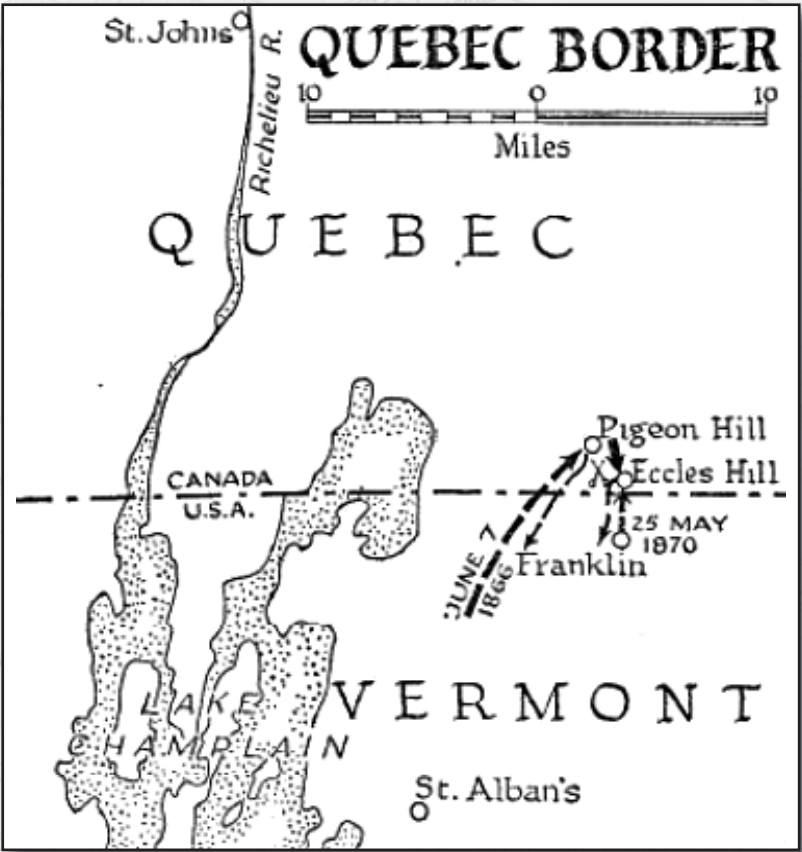
Soon after joining up in 1870, Private William James Kneeshaw, along with his brother, Sergeant Ebenezer Muir Kneeshaw, saw action during a Fenian raid on the Quebec/Vermont border.  Their unit - the 11th Battalion's Argenteuil Rangers - defeated the Fenian's attempt at invasion of Canada, once again; it was another of an ongoing string of incursions along the 45th parallel beginning in 1866.
 
In 1871 John O'Neill and an odd character named W. B. O’Donoghue asked the Savage Wing Council to undertake another invasion of Canada across the Dakota Territory border. The Council, weary of Canadian adventures in general and O’Neill in particular, would have none of it. O'Neill's idea was turned down, but the Council promised to loan him arms and agreed they would not publicly denounce him and his raid. O'Neill resigned from the Fenians to lead the invasion, which was planned in Saint Paul, Minnesota, to invade Manitoba near Winnipeg. About 35 men, led by John O'Neill, William B. O'Donoghue, and John J. Donnelly, hoped to join forces with Louis Riel's Métis. 

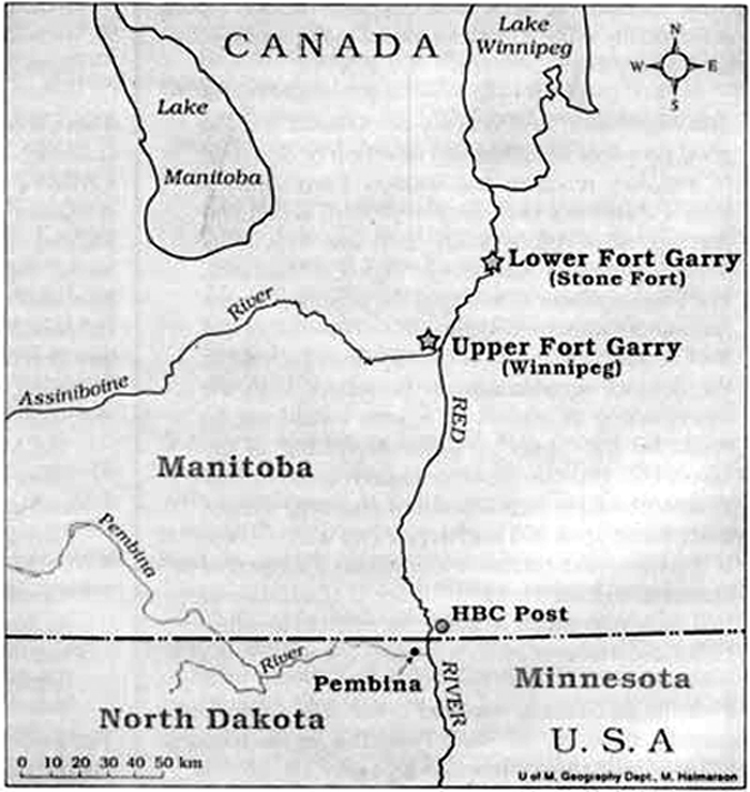
On October 5, O'Neill's force managed to capture a Hudson's Bay Company post and a Canadian customs house which they believed to be just north of the international border. A U.S. survey team had determined the border was two miles further north, placing the Hudson's Bay post and the customs house both inside U.S. territory. O'Neill, J. J. Donnelly and ten others were taken prisoner near Pembina, Dakota Territory by U.S. soldiers led by  Captain Lloyd Wheaton.


The farcical raid was doomed from the very start. It actually took place inside the United States, and the Métis under Riel had signed a pact with the British just as the invasion began. Riel and his Métis captured O'Donoghue and gave him to U.S. authorities. In a somewhat muddled federal response, O'Neill was arrested twice - once in Dakota and once in Minnesota - but was released and never charged for "invading" U.S. territory. The men captured with him were released by the court as simply "dupes" of O'Neill and Donnelly.  It was John O'Neill's last hurrah.

And what happened to Vermont's W.J. and E.M. Kneeshaw?  Well, W.J. ironically emigrated to Pembina in 1873, not long after his militia service expired.  He became a lawyer, and eventually the well-known judge,
Judge William J. Kneeshaw.  His older brother E.M. (or as Ebenezer preferred to be called, Muir) eventually followed him to Pembina in 1880, initially farming for a bit, later becoming a surveyor. 

On a medal that Muir received:  On one side it has Victoria Regina et Imperatrix meaning, "Victoria, Queen and Empress", along with her raised image in profile.  On the other side it has a raised image of the Canadian flag (1870 version), with the Union Jack and Canadian coat of arms, with some greenery.  Around the edge of the coin, is stamped the rank and name of Sergeant E. M. Kneeshaw, as seen below.  On a bar, across the base of the ribbon, is stamped, Fenian Raid 1870...


Saturday, November 16, 2019

St. Vincent Murder Trial

Matters of jurisdiction happened quite often in our area, due to the fact that we are close to an international border, as well as two states side by side, separated only by a river.

As you'll read here, such was the situation in the case discussed below; the method used to resolve it was, shall we say...creative!

[NOTE:  Any new information is courtesy of Jim Benjaminson, Pembina County Historical Society]
_______________

George Bates Murdered While Intoxicated, at St. Vincent

Bismarck Weekly Tribune, March 24, 1899
Courtesy:  State Historical Society of ND and
the Library of Congress' Chronicling America
Wednesday morning (March 8, 1899) the news went mouth-to-mouth that George Bates had been found dead in his house. The details as they began to develop were highly sensational.

Mr. Bates was addicted to excessive drinking. When under the influence of liquor he was apt to quarrel with his family. On Wednesday afternoon he had trouble of this kind. Later, he went to St. Vincent. What happened there is still somewhat contradictory at this writing.

Wednesday morning Mrs. Geo. Bates came downstairs and found her husband lying on the floor with every evidence of having been severely pounded. She hastily summoned Register of Deeds Chisholm from the office nearby and upon examination it was found that Bates was dead. He had a hole in his skull near the right temple from the effects of a blow of some kind and his face was badly bruised and had been bleeding profusely. As nearly as the facts can be gotten at they are as follows: Last night at 11:30 two young men from St. Vincent, Minn., just across the river brought Bates home and deposited him on the floor. They then notified Marshal Moorhead, who went up to see Bates. He found him apparently sleeping off the effects of a booze and did not arouse the family. This morning as above stated he was found dead.

Bates’ collar and a piece of his shirt were missing and this morning they were found in front of a saloon in St. Vincent kept by John Smith. Smith denies any knowledge of the affair, except that several Pembina parties were in a row in front of his saloon last night, but he had a badly swollen right hand and fails to account for it. He has been placed under arrest to await the verdict of the coroner’s jury.

George H. Bates, the deceased, was a heavy set man, aged about 50 years. He leaves a wife and two grown daughters in this city and one son, who resides in Grand Forks, who are much respected by our citizens and have the sympathy of the community.

Mr. Bates was naturally a bright man and but for his unfortunate habits would have been a prominent man in the community. In past years he had occupied responsible positions and has been well off peculiarly. He was for some years a customs officer at St. Vincent.

John Smith, the saloon keeper, over whom hangs so dark a cloud, has an excellent family, consisting of a wife and three children, one of the latter being a young man of about twenty one years of age.

A further note – Later Smith was given a preliminary hearing and arraigned for manslaughter, to be tried at the next term of the criminal court at Hallock, Minn.

Reprinted from the Pioneer Express, in the St. Thomas Times - March 17, 1889, Vol. XVII No. 42


____________________

From the Neche Chronotype
April 1, 1899

The trial of John Smith, the St. Vincent saloon keeper, who is charged with having caused the death of George Bates at that place a short time since, and which was to have taken place this week, has been postponed owing to the serious illness of the defendant. It will be remembered that at the time of Smith’s arrest one of his hands was found to be badly lacerated, as a result of the row in which poor Bates received the injuries that cost him his life, so it is claimed, and blood poisoning having resulted, his recovery is thought to be extremely doubtful.

Sunday, June 09, 2019

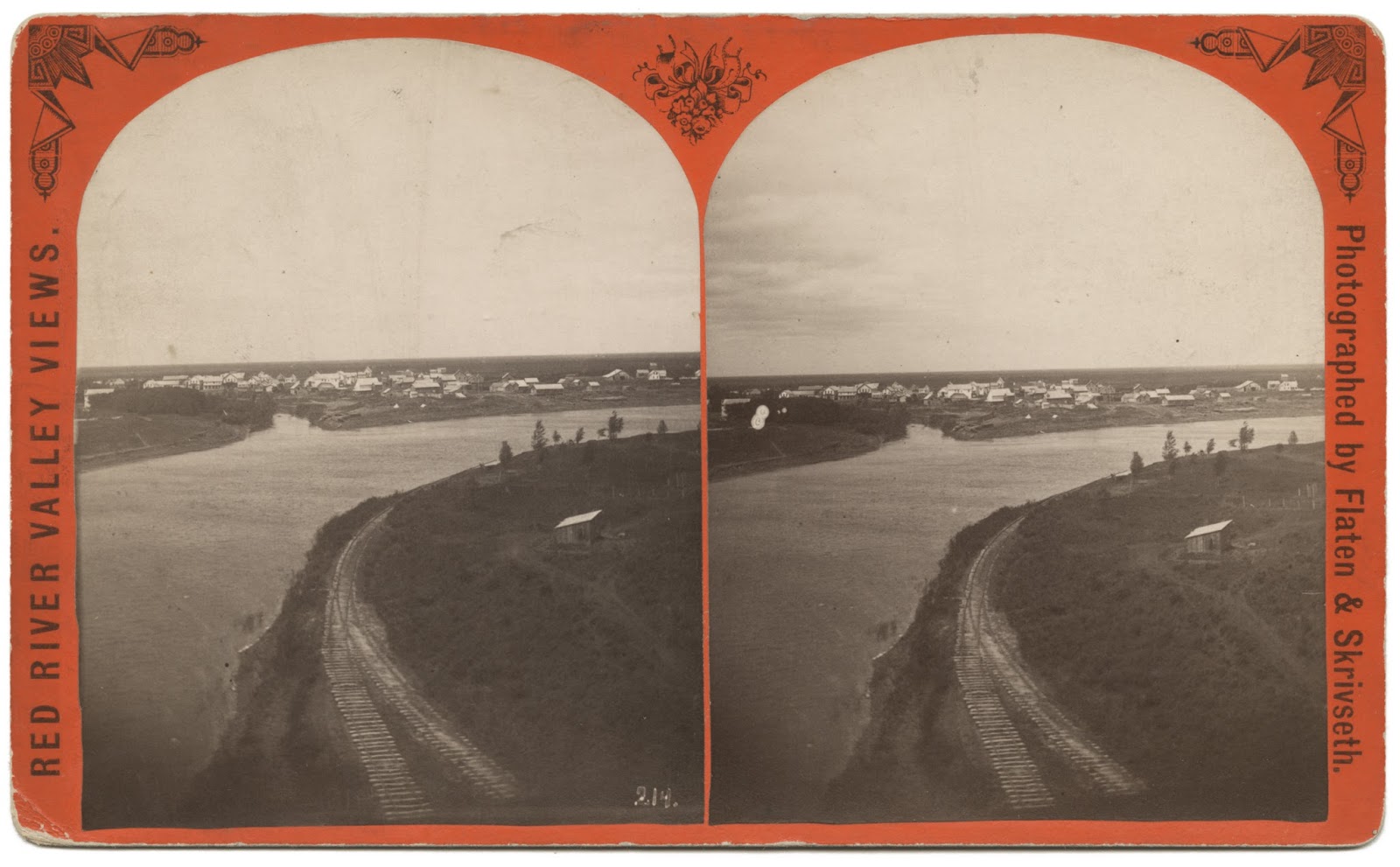
"...reserved a right-of-way along the top of the river bank"

PHOTO INFO: A stereoview showing the railroad track along the eastern bank of the Red River in St. Vincent.  This track is the continuation of the one coming in from the east into town from the "Y".  This was laid down early on in anticipation of the main line going through town and over the river, but a rail bridge was never built.

Swan Anderson would get fan mail from people far and wide that had once lived in St. Vincent and the surrounding area, generated from his newspaper columns for the Enterprise, and even from his toll-free phone number into his home. Swan kept sharing history even when he was in the nursing home. And thank goodness he did.

Speaking of fan mail, let me share with you a letter Swan received from the LeMasuriers of Ontario, California; as many reading this may remember, the LeMasurier family lived in St. Vincent at one time.  This letter shares some more history about St. Vincent and the railroads. Please note that the story told in the letter is second-hand, being told to the LeMasurier family by George (aka "Shorty") and Bessie Cowan. That does not make it any less true, but I wanted to be sure everyone knows the chain of how the story came to us.

Read on...

Before the turn of the century and when the railroad from Winnipeg east wasn't finished, St. Vincent was a booming railroad town. The round house was out by Lake Stella and had a turntable to turn the engines around. The long depot in St. Vincent housed the Customs and Immigration offices. There was also a Signal House. In 1901 William LeMasurier bought it and moved it to his farm north of St. Vincent. He and his bride, the former Maggie Easter, started housekeeping there in 1902. The land north of St. Vincent and west of the Emerson road was all railroad land. Phillip LeMasurier bought some and later sold it to his sons, William and Arthur. John and George Cowan bought some, also Mose Parenteau and Austin Griffith. The railroad reserved a right-of-way along the top of the river bank. Bessie Cowan told me at one time the railroad had planned to build a bridge across the Red River on Shorty's land.

The land that the railroad bridge would have crossed into/from is located on this plat map in the northwest corner of Section 35, labeled George Cowan . . .
The Great Northern Hotel was a three-story building with a ballroom on the third floor. Bessie Cowan gave us a picture of it and we left it with the Pembina Museum when we left St. Vincent. When the hotel was torn down, the attached section that was the kitchen was bought by the Russells and made into their home. Later, Harold Easton bought it and finally Milton Gregoire bought it and tore it down, and built what is now known as the Nellie Blair house.

There was a strip of land from the Red River to the Emerson road, 137 acres in the Village of St. Vincent on its north side. Austin Griffith bought the 36 acres next to the Emerson road and Charlie LeMasurier bought the rest from Peter Monro. Harris remembers when Charlie had a lot cleared along the river. The man doing the work used oxen. Mrs. Morrow, who lived in St. Vincent, used to pick roots and would give Harris fifty cents to haul a load to town for her.

Wednesday, April 24, 2019

Sociability Run: Jefferson Highway


[Note — General Manager McDougal of the Pershing Way [Association], who was for a short time Publicity Commissioner of the Jefferson Highway,  admits that he appropriated from the Jefferson many of the successful methods he is using on the Pershing. He also admits they are pretty good. 
We likewise are going to appropriate the story of his trip to Winnipeg, and in doing so likewise admit it is pretty good. That Manager [Herbert F.] McDougal has a microscopic eye, a retentive memory and a happy way of telling it is evidenced by what he saw and tells of his trip. 
Judging from his experience at the "Line", he should have borrowed the Jefferson's Rabbit Foot. 
Mr. McDougal's story will be read, with interest by the J. H. family, especially those who "made the trip" last July.  The following is an excerpt about the final leg of the run...]


AT Hallock the P. W. runs onto the Jefferson Highway marks and continues with them the rest of the way, going through Northcote, Humboldt, St. Vincent and Noyes to the International Boundary.

The Jefferson Highway touring group paused their sociability run 
in Emerson for "short" speeches and this group photograph...
Pro-lemonaders made another hit when Bronson was reached, where "most excellent lemonade was served" by the ladies. Decorations were mainly American and Canadian flags. Mayors Hodgson and Behrman spoke. The hotel menu at Hallock, a noon control, was a novelty, and uniquely distinctive over any other during the entire trip. Part of it was in French, and embraced dishes served especially in New Orleans. Banners and flags formed the principal decorative feature. Luncheon was served at the hotel and restaurants in the city. The Custom Houses of Noyes and Emerson were soon passed, owing to arrangements having been made beforehand. Short speeches were made by Governor Pleasant and Mayor Hodgson at Emerson.1
We had been sweeping along across the prairie, much of the time with no fences along the road, and came to a turn to the east along what, as memory recalls it, looked like the back side of a farm yard with perhaps an orchard bordered with forest trees in a sort of a scrubby growth. Straight ahead and eighty rods beyond was a dingy railroad station, and just before we reached it a turn to the right and north.

Before us loomed a signboard, high on stilts, announcing the "International Boundary," and there was a moment of bewilderment as we saw in one direction a road turning off to the station and in the other a pair of ruts curving around as entering the farm yard.

The original routing of the Jefferson Highway entered Canada directly from Noyes,
Minnesota into Emerson, Manitoba, Canada.   This is the approximate route the JH
followed. [Source:  Two Lane Traveler] NOTE:  The red line leading off 171 going
north was the 'Emerson Road' (dirt when I was growing up, now plowed under...)  
Over this seeming by-road was the remains of an arch1, placed there last July to welcome the Jefferson Highway tourists on their great sociability run, and the presence of the arch gave rise to the theory that this must be the entrance to the Dominion. Pursuing the tracks a bit further we were convinced that we really were on the highway into the neighboring nation, for at the side of the road was a glorified Keep Off the Grass Sign, bearing a solemn warning against going across the line without proper formalities.

The road took another turn and crossed a railroad track, which itself had crossed another track just previously. The one was the Soo, which ran along the margin of Canada, and the other was the Canadian Pacific, both heading for Winnipeg. All our pictures of an imposing entrance into Canada were dashed, as almost any country cross road is as pretentious. But still there was something picturesque about it and something that impressed itself upon the memory.

There are two railroad stations — one on the American side and one across in Canada, and at each immigration and customs officials, representing the two governments, are on guard. It looked as if it was a pretty simple thing, after all, getting into a foreign country, but it took just about an hour to do it, for a becapped official, swinging down the track to reach the switch tower and climb its dizzy steps to the bird-like house above, said that there was nothing to do but to report to the officials at the Emerson station, which took time and proved not to be the right thing, for we were first to go a mile or such a matter up town and be interviewed by the immigration official and get a card and then go across the street to where the Union Jack flew over the government building, and make our clearance at the customs office.

THE customs officials were polite, but inquisitive. They wanted to know how many in the party, what make of car, how many cylinders, its license number and factory number, whether it was equipped with windshield, top, speedometer and clock, and how much it cost, what baggage we carried and whether we had any camping equipment and how long we expected to tarry in Winnipeg.

Then a very nice old gentleman came down and rummaged through our suit cases in a formal and perfunctory way, withal rather thorough. But first there had come up the serious question as to the very typewriter on which this is being written. It is one of the folding sort and a constant companion. The G. M. would be lost without it, and the work of the organization would be hampered. It was rather important that it, too, make the trip into Winnipeg, for there would be the matter of correspondence and perhaps some magazine stuff.

But the officials were stern about it. They said that the wee machine was dutiable and that we had better put it in hock, so to speak, at the customs office to be picked up on our return, and to borrow a machine in Winnipeg. It looked as if the typewriter was to part company with the official car.

But the missus, waiting all this time down in the auto, said it didn't sound reasonable to her that a car and all that luggage could go in and a mere typewriter barred.

So we went back and argued that the typewriter was a tool of the trade and analogous to a monkey wrench in the tool box.

But these English are a fixed folk. They all had a look at the proposition, and turned it down; it wasn't regular. Then we offered to put up a cash bond, and finally succeeded in parting with $13 to that end, the money being in good American currency. Seeing the brand of money on deposit, a kind gentleman in the office suggested that we would be entitled to that sort back, as it was at a premium in Canada. So, on our return, we got $13.40 in Canadian currency, taking it across to the bank to be exchanged for American money. The rate of exchange had fluctuated during the walk across the street, however, and the bank demanded 50 cents instead of the 40 we had been paid.

And even at that we afterward discovered that we had a few Canadian bills in our script and had to give a discount on them.

BUT our troubles were not over yet. We discovered that our Canadian immigration permit, nor our clearance papers from the customs were sufficient; the becapped gentleman had deceived us. We had to go all the way back to the American side, to that little station of Noyes, to see a blue-eyed Irishman named Fahey in order to get a formidable document showing that Uncle Sam was willing to relinquish us for a few days.

That document had to be turned in to the Canadian customs officials, and then we were ready to go — all excepting the changing of a flat tire that had grown discouraged and depressed during all this formality. If we had known about the rest of that night that tire would have worried us.

But let us move on.

Over a bridge, combined wagon and railroad, under a viaduct we turned and then we were on the road to Winnipeg, sure enough. A little further and we were as good as in France, for, turning into a little village that proved to be Letellier, we grew uncertain of the way and stopped at a house to make inquiries if this were truly the way to Winnipeg.

The answer was "Oui, oui," which the doughboys all will recognize at once.

Turning just at the edge of that little village, which was mostly edge, we were at once in the old Hudson Bay Company's trail, a road 132 feet wide that goes in windings along the Red River of the North right into Winnipeg and becomes Main street, remaining 132 feet wide. That and Portage avenue, at right angles and of the same width, are boasted the widest streets in the world.

The boundary is sixty-eight miles from Winnipeg, and all the tedious details at Emerson, had taken time. It was 5 o'clock when we left Emerson, and that was Canadian time, the Canadians not having turned their watches ahead as the States had.

So we rather stepped forward a little on the gas, for there was a certain strangeness about the country that urged us to get along before dark covered the unknown roads. The trail at places was little more than sections of a fenced pasture, with ruts winding about between an endless row of telephone and telegraph poles. Winnipeg is paving out for miles and someday will have a concrete road to the border, no doubt, but nature still holds sway largely as yet there.

Jefferson Highway Sociability Run, NOLA to Winnipeg
L'Observateur (Reserve, Louisiana) · 28 Jun 1919
And we came into St. Jean Baptiste, a French town of 500 with only two English families in it. We sought to replenish our gas supply and pulled up at a garage and said "Five gallons." The tank filled up as we filled with astonishment. The answer was that we were getting British Imperial gallons, 277.274 cubic inches to the gallon, instead of our own United States gallons of 231 cubic inches. Five of our British cousin's gallons made six of our own, but we paid 40 cents for each and every gallon. 

They said in Winnipeg that American watches can be bought cheaper there than in the states, the protective tariff making it thus, but there was nothing like that about the gasoline, even Imperial gallons. 

Hunger was gnawing and we decided to have a bite to eat, much as we hated to waste daylight. So we asked for the eating place and were directed to a little wooden building that plainly was labeled "Public Hotel." 

Entering we found a dingy office that was a combination of a barber shop and bar. Prohibition had put the bar out of business, age had done for the barber chair, and the prospect was discouraging. But that was where appearances were deceptive, for, after a brief delay, we were led into a neat little dining room and |served with a supper as only the French served food. Bright-eyed French girls were jabbering French in the kitchen, and one of them went to the telephone and assaulted it with a flow of language that was beyond us. 

Then a husky chap went up to the instrument and bawled out a question. "What's the score?" he demanded. It seemed that Cincinnati had won. We felt quite at home for a minute. 

WE had been inquiring anxiously about the road conditions, and the official car had attracted considerable attention, so supper done, we stepped out of the dining room into the midst of a curious crowd that wanted to talk. The men all agreed that the best road lay across the Red River, and they grinned as they said that the largest city along the way was Winnipeg. Afterward we came to realize the point of the remark. Only one village intervened in all that fifty miles. The rest of the trip lay through a country where a house was a surprise and bachelor shanties were the rule. Mile after mile was along a fence-less road that ran at will and at angles, but it was a good road, except lonesome. In the distance we could see straw stacks burning in various places, and occasionally we passed an automobile, but mostly there were solid banks of second growth white birches.

If we had ever needed a bit of gas or some air pressure we'd have had quite a walk for it. And there was that flat spare on the rack!

It sounds a bit dreary, just to tell about it. but it really was a wonderful drive, with the air balmy and the night pleasant. Occasionally we would wonder whether we were on the right road, and would stop at a house to make inquiries. Always we were, although sometimes the children had to be called up to translate, the parents being French.

The engine worked to perfection, the tires held out and we had had a good supper, so on we sped, over bridges, through woods, out in the open. Finally we came to that sole village, passed it, got out into the wilds again and wondered. Then there appeared one of the blessed concrete roads that Winnipeg has built out for nine miles, and we felt as if we were nearing the goal.

But the lights of Winnipeg didn't settle all of our troubles. There was the matter of a hotel. A motorman, waiting to catch his car, offered advice. It wasn't any good, for every hotel he mentioned was full for the night. Finally, after we had tried one after the other, we were forced to put up at one that always will haunt our memories and make as firm in favor of strict hotel inspection laws.

The next morning we found room in a comfortable one...
____________

1 - "A very artistic arch-way had been erected at the border, but we had already been made to feel that we would be just as much at home in Canada as in Louisiana." [The Story of the Run, The Modern Highway, Vol 4, No. 7, August 1919, Pub. by the Jefferson Highway Association]

Wednesday, May 23, 2018

Guest Essay: The Story of West Lynn

West Lynne, Manitoba townsite, today.

The Story of West Lynne and the First Customs House in Western Canada 
by James McClelland

To  say that the oldest federal building in southern Manitoba had a diverse and chequered past would be an understatement. According to the old Winnipeg Telegram, this building was originally built in the 1850s. The design and architecture were similar to buildings found in the Acadian region of Canada. The article describes the building as "20x26, and made from hewn oak timbers, dove tailed at the corners." Later this building would serve as a symbol of Canadian sovereignty and a floodgate against Yankee commerce.

Today it sits just 500m north of the border it guarded for so long.
The line separating the United States from British territory had always been vague and tentative. Agreement that the 49th parallel would record the western boundary was established as early as 1818, but its exact location tended to shift each time a party had been sent out to survey it. Between 1823 and 1870 three different boundary lines had been drawn; all of them controversial.
In the 1840s, agitation began to develop along this line between the free traders from the Red River Settlement and the Hudson Bay Company officials at Fort Garry. In 1843, the first regular cart service between Pembina and St. Paul was opened. This provided easy access to the American markets. This bickering heightened as more Red River traders sought the higher American prices. It intensified in 1845 when Norman Kittson, an American Trader, opened a store just a scant 4km south of British Territory, at the junction of the Red and the Pembina Rivers.

The door of American commerce was beckoning. In fact, Kittson offered such good prices for fur that the ensuing rush of illegal trade from British Territory was referred to by the HBC as "Kittson’s Fever". As a counter-move in September of 1845, the Hudson Bay Company opened a post called North Fort Pembina. It was located on what they considered their side of the line. The Company put John Palmer Bourke, a retired officer living in the colony, in charge of this new frontier post.

During the winter of 1845-46, Robert Clouston, an employee from the Stone Fort visited this place. In his journal, he described these Spartan surroundings.
"Mr. Bourke has a rough log house, the walls of which, inside and outside are plastered with clay, and the roof covered with earth - it is floored with rough logs: the men live in the same house, with merely a partition between them - a mud chimney in each room and a door opening from Mr. B's apartment to his trading room"
The following day Clouston visited Kittson's store. The uncertainty of the exact spot where American and British authority met is noted in his diary:
"About quarter of a mile above the house (the HBC store) we saw a post planted by Major Long - marking the boundary at a place called Monroe’s Encampment some wag had pulled up the post of demarcation and placed Uncle Sam's initials toward British territory." 
Clouston later reported that Kittson's store was about 3 kms farther south. Here, between Kittson's store and the HBC post, the log house was originally located.

From these squalid beginnings the HBC post at the border continued to develop. A sketch from 1858, shows several log buildings surrounded by a sturdy log palisade.

However, the strip of land between North Pembina and Kittson’s store quickly developed into a "no-man's land." Other buildings sprang up and an unsavory frontier community known as Huron City was born. A few years later the Lieutenant-Governor of Manitoba would complain to Ottawa about the rowdy brawling atmosphere and the flourishing trade in whiskey smuggling that was going on in this "Whisky Post". By this time, the log building, had been turned into an inn.

Unquestionably, many travelers passed through the doors of this establishment, but two guests in particular played a very important role in the creation of Manitoba. In the autumn of 1869, the Hon. Wm. McDougall, the Governor designate of Rupert's Land, stayed here briefly after he was denied entry into the Red River Settlement by Louis Riel's metis guards. In December, McDougall would return to the deserted post and read a Proclamation declaring himself the official lieutenant-governor of the region. Ironically, in August of the following year, Louis Riel himself found momentary refuge in the same building after his hasty escape from Fort Garry.


On July 1, 1871, F. T. Bradley arrived to become Collector of Customs. The log building, empty at the time, became Manitoba's first regular Customs House. It also served as a telegraph, express and postal office. Yet, in October 1871, one of the most bizarre events in Canadian history had yet to unfold on these premises.

Thursday, February 02, 2017

StVHS Sports: 1927/28

Vintage St. Vincent High School pennant from 1920s

[Guest article by Michael Rustad, originally from nearby Humboldt, MN]

In the summer of 1999, my daughter Erica and I visited the town of St. Vincent.

There is no longer a bridge connecting the central business districts of Pembina, North Dakota and St. Vincent. The old bridge connecting the towns that I remember as a child has long been dismantled. The places that I remember in St. Vincent have long since closed. Short's Cafe, Sylvester's Store, the Curling Rink, St. Ann's Catholic Church, and the St. Vincent Fairgrounds. The curling rink is now neglected and in state of decay. The Church is a private residence. The St. Vincent School, too, is in a state of benign neglect. The school is in disrepair and the fire escape slide detached.

It was difficult for me to explain to my daughter that St. Vincent was once a bustling community. We attended catechism each summer in the basement of St. Ann's Catholic Church. We had a large number of ball games in the yard outside the church which is now overgrown and marred by abandoned cars. When my sister and I visited the Kittson County Museum in Lake Bronson, I was amazed to find some high school yearbooks [called Borderlines] from St. Vincent High School. St. Vincent High School closed in the late 1930s and never reopened. Instead, it eventually consolidated its school district with Humboldt from 1957 to 1991.
[Note from Trish:  In-between StVHS closing and St. Vincent consolidating with Humboldt, students had the choice of attending Pembina High School, or other schools in Kittson County like Hallock...]
It was an unexpected joy to find yearbooks from the St. Vincent High School from the 1920s. This was a yearbook from a small town in NW Minnesota prior to the Depression. High school life in St. Vincent was marked by lots of school spirit judging from the many activities. St. Vincent fielded a football team, basketball team, hockey team, track team and baseball team in [school year] 1927/28.

"If you could walk or run, you were in the starting line-up."

Thursday, February 25, 2016

Ferry Command Article

Pembina’s brief moment of world attention, then, was part of the demise of American innocence. 
- "Earth Angels Rising", by Ted Beaudoin
It has been reported that the opening scenes of the 1941 Tyrone Power-Betty Grable movie, “A Yank in the RAF,” shows airplanes on the Pembina border being hauled into Canada. The narrator says, the way to get around neutrality restrictions is “Yankee ingenuity and a stout rope.” 
- Horse-drawn planes part of N.D. history (Bismarck Tribune, Jan. 16, 2011)

Emerson International Airport
by Bill Zuk (Nov 3, 2012)
Copyright © 2015 CAHS

Prince & Fred help make history! 
January 15, 1940 - It was miserably cold that morning when Joe Wilson hitched his team of horses to a wagon. He looked up in the sky to see two aircraft circling overhead. Joining a procession of cars and a truck laden down with fuel barrels, he lumbered his way to the front, coaxing his workhorses, Prince and Fred, forward along the wind-swept field. The assembled crowd began to gesture at the swooping twin-engine planes now clearly in view. Piling out of one of the lead cars was a film crew that hastily set up a tripod and movie camera.

Approaching the 'landing strip'
on Pembina side of the border.
Jimmy Mattern, the famous test pilot, peered out the side cockpit, astonished at the sight below. It was a wind sock planted in the middle of the prairies. After the long cross-country excursion from Burbank with numerous stops along the way, he was nearly at the end of his ferry flight. Lining up for an approach, he maneuvered the Lockheed Hudson bomber downwind for a landing short of the international border that straddled his landing site. Following closely behind was an identical Hudson bomber, also painted in a dark drab, with only civilian markings on the underside of the wings to identify it. The subsequent touchdown was hard, the second bomber swerving off the improvised runway and nearly tipping on its nose, before righting itself.

Sunday, January 18, 2015

Saloon Manslaughter: The Rest of the Story


It all started with a trade:  One hat, for one bottle of whiskey...

If there's one thing I've learned writing this blog, it's that history often reveals itself slowly, despite doing what you feel at the time is due diligence researching a subject.  New records become available that were not present the first time around. People come forward with information only they were privy to.  Etc.

Such is the case concerning a particular murder that occurred in St. Vincent in 1899.  The new records came in the form of old newspaper accounts now available through the Library of Congress.  The new information came from an old friend of this site, Jim Benjaminson, of the Pembina County Historical Society.

When you read the accounts below - along with the links to earlier posts on this subject - you will get something very rare for local history of a small town nature:  As complete a picture about the subject as could be expected.  A rare treat, indeed...
_______________

George Bates Murdered While Intoxicated
Wednesday morning (March 8, 1899) the news went mouth to mouth that George Bates had been found dead in his house. The details as they began to develop were highly sensational. Mr. Bates was addicted to excessive drinking. When under the influence of liquor he was apt to quarrel with his family. On Wednesday afternoon he had trouble of this kind. Later, he went to St. Vincent. What happened there is still somewhat contradictory at this writing. 
Wednesday morning, Mrs. George Bates came downstairs and found her husband lying on the floor with every evidence of having been severely pounded. She hastily summoned Register of Deeds Chisholm from the office nearby and upon examination it was found that Bates was dead. He had a hole in his skull near the right temple from the effects of a blow of some kind and his face was badly bruised and had been bleeding profusely. As nearly as the facts can be gotten at they are as follows:

Thursday, July 10, 2014

Noyes Customs Building Up for Auction

While nothing was really mentioned of the history of the depot, it was difficult, yet good to read this article about Noyes today.  A very sad article about Noyes generally, and the old Customs building specifically. There was a beginning, and this is the beginning of the end.

It will be interesting to see who buys it and what they do with it. I could see turning it either into a very interesting residence (granted, it would take a lot of internal remodeling with all that ugly government modernization they did over top of the original early 1930s classic look, i.e., the paneling and indoor/outdoor carpet...), or a Bed and Breakfast with a border theme.  Who knows - it could just end up being a storage shed. Obviously someone wants it for something. Bidding started in May at $5,000 and it's already up to $30,000 with 4 bidders so far, and three weeks to go despite what the article says; there is a notation on the listing that the time period for bids may be extended, which is evidently has been...

Chris Misson, chief Customs and Border Patrol officer, stands in front of
the former Customs and Immigration Station at Noyes, Minn. Wednesday.
The station, closed several years ago, is being sold on an online auction.

[Photo by Eric Hylden/Grand Forks Herald]

Old Noyes, Minn., border station for sale, reminder of closed crossing

By Kevin Bonham (Grand Forks Herald, July 10, 2014)

NOYES, Minn. — When Mary Delaquis first arrived at what then was the U.S. Customs and Immigration Station in Noyes as a customs inspector, her daily commute took her just across the international border to a motel in Emerson, Man., where she lived that first summer in 1984.

Customs and Immigration Station in Noyes as a customs inspector, her daily commute took her just across the international border to a motel in Emerson, Man., where she lived that first summer in 1984.

That wasn’t unusual.

The Noyes border station — located along U.S. Highway 75 but just a 15-minute drive from the Interstate 29 port of entry north of Pembina, N.D. — was more of a neighborhood crossroads than an international port of entry.

“We didn’t see a lot of commercial traffic at the port,” said Delaquis, now Pembina Area Port director for U.S. Customs and Border Protection’s Office of Field Operations.

“It was an opportunity for locals to use the facility, she said. “They could move more quickly through the border.”

Canadians living in Emerson, Letellier and other nearby Manitoba communities would cross the border to get their mail, buy gas or to buy groceries.

Noyes-area residents, in turn, would drive across cross to eat, have a couple of beers, or to take their families swimming at the pool in Emerson.

“We saw a real local flavor at the border crossing,” said Delaquis.

The Border Patrol building, now closed and up for online auction, is an empty reminder of the past activity.

Monday, February 17, 2014

News from the Past VI

First & Last Chance Saloon

More News from the Past...
George Bates Murdered While Intoxicated, at St. Vincent
Wednesday morning the news went mouth to mouth that George Bates had been found dead in his house. The details as they began to develop were highly sensational. Mr. Bates was addicted to excessive drinking. When under the influence of liquor he was apt to quarrel with his family. On Wednesday afternoon he had trouble of this kind. Later, he went to St. Vincent. What happened there is still somewhat contradictory at this writing. 
Wednesday morning Mrs. George Bates came down stairs and found her husband lying on the floor with every evidence of having been severely pounded. She hastily summoned Register of Deeds Chisholm from the office nearby and upon examination it was found that Bates was dead. He had a hole in his skull near the right temple from the effects of a blow of some kind and his face was badly bruised and had been bleeding profusely. As nearly as the facts can be gotten at they are as follows: Last night at 11:30 two young men from St. Vincent, Minn., just across the river brought Bates home and deposited him on the floor. They then notified Marshal Moorhead, who went up to see Bates. He found him apparently sleeping off the effects of a boozer and did not arouse the family. This morning as above stated he was found dead.

Thursday, October 31, 2013

The Border

The little border town of Emerson, Manitoba, was a surreal place to be in April 1997.  Behind the permanent dike that had been doubled in height with the addition of a temporary structure of plywood and sandbags, Emerson was a dry island in the vast sea of the Red River, which had burst its banks.  All the inhabitants, with the exception of a few who had been left behind to fight the flood, had been evacuated.  The electric power still worked, so that at night the island of Emerson was ablaze in a strange white light.  Deer and hares and other smaller animals had gravitated to the town to escape the ice cold waters of the raging river.  They stood, frightened sentinels, in the white light of the ghost town. 
A remarkable crew made up of town employees, a detachment of troops from the Canadian Forces and local Mounties kept the town of Emerson itself dry and secure.  As the river rose to a critical level in late April, with no firm prediction on how high it would get, the struggle to maintain the wall around the town was in deadly earnest.  Coordinated out of the Emerson Town Hall, the beleaguered warriors filled sandbags and directed them to potential weak points on the perimeter.  So close is Emerson to the U.S. border, that a portion of the dike actually crossed into the small neighboring community of Noyes, Minnesota, protecting a U.S. Customs office and several nearby homes on U.S. soil.  As residents noted at the time, what they were calling the "Red Sea" did not make distinctions between one side of the border and the other.
[The writer returns five years later, and talks to survivors in both Emerson and Pembina of their ordeal during the 1997 flood, then goes to the border to travel to Grand Forks to interview survivors there...]
In the large new Canada Customs post at the border- built since the flood of '97 - I meet two tall, muscular customs officers who have recollections of the mayhem...When asked about the purpose of my trip to North Dakota by a U.S. Customs official with grey hair, I tell him I am going to Grand Forks to talk to people on the fifth anniversary of the flood of '97.  Not bothering to ask me for ID, he comments sardonically, "Why not go to Pembina?  They know at least as much about the flood as anyone in Grand Forks." 
I follow his advice and drive into the little town of Pembina, two minutes south of the border.  The town had been British territory before it was handed over the U.S. with the adoption of the forty-ninth parallel as the border across the Prairies in 1818.  On the east side of Pembina, there is a high earthen dike to protect the town from the Red River.  It is the same on the other side of the river in the tiny hamlet of St. Vincent Minnesota.  This April the Red is tame, but the dike is there for protection against future floods. 
On the main street of Pembina, I find an old preacher and his young disciple out trying to win converts.  I ask them if they were in town for the great flood of '97.  In reply, the old man hands me a pocket-sized pamphlet titled, "A Preacher of the Old School."  In our conversation, Mr. W. Seed and I are at cross-purposes.  He is trying to save my soul from a flood of biblical proportions while I am in search of memories of a mere earthly flood.  I manager to get Mr. Seed onto my line of inquiry, and he tells me of the long series of floods that have afflicted this community - in 1897, 1950, 1966, and 1979.  In 1997, he says, the dike held and the town was saved.
From:  The Border: Canada, the US and Dispatches From the 49th Parallel

Sunday, February 24, 2013

Past Resident Memories: John Stranger

John Stranger - Back row, middle


A MEMOIR OF A LIFE, FOR BETTER OR WORSE
By John A. Stranger

CHAPTER ONE
Beginnings

This all begins in a small town in Minnesota during the 40's when growing up was a struggle without all the things a boy wants and dreams about. Outdoor toilets and dressing behind the oil burner turned up full blast where my brother (4 yrs. Younger) and I learned to dress very fast during the cold Minnesota winters.

My brother was a great kid even though we would have our brotherly confrontations. We had a younger sister too and she learned to hold her own with us boys. Our parents were very strict on almost everything that they thought was for our best interests even though we tried to disagree with our parents at times but trying to obey seemed better than a beating, (most we probably had coming).

Saturday, May 26, 2012

Curling Memories

Curling stone (or rock)
used in St. Vincent rink

[Courtesy:  Matt Cleem]

The curling rock (or stone) at left was recently shared on the St. Vincent Town Reunion Facebook page.  It brought out many memories from people who had grown up in and around St. Vincent, and had a connection to the St. Vincent Curling Rink...

Cleo Bee (Lang) Jones - I recall going to the St.Vincent curling rink with my uncle Laurence Turner when I was pretty young...

Trish Short Lewis - I was in the rink only a few times, saw a few older people curling.  I don't know if they ever had a warming house portion of the rink, but when I was there, it was always freezing on the bleachers in the front area, so I'd usually beat a fast path back to Grandma's house a block away...

Phil "Jack" Gooselaw - This we called a curling "rock" and may be one of the ones we used during the late 50's at the St. Vincent curling rink. My dad Manuel, Uncle Lewis Gooselaw, Dave Gooselaw and I had a curling team the last couple winters I was there prior to my graduation from high school (1960) and going into the Navy. As an aside, I was in the Navy for 2 weeks when I rcvd news that Dad had had a heart attack and passed away while throwing one of these rocks in a game (Feb. 1960)...

Delphine (Beaudette) Mundorf - Our Grandpa (Trish) use to curl. His team made it in the winning bracket and they came to Bemidji one year. I was so proud to watch my Grandpa curling. So exciting. I was quite young when Grandpa curled in Bemidji. I think they won and went on to state but not sure about that. Just know it was so exciting to watch him out there on the rink. I don't even remember for sure if he was the stone thrower or if he was one of the sweepers. But I think he threw the stone. I might have been around 12 then so would have been around 1950.

Judy (Turner) Ziesman - I remember when your dad passed away. I was pretty little, but I remember standing outside your house and talking to Denise and Debbie while everyone was in the house. Back then they would have the viewing at the house. I don't know how long after our family bought and moved into your house. My mom and dad always talked highly of Manuel [Gooselaw]. Sadly a few years later my dad passed away also. I think my dad was at the rink when your dad had his heart attack. I spent a lot of time at the rink.  I had my first lesson on that rink, they made it look so easy....little did I know!

Keith Finney - I remember the first time I curled. Herb Easter had a conflict so he could not curl one night. He gave me his shoes, broom and gloves and sent me to the rink. Almost put the rock through the end first time I delivered a rock. Herb forgot to give me instructions. :)

Dorothy (Giffen) Barber - I will never forget that night. Don was curling and saw Manuel when he threw the rock and slumped on the ice. He came home and told me about it. It was such a sad time.

Jake Rempel from Halbstadt, Manitoba shared: The Emerson Curling Club used to borrow the Rocks from St Vincent when they still had bonspiels in the shating rink in Emerson (right after New Year's). Lawrence Calder liked to tell the story of crossing the Border and as it happened an American from farther South was at the Customs and asked what they were? Curling Rocks. "What is Curling" It’s a game – you throw them 160 ft and see who can get them closest to the centre to win the game ! "Wow ! I would like to see the people that throw them!"

Betty (Short) Thorsvig had fond memories of hanging out in the rink; Jamie (Rustad) Meagher thinks her father also curled there.

Saturday, April 21, 2012

An Arduous Journey


I've been reading this book about Enos Stutsman titled Attorney for the Frontier. Ever since I came across "Stuts", as his contemporary friends called him, I've been fascinated by the man.  To my knowledge,  Attorney for the Frontier is the only book ever written about him, and it includes an entire chapter about his time in Pembina, his last home base.

Below is a letter he wrote to his supervisors.  As a past federal government employee myself, I am well-acquainted with the paperwork involved whenever you go away from the office.  Reports must be filed!  Read below on what this particular early government employee went through just to get from Point A to Point B; you'll note he has a pretty wry sense of humor, which I guess you had to have when encountering such difficulties.  All in all, if you take the time, you'll discover it's quite illuminating, and an enjoyable read...

Saturday, November 26, 2011

Line of Fire

Back in the day, just as now, lawmen worked together between Canada and America.  There was less red tape then, although that was there, too.  The excerpt below is about one of the early lawmen of our area, this time on the Canadian side of the 49th parallel.  He has been mentioned in passing before, in the story of Sheriff Charley Brown.  You could say he was Charley's counterpart over the line.

It's fun to learn more of his story, and the context.  We're very lucky to have this recounting - I have read that "virtually no documentation was preserved for the MPP"...
The North-West Mounted Police were not the only officers who made life difficult for bad men in the Canadian West. Even before the Mounties arrived on the prairies, the newly formed province of Manitoba organized a small, but effective, police force. The Manitoba Provincial Police began in 1870 with nineteen men. It was operated out of an old Winnipeg post office that was converted to a police station and courthouse. A log house behind the building was used for a jail. The force was poorly funded, so the officers had to provide their own firearms. They had no standard uniform. Within a few years, the department dwindled to a mere eight men. Some constables were dismissed for inappropriate behavior, such as public drunkenness, others resigned to seek better paying employment! 
In 1874, Richard Power, a twenty-three-year-old who had become an original member of the force at the age of nineteen, was made Head Constable - the equivalent of Chief of Police. The rapid decline in the force's number was only a part of the reason for this young man's promotion to such a position. Even before joining the MPP, he had allegedly served as a scout for the United States Cavalry. He was also a lieutenant in the Winnipeg militia. Power's contemporaries described him as "a fine looking man, magnificently proportioned, every inch a soldier with the courage that nothing could daunt. Power wore a Colt .45 with a nine-inch barrel, and a gunbelt that was always full of cartridges. Local newspapers called Power "a terror to evildoers." In A few short years, Power had shown himself to be a courageous and enthusiastic policeman. Some thought he might have been too enthusiastic. He had once been sharply reprimanded for shooting a Native during an arrest. 
By the time Power took command of the Manitoba Provincial Police, Winnipeg had been incorporated as a city and had its own police department. That left the rest of Manitoba under the eyes of Power and his tiny department. Power strategically placed men in the more populous settlements outside Winnipeg; towns like Selkirk and Kildonan. He kept a few men with him at his headquarters in Winnipeg. Most Manitoba communities had to depend on special constables - civilian volunteers - to keep the peace. If there was any real trouble, Power could send one of his constables out to see to the matter. The policing situation in rural Manitoba was not unlike that of rural Ontario and other points east. 
Manitoba, especially the country along the American border, was woefully under-policed, but the situation was same on the other side of the international line in the Dakota Territory. There was a sheriff in Pembina, just over the border, and another many miles away in Fargo. For those lawmen, just looking after their towns was a full-time job. They didn't have the resources, or manpower, to go chasing after the desperadoes who roamed the plains and hills of the Dakota country. Rustlers, gunmen, and other men on the dodge had only to keep out of the Sheriff's way to avoid arrest. With so much open country, that was not a hard thing to do. Moreover, American lawmen were often unwilling to apprehend fugitives wanted in Canada, unless there was a reward involved.