Saturday, May 13, 2006

Prohibition Story


The Volstead Act of 1919, named for its author, Minnesota senator Andrew Volstead, made provisions for Prohibition's enforcement, but it contained loopholes that invited abuses.

Somehow, I don't think that writer meant my grandfather, but in his own little way, Grandpa Fitzpatrick was flouting the law of the time when he was making beer during this time period, using honey from his bees in the process. They lived in the north part of town, a bit off the beaten track and somewhat private. Maybe Grandpa thought it would be OK if he kept it low-key.

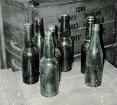
Grandma wasn't thrilled about the idea, since it was illegal at the time, but she put up with it...He was even known to sell a bottle now and then to someone. Grandma herself, after a hard day's work, would drink a bottle against the heat. However, one day Grandpa crossed the line...On that day, my mother, who was around 9 years old, was uptown with my grandma visiting friends. Upon their return a few hours later, they came upon this scene...
Walking up the road to the house, we came upon an unbelievable scene: Men, women, sitting around, having a good time...drinking Grandpa's beer! It was a regular outdoor honkytonk.
Well, if you only knew my Grandma, you could imagine what happened next: She was not amused. People knew my Grandma well enough that just her arrival meant they had better clear off. As they did, she proceeded to grab the remaining bottles of beer within her reach and smash them against the side of the shed.

Thursday, May 11, 2006

Gamble Letter #17

1885 Minnesota train wreck
January 10, 1885

My dear Maggie we received your kind and welcome letter and was glad to hear that you were all well as this leaves us at present we got the cards grandma sent us and we liked them very much we were all very sorry to hear about grandma being sick again we are very sorry we are so far away from you when yous have so much to do this has been a very cold month it has been forty four below zero but we dont feel it very bad for we have a warm house a good many got all their potatoes frozen we do not know about ours for we have them in a roothouse and we cannot get into it for it is [4 lines missing] any day there has been a wreck on the railroad and eight engins are lying in the ditch and one engineer is not expected to live it was between here and St Paul they send out two engins on one train when the snow is deep we had a very good time at Christmas and new years we were at a teaparty across the river in Penbno and then there was Christmas tree in the schoolhouse at St Vincent where us little ones all got Preasants we are all going to start to school in a week or two Provisinous are very high Just now yous think wood is very dear there but it is eight dollars a cord here and scarce at that we have got off [2 lines missing] cheaper we think people will get up here for fifteen dollars a head as then emigrants will come by Prince Arthur landing I am sending you some receipts for knitting I think I have told yous all the news Pleas Do not be long in writing as we are always glad to hear from yous

good by for the Preasant
Ellen Gamble St Vincent

"...brief moment of world attention..."

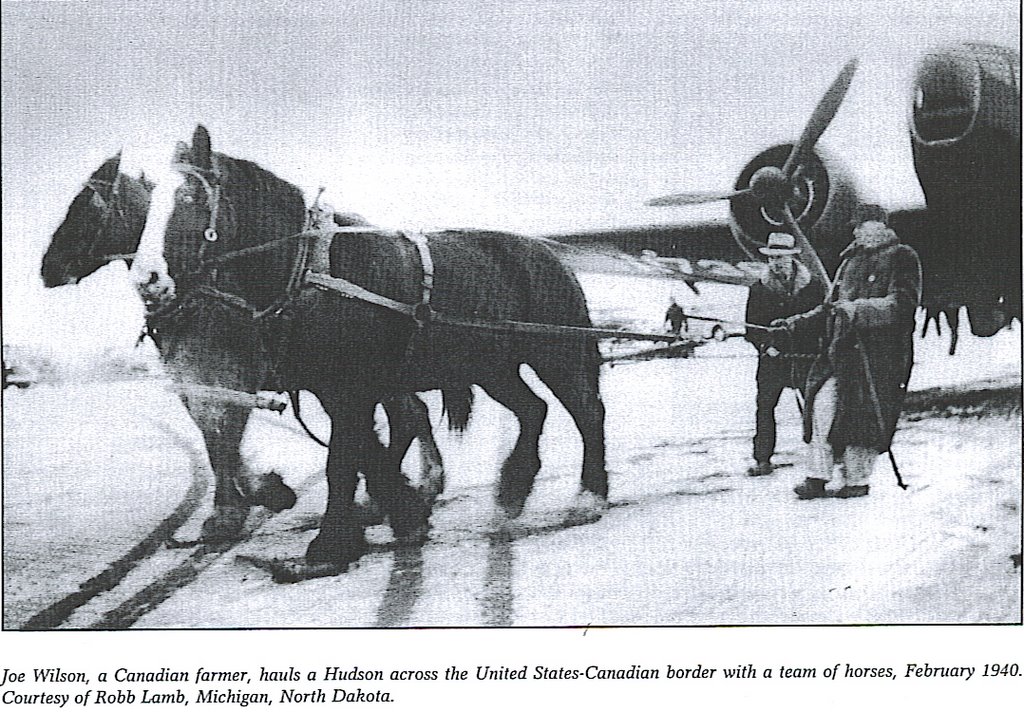
Photo by Robb LambNorth Dakota was...the site of one of the first publicized actions taken in favor of the Allies. This came to the world’s attention when some unusual photographs appeared in early 1940, showing, of all things, a few airplanes being pulled by a horse team across the Canadian border near Pembina, North Dakota.

My mother was a senior in high school in 1940, when the event the quote above happened. She showed me photos she had taken herself of the event. She got the basic facts right, too, from what I recently learned. But the broader story is even more interesting than the overview.

A regional historian, Tom Shoptaugh, wrote an article about 12 or so year ago, that fills in the details...
The transport of military aircraft at Pembina...provided evidence that another belief was no longer valid: the oceans could not provide enough distance to protect America from harm. If Hudsons could be flown in stages from California to England, then it could not be long before other, perhaps hostile, bombers could fly over American soil. In December 1941, Japanese aircraft did just that, putting an end to the myths of American isolation and security.

Pembina’s brief moment of world attention, then, was part of the demise of American innocence. Neither the small town nor the great nation could remain isolated from the course of world events in modern times.

Saturday, May 06, 2006

KCND

The station during its heydey, near I-29 on the west side of Pembina...
KCND was the name of a small independent television station in Pembina, North Dakota, which first signed on in 1959. 
KCND was purchased by Winnipeg, Manitoba businessman Izzy Asper in 1974 and relocated to Winnipeg. 
The station signed off as KCND for the final time on September 1, 1975 and signed back on as CKND later that same day.


OK, that's the very short, official history of KCND. But MY history of the station runs a bit more like this...


- Chiller Thrillers! Mom and me, Saturday night, stay up to midnight, scared silly and loving it, chomping away at homemade buttered popcorn; we couldn't get enough of Vincent Price, Boris Karloff, or the old Hammer films with Christopher Lee & Peter Cushing, all thanks to scratchy old films KCND ran.

- Saturday & Sunday afternoon movies! All the classics from Errol Flynn's Robin Hood to Abbott & Costello Meets Frankenstein (I have never laughed harder before or since...); we didn't need cable or Turner Classic Movies - we had KCND programmers who got ahold of bad copies of great films and we the audience were all the beneficiaries.

- Christmas Concerts! All area schools would be invited to come and present mini-concerts on "Live TV", as a community service to the viewers at Christmas time.

- I met my first best friend! Thanks to KCND, I met a great friend when her Dad moved their family from Indiana to take an announcer job in Pembina where we met at a church youth group.


KCND Trivia: A modern pop band (once known as The Lucy Show), one of whose members lived in our area and grew up listening to KCND, eventually wrote a song directly relating to KCND, an homeage to their beloved Saturday night horror film series. It is aptly named, Channel 12 Chiller Thriller (KCND 10:30)!

Friday, May 05, 2006

Gamble Letter #16

In another recent post on this same story, I admitted I couldn't remember where I had read about it in the first place. Chalk it up to advancing senility, dear readers. I read about it in none other than the Gamble Letters!

Yes, I remembered when I was once again skimming through them today, and realizing that the NEXT letter (below), was where I had read it some weeks ago.

Without further ado, here is the second-hand account of the crooked Postmaster of St. Vincent...

St. Vincent
August the 8th, 1883


Dear father & Mother I now sit down to write a few lines to yous hoping these will find yous Well My family is all well but myself I am better today than I have been for three months back last week I took Nuralga* in my face and it all sweld up like a loaf When it is windy my teeth starts to ache I had good health til Now but that is enugh about Myself I hope My Mother is some better We would have wrote Sooner but they are all so busey now with the hay and the wether is very Showery there is all apearance of a good crop this year it was very dry all sumer and warm there has been great robbery in the post office here this last while regestered letters would be opened and the money taken out there come detecteves from the government and they went to Winnipeg and sent decoy letters to St. Vincent with money in them and marked the bills and then came themselves and got drinking with the post master and he pulled out there own money to treat them and they took him prisnor right there every one says he will get ten yers at least [2 pages missing]

Mary Ann Gamble

* - Nuralga, or Neuralgia: In old medical terminology of the period, it described discomfort, such as "Headache" was neuralgia in head

Thursday, May 04, 2006

Gamble Letter #15

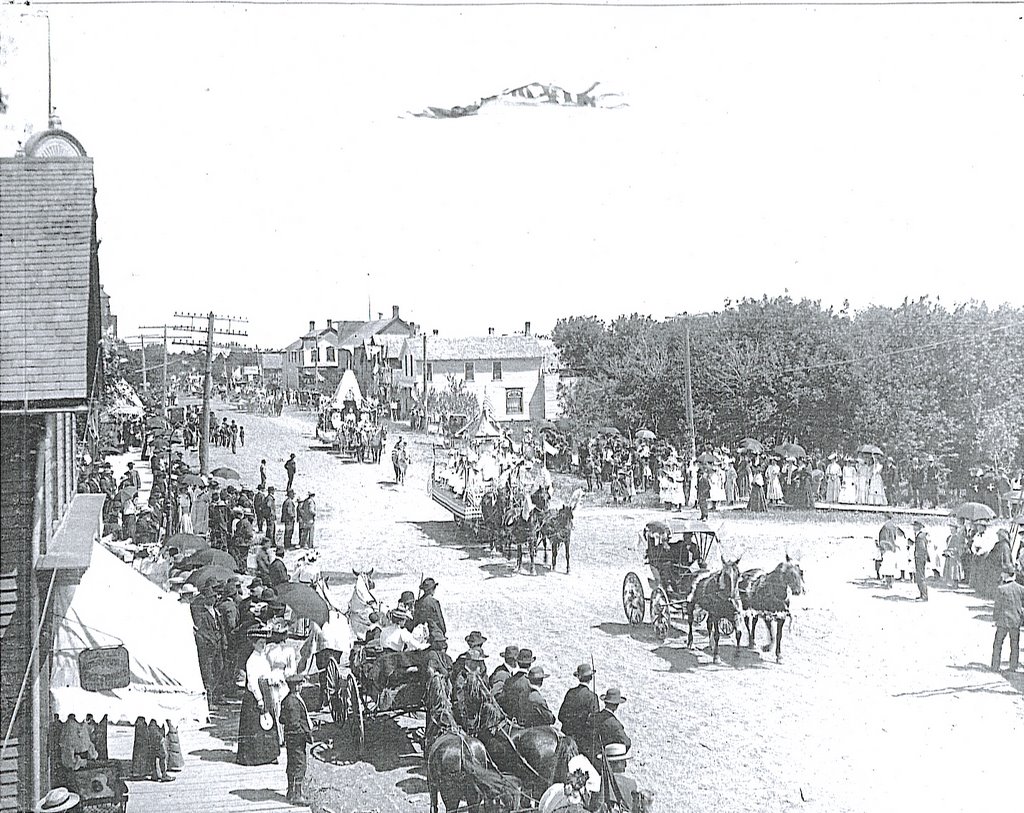
An early Pembina July 4th parade...
St. Vincent
July 9, 1883


My dear Maggie we received your kind and welcome letter and we were sorry to hear that Grandma was not better this is the dryest summer we have had since we came here there is a bad prospect of any crops this year ma has been sick all this summer ma thought she would go to see yous this summer but she is to sick to go We had a good time on the fourth of July, there were all kind of races and dancing and the band was from Winnipeg and there was fireworks at night there was a procession in the morning there was a bad accident here on Thursday night a man got run over by the train they say he fell asleep on the track and the engine passed over him before they could stop it his name was James Woods he was just up from Ontario and was taking up land we go to sunday school every sunday now you asked me how Mr. Cowan lost his stock they all died I do not think they take very good care of their stock. The station and Custom house is going to be built quite near us they are going to be large buildings. There has been a good many sudden deaths here but you do not know the people.

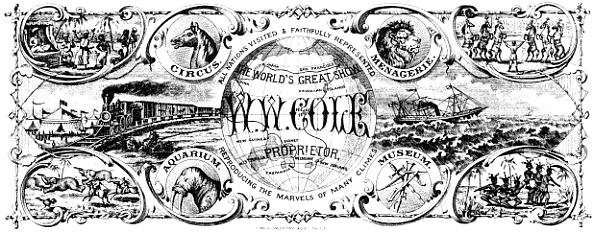
There is to be a large circus in Emerson on the 20th of July, it is one dollar to get in. We be very busy now time are rather dull here just now there is a great many travling around out of employment. Alick is still at the pump. We all hope that Grandma will get better write soon for we all think the time long when we do not hear from you. I think I must finish now we all send our kind love to yous all

Ellen Gamble

Wednesday, May 03, 2006

Children's Blizzard of January 1888

On January 12, 1888, "...the mercury fell within twenty-four hours from 74 above zero to 28 below it in some places, and in Dakota went down to 40 below zero. In fine clear weather, with little or no warning, the sky darkened and the air was filled with snow, or ice-dust, as fine as flour, driven before a wind so furious and roaring that men's voices were inaudible at a distance of six feet. Men in the fields and children on their way from school died ere they could reach shelter; some of them having been not frozen, but suffocated from the impossiblility of breathing the blizzard." - from The Big Brash Blizzard of 1888, by Dick Taylor

The Gamble letters have a gap with no letters in 1888, so they are unfortunately silent concerning this storm.

But one source - a biography of a storm, if you will - is David Laskin's "The Children's Blizzard", which I can't recommend highly enough. It covers the communities and individuals - through news accounts, officials records of the time, and narratives by the survivors - of our region, and what they saw and experiences that day they never forgot...

Tuesday, May 02, 2006

Purdy Horgan & the Pembina Museum Saga

I was just informed yesterday, that the items I requested from the State Historical Society of North Dakota in Bismarck, was picked up in Bismarck last Friday, and is now available for my perusal at NDSU's Institute for Regional Studies here in Fargo, where I live. To say I am excited is an understatement! I'll be going in tomorrow afternoon and taking my first look at the contents, and spending all day Friday (which I am taking off as another vacation day especially for this occasion) at the Institute taking a closer look. This weekend, if not before, I'll definitely be posting my first take on what I find, right here...

Today I received a response to a letter of inquiry to a Purdy Horgan from Cavalier, ND. I had never heard of Purdy, but was put on the trail to him via a lady I found thanks to a fellow Freecycle Fargo person (long story, but let us say, it pays to network!)

Purdy is an elderly man who has had involvement in the historical preservation community in the area I come from, on the North Dakota side of the Red River, in Pembina County. I had asked Purdy what he knew about the contents of the former Pembina Museum, how they were dispursed, since I knew I didn't know the whole story yet.

I will quote his letter in full, since it is an interesting and colorful read...I think I would really like this Purdy...
Cavalier, N.Dak.
April 27, 2006

Dear Ms. Lewis:

If you have a couple of seconds to squander I will be happy to tell you all I know about the "Icelandic Museum".

The Museum you refer to is the Pembina County Historical Society Museum. DUe to building deterioration and lack of handicap accessability it was necessary to abandon the old location in town. Consensus of the opinion of many people OK'ed the selection of a site in the Icelandic State Park (what a misnomer - this is not an Icelandic State Park...it is a North Dakota State Park) five miles west of Cavalier, at Lake Renwick.

Four hundred feet north of the Museum complex and across Highway #5 is the entrance to the park. The park offices are located there within the Northeastern North Dakota Heritage building, which is often mistaken for a museum - which it is not. It is a Pioneer Interpretive Center covering the settlement days to the present, in the northern Red River Valley of Pembina County. It is difficult to keep these enterprises in their proper perspective.

There is one more Museum in the county - the North Dakota State Museum at Pembina.

Elmer Barry's collection was on display in the old Pembina City Museum for many years. Due to possible Red River flooding every spring, it was necessary to move all the artifacts to higher ground. The transportation was furnished by high school students excused from class for the chore. It was a blast for those who were capable but age and responsibilitiy allowed a certain amount of horse play resulting in like amount of carelessness and toll on the objections of salvation.

One spring - perhaps ten years ago - the City, unwittingly asked the North Dakota Heritage Association [Note: I may be wrong here, but I think Purdy actually means the State Historical Society of North Dakota here - I searched extensively online and cannot locate a North Dakota Heritage Association anywhere...] for help while there was still some unbroken artifacts left. Of course the NDHA was more than happy to help. In a few days several trucks arrived, loaded the entire collection, and took it to Bismarck.

Now - with the exception of a few items donated by other people, the rest of the stuff belonged to Elmer's daughter, Mrs. Cummings, living a long ways from Pembina County. Try as she might there was no way NDHA would relinquish control of the exhibit. THey did make one last seemingly safe offer. She was informed the exhibit would be returned if she had a safe place for it to be stored. In desperation she contacted the NEND Heritage Assocation.

Ninety percent of the exhibit would not be used by the local HC but there was a brand new full basement under a recently renovated Town Hall on the Center grounds. A deal was made between the PCHS and the NEND HC whereby the museum would take the exhibit and the Heritage Center would store it temporarily (it is not difficult for the two entities to deal - most of the members of the Society belong to the HC and vice versa...)

I was working in the HC the day a large truck came in from Bismarck with the load of the smaller items of the Barry collection. Being the Vice President of the Historical Society at the time, I was honored to sign for and also unload the truck, plus put all the stuff in the basement of the old Town Hall. Although there were several items missing (that is ANOTHER story...) Mrs. Cummings was so happy to have the exhibit back in Pembina County where it belonged she donated the whole shebang to the museum and made a substantial cash donation besides!

About the only way you could borrow anything from either place would be if you formed and registered a non-profit organization with an excellent credit rating. All of the books, papers, documents, and artifacts either on exhibit or in storage are available for research at all times but not to be removed from the premises. For further information you might need or clarification of my offer, contact:

Zelda Harje - Curator
PCHS Museum
13571 Hwy #5
Cavalier, N.Dak. 58220

Rosemarie Myrdal, President
NEND Heritage Assn.
13571 Hwy #5
Cavalier, N.Dak. 58220

Sincerely,
Purdy Horgan
Monday, May 01, 2006

Gamble Letter #14

A typical prairie root cellar...
St. Vincent Minn
Oct 30th 1881

My dear Maggie we received your kind and welcome letter and was glad to hear that you were all well as this leaves us at present we were sorry to hear that Grandmama was so sick we thrashed on Thursday and had 140 pushels of oats and 40 bushels of barley we had 100 bushel of potatoes we go to school every day I got the first prize in American History it was an Album with lots of lovely pictus in it I did not go to Sunday School on sunday it was to muddy Samy is growing a big boy Willie is growing a big boy too he is in the third book - 19th century primerpapa has left the station and is going in Alick's place Alick has not been well all sumer he is going to school all winter Alice is going to school She is learning well She is going to write you a letter pa has made a root house to hold the potatoes and turnips - we are going to have a party on thanksgiving day we are going round gathering money We got 12 D on friday there is nothing particaular here just now Alice send you a picture you must write soon to us

Ellen Gamble

Silo Circuit Vaudeville

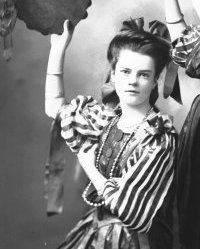
Marguerite Burnet Tambourine All Stars - Roy Studios (Petersborough, Ontario)
I asked my mother recently if movies were ever shown in St. Vincent and Pembina. She said yes, but in town halls, not movie houses.

She also said there were live acts that put on shows in the halls, but wasn't sure if it was strictly amateur, or also professional (vaudeville, etc.)

There very well could have been professional shows. According to Frank Cullen, American Vaudeville Museum, this area "...was on the 'death trail' or 'silo circuit' of vaudeville; an excerpt from my forthcoming two-volume set, Vaudeville: Old & New: an Encyclopedia of Variety Performers in America (to be published by Routledge, September 2006)":
The 'Death Trail' was a patchwork of theatres on several small small-time circuits, such as Ackerman & Harris, and Webster's. George Webster sometimes booked only one live performer and one film and demanded as many as ten shows a day. Among the Canadian outposts on the 'Death Trail' were Winnipeg, Regina, Moose Jaw, Saskatoon, Medicine Hat, Calgary and Edmonton. The situation on the USA side of the border wasn't much better, with dates in garden spots like Fargo, Jamestown and Deadwood in the Dakotas, Duluth in Minnesota, Butte and Missoula in Montana and Coeur d'Alene, Idaho.