Showing posts sorted by relevance for query 1897. Sort by date Show all posts

Friday, December 22, 2006

1897 Red River Flood

April 22, 1897 - Dr. Harris home in Pembina, ND This is Doctor Harris' home during the 1897 Flood; Chuck Walker tells me that the same photo was featured in comparison to the house today in a New York Times piece reflecting on the 100 year anniversary of the 1897 flood.

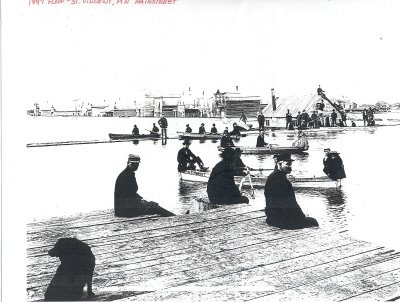
St. Vincent's Christ Church rectory during the flood; although boats were used, as you can see from the man standing in the water, it was only about 18" deep in that particular spot. Still, I think the people in the boat have the better idea!

Monday, January 10, 2011

Collector Photos: Wayne Stewart

I can't prove it, but I'd bet that this photographer is the one who took
this infamous photograph of the 1897 Red River Flood in St. Vincent...
These photos are from the Wayne Stewart collection. This first photo shows another photographer taking a picture. The photographer being shot is setting up to take a picture of two men in a boat during the 1897 flood in St. Vincent. The print is labeled as taken on April 22, 1897; written on the side of the boat are the words, "Ferry Boat for St. Vincent".

Ad sign, as seen on building in above photo

Further in the background, on the upper story of the storefront behind them, is an ad for Climax Plug Tobacco, a popular chew of the time, and purported to be the inspiration for the Minnesota town of the same name.

I've been in touch both indirectly and directly a few times with Wayne in recent months about various subjects, mostly connected with his photograph collection, but also his brother Bob.

In a mailing to me from last year, that included the photos in this post, Wayne had this to say...

Friday, February 06, 2009

Profile: William H. Moorhead

William MoorheadThis is William Henry Moorhead of Pembina. He was known to be, among other things, a land speculator and an undertaker.  Why the text says he died in 1871, I cannot explain, but according to all sources, he did not die until 1897.

Sometimes referred to as "Highwater Bill" - according to the Chuck Walker's family oral history, because "...during one of the floods a wager was made between some men...Bill Moorhead drove a board in the water with a knot hole and said, 'The water will come up and run through the hole.' He won and later it was said that he came back after dark and drove the board deeper..."

Oh, dear...well, gossip aside, I rather like his moniker however he came by it, cheating or legitimate!

William Henry married Lizzie La Verea, a French Canadian, of North Dakota, where he was employed by the Hudson Bay Company, later owning a large tract of land and an undertaking establishment at Pembina, N. Dak.; the town of Moorhead, was named for him. He died July 3, 1897. His children were: James, Stanley, Shepley, Mary, Delia, and one or two who died in infancy.

Mr. LaFromboise says the men prominent in making Walhalla are Father Belcourt, John Meger, Joseph Rolette, William Moorhead, and Charlie Bottineau. William Moorhead was the first whiteman that he remembers at Walhalla Dak. Territrory. Mr. Moorhead and Jim McIntosh another white man came about the same time, this was about 1863. Jim McIntosh was later killed by Indians while he was carrying mail from Devils Lake South west to another post. A lady named Mrs. Reed was one of the first white women in Walhalla. - From the Early History of North Dakota

He was born at Freeport, PA Sept. 20th, 1833, and died at Pembina, July 3rd, 1897. He came to St. Paul in 1852, and arrived at Pembina, Aug. 20, 1856, with the Red River Carts, bringing supplies from St. Paul. With him came Antoine Girard and Lucien Geroux. He was in partnership at St. Joseph with Joseph Lemae, and after the latter’s death, he returned to Pembina.

Moorhead was one of the early settlers of Pembina, N.D., who had traveled in Roseau County before the white settlement. Two of his sons settled on what is known as the Northwest Angle of Lake of the Woods. Moorhead told J.W. Durham that Roseau County was the greatest. From Minnesota's Last Frontier

Saturday, January 21, 2017

Ephraim Clow: Professional Pedestrian

I have been one acquainted with the night.
I have walked out in rain — and back in rain.
I have outwalked the furthest city light.... 
~Robert Frost

Ephraim Clow was a cousin of mine on my grandmother's maternal line.  Family oral history said he was a long distance runner and had run in the Boston Marathon and won.  I had to find out if this was true or not.

I first found out that the Boston Marathon began in 1897.  Ephraim was born in 1854.  In 1897, he would have been 43.  Above-average age to be doing a marathon.  So I wondered, could this be a situation where the family oral history had a nugget of truth, but it wasn't quite how it was remembered?  In fact, it was.

First, I checked to see if Ephraim had ever been in Boston.  I found that he had.
Ambrose Clow, and his brothers, Charles, George, and Ephraim, went to Boston to seek their fortune. Around 1878-1880, he received word that land was available in Minnesota. Charles was sent to check out the territory. What he saw (in Kittson County) pleased him so he advised his brothers to join him in this new venture. Ambrose brought his new wife, Mathilda Crewye, who was also born on Prince Edward Island. Ambrose had a house built in Humboldt where he and his wife lived the rest of their lives. They had a son, George Victor, who was born 19 Nov 1880.  
 - From George Clow family lineage on Red River Valley website. 
A racing Pedestrian, being avidly
observed by spectators mid-race
I found out that during the early 1880s, Ephraim was a competitor in pedestrian  races, or "go-as-you-please" races. I've found him mentioned in newspaper articles during the right time period, and in Boston.  I had found my cousin.  And I had confirmed that the family oral history was true - just a bit wrong in the details!

To find out more about what race walking was like in its 'Golden Age', check out this podcast that features the author of the book - Pedestrianism: When Watching People Walk Was America's Favorite Spectator Sport – Matthew Algeo.

A passage from the book mentions Ephraim, alleges a possible scandal he may have been part of:
Early on the morning of the final day of the race, the Boston Globe reported, “...an utterly unexpected and exciting incident occurred...” - Ephraim Clow of Boston, who had been backed heavily to secure second place, and who stood third on the score-sheet, with every prospect in his favor, as he was undoubtedly the freshest man on the track, suddenly left the track and went to his room. Inquiries were at once made as to the reason for his action. He gave various excuses, all of a flimsy character.  
I could find nothing else about the matter, or how it was resolved.

Ephraim eventually came to Kittson County as his brothers had done. He and his family settled in the Humboldt, Minnesota area, where Ephraim farmed for some years.  By the time of the 1910 and 1920 censuses, the family is living in St. Vincent. Evidently they moved there from their farm, in their later years.


This article mentions Ephraim Clow in the middle of the final paragraph; he is
included among those with the best records in the O'Leary International Belt,
held in the old Madison Square Garden in New York City, in January 1881...

[Source:  New York Tribune, May 23, 1881 - chroniclingamerica.loc.gov]

Wednesday, December 20, 2017

Traveling Shows: Uncle Tom's Cabin

Source:  Pembina Pioneer Press (August 13, 1897)
In his book, “Uncle Tom’s Cabin on the American Stage and Screen,” drama professor and theater historian John Frick of the University of Virginia’s College of Arts & Sciences chronicles how Stowe’s novel was adapted to theater not long after the book the plays were based on, was published – and details how, by the beginning of the 20th century, more than 400 separate companies traveled and performed some theatrical version of the story.

The Tom Shows as they were colloquially known as, were “ubiquitous and part of the common culture by the end of the 19th century...” Professor Frick said – a theatrical phenomenon that bridged culture, commerce and ideology.

The shows were a small industry built on the genre known as moral reform dramas or melodramas, such as “The Drunkard," “The Gambler,” or "Ten Nights in a Barroom," which were widely received.

Midway through the traveling shows' popularity, the show advertised in this newspaper ad (see left) came to our area, including Pembina.  Going by what the write-ups uncovered, it would have been quite the show, especially under a big tent as it was.  Excitement would have pervaded the atmosphere as you waited for the show to start!  Prior to the show, the show's performers  would arrive in town to much fanfare, later parading through the town to drum up business, encouraging one and all to attend the show that night.  Yes, it would be quite exciting for small towns in 1897...


Part of the Terry Show's train, and company readying themselves for the pre-show parade...
Terry Show troupe portrait, in front of the show's tents; note Uncle Tom's Cabin in center back...

Wednesday, November 26, 2008

Maggie's Book: Part I

Back in August, I wrote that once Gamble descendent Alice had time to scan her ancestor's scrapbook (known as the 'Maggie Book'1) - then donate it - she would share with me copies of the pages I had told her I'd like.

Recently I received those copies, and here is the first example...

PEMBINA, N.D.,
FRIDAY,
APRIL 23, 1897


THE FLOOD
_______________

An Awful Storm on Easter Sun-
day Adds Horror and Makes
Havoc to the Already
Distressed.
_______________


The flood has kept rising slowly and steadily since our last week's report. On Wednesday morning it came to a standstill, and has fallen about two inches up to to-day noon, (Friday,) and it is hoped that the high water mark of this year has been reached, being about thirteen or fourteen inches above the flood of 1882, a total rise of 42 feet 4 1/2 inches. Here in the city, between the railroad and river, there are yet about a dozen dwelling houses with dry floors. West of the track it is still quite dry and most of the houses in that locality are dry. The stores on the west side of Cavileer street are as yet all right. Some of them however had their floors just on a level with the water, and two or three inches of a rise would make considerable trouble for a good many folks. The Winchester House is still high and dry and the Pembina House is above the level and while the Headquarters is a little moist down stairs yet is doing business just the same. Quite a number of families have gone to the hotels to stay during "the unpleasantness." Most of our towns people however are living "high" but though somewhat elevated have no disposition to look down on more fortunate or unfortunate people. Full preparations were made and as everybody was prepared, the only result to most people is considerable inconvenience for a time. Our people are taking the matter philosophically and are and have been this week taking active steps to aid others, whose troubles are real misfortunes, and whose losses involve nearly all they possess. Of course the general hope is that we have seen the worst and that the waters will speedily retire to their natural bounds.

THE STORM

If the flood had come no higher than in 1882 and the weather remained pleasant, the flood of 1897 would not have been a very serious affair except in some few cases. But most people had made 1882 the extreme possible limit and thought of no danger of anything above that. But the water not only came above that, but the severe wind and storm of Easter Sunday passed over miles of water, raising great waves which beat down houses and barns and sent others floating to distant places.

No tongue can speak the horrors and terrors suffered by many families, by women and children, who were exposed to the pitiless storm and the relentless waves, miles from land. The mariner in his ship has a chance to fight for his life; good seamanship and hard work and he may or can weather the gale, but these poor wretches huddled in rickety buildings, rocking in winds and waves, helpless as babes, without fire, with the spray freezing in fantastic shapes where it fell. Oh! the horror of it.

A few houses in this city were somewhat exposed and the inmates were somewhat frightened, but the railroad grade, the numerous sidewalks staked down, and the surrounding timber broke the force of the sea and wind to most of the houses. At the grade the sight was like the sea shore in a storm. The spray from the waves dashed as high as the tops of the telegraph poles and one side of the grade was badly washed away. One side of the front of William Moorhead's undertaking building was torn off by the force of the wind. One of T.L. Price's large windows was blown in and a section of the shingles on the Episcopal church was ripped off. Fortunately a large proportion of the sidewalks had been staked before the storm and most of it remains in position. Perhaps no one in town had more trouble on their hands on Sunday than Charley Atkinson and his men. Mr. Atkinson had a herd of cattle for shipment about 125 in number. He had driven them to the western part of town beyond the depot but they had no shelter except that they were behind a barn and some hay stacks. It was found impossible to get there from town by boat and Mr. Atkinson made several trips on horse-back through the icy water and waves, the spray freezing on his horse as he went. The cattle came out without loss, and have been driven to Neche for shipment to-morrow.

Gisli Gislason, an Icelandic carpenter, about six in the morning Sunday, saw two boats get loose from Mr. Oliver's hotel in South Pembina; with two other men he followed in a large boat to bring them back. They found themselves drifting before the wind in the middle of the river, with waves mountain high, and in spite of their best efforts they drifted up the river, and landed on the roof of a submerged house on the river bank nearly opposite Fort Pembina. Only a small portion of the house was above water, and there the three remained until Sunday evening, ready at any moment to make a jump for the boat, if the house toppled over. They got to the Fort that evening and arrived back next morning, just as searching parties were starting out for them. Although they suffered seriously with cold yet they were all right next day.

It was very hard work and attended with some danger to navigate the icy sidewalks, and an "alpen stock" was almost absolutely necessary to prevent being blown into the water. Our sidewalks and crossings though generally well staked were badly scattered in some parts of town, by the storm, and it will be no small expense to put our sidewalks and bridges in shape again. A peculiar incident of the storm was the sudden fall of the water. Beginning about 7 o'clock Sunday morning the water fell over an inch an hour for five or six hours, and continued until about five o'clock in the evening dropping nearly twelve inches. Of course this cleared the water from the floors of most of the residences and there was much rejoicing, but the next day it was all back again and two inches more. It was doubtless the action of the wind on the surface of the water.

STEAMER "GRAND FORKS."

On Wednesday evening the steamer "Grand Forks" sounded her whistle opposite Pembina and in a few minutes nine-tenths of the male population and even some ladies, were at the Pembina bridge to meet her. The steamer tied up at the edge of Cavileer street, her bow pushing in the floating sidewalk on that side. She was under the charge of Mr. O.W. Pennison as manager fro the Great Northern railroad company, her owner. Capt. Bruce Griggs is captain and Capt. Perrault, pilot. The steamer and crew is furnished by the Great Northern railroad company, the fuel is supplied by towns and counties along the river, Grand Forks merchants sent a large quantity of supplies under the charge of Capt. James Elton and East Grand Forks merchants an additional amount under the charge of Mr. DeWolf. This is the third trip of the steamer for the relief of the flooded farmers. She left Drayton Wednesday morning and the history of her trip northward is similar to the report given us by Messrs Colley and Hogg who came by sailing skiff the day before. Hundreds of farm buildings wrecked and floated off, considerable stock drowned, and a repetition of the terrors suffered by people caught miles from land in half-floating and rickety houses, and of people and stock on roofs and rafts exposed to the waves and winds. We have not space nor time to give a tenth of the stories that are told of the sufferings and but a small part is yet told, and much will never be known.

The steamer had on board three women, a widow Johnson and two daughters who, lived near the river ten miles west of Hallock on the Minnesota side. A part of her house had floated away and she had fifteen head of cattle. These were taken on board the boat. Besides these cattle there were also about thirty head of horses and cattle belonging to Messrs Murray, McLellan, McKean and McLean from near Bowesmont. These will be landed at Drayton on the return trip.

The steamer left early on Thursday morning to continue her relief service as she went southwards. On her trip north she left several men and boats to go through the Snake river country east of Drayton, where considerable suffering has been reported and she will pick them up on her return and do what may seem necessary for the relief of the flooded farmers.

And here we may say, that both the Great Northern and Northern Pacific companies have not spared expense or trouble in sending relief boats and trains, and the liberality of Grand Forks and East Grand Forks is certainly very opportune and kind hearted. The party of Drayton people who took their boats on a special N.P. train to Bowesmont on Monday and spent two days of hard work in rescuing people and stock deserve particular credit for their thoughtfulness as well as willingness.

On board of the steamer as passengers were Messrs Wylie, Wallace, McCrea, and Crandell of Drayton, Cashier D.C. Moore of the First National Bank and H.L. Hausseman druggist, of Grafton. These gentlemen ame down to look over the situation, so as to be better informed as to the relief needed, and which they have to some extent initiated. Besides these mentioned were Messrs Thos. Murray and Mr. McClellan, in charge of part of the stock on the barge, and the three women, Mrs. Johnson and daughters before mentioned. Capt. Elton and son were also passengers.

SEEN FROM A SKIFF

Mr. J.T. Colley and Howard Hogg came down from Drayton on Tuesday evening in a small sailing skiff. Mr. Colley was interviewed by the Pioneer Express and his story of the voyage will give our readers an approximate idea of the troubles and misfortunes of the farmers who reside in the flooded district. Of course in just a sailing trip of forty miles or so from Monday noon to Tuesday night, the information gathered is must necessarily be fragmentary and sometimes erroneous as to detail, but enough is certain to show what an awful state several hundreds of our friends, neighbors and citizens were placed in during the terrible storm of wind and wave during Saturday night and Sunday, and the particular instances given are only examples. For it must be remembered that an extent of country averaging at least five miles on either side of the river from about Grand Forks to Winnipeg is and was submerged with the flood, and hundreds of farm buildings are or were standing in water, some as high as the eaves, and many from three to five miles from the nearest land. In this county the country east from Bowesmont is low and the flood is a mile or two beyond the railroad track at that place.

In South Joliette the water is four or five miles inland. The water near the banks of the river is about five or six feet deep on the average and then shoals up very gradually to the dry land, as the country is so nearly level. The Minnesota side is generally somewhat lower than our side and the water is farther inland. The water on Monday was eight and a half miles out of its banks eastward and only one and a half miles from Hallock. The Minnesota side is not so thickly settled over here, but there are farmers all along. On this side, in the flooded district, there is a farmer on almost every quarter section; and as we stated last week a large proportion of them had no crops last year owing to the heavy rains. This much for the general situation, the following cases of loss, and hardship, as we said, are simply examples, and the reader will be able to imagine the rest. In only a few instances where people had exceptionally good buildings, was there an attempt to remain in the upper stories until the flood subsided. Nearly all the farmers along the river had driven their stock back to high land, but in many cases, some one or two persons were left at the house to take care of things, or rowed there in bats on Saturday and were caught by the storm, not daring to face the waves in their rude boats.

Messrs Colley and Hogg left Drayton as stated, about noon on Monday. They had heard it reported before they left, that there were no particular cases of suffering towards the north. On their way down towards Pittsburgh, they saw many buildings badly wrecked. When they came to the house of Mr. George Reid Sr. they found it badly wrecked, granary and out buildings, with seed and contents all gone. Mr. Reid and family consisting of his wife, daughter and niece, were in the house and had been badly frightened by their terrible experience of the day before. Another boat came about this time and between them the family was carried to the nearest dry land, the railroad grade, two and a half miles distant. Here a rescue train from Drayton was found standing on the track. Word had been sent out from Bowesmont and a car had been loaded with boats and men and on arrival they went promptly to work at rescue and relief. After leaving the Reid family safe but still suffering from their fright, Messrs Colley and Hogg sailed to the north again.

At the house of Mr. Campbell three or four boys, his sons, who were there taking care of things, had to abandon the house during the storm on Sunday and go through five feet of water to the barn, where they remained on the roof until Monday morning in their wet clothes without fire. They lost some cattle as well as other property.

Frank DeLong son-in-law of old Mr. Reid, before mentioned, was in his house during the storm with his wife and several children. The house rocked violently with the waves, and they expected every minute to be dashed to pieces. They were rescued Monday noon. They had no fire and though wrapped in bed clothing they were very cold.

George Reid Jr. lost part of his buildings. Himself and family were at Nowesta on high ground. Israel Black also lost part of his buildings but fortunately was away.

Robert McLean's house washed away and both he and his brother Lemuel lost seed grain. The father, old Mr. McLean, is very ill and on his account the family had moved to high ground, and thus were saved from a watery grave.

The house and buildings on the farm of Joseph Shaw, who resides in this city, and rents the farm to Tunis Simmons, was destroyed, with seed wheat and other stuff.

James Craig and W.H. Purdy lost all their buildings, with seed wheat and other stuff. Themselves and families had removed.

James McClellan's fine house built to stand above 1882 mark is badly damaged.

Joseph Lareva lost buildings and everything in them including seed wheat.

On W.P Goff's place rented by Tom Murray, Murray was in the stable and the hired man was in the house. The house is gone, and there is no news from the hired man. So far as is heard this is the only probably loss of life.

District No. 12, two miles and a half southeast of Bowesmont has lost its school house.

All the buildings on the David Murray place were destroyed. James Nicholson lost part of his house and some stock. Two boys and two girls who had been left to take care of the stock were rescued on Monday.

Adam McKibben lost all buildings and contents. High Patterson's buildings are all gone.

When about a mile west of the house on the Joliette road, which was formerly the residence of Joseph Muir now deceased, and now owned by Geo. Switzer, Mr. Colley, who sat looking backward in the boat saw something like a flag flying from the top of the house. After some discussion and hesitation, as it was getting late and they wanted to get to Pembina, they concluded that it night be possible that some one was there and in trouble. So they retraced their course and went over. They found Switzer and High Patterson there. Switzer said, "How much will you take to put us ashore?" and could hardly realize the fact that Messrs Colley and Hogg had come purposely to help them. A part of the out buildings had floated away and tone whole end of the house was just attached by the top to the building. They had gone out to the buildings on Friday , the wind got up and they did not dare to venture back on account of the waves. Next day the boat had drifted away. All day Sunday they stood by the open windows ready to jump if the building should fall, hoping in that case to get to a part of the stable which still stood.

1 - It had once been a chemistry book over 100 years ago, but Maggie O'Neill used it as a scrapbook, pasting in all the newspaper clippings she was sent from the Gamble family about events concerning the family and/or St. Vincent over a 50+ year period.

Thursday, March 01, 2007

Gamble Letter #41-44

1897 FloodThe winter of 1896/1897...it was a portentious winter, with heavy snowfall. It would lead to one of the worst floods on record. Read about that winter, and more, in these Gamble letters...

St. Vincent, Minn.
Nov. 25, [18]96


Dear Maggie,

I received your letter some time ago I was waiting untill my school closed before answering it, it was so cold the last three weeks, I had to stay at Lizzie's I finished teaching my first three months, last friday.

The like of the fall of snow and cold weather has not been known for many years, it is almost impossible to go any place the roads are so badly drifted. 31 is the coldest is has been so far. Aleck has gone to Colorado Springs, he went with a boy George Ford, who has asthma too, we have had only two letters from him, he says he has not had the slightest touch of asthma, since he has been there. I think he will stay till spring. Maggie had a little girl a few days before he went away, she named it Mary Mildred, Jennie & Jack are living with Maggie helping take care of the place for the winter. They moved their house out of town unto their farm, but it was to cold to fix it up till spring. I think I have told you pretty near all the news this time is is still snowing and stormy. I think this all for this time.

Good by from Yours as ever,
Alice Gamble

- - - - -

St. Vincent, Minn.
Jan 25 [18]97


Dear Maggie,

I received your letter alright I have been waiting to see if something new would turn up before writing, but since nothing turned up only colder weather I decided to write.

It has been dreadfully cold lately Pa says it is the coldest winter since the year he came up 42 degrees [below?] is the coldest it has been yet, we have a snowbank as high as the house on the wash side, it is quite a protection from the north winds. There has been a blizzard almost every day

[1 page missing]

would like to go away with Aleck if they would let me. But I do not think I would be pleased no matter where I went for I am a dreadful crank.

Write soon, Good by from your loving niece,
Alice Gamble

- - - - -

St. Vincent, Minn.
Feb. 6, [18]97


Dear Maggie,

I received your letter today. Aleck is better now he has been sitting up now for two days, we think he will soon be all right again. The doctors did not have much hope for him, "...it was pleurisy he had." He is still very weak. I only seen him once since he was sick and then when he was sitting up. I would not have known him. He was so thin he is going back to Colorado a week from Monday. He has sold quite a lot of his things, but not sold

[1 page missing]

May has been staying with us since Aleck is sick, she likes her Grandpa and Grandma better than her father and mother.

[1 page missing]

- - - - -

St. Vincent, Minn.
March 7, [18]97


Dear Maggie,

I received your letter alright. Aleck has gone to Colorado Springs. He sold his farm, horses, and everything he had on auction sale. The things did not go very high, he sold the farm to man the name of Sandy Blair a scotchman who has been working on the Reid Farm he got $3700, I think and he sold $1000 worth with out the farm, horses and machinery they left here last Tuesday the 2nd he felt bad about going away, he will not be able to work for a while, his address is Colorado Springs Colorado, we have all had somthing like the Gripp. Ma is quite sick yet.

I pretty nearly came forgetting the best news. Lizzie has another little girl. I can scarecely keep track to the Babies there are so many this baby is just as pretty as the other two. I think Maggie & Alice, are the two sweetest little girls in the world. I wish you would see them. Lizzie says she don't know where they got their good looks. Maggie is dark and Alice fair. There is no sign of spring yet. The snow gets deeper and deeper. The natives prophesy a flood. In some places the snow banks are so high that a person walking can touch the telegraph wires. I think I have told you pretty near all the news this time do you know some pretty names for girls Lizzie can't get a name nice enough for her baby. I think you told us some nice names in one letter but I lost it, they were names of our cousins I think or some relation. Good by for this time, I remain as ever

Alice Gamble
Only a month or so after the last letter here, the flood would hit the Red River Valley.

Tuesday, May 25, 2021

A (Back)Story of a Drowning: John Mortimer, St. Vincent, & the Red River

John Thomas Mortimer – Portrait of a Radical


by Isabel Watson


When we were children, my Mother often talked about her childhood: her parents, her brothers, their home life. She had a fund of stories too about aunts and uncles, many of whom we had never met but whom we came to know through the many retellings. This is often the starting point for family history exploration. One detail frequently mentioned was that her father had farmed in Canada at one point in his life and one of his sons from his first marriage had died tragically by going through the ice on the Red River "near Winnipeg" (read: St. Vincent, Minnesota) and his body had not been recovered until the spring. We knew nothing more than that bare outline of a story. It was not until I began to research my Grandfather's life that I came to discover the full extent of the story of John Thomas Mortimer.


My Grandfather, James Mortimer, was born at the Home Farm, Kirkton of Tealing, in the rural hinterland of Dundee in 1841. He came from generations of farm workers, many of whom had had small-scale tenancies on the Glamis estate, especially at Upper Arniefoul. Although James's father Alexander had moved to nearby Tealing, then to Balbeuchley at Auchterhouse, James returned to Glamis to serve his apprenticeship as a blacksmith with Peter Anderson at the smiddy there. Perhaps looking for more lucrative employment after his time was served, he moved to Dundee to one of its many jute mills, Ladybank Mill, and in 1864 married Ann Russell, a steam loom weaver, in Lochee. They were to have six children before Ann's untimely death from cerebro-spinal meningitis in 1876.


John was the fourth of the children, born on 3 March 1871 at 3 Laing Street, Dundee, becoming the eldest son, as the first-born boy, Samuel, had died aged two in 1867. After Ann's death, James was married for a second time in 1880 to Helen Innes (nee Watson), widow of a blacksmith journeyman. Their marriage certificate provided a surprising piece of new information: James's occupation was given as 'Insurance Agent'. From blacksmith to insurance agent – how had this transformation occurred? My Mother had always favoured the Prudential Assurance Agency because of her father's connection to that company. So I felt it would be worthwhile to approach their Head Office in the hope that they might have some archive material about former employees. Their Archivist was able to provide me with a full account of my Grandfather's career with them – treasure trove indeed!


The  history of the company, A Sense of Security: 150 Years of Prudential, gives an idea of how field staff were recruited, being 'only capable men of thorough respectability, and of favourable appearance and address'. In his latter years, my Grandfather continued to demonstrate a lively mind and interest in a wide variety of subjects. It is likely that he had pursued evening class studies as a young man and was eager for self-improvement, thus fulfilling the requirement of being seen as capable.


In the Census of 1881, the family was living at 13 North Wellington Street, Dundee, with father working as an Insurance Agent and Helen established as wife and mother to the five children, all still at home, Maggie (13), Annie (11), John (10), Alexander (8) and William (6), all scholars. Between his initial appointment to the Prudential in 1876 and 1884, James held contracts of employment in Dundee and Forfar, then in February 1884 he was appointed to a position in Airdrie, Lanarkshire, where he was to remain for most of the rest of his life.


By the 1891 Census, James and Helen were living at 13 High Street in Airdrie and had only two of the family still living at home, Alexander aged 18, a schoolmaster, and William aged 16, a letter carrier. The daughters had moved out, perhaps into employment, and John was in lodgings in Glasgow at 113 McAslin Street (St. Rollox) and working as a tailor. His fellow-lodger in the home of John and Mary Mitchell was Peter McPherson, who would become his brother-in-law by marrying his sister Maggie.


A moment of serendipity


I need to digress at this point to explain how it was I came to learn of the Canadian part of the story. What follows is a moment of serendipity. I had joined the Tay Valley Family History Society and being distant from the Research Centre in Dundee, was delighted when an e-mailing group, Tay Valley Bridges, was set up to bring into contact the many members worldwide who were not able to visit Dundee regularly. On one memorable occasion, an online conversation was taking place which involved Winnipeg. On a whim, I posted a request to see if anyone could tell me how to go about tracing the death of a young man named Mortimer by drowning in the Red River, on some unknown date. Back came the reply from fellow-member Susan Bethune, who happened to have in her possession a copy of the Dictionary of Canadian Biography, with an entry about John Thomas Mortimer, tailor and Trade Union activist. And so his story unfolded.


It is by no means clear when John first went to Canada. He was registered as an American citizen in St. Vincent, Kittson County, Minnesota, on 11 June 1906, having 'landed at the port of St. Vincent on or about the month of November in the year eighteen hundred and ninety'. This information seems at least debatable.1 His entry in the 1891 Census in Glasgow is quite clear and credible. There would not be any obvious reason why, having made the journey to the USA or Canada, he should immediately return to employment in Glasgow. His connection with St. Vincent came about through his wife, Lena Cameron, of whom more later. The first mention of him living in Winnipeg is in 1895, when we find him listed as a tailor in the Henderson's Directory and resident at 326 McDermot Avenue, Winnipeg. along with Wm. Mortimer, described as an engineer. The brothers remained at that address for each year until 1898.


The year 1895 certainly does seem significant. My Grandfather James and  his wife Helen also travelled to Canada in that year. James resigned from his employment with the Prudential in April 1895 and was awarded a gratuity of £30. He and Helen sailed from Glasgow on 25 April, occupying a second-class cabin on the SS Samaritan, and arrived in Montreal on 8 May. They would then have made their way overland to Winnipeg. Little is known of their time there. James had a farm near Brandon, north-west of Winnipeg, which he eventually sold to a James Fraser in 1897 before returning to Scotland. It was always related within the family that Helen was unwell and yearned to go back home to Scotland. Indeed she died in Airdrie in 1898 and is buried in the New Monkland Cemetery. Grandfather James subsequently married for a third time, to Isabella Ann Power, my Grandmother, and had a new young family of which my Mother was the only daughter.


John's involvement with the Trade Union movement in Winnipeg is well documented. John Hample, in his entry about John Thomas Mortimer in the Dictionary Of Canadian Biography, states: After September 1896 he began a rise to prominence in Winnipeg's working-class movement by helping to rebuild Local 70 of the Journeymen Tailors' Union of America (JTUA), affiliated with the American Federation of Labor (AFL).


Local 70 had originally been formed in 1892 to give the tailors of Winnipeg protection from the sweatshop practices of the men's custom-made tailoring workshops. After a fruitless strike over an attempt by the merchant tailors to cut wages, Local 70 had been adrift. In 1897, JTM was elected its President and promptly set about galvanising the union, urging the City Council to impose conditions in their contracts for the
manufacture of clothing and intervening on behalf of factory seamstresses during a strike which led to the establishment of one of the first unions of women workers in Canada.

By 1899-1900, he was President of the Trades and Labor Council of Winnipeg, representing that organisation at meetings of the Trades and Labor Congress of Canada. During this period at the turn of the 20th century, he developed a close association with Arthur W. Puttee, acting as his election agent in a Winnipeg by-election which made Puttee Canada's first independent Labour MP in 1900. Puttee acted as John's best man at his marriage to Lena Cameron on 2 September 1901, immediately after the Labor Day Parade through Winnipeg.

Lena was the daughter of Edmund Cameron and Allis Clow, who had settled in St. Vincent, Minnesota, just south of the Canadian border on the east side of the Red River, having moved out west from Prince Edward Island, and like John she was a labour activist. John had begun to make a name for himself as an uncompromising militant, considered 'impossibilist' by some in his demands for workers' rights and justice, but was highly regarded within trade union circles. He had reputedly been saving money to enable a visit home to Scotland, but a major national strike of the JTUA saw him invest his money into the strike funds, only to be fired from his job, reviled in the press and ultimately blackballed from employment in the tailoring trade in Winnipeg.

Thursday, July 05, 2018

History of the Kittson County Bench & Bar

"The term was finished in two and a half days, and the balance of last day, awaiting the arrival of the train south, was spent fishing by the court and attorneys, after each catching his own frogs for bait. To the younger members of the bar it was rather an amusing circumstance to see Judge Stearns, then well up in years and of a very dignified and patriarchal appearance, lay aside his judicial dignity and pursue the diminutive amphibians with an agility which surprised them all."
And such were the salad days of early Kittson County law!

To learn more about it, read on...
_______________________

Bench and Bar of Kittson County
By Peter H. Konzen

Foreword by
Douglas A. Hedin, Editor
Minnesota Legal History Project (April 2008)

The article that follows is a highly personalized history of the bench and bar of Kittson County written by Peter Henry Konzen, a prominent attorney. After devoting two pages to early terms of the district court, Konzen announces that he will avoid “the monotony of legal routine” by describing two amusing trials—the prosecution of Kate Rafferty before Ozora P. Stearns, a legendary judge of northern Minnesota, in 1883, and a civil suit for damages for the killing of a dog, in which he represented the plaintiff, in 1888. Konzen’s client was awarded an amount somewhat less than he sought.

In the style of most county legal histories of this period (it was published in 1909), Konzen includes biographical sketches of eight lawyers who practiced in the county, the longest being of himself. Apparently finding the opportunity irresistible, he wrote, Mr. Konzen is recognized as one of the ablest and most prominent attorneys north of Crookston, and during his residence at Hallock has amassed a snug little fortune, besides building up a professional and business reputation of which he may well be proud. He has helped in an eminent degree to shape the destiny of his city, and when the history of Kittson shall be written he will appear as one of its most conspicuous figures.

There is an ironical footnote to this flattering self-portrait. Konzen died on July 15, 1935, twenty-six years after the publication of his article on the county bench and bar. His death was headlined on the front page of the Kittson County Enterprise on July 17, 1935. The newspaper described not only Konzen’s final days but also, under the subheading “Biography,” his youth, education and early years in the county. Almost all of that “biography” was taken verbatim from Konzen’s earlier self-portrait. Thus Peter Henry Konzen was placed in the unusual position of writing much of his own obituary.

Passes To His Eternal Reward
Peter Konzen, Pioneer and Highly
Respected Citizen Passes Away
After Long and Useful Service
to City and Community

Peter H. Konzen
Today Hallock mourns the passing of one of her most outstanding venerable citizens and townsmen. Peter H. Konzen, who died at his home in this city on Monday, July 15th at the age of 78 years, one month and 18 days—he has gone his reward. Hallock never had a finer citizen and more devoted father.

Quiet, unpretentious, wonderfully human and amazingly competent, he represented the best that a city can expect from its citizens. His more than half a century of life in our city was a precious gift to his fellows. He had done much good and was ready day or night to serve the needs of anyone who called on him. He never made any fuss about living—he just lived, which is a priceless legacy to those of us who are inclined to philosophize.

He was a man of quiet, retiring disposition and minded his own business, both with reference to himself and others. In his youth, he was of good physique, but of late years had suffered afflictions incidental to advanced years, which at times confined him to his bed and home. About a week before his death he again became afflicted and gradually and slowly sank, growing weaker and weaker, with but little pain until about three days before his death when he became overcome with chills. At the last, however, death came peacefully and quietly, and while apparently in sleep, his breath came slower and slower, until the last. All of his family were at his bedside excepting a daughter, Mrs. F. V. King, who in a race with death across the continent failed to arrive in time to see her father alive. During his final illness he was watched over by members of his family and friends and a special nurse.

The funeral services were held from St. John’s Episcopal church Wednesday afternoon with Rev. S. J. Hedlund officiating. The cortege was the largest ever gathered in Hallock, which testified to the high esteem in which the deceased was held in the community. The active pallbearers were members of the Kittson County Bar Association of which the deceased, was a member. They were: A. D. Bornemann, Wm. L. Peterson, J. E. Sundberg, C. J. Hemmingson, John Matt Brendal, Lyman Brink. The honorary bearers were twenty pioneer citizens of the town. The district bar association also sent delegates to attend the funeral. These were: L. S. Miller, Martin O’Brien, Wm. P. Murphy, W. E. Rowe, F. A. Grady, Crookston; H. O. Chommie, C. M. Bishop, Theodore Quale, Thief River Falls; Judge B. B. Brett, W. O. Braggans, Oscar Knutson and Rasmus Hage, Warren.

The remains were laid to rest in the family lot at Greenwood cemetery, beside those of his wife who preceded him in death several years ago, and thus has passed away another of our old timers—they are passing away and soon only their memories will be left. May they all leave as pleasant recollections as does our friend and venerable townsman—God rest his gallant soul.

Biography

Peter H. Konzen was one of the pioneers of Kittson county, having located here in the spring of 1881, when a young man of 24 years. He was born on the 27th of May, 1857, in Chickasaw county, Iowa, on a farm now embracing the site of the village of Lowler. His parents emigrated from Germany in 1852 and the following year located on the farm upon which deceased was born. He was the third child of a family of five, all of whom have since passed away, excepting one, Mrs. Kate Buchholz living at Forest City, Ia. He was educated in the public schools of Lawler, afterwards attending an academy at Bradford in that county and completing his education at the University of Iowa City and at Boyleer’s Mercantile College at Keokuk, Iowa. His boyhood life was spent upon the farm until the age of 17 when he began teaching while completing his education.

In 1878 he began the study of law, first in the office of Judge H. H. Potter at New Hampton and afterwards under the direction of John R. Geeting, a gentlemen who later rose to considerable distinction as a criminal lawyer in the city of Chicago. Mr. Konzen first came to Minnesota in 1879 and entered the law office of a Mr. Parker at Sleepy Eye, where he remained until the fall of that year when he again returned to Iowa to enter the newspaper business, editing the Lowler Herald until the spring of 1881, when he sold out and returned to Minnesota and locating at Hallock, then a hamlet numbering not more than half a dozen buildings, where he opened a law office, and in the words of the immortal Horace Greely, “grew up with the country.”

In the fall of 1881 Mr. Konzen was elected superintendent of schools for Kittson County which position he held for several years, having been three times re-elected. He had since held various public offices, as County Attorney, president of the Kittson County Agriculture Society and in 1898 was the Republican nominee for member of the state legislature. Although defeated by the tide of populism at that time, he received a creditable vote and conducted a model campaign. In 1916 he was again the nominee for his party for member of the state legislature and this time was elected by a comfortable majority. Mr. Konzen was one of the most progressive and public-spirited citizens in Kittson county. He was for many years a member of the Hallock school board, and it was chiefly owing to his push and perseverance that this thriving little city can now boast of a high school second to none in the state. Mr. Konzen was elected mayor of Hallock in 1897 and held the office for a dozen or more consecutive years to the eminent satisfaction of her people. He had also served as a member of the state drainage board, probate judge and in his time had filled various town and village offices, so that he had helped in an eminent degree to shape the destiny of his beloved city and community.

During his early career in Hallock, he was associated in the law business with W. H. Alley, now deceased, and in 1901 Mr. Konzen and J. D. Henry formed a co-partnership for the purpose of conducting a real estate, loans, insurance and collection business in connection with the law business. Mr. Henry is not a lawyer but handled the insurance, loans, collection and real estate business of the firm and was very successful, especially in the sale of real estate. Konzen’s article appeared first on pages 944 to 951 of the second volume of History of the Red River Valley. It has been reformatted. Page breaks have been added. His spelling and punctuation have not been changed.

Bench and Bar of Kittson County
From:

IN
HISTORY
OF
THE RED RIVER
VALLEY
PAST AND PRESENT


Including an Account of the Counties, Cities, Towns
Villages of the Valley from the Time
of Their First Settlement and
Formation
BY VARIOUS WRITERS
IN TWO VOLUMES
VOLUME II
__________________

ILLUSTRATED
__________________

HERALD PRINTING COMPANY
GRAND FORKS
C. F. COOPER & COMPANY
CHICAGO
1909

Bench and Bar of Kittson County.
By P. H. Konzen.


Thursday, March 16, 2017

Frederick A. Bailey: An NWMP 'Original'

Sgt. Fred Bailey
[Source:  RCMP Veterans Association,
Vancouver Division]

Let me introduce you to an ordinary man who happened to make a bit of local history by just doing what many in his day did - living life, making choices, taking risks.  

"This I believe is the diary of Frederick Bagley when he enlisted in the North-West Mounted Police as a trumpeteer at 15 years of age; They left Fort Dufferin in 1874 to secure the Medicine Line!" 
- J. Rempel

I will be sharing portions of that diary here on this blog at a later time. But for now, let us learn a bit about Sub-Constable Fred Bagley, Trumpeteer ...


According to a fascinating online biography (which I quote here in-full since so many such pages seem to disappear):
Fred Bagley’s musical talents and leadership provided a major contribution to the Force and to the communities he served in.

With regarding setting records, he was first in the following areas: 
a) being the youngest member to be sworn into the Force; 
b) first Trumpeteer in the Force; 
c) present to guard and witness the first person to be hung in the North-West Territories at Fort Saskatchewan; and 
d) first member to lead a musical performance before Royalty.

Friday, May 08, 2015

Final Resting Places: Brown & Kabernagle

Sheriff Charley Brown's grave site is in the north section of the Pembina Cemetery;  his stone reads:
Charles J. Brown
Oct 4, 1884
Aged 39 years
Sgt. Co. I 20th U.S. Infantry

I took this photo when surveying for BillionGraves
Charley sadly had a short, yet amazing life...
Another smaller foot stone acknowledges his service 
as a soldier in the Civil War, but it doesn't attest to 
his time as a POW in Andersonville... 


Buried in the same section is Charley's business partner:

John Kabernagle
Born
Jan 8, 1853
Died
Dec 20, 1893
Aged
40 Yrs, 11 Mos,
& 17 Dys

It's sad that both John - friend and business partner to Charley
Brown - died young around the same age as Charley did...
Another old-timer that was well-known for his many services rendered the town - and his colorful character - is in the SW section of the cemetery:
Who Settled in Dakota 1867
Died July 9, 1897
63 yr 10 mo 17 d
One of our area's true pioneers - Land Agent, Indian 
Trader, Trading Post Clerk, Buffalo Hunter, 
Undertaker, Farmer, and Flood Prognosticator... 
Charley's grave is also marked with a G.A.R. star,
signifying him as a Union veteran of the Civil War. 

Thursday, February 10, 2011

Old Pembina City Hall

Old City Hall in Pembina (1934) - Does anyone know when it was built?
[Source: SHSND's Digital Horizons]
Until recently when a reader of this blog alerted me to this image in an online collection, I had never seen a photo of the old Pembina city hall.  I definitely had never seen the building myself.  What happened to it? I found out that in 1935, a new city hall was built - the one I had been familiar with - and soon after that building was started, the old one burned down.

An earlier photograph (date unknown, but presumably around the WWI
time period) showing parade, with old Pembina city hall in background...
I notice one difference in the building in this earlier shot - no 'City Hall Pembina' sign on the bell tower.  It's possible there is no exterior staircase, also, but the soldiers in the parade prevent that determination.

Since this post is about city hall, let's review some of Pembina's past mayors:

Charles Cavileer - He was also (at various times), Pembina's postmaster, Collector of Customs, and a territorial librarian.
J.M. Chisholm - In 1897, Hamilton, ND is listed as his residence, but by 1904, he's in Pembina, and listed as Mayor.  However, later that same year, he is listed as deceased...
Albert J. Christopher - He was mayor of Pembina for over 38 years in 1968 when I found this quote of his:  "I was elected mayor in 1931 and I am now in my 38th year as mayor.  My present term expires in 1970.  I was 34 years old when first elected."  I have not yet confirmed it, but I think there is every reason to believe he holds the record for the longest-serving Mayor of Pembina!
A. Franklyn Barron - I am fairly confident that he was mayor right after Albert Christopher, according to this record found online - his length of office, however, is not known.
Hetty Walker - Wife of Charles Walker, and another long-time mayor, including during the 1997 Red River of the North flood...