Showing posts sorted by relevance for query red river valley website. Sort by date Show all posts

Sunday, November 27, 2016

Mrs. Roberts Wins History Award

"An annual award, History Educator Hall of Fame is presented to the teachers, one in each county, who are the most effective in teaching history of the region..."
- Education Manitoba - Volume 2 by Eileen Pruden (1975)

Mrs. Martha Marie (Beck) Roberts,
was the recipient of the first annual
Red River Valley History Educator
 Hall of Fame Award
, 1972
[for Kittson County...]
Among the Red River Valley Historical Society's many projects over the years was establishment of liaisons between various historical organizations, educational institutions and individuals, and sponsoring a high school historical essay contest...

[From Red River Valley Historical Society Records collection at The Institute for Regional Studies (NDSU)]

The contest began as the “Historical Research Essay Contest" in 1965.  It was sponsored in the schools of the Red River Valley of Minnesota, North Dakota and Manitoba.

In a letter regarding the 1968 contest the stated purpose was:
“A. To alert youth of the Red River Valley to the wonders of its rich pioneer heritage; 
B. To acquaint our youth, through interviews and other research, with the fascinating lives of those who developed the Red River Valley;
C. To encourage scholarly research and writing among our high school students; and
D. To record matters of historical interest for the benefit of future generations.” 
Most years a specific theme was chosen by the society. In 1966 and 1967 it was biographies of local pioneers or places of historic interest, and in 1968 an artifact of historical interest was added.

In 1965 only four essays were submitted, but quickly grew to well over 100 a year. The first place award the first year went to Theresa Scholand of Mount St. Benedict Academy, Crookston, Minn. The 1966 winner, Rebecca Hole, was the first to be published in the society’s periodical, the Red River Valley Historian. Later years they established winners in junior high and senior high categories Future winners were published in issues of the Historian, succeeded by its Red River Valley Heritage Press. Essay contests continued into the 1990s with submissions after 1987 retained by the Red River Valley Heritage Society at their offices at the Heritage Hjemkomst Interpretive Center in Moorhead, MN.

[From Red River Valley Heritage Society Essay Contest Entries, 1965-1987 collection, Institute for Regional Studies & University Archives, NDSU) Collection number: Mss 5, 44, 69, & 252]

Dennis Matthews
[Senior Portrait 1944]
The inimitable, amazing, Mrs. Roberts. She was a memorable teacher in the best sense of the word. She expected the best and thus propelled you to give your best, time after time. For some of us, with her reputation proceeding her, we arrived in her classroom intimidated. For those that gave her a chance, they found out she was tough but fair. She was definitely...unforgettable.

It was Mrs. Roberts who promoted and inspired the students in her school in Humboldt, Minnesota, to find and preserve their local history via the Historical Essay program.

A portion of all the essays written for this contest - those written by Humboldt-St. Vincent High School students - were preserved by Dennis Matthews on the RED RIVER VALLEY website.

Tuesday, March 20, 2007

WPA Tours of 1938: North Dakota


From the NDSU Center for Heritage Renewal's project, Highways and Trails of the WPA...


Tour 1
(Winnipeg, Man., Can.) – Pembina – Grand Forks – Fargo – Wahpeton – (Watertown, S. Dak.). US 81. Canadian boundary to South Dakota Line, 256.5 m.

N. P. Ry. parallels route between Canadian border and Joliette; G.N. Ry. between Hamilton and Fargo; Milwaukee R. R. between Fargo and South Dakota Line. Winnipeg-Fargo route of Northwest Airlines parallels route between Canadian border and Fargo. Graveled roadbed except about 31 m. bituminous-surfaced. Accommodations of all types in principal towns.

US 81 crosses North Dakota along its eastern boundary from the Canadian to the South Dakota border, and passes through the rich low valley of the Red River of the North, a wide level plain that was once the bed of the great prehistoric Lake Agassiz. The route parallels the Red River to Wahpeton, and the Bois de Sioux River between that city and the South Dakota Line. Constantly in sight to the left of the road are the heavily wooded river banks, but except for crossing several timbered tributaries the route runs through almost unbelievably flat green fields, broken here and there by an occasional farmstead.

During the early settlement of this region the Red River provided transportation into the newly opened Northwest, and beside its course slow-moving trains of creaking oxcarts preceded the steamboat into the new land. It was in the Red River Valley that the first white settlements in the State were made. Here in the last quarter of the nineteenth century flourished the bonanza farms--those huge land tracts entirely devoted to the growing of wheat that earned for this valley the title of "the bread basket of the world." Today the Red River Valley produces many other crops—potatoes, sugar beets, alfalfa—in addition to wheat. Its natural endowments of rich soil and good rainfall combine with the man-made facilities of transportation to constitute the most prosperous section of North Dakota.

US 81 crosses the Canadian border 64.5 m. S. of Winnipeg, Can.

PEMBINA (Chippewa, for highbush cranberry), 3 m. (792 alt., 551 pop.), named for the berries that lend their flaming color to the nearby woods in autumn, is the cradle of North Dakota white settlement. Here, at the confluence of the Red and Pembina Rivers, the earliest trading posts and the first white colony in the State were established. Charles Chaboillez, representing the North West Co., built the first fur post on North Dakota soil on the south bank of the Pembina River within the present site of Pembina in 1797-98. Rudely constructed and of short duration, it had already disappeared when Alexander Henry, Jr., also of the North West Co., came up the Red River in 1800. The following year he built a post on the north side of the Pembina, and in the same year both the XY and the Hudson's Bay Co. opened posts at the mouth of the river. The three competing companies, with their free rum and unscrupulous trading, brought about a lawless social condition in the new settlement. Drinking bouts and brawls were continuous as the Indians were plied with liquor by the conscienceless traders, who excused their conduct on grounds of competition.

It was during this time that the first child of other than Indian blood was born on North Dakota soil. The child was not white, but Negro, the daughter of Pierre Bonga, Henry's personal servant. The first white child in the State was born at Henry's post in 1807, the illegitimate son of the "Orkney Lad", a woman who had worked at the post for several years in the guise of a man. Her imposture was not generally known until the birth of her child, after which a collection was taken up and she and the child were sent back to her home in the Orkney Islands.1

During the middle of the nineteenth century Pembina was the rendezvous for white and metis hunters, and the town was the starting point for the great Pembina buffalo hunts (see Side Tour 5A).

...Charles Cavalier, one of the most prominent settlers of the State [resident of Pembina, and what would become North Dakota], in the 1860s while making a trip with a party from Pembina..., saw a herd of buffalo like a black cloud on the horizon. The party immediately arranged their carts in a semicircle and prepared for an onslaught. The bison came on with a rumble like thunder, the rumble became a roar, and the earth trembled; but when they reached the carts the heard parted and swerved on either side, upsetting only the outside row of the improvised stockade. Not until the second day could the journey be resumed, and even then there were buffalo in sight for another day. The herd was believed to number two or three million, and in its wake was an area, several miles in width, entirely devoid of vegetation.
The fur trade brought some white settlers to this area, but it was not until 1812 that systematic colonization was attempted. In that year William Douglas, Earl of Selkirk, brought a group of dispossessed Scottish peasants to the Red River Valley to farm under an agreement with the Hudson's Bay Co. Untrained for the rigors of frontier life, and persecuted by the fur traders of the rival North West Co. who did not want settlers in their lucrative area, many of the Selkirk colonists moved to Canada in 1818 after establishment of the international boundary defined Pembina as United States soil. The next 30 years saw a slow influx of settlers into the Red River Valley and by 1851 Pembina had become a fairly important river port. In that year Norman Kittson, a fur trader, was named postmaster, the first in North Dakota; and Charles Cavalier, for whom the town and county of Cavalier were later named (see Tour 5), was appointed collector of customs at Pembina. Cavalier became postmaster in 1852, and, as under his influence newcomers arrived to farm, the fur trade declined and there developed the first permanent agricultural community in the State.

Pembina appears from a distance more like a grove of trees than a town. Most of its buildings are old, reflecting the rococo architecture of an earlier day.

On the Red River at the eastern end of Rolette St. is MASONIC PARK, where a marker commemorates the site of the first Masonic lodge in the State, organized at Pembina in 1863. Each year, both on July 1, which is Dominion Day (the Canadian holiday similar to the U.S. Independence Day) and on July 4, the flag of the United States and the Canadian Union Jack fly together from the park flagpole, a practice illustrating the neighborliness of the border States and Provinces. The Canadian flag is a gift of the Masonic Grand Lodge of Manitoba.

The highway crosses the Pembina River, which in dry seasons is likely to appear more like mud than water. Left on the highway is PEMBINA STATE PARK (good water, firewood, kitchens, and tables), which includes the site of the Chaboillez trading post.

A bridge over the Red River connects Pembina with St. Vincent, Minn., situated on US 59 (see Minn. Tour 17).

At 4 m. is the PEMBINA AIRPORT (R), airport of entry operated by the Northwest Airlines. It is on part of the former military reservation of Fort Pembina, established in 1870. The reservation was turned over to the U. S. Department of the Interior in 1895 and sold at public auction. The fort was situated a mile and a half S. of the city of Pembina on the Red River ...


Isobel Gunn
1 - UPDATE January 29, 2016:  Since I posted this in 2007, I have found out a few more details about the "Orkney Lad" named John Fubbister.  Her name was actually Isobel Gunn, and while her story began with courage and inspiration (not to mention hard work), it ended with more hard work, but sadly. Another recent article shares even more information, along with the sources they came from. Hudson's Bay Company itself has a history write-up about Isobel Fubbister "Gunn", aka John Fubbister, on their website with additional parts of the story.  However, another version claims that Isobel and the father of her son, John Scarth, were not so unknown to one another as others have contended.

Monday, April 23, 2007

A New Cousin

Memories are extremely powerful. Whoever you are, as you read this, you have memories that mean a lot to you. Good or bad, old or new. Memories about people...memories about events...and memories about places.

That's what motivated Angela Lucas in the first place. Back in the late 1990's, she found Dennis Matthew's Red River Valley website, which at that time was virtually the only place you could go to get good information on our area.1 In her emails to me, Angela had this to say:
I just discovered your blogs on the internet. I am so excited to see so much information in one place about St. Vincent and Emerson! I have many ancestors and relatives from this area, namely the Lucas and Lang families. I am also connected to the Turners and Finneys, and one Lucas in my line married a Fitzpatrick. I am familiar with your family names, too. I went to your pictures on flickr and saw Harriet Short. Is this your mom? I think I talked to her on the phone once about St. Vincent. She told me some information about my Lucas family, Hugh and Iva and children, that settled in St. Vincent in 1898. She remembered them and told me about their house and memories about my family. They came over from Emerson. My Lucas ancestors settled in Emerson shortly after 1870, and my great-grandparents were married there in 1895. I have been reading the Gamble letters online with great fascination! Thank you for posting them.
I wrote back right away, telling her "... My family on my Mom's side is also connected to the Finney family - a Fitzpatrick married into that family. As my Mom (yes, Harriet [Fitzpatrick] Short) has always said, we seem to be related to everyone up there!" I encouraged her to share more about her ancestors experience in our area over a century ago, and she replied:
I think I talked to your mom in 1999. I took notes, which I will try to find. She was very sweet on the phone. I only talked to her once. I think it was Keith Finney that gave me her number. We (Keith and I) were emailing back and forth after I found his name on Dennis Matthews' Red River Valley website as a contributor. (I contributed there, too; the notes on the Lucas lineage posted on the site are mostly mine.)

You and I are almost the same age. My dad, Earl Lucas, grew up in Hallock and we visited there a few times when I was growing up, but it was a long trip for us so we didn't go much. I do have pictures of the area...some are from the time period of 1918-1920s in St. Vincent...just a few, though. There is one that I'll try to find for you; it shows one of the family homes in St. V. and a train going by in the background.

My dad's parents were Vernon Lucas and Reta Lang. The Langs, Reta's parents, moved to St. V or Clow township in 1880 and had a homestead there. Vernon Lucas was a pilot and an radio expert, son of Hugh and Iva Lucas. He was a very nice guy, popular and smart, and my Grandma Reta loved him a lot. They were married in St. V. in 1921 and had 4 kids, one of whom was my dad. Vernon died young in a plane crash, and my grandmother remarried after that. People knew her for years as Reta Hord. She stayed in the area, worked at local restaurants, and died in 1995 in Hallock. She was one of 12 Langs that grew up in St. Vincent in the early 1900s. Many of her siblings also stayed in the area and married, raised families, etc. That's how I am connected to Finneys and Turners. So yes, your mom was right; everybody in St. V. was related!

My grandparents were Hugh Lucas and Iva Colby Lucas. They are the ones that your mother remembered. Iva was a nurse and she traveled with a local doctor on house calls. They had 7 kids. Hugh Lucas was a compositor and printer for the Emerson International newspaper in the late 1800s and worked there with J.E. Bouvette. He was also a carpenter and built their first home in St. Vincent with his own hands, or so the story goes. He died in Hallock in 1958.
Later this past weekend, Angela's sister Elaine also wrote to share:
Elaine Lucas Hubbard here. My sister Angela found your blog and sent me the link since we’re Lucas/Lang family and very connected to Red River, Emerson, St. Vincent, Pembina, Kittson County, Hallock, etc. She noted your Fitzpatrick connection, but wasn’t sure how it fits our line. I think this is it:

Ella Lucas married Frederick George Fitzpatrick, son of Sheldon and Margaret Berry Fitzpatrick . They were Stella's parents. Cousin Jackie Zimmer [Note from Trish: Jackie is Stella's daughter and my cousin as well as cousin to Angela and Elaine...] is in this line I think.

Ella Lucas was daughter of William Lucas of Dewittville, Quebec and Portage La Prairie, Manitoba. This William Lucas and our great-grandfather Hugh Lionel Lucas Jr. were brothers.

Our father, Earl Lucas, was born in Fargo, but grew up in Hallock. His parents (our paternal grandparents) were Vernon R. and Margareta “Reta” Lang Lucas.

Incidentally, I may be named for Elaine Fitzpatrick (something Angela may not even know!) It was not in memory of, as she was still alive when I was born, but I remember being told as a child that had the same name, or had been given the same name, as someone (related, family, close-to-family) who had a twin sister and they had both died young and very tragically. I’d always thought they both died at the same time, and before I was born, being told it involved a car accident (a convertible?) Not until I went to your MyFamily site, logging in as guest, and saw the drunk driver reports and all did I make the connection to Elaine Fitzpatrick, and saw that her twin Alice and other sister and father all drowned a few months later in the farm pond. That seems to connect to what I was told in the mid-50s.

You seem to have Finney connections, as we do. Our Grandma Reta’s sister Dorothy Lang married George Finney.

Your blog and site are very interesting and help to fill the gaps historically and culturally for us. We’re digging in now. Thanks and keep up the good work!!
Nothing makes me happier than to know I'm helping others make connections with each other and with their roots. That's what this is all about.

1 It's still a core reference, and I value it highly and can't recommend it enough.

Tuesday, November 24, 2009

Historical Essay Vault: Lost Potential

St. Vincent main street looking east, 1918The excerpt below is from a historical essay written by a Humboldt-St. Vincent student, and originally copied off of the Red River Valley website. Currently, most of that website is offline, but we're trying to piece it back together again at its new location on Rootsweb where Ancestry.com has kindly given us free space to host it. Until it's back up, here's a bit of the history that the site preserves from the students who documented it through the Historical Essay program, the Red River Valley's answer to the Foxfire books...

It looked like St. Vincent was blessed with everything a good town needs: easy transportation, jobs, and good soil, and water. But somewhere they lost whatever it was they had had. For St. Vincent is no longer a little town with a lot of growing to do-- but now St. Vincent has little to look forward to except a slow death. In 1909 these words were written:
"Today we have abundant evidence that we are standing at the threshold of a new dominion that is to arise on this plateau of North America...With unshackled hands, free thought and liberty of conscience, the people of the valley of the Upper Mississippi and Red River of the North may add much to the luster of the Great Republic, born on the 4th of July, 1776. Let us pursue no narrow policy. Let us welcome the Dane, the Swede, the Norwegian, the Russian, the German, and all newcomers..."
Somewhere along the line we forgot how to use this potential, and now we are paying for it. We will probably never regain our way of life and the promises it showed, but this area will always be rich with the memories of the bright past.

St. Vincent main street looking west, 1918

Saturday, January 03, 2009

Red River Sled Dog Derby 2009

I have written about past sled dog races, never thinking I'd have an opportunity to write about its revival, but it's happening! Talk about exciting; to have sled dogs racing the Red River Valley again after nearly a century is indeed something to celebrate...

Todd Lerol, President of the Red River Sled Dog Derby Association, shared this with me:
I started training sled dogs and along with that came an interest in the history of dog sledding in the Red River Valley. My wife and I would like to see a race as close to the original Winnipeg to St. Paul Dog Derby as possible. There are a number of other things involved that would need to take place to have this happen. To get the mushers to come here, sponsors need to be obtained. An increased interest from the communities to have a winter event is also necessary. This all started during a year that most of the sled dog races that we had entered were cancelled due to a lack of snow. Emails were sent out to communities from Winnipeg to Fargo. Halstad, MN was the first community to be motivated in putting an event together with us. This past year a race organization was formed to work on planning the race for the coming year and to set goals for future growth of the race. This year we are seeing good interest from the mushers and some interest from sponsors. Currently the race is 150 miles. We are seeking volunteers to assist during the race this year and will have the first meeting with volunteers in Halstad on January 25 at 3:15 pm.
If anyone reading this has any interest in participating in the event or have any other questions on the race, be sure and check out the derby's website.

Approaching the Thompson Bridge south of Grand Forks, ND, on the Red River of the North...

Friday, January 21, 2011

Humboldt Depot

Humboldt, MN Great Northern depot looking SW (June 1969)
Source:  Great Northern Railway Historical Society 
I can't say I remember the depot in Humboldt that well, although it obviously still existed in my lifetime.  Looking at this photograph now brings back some recollection.

I see it was two-stories in the main part of the building, which leads me to believe it had living quarters over the offices for the depot agent, (and his family, if he had one.)  The attached single-storey portion is probably the freight office.

I did a little digging online and found that one of the those families were the Merck's.

Monday, September 22, 2008

Freemasonry in Pembina: The Northern Light Lodge

The first Lodge of Ancient Free and Accepted Masons to organise in what is now the Province of Manitoba was authorised by M. W. A. T. C. Pierson, Grand Master of the Grand Lodge of Minnesota, under a Dispensation dated September 13, 1863. It reached Canada by way of Pembina, Dakota Territory, and Fort Garry, now Winnipeg, in what was then known as the Red River Settlement in the Canadian Northwest. In his address to the Grand Lodge of Minnesota at the eleventh Annual Communication held at St. Paul on October 2, 1863, M. W. Bro. Pierson, Grand Master of Minnesota, made the following statement: "About the middle of last month I received an Application signed by W. Bro. C. W. Nash, Bro. J. L. Armington, Bro. A. T. Chamblin, Bro. Charles H. Mix, and eight others, who were en route for Pembina, Dakota Territory, for a Dispensation authorising them to open and Work a Lodge.
Pembina is the most northern point in the territory of the United States, a great central point where concentrates a large amount of emigration and of travel between the two oceans. The want of a Lodge at that place has been long felt and often expressed; and as the Brethren named were active, well informed, and discreet Masons, the first two, former Masters, and the latter, Wardens of Lodges within this jurisdiction, and as they expected to remain in that hyperborean region for at least two years, I granted a Dispensation to establish a Lodge at Pembina." Prior to holding the first meeting, it was discovered, however, that no name had been given the Lodge in the Dispensation. "How it was settled," says M. W. Bro. William G. Scott, Past Grand Master of the Grand Lodge of Manitoba, in his article " Early Masonry in Manitoba," " I will leave Bro. Nash to describe." The following description was then given " I wrote to the Grand Master calling his attention to the omission, and took occasion to suggest what I thought would be a proper and very appropriate name, and in case it met with his approval to so advise me and direct that I insert it in the Dispensation. The name that was suggested met with his cordial approval and was thus named. It came about in this way: It was at night that I was writing the Grand Master, and going out of my quarters I observed the grandest display above me that it was ever my pleasure to behold. I never witnessed such grandeur of this character before, and I never expect to again. It was an exhibition of Northern Lights. The celestial globe was grand and beautiful in the extreme, and for a long time my eyes feasted upon the sight with delight. It was witnessed by many in our cantonment. On returning to my quarters to complete my letter to the Grand Master, I narrated the circumstances; hence the name, Northern Light Lodge, was given." The Lodge held its first meeting about the middle of January 1864. During the few months that it remained active in Pembina, several residents of Fort Garry and the vicinity made applications for membership, were accepted, and received the Three Degrees of Freemasonry. Among those who became members at that time were Bro. A. G. B. Bannatyne, Bro. W. B. Hall, and Bro. William Inkster. Then, in the early part of that year, application was made to M. W. Bro. Pierson, Grand Master of Minnesota, for a continuance of the Dispensation and for authority to transfer it to Fort Garry. This request was granted. In his address to the Grand Lodge at the twelfth Annual Communication held in St. Paul on October 12, 1864, the M. W. the Grand Master reported as follows: " I also renewed the Dispensation of Northern Light Lodge, removing it to the Red River Settlement." The first meeting of the Lodge in Fort Garry was held on November 8, 1864, in a room over the trading‑house of Bro. A. G. B. Bannatyne. In a letter to the Grand Lodge of Manitoba, written in 1895, W. Bro. Schultz described that meeting in the following words And a novelty it was, indeed, in this country at that time! It was spoken of far and wide, and the descriptions, which did not decrease in detail or increase in accuracy, as to what was done therein were listened to with much curiosity, and in some cases, with awesome wonder, which was enhanced by the jocoseness of Bro. Bannatyne's clerks, who spoke knowingly of the whereabouts and propulsive propensities of the goat, and who pointed out from the room below (to wit, the trading‑house), exactly in what part of the upstairs room the W. M. hung his hat while the Lodge was at Work. The Lodge Room itself was made as tasteful as the circumstances of that day would admit, and it may interest the curious to know the exact cost of some of its furniture, as given in a memorandum which I happen to have near me, in the sterling money of the day, namely: tables, 19/6; inner door, 15/; altar, 19/6; wall‑paper, 39/, 24 black beads, 1 /6; 24 white beads, i /; 100 copies of the by‑laws, 40 /. And it may be inferred that the Craft were not always at Work, for I find the following on the same list: 15 tin plates, 15 iron tablespoons, 15 teaspoons, 12 cups and saucers, 1 tin pan, 4 cans of pickled oysters, 1 pound of butter, 1 pound of coffee, and 2 pounds of sugar. This would seem to show that there were intervals for refreshment. The jewels were borrowed ones from the Pembina Lodge; they were used until the following January, the Lodge having commenced Work in November 1864. They were then replaced by finer ones from Chicago, through the good offices of N. W. Kittson.

Sources:  Manitoba Historical Society
, Gould's History of Freemasonry Throughout the World Vol. 4 (1936), Northern Light Lodge history (Red River Valley website), and Proceedings of the Grand Lodge of Minnesota at its Grand Annual Communications in the City of St. Paul (1869)

Wednesday, March 25, 2009

Changes

To anyone trying to access the Red River Valley website in the last few days, you will have noticed it was down. The good news, is it's back...

I've been working with Dennis Matthews to get the site back up. We were able to obtain permission to host it on Rootsweb, which is a great solution since they permanently host some of the most important local and regional genealogy and history websites out there, and do it all for free. It's long-term and secure. Which is a relief since Dennis has worked so long and hard to preserve our local history.

The new website is located here; please note that the website has to rebuilt from the ground up from files retrieved from the Internet Archive (long story), so be patient - it'll be awhile until all the pages are back up...

Monday, June 07, 2010

RRV Website Restored

Recently I updated readers about the status of the Red River Valley Website, an early and important website documenting my hometown region's history, created by a distant cousin of mine.

Another native of my area, Kris Baldwin Ohmann, has been working behind the scenes to obtain the over 6,000 files that make up the site. In the past month, Kris was able to visit in person with Dennis, and obtain all the files from his computer. She then came home and obtained information from me to remotely upload the files to the Ancestry.com community Rootsweb, where the site was given a free home in perpetuity. It will be, we are hoping, it's final and secure home long-term...

Thank you SO much, Kris. We - those of us today, and those of us to come tomorrow - thank you for helping preserve our history!

Monday, January 31, 2011

Remembering Bobby Stewart

A "Bobby" moment in 1962 
The above photograph shows Bobby Stewart (age 18) - the lanky jockey from Kittson County, Minnesota - being presented with a winner's trophy by legendary jockey Eddie Arcaro, who was on a retirement tour at the time.  Who knew that Bobby would go on to win six riding titles, set five track records, and even ride in the (1969) Kentucky Derby?

Remembering Bobby: A brilliant career, a tragic end
In the photograph:  Winners' Circle, Saturday July 10, 2010, with paddock host Kirt Contois (right) following the Bobby Stewart Memorial Stakes are Bobby's brother Wayne (left), daughter Lori, son Lance and brother Garylle, all who live in the U.S. Garylle recollects the 1960's and 1970's when his brother (inset) lit up the toteboard with 724 wins and bagged a record six riding titles. Later, son Lance, a former U.S. Marine who now repairs X-ray equipment, talked about the demons that haunted his father after an ailing back ended his riding career in 1976. Bobby, he said, couldn't deal with "going from everything to being nothing" and in 1985, at the age of only 41, died from a police bullet after taking a gun to visit his estranged wife in Lake Bronson, Minnesota.

From the Assiniboia Downs website comes this tribute, written in anticipation of the race named in Bobby's honor:
He was the master of swagger, the Fargo Phantom, the reaper of records. He was, in short, a riding dynamo at the Downs in the 1960s and 1970s who's never been equalled. Bobby Stewart. Never in a hurry to get to the paddock to mount up ("C'mon, let's go!") but always in a hurry to cross the finish line first ("Way to go!"), he earned the leading jockey title six times (no other jockey has more than four) and set five track records. He even rode in the Kentucky Derby. Lanky frame, cherubic grin. "He had no peer," said ASD patriarch owner/trainer Bert Blake who had Bobby ride his horses every opportunity he got.
 
From the Red River Valley website on Bobby's family, a quote from Mike Rustad reminds us that "Former residents of Kittson County will remember that Glen Stewart's son got their start at the Kittson County Fairgrounds."  From humble beginnings can come much greater things!


Saturday, September 17, 2011

The Perils of Rev. Appleby

Rev. Appleby circa 1890
Photographer: W. H. Stalee 

[Minnesota Historical Society]
From the records left behind, it's clear that life could be difficult in the late 1800's on the frontiers, including here in Minnesota.  Even for pioneers of the Christian churches.  As with any group, there were good and bad 'men of the cloth'.

St. Vincent was fortunate to have one of the good ones.  After working with Ojibwa groups in the region, he was assigned to our parish.

During his time in St. Vincent, there were many practical difficulties he had to contend with...
St. Vincent's Mission, which is in charge of the Rev. H.M.V. Appleby, is the most northern in the United States.  It covers one county in Minnesota, one in Dakota, and has three outside stations involving journeys of thirty-four and forty-six miles respectively.  The difficulties met with by one traversing the region reminds one of the perils of St. Paul.  "Our work is most fatiguing, both in winter and summer;" observes the missionary, "Three times in my experience has my horse sunk through the ice and both myself and he been nearly lost.  At different times I have been lost all night, and once my horse rolled down the embankment at the end of a bridge, plunging us both into the river, though without injury.  Five times I have been nearly lost in open boat and canoe."  
Yet, notwithstanding all this, the personal inconvenience is greatly outweighed by the warm welcome, earnest inquiries after the Truth, and the deep regrets at having been so long deprived of the Church's service.  Two new churches are needed immediately in northern Dakota, pressing debts of $1,300.00 burden the mission in Minnesota, and for all the sum of $3,000.00 is needed by Bishop Whipple and the Rev. Appleby, in order that this important work be not abandoned. - Report on Minnesota, May 29, 1886 [The Churchman, Volume 53]
His impact was felt for years after he left, and is reflected in this article...
The Venerable Archdeacon  Appleby1 assisted at the service, and his well remembered face, and soft English voice, that, for so many years, was, each succeeding Sabbath, listened to from the pulpit, will never be forgotten by his old parishioners.  Here it was that he and his Christian lady reared their interesting family; he knows every one of us, and his worth is known after he has left us. - Excerpt from article concerning Christ Church Harvest Festival, held December 4, 1891 [St. Vincent New Era2]
1 - Thomas Henry Montague Villiers Appleby, Episcopal clergyman, b. in Regent's Park, Eng., Oct 28, 1843; was educated as a physician and priest in England; came to America in 1866; was rector in St. Vincent, Minn., 1881-1888; was appointed archdeacon of Minnesota in 1888, and of North Dakota in 1898; and general superintendent of Indian missions 1900, residing in Duluth...

While serving in St. Vincent's Christ Church, he also served in the capacity of Kittson County probate judge...

2 - William Deacon, who owned and published the St. Vincent New Era until 1913 (after which the DeFrance family took over...), died in 1920 at age 83. Mr. Deacon was many things to St. Vincent, as well as being great grandfather to Margaret "Toots" Ryan, my grandmother's neighbor and good friend - Sources include The Fourth Estate [August 21, 1920]; Ryan Family page [Red River Valley website]

Tuesday, November 26, 2013

FOUND! Jerome Family Portrait

A lost family portrait is found!

Recently, Ed Merck posted an intriguing entry on the Kittson County Historical Society website:

A kind lady contacted me about a picture she found in a California antique mall. Fortunately, she found my website about the Jerome Family and offered me the picture for her cost. It is in excellent condition. What a find! Based on the apparent size of my Uncle Julius, the boy in the photo, I estimate the picture was taken around 1904-5. 


There are comments on the backside written by an unknown descendant of the Smith-Jerome families. I include them here:

Back Row:  Elizabeth Smith Burk (mom's sister), Anna Smith Irwin (Mother) 14 yrs., Angeline Jerome Parenteau (mom's aunt)(sitting), Marie (Mae) Smith (Panshab, Whiteside ) (Mom's sister), Roger Jerome (mom's uncle), James H Smith (mom's father) ((Hiram – Elizabeth Smith) mom's grandparents)(sitting), Martin Jerome (mom's uncle)
Front Row: Andre Jerome (mom's grandfather), Julius Jerome (Napoleon's son), Margaret Gooselaw (orig. spelling: Goselin) Jerome (mom's grandmother) (Her mother McKay King), Napoleon Jerome (mom's uncle) (his wife was Elizabeth Renville), Margaret Jerome Smith (Mrs. James Smith) (mom's mother)
This is the only picture I have of my grandfather Napoleon in his younger years. It shows him with the athletic appearance I pictured him having. I had heard stories when I was a kid about how he and his brothers raced across the Red River, swimming with their hands tied behind them. Andre had a homestead on each side of the Two Rivers where it joins the Red River, so I imagine that is where those races were held when they were young. Grandpa was a great 'buddy' to me when I was a kid when he would spend a few months a year in our home at Ada and Argyle. Unfortunately, I never knew Grandma.

Andre lived just North of Emerson on land given him by Hudson Bay Company, near the fort. In early census listings they were included in U. S. census because of confusion over border. That was before he was arrested and tried for treason against the Queen following the Fenian raid. Stories say he, and his brothers or sons were in the dray business and carried supplies for the raiders. He was imprisoned by the British in the 'Stone Fort' at Winnipeg; the trial ended in a hung jury so he was returned to prison for the winter, then tried again, and once again it ended with a hung jury. Following release, he moved to a homestead west of Hallock. 


At one time, Napoleon bought and lived on what had been Fort Pembina, which they called the 'fort farm' and my mother spent several of her younger years there. Amos (Napoleon's son) and his family lived in Pembina and some of his family lived in St. Vincent at one time or another...Joe Rolette's wife was Angelique Jerome, but I think they lived in Pembina (I'm not sure of that because Pembina County included much of what is now Kittson County...) Angeline Parenteau was a Jerome. Her son Mark became a noted artist. I accidentally met him when I was going through flying training in the Rio Grande Valley in 1957, so we became friends and I have a portrait he painted of me at that time. He spent winters there with his sister. I remember visiting him and his mother in St. Vincent when I was very young. At that time he was a teenager and I was impressed with the soap carvings he had whittled.


I just checked the 1857 census for St. Vincent, Pembina County, Minnesota. It lists several Jerome families including Andre, his father Martin, and some of Andre's brothers as well as Joe Rollette.

Friday, May 14, 2010

Historical Society Website News

Glenn Brown, administrator for the Kittson County Historical Society website, wrote today to say that the website will be moving. The need was precipitated by the current site switching from being free to charging fees.

As anyone reading this probably knows, historical societies have a hard enough time surviving without this added financial stress. But there is good news! Glenn has found a viable and free alternative!

I encourage anyone reading this that cares for local history in the upper Red River Valley of the North, Minnesota, or Kittson County in particular, to join this site and participate. Read the details below...
...I have spent considerable time checking a dozen sites out and I picked Spruz.com as the most appealing. I have spent considerable time checking a dozen sites out and I picked Spruz.com as the most appealing.

I could write pages about the good and bad things found in my search but we have to act fast before our present pages on Ning.com are deleted.

Ning.com is preparing software in order to allow us to migrate our sites to other providers. That will not be ready until July 2010. Our site will be condensed into a special import file and when ready Spruz will be able to migrate our site and everything in it. Sorry, but I expect many trials and tribulations before this is all done.

Small uncomplicated Ning.com sites simply deleted their files and started all over on a new site. They then had to contact all their old members and sign them all up again. We cannot do that because we have too many groups and photos that would be lost, not to mention the data.

I have opened the new site that can be located at here. I have started a Blog that you can read but you cannot add any comments or suggestions unless you are a member. There is nothing else on the page and there will be little but the blog until at least July. I suggest you hold off joining and contact me at my email address if you have any comments or suggestions. I will also post information on my blog on the old ning page. If you would like to open a topic of discussion under the forums please do so.

In the 13 and a half months since our [original] web page was created I have contributed a great deal of time and effort and to lose it is irritating. If you are unhappy with recent developments I fully sympathize. I will keep you informed of developments as they arise.

Glenn Browne
Kittson County Historical Society (old site, up until July 2010)
Glenn, best of luck on the new site. From small acorns grow great trees!

Saturday, January 21, 2017

Ephraim Clow: Professional Pedestrian

I have been one acquainted with the night.
I have walked out in rain — and back in rain.
I have outwalked the furthest city light.... 
~Robert Frost

Ephraim Clow was a cousin of mine on my grandmother's maternal line.  Family oral history said he was a long distance runner and had run in the Boston Marathon and won.  I had to find out if this was true or not.

I first found out that the Boston Marathon began in 1897.  Ephraim was born in 1854.  In 1897, he would have been 43.  Above-average age to be doing a marathon.  So I wondered, could this be a situation where the family oral history had a nugget of truth, but it wasn't quite how it was remembered?  In fact, it was.

First, I checked to see if Ephraim had ever been in Boston.  I found that he had.
Ambrose Clow, and his brothers, Charles, George, and Ephraim, went to Boston to seek their fortune. Around 1878-1880, he received word that land was available in Minnesota. Charles was sent to check out the territory. What he saw (in Kittson County) pleased him so he advised his brothers to join him in this new venture. Ambrose brought his new wife, Mathilda Crewye, who was also born on Prince Edward Island. Ambrose had a house built in Humboldt where he and his wife lived the rest of their lives. They had a son, George Victor, who was born 19 Nov 1880.  
 - From George Clow family lineage on Red River Valley website. 
A racing Pedestrian, being avidly
observed by spectators mid-race
I found out that during the early 1880s, Ephraim was a competitor in pedestrian  races, or "go-as-you-please" races. I've found him mentioned in newspaper articles during the right time period, and in Boston.  I had found my cousin.  And I had confirmed that the family oral history was true - just a bit wrong in the details!

To find out more about what race walking was like in its 'Golden Age', check out this podcast that features the author of the book - Pedestrianism: When Watching People Walk Was America's Favorite Spectator Sport – Matthew Algeo.

A passage from the book mentions Ephraim, alleges a possible scandal he may have been part of:
Early on the morning of the final day of the race, the Boston Globe reported, “...an utterly unexpected and exciting incident occurred...” - Ephraim Clow of Boston, who had been backed heavily to secure second place, and who stood third on the score-sheet, with every prospect in his favor, as he was undoubtedly the freshest man on the track, suddenly left the track and went to his room. Inquiries were at once made as to the reason for his action. He gave various excuses, all of a flimsy character.  
I could find nothing else about the matter, or how it was resolved.

Ephraim eventually came to Kittson County as his brothers had done. He and his family settled in the Humboldt, Minnesota area, where Ephraim farmed for some years.  By the time of the 1910 and 1920 censuses, the family is living in St. Vincent. Evidently they moved there from their farm, in their later years.


This article mentions Ephraim Clow in the middle of the final paragraph; he is
included among those with the best records in the O'Leary International Belt,
held in the old Madison Square Garden in New York City, in January 1881...

[Source:  New York Tribune, May 23, 1881 - chroniclingamerica.loc.gov]

Wednesday, September 08, 2010

City of St. Vincent - Older Than We Realized

From Minnesota Place Names:  A Geographical Encyclopedia by Warren Upham
I just found out today that St. Vincent was incorporated twice. No one knows why, but I have some theories.1 The first time in 1857, the second time in 1881. This was brought to my attention by current resident and St. Vincent City Council member Kris Baldwin Ohmann, whom I worked with earlier this year in reclaiming the Red River Valley website. I greatly appreciate Kris letting me know about this odd situation. To be honest, it makes a lot of sense that the town would have been incorporated much earlier than 1881 because it has a very old history in the region.

For purposes of organizing a community celebration of my hometown, I am hoping that everyone I will eventually be working with (I'm trying to organize a committee as we speak...) will agree to work with the earlier date - May 23, 1857 (and yes, it is verified by historians...) To keep my sanity and give us a wee more wiggle room to get things properly organized, we're likely gonna move the original, tentative date of August 6, 2011 (when it was going to be the 130th based on 1881 date) up to August 4, 2012 for the 155th based on the newly-discovered older date.

1 - For the first incorporation:  Athough it didn't become a state until 1858, Minnesota's constitution was drawn up and ratified in 1857. In fact, in February 1857, the U.S. Congress passed the Enabling Act for the State of Minnesota which allowed for it to organize and become a state.  I think St. Vincent's timing for this initial incorporation was in anticipation of the territory in which it was currently a part of, becoming a state in the very near future.  A mere week after St. Vincent incorporated that first time, an election was held to select delegates for the future state's constitutional convention on June 1, 1857.  The convention itself met in July and August 1857, and the constitution was ratified by the U.S. Senate in 1858.  St. Vincent was positioning itself for the future!  As for the second incorporation, I have yet to find anything definitive as to the reason, but I shall continue to research this - my working shot-in-the-dark theory is, maybe they reincorporated 24 years later to absorb another nearby settlement - if it's one thing I'm learning since starting this local history blog the past several years, it's that there is a LOT more to learn about my hometown than I ever imagined...

Friday, August 26, 2011

Breadcrumbs of a Life: P.N. Tri

From 1920 "Farm Boys & Girls Leader".
Organized in 1919, it was the start of what
would be known as the the 4-H club of the
same name.  It's fun to read the origin of
the club, and the meaning of the name...

I was recently told that "...P.N. Tri was a world renowned beekeeper and featured in apiary magazines. They shipped honey all over the world!"1 Well, of course that meant I had to see what I could find out.

The online record is slim, but I did find one article where P.N. Tri was quoted as wintering his bees in a potato cellar!  Not much to go on, but interesting...

According to the Red River Valley website, P.N. Tri, or Peter Nicholas Tri, came to St. Vincent in 1915 to be Superintendent of Schools.

Later he worked at the Humboldt School, as you can see in the magazine article clipping at left.  In this 1920 article, the St. Vincent Fair is referred to as the 'county fair'.  I have never been clear if it was officially the county fair at one time or not, but this is one occasion where it appears it may have been...


1 - The little birdie's name was Michael Rustad...

Monday, July 05, 2010

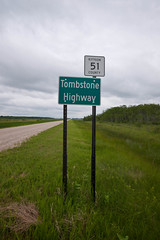
Mystery: Tombstone Highway


Originally uploaded by afiler
I came across this photo of a sign in my hometown county, Kittson County, that I wasn't aware of before. All my research has proven fruitless so far.

Can any reader enlighten me as to what the significance is to the sign? What is/was 'Tombstone Highway'? Why was it called that?


12/15/2015 UPDATE:  I recently found out the answer to this mystery was, ironically, contained within the historical essays archived on the Red River Valley website, co-administered by me and Kris Baldwin Ohmann.

Monday, May 17, 2010

History Detectives, Local Style

Wow, the news keeps coming on all the websites and history that our area encompasses, and changes to them. The following news is extremely exciting, because we've been working on resolving this problem for over a year: What to do about losing the Red River Valley history website started by Dennis Matthews, one of the earliest websites documenting my hometown area and surrounding region. It's a long story but in summary Dennis lost his host for the site and all the data is locked on his computer. A fellow expatriate wrote to say this, just this past weekend:
Meant to email you sooner. I am out in Seattle for a graduation and I am trying to set up a meeting with Dennis Mathews to see if I can get a back up of all of his historical data for you on Monday or Thursday of this week.
I wrote back to her to express my delight at hearing this news, and that her inquiry about if the Rootsweb site was still available and a viable option, to reassure her that yes, indeed it was!

The hundreds (probably thousands) of hours Dennis has put in on putting this website up is just amazing. He transcribed historical essays among other documents into web pages that had before only existed in rare hard copy format up until then. We owe him a LOT, and thus are going the extra mile to help him recover and preserve his work...

Thursday, March 06, 2008

Sheriff Charley Brown: Chapter XVII

It was noon the following day when Frank Myrick burst excitedly into Charley's saloon, shouting, "Charley, there's a fight in front of Angus McLellen's hotel. Gilbert Godon has gone crazy and is beating the hell out of Alex Montreault. Montreault hasn't a chance against that big bastard. You'd best get there damn quick or he'll be killed."

Charley knew of Godon's reputation1 as a troublemaker, and also knew the man was wanted in Canada for murder. As he ran out the door following Myrick2, he wondered why the Canadian Government had failed to file wanted papers on Godon, and why Godon had suddenly appeared in Pembina?

He arrived at the scene just as Godon was kicking mercilessly at the apparently unconscious Montreault. Spectators had surrounded the pair, but were making no effort to stop the abuse. Seizing Godon by the sleeve, Charley shouted, "Stop it! Stop it! That's enough!"

Godon, a huge powerful man, turned and unleashed a roundhouse swing at the sheriff that would have downed a horse. The blow skimmed Charley's shoulder and in reaction he loosed an open-handed chop that caught Godon across his throat. Godon's eyes bulged as he froze in motion, gasping, suddenly unable to breath. For moments Charley regretted the almost deadly blow, realizing that massive damage might have been done. Godon slowly settled to a sitting position in the snow, his hands at his throat, apparently helpless, unable to breath.

Charley knelt at Montreault's side, carefully rolling the man's body face-up, from the snow. At first glance the man appeared dead, but after long moments small convulsive jerks began in his body, indicating returning consciousness. Disgusted, Charley shouted angrily to several of the bystanders who had watched the fight. "Pick up Alex and take him into the hotel. Get him to a cot."

Turning back to Godon he was relieved to find the man apparently capable of restricted breathing, all of the fight apparently gone.

As the men began to pick up Monteault, Charley exploded, "Don't pick him up like a sack of wheat, he's in bad shape. Get your hands under him and carry him flat.”

Leaning over, he grasped Godon by the shoulder. "Come on, Gilbert. This is one fight you'll pay for."

Getting Godon to his feet required some doing. The man was heavy, retching continually, barely able to breath or remain upright. A small rivulet of blood ran from the corner of his mouth. Charley realized that he had probably caused serious damage to Godon's pharynx. Grimly he thought of the repercussions, then shrugged. What the heck! I was only defending myself.

Escorting the man two blocks to the jail took several minutes, his prisoner barely able to move. The stout, stone-faced breed seemed almost helpless, wheezing for each breath, the damage to his windpipe evidently severe. Flinging open the outside jail door Charley thrust Godon inside. Captain Bob, the jailer, hastily arose from the desk in alarm, "What the hell?"

"Another customer for you, he's been fighting with Montreault. Search him and lock him up -- don't know the charge as yet, it depends upon Montreault's condition and what the witnesses say. The least charge will be assault, but it could also be attempted murder, or even murder if Mantreault dies. Gilbert has killed before."

"Yah, I heard about that. Used an axe on a man at Fort Dufferin, in Canada, just a few miles north of Emerson. But that was years ago."

"It was in October of '73, if I remember right." Charley said. "I was stationed at Fort Pembina at the time. Chief Constable Richard Power of Canada picked him up and he was charged with murder. He was found guilty, suppose to hang, but somehow he evaded the sentence, and then escaped. I'll check further with Fred Bradley, the Justice of the Peace in Emerson. He's a good friend, also a fellow Mason."

Captain Bob quickly searched the prisoner for weapons, finding only a pocketknife and small change. Ordering the two other prisoners to the rear of the cell, Godon was thrust inside, the cell door was closed and locked.

"Will you tell Jud that I've three to feed now?" Bob turned to Charley.

"No problem, everyone downtown probably knows about it already." He walked to the door. "I'm going over to see Alex now; he looked to be in bad shape. I hope those men who carried him into McLellen's had enough sense to send for Doc Appel at the fort. If I see him, I'll have him check Gilbert too." He warned, "You be careful with these three. Remember what happened to Pete. No booze, and make sure no eating utensils or tools are hidden."

Directed into a side room at McLellen's hotel he was surprised to find Doctor Appel already there. Montreault had been stripped to the waist, the doctor busy wrapping his chest with a roll of muslin. Looking up at Charley, Appel said, "He's got at least five broken ribs and one lung is punctured -- also a broken leg. He's black and blue everywhere and coughing blood, might even suffer a concussion. That brute nearly kicked him to death. He should be charged with attempted murder!"

"He will be!" Charley gritted, "How serious is it?"

"It's critical. The puncture of his left lung is causing internal bleeding. If it stops, or if no infection occurs, he's got a fair chance. If not,” He shook his head. Turning to McLellen who stood nearby, he said, "He's got to be kept as quiet as possible. I've given him enough laudanum to keep him asleep for hours, but when he wakes up, you'll have to get more into him. Any movement could kill him. I'll remain in town and check him again after supper. If he has trouble breathing because of an accumulation of blood in his lung, roll him gently onto his right side. It may serve to drain the blood. Come now", he beckoned to McLellen, "I'll show you further, what you must do."

Charley waited in the small lobby until Appel again appeared. The doctor looked incensed. "Isn't Godon supposed to be in prison in Canada? Wasn't he sentenced for murder?"

"Truthfully, I don't know the circumstances, but I'm going to look into it. I'd heard he escaped from prison a couple of years ago, but he's not shown up around here until now. He probably has been farther south. It's my bad luck that he's appeared in town, but I'll see he's charged.”

The doctor looked troubled, "I'm headed to Geroux's for lunch, It is lucky I was in town when this happened. Will you join me? I'd like to discuss the LaRose with you. It appears he won’t come to trial for a long period."

A smiling Marguerite met them at the door of the dining room and seated them at a table. Returning with menus, she asked, "How is that old man, Mr. Montreault. I heard he was severely beaten?"

"News travels fast in this town," Charley smiled grimly. "The doctor here says he's got a chance, but he took quite a beating."

"Good afternoon, young lady!" Appel smiled pleasantly. "What is your interest in Mr. Montreault?"

Marguerite smiled, "None I guess, except that he's harmless. His only trouble is his mouth, he can't keep it shut."

Charley looked down at the table and smiled. "A lot of people in town have that problem."

Marguerite looked perturbed, "I hope you aren't referring to me."

"Nope, just spoke in general terms -- making an observation." He looked up to wink at her.

After placing their order, Dr. Appel said, "Do you think the jury will bind LaRose over for trial?"

"I'm sure of it. His reputation will be the clincher. The trouble is, now I've got three men to hold for trial in July. I've got to feed and keep them until then. The commissioners will be wild at the expense since the district court won't pay a cent on their keep. I'll be glad when they get the new courthouse finished, but that won't be available until fall. The old log jail isn't too secure. Then again, taking the prisoners out each day to cut their own firewood isn't a safe policy. Still, it's an order set down by the county commissioners in an effort to save money. I just hope the jailers keep on their toes. By the way, would you stop over there and check Godon? I may have damaged his neck with the heel of my hand. He has trouble breathing."

"You could have damaged some of his laryngeal cartilage. That's a chancy place to strike a man."

"I know, but I did the first thing that came to mind. He's a dangerous man!"

"I'll check him over after we eat. Frankly, if his windpipe is damaged there is little I can do. It will probably heal with time."

With the LaRose case still not settled, Charley decided to contact Fred Bradley, the Justice of the Peace at Emerson, concerning Godon's status.

Bradley was surprised to hear that Godon had made an appearance in Pembina. "You bet we want him over here, Charley. Although his sentence for the murder of Marchand was commuted, he was transferred to our provincial penitentiary at Upper Fort Garry. In September he broke from the woodpile where he was working with several other prisoners. He made it to a small boat moored on the river. The prison guards were lousy shots; they fired at him but missed. You probably know the rest. He gathered up his wife and scooted to your side of the line."

"But wasn't there some hassle in Emerson shortly after that? Wasn't he captured again?"

"That's the embarrassing part." Bradley wore a look of chagrin. "I had heard he occasionally visited his brother in Emerson, so I laid a trap for him. I deputized Bill and John Lucas, together with my bailiff, William, in case he came back. When we received a tip he was at his brother's house, William was posted at the back entrance to seize him. Bill burst into the house to confront Gilbert, but Godon's mother and sister-in-law tore into him, kicking, biting and screaming. During the excitement Godon slipped out the door and surprised William, grabbing his revolver, then throwing it into a clump of weeds.”

"John managed to run around the corner of the house just as Godon calmly walked away, but his gun failed to fire. Bill, finally free of the two women, got out of the house and was able to fire four shots, but he missed each time. When I arrived at the scene it was all over. Godon had disappeared into the underbrush along the river, evidently crossing to your side of the border. He hasn't been seen since. We never did get around to issuing papers on him; he just disappeared." He smiled guiltily, "We figured he'd stay away from Canada."

Charley shook his head, hardly able to believe his ears. He remarked sarcastically, "Three men and he got away clean?"

Fred looked sheepish. "I should have gone along with my men. I knew they had no experience at apprehending a desperate man. 'Course, neither had I, come to think of it."

"Well, I'm charging him with attempted murder. Another minute or two and Montrault would have been dead. As it is, he has several broken ribs and a punctured lung. He's hanging on, but it's going to be close. If he dies, Godon will hang just as sure as God made little green apples. Incidentally, where did Godon come from originally?"

"Don't know exactly, but I know a few things about him. He came into being shortly after the Riel uprising, used to hang out at Fort Garry and St. Boniface. He also had a bad reputation for fighting and swinging a bottle -- hung out at Fort Garry's, Pride of the West Saloon. It's said the soldiers patronized the bar by day, the MĂ©tis, by night. It was only a matter of time until they tangled since they hated each other.”

"During one of the many donnybrooks between the soldiers and MĂ©tis, someone fired a shot at Sinclair, the bartender. Godon stepped in the way and took the bullet in his right arm. When reinforcements arrived from the soldiers barracks, Godon was treated and the whole thing was covered up as youthful exuberance.”

"Later he appeared out at Fort Dufferin where old Fawcett was selling illegal liquor to the soldiers. I guess everyone got pretty drunk and when Fawcett tried to shut them off, Benjy Marchand caused trouble, pushing and shoving at Fawcett. A wild fight began between Marchand and Godon, and as Godon's brother and father were present, the Marchand bunch was booted out of the house. They were badly used.”

"When the fight was over Fawcett proceeded to set-em-up again. Then Godon went outside and dragged Marchand in, beating him even more, knocking him to the floor unconscious. Seizing an axe he struck Marchand, and when a man attempted to intervene, Godon again hit Marchand with the blade, killing him, almost splitting his head."

"Faucett was scared so he ran over to the Boundary Commission headquarters and returned with a group of soldiers under Sergeant Armstrong of the Royal Engineers. Godon surrendered and was held overnight, but the head of the Boundary Commission refused to accept the responsibility for him. Released, he escaped prosecution by crossing over to your side of the border."

"I recollect that," Charley murmured. "Bill Morehead put him in jail a few days after the affair for picking fights in town. I remember when constable Power came over to pick him up."

"Yes, a grand jury brought a true bill of murder against him, and a bench warrant was issued. When we got him back the jury deliberated only a few minutes, then sentenced him to death. He was only 22 years of age then, tall, heavy and bull-strong.

"He shared a cell with Joseph Michaud, a gunner of the artillery. Michaud was to hang in August for stabbing a passerby who attempted to stop a fight between Michaud and another soldier. When Michaud was hanged, Dugald Sinclair took up for Godon, beginning a campaign for clemency. He managed to get Godon's sentence commuted to a long term in prison, that's when he was transferred to Upper Fort Garry." He hesitated, "You know the rest as I've told it. He escaped from there."

Charley rose to his feet. "We'll see how he fares at his trial in July. If he gets off lightly, I expect you'll want him back, won't you?"

"I certainly do! I'll watch your trial with interest and have papers forwarded so you can hold him for us."

During his ride back to Pembina, Charley considered the problem of his three prisoners. His worry was compounded by the caliber of his jailers. They each served a twelve-hour shift for their one-dollar a day pay. He knew that all three prisoners would be actively planning an escape. He wished he didn't have to resort to the dregs of town for jail guards, but the county commissioners refused to pay more for good men.

Charley finally made amends with his mother after she surprised him with an evening visit to his apartment. Invited inside, she eyed the interior of his apartment with surprise. "You certainly have improved your quarters. Eugene said your furniture was all old and worn. What I see looks new. Did you lose all your other belongings in the fire?"

"No, it was all saved, I just decided to splurge a little." He smiled, "Kinda miss the old stuff though."

"Still, it's not a home for a woman." She watched intently for his reaction.

"Mother, it suits me just fine. I'm a bachelor and don't need fripperies. I don't have a wife to please and I have no immediate plans to acquire one." Instinctively he knew her thinking; she was probing his mind, attempting to delve into his association with Marguerite.

She changed her tactics at his blunt answer. "I may have a pleasant surprise for you in the near future, perhaps in the month of May. I won't tell you any more, since it's to be a surprise, but you'll enjoy it."

Puzzled, he asked, "Are the rest of the Harris family finally coming out here?"

"No, that's not it; I've had no word from Charles or his mother; this is entirely another matter." She felt a smug satisfaction.

"Well, I'll not worry if it's a secret." He arose from his chair, turning toward the kitchen. "As long as you're here I'll make us tea. Do you still take lemon with yours?"

"So you remembered!" She followed him to the kitchen where he struck a match to light both a table lamp and wall sconce.

"Do you remember the good times back in Martinsburg when you were a boy?"

"Oh, there good times, but then bad times came just before war broke out. I never realized the stress Pa must have been under, trying to keep the lid on things. No wonder he rode me so hard."

"Yes, while Martinsburg was predominantly pro-slavery, there were plenty of Yankee dissenters. We never did understand why you turned to the Union; it nearly broke your father's heart."

Charley looked up at her accusingly, "You've forgotten! I joined the Southern cause, and then Pa and Grandpa Boarman sent some red-necked sheriff after me. After his abuse I was thoroughly disenchanted with the South. You'll remember, the next day I went north and joined the Union Army."

Spooning tea into a pot he then added hot water from the kettle. "I'll let it steep a moment."

As she seated herself at the table, she said, "You were too young for the war, that's why your Father sent south for you. When you were returned to us we never dreamt you'd run away again."

While filtering out the tealeaves he broke into a smile. "I was lucky in the army, managed to stay alive. It was just after I made lieutenant that I was captured. Libby Prison, in Richmond, wasn't all that bad except there was mighty little to eat. Luckily nearly sixty of us managed to escape through a tunnel and got back to Union lines. I guess a lot more were captured because they didn't know the lay of the land. I headed west, swiped some clothes, then I conveniently developed a bad limp." He smiled, "Wrapped my leg with rags so it looked bad. 'Course by the time I got back to the outfit, the war was nearly over."

"Yes, and I remember when the Union troops came to search our house and took everything of value. Grandma had her few gold and silver coins hidden in the bottom of a bowl of peas she was shelling when they searched. They didn't leave us much. You must remember that they took our horses, cows, pigs and everything they could eat."

"Those were hard times," Charley admitted.

"Why did you leave after coming home from the war? I thought you liked your job at the store."

"I was at loose ends and storekeeping grew boring. Plus Josey jilted me. I traveled until my money ran out, then rejoined the army as you already know. In my youth I craved excitement. Now I've settled down to a more staid life."

"Isn't your sheriff job dangerous at times?"

"Nothing like being in the army. While there have been occasional crimes, it's been quiet of late."

"Quiet indeed! I heard you have two murderers in your jail at the moment."

"It runs hot and cold at times."

"Son, you've continued to run with that Grant girl. You must know she's a breed?"

Charley turned to her with a fierce expression. "Yes, I know it. She's a lovely girl, beautiful and talented. Just leave her out of this discussion."

His mother had finished her tea and stood to put on her coat. "She's not a suitable woman for a person of your caliber. You should be more discriminating. You can do far better than to demean yourself."

Charley coldly escorted her to the door. "I've run my own life since I was sixteen years of age. While I respect and love you as my mother, don't attempt to push me. My life is my own."

After his mother left Charley returned to the kitchen to muse over a second cup of tea. Why is it she can get my dander up to easily? She still tries to run people. That surprise she spoke of? I wonder what she's got up her sleeve?
______________________

1 - 1872: Gilbert Godon, a Metis from the Red Lake district of the Minnesota Territory, has gone down in history as Manitoba's first official outlaw when he killed Benjamin Marchand during a drinking brawl in 1872. Godon was in many fights and usually nothing serious happened until the night of October 10th 1872. Godon and a group of drinking buddies arrived at the Fort Dufferin home of A.J. Fawcett who was selling liquor illegally, when Fawcett refused to serve the new arrivals he was pushed and threatened by Benjamin Marchand. Godon, in defense of Fawcett, intervened and chased Marchand outside. Marchand?s son (Benjamin Jr.) retaliated by grabbing a shovel and banging Godon on the head. The fight was then joined by Godon's father and brother and the Marchands retreated to the backyard. They then attacked the Godons for a second time and were again repelled. After the victory, Fawcett remembered that he did have some whiskey hidden, and began serving the victors of the fight. An hour later Gilbert went outside for fresh air and ran into young Benjamin in the yard. Fearing another attack, he grabbed Marchand and dragged him inside. He then knocked him down several times and began striking him on the head with the back of an axe head. Before his family and friends could intervene, Godon struck Marchand in the head with what was to later prove to be a fatal blow from the blade. Fawcett then went to the nearby headquarters of the Boundary Commission (help at Fort Garry was 95 km. north). He returned with fifteen men led by Sergeant James Armstrong of the Royal Engineers. Benjamin died shortly after their arrival so they detained Godon. However, the officer in charge of the Boundary Commision refused to accept responsibility for him and he was released. He then fled across the border into Dakota Territory. Subsequently, a coroner's jury found Gilbert to be responsible for Marchand's death and on November 12, 1873, a grand jury brought a charge of murder against him and a warrant was issued for his arrest. Six months after arriving in North Dakota Godon was involved in another fight and jailed at Pembina. Manitoba's chief constable, Richard Powell, learned of this and traveled to Pembina to return Godon to Winnipeg. On June 19th, 1874, Godon appeared in court and plead not guilty. The following Monday, his trial was held, the jury deliberated for thirty minutes, found him guilty and he was sentenced to hang on August 26th. Godon, however, still had the sympathy of one man, bartender Dugald Sinclair, whose life Godon had saved in 1870. Sinclair began a campaign for clemency and in response to these petitions, the government commuted Godon?s sentence to 14 years imprisonment. He was then transferred to the provincial prison at Upper Fort Garry. On the morning of September 23, 1876, Godon bolted from the work gang he was on, grabbed a small boat and took off across the Red River. He then collected his wife and his horse and again fled to the Dakota Territory. He lived back and forth between Pembina and his brother's place at Emerson. In 1877, Bradley, the Justice of the Peace at Emerson sent a posse to pick Godon up at his brother's house. Godon met them with a revolver in each hand, then in the meelee caused by his mother and sister-in-law he again escaped. In February of 1880 he was again arrested for a brawl at Pembina, locked up again only to escape soon after with Frank La Rose. He and LaRose were reported to be in a Half-Breed camp on the Missouri River five months later. LaRose died shortly after their arrival of hunger and exposure. Gilbert Godon survived, never to be seen in Canada again. - From the Manitoba Metis Federation website...

2 - "...Prior to 1878 there had been a few shipments of wheat, which had been picked up along the river by the boats. Frank C. Myrick, who was in the commission business from 1864, made the largest shipment on one of the boats ever made from Pembina. It amounted to 500 bushels of wheat, which he had collected from the back country on the Pembina and Tongue rivers." - History of Wheat Raising Wheat in the Red River Valley (First Wheat Raising Near the Pembina River), Minnesota Historical Society Collections (1899-1904), General Collections, Library of Congress