Showing posts sorted by relevance for query LeMasurier. Sort by date Show all posts

Sunday, June 09, 2019

"...reserved a right-of-way along the top of the river bank"

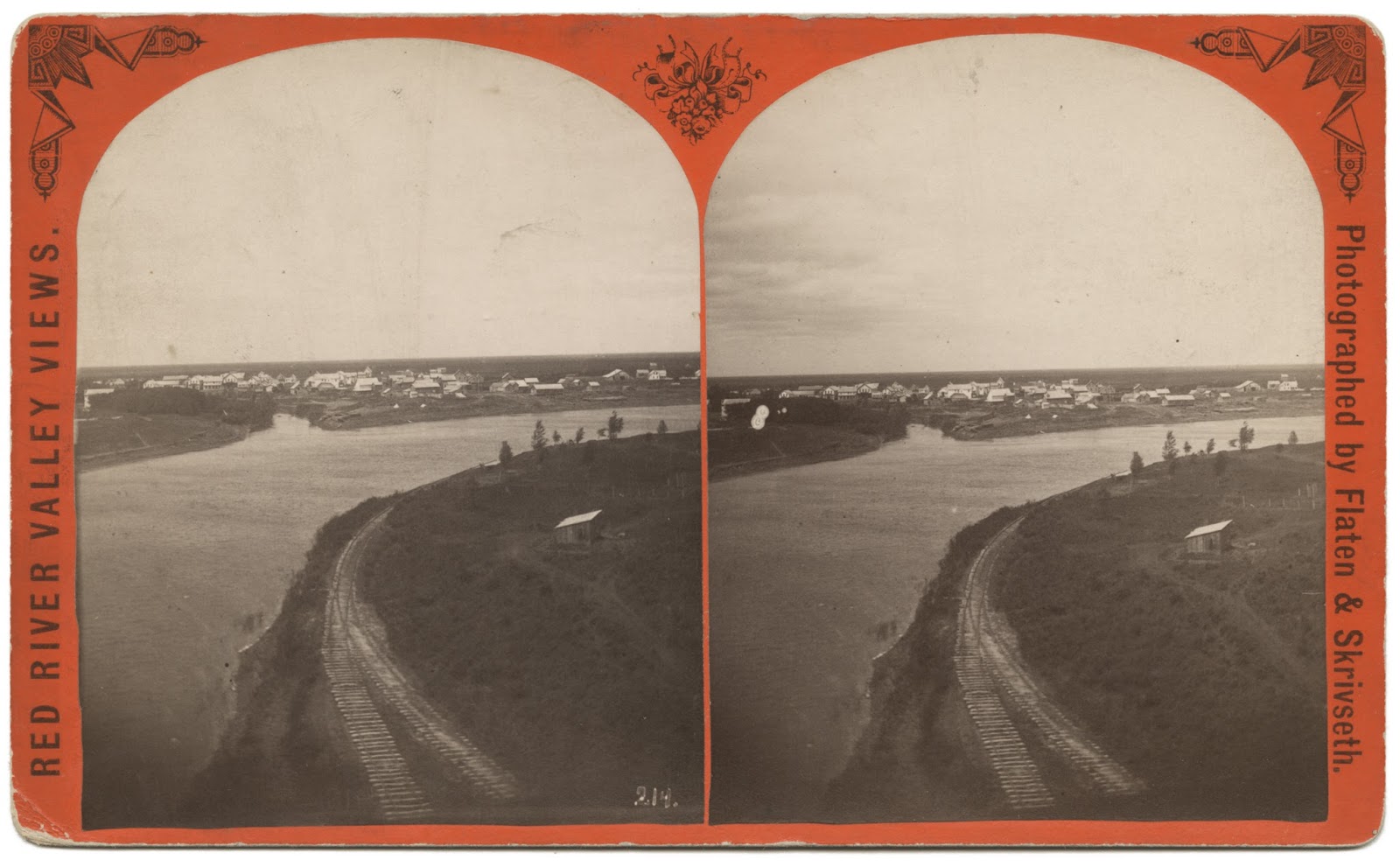
PHOTO INFO: A stereoview showing the railroad track along the eastern bank of the Red River in St. Vincent.  This track is the continuation of the one coming in from the east into town from the "Y".  This was laid down early on in anticipation of the main line going through town and over the river, but a rail bridge was never built.

Swan Anderson would get fan mail from people far and wide that had once lived in St. Vincent and the surrounding area, generated from his newspaper columns for the Enterprise, and even from his toll-free phone number into his home. Swan kept sharing history even when he was in the nursing home. And thank goodness he did.

Speaking of fan mail, let me share with you a letter Swan received from the LeMasuriers of Ontario, California; as many reading this may remember, the LeMasurier family lived in St. Vincent at one time.  This letter shares some more history about St. Vincent and the railroads. Please note that the story told in the letter is second-hand, being told to the LeMasurier family by George (aka "Shorty") and Bessie Cowan. That does not make it any less true, but I wanted to be sure everyone knows the chain of how the story came to us.

Read on...

Before the turn of the century and when the railroad from Winnipeg east wasn't finished, St. Vincent was a booming railroad town. The round house was out by Lake Stella and had a turntable to turn the engines around. The long depot in St. Vincent housed the Customs and Immigration offices. There was also a Signal House. In 1901 William LeMasurier bought it and moved it to his farm north of St. Vincent. He and his bride, the former Maggie Easter, started housekeeping there in 1902. The land north of St. Vincent and west of the Emerson road was all railroad land. Phillip LeMasurier bought some and later sold it to his sons, William and Arthur. John and George Cowan bought some, also Mose Parenteau and Austin Griffith. The railroad reserved a right-of-way along the top of the river bank. Bessie Cowan told me at one time the railroad had planned to build a bridge across the Red River on Shorty's land.

The land that the railroad bridge would have crossed into/from is located on this plat map in the northwest corner of Section 35, labeled George Cowan . . .
The Great Northern Hotel was a three-story building with a ballroom on the third floor. Bessie Cowan gave us a picture of it and we left it with the Pembina Museum when we left St. Vincent. When the hotel was torn down, the attached section that was the kitchen was bought by the Russells and made into their home. Later, Harold Easton bought it and finally Milton Gregoire bought it and tore it down, and built what is now known as the Nellie Blair house.

There was a strip of land from the Red River to the Emerson road, 137 acres in the Village of St. Vincent on its north side. Austin Griffith bought the 36 acres next to the Emerson road and Charlie LeMasurier bought the rest from Peter Monro. Harris remembers when Charlie had a lot cleared along the river. The man doing the work used oxen. Mrs. Morrow, who lived in St. Vincent, used to pick roots and would give Harris fifty cents to haul a load to town for her.

Thursday, March 09, 2006

St. Vincent Oral History

Swan Anderson would get fan mail from people far and wide that had once lived in St. Vincent and the surrounding area, generated from his newspaper columns for the Enterprise, and even from his toll-free phone number into his home (another story for another time). Swan kept sharing history even when he was in the nursing home. And thank goodness he did.

Speaking of fan mail, let me share with you a letter Swan received from the LeMasuriers of Ontario, California; as many reading this may remember, the LeMasurier family lived in St. Vincent at one time (to be honest, I am unsure if any of the family may still be in the area...) This letter shares some more history about St. Vincent and the railroads. Please note that the story told in the letter is second-hand, being told to the LeMasurier family by George (aka "Shorty") and Bessie Cowan. That does not make it any less true, but I wanted to be sure everyone knows the chain of how the story came to us. Read on...

Before the turn of the century and when the railroad from Winnipeg east wasn't finished, St. Vincent was a booming railroad town. The round house was out by Lake Stella* and had a turntable to turn the engines around. The long depot in St. Vincent housed the Customs and Immigration offices. There was also a Signal House. In 1901 William LeMasurier bought it** and moved it to his farm north of St. Vincent. He and his bride, the former Maggie Easter, started housekeeping there in 1902. The land north of St. Vincent and west of the Emerson road was all railroad land. Phillip LeMasurier bought some and later sold it to his sons, William and Arthur. John and George Cowan bought some, also Mose Parenteau and Austin Griffith. The railroad reserved a right-of-way along the top of the river bank. Bessie Cowan told me at one time the railroad had planned to build a bridge across the Red River on Shorty's land.

The Great Northern Hotel was a three-story building with a ballroom on the third floor. Bessie Cowan gave us a picture of it and we left it with the Pembina Museum*** when we left St. Vincent. When the hotel was torn down, the attached section that was the kitchen was bought by the Russells and made into their home. Later, Harold Easton bought it and finally Milton Gregoire bought it and tore it down, and built what is now known as the Nellie Blair house.

There was a strip of land from the Red River to the Emerson road, 137 acres in the Village of St. Vincent on its north side. Austin Griffith bought the 36 acres next to the Emerson road and Charlie LeMasurier bought the rest from Peter Monro. Harris remembers when Charlie had a lot cleared along the river. The man doing the work used oxen. Mrs. Morrow, who lived in St. Vincent, used to pick roots and would give Harris fifty cents to haul a load to town for her.
* - Ah, yes...Lake Stella...supposedly a man-made Lake, but by whom, and why? Does anyone know out there? If so, please let me know!
** - Didn't St. Vincent have a depot after 1901? Mmmm...now I shall have to research this to find out if it did or not; to be honest, I never knew when the depot was no longer in operation, but always assumed it was around longer than 1901.
*** - I am in the process of tracking this photo down, and will definitely share it here when I do...

Saturday, April 19, 2008

Treaty of Old Crossing

Outlined land, colored in yellow, ceded in 1863 Old Crossing Treaty
I grew up with many of the descendants of the early Metis and indigenous peoples. By my time, there were far fewer living in our area than in my grandmother's or even my mother's time, but there were some families still here. The names Jerome, Gooselaw, Parenteau, LeMasurier, Monette, and LaPeire (to name only a few) were not only familiar, but I went to school with some of them.

Since beginning this blog, I have started thinking more deeply about who we were, and who we are as a result. For these families, I wanted to know about what happened to their ancestors on the indigenous side, why, and when. So I started digging...

According to this website, the original tribes in our area were the Arapaho, Cheyenne, Chippewa (or Ojibway), and Dakota (part of the Sioux nation). Also, due to our close proximity to Canada, there are many families with bloodlines from the Manitoba tribes, which included many found in the U.S., but also the Cree and Assiniboine.

Going back to the early days of settlers and natives mixing, it was mostly cordial (I say mostly because human nature always gets all of us in trouble sooner or later!) The more the settlers came, the more the different communities were stressed. One group pushed, the other pushed back. Terrible consequences befell the native peoples, many succumbing or closely succumbing to starvation. Out of this (and other issues) came the 1862 uprising. Not coincidentally, I assume, more aggressive treaties were the result.

One such treaty was the Treaty with the Chippewa-Red Lake and Pembina Bands, 1863 - or as it is otherwise known as, the Treaty of Old Crossing.

You can read the treaty itself here...

NOTE: A very interesting blog post about conditions on North Dakota reservations got the writer banned from the Turtle Mountain Indian Reservation (and rightly so).  While there were insulting comments left on the article, there was also a lot of great discussion on it on many relevant topics concerning the native populations living on them today, as a direct result of the treaty above and others like it. The original blog post was deleted but the link at the beginning of this note has it in-full along with the comments...

Sunday, May 20, 2007

1880: Who Was Here?


1880 Federal Census of St. Vincent, Minnesota
Just before the influx of new settlers

Who was here? Below is a snapshot of the 320 souls counted that census, the one just before the major influx of settlers hit the town...

NOTE: Names highlighted are 'heads of household' and those listed under are part of the same household (not necessarily showing all in each household...)
Stephen Flynn, a merchant and his partner William O'Keefe, both from Ireland; living in the same household, perhaps William's younger brother, was John O'Keefe, occupation listed as "Clerk"

James Kirk, River Pilot from Ireland
Elizabeth David, Servant in the Kirk household

William Jones, a butcher from Germany
Seneca Thompson, brick mason from Ontario, Canada (a relative of mine via marriage into Fitzpatrick family), part of the Jones household, possibly boarding with them...

John Harrington, another brick mason, from Ireland

Charles La Page, bar tender from Canada

Patrick Lenahan, tailor from Ireland
James White, brakeman from England
John Walter, cook from Ireland

Remi Desautel, hotel keeper from Canada
Oscar Lyke, engineer from New York
William Adams, saloon keeper from Canada
Andrew Stewart, laborer from Canada
James Gorden, clerk from Ireland
William Kirk, baggage master from Canada
James Morrison, railroad clerk from Minnesota

William Gooding, telegraph operator from New York

Frank McLaughlin, clerk from Ireland
Ed J. Houde, barber from Minnesota
Thomas Hickey, railroad clerk from Canada
David Shannon, laborer from Canada

George Raywood, brewer from England

John Devine, laborer from Ireland
William Milligan, surgeon from Canada
Thomas Dunbar, blacksmith from Canada

John O'Connor, hotel owner from Ireland
John Buie, livery stable hand from Canada
William Smith, saloon keeper from Ireland
David Weaver, laborer from Canada

George Combs, boarding house owner from Canada

George Tiffany, restaurant owner from Ohio

Benjamin M. Ensign, conductor from New York

James Kelley, policeman from Louisiana
William Deacon, clerk from England

George F. Winter, retail grocer from Canada

Robert W. Lowery, retail grocer from Canada
Catherine Grish, cook from New York
Sarah Waldo, waiter from Canada

John Crawford, baker from Scotland

George B. Gilchrist, pattern maker from Scotland

Phillip Lemasurier, carpenter from England
Swen Bjornson, laborer from Iceland
Olof Olson, laborer from Iceland
John Johnson, laborer from Iceland

Fred Paschinsky, tin smith from Poland

James W. Major, miller from Canada
Elizabeth Major (wife), boarding house from Indiana
[At the time of the census, there were over 20 boarders of various stripes living in their boarding house...]

William Mason, blacksmith from Canada

William W. Nicoles, lumber merchant from New York

George Parker, boarding house owner from Canada

William L. Robertson, hotel keeper from Scotland

Louis E. Booker, merchant from Illinois

John H. Rich, banker from Wisconsin

John W. Shepard, agent for townsite from Connecticut

David Saummatt, teamster from Manitoba

Robert McClary, farmer from Canada

H. D. Savage, engineer from Maine

John Marshall, laborer from Ireland

John A. Vanstrum, assistant postmaster from Sweden

Alexander Campbell, surgeon from Scotland

Saturday, October 23, 2010

Christ Church Revisited

At this point, Christ Church was still considered a Mission...

In 1971, attempts were made to preserve Christ Church, the Episcopal church in St. Vincent. 

QUESTION:  If Christ Church was bought, restored, and donated to the St. Vincent Historical Society, how did it get back into private hands, the situation it is in today?  Some possible answers follow the article below, which documents the 1971 preservation efforts...