Showing posts sorted by relevance for query depot. Sort by date Show all posts

Saturday, February 10, 2007

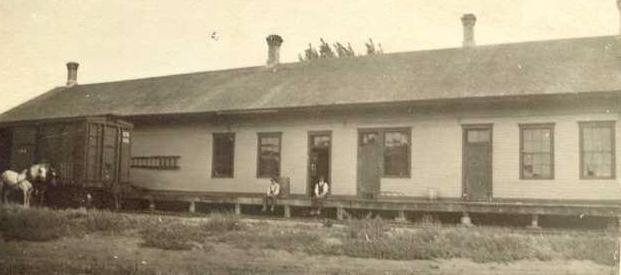
Noyes Depot

Hudson Leighton from the GN Goat shared with me these great photos of the Noyes Depot* and border crossing area, from the early days until 1970; I found a newer image online myself to finish it all off, not sure how new, but it looks fairly recent. Hudson also shared stats on the depot, which I found rather fascinating since my Dad worked there for many years. It's also interesting to me because it was one of many such towns across the country lining the US/Canadian border that ensured trade between our countries over generations, and still do.

This is an extract from the stats file...

GN RPC records:

Noyes is in Valuation Section # 224 - which starts just north of Barnesville went to Crookston and ended at Noyes. Anything I have ended with BN merger in 1970

A depot was built in 1922 - 30' x 138' frame, w/ customs & immigration quaters.
In 1924 is was extended - 10 x 20 to provide room for an immegration office
1944 building was insulated and additional lighting installed
1948 - building was rearranged to provide room for R.E.A.
1952 - toilets were installed
1953 - new lighting provided & fuel oil heater
1966 - remodeled removing 32' of same and place concrete foundation on remaining building
1967 - new depot built using wood from old depot

This is a joint use building w/ SOO Line.


I found this online - a summary of original proposal to close Noyes port and consolidate port entry for rail to be covered by Pembina port. The latest word about line abandonments does not list the line going up to Noyes into Canada as such, but other lines in the region are being abandoned for economic reasons due to decreasing traffic.
Emerson has its supporters also for their recent loss of the port just north of Noyes. I didn't realize until I read this article that "In Emerson, the history of protection is not restricted to the presence of Canada Customs. Known as Manitoba's First City, Emerson was home to the original headquarters of the Northwest Mounted Police. Like many border towns, Emerson has a proud heritage of standing on guard for thee...."

THE END:  In circa 2020, the old depot, on the original site throughout all its years, was demolished to make way for a new combined-agency building [U.S. Customs & Border Protection (CBP) , and U.S. Customs & Immigration Enforcement (ICE)/Soo-Line/BNSF/CP]
In 2005, in anticipation of the 2006 Noyes port-of-entry closing, a Federal ruling stated, "...CBP is extending the limits of the Port of Pembina to encompass the railroad yard located at Noyes, Minnesota, owned by the Canadian Pacific Railway and the Burlington Northern Santa Fe Railway. The Port of Pembina will assume responsibility for processing trains as they arrive at Noyes. However, other traffic must utilize the border crossing within the City of Pembina and will no longer be processed at Noyes. The office facility at Noyes will continue to be used to support the needs of several Border Patrol agents and ICE agents. Security gates and surveillance cameras have also been installed at the Port of Noyes to ensure continued remote monitoring of that location by the Port of Pembina." After 2006, CBP and ICE maintained staff on an as-needed basis in the old depot.  Drones have also been added to assist in border security.

* An interesting piece of railroad trivia about the Noyes Depot is, it's the only depot in Kittson County still on its original site...

Sunday, September 05, 2010

YouTube Local History: Pembina Depot

The video above was brought to my attention by Bill Ash the other day. In the interim, Bill found out from Clarence Bingham the scoop on the last few seconds of the film showing a depot, which turned out to be the old Pembina Depot, in its glory days!

Clarence also had this to say about Olaf Hanson, whose family (including Olaf) are shown earlier in the film:
Olaf Hanson was a Customs Inspector at Pembina during the 1950s. The depot in the video is the old Great Northern depot in Pembina. Olaf had a penchant for getting in trouble with the passengers he inspected by trying to joke with them. Unfortunately, travelers were not in a joking mood when crossing the border. To make matters worse the Collector of Customs office was just a couple of miles down the road in Pembina, so they would stop and complain. My desk in the headquarters office was close to the Collector's , so I could not help but hear some of those tirades. One day Olaf inspected a young man and woman at the Pembina Border station. He ascertained they were not married while establishing their citizenship, then when he was inspecting their car/suitcase, he jokingly inquired if it was appropriate that their underwear was comingled in the suitcase. They did not appreciate his attempt at humor and stopped at the Headquarters to lodge a complaint. The Collector - John O'Keefe - subsequently had Olaf in and threatened to transfer him to Hannah, N.D., where he would not encounter so many travelers. I don't recall if the transfer was in fact ever carried out.

When we lived in Pembina the GN depot was repainted. The B&B crew came to town - about 1958/59 - and in a few days painted the depot and associated buildings that God awful brownish/mustard yellow color the GN used in those days. A year or two later the section crew chief in Pembina repainted his house and by some mysterious circumstance the color was the same as the depot.
Bill Ash has this to share about Clarence:
Clarence "Bing" Bingham is a first cousin of my mother...He grew up in Wisconsin but got a job at the Railway Express office in Noyes, MN in the early 50's and soon after took a position with US Customs at Pembina and Noyes. He is retired now and is living in the state of Oregon.

Sunday, September 13, 2020

A Lifetime of a Depot: NOYES

Depot built 1906 (joint GN/SOO Depot) - 30' x 137' frame. 
Depot remodeled 1912. 
Burned 1921. 
Depot 30' x 138' rebuilt 1922.  
10' x 20' addition added 1924.
Remodeled 1943. 
North 32 feet of Depot removed in 1966 and Depot rebuilt 1967 (after 1966 flood) - platforms removed, landscaping built up to accommodate dike around town.

Torn down/demolished:  August 2020.


Friday, January 21, 2011

Humboldt Depot

Humboldt, MN Great Northern depot looking SW (June 1969)
Source:  Great Northern Railway Historical Society 
I can't say I remember the depot in Humboldt that well, although it obviously still existed in my lifetime.  Looking at this photograph now brings back some recollection.

I see it was two-stories in the main part of the building, which leads me to believe it had living quarters over the offices for the depot agent, (and his family, if he had one.)  The attached single-storey portion is probably the freight office.

I did a little digging online and found that one of the those families were the Merck's.

Thursday, April 30, 2009

Expatriate Contact

I heard from another expatriate of our area a few days ago. His name is Clarence L. Bingham. As many do, he found my website serendipitously, reading the post about Dick Lapp, who he knew and - you'll read below - worked with...
A great blog. I went to work for Railway Express at the Noyes depot in January 1949. Scottie and I lived upstairs in the Fitzpatrick house in Pembina. In late 1949 I started work with U. S. Customs, assuming Dick Lapp's job as supply and seizure clerk when he was promoted to liquidator.
I asked him if the Fitzpatrick home he stayed at was perhaps my great uncle Richard Fitzpatrick's home, and who was Scottie? He replied...
Yes, a big brick home just south of the hotel. We called him Dick and I cannot at the moment think of Mrs. Fitzpatrick's name. He was depot agent for the GN at St.Vincent.

Bing with his dog BarnabyScottie was Mary Helen Scott Bingham. My wife of 59 odd years, who died in 2007 here in Oregon. We were married January 22, 1949 at Muscoda, WI. Took the train a couple days later to Noyes, MN. where I had taken a job with Railway Expess. I had heard of the job through my uncle Sheldon Joyner,who was depot agent at Noyes for both the GN and Soo Line. Our office was in the north (cold) end of the depot, so was acquainted with all of the section hands and depot clerks. C. L. Bingham

Sunday, August 15, 2010

Depot in Decline

Iconic sign still on depot roof...
Photo by Bill Reynolds

While up home for the Gamble Reunion, I stopped at Dad's old place of work, the Noyes, MN depot. There were several customs agents milling about outside as well as railway workers, waiting. I knew why1...

I went into the 'waiting room', and the door to the work area was open. Two men were in there, leaning on the front desk area - the area where the telegraphs used to sit, and later the dispatch phones were. Many a time I saw my Dad with a pad, writing out train orders there. Not far in front was a table with a typewriter back then, one I typed more than one of my first stories on. Yes, even a writer then, although using the hunt-and-peck method (as did my father...)

I greeted the railroad worker, introduced myself explaining my Dad used to work here. I asked his name, and he said it was Zimmerman (but not related to the Darryl Zimmerman my Dad worked with) This guy was surprised he didn't recognize Dad's name since he started in 1979, before Dad retired, but he didn't.  However, he did recognize Steve Skjold's name, who worked with Dad for part of his career. I said it looks pretty bare in here - there was no sign people regularly worked here. He explained it's still used, for Conductors to stop in at and place calls or take calls, use the computer in the old computer room (the one that used to hold all the mainframe terminals and old punch card and ticker tape computer machines that Dad cut his teeth on when they brought in computers in the 1970's).  Everything is automated now, he said, so no need for full-time depot there anymore. "It's centralized out of Fort Worth and Kansas City," he explained. And so it goes...time marches on. The old, iconic NOYES sign is still there though.  One consistent standard that hasn't changed on the depot for many years.  It's comforting and disturbing at the same time to see it still there.  I think I'm gonna contact BNSF and see if I can get that sign if they ever demolish the building.  What would I do with it?  I'd put it on one of our out-buildings, maybe put up some old metal Great Northern signs on the outside siding to go with it.  It'll be part memorial to my father, part acknowledgment of the important role that railways have played in this region (and in my family in general2)
__________________________

1 - A Canadian National Railways bigwig was about to come through on a private train. Bill and I had been following it ever since the Hill mansion in Northcote - we were just finishing up our exploration there when we heard the trains whistles as it came through various unguarded crossings. We jumped in the car and off we ran to catch it up, after initially watching it pass. I called out to Bill, that's gotta be a private coach, a special train of sorts. As we got on the highway and caught up, we slowed a bit to match the train speed to take a closer look. We could see a man in a suit in the rear of the passenger car, but weren't sure we saw anyone else in it.

2 - Before my father, two maternal uncles (my great uncles - Uncle Dick and Uncle Charlie - brothers to my grandfather) worked for the Great Northern...

Thursday, August 23, 2007

Sheriff Charley Brown: Chapter XI

Dressing warmly against the bitter cold, Marguerite left the house just as the morning passenger train was backing away from the St. Vincent depot. The sudden spinning of the engine's wheels and the belching of dark smoke briefly drew her attention. Moments later, while passing the depot, she heard a door slam at the station. Glancing up, she observed a tall man stepping from the depot platform. Over the rumble of the departing train she heard his crunching footsteps as he crossed the icy crust angling toward her. Although it was apparent he would overtake her, she felt no trepidation since it was a bright, sunny day. Surprisingly, he pulled abreast and slowed to her pace.

As she looked up she became aware of his striking good looks, his clean-cut, beardless face. She judged him to be in his mid-twenties, a bit over six feet in height. His clothes showed a casual elegance, his garments, including his overcoat, all indicated custom tailoring. He's from the city, she decided.

Smiling at her, he said, "I'm on my way to Pembina. If that's where you're headed, may I walk with you?"

"You must have come in on the morning train." She was certain she had never seen him before.

"Yes, I'm from Chicago. I'm a representative of the McCormick Machinery Company. My name is Paul Evans, and I'm making the rounds of the local implement dealers. It seems a poor time of the year to do it though." His face held a wry look.

She laughed lightly, "I'm Marguerite Grant. You're welcome to walk along with me. Perhaps you can tell me something of your big city." She noted his smooth complexion, his nicely shaped nose and vivid blue eyes. Wisps of light brown hair protruded from the sides of his stylish derby hat.

"There really isn't much to tell you about Chicago except for the great fire back in October of '71. You probably heard all about that.”

"Very little detail -- we get few newspapers here. Were you involved?"

"I lived it! I was only fifteen years old at the time and my family was burned out. My father, mother and I took refuge on the edge of the Lake Michigan--we almost stood in the water at times." His voice faltered, "There were nearly 100,000 others who lost their homes, and over 300 people lost their lives. Surprisingly, within a year the city was nearly rebuilt. Now Chicago is booming, mainly because of the railroads, packing houses and manufacturing."

"That must have been a horrible experience. We've had few dangerous fires around here." She glanced at him fleetingly.

As he studied her, his interest grew. He noted her slimness and striking looks. Her dark eyes seemed to devour him and her shapely lips awoke strange feelings. A brief silence settled between them, then he finally said, "Christmas time is certainly a poor time of the year for me to see distributors. I'll probably have to wait days before being able to transact any business." He added ruefully, “It wasn't my idea to come here at this time of the year, my blockman boss insisted upon it. Say, what do people hereabout do on a Christmas Eve?"

"Where are you staying? I see you're not carrying any luggage."

"The depot agent promised to deliver my bags to the Geroux Hotel in Pembina by one o'clock this afternoon."

She looked up at him with interest. "Geroux's hotel is where I'm headed. A Christmas Eve ball is planned for this evening. I'm going over to help with the final decorations. The party is open to one and all."

He slowed in his walk, turning, "Will you be there?"

She felt her cheeks warming. "Yes, my fiancé is escorting me." She thought she detected a sudden crestfallen look on his face.

He hesitated several moments before finally saying, "Well, if it's a ball, there must be an orchestra. Perhaps you'll save a dance for me?"

"It's possible, we'll see." She was smiling outwardly, but her emotions were suddenly nettled. Charley might not approve of her dancing with a total stranger, especially a handsome stranger. Abruptly, it occurred to her that this just might awaken a spark of jealousy in him. She tossed her head -- it'll serve him right! I'll dance with this Paul, if he asks.

Reaching Pembina's main street, Paul remarked, "For a small town it has a lot of stores."

"Oh, folks have been crowding into town for the past three years. Much of the land has been free to homesteaders; also the railroad has cheap land to sell. We've nearly 4500 people between the two towns." She nodded to the north; "That's Geroux's new hotel on the corner, it just opened recently. It's supposed to be the finest in the Territory. I'll introduce you to Lucien, he's the owner."

Paul took her arm to aid her on the icy hotel steps. "I'm looking forward to seeing you this evening."

As he reached out to tug on the door handle, she looked at him shyly, "I'd like that!"

"And I'm also looking forward to seeing you in future days to come!"

She felt her cheeks flush, "That remains to be seen." Minutes later she joined others in the huge dining room being converted into this evening's ballroom. Lulu Robinson had seen her enter the hotel with Paul and was inquisitive. "Who was that handsome man you introduced to Lucien. Where did he come from?"

Lulu and Marguerite had never been close friends, obviously because of Marguerite's family and heritage. A Machiavellian idea struck her; she said coolly, "He's a friend of mine from Chicago. He's coming to the dance this evening."

"Isn't Charley escorting you?"

"Certainly, but I'll be dancing with Paul, too."

She could immediately see the expression of envy on Lulu's face. A warm feeling of smugness came. It serves you right Lulu! You've always treated me like trash!

Sarah Abrams rushed gaily over to her. She carried a small paper bag partially concealed under colored crepe paper. She wore a secretive expression. "I managed to get three sprigs of mistletoe from Ned Cavalier. Where can we hang them to our best advantage?"

Marguerite smiled. "I suppose one cluster hanging from the center of the dance floor, and maybe one hanging in the foyer. But darned if I know about the third."

"How about the cloak room. It'll be a quiet place and out of the way."

"Fine, as long as Mrs. Geroux doesn't find out. She's won't want any embarrassment."

Sarah laughed gaily, "She's got her man; we've got to catch ours."

"Fine then, but we'll need a ladder."

The Christmas Eve supper at the McLaren home was gay and festive. The entire McLaren family, with the exception of Mary, who was living at Fort Leavenworth with Kirby, was present. Susan had seated her mother between Charley and Ian's mother. Grace was said and wine glasses were filled as Ian's father, Patrick, carved the turkey. Susan and Marguerite began serving platters of fluffy mashed potatoes, gravy, vegetables, deviled eggs, and cranberries. In addition, sweet and sour pickles along with small cut slices of both rye and white bread magically appeared.

A half hour elapsed before Patrick firmly pushed back from the table. "I'm plumb full of dinner and wine; it's all I can hold. You youngsters going to the dance had better be on your way. Mother and I will clean up and take care of the baby. In fact," he looked roguishly at Jerold and Knute, "You two just might make yourselves useful with the dishes, too!"

"Like heck we will!" Jerold began to grin. We're going to the dance. In fact, you and mother should come along with us," Maggy smiled, "It'll be too crowded and too much for us. I'll clean up and take care of the Susan's babe."

"No, mother!" Susan shook her head, turning to Ian, "Marguerite and I will do the kitchen, then we'll go up and dress for the ball. Ian, why don't you and the boys harness up a team to the bobsled? Marguerite is riding with Charley, but there'll be four of us, and the cutter is too small. We won't be long, we'll hurry!"

With Ian and Susan on the front seat and the two boisterous boys seated behind them, the bobsled led off. The boys began singing Jingle Bells at the top of their lungs, accompanied by the jingling string of bells attached to their team. Charley and Marguerite followed immediately behind, bundled snugly together under a buffalo robe.

The night sky had cleared with a quarter moon emitting a ghostly, foggy cast, abetted by the sounds of the trotting horses and crisp hissing of sleigh runners. Sounds of the steadily ringing bells came from the lead sleigh, gradually fading as Ian pulled far ahead.

Charley felt thwarted, "Those darn kids swiped the string of bells I had the hostler put on my horse. I might have known they'd pull that stunt."

"We'll just steal them back," Marguerite chuckled, "They'll park and blanket the team behind Geroux's. We can do the same."

Entering the hotel lobby Marguerite pretended indifference to the mistletoe hanging in the foyer. Waiting momentarily for Ian and Susan, she finally removed her wrap with Charley's assistance. Her appearance drew gasps of admiration from several onlookers, and to her delight, Charley actually whistled. She wore a snow-white décolleté dress of white silk that appeared to have no support. Then he noted the barely visible, shoulder straps. The dress was of a simple design, but it emphasized her shapely shoulders and bustline. It fitted snugly to her sleek body, ballooning out to within an inch of the floor. The gown was a complete surprise to Charley, as she had donned her coat prior to descending the stairs at Ian's house.

Her heavy fall of hair was braided into coils arranged crown-like, sprinkled with tiny flicks of mica, to sparkle much like snowflakes. Although momentarily shocked at the daring of the dress, Charley realized he would be the envy of every unattached man in the room, and probably many of the married ones.

Smiling saucily, Marguerite pirouetted for him. "Well, how do I look? Is it a bit too daring?"

Charley was almost tongue-tied. "My Gosh! I almost forgot how beautiful you really are! Where did you buy that stunning gown?"

"I made it myself -- ordered the material from the cities."

At that moment Paul Evans was the furthest thing from Marguerite's mind, her love for Charley so apparent.

While hanging up their coats Charley noted the sprig of mistletoe dangling in the cloakroom, but deemed the room too crowded to take advantage of the moment. As they entered the ballroom he and Ian were forced to take an available table next to the dance floor. Nearly half of the huge room was already crowded with revelers, while only a third of the floor was cleared for the actual dancing. Gazing around the room Charley observed his mother seated with friends. He was conscious of her gaze and noted that she watched him intently as he seated Marguerite. Bending to Marguerite's ear, he whispered, "I'll be right back." Squeezing through the throng he approached his mother, nodding briefly to her friends.

"Mother, would you care to join our group?"

She gazed at him frostily, and then said, "I will remain here. I prefer to sit with my friends."

For moments her crude rebuff shocked him, then he stiffened to murmur dispassionately, "As you wish." Turning away in dismay, he determined to totally ignore her. I might have known, he thought, she hasn't changed a bit.

Marguerite noted the grim expression on his face as he returned and sensed his disquiet. Reaching out to cover his hand lightly, she suggested, "Could we have some wine or champagne. I'd like something bubbly to start the evening."

Susan smiled, nodding agreeably. Jarred from his brooding, Charley said, "Certainly! I heard Lucien ordered several cases of wine just for the occasion. We'll find a waiter."

Ian and Susan had also sensed his uneasy mood and Ian stood to say, "The service is slow -- just too many people. I'll step into the bar for a bottle and glasses."

The Emerson band members began gathering in the corner of the dance floor, setting up their music stands and tuning their instruments. Susan exclaimed, "Look, they have two violins and a cello. Hopefully that'll tune down those loud coronets and drums they love so much."

When Ian returned with a tray of glassware, he handed dance cards with small-attached pencils to each of the girls. Charley reserved the first and last dance with Marguerite, saving two others. Smiling, he pleaded two dances with Susan, exclaiming, "I'd love more, but I suppose you two will be dancing with the boys, and probably every other Tom, Dick and Harry, too"

As Marguerite tied the dance card to her wrist she smiled, "Yes, and I'm going to enjoy tonight, even if my feet feel worn-out tomorrow."

Gathering their instruments, a brief prelude was played to indicate the forming for the Grand March. Couples paired off, vying for positions in the march behind the sponsors of the ball, Lucien Geroux and his wife.

Charley and Marguerite found their position in the line almost back by the kitchen of the huge building. The stirring march music then began, leading to their grand entrance into the ballroom. The orchestra then accompanied them in two circles of the ballroom before finally swinging into the Blue Danube Waltz. Surprisingly, Marguerite judged the orchestra's rendition of the waltz quite excellent. When the music ceased for an exchange of partners, and before they could fully return to their table, the girls were besieged with dance requests.

After exchanging the second dance, Charley and Ian retired to the adjoining bar, leaving the girls to cope with admirers.

Ian noted Charley's glum mood. "Something troubling you?"

"Is it that obvious?"

"Well, it appears something is tearing you up. What is it?"

"It's a family matter. I'm disgusted with my Mother; she's so set in her ways."

"You mean it's over your escorting Marguerite, isn't it?"

His question went unanswered; Charley turned to the bartender, ordering bourbon. After casually sipping his drink, he morosely remarked, "You're right. The problem is, my Mother met Marguerite while she was working as a chambermaid upstairs. How she found out that Marguerite is part Indian I'll never know. Even I would hardly have suspected it if I hadn't known her folks. Because of my mother's moralistic traits, she frowns on miscegenation. You see, intermarriage is not allowed in Virginia or any other southern state for that matter. It's considered a reflection of complete degeneration of white mankind."

"Is that the way you feel?"

"I just don't know my own mind, Ian." Charley shook his head wearily. "I'm half-afraid of marriage."

"You'd better straighten your head out," Ian was growing peeved. "Marguerite is a mighty fine woman and she's not going to wait forever. I know she's in love with you now, but love will fly out the window after too long a period of time.”

"For heavens sake, Ian, drop the subject! It's my problem; I don't need any further advice!"

Ian downed his drink, and then he turned abruptly toward the ballroom.

During the men's absence cut-ins became prevalent on the dance floor. While dancing with Knute, Marguerite became aware that Paul Evans was approaching. Tapping Knute on the shoulder, Paul smiled pleasantly to say, "May I have the honor?"

Knute looked hopefully to Marguerite, but saw her radiant smile at the stranger.

"Do you mind Knute? We can dance later."

After sweeping Marguerite into his arms, she became aware that Paul was an accomplished dancer; they seemed to reach a smooth fluidity on the floor. While Charley was a fair dancer, this man easily matched her every nuance with ease. As they twirled at each step, her skirt twisted around her ankles, falling away as they reversed. The decor of myriads of lighted Japanese lanterns used in the ballroom seemed to blend into kaleidoscopic images. She became aware of a rapt enchantment, dancing dreamily with him, cheek to cheek. Even the faint male odor of him seemed strange, but comfortable. Almost too quickly the dance ended and he escorted her to her table.

As he thanked her, he managed the chair to ease her seating. "Is it possible to dance with you later?"

She looked up at him, smiling, "My scheduled dances are all taken, but it's possible you can cut-in again."

Susan arrived almost breathless after her dance with Jerold. She looked up at Paul and asked nonchalantly, "Just who are you?"

Marguerite laughed aloud. "This is Paul Evans, the man I told you about. Paul this is my sister Susan, she's married to Ian McLaren." She turned to Susan. "Where are the men?"

"We're footloose and fancy free -- they're both at the bar."

Marguerite gave Paul a brief peek at her card. "See, it really is full-up. But you can try again later."

"I'll certainly do that." Turning to Susan he added, "Now that I've had the pleasure of meeting two beautiful women, I'll leave to bask in my reflections." He smiled as he bowed briefly and turned away.

"You didn't tell me he was that handsome." Susan accused.

"And he's a wonderful dancer too!" Marguerite was smiling.

"Won't Charley be jealous if you dance with him more than once?"

"Let him, it's a free world." She smiled dreamily, "He didn't see me dance with Paul this time, but I hope there will be another time when he will."

Susan slapped her sister's hand lightly, "I'll bet Charley will be green-eyed! Lordy, that guy is gorgeous!"

"It'll serve him right. He's too possessive and sure of himself. Maybe he'll finally propose."

"A little jealousy goes a long way, but what do you know about this Paul?"

"Not much. He's well mannered, polite and works for the McCormick Company. He seems quite sincere and honest."

Susan indicated with her hand, "Here comes Ian, and Charley is right behind him. I've got the next dance with Mike."

Marguerite studied her card, smiling as she shook her head; "I've got the next dance with Ned Cavalier. I'll have to hold him at arms length. He's a devil in disguise, always holding me too close."

Susan turned to Ian and Charley. "You two can roam the room looking for girls. We're going to be busy dancing, especially Marguerite."

Ian noticed Knute dancing with a young girl. He nudged Charley. "Look at that Knute dancing up a storm. You'd never know he lost a foot."

"He adjusted well after that bastard Murphy threw dynamite under his buggy horse. It's a wonder he and Mary weren't killed. Their carriage was smashed to bits in the runaway. At least Murphy is dead now. He got what was coming to him."

"Hey, look! Someone is cutting in on Ned."

Charley leisurely turned to see a tall handsome man whirl Marguerite away from a surprised Ned. They swept the floor with a visible grace, and it became apparent other dancers were watching them closely. He had to admit that they were well matched; they seemed to meld in every dance movement.

"You've got some competition, Charley. I've not seen the man before."

"Neither have I. He's probably a drummer, or someone new in town."

As the dance ended and Paul escorted Marguerite back to her table, Charley noted the flushed and obviously happy look on her face. She smiled up at him as she made the introduction. "Charley and Ian, this is Paul Evans. He's here for the next few days on business. He sells farm machinery."

Charley felt a pang of jealousy as he took the stranger's hand. "Odd time for you to be in Pembina, isn't it? Not much machinery moving now."

Paul quickly sized up Charley, guessing that this man was Marguerite's escort. He smiled, "You're quite right. My business might take longer that I first anticipated." He studied the faces of Charley and Ian. "Although I'm a stranger in town, I've already met two lovely ladies."

"Won't you join us at our table?" Susan asked.

Paul noted the stiff expression on Charley's face, but Ian was smiling graciously.

"No, I don't want to intrude upon your kindness. I believe I'll step to the bar."

As he walked away, Charley turned to Marguerite. "This is our dance I believe." As they went onto the floor, he asked, "What was that all about? How well do you know him?"

His questioning raised her dander. "He asked me for a dance. What's it to you? Are you running me? Are you my husband?"

"No, but I'm the one who brought you to the dance."

"Well, goody two-shoes! Aren't you the nice one now! What would I do without you?" Long moment’s later reasoning returned and she calmed down, moving tightly to him.

Charley realized he had no right to question her and remained silent for the remainder of the dance.

At the stroke of midnight, couples endeavored to crowd under the mistletoe to kiss. As the final notes of Auld Lang Syne faded, a buffet lunch was wheeled out on long tables and lines formed. By l a.m. many of the older folks began to leave. Marguerite noted that Charley's mother and her friends were among the first to go.

At times Marguerite felt self-conscious, since she observed Paul gazing at her occasionally. She wished he would cut-in one more time, but he only smiled at her as he watched from a distance. She noted that several of her recent schoolmates conveniently crowded close to him, hoping for his attention; apparently he was ignoring them all.

It was nearly 3 a.m. when Susan finally said, "I'm exhausted; isn't it time to go home?"

Entering the cloakroom they surprised Knute who was in a torrid embrace with the youngest Johnson girl. The couple was completely unaware of their existence. At first the girls stopped at the door, not wanting to embarrass the pair, but Ian laughingly approached Knute. He put his hand upon Knute's shoulder. "I hate to break up this romance, but I have to get our coats."

The surprised couple broke apart, the Johnson girl not a bit embarrassed. Knute looked abashed, "Kate is riding home with us. Her folks left her in my care."

Ian smiled at the girl, "Kate, I'd watch him like a hawk. Thank heaven you're safe now; we'll all escort you home." Turning to Knute, he advised, "Better find Jerold, unless he has another ride home."

Knute was already helping Kate with her coat. "We'll round him up. It's too darned cold for walking."

Stepping into the sleigh, Marguerite arranged the robes while Charley removed and folded the blanket cover from the horse. Placing it on the floor beneath their feet, he tucked the buffalo robe around them, pulling it to their chests. Turning to Marguerite, he asked, "Whither way?"

She looked at him mischievously, "It's too cold outside so I guess you might as well take me home."

"We could sneak upstairs to my place for awhile."

"Yes, and we'd probably fall asleep and be seen coming out of there in the morning. No thanks! We'd be the talk of the town."

"Any better idea?"

"Nope! Not at the moment. Of course you could marry me and make me an honest woman."

Charley turned to her defensively, "Bringing that up again?"

"Just take me home!" A sudden anger came. "It seems I'm just not good enough for you." Involuntarily tears began streaming down her cheeks and she pulled her hood tightly over her face. After their wonderful evening together everything seemed to be falling apart; Charley was spoiling it all!

Returning Marguerite to St. Vincent, Charley attempted to break the ominous silence twice, but she remained tight-lipped. As he drew up in front of her home he tried for a final kiss, only to have his arms thrust away. Quickly stepping from the sleigh, she entered the house without as much as turning her head. Frustrated, he hesitated for long moments. Shaking his head, puzzled, he slapped the reins and drove away.

Dressing for bed, Marguerite pondered wearily. Why do I have such trouble with Charley? It seems we always end up in an argument. Perhaps if Paul remains in town for a few more days I'll see more of him. He is charming and so sure of himself. If it upsets Charley, then so be it! It's been two years now and we don't seem any nearer to marriage.

Friday, July 11, 2008

Sheriff Charley Brown: Chapter XXI

Wednesday, June 23, l881

For the past week Marguerite's thoughts had become more and more unsettled. Although she and Charley met almost daily and spent an occasional evening together, she knew he was frequently seeing Josey and her children. In fact she had seen the four promenading along the downtown streets on more than one occasion. Whenever she brought up the subject, Charley immediately grew cold, obviously irritated, finally saying, "Damn it all, Marguerite, get off that subject."

Revulsion finally came as she was checking the hotel dining room in preparation for the noon meal; Eliza Brown entered the doorway to confront her.

"Miss Grant, I must speak with you. It is vitally important, for my son is preparing to marry soon."

Marguerite was startled, almost speechless as Eliza's words registered. "Are you sure about that?"

"Dead sure! He is going to marry Josey Watson. Hasn't he told you yet?"

"He hasn't said a word to me." A sudden, sickening feeling came; she could feel her world falling apart.

"Young lady, did you think he was going to marry you? Why, you are nothing but a breed! Nothing but a tramp! Used goods! Do you think a man of my son's stature would stoop so low as to marry the likes of you?"

Colors began to swim before Marguerite's eyes; she was beginning to feel faint. Sagging into a chair, she muttered, "I don't believe it. Charley would never marry that woman without telling me."

"Oh no? Perhaps he hesitates to do so. Did you think that after two years he would finally marry you?" Her vicious look suddenly turned triumphant, "Why buy the cow when the milk is free?"

Marguerite suddenly felt an inner strength and rose to her feet -- a sudden rage came. "Get away from me, you old hag! Marry your precious son to that woman who abandoned him years ago. If he marries her after the way she treated him, he'll deserve everything he gets!"

At that moment Mrs. Geroux entered the room. "What is the trouble, Marguerite? I heard loud shouting."

Marguerite's temper had peaked and she pointed her finger shakily at Eliza Brown. "That old woman has just informed me that Charley is marrying the woman who is visiting her. She, the same as called me a slut because I'm of mixed breed, a Métis!

Mrs. Geroux looked coldly at Eliza. "Eliza, up to now we have been pleasant friends, but no longer. Please leave my place of business this instant -- don't ever come back! You won't be served. I happen to be Métis myself, and both my husband and I are proud of it."

The look on Eliza's face was scathing as she hurriedly left. Marguerite almost instantly burst into tears, throwing herself into the protective arms of her friend. Gently, Mrs. Geroux led her to the adjoining bar.

"We both need a lift after seeing that old harridan." Handing a napkin to Marguerite, she added, "Wipe your tears child. Some men just aren't worth a damn!"

Casually she poured whiskey into two glasses and added water. Handing one to Marguerite, she spoke softly, "It's a bit strong, but perhaps that's best." Picking up the other glass she tossed the drink down neatly. Turning, she asked, "What are you going to do now?"

Marguerite barely sipped at her drink. "Paul has asked me to marry him; I'm going to do just that. Perhaps it will be for the best. He's handsome and although I don't believe I love him, perhaps that will come in time."

"Isn't that the young man who was here during the Christmas holidays, the one who escorted you to the Emerson Ball?"

"Yes. He proposed to me that night while on our way back from Emerson, but I was so confused. I still love Charley, but it's hopeless now. I'll wire Paul to see if he still wants me. Perhaps he's changed his mind."

"I doubt it. He seemed to have a serious crush on you. Couldn't you tell?"

Marguerite shook her head impatiently, "I'll soon know. I'll send a wire from the telegraph office."

"Best you wire from the depot in St. Vincent. Anything that's sent from Pembina seems to be on the street within minutes." She put a comforting arm around Marguerite's shoulders. "I know you won't feel like working tonight. Why don't you go home and think things over. Perhaps you're being too hasty."

"You're right. I don't feel up to facing people. I feel more like hiding myself away. But I've made up my mind; if Paul wants me I'll go to him."

Leaving the hotel Marguerite found the street almost devoid of people. A slight breeze from the west filtered dancing spots of sunlight beneath the trees. As she turned down the hill toward the ferry a startled flock of redwing blackbirds rose in a black cloud to twist away up-river, the rust-tinted females mixed with black, shiny males. Trudo, the ferryman was lounging on a bench just outside his small shack on the barge, his hooked pipe resting against his chin. Rising, he walked over to his rowboat and began untying the bow rope. "I'll row you over, Marguerite -- it's quicker." Steadying her step into the flat-bottomed boat, he queried, "Quitting early today? You usually don't return home until just before dark."

"I've got problems, Joe. I'll have to sort them out on my own."

Trudo stepped into the craft and unshipped the oars, using one to push away from the barge a wry smile came to his face. "Everyone has troubles, even me. If the river is high, ferrying is hard work. If the river is low the barge sticks in the mud and I've got to dig it out. Then too, I must lower the cable when each steamboat passes. Either that or they'll break my wire. My only solace is a drink now and then."

Marguerite said nothing, knowing well that Joe was often too drunk to operate the ferry. When that happened teamsters took matters into hand and cranked the ferry across themselves, failing to pay. Determined, she stopped at the railroad depot to wire Paul. She found herself fighting tears that embarrassed her. Her wire was blunt: Do you still want to marry me? If so, where will I meet you? Marguerite.

Her answer came shortly before the supper hour while she and her mother were arguing over her decision to marry Paul. Her mother was advising restraint, when a sudden knock on the door was heard. Opening the door Marguerite found the depot agent's small son holding an envelope. The lad was smiling bashfully. "Pa said you'd want this telegram right away."

"Thank you, Pat!" Nervously she handed him a coin, then as he left she slid her finger under the envelope flap. Unfolded, the message brought a sudden feeling of euphoria and confidence: Yes! Yes! Yes! When can you take the train to Chicago? Let me know the time of your arrival. I will meet you, or I'll come for you if you like. All my love! Hurry! Hurry! Paul.

Handing the wire to her mother, she said, "Mother, my mind is made up! I'm going to look out for myself, and gain all the happiness I can. There is nothing left for me here. There must be a future with Paul."

"I still think you are making a mistake. You should confront Charley."

"After that scene with his Mother? I just couldn't face him. I'm not going to take any more abuse."

"At least talk with Susan. If you do go to Paul you'll have to plan ahead."

"Oh, I'll see Susan, but I'm leaving tomorrow morning. I'll pack my clothes tonight. Thank goodness I've money on hand."

"If you're short that's no problem. You know I keep a little hidden away."

Putting her arms around her mother, Marguerite hugged her affectionately. "Mom, you've put up with me for years. It's time I left the nest. I'll always love you, you know that!"

"Yes, both you and Susan have grown up to be everything I've wanted you to be. You both have talent and I'm proud of you. Susan has married a fine man and I know you'll do well. I did like Paul, he was honest with me when he came to pick you up that New Year's evening. He told me he was going to marry you. It came as a sudden shock and I never mentioned it to you. Perhaps I've favored Charley too much. Anyway, you know I'll always support you."

Marguerite took the telegram from her mother's hand, folding it slowly. "I'm going over to Susan's. If I catch the early train tomorrow, I'd better say my good-byes."

She found Susan in the garden behind their house weeding rows of vegetables. Her small son, Patrick, was rolling on a blanket nearby, bare legs thrust in the air. Susan was obviously surprised at her sister’s appearance.

"How come you're home so early?" Then she detected the signs of distress on Marguerite's face. Rising to her feet she brushed the dirt from her hands. "What's up? Is there trouble?"

Marguerite silently handed her the telegram, then turned to pick up the baby.

"So what are you going to do about this?" Susan waved the wire impatiently.

Fondling the smiling child, Marguerite attempted to explain her encounter with Charley's mother.

"That horrible woman!" Susan's anger showed. "Then you're really going to marry Paul. Is that it?" Suddenly she looked distressed, "Oh, Marguerite, you'll be so far away from us!"

"It's not the end of the world. We'll see each other; the trains still run."

"I've done enough weeding. Let's go inside and make tea." She looked toward the lowering sun as it cast long shadows across the garden. "It's getting late, Ian and the boys will be home soon. Best I get supper started."

While preparing tea, she suggested, "I've that yellow silk dress and the long blue one. I'll never wear them again. They'll be handy where you're going."

"Oh, they've both meant so much to you, I can't accept them."

"Why not? Mary passed that yellow silk down to me when she married Kirby, and I've worn the blue one on three occasions. They'll both fit you. Heck, they're old hat to me."

"In that case I'll gladly take them. I had planned on traveling light, but perhaps I should pack a small trunk. I can check it on my ticket."

"That's what I'd do; you can carry a small bag too. Since Paul will meet you at the station in Chicago there shouldn't be a problem. Why don't I come over after supper and help you pack. I'll bring the dresses. After all, we probably won't see each other for weeks, even months. At least I'll be able to see you off at the depot."

Marguerite found herself tossing and turning in bed that night, unable to catch a firm sleep. She hoped she would be able to relax on the trip, not wanting to appear tired and worn when she reached Paul. At early daylight she awoke to the crunching sounds of coffee beans being ground in the kitchen. Dressing hurriedly, she joined her mother who was bustling about the stove.

"Marguerite, Susan and I will both see you off on the train. I'm taking the day off." She turned to face her daughter, "I can't afford going to Chicago to see you married, but I'll see you on your way."

"Oh, Mom, you'll lose a day's pay at the fort.""

"No I won't. I'm getting $20 a month now and the fort furnishes me rations to take home. That's a lot more than the $13 a month the soldiers get. Ian is coming by to pick up your trunk. He'll drop Susan so the three of us can walk to the depot together.

"Where's Pa?"

"He went fishing at daylight. I didn't tell him you are leaving."

"No matter, I know who my true Father is." She felt an instant guilt, knowing the hurt her Mother must feel.

She could bite her tongue for she knew the remark was uncalled for. Her mother flushed, dropping her head. "Long ago I should have told you girls the truth, that Peter was your Father, but he wouldn't allow it. At least he told Susan the truth before he was murdered."

"Yes, he told Susan and she told me. That was after the night she was nearly raped; the night our Father killed that horrible man."

Marguerite, Susan and her mother walked to the depot at 7 a.m. the following morning, arriving only minutes before the train pulled into the station. The sharp whistle of the engine could be heard in the distance as the train switched onto the St. Vincent spur. The low rumble gradually grew louder and louder, the sound diminishing as the engine slowed to a stop just beyond the depot platform. Clouds of steam immediately surrounded the huge wheels, accompanied by a rhythmic, panting sound. Ian, emerged from the door of the express office with Marguerite's baggage check at the tips of his fingers. Seeing the three women standing together, he joined them, to say, "Your trunk is cleared through to Chicago. It'll be there to be picked up at your leisure." Handing the baggage check to Marguerite, he wrapped his arms around her in a fond embrace to whisper in her ear, "I only met Paul that one time at Christmas, but I really liked him. I know you'll have a good life together."

"Oh, Ian, thank you! I'll bring him back someday to really get acquainted."

Giving her mother and Susan a final hug she boarded the car at the brakeman's warning. Seating herself next to the window she gazed down at her family as they searched for the sight of her. When the train began backing toward the main line she saw her mother wiping tears as she waved. The smile on Susan's face seemed fixed, almost grim. Ian was waving slowly, a worried look on his face.

As they passed from sight she began reviewing her plans. She would arrive in St. Paul the next morning at 9 a.m. then transfer to another railroad for the final trip to Chicago. A sudden dark thought came when she realized she hadn't come around on time this month; she was overdue nearly a week. Could it have been that last Sunday in May when she and Charley picnicked out past the fort? Then she smiled to herself, relieved, remembering the many times she had been late. Things had been so stressful these past days, anxiety was probably the culprit. After all, she and Charley had been intimate before, and nothing had happened. That lack had been frustrating, for she had wanted his child. She realized that during the past weeks Charley seemed no longer close to her. Their lives had seemed not to be blending, more like separating. She knew that a wedding between she and Charley would have been fraught with danger with his mother pulling the strings of dissent. She also realized that even with her stepfather's drinking problem, the affection and love in her family had been constant. Now it was her emotions that were twisting her heart, for Charley's mother had made her feel almost helpless.

As the train cleared the sidetrack and gained speed, she glanced upward through the window, noting the fleecy, snow white cumulus clouds that cast shadowy ocher colors on the terrain. Between their folds she noted the Delft sky that reminded her of a saying she had read, enough blue to make a Dutchman a pair of pants. She found herself suddenly eager to see Paul.

Tuesday, August 24, 2010

Small Town Girl Sports

Many years ago I was fortunate enough to have been able to
handle & read a 1928 copy of the St. Vincent School's annual
"Borderlines", copying several pages pertaining to my family
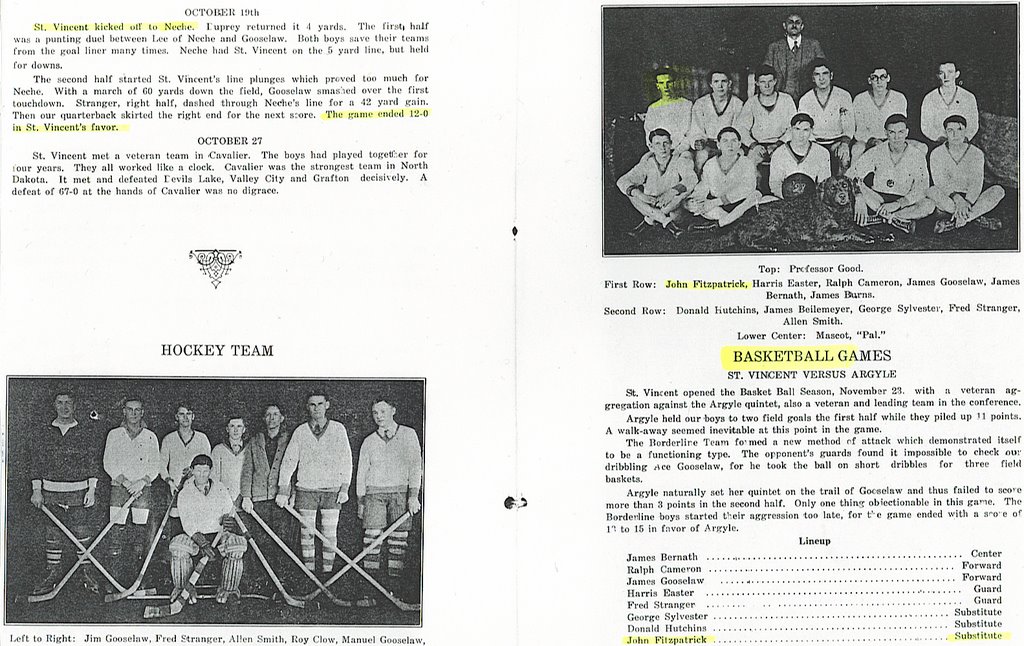
The piece below was written by Mike Rustad and and originally posted on my family's 'family' website, a website I created to gather family history to which I invited Mike to be a part of due to his love of local history and knowledge of so many area families that intersected with my own.

Mike shared this fascinating look into St. Vincent's past back in 2004; I am currently reviewing all content on an old site because it will be discontinued soon. Many great pieces of local history were shared there, and I intend to preserve it all in some shape or form. I invite you to share in this wonderful view to our past, this little 'time machine' to not only my family's roots but those that touch on the wider communities they lived in...

[And as Mike ponders, where DID those girls practice some of their sports? My theory is they shared practice/play space with Pembina, but that's just a working theory...]


This little essay was inspired by reviewing some old clippings about the St. Vincent girls basketball team that appeared in the 1927-28 school yearbook that can be found in the Lake Bronson-based Kittson County Museum. St. Vincent is today nearly a ghost town. First, a little background. Mrs. Dick Lapp's little history of St. Vincent notes that the towns was the oldest city in Kittson County from the standpoint of settlement. Mrs. Lapp writes that "[t]he history dates back as far as 1857, when Minnesota was still a territory. A trading post on the village site had been named St. Vincent in honor of St. Vincent de Paul, founder of missions and hospitals in France." St. Vincent was built up as a town that serviced Fur Company XYZ (what an unimaginative name!). She notes the town was a byproduct or expansion by the Selkirk settlers that founded Pembina. St. Vincent had the reputation of being a rough and tumble town. Mrs Lapp writes:
"Ox-carts were the first means of travel in this area. Norman Kittson enveloped the ox-cart enterprise. Later steamboat traffic became important not only to the village but to settlement of the community. As early as 1862, railroad talk began. In Winnipeg, Donald Smith thought the Red River needed a lifeline to the east. He took his idea to Norman Kittson, the president of the steamboat line which held a monopoly on the river. Kittson referred the matter to his silent partner, James Hill. Hill had a dream of reviving the bankrupt railway at St. Paul and latched onto the idea immediately. In 1878, his dream was realized. He saw the first locomotive arrive in Emerson, Manitoba from St. Paul. It was the Great Northern Railway and later known as the Burlington Northern. The customs office and depot were in St. Vincent until 1905 when they were moved to the Canadian border at Noyes. In 1900, a roundhouse was built, James J. Hill backed the project. It was located by Lake Stella, east of St. Vincent. A turning table was included that was used to turn the trains around. Charles Gooding was the first depot agent. John McGlashen was the first man to take a carload of horses through from St. Cloud to Winnipeg. He also operated a saloon".
Mrs. Lapp notes how vibrant the town was by the turn of the century. The fur traders were prosperous and started the first stores. She writes further:
"The first bank was established in 1880 by J. H. Rich, E. L. Baker and F. B. Howe. It was later sold and closed. J. R. Ryan operated a livery and sales and William J. Mason opened a blacksmith's shop and also ran a wagon and carriage shop. The Firehall was built in 1903 by Edward Cameron and his three sons. It was on main street, east of the Red River bridge and housed fire engines run by steam. The Firehall was pushed over in 1972, the town hall demolished and a new hall built on original site of depot."
Mrs. Lapp notes that the first teacher in the St. Vincent School was none other than Eliza Moore.  The first schools in the county were on or near this village. Lapp's sure-footed history records that it was "Eliza Moore, then age fifteen, taught all eight grades in a little one room school in the west end of town. She told stories in later years of the Indians riding their ponies around the schoolhouse and looking in the windows and frightening her and the pupils. The present school was built in 1903. It was a square two-story white frame building and originally housed all the grades from one through twelve."

Eliza Moore continued to teach in St. Vincent when I was a student in the 1950s and 1960s. I thought of her as an Ancient Mariner or School marm. Mrs. Lapp gives her great credit for the development of the school in St. Vincent. In the late 1950s and early 1960s, Prof. Moore was a big part of the St. Vincent school. Other St. Vincent teachers from my day included Maribel Berg, Velma Isley and now my memory so many decades later becomes fuzzy. I think Simeon Cameron was the school cook. [Note from Trish:  I also had Mrs. Berg & Mrs. Isley as teachers at the St. Vincent School, and Simeon Cameron was still the cook while I attended...] 

Now, let's fast forward to 1928. The town of St. Vincent in its heyday had a hotel called the Northern Hotel. It also had saloons, stores, a jail, fire station, curling rink, etc. However, the jewel in the crown was the St. Vincent School. The School field both boys and girls teams for basketball, track. tennis and baseball. I think that the social history of girls' sports is largely a lost memory. I want all of the readers to think of the St. Vincent described by Mrs. Dick Lapp. There was a vibrancy. It was 1928 only a year before the Great Depression was to cause the citizens of St. Vincent great economic and personal turmoil. The Great Depression which was to begin in 1929 decimated St. Vincent. Mrs. Lapp blamed the Great Floods of 1948 and 1950 and she may be right about the factors leading to the dissolution of vibrant St. Vincent. I think that the Great Depression might have played a role. Mrs. Lapp lived through the Great Deapression and both floods. I was a baby during the Flood of 1950. I digress. Fast forward to the 1927-28 school year. The school was the center of town life.

The St. Vincent School had a strong (women's) basketball team consisting of Mamie Cleem, Isabel Fitzpatrick, Lelia Davis, Fidessa Wilkie and Alberta Fitzpatrick. The Girls' Basketball Team of 1927 is pictured during the first game of the season. The first game for the girls was held on December 4, 1927. I found the school yearbook to be amusing. Isabel is pictured as tall and lean and quite attractive in a picture taken during the first game of the year. In the back row, there is yet another Fitzpatrick named Fern. The name is alternatively spelled Fern or Ferne. Ferne was the starting Left Forward on the team and had the nickname of Coon. Isabelle was known as Issy or at least that's what her teammates called her. Issy was apparently the team's star ball handler and dribbler and played at the right guard position. What's so puzzling to me is that there appears to be 6 players on the starting lineup for girl's basketball. Issy was at the Right Guard position Fidessa Wilkie or Fido was at the Center Guard and Verlie Cameron or Plug was at the Left Guard. The nicknames for the girls were not exactly comely or feminine names. I was impressed with their apparent fitness and competitiveness. Every girl had a nickname. The Center Forward, Mamie Cleem, was nicknamed "Slivers" There was Coon (Ferne) at the Right Forward position and Lelia Davis or Lee at the Left Forward. Isabelle or Issy played Right Guard. Fido was at the left guard. They were spelled by substitutes Verlie Cameron (Pug), Violet "Cutie" Cleem and Mae (O'Leary) Gamble. Eileen Twamley also played on the team. I assume she was the sister of Merle Twamley who was the patriarch of the large Twamley family we knew growing up in Humboldt and St. Vincent.

The other sports stories about the girls basketball team of 1928 mentions the injuries the girls sustained and how they played the game. Isabelle, for example, jammed two fingers, and was hurt in the game with Stephen. St. Vincent beat Stephen 21 to 16. Issy continued to play despite having sprained fingers. She was not the only girl to be injured. Coon's leg was twisted and the game delayed. She limped through the end of the quarater and could not continue. She was replaced by "Cutie" Cleem. In that game, Mamie "Slivers" Cleem was the superstar scoring 12 of the 16 points and playing like a champ. St. Vincent beat Stephen! I don't ever remember Humboldt-St. Vincent beating Stephen. St. Vincent beat Stephen at the game held in St. Vincent. Does anyone remember where the games were played? I think that the Boy's Teams were played in Pembina. It may be that the games were played at Pembina's gym. St. Vincent played Pembina February 8, 1928. The Game ended in a 10 to 10 tie. In the Stephen game, St. Vincent's star players missed key free throws while Stephen made their shots. St. Vincent took the win because of their better outside shooting. In the Pembina game, the game game had a number of hard fouls against the St. Vincent girls. Issy Fitzpatrick had a key personal foul levied against her. A technical foul was called on Fido Wilkie. Slivers was hurt in a hard foul and knocked against the back wall and then to the floor. There were officiating disputes in all of the girls' games or there was a hyperactive imagination on the part of the St. Vincent sports writers. In the return game with Stephen at Stephen held on January 20, 1928, the St. Vincent team made baskets that were not counted. The home town (Stephen tilted) referree ruled that when Slivers made a basket, it did not count. When Coach Dick Lapp objected, he was told that the basket did not count because of interference. Lapp retorted, "Interference, YES, BECAUSE ST. VINCENT MADE THE BASKET."

The third quarter of the Stephen game ended in a 14 to 14 tie. In the fourth quarter, a St. Vincent player named Mae Gambel or O'Leary went into the game replacing Issy Fitzpatrick. That substitute was not a wise choice as then Stephen made four baskets and St. Vincent only two to round off the game which ended "18 to 22, in Stephen's favor." In the Pembina game, Cutie Cleem substituted for Coon. Apparently, the ref called a foul on Cutie for chating with someone on the team so a technical foul was called.

I was wondering whether anyone knows additional facts about any of these colorful girl sports heroes from the late 1920s. St. Vincent was a great sports town with a full array of girls sports during the 1920s: basketball, tennis, softball or kitten ball etc.

I responded to Mike's post by saying:

Wow, Mike! Keep the stories coming, sports-related or otherwise! You really bring St. Vincent alive for us. It's really neat to hear about the history of where I grew up. I wonder what other source material there might be out there that would have information about the town's life? I'd love to hear more about the merchants, who owned what, what the saloons and hotel, etc. was like, the background of the town's politics, etc...even the gossip of the past. Any ideas anyone?
My cousin Delphine Mundorf responded:
Alberta Fitzpatrick as you may know from other postings is my mother. I was surprised about her name mentioned here on the basketball team. I guess she has mentioned it to me but her biggest thing she talks about is playing tennis. She says she was very good at tennis and she and her partner did so well they had a chance to go to the State tournament. However that cost money and her folks didn't have the money to send her so she never got to the state competition. I believe she felt she was good enough to maybe have become a pro. The Fern you talk about is mom Alberta's & my aunt Harriet's first cousin. I met her several times as she lived in Crookston when I was a child and we usually stopped to visit her whenever we went to St. Vincent to see my grandparents. My mother is still living and will be 92 in July. To my knowledge she has outlived in age all her family. They all had longevity but most of the elders died in their late 80's.
Mike Rustad then commented:
Alberta was in fact a member of the St. Vincent tennis team. What this demonstrates is that the St. Vincent girls program was fully developed. The girls did not play football or hockey in the late 1920s, but every other sport. The point was that the town followed these teams. I find it amazing that St. Vincent played Neche, Cavalier, Stephen, and towns that were much bigger. I wonder where St. Vincent played their hockey games. Jim Gooselaw, Fred Stranger, Allen Smith, Roy Clow, Manuel Gooselaw, Cecil Smith, Bill MacKay and Ralph Cameron were on the school's hockey team. I have no further information. I think that if I were to get back to Lake Bronson that I could find a great deal more about the St. Vincent school. One of the problems I have being in Vermont is that I don't have ready access to these materials. Maybe one of you could do a field trip to the Kittson County Museum and make some copies of the St. Vincent materials. Another great source would have been the Pembina Museum. I am not referring to that antiseptic boring museum today, The old museum had tremendous numbers of artifacts etc. I asked someone what happened to that stuff and was told that the State has it in storage in Bismarck. What a waste. I think a fellow named Barron had his own private museum in Pembina. [Note from Trish:  Mike is right in this - it was Elmer Barry, and his private museum became the basis of the old Pembina Museum!]  I bet he had tons of stuff on St. Vincent. The shame of having this lost history is that everyone is now deceased or very old who attended St. Vincent High School. We have only fragments to draw from. We must be like archaeologists in trying to construct social history from such scant data. I think who we are is deeply rooted in our history. Going back to far in history for wisdom is like ox-tail soup. It's going back too far for a good thing.
Delphine Mundorf again commented:
My mother as I mentioned is now 92. She & I believe 3 other boys were the only 4 to graduate from the St. Vincent High school all others transferred to Humboldt I believe. I wish I had pd. more attention to Mom's stories but not being a historian I didn't. But I think Mom, Fred Stranger, and a Smith boy & one other graduated from St. Vincent High school. The rest transferred but it cost a tuition to do so & these 4 parents didn't have the money for it. So Mom wasn't going to finish school. One morning she came downstairs and found her mother crying and when My Mom asked Grandma why she was crying Grandma said because I only had a 3rd grade education and you have a chance to graduate and aren't going to do it. So my mother called the boys and asked them if they would be willing to go back to school and they agreed so they showed up in Prof.1 Good's class. Mom said he was so happy to see them he got tears in his eyes, Moms favorite thing she used on us kids was that we better do good in school because she was valedictorian of her class. I wasn't til later we found out she was only 1 of a class of 4, no wonder she was valedictorian. Ha Ha. She also has told me that the professor was so glad they came back to his class that he offered to help each one of them should they decide to further their education. She then went on to Minneapolis and went into nurses training but at her time it didn't cost to go to nurses training you worked some of your education so got the room free and got pd. $12 a month. She made it through the 3 yrs. to become a registered nurse but was never able to take the state boards. Her story all these yrs. was because it cost $12 to take the board exam and she didn't have the money to pay for it nor did her parents. I always asked her why didn't you contact Prof Good since he said he would help any of you. To go through the whole training then not take that final exam to get you certificate is such a waste. She just said Ya I suppose I could have asked him. However I have since very shockingly found out there was a a whole other reason why she never got that final exam.
1 - The use of "Prof.", short for "Professor" was curious to me, since I had only been familiar with it in association with teachers at a university or college level, but here it is used with teachers at a secondary level. I did a bit of research, and it appears to have been common at this time...

Friday, November 27, 2009

Historical Depot Photos

Pembina ND NP depot looking northeast in 1969 (Photo by Charles W. Bohi) from Northern Pacific Railway Historical Association

Emerson Junction MB CN depot looking southeast. It was used by NP passenger trains after crossing the Canadian border (Photo by Charles W. Bohi) from Northern pacific Railway Historical Association

William Ash shared the above photo links with me recently...

Thursday, March 09, 2006

St. Vincent Oral History

Swan Anderson would get fan mail from people far and wide that had once lived in St. Vincent and the surrounding area, generated from his newspaper columns for the Enterprise, and even from his toll-free phone number into his home (another story for another time). Swan kept sharing history even when he was in the nursing home. And thank goodness he did.

Speaking of fan mail, let me share with you a letter Swan received from the LeMasuriers of Ontario, California; as many reading this may remember, the LeMasurier family lived in St. Vincent at one time (to be honest, I am unsure if any of the family may still be in the area...) This letter shares some more history about St. Vincent and the railroads. Please note that the story told in the letter is second-hand, being told to the LeMasurier family by George (aka "Shorty") and Bessie Cowan. That does not make it any less true, but I wanted to be sure everyone knows the chain of how the story came to us. Read on...

Before the turn of the century and when the railroad from Winnipeg east wasn't finished, St. Vincent was a booming railroad town. The round house was out by Lake Stella* and had a turntable to turn the engines around. The long depot in St. Vincent housed the Customs and Immigration offices. There was also a Signal House. In 1901 William LeMasurier bought it** and moved it to his farm north of St. Vincent. He and his bride, the former Maggie Easter, started housekeeping there in 1902. The land north of St. Vincent and west of the Emerson road was all railroad land. Phillip LeMasurier bought some and later sold it to his sons, William and Arthur. John and George Cowan bought some, also Mose Parenteau and Austin Griffith. The railroad reserved a right-of-way along the top of the river bank. Bessie Cowan told me at one time the railroad had planned to build a bridge across the Red River on Shorty's land.

The Great Northern Hotel was a three-story building with a ballroom on the third floor. Bessie Cowan gave us a picture of it and we left it with the Pembina Museum*** when we left St. Vincent. When the hotel was torn down, the attached section that was the kitchen was bought by the Russells and made into their home. Later, Harold Easton bought it and finally Milton Gregoire bought it and tore it down, and built what is now known as the Nellie Blair house.

There was a strip of land from the Red River to the Emerson road, 137 acres in the Village of St. Vincent on its north side. Austin Griffith bought the 36 acres next to the Emerson road and Charlie LeMasurier bought the rest from Peter Monro. Harris remembers when Charlie had a lot cleared along the river. The man doing the work used oxen. Mrs. Morrow, who lived in St. Vincent, used to pick roots and would give Harris fifty cents to haul a load to town for her.
* - Ah, yes...Lake Stella...supposedly a man-made Lake, but by whom, and why? Does anyone know out there? If so, please let me know!
** - Didn't St. Vincent have a depot after 1901? Mmmm...now I shall have to research this to find out if it did or not; to be honest, I never knew when the depot was no longer in operation, but always assumed it was around longer than 1901.
*** - I am in the process of tracking this photo down, and will definitely share it here when I do...

Tuesday, November 15, 2005

St. Vincent Depot, circa 1910

Albert and Richard Fitzpatrick, sitting on the St. Vincent depot loading dock...I don't really know when this photo was taken, but I have a rough idea. It shows my grandfather, Al Fitzpatrick, and his brother Dick, sitting on the loading dock by the St. Vincent depot. My great uncle Dick worked for the railroad, and my grandpa was still putzing around doing some drayman work for the town, so they ran into each other quite often. St. Vincent was, and is, a small town - some would say barely a village - but it had it's moments. I'll be tracking them down and posting them here. I hope you'll come back and join me...

NOTE: If you or someone you know have photos and/or stories about St. Vincent, please contact me; I'd like to share them here!

Monday, November 28, 2005

St. Vincent Boom Times, Part I

Old Times In The Red River Valley: St. Vincent, "Uncle John," The Pacific Hotel, "Col. Flake," Boom and Bust
By George B. Elliott

No. 5
The Northwestern Farmer and Breeder
20 September 1886

"The Valley of Eden" had its Tapley "who was always jolly under difficulties, but it was left to the Red River Valley to have a man who was "the same" no matter whose lot was "criss-cornered," or whose stake was pulled up. Uncle John Stewart is a type of a New Englander not often found in frost-bound latitudes. In the palmy days of '74 Uncle John was proprietor of the Exchange Hotel, Winnipeg, in which city he still has many warm friends.

The same fatality which drove many thousands to California in '49 induced Uncle John to erect the Pacific Hotel in what was then thought to be the coming Frisco of the Northwest - St. Vincent.

A man was found who could demonstrate to a certainty that what Helena was to Montana so would be St. Vincent to Minnesota. The Gamaliel who instilled this enthusiasm into the hearts of even old timers was "Colonel" Fiske, who on the completion of the St. Paul & Manitoba road to the International boundary line, was placed in charge of the town to "boom it or bust."

The road was completed early in the fall of 1878, and the scale of the boom which followed, though not such as occurred in the "Valley of Eden," was nevertheless the sliding variety.

Uncle John Stewart went into the middle of a poplar brush and cut out two lots on which he erected his Pacific Hotel. Jim White, who subsequently ran Huron City "for all it was worth," had declared that in '71 he had paddled all over St. Vincent in a dugout and shot ducks where the depot was located. Mac Cavileer corroborated this statement and produced a doubled barrel shotgun in order to relieve any one of any unnecessary doubts. Daniel Brawley, whose name must always be identified with that of St. Vincent, emphatically maintained that St. Vincent was "booming." Even when cross questioned by a citizen of Pembina, who invariably objected to the great future which was the alleged destiny of St. Vincent, Brawley would remark that it was "booming nevertheless."

The railway people, however, played sad pranks with St. Vincent. They scattered the place all over like sage brush on an Arizona cattle range. They put the depot in one place, they ran a spur down to the river, and the inhabitants were informed that sometime in the near future they would build a jetty at the end of the spur, and Mr. William Moorhead, of Pembina, waggishly observed that they would eventually extend the jetty across the river and thus have a bridge. Then by way of variety the same railway company located their engine house about half a mile from the town. Then half way to Emerson they built another depot - a kind of an opposition establishment - and then about half a mile further east, in another direction, they built a section house. They scattered their buildings around promiscuously, expecting to see the town fill up in a hurry, but the town never filled up. It was attacked early - - in the first stage of its career, and it never rallied. Col. Fiske had build a ditch to drain a swamp which covered half the neighborhood, but the swamp after bestowing a portion of its contents into the ditch refused to part with the major portion of its contents. Still those who located at St. Vincent were there to stay; they had stout hearts, and it was not their fault if the place did not come up to the original anticipations.

There is no western town without its redeeming features, and when railway magnates induce people to locate at their terminal towns, they should stay with the people and not leave them to their fate. "Conductor, throw this town overboard, we've got to build another further on."

Nothing shocks your staid man from the East, more than the odd fashion the Western people have of living in tents and shacks, and then pulling up stakes and going off further west. The eastern man's momentum has been of the slow description; he cannot move fast at first, even if you kick him; his joins are stiff, and how can you expect him to move with the celerity of a western rustler? When he locates it is like the dump of a pile-driver, he makes an impression on the soil and there wants to remain and conduct matters in the old fashioned way, but the western man cannot allow such foggyism, and the eastern individual soon discovers that he must do likewise or be "a bump on a log." If he has snap he does "likewise;" if has not he remains as a surveyor's mark, sure to be found around the same old spot many years afterward.

The life incident to a new town in the west is real and earnest. Such activity as might have been observed about St. Vincent in the palmy days of its career was of the western type. Like Moorhead to Fargo, it defied its neighbor across the river, but the old inhabitants of Pembina shook their heads ominously. Mr. Moorhead would vary the occasional solemnity by observing that "he did not think it was fair to attack a place because it was hard to see." But when Col. Fiske undertook to interrupt the ferry and thus cut off communication with Pembina, Mr. Moorhead remarked that it was a "territorial offense" to interrupt communication across a navigable stream, and so Col Fiske was foiled, pending the question as to which side of the river was the stronger. It was not long before the people of the territorial town found that even a territory has rights, and so they continued to vindicate them.

For a long time St. Vincent bore the unequal struggle, first against the railway company then against Pembina; the latter, of course, being its natural rival. But between the contending forces from a thriving, ambitious town it was "flattened out" until natural growth would assist it. It was not without its virtues, and like many a railway terminus, its promoters were promised a great deal and the promises were not kept.

The price of lots went down from considerable to nothing. The town site company expended a good deal of money in making improvements "but the west side always" seems to have a withering effect on the right bank of the Red.

One of the incidents connected with the early history of St. Vincent was the celebration of the arrival of the first train. That was a glorious occasion! There was no dearth of champagne on the occasion either. There was a happy time for it really meant through trains to Winnipeg from the far East.. Many of the chief actors in that scene are gone - - among the number poor Brawley, "the member for St. Vincent" who certainly believed that some day his town would rival St. Paul.

The illustration shows the Pacific Hotel with Uncle John Stewart at the door, in his good, old fashioned way.

Many an interesting anecdote "Uncle John" is able to tell, for he has handled the ribbons in his time as a stage, and he can tell his story with a dry humor that is inimitable. A warm heart and a kind and hospitable landlord is "Uncle John" to all.