Showing posts sorted by relevance for query alberta fitzpatrick. Sort by date Show all posts

Sunday, January 08, 2012

1927-28 Girls Basketball Team

Front: Eileen Twamley, Mamie Cleem (Captain), Mae Gamble
Back: Isabelle Fitzpatrick, Verlie Cameron, Fidessa Wilkie, 

Dick Lapp (coach), Leila Davis, Violet Cleem, Fern Fitzpatrick.
ARE THE NAMES in the RIGHT ORDER?

[Photo Courtesy:  Kittson County Historical Society via Perm Diamond]
When growing up in St. Vincent, I regularly heard stories told by my mother, father, and grandmother (not to mention other village and county residents) about our hometown.  They ranged from tales of what the town looked like in the past, its businesses, the railroad, the churches, the roads and sidewalks (or lack thereof), to the lives of the residents themselves - their dreams, their families, and yes - their trials and woes.  More often than not, it was the tragedies and disappointments that were remembered.

However, there were also many happy memories shared.

Among them, was a passing reference to my Uncle John being an athlete in high school.  Not a lot to go on, and nothing about the fact that around the same time as John was participating in sports, the entire school had blossomed.  Except for the first years following incorporation and the initial surge of immigration, the time period we're talking about had the highest population.  There was a wide variety of extra curricular activities being offered for a small school, including sports.  I found all of this out many years later.  Even still later, I began finding out details to put on the skeleton of the bare-bone facts.

Recently, I was sent an image of the 1928 Girls Basketball Team from the St. Vincent School.  You can make a fairly safe conclusion, with the inconsistency of design, that the girls are wearing homemade uniforms. But bless them, they did their best.  My guess is that the girls made their own uniforms, at least the appliques - they show an immaturity that their mothers would have overcome had they created them.  It's sweet to see their efforts, though - the students and their community may have been humble, but they had school spirit!

NOTE:  Thanks to Kent Myrick (whose mother is in the above photograph, and who owns a complete, original copy of the 1928 Borderlines school annual), Lori Kohut Bianco (Gamble family descendant and whose great aunt is in the photo), and myself (who has two cousins in the photo), we know exactly WHO is in the photo, but we're still not entirely sure of the ORDER.  The ones we know for sure are the two Fitzpatricks girls (my cousins, one on each end of the back row), Leila Davis (Kent's mother, to the right of the coach), and the coach himself, Richard Lapp.  The other names are not conclusively matched to faces.  Personally, I think the girl second from the left in the back looks like a Twamley, but I could be wrong.  Also, Lori had heard oral family history about her great aunt having round glasses like the one girl does in the photo, at this time, but Kent says other photos showing a Mae Gamble with others doesn't show a girl with glasses.  VERY confusing.  Anyone reading this that can help clarify, I would love to hear from you!

A year later:  College Girl ID photo

St. Vincent Trivia:  My Aunt Pat (Alberta Fitzpatrick)  - who played on the St. Vincent Girls Basketball Team in high school - was in the final graduating class of the St. Vincent school, the Class of 1930.  Although the official consolidation bringing about District 352 didn't happen until the 1950's, evidently in the school year of 1929-30, the majority of the higher grade students began going to Humboldt.  My cousin (Aunt Pat's daughter) said her mother told her that she and three other boys were the only 4 to graduate from the St. Vincent High school in the 'last class' - Alberta, Fred Stranger, a Smith boy, and one other.  All others transferred to Humboldt.  The ones that transferred had to pay a tuition to do so.  The parents of the four students didn't have the money for it. So Alberta wasn't going to finish school. 
One morning she came downstairs and found my grandma (her mother) crying and when Alberta asked Grandma why she was crying Grandma said because I only had a 3rd grade education and you have a chance to graduate and aren't going to be able to do it. So my mother called the boys and asked them if they would be willing to go back to school and they agreed so they showed up in Prof. Good's class. Mom said he was so happy to see them he got tears in his eyes. From what I understand, the Professor made sure these four students graduated that final year...

Thursday, February 23, 2006

St. Vincent School Alumnus Remembers...

Alberta Fitzpatrick, on her way to Nursing School...
As a result of yesterday's post about the St. Vincent School, and the snapshot of the 1925/26 7th & 8th grade classes, I received this feedback from an alumnus from that photo, Alberta Fitzpatrick, via her daughter (and my cousin) Delphine:

Mom for one thing knew everyone whose name I mentioned and said she could just see the Gamble farm in her mind. It appears that the people in the picture correspond to the names as listed. For one thing Jean Gamble and Mom are in the right places with the names. She identified Eileen Twamley and Fred Stranger and they too were in the right places as per the names listed below the photo. So I am inclinded to believe the names and photos of each are in the correct order from left to right row by row.

She did however make a few changes in that the one listed as Jean Scott her name isn't Jean but Jane. Brock Perry isn't Brock but Brooks. As soon as she said Brooks Perry I remembered her talking about him over the years. Brooks Perry's dad [Gale Perry] was the St. Vincent Postmaster. Norton DeFrances' Dad [Roy DeFrance] was editor and owner of the St. Vincent Herald [later named the St. Vincent New Era...] Grandpa and several other men use to gather in front of the Herald every day and gossip with each other.

Mom's class started out with 18 students and had they stayed together would have been the largest class to graduate St. Vincent. I earlier [wrote] that the class transferred to Hallock but I was wrong the class transferred to Pembina thus why they had to pay tuition. Going from Minn. to N.D. Grandpa and Grandma Fitzpatrick, the Smith family, and the Strangers couldn't afford that tuition so those kids weren't going to finish school. One morning Mom came downstairs to find Grandma crying. When she asked her why, Grandma who only had a 3rd grade education told Mom because if she would have had the opportunity to graduate she would have done so and Mom was throwing that chance away. Mom said if it meant that much she would go back and graduate. She contacted Fred Stranger and John and Allen Smith and asked them if they would go back to school. They all agreed so they met at the school the next morning at 9am and walked into Professor Vick's class. Mom said Professor Vick was so happy to see them he cried. He told them all at the end of the year that if any of them wanted to further their education he would pay for their college. According to Mom Fred Stranger and the Smith boys did go on to college on Professor Vicks' help. Mom went on to Nurses training which was free so she needed no help. In fact when Mom went to Nurses training it was a working school as well as classes so she not only did not have to pay to become a nurse she got paid $12 a month for nursing.

Others of the DeFrances family (not in the picture) were Gladys amd Marjorie*. She also talked about Mae Gamble who Mom knew well but also not in the picture as she was in a higher class. She knew every name I mentioned but before she could remember much her mind would cloud over again and then I would show her the picture once again to see if she could see it better so as to identify people and she then would tell me yet another story.

* I spoke with Marjorie DeFrance on the telephone about 6 weeks ago. We made tentative plans to meet at her Pembina home when she returns from the southwest where she winters, so we can go through her father's papers and photos, much of which covers not only the DeFrance family, but touches on the history of St. Vincent, Pembina, and the St. Vincent/Pembina New Era...

Tuesday, August 24, 2010

Small Town Girl Sports

Many years ago I was fortunate enough to have been able to
handle & read a 1928 copy of the St. Vincent School's annual
"Borderlines", copying several pages pertaining to my family
The piece below was written by Mike Rustad and and originally posted on my family's 'family' website, a website I created to gather family history to which I invited Mike to be a part of due to his love of local history and knowledge of so many area families that intersected with my own.

Mike shared this fascinating look into St. Vincent's past back in 2004; I am currently reviewing all content on an old site because it will be discontinued soon. Many great pieces of local history were shared there, and I intend to preserve it all in some shape or form. I invite you to share in this wonderful view to our past, this little 'time machine' to not only my family's roots but those that touch on the wider communities they lived in...

[And as Mike ponders, where DID those girls practice some of their sports? My theory is they shared practice/play space with Pembina, but that's just a working theory...]


This little essay was inspired by reviewing some old clippings about the St. Vincent girls basketball team that appeared in the 1927-28 school yearbook that can be found in the Lake Bronson-based Kittson County Museum. St. Vincent is today nearly a ghost town. First, a little background. Mrs. Dick Lapp's little history of St. Vincent notes that the towns was the oldest city in Kittson County from the standpoint of settlement. Mrs. Lapp writes that "[t]he history dates back as far as 1857, when Minnesota was still a territory. A trading post on the village site had been named St. Vincent in honor of St. Vincent de Paul, founder of missions and hospitals in France." St. Vincent was built up as a town that serviced Fur Company XYZ (what an unimaginative name!). She notes the town was a byproduct or expansion by the Selkirk settlers that founded Pembina. St. Vincent had the reputation of being a rough and tumble town. Mrs Lapp writes:
"Ox-carts were the first means of travel in this area. Norman Kittson enveloped the ox-cart enterprise. Later steamboat traffic became important not only to the village but to settlement of the community. As early as 1862, railroad talk began. In Winnipeg, Donald Smith thought the Red River needed a lifeline to the east. He took his idea to Norman Kittson, the president of the steamboat line which held a monopoly on the river. Kittson referred the matter to his silent partner, James Hill. Hill had a dream of reviving the bankrupt railway at St. Paul and latched onto the idea immediately. In 1878, his dream was realized. He saw the first locomotive arrive in Emerson, Manitoba from St. Paul. It was the Great Northern Railway and later known as the Burlington Northern. The customs office and depot were in St. Vincent until 1905 when they were moved to the Canadian border at Noyes. In 1900, a roundhouse was built, James J. Hill backed the project. It was located by Lake Stella, east of St. Vincent. A turning table was included that was used to turn the trains around. Charles Gooding was the first depot agent. John McGlashen was the first man to take a carload of horses through from St. Cloud to Winnipeg. He also operated a saloon".
Mrs. Lapp notes how vibrant the town was by the turn of the century. The fur traders were prosperous and started the first stores. She writes further:
"The first bank was established in 1880 by J. H. Rich, E. L. Baker and F. B. Howe. It was later sold and closed. J. R. Ryan operated a livery and sales and William J. Mason opened a blacksmith's shop and also ran a wagon and carriage shop. The Firehall was built in 1903 by Edward Cameron and his three sons. It was on main street, east of the Red River bridge and housed fire engines run by steam. The Firehall was pushed over in 1972, the town hall demolished and a new hall built on original site of depot."
Mrs. Lapp notes that the first teacher in the St. Vincent School was none other than Eliza Moore.  The first schools in the county were on or near this village. Lapp's sure-footed history records that it was "Eliza Moore, then age fifteen, taught all eight grades in a little one room school in the west end of town. She told stories in later years of the Indians riding their ponies around the schoolhouse and looking in the windows and frightening her and the pupils. The present school was built in 1903. It was a square two-story white frame building and originally housed all the grades from one through twelve."

Eliza Moore continued to teach in St. Vincent when I was a student in the 1950s and 1960s. I thought of her as an Ancient Mariner or School marm. Mrs. Lapp gives her great credit for the development of the school in St. Vincent. In the late 1950s and early 1960s, Prof. Moore was a big part of the St. Vincent school. Other St. Vincent teachers from my day included Maribel Berg, Velma Isley and now my memory so many decades later becomes fuzzy. I think Simeon Cameron was the school cook. [Note from Trish:  I also had Mrs. Berg & Mrs. Isley as teachers at the St. Vincent School, and Simeon Cameron was still the cook while I attended...] 

Now, let's fast forward to 1928. The town of St. Vincent in its heyday had a hotel called the Northern Hotel. It also had saloons, stores, a jail, fire station, curling rink, etc. However, the jewel in the crown was the St. Vincent School. The School field both boys and girls teams for basketball, track. tennis and baseball. I think that the social history of girls' sports is largely a lost memory. I want all of the readers to think of the St. Vincent described by Mrs. Dick Lapp. There was a vibrancy. It was 1928 only a year before the Great Depression was to cause the citizens of St. Vincent great economic and personal turmoil. The Great Depression which was to begin in 1929 decimated St. Vincent. Mrs. Lapp blamed the Great Floods of 1948 and 1950 and she may be right about the factors leading to the dissolution of vibrant St. Vincent. I think that the Great Depression might have played a role. Mrs. Lapp lived through the Great Deapression and both floods. I was a baby during the Flood of 1950. I digress. Fast forward to the 1927-28 school year. The school was the center of town life.

The St. Vincent School had a strong (women's) basketball team consisting of Mamie Cleem, Isabel Fitzpatrick, Lelia Davis, Fidessa Wilkie and Alberta Fitzpatrick. The Girls' Basketball Team of 1927 is pictured during the first game of the season. The first game for the girls was held on December 4, 1927. I found the school yearbook to be amusing. Isabel is pictured as tall and lean and quite attractive in a picture taken during the first game of the year. In the back row, there is yet another Fitzpatrick named Fern. The name is alternatively spelled Fern or Ferne. Ferne was the starting Left Forward on the team and had the nickname of Coon. Isabelle was known as Issy or at least that's what her teammates called her. Issy was apparently the team's star ball handler and dribbler and played at the right guard position. What's so puzzling to me is that there appears to be 6 players on the starting lineup for girl's basketball. Issy was at the Right Guard position Fidessa Wilkie or Fido was at the Center Guard and Verlie Cameron or Plug was at the Left Guard. The nicknames for the girls were not exactly comely or feminine names. I was impressed with their apparent fitness and competitiveness. Every girl had a nickname. The Center Forward, Mamie Cleem, was nicknamed "Slivers" There was Coon (Ferne) at the Right Forward position and Lelia Davis or Lee at the Left Forward. Isabelle or Issy played Right Guard. Fido was at the left guard. They were spelled by substitutes Verlie Cameron (Pug), Violet "Cutie" Cleem and Mae (O'Leary) Gamble. Eileen Twamley also played on the team. I assume she was the sister of Merle Twamley who was the patriarch of the large Twamley family we knew growing up in Humboldt and St. Vincent.

The other sports stories about the girls basketball team of 1928 mentions the injuries the girls sustained and how they played the game. Isabelle, for example, jammed two fingers, and was hurt in the game with Stephen. St. Vincent beat Stephen 21 to 16. Issy continued to play despite having sprained fingers. She was not the only girl to be injured. Coon's leg was twisted and the game delayed. She limped through the end of the quarater and could not continue. She was replaced by "Cutie" Cleem. In that game, Mamie "Slivers" Cleem was the superstar scoring 12 of the 16 points and playing like a champ. St. Vincent beat Stephen! I don't ever remember Humboldt-St. Vincent beating Stephen. St. Vincent beat Stephen at the game held in St. Vincent. Does anyone remember where the games were played? I think that the Boy's Teams were played in Pembina. It may be that the games were played at Pembina's gym. St. Vincent played Pembina February 8, 1928. The Game ended in a 10 to 10 tie. In the Stephen game, St. Vincent's star players missed key free throws while Stephen made their shots. St. Vincent took the win because of their better outside shooting. In the Pembina game, the game game had a number of hard fouls against the St. Vincent girls. Issy Fitzpatrick had a key personal foul levied against her. A technical foul was called on Fido Wilkie. Slivers was hurt in a hard foul and knocked against the back wall and then to the floor. There were officiating disputes in all of the girls' games or there was a hyperactive imagination on the part of the St. Vincent sports writers. In the return game with Stephen at Stephen held on January 20, 1928, the St. Vincent team made baskets that were not counted. The home town (Stephen tilted) referree ruled that when Slivers made a basket, it did not count. When Coach Dick Lapp objected, he was told that the basket did not count because of interference. Lapp retorted, "Interference, YES, BECAUSE ST. VINCENT MADE THE BASKET."

The third quarter of the Stephen game ended in a 14 to 14 tie. In the fourth quarter, a St. Vincent player named Mae Gambel or O'Leary went into the game replacing Issy Fitzpatrick. That substitute was not a wise choice as then Stephen made four baskets and St. Vincent only two to round off the game which ended "18 to 22, in Stephen's favor." In the Pembina game, Cutie Cleem substituted for Coon. Apparently, the ref called a foul on Cutie for chating with someone on the team so a technical foul was called.

I was wondering whether anyone knows additional facts about any of these colorful girl sports heroes from the late 1920s. St. Vincent was a great sports town with a full array of girls sports during the 1920s: basketball, tennis, softball or kitten ball etc.

I responded to Mike's post by saying:

Wow, Mike! Keep the stories coming, sports-related or otherwise! You really bring St. Vincent alive for us. It's really neat to hear about the history of where I grew up. I wonder what other source material there might be out there that would have information about the town's life? I'd love to hear more about the merchants, who owned what, what the saloons and hotel, etc. was like, the background of the town's politics, etc...even the gossip of the past. Any ideas anyone?
My cousin Delphine Mundorf responded:
Alberta Fitzpatrick as you may know from other postings is my mother. I was surprised about her name mentioned here on the basketball team. I guess she has mentioned it to me but her biggest thing she talks about is playing tennis. She says she was very good at tennis and she and her partner did so well they had a chance to go to the State tournament. However that cost money and her folks didn't have the money to send her so she never got to the state competition. I believe she felt she was good enough to maybe have become a pro. The Fern you talk about is mom Alberta's & my aunt Harriet's first cousin. I met her several times as she lived in Crookston when I was a child and we usually stopped to visit her whenever we went to St. Vincent to see my grandparents. My mother is still living and will be 92 in July. To my knowledge she has outlived in age all her family. They all had longevity but most of the elders died in their late 80's.
Mike Rustad then commented:
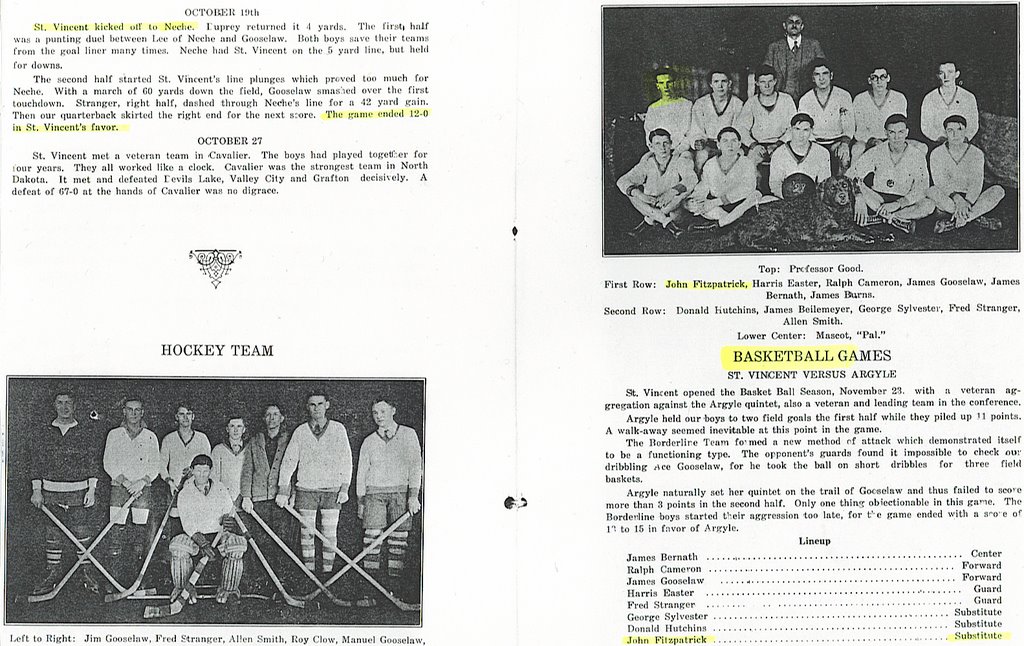
Alberta was in fact a member of the St. Vincent tennis team. What this demonstrates is that the St. Vincent girls program was fully developed. The girls did not play football or hockey in the late 1920s, but every other sport. The point was that the town followed these teams. I find it amazing that St. Vincent played Neche, Cavalier, Stephen, and towns that were much bigger. I wonder where St. Vincent played their hockey games. Jim Gooselaw, Fred Stranger, Allen Smith, Roy Clow, Manuel Gooselaw, Cecil Smith, Bill MacKay and Ralph Cameron were on the school's hockey team. I have no further information. I think that if I were to get back to Lake Bronson that I could find a great deal more about the St. Vincent school. One of the problems I have being in Vermont is that I don't have ready access to these materials. Maybe one of you could do a field trip to the Kittson County Museum and make some copies of the St. Vincent materials. Another great source would have been the Pembina Museum. I am not referring to that antiseptic boring museum today, The old museum had tremendous numbers of artifacts etc. I asked someone what happened to that stuff and was told that the State has it in storage in Bismarck. What a waste. I think a fellow named Barron had his own private museum in Pembina. [Note from Trish:  Mike is right in this - it was Elmer Barry, and his private museum became the basis of the old Pembina Museum!]  I bet he had tons of stuff on St. Vincent. The shame of having this lost history is that everyone is now deceased or very old who attended St. Vincent High School. We have only fragments to draw from. We must be like archaeologists in trying to construct social history from such scant data. I think who we are is deeply rooted in our history. Going back to far in history for wisdom is like ox-tail soup. It's going back too far for a good thing.
Delphine Mundorf again commented:
My mother as I mentioned is now 92. She & I believe 3 other boys were the only 4 to graduate from the St. Vincent High school all others transferred to Humboldt I believe. I wish I had pd. more attention to Mom's stories but not being a historian I didn't. But I think Mom, Fred Stranger, and a Smith boy & one other graduated from St. Vincent High school. The rest transferred but it cost a tuition to do so & these 4 parents didn't have the money for it. So Mom wasn't going to finish school. One morning she came downstairs and found her mother crying and when My Mom asked Grandma why she was crying Grandma said because I only had a 3rd grade education and you have a chance to graduate and aren't going to do it. So my mother called the boys and asked them if they would be willing to go back to school and they agreed so they showed up in Prof.1 Good's class. Mom said he was so happy to see them he got tears in his eyes, Moms favorite thing she used on us kids was that we better do good in school because she was valedictorian of her class. I wasn't til later we found out she was only 1 of a class of 4, no wonder she was valedictorian. Ha Ha. She also has told me that the professor was so glad they came back to his class that he offered to help each one of them should they decide to further their education. She then went on to Minneapolis and went into nurses training but at her time it didn't cost to go to nurses training you worked some of your education so got the room free and got pd. $12 a month. She made it through the 3 yrs. to become a registered nurse but was never able to take the state boards. Her story all these yrs. was because it cost $12 to take the board exam and she didn't have the money to pay for it nor did her parents. I always asked her why didn't you contact Prof Good since he said he would help any of you. To go through the whole training then not take that final exam to get you certificate is such a waste. She just said Ya I suppose I could have asked him. However I have since very shockingly found out there was a a whole other reason why she never got that final exam.
1 - The use of "Prof.", short for "Professor" was curious to me, since I had only been familiar with it in association with teachers at a university or college level, but here it is used with teachers at a secondary level. I did a bit of research, and it appears to have been common at this time...

Thursday, February 02, 2017

StVHS Sports: 1927/28

Vintage St. Vincent High School pennant from 1920s

[Guest article by Michael Rustad, originally from nearby Humboldt, MN]

In the summer of 1999, my daughter Erica and I visited the town of St. Vincent.

There is no longer a bridge connecting the central business districts of Pembina, North Dakota and St. Vincent. The old bridge connecting the towns that I remember as a child has long been dismantled. The places that I remember in St. Vincent have long since closed. Short's Cafe, Sylvester's Store, the Curling Rink, St. Ann's Catholic Church, and the St. Vincent Fairgrounds. The curling rink is now neglected and in state of decay. The Church is a private residence. The St. Vincent School, too, is in a state of benign neglect. The school is in disrepair and the fire escape slide detached.

It was difficult for me to explain to my daughter that St. Vincent was once a bustling community. We attended catechism each summer in the basement of St. Ann's Catholic Church. We had a large number of ball games in the yard outside the church which is now overgrown and marred by abandoned cars. When my sister and I visited the Kittson County Museum in Lake Bronson, I was amazed to find some high school yearbooks [called Borderlines] from St. Vincent High School. St. Vincent High School closed in the late 1930s and never reopened. Instead, it eventually consolidated its school district with Humboldt from 1957 to 1991.
[Note from Trish:  In-between StVHS closing and St. Vincent consolidating with Humboldt, students had the choice of attending Pembina High School, or other schools in Kittson County like Hallock...]
It was an unexpected joy to find yearbooks from the St. Vincent High School from the 1920s. This was a yearbook from a small town in NW Minnesota prior to the Depression. High school life in St. Vincent was marked by lots of school spirit judging from the many activities. St. Vincent fielded a football team, basketball team, hockey team, track team and baseball team in [school year] 1927/28.

"If you could walk or run, you were in the starting line-up."

Wednesday, February 22, 2006

School Days

Click for larger version

This is a snapshot taken during the school year 1925/26, of the 7th & 8th grade classes, on the steps of the St. Vincent School.


Names of students in photograph are:

Jean Gamble (far left, front row), Jean Fleming, Vera Rustad, and Alberta Fitzpatrick *(far right, front row)
Jane Scott, Eileen Twamley, Fred Stranger
Clarence Dorian, Warren Griffith, Dan Hutchins, Raymond Scrimshaw
Neill "Bo" Gamble (Jean's brother), Allen Smith
Merlin Twamley, Norton DeFrance, James Bernath, Brooks Perry, Manuel Gooselaw
Cecil & John Smith


The photo was shared with me by Barbara (Maloney) Sitar. Her mother was Margaret "Jean" (Gamble) Maloney; Jean's parents were William Gamble and Lillie Maud (Griffith) Gamble. Through her grandmother, Barbara is therefore also related to the Griffith family. Both the Gambles and Griffiths were early settlers to the town.

Barbara shared this with me...

My mother was born in 1914, attended school and church [in St. Vincent.] Her mother, Lillie Maud Griffith Gamble died when my mom was around 14 years old. At some point after that, my grandfather moved from the farm in St. Vincent to Hallock where they lived. I think he lost the farm and took a job with the railroad.


* Alberta, otherwise known as Pat, is my mother Harriet's older sister, and my aunt...

Sunday, March 15, 2026

PROFILES: My Grandmother’s Friends

Left to right:  Mrs. Zaharia, Margaret 'Toots' Ryan, Florence Godon, Esther Cleem (Florence and Esther were Thiefault sisters...), and Alberta 'Pat' Fitzpatrick Baudette, and in front, my grandmother, Elizabeth Fitzgerald Fitzpatrick in the wheelchair...

All the women in this picture (with the exception of my Aunt Pat who just happened to be home visiting that day...) were part of a group of friends who regularly hung out with one another, on an almost daily basis.  Growing up in St. Vincent, I saw many of them myself daily, as we all went about our business.  Most of the time, they were busy keeping house, looking after their families.  But as they went about their days, they would often run into one another at stores or church, in their yards or on the street, or stop by and visit.  Years ago, there was no common desire to avoid people and self-isolate as is common today; quite the contrary - most people sought out opportunities to socialize, to catch up.  

Names that still conjure up well-remembered faces and voices:

  • Mrs. Zahara (a Ukrainian lady whose strong accent made me nod a lot without knowing a thing she was actually saying), 
  • Matilda Cameron (a well-regarded seamstress whose second husband Wallace Cameron was a famous town constable), 
  • Esther Cleem (who along with her husband were victims of a home invasion turned deadly), 
  • Mrs. Gardiner (whose family tragedies rivaled my own Aunt Lena’s), 
  • Florence Godon, whose husband Bill worked for many years with my Dad at the Noyes depot,
  • Toots Ryan (good friend and neighbor-across-the-alley of my grandmother),
  • Glenice Friebohle (good friend of my mother’s), 
  • Ena Scobbie (wife of first pastor I remember of St. Vincent Evangelical Free Church), and 
  • Cousins Hattie  Schwenzfeier, Annie Nordine, Mabel Steien, and Faye Lyberg.

They all loved to gab, to share news and gossip, and to have a good laugh.  In other words, they loved to visit!  They were never at a loss for words.  There were no awkward silences.  If anything, people spoke over top of one another at times, interjected at others, and at still other times, the room divided into two or three subgroups like modern-day ‘threads’, multiple simultaneous conversations, and later came back into one again.  

The one who was more often than not dropping by Grandma’s place, or she to her’s, was Toots Ryan.  Toots lived north of Grandma’s place, just out the back door, through the back yard, and across the alley.  As you’d approach Toot’s house, you would notice the steps were higher than most around town.  That’s because the house had been put up on a higher foundation, my guess to protect the home’s contents in case of flooding.  It was the only house like that in town, but I later thought that was pretty smart thinking.  But as a little girl, the time period I knew Toots well, it never crossed my mind - it was just the way it was.  Her steps were harder to get up than my Grandma’s, each one a bit taller than normal, so I’d have to lift my little legs especially higher and give an extra hrmph to lift myself up.  The top step was a length of railroad tie, then the highest step of all over the lintel into the house proper.  

The door led into the kitchen, which as I recalled had one length of counter along the west wall.  There was a sink like at home, but instead of a faucet and water turns for hot and cold, there was a hand pump, which brought up water up from a private well under the house.  I have a feeling there was probably more of these at one time, but to my knowledge it was the only one left in town by then, the early 1960s.  There was still a town hand pump just kitty-corner from the Ryan home, by the town pond and curling rink.  Knowing more now historically, I think the town pond and pump may have served multiple reasons - for watering animals, water for people, water for fighting fires.  Heck, Grandma would have me go fetch buckets of water for her, to water her garden during the summer, since drinking water for her cost her precious money; at that time, most of us had our water brought in by water trucks, costing x-amount much per 1,000 gallons, stored under the house in cisterns. Anyways, I always thought it was so interesting that Toots still pumped her water.  She had a big stove in her house, too, but I never noticed what kind it was.  

The only other room in the downstairs was her parlor.  The first time I saw the parlor was on a visit to Toots with my Mom; in the parlor were two chairs, and a piano.  I hadn’t started playing the piano yet, but we had one that I was always tinkling on at home, showing an interest in learning already.  So it wasn’t surprising at all that I headed straight for it the first time I saw hers.  It had a fascinating seat, not a bench like ours, but a stool.  I found out immediately that it could be adjusting in height, delightfully by spinning it to the right for up, or left for down.  The stool’s feet looked like the claws of an animal, and clutched within those claw were small, clear, crystal balls.  I opened the lid to the keys to see keys that had faint marbling and yellowing, which I later learned meant they were real ivory keys made from elephant tusks.  A few were missing, but most were still there.  The really cool part was when I began ‘playing’ the keys, I learned the piano was badly out-of-tune.  However, to me, that made is all the more special:  It reminded me of the pianos played in the old western movies on TV - in tune enough to make out familiar melodies, but enough out-of-tune to be an authentic saloon piano!  

Once I wore out my welcome on the piano, I jumped off to rejoin the women (my Mom and Toots, visiting…)  Toots was a shorter-than-average lady, who was almost as round as she was tall.  That day, I was probably about four years old.  I interjected into their conversation with the observation, “You’re really fat!”  There was sudden silence.  Then Toots erupted into what I can now only describe as jolly laughter.  My Mom directed a mortified, “Patricia Kaye!” Towards me.  Toots came to my rescue by saying, “Patricia Kaye, eh?  That used to be my favorite chewing gum!”  She got a kick out of my outburst.  I had no idea I had done anything wrong, stating the obvious.  Toots and I always got along famously after that early meeting - I would often run out my Grandma’s back door and run over to her house and into her house up those high stairs.  

But when Grandma had friends drop by, there was a lot of visiting…and always over tea and baked goods.  The visiting might start off slow and casual, and build up to stories filled with gales of laughter; or they might start out with an excited, “Have you heard…?”  Whether it was a neighbor, or a cousin coming from across the county, in those days, people would often just pop in, no call ahead - no one minded, in fact, it was an occasion to be excited about.  Out would come the teapots full of Red Rose tea, served up with bars, cookies, and sometimes even cake…but always plenty of tea!  If Mrs. Zahara was in attendance when I was there, I would avail her of her talents and beg her for a reading of the tea leaves. I wish I could recall at least one of those readings now…