Showing posts sorted by relevance for query St. Vincent School. Sort by date Show all posts

Thursday, February 02, 2017

StVHS Sports: 1927/28

Vintage St. Vincent High School pennant from 1920s

[Guest article by Michael Rustad, originally from nearby Humboldt, MN]

In the summer of 1999, my daughter Erica and I visited the town of St. Vincent.

There is no longer a bridge connecting the central business districts of Pembina, North Dakota and St. Vincent. The old bridge connecting the towns that I remember as a child has long been dismantled. The places that I remember in St. Vincent have long since closed. Short's Cafe, Sylvester's Store, the Curling Rink, St. Ann's Catholic Church, and the St. Vincent Fairgrounds. The curling rink is now neglected and in state of decay. The Church is a private residence. The St. Vincent School, too, is in a state of benign neglect. The school is in disrepair and the fire escape slide detached.

It was difficult for me to explain to my daughter that St. Vincent was once a bustling community. We attended catechism each summer in the basement of St. Ann's Catholic Church. We had a large number of ball games in the yard outside the church which is now overgrown and marred by abandoned cars. When my sister and I visited the Kittson County Museum in Lake Bronson, I was amazed to find some high school yearbooks [called Borderlines] from St. Vincent High School. St. Vincent High School closed in the late 1930s and never reopened. Instead, it eventually consolidated its school district with Humboldt from 1957 to 1991.
[Note from Trish:  In-between StVHS closing and St. Vincent consolidating with Humboldt, students had the choice of attending Pembina High School, or other schools in Kittson County like Hallock...]
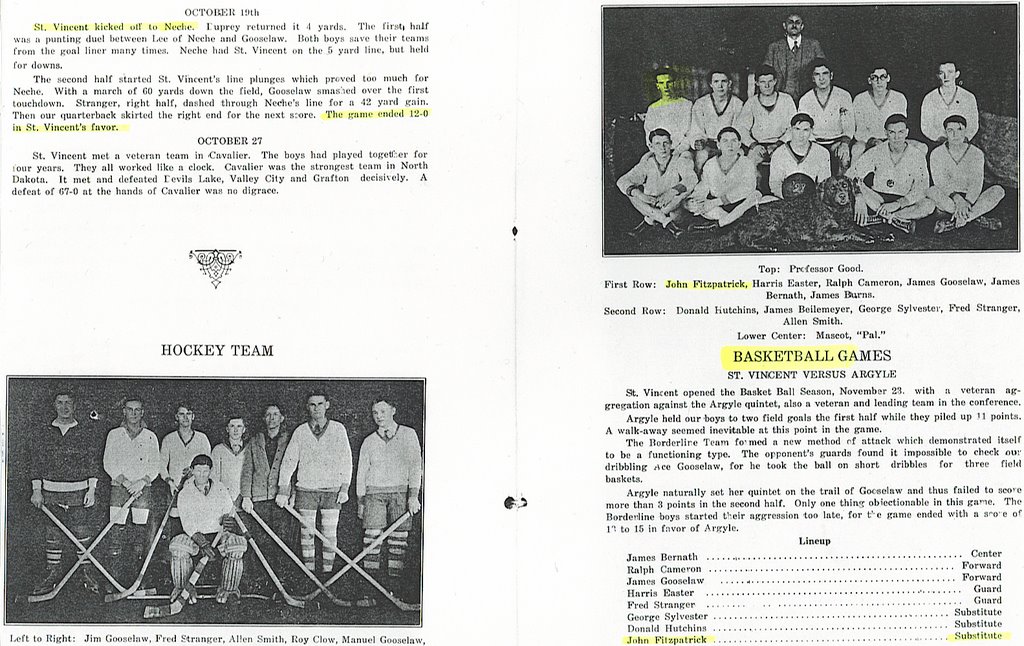
It was an unexpected joy to find yearbooks from the St. Vincent High School from the 1920s. This was a yearbook from a small town in NW Minnesota prior to the Depression. High school life in St. Vincent was marked by lots of school spirit judging from the many activities. St. Vincent fielded a football team, basketball team, hockey team, track team and baseball team in [school year] 1927/28.

"If you could walk or run, you were in the starting line-up."
Tuesday, August 24, 2010

Small Town Girl Sports

Many years ago I was fortunate enough to have been able to
handle & read a 1928 copy of the St. Vincent School's annual
"Borderlines", copying several pages pertaining to my family
The piece below was written by Mike Rustad and and originally posted on my family's 'family' website, a website I created to gather family history to which I invited Mike to be a part of due to his love of local history and knowledge of so many area families that intersected with my own.

Mike shared this fascinating look into St. Vincent's past back in 2004; I am currently reviewing all content on an old site because it will be discontinued soon. Many great pieces of local history were shared there, and I intend to preserve it all in some shape or form. I invite you to share in this wonderful view to our past, this little 'time machine' to not only my family's roots but those that touch on the wider communities they lived in...

[And as Mike ponders, where DID those girls practice some of their sports? My theory is they shared practice/play space with Pembina, but that's just a working theory...]


This little essay was inspired by reviewing some old clippings about the St. Vincent girls basketball team that appeared in the 1927-28 school yearbook that can be found in the Lake Bronson-based Kittson County Museum. St. Vincent is today nearly a ghost town. First, a little background. Mrs. Dick Lapp's little history of St. Vincent notes that the towns was the oldest city in Kittson County from the standpoint of settlement. Mrs. Lapp writes that "[t]he history dates back as far as 1857, when Minnesota was still a territory. A trading post on the village site had been named St. Vincent in honor of St. Vincent de Paul, founder of missions and hospitals in France." St. Vincent was built up as a town that serviced Fur Company XYZ (what an unimaginative name!). She notes the town was a byproduct or expansion by the Selkirk settlers that founded Pembina. St. Vincent had the reputation of being a rough and tumble town. Mrs Lapp writes:
"Ox-carts were the first means of travel in this area. Norman Kittson enveloped the ox-cart enterprise. Later steamboat traffic became important not only to the village but to settlement of the community. As early as 1862, railroad talk began. In Winnipeg, Donald Smith thought the Red River needed a lifeline to the east. He took his idea to Norman Kittson, the president of the steamboat line which held a monopoly on the river. Kittson referred the matter to his silent partner, James Hill. Hill had a dream of reviving the bankrupt railway at St. Paul and latched onto the idea immediately. In 1878, his dream was realized. He saw the first locomotive arrive in Emerson, Manitoba from St. Paul. It was the Great Northern Railway and later known as the Burlington Northern. The customs office and depot were in St. Vincent until 1905 when they were moved to the Canadian border at Noyes. In 1900, a roundhouse was built, James J. Hill backed the project. It was located by Lake Stella, east of St. Vincent. A turning table was included that was used to turn the trains around. Charles Gooding was the first depot agent. John McGlashen was the first man to take a carload of horses through from St. Cloud to Winnipeg. He also operated a saloon".
Mrs. Lapp notes how vibrant the town was by the turn of the century. The fur traders were prosperous and started the first stores. She writes further:
"The first bank was established in 1880 by J. H. Rich, E. L. Baker and F. B. Howe. It was later sold and closed. J. R. Ryan operated a livery and sales and William J. Mason opened a blacksmith's shop and also ran a wagon and carriage shop. The Firehall was built in 1903 by Edward Cameron and his three sons. It was on main street, east of the Red River bridge and housed fire engines run by steam. The Firehall was pushed over in 1972, the town hall demolished and a new hall built on original site of depot."
Mrs. Lapp notes that the first teacher in the St. Vincent School was none other than Eliza Moore.  The first schools in the county were on or near this village. Lapp's sure-footed history records that it was "Eliza Moore, then age fifteen, taught all eight grades in a little one room school in the west end of town. She told stories in later years of the Indians riding their ponies around the schoolhouse and looking in the windows and frightening her and the pupils. The present school was built in 1903. It was a square two-story white frame building and originally housed all the grades from one through twelve."

Eliza Moore continued to teach in St. Vincent when I was a student in the 1950s and 1960s. I thought of her as an Ancient Mariner or School marm. Mrs. Lapp gives her great credit for the development of the school in St. Vincent. In the late 1950s and early 1960s, Prof. Moore was a big part of the St. Vincent school. Other St. Vincent teachers from my day included Maribel Berg, Velma Isley and now my memory so many decades later becomes fuzzy. I think Simeon Cameron was the school cook. [Note from Trish:  I also had Mrs. Berg & Mrs. Isley as teachers at the St. Vincent School, and Simeon Cameron was still the cook while I attended...] 

Now, let's fast forward to 1928. The town of St. Vincent in its heyday had a hotel called the Northern Hotel. It also had saloons, stores, a jail, fire station, curling rink, etc. However, the jewel in the crown was the St. Vincent School. The School field both boys and girls teams for basketball, track. tennis and baseball. I think that the social history of girls' sports is largely a lost memory. I want all of the readers to think of the St. Vincent described by Mrs. Dick Lapp. There was a vibrancy. It was 1928 only a year before the Great Depression was to cause the citizens of St. Vincent great economic and personal turmoil. The Great Depression which was to begin in 1929 decimated St. Vincent. Mrs. Lapp blamed the Great Floods of 1948 and 1950 and she may be right about the factors leading to the dissolution of vibrant St. Vincent. I think that the Great Depression might have played a role. Mrs. Lapp lived through the Great Deapression and both floods. I was a baby during the Flood of 1950. I digress. Fast forward to the 1927-28 school year. The school was the center of town life.

The St. Vincent School had a strong (women's) basketball team consisting of Mamie Cleem, Isabel Fitzpatrick, Lelia Davis, Fidessa Wilkie and Alberta Fitzpatrick. The Girls' Basketball Team of 1927 is pictured during the first game of the season. The first game for the girls was held on December 4, 1927. I found the school yearbook to be amusing. Isabel is pictured as tall and lean and quite attractive in a picture taken during the first game of the year. In the back row, there is yet another Fitzpatrick named Fern. The name is alternatively spelled Fern or Ferne. Ferne was the starting Left Forward on the team and had the nickname of Coon. Isabelle was known as Issy or at least that's what her teammates called her. Issy was apparently the team's star ball handler and dribbler and played at the right guard position. What's so puzzling to me is that there appears to be 6 players on the starting lineup for girl's basketball. Issy was at the Right Guard position Fidessa Wilkie or Fido was at the Center Guard and Verlie Cameron or Plug was at the Left Guard. The nicknames for the girls were not exactly comely or feminine names. I was impressed with their apparent fitness and competitiveness. Every girl had a nickname. The Center Forward, Mamie Cleem, was nicknamed "Slivers" There was Coon (Ferne) at the Right Forward position and Lelia Davis or Lee at the Left Forward. Isabelle or Issy played Right Guard. Fido was at the left guard. They were spelled by substitutes Verlie Cameron (Pug), Violet "Cutie" Cleem and Mae (O'Leary) Gamble. Eileen Twamley also played on the team. I assume she was the sister of Merle Twamley who was the patriarch of the large Twamley family we knew growing up in Humboldt and St. Vincent.

The other sports stories about the girls basketball team of 1928 mentions the injuries the girls sustained and how they played the game. Isabelle, for example, jammed two fingers, and was hurt in the game with Stephen. St. Vincent beat Stephen 21 to 16. Issy continued to play despite having sprained fingers. She was not the only girl to be injured. Coon's leg was twisted and the game delayed. She limped through the end of the quarater and could not continue. She was replaced by "Cutie" Cleem. In that game, Mamie "Slivers" Cleem was the superstar scoring 12 of the 16 points and playing like a champ. St. Vincent beat Stephen! I don't ever remember Humboldt-St. Vincent beating Stephen. St. Vincent beat Stephen at the game held in St. Vincent. Does anyone remember where the games were played? I think that the Boy's Teams were played in Pembina. It may be that the games were played at Pembina's gym. St. Vincent played Pembina February 8, 1928. The Game ended in a 10 to 10 tie. In the Stephen game, St. Vincent's star players missed key free throws while Stephen made their shots. St. Vincent took the win because of their better outside shooting. In the Pembina game, the game game had a number of hard fouls against the St. Vincent girls. Issy Fitzpatrick had a key personal foul levied against her. A technical foul was called on Fido Wilkie. Slivers was hurt in a hard foul and knocked against the back wall and then to the floor. There were officiating disputes in all of the girls' games or there was a hyperactive imagination on the part of the St. Vincent sports writers. In the return game with Stephen at Stephen held on January 20, 1928, the St. Vincent team made baskets that were not counted. The home town (Stephen tilted) referree ruled that when Slivers made a basket, it did not count. When Coach Dick Lapp objected, he was told that the basket did not count because of interference. Lapp retorted, "Interference, YES, BECAUSE ST. VINCENT MADE THE BASKET."

The third quarter of the Stephen game ended in a 14 to 14 tie. In the fourth quarter, a St. Vincent player named Mae Gambel or O'Leary went into the game replacing Issy Fitzpatrick. That substitute was not a wise choice as then Stephen made four baskets and St. Vincent only two to round off the game which ended "18 to 22, in Stephen's favor." In the Pembina game, Cutie Cleem substituted for Coon. Apparently, the ref called a foul on Cutie for chating with someone on the team so a technical foul was called.

I was wondering whether anyone knows additional facts about any of these colorful girl sports heroes from the late 1920s. St. Vincent was a great sports town with a full array of girls sports during the 1920s: basketball, tennis, softball or kitten ball etc.

I responded to Mike's post by saying:

Wow, Mike! Keep the stories coming, sports-related or otherwise! You really bring St. Vincent alive for us. It's really neat to hear about the history of where I grew up. I wonder what other source material there might be out there that would have information about the town's life? I'd love to hear more about the merchants, who owned what, what the saloons and hotel, etc. was like, the background of the town's politics, etc...even the gossip of the past. Any ideas anyone?
My cousin Delphine Mundorf responded:
Alberta Fitzpatrick as you may know from other postings is my mother. I was surprised about her name mentioned here on the basketball team. I guess she has mentioned it to me but her biggest thing she talks about is playing tennis. She says she was very good at tennis and she and her partner did so well they had a chance to go to the State tournament. However that cost money and her folks didn't have the money to send her so she never got to the state competition. I believe she felt she was good enough to maybe have become a pro. The Fern you talk about is mom Alberta's & my aunt Harriet's first cousin. I met her several times as she lived in Crookston when I was a child and we usually stopped to visit her whenever we went to St. Vincent to see my grandparents. My mother is still living and will be 92 in July. To my knowledge she has outlived in age all her family. They all had longevity but most of the elders died in their late 80's.
Mike Rustad then commented:
Alberta was in fact a member of the St. Vincent tennis team. What this demonstrates is that the St. Vincent girls program was fully developed. The girls did not play football or hockey in the late 1920s, but every other sport. The point was that the town followed these teams. I find it amazing that St. Vincent played Neche, Cavalier, Stephen, and towns that were much bigger. I wonder where St. Vincent played their hockey games. Jim Gooselaw, Fred Stranger, Allen Smith, Roy Clow, Manuel Gooselaw, Cecil Smith, Bill MacKay and Ralph Cameron were on the school's hockey team. I have no further information. I think that if I were to get back to Lake Bronson that I could find a great deal more about the St. Vincent school. One of the problems I have being in Vermont is that I don't have ready access to these materials. Maybe one of you could do a field trip to the Kittson County Museum and make some copies of the St. Vincent materials. Another great source would have been the Pembina Museum. I am not referring to that antiseptic boring museum today, The old museum had tremendous numbers of artifacts etc. I asked someone what happened to that stuff and was told that the State has it in storage in Bismarck. What a waste. I think a fellow named Barron had his own private museum in Pembina. [Note from Trish:  Mike is right in this - it was Elmer Barry, and his private museum became the basis of the old Pembina Museum!]  I bet he had tons of stuff on St. Vincent. The shame of having this lost history is that everyone is now deceased or very old who attended St. Vincent High School. We have only fragments to draw from. We must be like archaeologists in trying to construct social history from such scant data. I think who we are is deeply rooted in our history. Going back to far in history for wisdom is like ox-tail soup. It's going back too far for a good thing.
Delphine Mundorf again commented:
My mother as I mentioned is now 92. She & I believe 3 other boys were the only 4 to graduate from the St. Vincent High school all others transferred to Humboldt I believe. I wish I had pd. more attention to Mom's stories but not being a historian I didn't. But I think Mom, Fred Stranger, and a Smith boy & one other graduated from St. Vincent High school. The rest transferred but it cost a tuition to do so & these 4 parents didn't have the money for it. So Mom wasn't going to finish school. One morning she came downstairs and found her mother crying and when My Mom asked Grandma why she was crying Grandma said because I only had a 3rd grade education and you have a chance to graduate and aren't going to do it. So my mother called the boys and asked them if they would be willing to go back to school and they agreed so they showed up in Prof.1 Good's class. Mom said he was so happy to see them he got tears in his eyes, Moms favorite thing she used on us kids was that we better do good in school because she was valedictorian of her class. I wasn't til later we found out she was only 1 of a class of 4, no wonder she was valedictorian. Ha Ha. She also has told me that the professor was so glad they came back to his class that he offered to help each one of them should they decide to further their education. She then went on to Minneapolis and went into nurses training but at her time it didn't cost to go to nurses training you worked some of your education so got the room free and got pd. $12 a month. She made it through the 3 yrs. to become a registered nurse but was never able to take the state boards. Her story all these yrs. was because it cost $12 to take the board exam and she didn't have the money to pay for it nor did her parents. I always asked her why didn't you contact Prof Good since he said he would help any of you. To go through the whole training then not take that final exam to get you certificate is such a waste. She just said Ya I suppose I could have asked him. However I have since very shockingly found out there was a a whole other reason why she never got that final exam.
1 - The use of "Prof.", short for "Professor" was curious to me, since I had only been familiar with it in association with teachers at a university or college level, but here it is used with teachers at a secondary level. I did a bit of research, and it appears to have been common at this time...

Sunday, March 04, 2012

Interview: Beth Lapp

Elizabeth Lapp in 1948
[Courtesy:  Digital Archive, UMC] 
Thanks to Kristine Baldwin Ohmann, who facilitated our get together, I interviewed one of the oldest living natives (and a resident) of St. Vincent last weekend.

Elizabeth Lapp, better known as Beth, was raised in St. Vincent.  Her parents, Richard (Dick) and Lillian Lapp, met in 1926 when her mother came to town to teach at the school. Dick's parents were early settlers of St. Vincent, arriving in 1879 from Canada.

I share with you here the interview in its entirety, as it happened.  As you will read, there are a lot of clues for further stories, which I intend to explore in future posts...

1. Her earliest memory is of getting ill and vomiting on her workbook at school. In those days, you only got one workbook to use for your schoolwork, so she was mortified. She was sitting near chalkboard at the time. Her teacher was Miss Penovich.

2. Some of her other teachers were: Elaine Bergh, Gunda Hanson, Mrs. Isley, and Mrs. Monte(gue) Clinton.

3. The year she had Mrs. Clinton, “we didn’t learn anything”. Math and Science were "sacrificed for art". All she remembers is Mrs. Clinton having the class place chairs facing west and looking out towards Christ Church and drawing what they saw…

4. When it came time to go to high school, students during her time had three choices: Hallock, Pembina, or Crookston. Hallock and Pembina were public school (free) while Crookston was a boarding school and charged tuition. This was during the 1940’s and into the 1950’s.

Northwest School of Agriculture Crookston MN
[Photo Courtesy Digital Archive, UMC]
5. Crookston was called the ‘Ag School’. It's actual name was the Northwest School of Agriculture.  Several area natives attended it, including Beth and her siblings.

Wednesday, July 24, 2013

Last Hurrah for a Rural School

Controlled Burn:  Older section of school
There were no girls in the senior class of 1987, forcing Humboldt-St. Vincent to do without a homecoming queen. Things improved this year, when all three girls in the class vied for the honor.

Classes don't come any smaller than in Humboldt-St. Vincent. It's a school with 65 students in kindergarten through 12th grade, including one fourth-grader. The average grade has five students.

That's too small for state officials, who see nothing romantic about the arrangements and are happy that the school district is finally ready to close shop. For Education Commissioner Gene Mammenga, the tiny school in Kittson County is a prime example of public education gone awry.

Humboldt-St. Vincent, 410 miles northwest of the Twin Cities, ranks as the state's smallest K-12 school district and spends $11,381 each year to educate a single student. That's the highest of any K-12 district in Minnesota and more than twice the state average. A state study called the spending astronomical.

Moreover, the district holds classes in an 85-year-old school that violates state codes and is faced with a financial crisis after piling up debt for four years. A lack of money and students makes it difficult to offer many electives.

"It's a waste of money, but more important than that, it's a waste of human potential, with young people who had a limited academic experience," Mammenga said.

Those are fighting words for those who farm the flat, rich land of the Red River Valley.

"Typical bureaucrat sitting in the white ivory towers, totally removed from the realities of rural America," said Humboldt Mayor Curtis Miller, who grows wheat, barley and sugar beets on 2,100 acres. "The way of life in rural America is very sacred to us."

That's why these are sad days in Humboldt, where farmers need rain and school ends for good on May 30. It's the end of a long era that began in 1882, when the district was created.

Thursday, January 26, 2006

St. Vincent Native Responds...

A St. Vincent expatriot contacted me yesterday out of the blue. It was great hearing from someone, and to know that I'm touching people with the town history. That is one of my main goals with this project...
Dear Trish:
I don't know if you remember me. I am from St. Vincent...I just stumbled across your St. Vincent website and it brought up such a well of emotions. I think of St. Vincent a lot...I was a bit of an outcast in school -- the one that everybody picked on -- so when I graduated from high school, I left town and never looked back. But St. Vincent never left my heart and it makes me so incredibly sad to see it disappearing before our very eyes. The...Humboldt School is no more, the Sylvester's store building is gone and there's not even a post office anymore. I always say, only half joking, that today I know more people in the St. Vincent Cemetery than I do in the actual town. It's scary to think that it can all go away, like we never even existed. So to see your web site warmed my heart, to know that someone actually cares enough to keep the memory alive.

I have a St. Vincent de Paul medallion (St. Vincent was named after him) that I wear constantly as a reminder of "home." When I purchased it at a Bible book shop, the clerk asked me If I wanted it blessed. The priest looked at it and said, "St. Vincent dePaul -- he's my patron saint," to which I replied, "Oh yeah? Well he's my home town!" I have to laugh when people here refer to [censored for privacy] as a "small town." They don't know what a small town is!!!!!

By the way -- I have a set of very old salt and pepper shakers that belonged to your Grandmother Fitzpatrick. I bought them at a rummage sale at her house...They are small, in the shape of an elongated square that flares out at the bottom. The bottom half is painted a sort of periwinkle and the tops are a rose pink with delicate flowers and leaves.

Anyway, I've bent your ear enough for one evening. Keep up the good work on the web site. I haven't had a chance to look over every aspect of it, but certainly plan to...
I responded with this...
You're the first person (besides Mike Rustad, but he's been writing to me for a long time now about home stuff, before I started the website...he's a law professor back east now!) to write and let me truly know what you think. I LOVED IT! *smile*

Yeah, I know just what you mean about the town slowly disappearing before our eyes. My Mom said that very same thing when I was a little girl 40 years ago, and I didn't understand, but I do now. St. Vincent was a much busier place than what we remember, when she was young back in the 1920's and 1930'. My Grandma Fitzpatrick, of course, remembered the 'boom time' in the 1880's and 1890's when everything seemed possible.

While St. Vincent per se is a ghost of what it once was, the spirit is still there, and I'd like to let people know, it was there, it's still there, and there is a legacy not only about St. Vincent but the whole area up there that made a difference in many people's lives. Not only that, but those people went on to make a difference in other people's lives.

I will be periodically updating the St. Vincent website, at LEAST once a week, if not more so be sure and continue stopping by. By the way, I have comments enabled on the St. Vincent site for each entry, and you can even comment annonymously if you want, so feel free to comment...

Trish

Sunday, August 21, 2011

Grand Old Lady

So many children entered through these doors

The sign is blank.  The steps are mostly buried, a railing rises from the earth.  A gibbet of sorts protrudes from the front.

 It's obvious that just about everything needs help.  Roof, siding, windows, foundation.  The "Grand Old Lady" of St. Vincent, that housed so many young souls on their journey of learning, deserves better.

Sunday, May 19, 2013

A Tale of Two School Buildings

St. Vincent (left) & Orleans (right):  Built using same plans...?
School districts were especially numerous in the early history of Minnesota, and were much smaller than the township - often within the 26 square miles there would often be a half dozen or more.

Such was not the case in sparsely-populated Kittson County, however.

Stats for St. Vincent:
  • St. Vincent's first school board was organized on January 7, 1880.
  • The first schools in the county were on or near the St.Vincent village. 
  • One of the first teachers was Eliza Moore, who taught all eight grades in a little one room school on the west end of St. Vincent. 
  • The final St. Vincent school - located conveniently in the center of town - was built in 1903 (Orleans school was built in 1905).
[Click to enlarge & read details]

From my research it appears that schools like these were very common in smaller communities, and many were built across the country in the early 1900s.  Some were two-story, two-room, while others like those above were two-story, four-room.  You could buy standard plans, and have local carpenters, like St. Vincent's Ed Cameron and Al Fitzpatrick, build it for you.


Sources:

Thursday, February 23, 2006

St. Vincent School Alumnus Remembers...

Alberta Fitzpatrick, on her way to Nursing School...
As a result of yesterday's post about the St. Vincent School, and the snapshot of the 1925/26 7th & 8th grade classes, I received this feedback from an alumnus from that photo, Alberta Fitzpatrick, via her daughter (and my cousin) Delphine:

Mom for one thing knew everyone whose name I mentioned and said she could just see the Gamble farm in her mind. It appears that the people in the picture correspond to the names as listed. For one thing Jean Gamble and Mom are in the right places with the names. She identified Eileen Twamley and Fred Stranger and they too were in the right places as per the names listed below the photo. So I am inclinded to believe the names and photos of each are in the correct order from left to right row by row.

She did however make a few changes in that the one listed as Jean Scott her name isn't Jean but Jane. Brock Perry isn't Brock but Brooks. As soon as she said Brooks Perry I remembered her talking about him over the years. Brooks Perry's dad [Gale Perry] was the St. Vincent Postmaster. Norton DeFrances' Dad [Roy DeFrance] was editor and owner of the St. Vincent Herald [later named the St. Vincent New Era...] Grandpa and several other men use to gather in front of the Herald every day and gossip with each other.

Mom's class started out with 18 students and had they stayed together would have been the largest class to graduate St. Vincent. I earlier [wrote] that the class transferred to Hallock but I was wrong the class transferred to Pembina thus why they had to pay tuition. Going from Minn. to N.D. Grandpa and Grandma Fitzpatrick, the Smith family, and the Strangers couldn't afford that tuition so those kids weren't going to finish school. One morning Mom came downstairs to find Grandma crying. When she asked her why, Grandma who only had a 3rd grade education told Mom because if she would have had the opportunity to graduate she would have done so and Mom was throwing that chance away. Mom said if it meant that much she would go back and graduate. She contacted Fred Stranger and John and Allen Smith and asked them if they would go back to school. They all agreed so they met at the school the next morning at 9am and walked into Professor Vick's class. Mom said Professor Vick was so happy to see them he cried. He told them all at the end of the year that if any of them wanted to further their education he would pay for their college. According to Mom Fred Stranger and the Smith boys did go on to college on Professor Vicks' help. Mom went on to Nurses training which was free so she needed no help. In fact when Mom went to Nurses training it was a working school as well as classes so she not only did not have to pay to become a nurse she got paid $12 a month for nursing.

Others of the DeFrances family (not in the picture) were Gladys amd Marjorie*. She also talked about Mae Gamble who Mom knew well but also not in the picture as she was in a higher class. She knew every name I mentioned but before she could remember much her mind would cloud over again and then I would show her the picture once again to see if she could see it better so as to identify people and she then would tell me yet another story.

* I spoke with Marjorie DeFrance on the telephone about 6 weeks ago. We made tentative plans to meet at her Pembina home when she returns from the southwest where she winters, so we can go through her father's papers and photos, much of which covers not only the DeFrance family, but touches on the history of St. Vincent, Pembina, and the St. Vincent/Pembina New Era...

Sunday, January 08, 2012

1927-28 Girls Basketball Team

Front: Eileen Twamley, Mamie Cleem (Captain), Mae Gamble
Back: Isabelle Fitzpatrick, Verlie Cameron, Fidessa Wilkie, 

Dick Lapp (coach), Leila Davis, Violet Cleem, Fern Fitzpatrick.
ARE THE NAMES in the RIGHT ORDER?

[Photo Courtesy:  Kittson County Historical Society via Perm Diamond]
When growing up in St. Vincent, I regularly heard stories told by my mother, father, and grandmother (not to mention other village and county residents) about our hometown.  They ranged from tales of what the town looked like in the past, its businesses, the railroad, the churches, the roads and sidewalks (or lack thereof), to the lives of the residents themselves - their dreams, their families, and yes - their trials and woes.  More often than not, it was the tragedies and disappointments that were remembered.

However, there were also many happy memories shared.

Among them, was a passing reference to my Uncle John being an athlete in high school.  Not a lot to go on, and nothing about the fact that around the same time as John was participating in sports, the entire school had blossomed.  Except for the first years following incorporation and the initial surge of immigration, the time period we're talking about had the highest population.  There was a wide variety of extra curricular activities being offered for a small school, including sports.  I found all of this out many years later.  Even still later, I began finding out details to put on the skeleton of the bare-bone facts.

Recently, I was sent an image of the 1928 Girls Basketball Team from the St. Vincent School.  You can make a fairly safe conclusion, with the inconsistency of design, that the girls are wearing homemade uniforms. But bless them, they did their best.  My guess is that the girls made their own uniforms, at least the appliques - they show an immaturity that their mothers would have overcome had they created them.  It's sweet to see their efforts, though - the students and their community may have been humble, but they had school spirit!

NOTE:  Thanks to Kent Myrick (whose mother is in the above photograph, and who owns a complete, original copy of the 1928 Borderlines school annual), Lori Kohut Bianco (Gamble family descendant and whose great aunt is in the photo), and myself (who has two cousins in the photo), we know exactly WHO is in the photo, but we're still not entirely sure of the ORDER.  The ones we know for sure are the two Fitzpatricks girls (my cousins, one on each end of the back row), Leila Davis (Kent's mother, to the right of the coach), and the coach himself, Richard Lapp.  The other names are not conclusively matched to faces.  Personally, I think the girl second from the left in the back looks like a Twamley, but I could be wrong.  Also, Lori had heard oral family history about her great aunt having round glasses like the one girl does in the photo, at this time, but Kent says other photos showing a Mae Gamble with others doesn't show a girl with glasses.  VERY confusing.  Anyone reading this that can help clarify, I would love to hear from you!

A year later:  College Girl ID photo

St. Vincent Trivia:  My Aunt Pat (Alberta Fitzpatrick)  - who played on the St. Vincent Girls Basketball Team in high school - was in the final graduating class of the St. Vincent school, the Class of 1930.  Although the official consolidation bringing about District 352 didn't happen until the 1950's, evidently in the school year of 1929-30, the majority of the higher grade students began going to Humboldt.  My cousin (Aunt Pat's daughter) said her mother told her that she and three other boys were the only 4 to graduate from the St. Vincent High school in the 'last class' - Alberta, Fred Stranger, a Smith boy, and one other.  All others transferred to Humboldt.  The ones that transferred had to pay a tuition to do so.  The parents of the four students didn't have the money for it. So Alberta wasn't going to finish school. 
One morning she came downstairs and found my grandma (her mother) crying and when Alberta asked Grandma why she was crying Grandma said because I only had a 3rd grade education and you have a chance to graduate and aren't going to be able to do it. So my mother called the boys and asked them if they would be willing to go back to school and they agreed so they showed up in Prof. Good's class. Mom said he was so happy to see them he got tears in his eyes. From what I understand, the Professor made sure these four students graduated that final year...

Monday, November 28, 2005

St. Vincent Boom Times, Part II

From what was popularly known as 'historical essays', written mostly by high school students throughout Kittson County over a period of many years, comes this piece about St. Vincent's better days...
St. Vincent
by Barbara Bostrom

Today, cities have taken the place of the many small towns across the country. In the cities a person may live for years in the same house and never know the names of his next door neighbors. There are very few small towns left. Even St. Vincent, Minnesota, the oldest town in Kittson County, is dying. There are approximately 170 people still left in St. Vincent, most of them old people. There are few evidences of the type of town St. Vincent once was.

The Great Northern Railroad brought most of the people here. The first people came as traders, because of the Red River. That was in the 1870's. They used to cart the furs up the river on barges. But since the fort was built at Pembina, North Dakota, most of the fur traders, and nearly all the other residents of this northern area, lived there. Part of the reason they would want to live in or near the fort was as protection against Indians. Especially after Fenian's Raid in the 1870's, people usually preferred to live by the fort. When the Sioux Indians were forced out of the state, the danger of Indian attack was reduced to nearly nothing. But they were not far away. Around l880, the talk of the town was Chief Sitting Bull's camp across the Canadian border in Emerson Manitoba.

Pembina was the "big town" when St. Vincent was born. Pembina, along with the rest of the valley, gained attention in both the United States and Canada, "owing to the so called rebellion in Manitoba under Louis Riel and O'Donhue, of Fenian fame, and many who were on their way to Fort Garry that year... were forced to make an unwilling sojourn at Pembina, waiting for the submission of the rebellion in order to go on to their destination. The quelling of the insurrection in June by British troops restored the tranquility and the noise attached to the whole affair seemed to have drawn the attention of the outside world and caused quite a stream of emigration into the valley."

Fort Pembina was built in 1870 and abandoned in 1897. At the time the fort was built Hills, Griggs & Company, of the Red River Steamboat Company, opened an extensive general store which usually carried $100,000 worth of merchandise. Henry MoKinney opened a saw mill in 1871 near the junction of the Red and Pembina Rivers, opposite St. Vincent. Nathan Myrick of St. Paul, opened a trading post near Ft. Pembina.

Saint Vincent is the oldest town in the county. The first meeting of the township board was held on May 15, 1880. R.W. Lowery, G.A. Hurd, F.M. McLaughlin, L.A. Nobels and F.M. Head were the township's first officers. Hardly a year later it was reorganized as a village, on April 16, 188l. The first president was James L. Fisk, possibly the son of the Hon. Charles J. Fisk, who was an associate justice )f the supreme court of North Dakota; recorder, J. W. Morrison; assessor, John A. Vanstrom, who afterward served as register of deeds, and later was elected sheriff.

In 1910 St. Vincent had a population of about four hundred. It is located in the northwestern part of the county, directly opposite Pembina, North Dakota. It was the terminal between the Great Northern and Canadian Pacific Railways, and also a port of entry for the purpose of collection of customs duties. Near Lake Stella, on the eastern side of town about a mile from the Red River, there had been a roundhouse, for trains, which burned down in 1905. There was the train depot in the middle of town. In the west end of the building was the customs office. From 1900 to 1905 J.A. Noyes was the head customs officer there. In 1905 he succeeded in having the customs office moved from St. Vincent to the Canadian border across from Emerson, Manitoba, where the town of Noyes is now.

There were three hotels in the St. Vincent of those days. the Thedore, the Ontario House, and the Northern Hotel. The Thedore was in the west end of town, on the main street. The Ontario House was owned and operated by the Ryan family. Mr. Ryan managed the hotel, but when he died, one of his daughters, Elly O'Connor, took over. The Northern Hotel was north of the railroad tracks that ran through town just south of what is now Highway 171, and it was owned by the Great Northern Railroad.

Until 1925 there was a black smith shop about a block east of the Northern Hotel, and earlier there was another in the west end of town.

There were four stores: Nelson Greene's Store, which sold nearly everything under the sun; a large store west of the Ontario House which sold mostly candy, and was owned and operated by a Mr. John Reynolds; and another store in the west end of town. This store contained the post office, which was run by Richard Lapp's father.

There were two beer distributing companies, one next to the tracks in the west end of town, and one a block from the other company, also next to the tracks. The first was Hyland's Low Start Lagger, the latter company was a Hamms Beer distributor.

Next to the Ontario. House was the Catholic church. It was purchased from John Reynolds and made into a church.

There was also an Episcopal church and a Presbyterian church in town. The Episcopal church was the first church built in the territory, and the lumber was all hauled in from eastern portions of the territory by oxen cart. It still stands today, on the "outskirts" of town, north of the railroad tracks. There was also a Methodist church in St. Vincent.

Between the train depot and the Hylan beer distributor, was the St. Vincent fire hall; which still stands today. It is a small, wooden frame structure with a bell tower in the southeast corner. St. Vincent had two fire engines, and a carriage that, I believe, carried fire hose.

The school was built in 1903. It is a two-story, square, white frame building which originally held grades 1-12, but now has classes for only kindergarten, and second through fourth grades.

It looked like St. Vincent was blessed with everything a good town needs: easy transportation, jobs, and good soil, and water. But somewhere they lost whatever it was they had had. For St. Vincent is no longer a little town with a lot of growing to do-- but now St. Vincent has little to look forward to except a slow death. In 1909 these words were written:

"Today we have abundant evidence that we are standing at the threshold of a new dominion that is to arise on this plateau of North America...

With unshackled hands, free thought and liberty of conscience, the people of the valley of the Upper Mississippi and Red River of the North may add much to the luster of the Great Republic, born on the 4th of July, 1776. Let us pursue no narrow policy. Let us welcome the Dane, the Swede, the Norwegian, the Russian, the German, and all newcomers.:"

Somewhere along the line we forgot how to use this potential, and now we are paying for it. We will probably never regain our way of life and the promises it showed, but this area will always be rich with the memories of the bright past.

Sunday, April 08, 2012

Evolution of a Church

This is the story of how a church came to be.

Churches are sometimes founded; they may begin as missions or outreaches. Others evolve.

The Humboldt Methodist Church and the St. Vincent Methodist Church (whose official name was actually the St. Vincent Community Church1, of the Methodist Episcopal denomination) were small congregations, so often shared ministers when the need arose.


The church was in the block directly south of the St. Vincent school, towards its northwest
 corner; Beth Lapp, who was a member, remembers the windows had stained glass in them.
[Image Courtesy:  Marcy Johnson]


Once upon a year, a minister named Reverend Everett Hanson came to the Humboldt Methodist Church. Rev. Hanson eventually instituted a split in the Humboldt and St. Vincent churches in 1949. He took 39 people with him and formed a new church in St. Vincent. People that followed were called "Hansonites". This new church was named Valley Community Church (nondenominational).  The St. Vincent Community Church closed and some of the congregants joined this new church, while others chose to merge with the Pembina Methodist Church.  Several years later, Valley Community Church joined the Evangelical Free Church of America.  In 1969, St. Vincent EFC moved to Pembina, selling the church building (which was the old Green store; it was moved to Hallock to be used as the Masonic Lodge for many years, and is still in-use to this day...)

Rev. Clara Wagner & Rev. Alice Engelbretson, the last ministers of the Community Church...
[Source:  Reynold and Carolyn Ward]

1 - From the 1936 WPA Survey of the churches in St. Vincent, comes this description of the St. Vincent Community Church, part of what eventually became the St. Vincent Evangelical Free Church:

Name of church:  Community Church.
Location:  St. Vincent, Minnesoa.
Denomination:  Methodist Episcopal.
Date of establishment:  The church was started in 1899.
Charter Members:  Nelson E. Green, John Bernath, and Thomas Ash
Places of meeting:  For about two years after the founding of the church, meetings were held in the different homes.  In 1900, the present church was erected.
Church buildings:  In 1900, the present church was erected and the same year a parsonage was built two blocks south of the track (the same one used for the Free Church pastors many years later...)
First officers:  There are no records showing the early history of the church so the names of the first officers cannot be given.  Present officers:  Mrs. Thomas Ash, president, Mrs. John Monro, treasurer; Mrs. Roy DeFrance, secretary; trustees, Waldo Clow, Clifford Clow, Mrs. R. DeFrance, Mrs. J. Monro, and Mrs. Esther Ash.
Pastors:  Reverend A.A. Meyers, Reverend George Swinnerton, Reverend Charles Flesher, Reverend Benjamin Collins, Reverend John Finscke, Reverend George Powell, Reverend Eli Slifer, Reverend Edwin Trigg, Reverend James, Reverend E.R. Ingram, Reverend Stanley McGuire, Reverend Clara Wagner, and Reverend Alice Engelbretson.
Organizations within the Church:  Ladies' Aid was organized in 1916.  No dates can be found in connection with organization of the Sunday School.
Remarks:  There are no records of the early history of the church available so a complete list of the charter members and pastors cannot be given.

(Compiled by Cyril Cannon, September 1936)

NOTE:  The North Star Church was an associated church for many years.  The North Star Church began as a Presbyterian Church, later having Covenant ministers serving it.  Eventually it was served by ministers from the Valley Community/Free Church.

Wednesday, February 16, 2011

Profile: James Scobbie

St. Vincent EFC - formerly Valley Community Church, Green Store 
(circa 1960s)
A big part of growing up in my hometown area was your church.  My church began in St. Vincent, and eventually moved to Pembina. The church was literally at the end of the road from my house, due south, and across the side road from my grandparents' home.

Of the St. Vincent church, I have fragmented memories:  large hanging ceiling lights; the piano on one side of the platform and the organ on the other; a nursery room in the back of the sanctuary near the entrance; a basement kitchen and eating area with several curtained sections, used for both Sunday School and potluck dinners; high, exterior entry steps that were used as a dare to jump off of.  I remember other things - after everyone greeted the pastor on their way out, there was lots of visiting after the services between the adults.  I suspect that there wasn't always a chance to visit otherwise during the week, men and women being too busy working and taking care of families.  People took more time then to find out how you were doing, and what the latest news was.  Social events like church were the 'Facebook' of their time.  Often we kids got restless, wondering what on earth the adults could possibly be talking about that long, so we'd start playing games like hide 'n seek, or kick the can.  Games like this were particularly fun if it was an evening service and were played after dark.

Some of that changed when the church moved to Pembina in 1968 - but that's another story.  This story is about the first pastor I remember of my church:  James Scobbie.  I recently reconnected with Mrs. Scobbie, or Ena (short for Christina), and asked her if she would be so kind as to provide some memories of their time with us.  The other day, she wrote to share...

Thursday, March 15, 2007

Gambles...AFTER the Letters

Descendents of the original Gambles that settled St. Vincent have been in touch, and shared this with me about the "story after the story", i.e., what happened after the letters stopped...
I do know a little about what happened to everyone, thanks mainly to my late grandfather, Neill (Bo) Gamble (Willie's son), who sat down one day & went through the entire family tree with me, including the names of almost all of his Gamble cousins.

Mary Ann Neill Gamble was born in Ireland in 1841 and passed away in 1903 (as you know from one of the later letters). (The letter is dated 1902, but the headstone at the cemetery says 1903 -- perhaps a transcription error?). She would have been 61 or 62.

Alexander Gamble was born August 20, 1834, in Coot’s Hill, County Cavan, Ireland, and passed away September 8, 1925, at the home of his daughter, Ellen Gamble Lapp, in St. Vincent at age 91. They are buried in St. Vincent Cemetery; there is a large headstone erected in their memory.

She and Alexander Gamble were married in Dundee, Scotland, on November 5, 1861.

Their children, in order of age:

Elizabeth (Lizzie) was born February 13, 1863, in Dundee, Scotland. She married Hugh Griffith and had five children. Hugh died August 2, 1909 at age 58 -- killed instantly when struck by lightning while atop a haystack. Lizzie died of pneumonia on March 19, 1916 at age 53. They are buried in St. Vincent Cemetery, as is their son, Hugh Jr. & his wife Agnes.

Alexander Jr. (Young Alick) was born May 26, 1865, in Albany, New York. After the death of his first wife, Maggie, he remarried. His second wife's name was Martha, and Barbara Kennedy believed she was the sister of his first wife, from Emerson. He wound up in Idaho, where he worked as a contractor and carpenter. He died in Idaho Falls, Idaho, of complications due to asthma on November 28, 1943, at age 78. I am not sure how many children he had; the letters mention three.

In 1990, I was contacted by a woman with the last name of Gamble from Idaho, who had gotten my name through the Ontario Genealogy Society. She was married to one of young Alex Jr.'s descendants & interested in the family history. I was thrilled to hear from her and sent her a copy of all my research notes to that time, but unfortunately never heard a thing back from her.

Ellen was born in 1868 in Ontario (likely Beaverton), married Richard Lapp and lived in St. Vincent. She died in 1960 and would have been about 92 at the time. They are buried in St. Vincent Cemetery. They had five children, most of whom lived in the St. Vincent area, & some of their descendants are still in the area.

Jane (Jenny) was born in 1870 in Ontario (likely Beaverton). She married John (Jack) Griffith, Jr. on October 19, 1893 (we believe he was a cousin to Lizzie's husband Hugh, not exactly sure of the relationship) and lived in St Vincent until her death in 1950 at around the age 80. They are also buried in St. Vincent Cemetery. They had five children, some of whom lived in the St. Vincent area, & some descendants still live in the vicinity.

William (Willie, also later known as Bill) was born March 17, 1871, in Beaverton, Ontario. He married Lillie Maud Griffith of Winnipeg (another cousin of Hugh's & Jack's, again, not entirely clear on the relationship) in 1901. They had nine children. After her death in 1928 (at the age of 44), he and the younger children lived in Hallock, and he later lived in Crookston, where he passed away in 1952 at the age of 81. He & Lillie are also buried in St. Vincent Cemetery.

Alice was born in the early 1870s in Ontario (Beaverton), married Alec Forrester, and lived in Memphis, Tennessee, where she died sometime in the mid-1960s. She would have been around 90. They had two children.

Samuel (Sammy) was born in 1879 in St. Vincent, and wound up in Golden, Colorado, where he died on May 23, 1964 at age 84. His death certificate listed his occupation as "custodian, Colorado School of Mines," but my grandfather told me he ran a pool hall for awhile and also worked with the police department. He & his wife Thea (who was a schoolteacher at St. Vincent) had no children.

Margaret (Maggie) Neill, to whom all the letters were written, never married and lived by herself after the deaths of her parents. She died in Beaverton, Ontario, on November 29, 1949 at age 89, and is buried in the cemetery of St. Andrew's, also known as "The Old Stone Church," on the outskirts of town.

William & Lillie were my great-grandparents. The only descendants from this part of the family still living in Kittson County (in Hallock) are their grandchildren (my mother's cousins) Dorothy Berard Swan, Kaye Walters Cederholm, and Kenny Walters.

I feel sad to see the letters coming to an end -- even though I've read them before, it's almost been like reading them all over again for the first time. I appreciate your sharing them with the world through the Internet, & especially all the explanatory little links you've added that really add colour & context to the story.
...and thus ends the story of the Gambles, early settlers of St. Vincent, as told through their own words.

Thursday, June 14, 2007

Old Article About Even Older St. Vincent

North West CompanyNOTE: Since writing this, I have been told this article is from the 50th Anniversary Edition of the Kittson County Enterprise, published in the 1930's (of which my mother had a copy, location now unknown but I looked through it many a bored summer day as a child, amazed at my county's history...) - August 1, 2010

Some time ago, I took down notes from an article written about St. Vincent in an old document. I normally take great pains to document source material, but for whatever reason, I cannot find the source documentation for the article, a fascinating excerpt of which is below. I do remember in general that it was written nearly 100 years ago. Although there have been efforts to document stories, there has never been the "ambitious effort" the writer assumed would happen in the near future. As you know I am trying to do that, although I have a feeling that many stories are lost to time, which is a big shame...

As St. Vincent is the oldest city in Kittson County from the standpoint of settlement, we find that the frontier lore and traditions of the Lower Red River Valley on this side of the boundary and west (sic) of the Red River are centered about this old town. Most of the "firsts" in St. Vincent are dealt with in the history of the county in this issue. Here we shall deal principally with the village proper. First however, we direct attention to the fact that there was a trading post at St. Vincent as early as 1780 and that the XY Fur Company erected a post there in 1800 and that prior to that time Peter Grant had maintained headquarters there as a fur trader. Of course, the Selkirk settlers who founded a colony at Pembina in 1812 spread over into Minnesota and later the Swiss and other settlers connected with this colonization enterprise settled to some extent in the St. Vincent community.


But while these settlements opened the way for later development, the harsh conditions of the frontier accentuated by the rivalry of the fur companies, which sometimes resulted in bloodshed, discouraged settlement on a large scale. Then, too, the remoteness of the region, lack of adequate transportation facilities, and improper protection against the severity of the winter operated to check settlement. St. Vincent seems to have been but little affected by the visits of explorers and government expeditions, such as those by [Major] Long and [Major] Woods.


Steamboat traffic, however, had an important bearing, not only on the village beginnings but on settlement in the community. From the early 1870s well into the 1880s, steamboat traffic pumped life blood into the Northern Valley. Then late in 1878 came the St. Paul, Minneapolis, & Manitoba Railway, now the Great Northern. St. Vincent's career as a village began soon after. The St. Vincent township board (the township is the oldest in Kittson County) held its first meetings May 15, 1880. The first officers were: R.W. Lowery, Chairman; G.A. Hurd, F.M. McLaughlin, L.A. Nobles, and F.M. Head. The village was organized April 16, 1881. The first Mayor was James L. Fisk, and J.W. Morrison was the Recorder. John A. Vanstrom was the first Assessor. It will be seen that he also served as Register of Deeds and later was elected Sheriff. The first St. Vincent school board was organized January 7, 1880 with John B. Tree as Chairman, George Ash as Treasurer, and John B. Hutchin as Clerk...


...St. Vincent today is a village rich in tradition and historic incidents. While little attempt has been made to probe for details of the rugged history of the community, it is probable that within the next ten years interest in local history will result in an ambitious effort to assemble and preserve major facts of the record of the region from distant exploration to the present...

Sunday, November 04, 2012

Solitary House in the Woods

Is this house the oldest surviving home in St. Vincent...?

This house, located all by itself in a woods that covers its entire block, is just west of the St. Vincent School.  To be a bit more specific, it's near the southwest corner of the block.  I went by that house hundreds of times when I lived in St. Vincent growing up.  It was near the corner of our own road going north, and as long as I can remember, no one lived there.

I wondered who had built it, why no one lived there now, and why that particular block of land was never cleared or anyone else built on it.

As I prepared for the St. Vincent town reunion earlier this year, I was making new connections with people who have old connections with the town itself through the St. Vincent Memories' Facebook page.  I learned  new things from them about the town.  This very house came up in conversation, and I attempted to find out something definitive.

Who lived here?
This is what I was able to find out, mostly in this one, long thread:

Saturday, September 24, 2011

School District No. 2

"HISSSSssss..." - I remember well
the sounds of the radiators...

After writing about the St. Vincent School recently, I remembered coming across a mention once of it being assigned as District No. 2 under the early state education system.  I got curious, and went looking for more information...

According to an historical essay: 
School District No. 2 was organized in 1880... Its north boundary was the Canadian border; the west boundary was the Red River. It extended south along the Red River six miles, east from the river four miles. A schoolhouse was built in St. Vincent...
St. Vincent School closed around 1977, after a crack in the boiler was found1. The cost to repair or replace it was prohibitive, so a hard decision was made to close the school, combining some lower grades in the Humboldt elementary.  It was the end of Humboldt-St. Vincent consolidation in name; consolidation in fact continued until even Humboldt closed.

1 - The school was still using the same coal-fired, central boiler/radiator system they had been using when I attended the school...!

Tuesday, June 02, 2009

Fan Mail


T
his blog generates a lot of interest among expatriates from the area. And there is nothing I love more than hearing from them.

The message below was received by me recently from one such individual, John Krogness Hansen. It is an amazing recollection of his time living in our area, written a lifetime later. It is so vivid, I wanted to share it with all of you...
I have enjoyed St. Vincent Memories for a period of time, so tardily, have decided to send you a note of appreciation for what you are doing. It's almost like you know me and are trying hard to assemble materials to please me! Keep it up! I feel you may have some interest in who is reading your material and why we have a shared a continuing interest in St. Vincent, Pembina and the surrounding area.

My parents, John and Margaret Hansen, were living in Pembina when I was born in the Hallock hospital in June 1926. They were renting a home on the south side of the coulee across the street from the Doc Harris home. My father was one of the first five people appointed to the Customs Patrol and was stationed in Pembina. The following year he received a permanent Customs appointment as an Inspector and Deputy Collector at Noyes, MN. In November of 1928 he was transferred and opened the Port of Entry at Noonan, ND. While I have memories from this period, at the age of two they are limited.

John Hansen, Customs Agent
After eight years in Noonan and two years in Portal , my father was transferred back to Noyes as Acting Appraiser and Deputy Collector in January 1939. We rented space in the north half of the Doc Harris home plus one bedroom upstairs on the Harris side. (This was during the period when Chuck Walker was away at school so, for all I know, it could have been in his former bedroom. Because of the timing, I knew most members of the Harris family very well (except for Chuck.) This was the first time our family had enjoyed an inside bathroom and running water but our arrangement was rather interesting. We shared the same bathroom with the Harris family and it was located just off of our kitchen area. The doors to both apartments would be left closed but unlocked. When in use by a member of our family, we locked their door. When in use by the Harris family, they did the same.

Father contracted the construction of a new home almost immediately and by the start of a next school year we had moved in. We were now located on the same street as the Catholic Rectory but at the west end of the block. This also placed us at a location kitty-corner from where the old courthouse was located. All that remained of the courthouse was its sunken foundation and its sewer system. The sewer system meandered by our home and down to the Red River. My father was aware of this during construction so this sewer line now served our new home.

I was in the middle of the seventh grade when we returned to Pembina. Because of WW II, I accelerated my high school program so I could graduate and enter the service when I turned 17. I was involved in athletics, band, boy scouts and many other activities and had the good fortune of having some very good teachers. I had friends from Pembina, St. Vincent and Noyes..

At that time, the kids from St. Vincent and Noyes were attending Pembina High School. Short's Cafe was our high school hangout. We would often stop in there after the Thursday night or weekend movie. With gas rationing, many of the trips from Pembina to Short's Cafe were made by foot crossing over the old Red River bridge.

While in high school, I worked as a part time clerk and delivery boy for Heneman's Cash Store. (Interestingly, many people charged and settled up at the end of the month.) This meant I was in charge of the stores Model A and used it to deliver groceries in Pembina and St. Vincent. This was another opportunity to meet people.

I lived in close proximity to Pembina in 1948-51, when I served as superintendent and basketball coach in the Bathgate schools. From 1951-55, I served in the same position at Crary, ND. While retuning to Pembina for my brother's wedding in August 1952, my wife gave birth to our oldest son, Mark, at the Fitzpatrick Nursing Home in St. Vincent. We stayed also in Pembina during the summer of 1954 when I had a temporary appointment in the US Customs.

My father was working as Custom Appraiser in the Pembina District Office when he died in 1961. My mother stayed on for several years before selling her home to be near her sister in Fergus Falls. After that our visits to Pembina became less frequent but would still occur for reunions and, sometimes, just to touch base.

Recently you added a number of pictures on the 1950 flood. I found them very interesting since I knew the photographer, they were excellent pictures and that was the year I got married. The flood did complicate the planning.

Mother Nature was playing games that Spring which mad the occasion especially memorable. The Red, Pembina and Tongue had all escaped their river bank and once again occupied vast portions of the bed of the ancient glacial Lake Agassiz. To the east was almost all water with the exception of some roadways or higher potions of ground. In Pembina, my parents home had flooded. In Bathgate, the home of my future in-laws had an early inundation from the Tongue. Even the Bathgate School, where I was finishing my second year as superintendent, was flooded. (It was a strange feeling standing in an upper story classroom to see the water a half mile away and heading for out building. We evacuated immediately and soon the school and school yard were flooded.

The flooding was not the start of my problems. It was a 42 mile trip from Bathgate to Langdon where my future wife was employed. We had well above normal snowfall that winter and getting through the Pembina Mountains en route became a progressively difficult challenge. My 48 Plymouth was equipped for many potential emergencies. It had a block heater and snow tires. In the trunk, I kept a shovel, chains, an old coat for under-wheel-tractions, a sleeping bag, and food. Sometime, in a blizzard, you would keep a window open to help look for the side of the road. You learned to judge snow drifts as you drove. In some cases you would accelerate. In some cases you would shovel. In a few instances, you might put on the chains and detour around through a farmer's field in order to by pass an otherwise impossible road blockage. In the end, snow plows gave up a loosing battle and Highway 5 remained blocked for the rest of the winter and did not open up again until about the middle of June. Langdon could only be reached by a near 200 mile detour to the south.

One weekend I picked up my bride to be in Langdon and brought her back to Bathgate for fitting her wedding dress. In order that we both could be at work on time that coming Monday, we arranged for a small plane to fly her back to Langdon. When she was ready to move back to Bathgate before the wedding, I again made the 200 mile detour trip to Langdon but our return trip to Bathgate was shorter and easier. I headed east and north using several county roads to end up on the escarpment just above the City of Walhalla. There was a road covered with a deep layer of mud that slowly followed the path of the road down the hill that went straight down into Walhalla. I entered this ooze, which came up to running board level ,and gently steered my way to the bottom. At that point, a person with a tractor pulled us for about a half block so we were out of the mud and could continue on our way.

My father was taking care of our flooded home in Pembina. Getting him out of there and to the wedding presented another challenge. While most of the land was under water, the County road to the east towards Highway 81 was serviceable except for two rather large washouts. Local farmers had resolved this problem by placing parallel bridge planks across these washouts. I was not too enthusiastic about their solution but if you made absolute certain they were parallel, the right distance apart and you could drive straight, they were possible to cross in an automobile. In order to not add weight to my car, and possibly other reasons, my passengers did elect to get out and walk or crawl across these planks. With slight unease on each occasion, I crossed these chasms going and our return trip. Reaching Highway 81, we drove north toward Pembina finally stopping where water covered the rode just south of the Pembina airport. Using hip boots and a pole, to avoid falling into the ditch, we waded north a short distance to the section line north of the airport. Following this road over to the Northern Pacific RR track, we only had about a mile to walk into town. Meeting Dad, we reversed our track and headed back to Bathgate.

My best man came by train from Minneapolis to Noyes, MN. The National Guard provided transportation to Pembina by duck boat and from there you know the route.

I probably have already written too much in introducing myself and expressing interest in your site. So, again, thank you, and I'll be visiting!