Showing posts sorted by relevance for query Noyes depot. Sort by date Show all posts

Saturday, February 10, 2007

Noyes Depot

Hudson Leighton from the GN Goat shared with me these great photos of the Noyes Depot* and border crossing area, from the early days until 1970; I found a newer image online myself to finish it all off, not sure how new, but it looks fairly recent. Hudson also shared stats on the depot, which I found rather fascinating since my Dad worked there for many years. It's also interesting to me because it was one of many such towns across the country lining the US/Canadian border that ensured trade between our countries over generations, and still do.

This is an extract from the stats file...

GN RPC records:

Noyes is in Valuation Section # 224 - which starts just north of Barnesville went to Crookston and ended at Noyes. Anything I have ended with BN merger in 1970

A depot was built in 1922 - 30' x 138' frame, w/ customs & immigration quaters.
In 1924 is was extended - 10 x 20 to provide room for an immegration office
1944 building was insulated and additional lighting installed
1948 - building was rearranged to provide room for R.E.A.
1952 - toilets were installed
1953 - new lighting provided & fuel oil heater
1966 - remodeled removing 32' of same and place concrete foundation on remaining building
1967 - new depot built using wood from old depot

This is a joint use building w/ SOO Line.


I found this online - a summary of original proposal to close Noyes port and consolidate port entry for rail to be covered by Pembina port. The latest word about line abandonments does not list the line going up to Noyes into Canada as such, but other lines in the region are being abandoned for economic reasons due to decreasing traffic.
Emerson has its supporters also for their recent loss of the port just north of Noyes. I didn't realize until I read this article that "In Emerson, the history of protection is not restricted to the presence of Canada Customs. Known as Manitoba's First City, Emerson was home to the original headquarters of the Northwest Mounted Police. Like many border towns, Emerson has a proud heritage of standing on guard for thee...."

THE END:  In circa 2020, the old depot, on the original site throughout all its years, was demolished to make way for a new combined-agency building [U.S. Customs & Border Protection (CBP) , and U.S. Customs & Immigration Enforcement (ICE)/Soo-Line/BNSF/CP]
In 2005, in anticipation of the 2006 Noyes port-of-entry closing, a Federal ruling stated, "...CBP is extending the limits of the Port of Pembina to encompass the railroad yard located at Noyes, Minnesota, owned by the Canadian Pacific Railway and the Burlington Northern Santa Fe Railway. The Port of Pembina will assume responsibility for processing trains as they arrive at Noyes. However, other traffic must utilize the border crossing within the City of Pembina and will no longer be processed at Noyes. The office facility at Noyes will continue to be used to support the needs of several Border Patrol agents and ICE agents. Security gates and surveillance cameras have also been installed at the Port of Noyes to ensure continued remote monitoring of that location by the Port of Pembina." After 2006, CBP and ICE maintained staff on an as-needed basis in the old depot.  Drones have also been added to assist in border security.

* An interesting piece of railroad trivia about the Noyes Depot is, it's the only depot in Kittson County still on its original site...

Saturday, June 21, 2008

Noyes Roadside Parking Area

If only it was that simple, eh?!

Sadly, the days of driving through the border with only a wave and a smile are long gone.

The site is located on the international border within the small village of Noyes.

Noyes is surrounded by a largely agricultural area. In general, the site is surrounded by Canadian farmland to the north, U.S. farmland to the east, the U.S. Border Station to the west, and residences to the southwest and southeast.

HISTORICAL BACKGROUND

In circa 1929, prior to the construction of the Noyes Roadside Parking Area, a granite marker in the shape of an obelisk was apparently erected at the border. No further information on this marker is currently available.

The Noyes Roadside Parking Area was constructed in 1937 by the Roadside Development Division of the Minnesota Department of Highways. The 692'-long project was designed to create a small wayside rest directly across T.H. 75 from the U.S. border station. The wayside rest was undoubtedly designed to encourage and support early auto tourism, to welcome Canadian visitors, and to provide a resting point for motorists who were crossing the border. At the time the wayside rest was built, the border station building was only six years old, having been built in 1931. The same building exists today.

The roadside parking area was developed as part of a larger highway project in which about 19 miles of T.H. 75 were paved. T.H. 75 was a gravel road at the time. Within Noyes, the highway was widened to six lanes between the customs station and the proposed wayside rest. The three miles leading southward from the Canadian border were paved with concrete, while the next 16 miles (to a point one mile north of the town of Hallock) were paved with bituminous.

The T.H. 75 improvements were built during the 1937 and 1938 construction seasons. The wayside rest was apparently built in 1937.

The T.H. 75 project had been supported by several northern communities who lobbied for the improvements. For example, in May 1936 while planning was underway, representatives from northern Minnesota towns including Crookston, Hallock, and Warren, as well as nearby Canadian communities met to discuss signage and methods of "securing traffic" for T.H. 75. Proponents hoped to entice tourists to travel T.H. 75 and to encourage travelers to cross the Canadian border within Minnesota, rather than using a North Dakota highway located a few miles to the west. Highway improvements on the Minnesota side were met with improvements on the Canadian side including the paving of the highway from Winnipeg to the border.

In June of 1937, the proposed roadside park -- which would be Noyes' only park -- was described to the public by the Kittson County Enterprise:

Noyes to Have Beautiful Park

Efforts of beautification sponsored by the Minnesota State Highway Commission, will soon be appreciably recognized at Noyes, Minn., where work is steadily progressing on what will perhaps be the most attractive park in the northwest corner of the county. An asset to Highway 75 and its tourists will be this triangular formed garden of nature, now taking shape on the left side of the highway, upon entering Noyes from the north. A rare sight to greet tourist Canadians.

The land, a donation to a worthy cause by Mr. McKay of Noyes, is receiving the hands of experts in tree and shrubbery planting. Beautiful elms, spruce and many other lovely plantings numbering 2,000 individual sets, will make their home in the rich soil. Ideal walks and an inscripted monument will form a border for the numerous flowerbeds. We urge you to make a visit to this lovely park, that symbolizes America's welcome to Canadians ("Noyes To Have" 1937).
The park was designed by A. R. Nichols, the Roadside Development Division's Consulting Landscape Architect. As befitting the importance of a site on an international boundary, Noyes Roadside Parking Area Noyes site is among the most formal of his MHD wayside rests. The original plans even include a drawing of an elegantly dressed man and woman standing near the flagpole.

Plans for the roadside parking area were presumably drawn in 1935 or 1936. Among the signatories on the plan's cover sheet is Harold E. Olson, head of the MHD Roadside Development Division. The plans were approved May 4, 1936.

The T.H. 75 highway project was apparently built mostly by private contractors. Federal dollars probably helped fund the highway project, but there is no direct evidence of Depression-relief labor being used. If built in another part of the state, the accompanying wayside rest would probably have been built using unemployed workers under a New Deal federal relief program such as the WPA. There is no evidence, however, that federal relief workers were used for the Noyes Roadside Parking Area. It is possible that, because of low population in this remote rural area, there were too few unemployed workers available. (During the Depression the MHD Roadside Development Division encountered this situation in some rural areas where there were not enough unemployed workers to use federal relief labor on construction projects.)

Details of the proposed highway work were reported in the Kittson County Enterprise in September of 1937. The article stated in part, The paving will start at a point where the international boundary line intersects the highway, which is a few yards beyond the customs and immigration buildings. From this point east and south three miles of concrete will be laid and from the point of the beginning of the concrete for a distance of 400 feet the pavement will be six lanes wide with a parked boulevard dividing each three tier section, making in all a total width of 83 feet. Throughout the length of this 400 foot stretch of wide paving the intersection will be provided with trees and flowers, beautifully set off with concrete curbing ("Highway Dep't." 1937).

The Enterprise article concluded, "When the concrete is completed at Noyes, an excellent road bed will present itself to thousands of tourists who have for years been patronizing the Dakota highway on the other side of the Red River" ("Highway Dep't." 1937).

The highway project at Noyes was completed in July of 1938, with the Enterprise commenting: "The new highway is a beautiful auto road and a great improvement to Noyes. Canadians entering the U.S. at Noyes should get a good impression of neighboring country if a good road creates a good impression" (Kittson County Enterprise, July 13, 1938).

The Noyes work was completed about the same time that The WPA Guide to Minnesota was published in 1938. The Guide wrote about Noyes, Noyes is a small village and a United States port of entry, with an almost cosmopolitan air of bustle and excitement emanating from the U.S. Customs and Immigration Offices. The American and Canadian flags flying not far apart, the trim uniforms of the officials, and the constant commotion usual to international boundaries contrast with the quiet of this remote north-woods country. A large force of railroad officials is necessary to take care of incoming and outgoing passengers and freight on both the Soo Line and the Great Northern Railway passing through Noyes (WPA Guide 1938/1985:335).

Mn/DOT Site Development Unit files indicate that in 1961 the wayside rest had an entrance and approach marker, a parking area, a pump or well for drinking water, three tables, three picnic fireplaces, one refuse container, a flagpole, and an informational marker highway.

In the 1980s Mn/DOT apparently drew plans to rehabilitate the site that were not implemented (S.P. 3709-17).

The site was rehabilitated in 1997 by Mn/DOT (S.P. 8809-198). The project included cleaning and repairing the stonework, installing some new vegetation, and adding a metal interpretive marker.

Because of current U.S. security concerns at international border crossings, visitors are no longer allowed to stop at the wayside rest, to stop on the highway shoulders near the site, or to take photographs in the vicinity.

This property may require further evaluation for potential archaeological resources.

Noyes

The St. Paul and Pacific Railway (later called the Great Northern) built a line through this portion of Kittson County in 1878-1879. The line met the Canadian Pacific Railway near present-day Noyes and thus linked Minnesota railroads with lucrative markets in Winnipeg and other Canadian cities. The village of Noyes did not yet exist, and the U.S. customs office and the St. Paul and Pacific depot were located in the nearby town of St. Vincent.

A competing railroad company, the Minneapolis, St. Paul, and Sault Ste. Marie, constructed a line to the international border at present-day Noyes in 1904. The village of Noyes was then established in 1905. In 1905 the U.S. customs office was moved from St. Vincent to Noyes. (The village, in fact, was named for J. A. Noyes, a U.S. customs official.) The village of Noyes remained small. A post office was established in 1927. Noyes was platted Nov. 15, 1933, but has never been incorporated. Noyes has a current population of about 65 people.

Thursday, July 10, 2014

Noyes Customs Building Up for Auction

While nothing was really mentioned of the history of the depot, it was difficult, yet good to read this article about Noyes today.  A very sad article about Noyes generally, and the old Customs building specifically. There was a beginning, and this is the beginning of the end.

It will be interesting to see who buys it and what they do with it. I could see turning it either into a very interesting residence (granted, it would take a lot of internal remodeling with all that ugly government modernization they did over top of the original early 1930s classic look, i.e., the paneling and indoor/outdoor carpet...), or a Bed and Breakfast with a border theme.  Who knows - it could just end up being a storage shed. Obviously someone wants it for something. Bidding started in May at $5,000 and it's already up to $30,000 with 4 bidders so far, and three weeks to go despite what the article says; there is a notation on the listing that the time period for bids may be extended, which is evidently has been...

Chris Misson, chief Customs and Border Patrol officer, stands in front of
the former Customs and Immigration Station at Noyes, Minn. Wednesday.
The station, closed several years ago, is being sold on an online auction.

[Photo by Eric Hylden/Grand Forks Herald]

Old Noyes, Minn., border station for sale, reminder of closed crossing

By Kevin Bonham (Grand Forks Herald, July 10, 2014)

NOYES, Minn. — When Mary Delaquis first arrived at what then was the U.S. Customs and Immigration Station in Noyes as a customs inspector, her daily commute took her just across the international border to a motel in Emerson, Man., where she lived that first summer in 1984.

Customs and Immigration Station in Noyes as a customs inspector, her daily commute took her just across the international border to a motel in Emerson, Man., where she lived that first summer in 1984.

That wasn’t unusual.

The Noyes border station — located along U.S. Highway 75 but just a 15-minute drive from the Interstate 29 port of entry north of Pembina, N.D. — was more of a neighborhood crossroads than an international port of entry.

“We didn’t see a lot of commercial traffic at the port,” said Delaquis, now Pembina Area Port director for U.S. Customs and Border Protection’s Office of Field Operations.

“It was an opportunity for locals to use the facility, she said. “They could move more quickly through the border.”

Canadians living in Emerson, Letellier and other nearby Manitoba communities would cross the border to get their mail, buy gas or to buy groceries.

Noyes-area residents, in turn, would drive across cross to eat, have a couple of beers, or to take their families swimming at the pool in Emerson.

“We saw a real local flavor at the border crossing,” said Delaquis.

The Border Patrol building, now closed and up for online auction, is an empty reminder of the past activity.

Thursday, April 30, 2009

Expatriate Contact

I heard from another expatriate of our area a few days ago. His name is Clarence L. Bingham. As many do, he found my website serendipitously, reading the post about Dick Lapp, who he knew and - you'll read below - worked with...
A great blog. I went to work for Railway Express at the Noyes depot in January 1949. Scottie and I lived upstairs in the Fitzpatrick house in Pembina. In late 1949 I started work with U. S. Customs, assuming Dick Lapp's job as supply and seizure clerk when he was promoted to liquidator.
I asked him if the Fitzpatrick home he stayed at was perhaps my great uncle Richard Fitzpatrick's home, and who was Scottie? He replied...
Yes, a big brick home just south of the hotel. We called him Dick and I cannot at the moment think of Mrs. Fitzpatrick's name. He was depot agent for the GN at St.Vincent.

Bing with his dog BarnabyScottie was Mary Helen Scott Bingham. My wife of 59 odd years, who died in 2007 here in Oregon. We were married January 22, 1949 at Muscoda, WI. Took the train a couple days later to Noyes, MN. where I had taken a job with Railway Expess. I had heard of the job through my uncle Sheldon Joyner,who was depot agent at Noyes for both the GN and Soo Line. Our office was in the north (cold) end of the depot, so was acquainted with all of the section hands and depot clerks. C. L. Bingham

Monday, June 19, 2006

Noyes Port-of-Entry Closes


I just learned that the Noyes Port-of-Entry will be closing on July 10th of this year.

For me personally, it will be an end of an era. I can't tell any of you reading this how many times I traveled through the USA-Canadian border at that crossing. I took it to Emerson for shopping with my Mom, for piano lessons, to visit Dr. Goossen the veterinarian, to go to Winnipeg, to visit churches in Altona, to go to the rodeo in Morris, to vacation at Riding Mountain National Park...the list goes on.

My father worked a good share of his adult life for the railroad in Noyes, working closely with many men who worked at the Noyes port. Someday, I can envision some sort of automation of the 'cutting' process (as my father would call it, a term that covered doing inspections and paperwork allowing the train to cross the border) so that the depot will close, too. Noyes will become a ghost town, and it will be as if it never was.

Time marches on.


This website has some fascinating information and commentary on the end of Highway 75, which is in Noyes to this day...


UPDATE April 1 2012:  The border crossing station at Noyes was established in 1905, after having been previously located in the nearby town of St. Vincent.  During the first three decades, most of the customs business at Noyes pertained to railroad rather than highway traffic.  In fact, between 1905 and 1931 the Noyes customs office was located in the Great Northern depot.  The current red brick customs building was built in 1931. - MN/DOT Historic Roadside Development

Sunday, September 05, 2010

YouTube Local History: Pembina Depot

The video above was brought to my attention by Bill Ash the other day. In the interim, Bill found out from Clarence Bingham the scoop on the last few seconds of the film showing a depot, which turned out to be the old Pembina Depot, in its glory days!

Clarence also had this to say about Olaf Hanson, whose family (including Olaf) are shown earlier in the film:
Olaf Hanson was a Customs Inspector at Pembina during the 1950s. The depot in the video is the old Great Northern depot in Pembina. Olaf had a penchant for getting in trouble with the passengers he inspected by trying to joke with them. Unfortunately, travelers were not in a joking mood when crossing the border. To make matters worse the Collector of Customs office was just a couple of miles down the road in Pembina, so they would stop and complain. My desk in the headquarters office was close to the Collector's , so I could not help but hear some of those tirades. One day Olaf inspected a young man and woman at the Pembina Border station. He ascertained they were not married while establishing their citizenship, then when he was inspecting their car/suitcase, he jokingly inquired if it was appropriate that their underwear was comingled in the suitcase. They did not appreciate his attempt at humor and stopped at the Headquarters to lodge a complaint. The Collector - John O'Keefe - subsequently had Olaf in and threatened to transfer him to Hannah, N.D., where he would not encounter so many travelers. I don't recall if the transfer was in fact ever carried out.

When we lived in Pembina the GN depot was repainted. The B&B crew came to town - about 1958/59 - and in a few days painted the depot and associated buildings that God awful brownish/mustard yellow color the GN used in those days. A year or two later the section crew chief in Pembina repainted his house and by some mysterious circumstance the color was the same as the depot.
Bill Ash has this to share about Clarence:
Clarence "Bing" Bingham is a first cousin of my mother...He grew up in Wisconsin but got a job at the Railway Express office in Noyes, MN in the early 50's and soon after took a position with US Customs at Pembina and Noyes. He is retired now and is living in the state of Oregon.

Thursday, May 14, 2009

Customs Stories I

From Clarence Bingham comes this story of life as a Customs Officer back in 1950s Pembina (and surrounding area...)

I went to work for the U. S. Customs at Pembina in December 1949, so did not get over to the Noyes depot much after that.

All the old Customs Border Patrol officers had a story or two about inspection experiences while examining the special trains chartered to return members of "that fraternal organization" from the convention in Winnipeg during prohibition. One that Lester Eddington1 told is that they started a rumor in the Winnipeg depot that you could successfully smuggle your liquor into the U.S. by hanging it out the coach windows on a string when the train got to Noyes, until the inspector went through the coach and checked your luggage. When the train got to Noyes the Customs officers walked down the outside of the train and cut the strings holding the bottles. Les said It was easier than looking for it in the luggage and saved the paper work of assessing a fine, because you did not know who it belonged to.


I spent a lot of nights and days in the car with Les during the Selkirk Wheat smuggling in 1952-53. I am sorry it was before the days of small tape recorders or I could have a wealth of border lore...


- From C.L. Bingham, aka Bing


1 - Police cars, like police work, have changed considerably over the years. Few of the early-day police cars were given insignias identifying their purpose. An early-day North Dakota federal officer, Lester Eddington, wrote in his autobiography, "...we did not wear uniforms, just carried Customs caps to use while stopping cars." Because of this, stopping cars was not easy; many times the officer would pull alongside the offending vehicle and display his badge to tell the driver to pull over. Even more dangerous was the practice of stepping out into the lane of traffic to hold one's hand in the air, ordering the offender to stop. - From The History of Mopar Squads: Chrysler, Dodge, and Plymouth police cars

Sunday, August 15, 2010

Depot in Decline

Iconic sign still on depot roof...
Photo by Bill Reynolds

While up home for the Gamble Reunion, I stopped at Dad's old place of work, the Noyes, MN depot. There were several customs agents milling about outside as well as railway workers, waiting. I knew why1...

I went into the 'waiting room', and the door to the work area was open. Two men were in there, leaning on the front desk area - the area where the telegraphs used to sit, and later the dispatch phones were. Many a time I saw my Dad with a pad, writing out train orders there. Not far in front was a table with a typewriter back then, one I typed more than one of my first stories on. Yes, even a writer then, although using the hunt-and-peck method (as did my father...)

I greeted the railroad worker, introduced myself explaining my Dad used to work here. I asked his name, and he said it was Zimmerman (but not related to the Darryl Zimmerman my Dad worked with) This guy was surprised he didn't recognize Dad's name since he started in 1979, before Dad retired, but he didn't.  However, he did recognize Steve Skjold's name, who worked with Dad for part of his career. I said it looks pretty bare in here - there was no sign people regularly worked here. He explained it's still used, for Conductors to stop in at and place calls or take calls, use the computer in the old computer room (the one that used to hold all the mainframe terminals and old punch card and ticker tape computer machines that Dad cut his teeth on when they brought in computers in the 1970's).  Everything is automated now, he said, so no need for full-time depot there anymore. "It's centralized out of Fort Worth and Kansas City," he explained. And so it goes...time marches on. The old, iconic NOYES sign is still there though.  One consistent standard that hasn't changed on the depot for many years.  It's comforting and disturbing at the same time to see it still there.  I think I'm gonna contact BNSF and see if I can get that sign if they ever demolish the building.  What would I do with it?  I'd put it on one of our out-buildings, maybe put up some old metal Great Northern signs on the outside siding to go with it.  It'll be part memorial to my father, part acknowledgment of the important role that railways have played in this region (and in my family in general2)
__________________________

1 - A Canadian National Railways bigwig was about to come through on a private train. Bill and I had been following it ever since the Hill mansion in Northcote - we were just finishing up our exploration there when we heard the trains whistles as it came through various unguarded crossings. We jumped in the car and off we ran to catch it up, after initially watching it pass. I called out to Bill, that's gotta be a private coach, a special train of sorts. As we got on the highway and caught up, we slowed a bit to match the train speed to take a closer look. We could see a man in a suit in the rear of the passenger car, but weren't sure we saw anyone else in it.

2 - Before my father, two maternal uncles (my great uncles - Uncle Dick and Uncle Charlie - brothers to my grandfather) worked for the Great Northern...

Sunday, September 13, 2020

A Lifetime of a Depot: NOYES

Depot built 1906 (joint GN/SOO Depot) - 30' x 137' frame. 
Depot remodeled 1912. 
Burned 1921. 
Depot 30' x 138' rebuilt 1922.  
10' x 20' addition added 1924.
Remodeled 1943. 
North 32 feet of Depot removed in 1966 and Depot rebuilt 1967 (after 1966 flood) - platforms removed, landscaping built up to accommodate dike around town.

Torn down/demolished:  August 2020.


Friday, July 07, 2006

From the SCRIBE TRIBE archives...

Dick Lapp's Reminiscences
of the U.S. Customs Service
by Don Keller

Prohibition was the name of the game when Dick Lapp entered the Customs Service in 1928. It was the era of John Dillinger, flappers, booze, speakeasies and Silent Cal. It was probably one of the most exciting times to be in the Customs Service. The Immigration Service, plus the Border Patrol and the Customs Service with the Customs Patrol, formed a very thin screen between Canada, with an unending supply of liquor, and a thirsty American public.

A smuggler awaiting arraignment told Dick that he was crazy to work for the Customs. He told him that he could make $2000 to $3000 a week running booze from Winnipeg to Minneapolis. He said that a single load of thirty cases meant a thousand dollars profit.

One winter evening a Border Patrolman became curious about the driver of a Ford coupe in Pembina. The patrolman had been on his way to pick up his partner at the bank corner and together they were scheduled to check the northbound NP passenger train. The driver of the Ford coupe cooperated beautifully as he drove past the bank. He evidently realized that he was being followed as he accelerated considerably going across the bridge. The Border Patrolman stopped to pick up his partner and they took up pursuit. As they cleared the Red River bridge [NOTE: By now, they must be in St. Vincent as I read it ] they saw taillights turn off the highway on the road leading to the school. About a block north of the highway they came upon the abandoned car. A quick search of the neighborhood failed to turn up the driver. They called for reinforcements and the area to the north was thoroughly searched, as they felt he would make an attempt to get across the border. The search was in vain, but when they got the car back to the barracks they emptied it of 711 bottles of whiskey. The next morning they returned to the scene of the abandonment and discovered the driver's tracks leading to an overturned water storage tank. Lifting up the tank they estimated from the amount of cigarette butts, that the driver had spent most of the night inside.

In 1928, the customs office at Noyes did not open for car traffic until 9:00am. By that time during the summer, cars were lined up back to where the Canadian office is now located. The Canadian office was in the post office building in Emerson. The Noyes office was located in the present Great Northern and Soo Line Depot and the highway ran alongside the Great Northern tracks.

During Mr. Lapp's first summer of work as an inspector at Noyes, they had orders to go through every car thoroughly for undeclared and prohibited items, particularly liquor. The Great Northern kept one steam engine stationed at Noyes. Mr. Lapp remembers how on hot afternoons the crew enjoyed backing their engine to the section of track nearest the inspection area. Between the hot afternoon sun and the panting steam engine both trying to outdo each other in the release of heat, and the mounting irritation of the auto's occupants, it was a very warm occupation.

One day they received a call at Noyes that a young man, his wife and baby had just checked out of a hotel in St. Norbert. They were U.S. residents and the hotel keeper suspected they would be heading to the United States. When the man had paid his bill, she placed the money in the safe but before she locked it she was called to another room. When she returned, the man, fifty-four dollars in currency, and a lady's #75.00 wristwatch had departed. She gave a good description of the car and its occupants and in due time they arrived.

Mr. Lapp had been called from Pembina to assist in the search as nothing had been discovered the first time through. When Dick arrived he noticed that the young man exhibited extreme nervousness. After searching the upholstery for a small tear where the money and watch could be secreted, Dick asked the other inspector if he had looked under the floor mat. Before the inspector could reply, the young man jerked out a pack of cigarettes. In his haste to take out one, the watch came flying out. Then lifting the floor mat the fifty-four dollars was discovered.

On day a letter came to Noyes from a disgruntled gentleman in Winnipeg. He said that he was sick and tired of listening to four young men, with whom he worked, brag about smuggling four, forty-ounce bottles of whiskey into the United States each weekend, which they would sell for twenty dollars apiece on their arrival at Detroit Lakes, Minnesota. Their profit covered all of their expenses for the entire weekend. The gentleman did not know where they secreted the whiskey but he gave a good description of the car.

The next Saturday morning the four young men, all well dressed and nicely groomed, arrived in the described car. A reasonably thorough search disclosed no liquor. One of the older inspectors suggested they take the car over to the gas station and put it over the grease pit. (For you younger readers, gas stations were not equipped with hydraulic hoists in those days.) The older inspector, having several years of seniority and being rather rastidious, suggested that Dick get down in the pit. Dick looked it over from stem to stern but noticed nothing amiss. He did happen to remark, however, that he did not know that Fords had two mufflers. The other inspector said they didn't and brought a hammer to Dick and told him to tap them. The first "muffler" he tapped gave off not metallic clang whatsoever. It turned out to be an innertube and with the four forty-ounce bottles inside, it closely resembled the other muffler. After paying the five dollar penalty for each bottle, the young men declined the opportunity to continue their trip to Detroit Lakes and returned to Winnipeg.

Most of the information received by customs was good, but sometimes it went awry. One day they received a tip that a quantity of liquor would be coming through the border in a blue Cadillac. The car was described in detail. The inspectors were given specific instructions that if the Cadillac showed they were not to let it go until they had located the whiskey.

In short times a blue Cadillac appeared, driven by a dapper man in his late forties. A thorough search of the car revealed no liquor. One of the inspectors went into the customs office and secured two long hatpins. With these in hand, they began probing the backs of the fronts and rear seats. The driver who had told them repeatedly that he had no liquor, now became irate. Undaunted, the two inspectors continued their probing to no avail. One finally remarked to the other, "We've looked everywhere. It's gotta be in the tires." Beginning with the spare they let the air out of all the tires. Still no whiskey. They had neglected to move the tar over to the gas station near the air hose and the driver lost his composure completely. He told them they "bloody well better" blow up his tires and that he would see someone about getting them fired. About fifteen minutes after the two perspiring inspectors succeeded in blowing up the tires with hand pumps and had given the gentleman permission to proceed, an identical blue Cadillac showed up, complete with the whiskey.

Several years before Mr. Lapp joined the Customs he was employed by a customs broker. He happened to be at Noyes one evening when three special trains, two on the Soo Line and one on the Great northern, arrived. They continued members of an organization which shall remain nameless. They had been attending a convention in Winnipeg and evidently the huge majority sought to lay up an entire year's supply of liquor. Customs had barely started their inspection when it became apparent they would have difficulty carrying off all the whiskey. So they requisitioned a quantity of pillow slips from the sleeper cars and it was soon necessary to recruit members of the train crew and the section crew to help carrying it off.

One of Dick's co-workers at the brokerage house was watching the fun with him. Suddenly he remarked, "You know, Dick, all of that liquor is not going into the customs office." As they watched, they noted some of the rail crew helping to carrying it off, slipping into a passageway through the depot leading to the Soo Line tracks. Dick's co-worker disappeared for a short time and he came back with a self-satisfied smile. He had moved some of the liquor from the crew's hiding place to a hiding place of his own.

The penalty for attempting to smuggle a bottle of liquor into the United States was five dollars a bottle regardless of the size of the bottle. On smuggler learned this to his dismay. He had removed all the lining fabric from a Model "A" coupe. He then carefully packed three miniature (two ounce bottles) into the exposed space and then replaced the fabric. His fine amounted to fifteen hundred dollars. The gas station operator at Noyes cashed his check after Customs refused to accept it and the would be smuggler went on his way a sadder but a wise man.

Monday, March 14, 2011

Letter to Rusty


The letter below was received by Alfred "Rusty" Rustad while he was in the service during WWII. It was written by a local representative of the Red Cross; the introduction is from an article that featured the letter, which appeared in the Kittson County Enterprise a few years ago. It paints a unique picture of his hometown area around Humboldt, capturing the people and events of that time...
Another View
by Rev. Hugh Bell
It's been almost one year since my last "View" so when I received a copy of this enclosed letter I thought it a most opportune time to catch up on correspondence in the Enterprise.
The enclosed letter was sent to Alfred Rustad, Jr. "Rusty" 60 years ago this month. For those of us old enough to remember WWII, we remember a time when just about everyone was in the same boat. It was a time of sacrifice and unbelievable hardship. It was also a time of great family support and great national support. Something that perhaps is lacking in the most recent of our wars including the present day battle in Iraq and Afghanistan. WWII was a time when the whole country pulled together for a common good. Today it seems as tho more energy is put into political rhetoric and profit seeking than into freedom in the Middle East. If we could just stop blaming others for our problems, wouldn't it be a wonderful world. Enough sermon, now to Rusty's letter.

Wednesday, April 15, 2009

Border Store

This is the Rustad store in Noyes that was owned and run by great Uncle Carl Rustad and his wife Aagot. It was a store/post office. Carmen Curtis later ran the store for many years and it was a fixture in Noyes from the 1940s through the 1960s and beyond. 
- Mike Rustad 
Frank and Grace Surface were the two that ran it when I knew it, in the late 1960's and 1970's - by then, the post office had moved across the street where Carmen was still the postmaster, but the store remained in this same building. Many a week, on the way to my piano lessons in Emerson, my Dad would stop there to let me get a treat or a comic book. Behind it was the Noyes Depot where my Dad worked for many years...

Monday, January 19, 2009

Maurice Godon

I was recently contacted by Maurice's daughter Sara who came across the story of an infamous relative1 on this blog. I ended up calling her Dad, and we set up a meeting at his home...


This is Maurice Godon. 

He was born in St. Vincent in 1935. His parents were William (or Billy) and Florence (Thiefault, sometimes spelled Tefo) Godon. 

They lived just northeast of my grandparents' home uptown across the little alley. 

His Dad Billy worked for many years with my Dad at the Noyes depot.


I brought along my presentation case which houses my larger photos and paper items like newspapers, to share with Maurice. We began in the living room but soon went to the dining room table where we could see things under better light. The photos were mostly of a time period before he was born so like me, they were new to him. As the evening wore on, he shared with me photos he had, as well as an amazing self-rendering of a map of St. Vincent as he knew it growing up in the 1940's and early 1950's. It is an amazing map, very recognizable even to me although 20 years earlier than my time. I will be sharing that map in another post to better serve it justice.

I'd like to say that I felt right at home with Maurice and his family. There is a common bond between us growing up in St. Vincent which was evident as soon as we met. I received a warm welcome from Maurice, his wife, and his daughter Sara, and greatly enjoyed reminiscing throughout the evening of our memories of our hometown...


1 - 1872: Gilbert Godon, a Metis from the Red Lake district of the Minnesota Territory, has gone down in history as Manitoba's first official outlaw when he killed Benjamin Marchand during a drinking brawl in 1872. Godon was in many fights and usually nothing serious happened...until the night of October 10th 1872.

Godon and a group of drinking buddies arrived at the Fort Dufferin home of A.J. Fawcett who was selling liquor illegally, when Fawcett refused to serve the new arrivals he was pushed and threatened by Benjamin Marchand. Godon, in defense of Fawcett, intervened and chased Marchand outside. Marchand's son (Benjamin Jr.) retaliated by grabbing a shovel and banging Godon on the head. The fight was then joined by Godon's father and brother and the Marchands retreated to the backyard. They then attacked the Godons for a second time and were again repelled. After the victory, Fawcett remembered that he did have some whiskey hidden, and began serving the victors of the fight.

An hour later Gilbert went outside for fresh air and ran into young Benjamin in the yard. Fearing another attack, he grabbed Marchand and dragged him inside. He then knocked him down several times and began striking him on the head with the back of an axe head. Before his family and friends could intervene, Godon struck Marchand in the head with what was to later prove to be a fatal blow from the blade. Fawcett then went to the nearby headquarters of the Boundary Commission (help at Fort Garry was 95 km. north). He returned with fifteen men led by Sergeant James Armstrong of the Royal Engineers.

Benjamin died shortly after their arrival so they detained Godon. However, the officer in charge of the Boundary Commission refused to accept responsibility for him and he was released. He then fled across the border into Dakota Territory. Subsequently, a coroner's jury found Gilbert to be responsible for Marchand's death and on November 12, 1873, a grand jury brought a charge of murder against him and a warrant was issued for his arrest.

Six months after arriving in North Dakota Godon was involved in another fight and jailed at Pembina. Manitoba's chief constable, Richard Powell, learned of this and traveled to Pembina to return Godon to Winnipeg. On June 19th, 1874, Godon appeared in court and pled not guilty. The following Monday, his trial was held, the jury deliberated for thirty minutes, found him guilty and he was sentenced to hang on August 26th.

Godon, however, still had the sympathy of one man, bartender Dugald Sinclair, whose life Godon had saved in 1870. Sinclair began a campaign for clemency and in response to these petitions, the government commuted Godon's sentence to 14 years imprisonment. He was then transferred to the provincial prison at Upper Fort Garry.

On the morning of September 23, 1876, Godon bolted from the work gang he was on, grabbed a small boat and took off across the Red River. He then collected his wife and his horse and again fled to the Dakota Territory. He lived back and forth between Pembina and his brother's place at Emerson. In 1877, Bradley, the Justice of the Peace at Emerson sent a posse to pick Godon up at his brother's house. Godon met them with a revolver in each hand, then in the melee caused by his mother and sister-in-law he again escaped.

In February of 1880 he was again arrested for a brawl at Pembina, locked up again only to escape soon after with Frank La Rose. He and LaRose were reported to be in a Half-Breed camp on the Missouri River five months later. LaRose died shortly after their arrival of hunger and exposure. Gilbert Godon survived, never to be seen in Canada again.

- From Metis Firsts in North America

Tuesday, August 24, 2010

Small Town Girl Sports

Many years ago I was fortunate enough to have been able to
handle & read a 1928 copy of the St. Vincent School's annual
"Borderlines", copying several pages pertaining to my family
The piece below was written by Mike Rustad and and originally posted on my family's 'family' website, a website I created to gather family history to which I invited Mike to be a part of due to his love of local history and knowledge of so many area families that intersected with my own.

Mike shared this fascinating look into St. Vincent's past back in 2004; I am currently reviewing all content on an old site because it will be discontinued soon. Many great pieces of local history were shared there, and I intend to preserve it all in some shape or form. I invite you to share in this wonderful view to our past, this little 'time machine' to not only my family's roots but those that touch on the wider communities they lived in...

[And as Mike ponders, where DID those girls practice some of their sports? My theory is they shared practice/play space with Pembina, but that's just a working theory...]


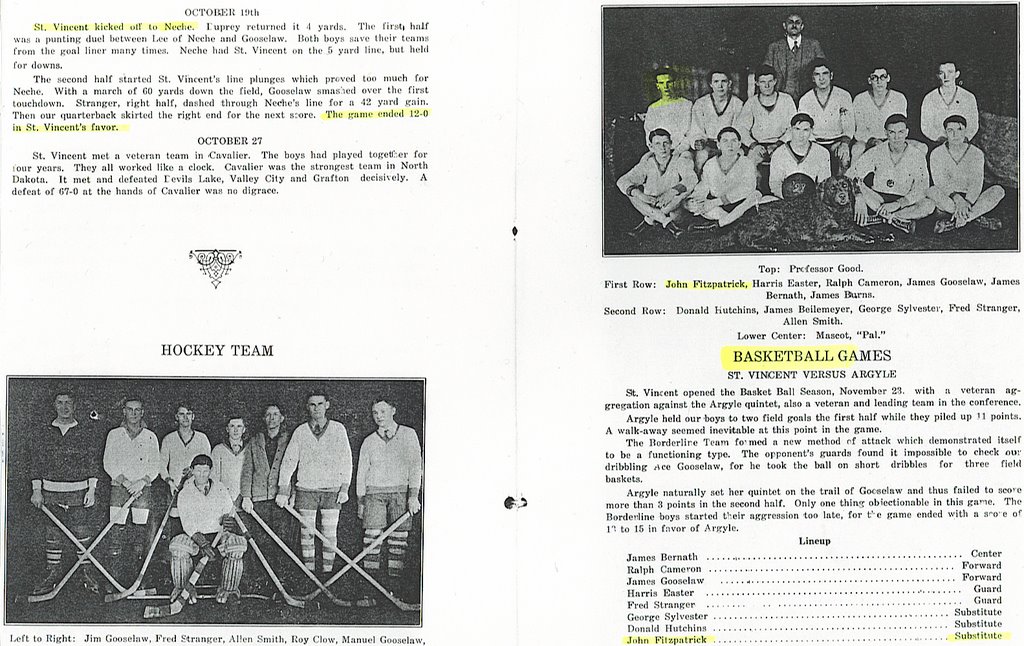
This little essay was inspired by reviewing some old clippings about the St. Vincent girls basketball team that appeared in the 1927-28 school yearbook that can be found in the Lake Bronson-based Kittson County Museum. St. Vincent is today nearly a ghost town. First, a little background. Mrs. Dick Lapp's little history of St. Vincent notes that the towns was the oldest city in Kittson County from the standpoint of settlement. Mrs. Lapp writes that "[t]he history dates back as far as 1857, when Minnesota was still a territory. A trading post on the village site had been named St. Vincent in honor of St. Vincent de Paul, founder of missions and hospitals in France." St. Vincent was built up as a town that serviced Fur Company XYZ (what an unimaginative name!). She notes the town was a byproduct or expansion by the Selkirk settlers that founded Pembina. St. Vincent had the reputation of being a rough and tumble town. Mrs Lapp writes:
"Ox-carts were the first means of travel in this area. Norman Kittson enveloped the ox-cart enterprise. Later steamboat traffic became important not only to the village but to settlement of the community. As early as 1862, railroad talk began. In Winnipeg, Donald Smith thought the Red River needed a lifeline to the east. He took his idea to Norman Kittson, the president of the steamboat line which held a monopoly on the river. Kittson referred the matter to his silent partner, James Hill. Hill had a dream of reviving the bankrupt railway at St. Paul and latched onto the idea immediately. In 1878, his dream was realized. He saw the first locomotive arrive in Emerson, Manitoba from St. Paul. It was the Great Northern Railway and later known as the Burlington Northern. The customs office and depot were in St. Vincent until 1905 when they were moved to the Canadian border at Noyes. In 1900, a roundhouse was built, James J. Hill backed the project. It was located by Lake Stella, east of St. Vincent. A turning table was included that was used to turn the trains around. Charles Gooding was the first depot agent. John McGlashen was the first man to take a carload of horses through from St. Cloud to Winnipeg. He also operated a saloon".
Mrs. Lapp notes how vibrant the town was by the turn of the century. The fur traders were prosperous and started the first stores. She writes further:
"The first bank was established in 1880 by J. H. Rich, E. L. Baker and F. B. Howe. It was later sold and closed. J. R. Ryan operated a livery and sales and William J. Mason opened a blacksmith's shop and also ran a wagon and carriage shop. The Firehall was built in 1903 by Edward Cameron and his three sons. It was on main street, east of the Red River bridge and housed fire engines run by steam. The Firehall was pushed over in 1972, the town hall demolished and a new hall built on original site of depot."
Mrs. Lapp notes that the first teacher in the St. Vincent School was none other than Eliza Moore.  The first schools in the county were on or near this village. Lapp's sure-footed history records that it was "Eliza Moore, then age fifteen, taught all eight grades in a little one room school in the west end of town. She told stories in later years of the Indians riding their ponies around the schoolhouse and looking in the windows and frightening her and the pupils. The present school was built in 1903. It was a square two-story white frame building and originally housed all the grades from one through twelve."

Eliza Moore continued to teach in St. Vincent when I was a student in the 1950s and 1960s. I thought of her as an Ancient Mariner or School marm. Mrs. Lapp gives her great credit for the development of the school in St. Vincent. In the late 1950s and early 1960s, Prof. Moore was a big part of the St. Vincent school. Other St. Vincent teachers from my day included Maribel Berg, Velma Isley and now my memory so many decades later becomes fuzzy. I think Simeon Cameron was the school cook. [Note from Trish:  I also had Mrs. Berg & Mrs. Isley as teachers at the St. Vincent School, and Simeon Cameron was still the cook while I attended...] 

Now, let's fast forward to 1928. The town of St. Vincent in its heyday had a hotel called the Northern Hotel. It also had saloons, stores, a jail, fire station, curling rink, etc. However, the jewel in the crown was the St. Vincent School. The School field both boys and girls teams for basketball, track. tennis and baseball. I think that the social history of girls' sports is largely a lost memory. I want all of the readers to think of the St. Vincent described by Mrs. Dick Lapp. There was a vibrancy. It was 1928 only a year before the Great Depression was to cause the citizens of St. Vincent great economic and personal turmoil. The Great Depression which was to begin in 1929 decimated St. Vincent. Mrs. Lapp blamed the Great Floods of 1948 and 1950 and she may be right about the factors leading to the dissolution of vibrant St. Vincent. I think that the Great Depression might have played a role. Mrs. Lapp lived through the Great Deapression and both floods. I was a baby during the Flood of 1950. I digress. Fast forward to the 1927-28 school year. The school was the center of town life.

The St. Vincent School had a strong (women's) basketball team consisting of Mamie Cleem, Isabel Fitzpatrick, Lelia Davis, Fidessa Wilkie and Alberta Fitzpatrick. The Girls' Basketball Team of 1927 is pictured during the first game of the season. The first game for the girls was held on December 4, 1927. I found the school yearbook to be amusing. Isabel is pictured as tall and lean and quite attractive in a picture taken during the first game of the year. In the back row, there is yet another Fitzpatrick named Fern. The name is alternatively spelled Fern or Ferne. Ferne was the starting Left Forward on the team and had the nickname of Coon. Isabelle was known as Issy or at least that's what her teammates called her. Issy was apparently the team's star ball handler and dribbler and played at the right guard position. What's so puzzling to me is that there appears to be 6 players on the starting lineup for girl's basketball. Issy was at the Right Guard position Fidessa Wilkie or Fido was at the Center Guard and Verlie Cameron or Plug was at the Left Guard. The nicknames for the girls were not exactly comely or feminine names. I was impressed with their apparent fitness and competitiveness. Every girl had a nickname. The Center Forward, Mamie Cleem, was nicknamed "Slivers" There was Coon (Ferne) at the Right Forward position and Lelia Davis or Lee at the Left Forward. Isabelle or Issy played Right Guard. Fido was at the left guard. They were spelled by substitutes Verlie Cameron (Pug), Violet "Cutie" Cleem and Mae (O'Leary) Gamble. Eileen Twamley also played on the team. I assume she was the sister of Merle Twamley who was the patriarch of the large Twamley family we knew growing up in Humboldt and St. Vincent.

The other sports stories about the girls basketball team of 1928 mentions the injuries the girls sustained and how they played the game. Isabelle, for example, jammed two fingers, and was hurt in the game with Stephen. St. Vincent beat Stephen 21 to 16. Issy continued to play despite having sprained fingers. She was not the only girl to be injured. Coon's leg was twisted and the game delayed. She limped through the end of the quarater and could not continue. She was replaced by "Cutie" Cleem. In that game, Mamie "Slivers" Cleem was the superstar scoring 12 of the 16 points and playing like a champ. St. Vincent beat Stephen! I don't ever remember Humboldt-St. Vincent beating Stephen. St. Vincent beat Stephen at the game held in St. Vincent. Does anyone remember where the games were played? I think that the Boy's Teams were played in Pembina. It may be that the games were played at Pembina's gym. St. Vincent played Pembina February 8, 1928. The Game ended in a 10 to 10 tie. In the Stephen game, St. Vincent's star players missed key free throws while Stephen made their shots. St. Vincent took the win because of their better outside shooting. In the Pembina game, the game game had a number of hard fouls against the St. Vincent girls. Issy Fitzpatrick had a key personal foul levied against her. A technical foul was called on Fido Wilkie. Slivers was hurt in a hard foul and knocked against the back wall and then to the floor. There were officiating disputes in all of the girls' games or there was a hyperactive imagination on the part of the St. Vincent sports writers. In the return game with Stephen at Stephen held on January 20, 1928, the St. Vincent team made baskets that were not counted. The home town (Stephen tilted) referree ruled that when Slivers made a basket, it did not count. When Coach Dick Lapp objected, he was told that the basket did not count because of interference. Lapp retorted, "Interference, YES, BECAUSE ST. VINCENT MADE THE BASKET."

The third quarter of the Stephen game ended in a 14 to 14 tie. In the fourth quarter, a St. Vincent player named Mae Gambel or O'Leary went into the game replacing Issy Fitzpatrick. That substitute was not a wise choice as then Stephen made four baskets and St. Vincent only two to round off the game which ended "18 to 22, in Stephen's favor." In the Pembina game, Cutie Cleem substituted for Coon. Apparently, the ref called a foul on Cutie for chating with someone on the team so a technical foul was called.

I was wondering whether anyone knows additional facts about any of these colorful girl sports heroes from the late 1920s. St. Vincent was a great sports town with a full array of girls sports during the 1920s: basketball, tennis, softball or kitten ball etc.

I responded to Mike's post by saying:

Wow, Mike! Keep the stories coming, sports-related or otherwise! You really bring St. Vincent alive for us. It's really neat to hear about the history of where I grew up. I wonder what other source material there might be out there that would have information about the town's life? I'd love to hear more about the merchants, who owned what, what the saloons and hotel, etc. was like, the background of the town's politics, etc...even the gossip of the past. Any ideas anyone?
My cousin Delphine Mundorf responded:
Alberta Fitzpatrick as you may know from other postings is my mother. I was surprised about her name mentioned here on the basketball team. I guess she has mentioned it to me but her biggest thing she talks about is playing tennis. She says she was very good at tennis and she and her partner did so well they had a chance to go to the State tournament. However that cost money and her folks didn't have the money to send her so she never got to the state competition. I believe she felt she was good enough to maybe have become a pro. The Fern you talk about is mom Alberta's & my aunt Harriet's first cousin. I met her several times as she lived in Crookston when I was a child and we usually stopped to visit her whenever we went to St. Vincent to see my grandparents. My mother is still living and will be 92 in July. To my knowledge she has outlived in age all her family. They all had longevity but most of the elders died in their late 80's.
Mike Rustad then commented:
Alberta was in fact a member of the St. Vincent tennis team. What this demonstrates is that the St. Vincent girls program was fully developed. The girls did not play football or hockey in the late 1920s, but every other sport. The point was that the town followed these teams. I find it amazing that St. Vincent played Neche, Cavalier, Stephen, and towns that were much bigger. I wonder where St. Vincent played their hockey games. Jim Gooselaw, Fred Stranger, Allen Smith, Roy Clow, Manuel Gooselaw, Cecil Smith, Bill MacKay and Ralph Cameron were on the school's hockey team. I have no further information. I think that if I were to get back to Lake Bronson that I could find a great deal more about the St. Vincent school. One of the problems I have being in Vermont is that I don't have ready access to these materials. Maybe one of you could do a field trip to the Kittson County Museum and make some copies of the St. Vincent materials. Another great source would have been the Pembina Museum. I am not referring to that antiseptic boring museum today, The old museum had tremendous numbers of artifacts etc. I asked someone what happened to that stuff and was told that the State has it in storage in Bismarck. What a waste. I think a fellow named Barron had his own private museum in Pembina. [Note from Trish:  Mike is right in this - it was Elmer Barry, and his private museum became the basis of the old Pembina Museum!]  I bet he had tons of stuff on St. Vincent. The shame of having this lost history is that everyone is now deceased or very old who attended St. Vincent High School. We have only fragments to draw from. We must be like archaeologists in trying to construct social history from such scant data. I think who we are is deeply rooted in our history. Going back to far in history for wisdom is like ox-tail soup. It's going back too far for a good thing.
Delphine Mundorf again commented:
My mother as I mentioned is now 92. She & I believe 3 other boys were the only 4 to graduate from the St. Vincent High school all others transferred to Humboldt I believe. I wish I had pd. more attention to Mom's stories but not being a historian I didn't. But I think Mom, Fred Stranger, and a Smith boy & one other graduated from St. Vincent High school. The rest transferred but it cost a tuition to do so & these 4 parents didn't have the money for it. So Mom wasn't going to finish school. One morning she came downstairs and found her mother crying and when My Mom asked Grandma why she was crying Grandma said because I only had a 3rd grade education and you have a chance to graduate and aren't going to do it. So my mother called the boys and asked them if they would be willing to go back to school and they agreed so they showed up in Prof.1 Good's class. Mom said he was so happy to see them he got tears in his eyes, Moms favorite thing she used on us kids was that we better do good in school because she was valedictorian of her class. I wasn't til later we found out she was only 1 of a class of 4, no wonder she was valedictorian. Ha Ha. She also has told me that the professor was so glad they came back to his class that he offered to help each one of them should they decide to further their education. She then went on to Minneapolis and went into nurses training but at her time it didn't cost to go to nurses training you worked some of your education so got the room free and got pd. $12 a month. She made it through the 3 yrs. to become a registered nurse but was never able to take the state boards. Her story all these yrs. was because it cost $12 to take the board exam and she didn't have the money to pay for it nor did her parents. I always asked her why didn't you contact Prof Good since he said he would help any of you. To go through the whole training then not take that final exam to get you certificate is such a waste. She just said Ya I suppose I could have asked him. However I have since very shockingly found out there was a a whole other reason why she never got that final exam.
1 - The use of "Prof.", short for "Professor" was curious to me, since I had only been familiar with it in association with teachers at a university or college level, but here it is used with teachers at a secondary level. I did a bit of research, and it appears to have been common at this time...

Sunday, March 15, 2026

PROFILES: My Grandmother’s Friends

Left to right:  Mrs. Zaharia, Margaret 'Toots' Ryan, Florence Godon, Esther Cleem (Florence and Esther were Thiefault sisters...), and Alberta 'Pat' Fitzpatrick Baudette, and in front, my grandmother, Elizabeth Fitzgerald Fitzpatrick in the wheelchair...

All the women in this picture (with the exception of my Aunt Pat who just happened to be home visiting that day...) were part of a group of friends who regularly hung out with one another, on an almost daily basis.  Growing up in St. Vincent, I saw many of them myself daily, as we all went about our business.  Most of the time, they were busy keeping house, looking after their families.  But as they went about their days, they would often run into one another at stores or church, in their yards or on the street, or stop by and visit.  Years ago, there was no common desire to avoid people and self-isolate as is common today; quite the contrary - most people sought out opportunities to socialize, to catch up.  

Names that still conjure up well-remembered faces and voices:

  • Mrs. Zahara (a Ukrainian lady whose strong accent made me nod a lot without knowing a thing she was actually saying), 
  • Matilda Cameron (a well-regarded seamstress whose second husband Wallace Cameron was a famous town constable), 
  • Esther Cleem (who along with her husband were victims of a home invasion turned deadly), 
  • Mrs. Gardiner (whose family tragedies rivaled my own Aunt Lena’s), 
  • Florence Godon, whose husband Bill worked for many years with my Dad at the Noyes depot,
  • Toots Ryan (good friend and neighbor-across-the-alley of my grandmother),
  • Glenice Friebohle (good friend of my mother’s), 
  • Ena Scobbie (wife of first pastor I remember of St. Vincent Evangelical Free Church), and 
  • Cousins Hattie  Schwenzfeier, Annie Nordine, Mabel Steien, and Faye Lyberg.

They all loved to gab, to share news and gossip, and to have a good laugh.  In other words, they loved to visit!  They were never at a loss for words.  There were no awkward silences.  If anything, people spoke over top of one another at times, interjected at others, and at still other times, the room divided into two or three subgroups like modern-day ‘threads’, multiple simultaneous conversations, and later came back into one again.  

The one who was more often than not dropping by Grandma’s place, or she to her’s, was Toots Ryan.  Toots lived north of Grandma’s place, just out the back door, through the back yard, and across the alley.  As you’d approach Toot’s house, you would notice the steps were higher than most around town.  That’s because the house had been put up on a higher foundation, my guess to protect the home’s contents in case of flooding.  It was the only house like that in town, but I later thought that was pretty smart thinking.  But as a little girl, the time period I knew Toots well, it never crossed my mind - it was just the way it was.  Her steps were harder to get up than my Grandma’s, each one a bit taller than normal, so I’d have to lift my little legs especially higher and give an extra hrmph to lift myself up.  The top step was a length of railroad tie, then the highest step of all over the lintel into the house proper.  

The door led into the kitchen, which as I recalled had one length of counter along the west wall.  There was a sink like at home, but instead of a faucet and water turns for hot and cold, there was a hand pump, which brought up water up from a private well under the house.  I have a feeling there was probably more of these at one time, but to my knowledge it was the only one left in town by then, the early 1960s.  There was still a town hand pump just kitty-corner from the Ryan home, by the town pond and curling rink.  Knowing more now historically, I think the town pond and pump may have served multiple reasons - for watering animals, water for people, water for fighting fires.  Heck, Grandma would have me go fetch buckets of water for her, to water her garden during the summer, since drinking water for her cost her precious money; at that time, most of us had our water brought in by water trucks, costing x-amount much per 1,000 gallons, stored under the house in cisterns. Anyways, I always thought it was so interesting that Toots still pumped her water.  She had a big stove in her house, too, but I never noticed what kind it was.  

The only other room in the downstairs was her parlor.  The first time I saw the parlor was on a visit to Toots with my Mom; in the parlor were two chairs, and a piano.  I hadn’t started playing the piano yet, but we had one that I was always tinkling on at home, showing an interest in learning already.  So it wasn’t surprising at all that I headed straight for it the first time I saw hers.  It had a fascinating seat, not a bench like ours, but a stool.  I found out immediately that it could be adjusting in height, delightfully by spinning it to the right for up, or left for down.  The stool’s feet looked like the claws of an animal, and clutched within those claw were small, clear, crystal balls.  I opened the lid to the keys to see keys that had faint marbling and yellowing, which I later learned meant they were real ivory keys made from elephant tusks.  A few were missing, but most were still there.  The really cool part was when I began ‘playing’ the keys, I learned the piano was badly out-of-tune.  However, to me, that made is all the more special:  It reminded me of the pianos played in the old western movies on TV - in tune enough to make out familiar melodies, but enough out-of-tune to be an authentic saloon piano!  

Once I wore out my welcome on the piano, I jumped off to rejoin the women (my Mom and Toots, visiting…)  Toots was a shorter-than-average lady, who was almost as round as she was tall.  That day, I was probably about four years old.  I interjected into their conversation with the observation, “You’re really fat!”  There was sudden silence.  Then Toots erupted into what I can now only describe as jolly laughter.  My Mom directed a mortified, “Patricia Kaye!” Towards me.  Toots came to my rescue by saying, “Patricia Kaye, eh?  That used to be my favorite chewing gum!”  She got a kick out of my outburst.  I had no idea I had done anything wrong, stating the obvious.  Toots and I always got along famously after that early meeting - I would often run out my Grandma’s back door and run over to her house and into her house up those high stairs.  

But when Grandma had friends drop by, there was a lot of visiting…and always over tea and baked goods.  The visiting might start off slow and casual, and build up to stories filled with gales of laughter; or they might start out with an excited, “Have you heard…?”  Whether it was a neighbor, or a cousin coming from across the county, in those days, people would often just pop in, no call ahead - no one minded, in fact, it was an occasion to be excited about.  Out would come the teapots full of Red Rose tea, served up with bars, cookies, and sometimes even cake…but always plenty of tea!  If Mrs. Zahara was in attendance when I was there, I would avail her of her talents and beg her for a reading of the tea leaves. I wish I could recall at least one of those readings now…