Showing posts sorted by relevance for query humboldt centennial. Sort by date Show all posts

Thursday, May 29, 2014

Water Cooler III: Further Down Memory Lane


This time, the water cooler chatter turned to our neighboring town - and good friends - Humboldt, MN.

Michael Rustad My Mother, Pat Carrigan Rustad, would have been 88 today. She died in 1989 at age 63.

Dan Ducharme So young

Cleo Bee Jones For sure, way too young

Donald Reese I think your dad was one of my closest friends.  I think he passed haway younger than that. I don't remember at what age...

Michael Rustad Dad passed away in 1986 at age 63.

Connie Lang Fowler I've already passed my mother's death by 16 years as well and all of the above died young as they say!

Maury Finney She and your Pop were super people!!! Great Humboldt memories!!

Michael Rustad Dad loved everyone in Humboldt. I remember him taking me to hear your Mom play the piano in the town hall. We actually had pretty vibrant town hall parties where everyone danced, roller-skated, played basketball. I think my Dad was just in love with Humboldt and everyone in the community. In all of his years, I never once ever heard him say anything remotely negative about anyone. Think the best of people was his watchword or his motto.

Cleo Bee Jones Sounds right...the more one thinks about it all, up there, the more one misses that way of life, my eyes leak so much when I remember all the people, friends, relatives, and just the life style and all...

Michael Rustad I was speaking last night with Aunt Norma and she told me that they would clear out the living room and have a house party with 50 or more. Everyone brought food and BYOB. She said she misses those house parties and where you can talk to your neighbor.

Maury Finney I really think when and where we grow up, we are so influenced by the community around us...Your mom and dad along with so many in Humboldt mentored a positive attitude and kindness. We were so fortunate to get our start there.

Donald Reese You're on-the-job education in a little community like Humboldt, including the surrounding farmers, really could be used for a foundation for your future,  I remember being interviewed at my workplace for an apprenticeship in maintenance job and was asked where I got my mechanic ability; my response was you don't grow up on a farm in Minnesota without knowing which end of the wrench to use. I got the job.

Tuesday, March 10, 2009

Old Film Stills

This is the druggist in Emerson, taken during the 1950 flood.

Harvest lunch break near Humboldt (circa 1950)

From Humboldt Centennial DVDs (2007)

I recently (finally!) bought the Humboldt Centennial DVDs that has the collected films of the Bockwitz family on them. They contain decades of filming done around my hometown area, priceless documentation of people and events of our times. I can't tell you how much they mean to me as I screen them, even though many of them were made before I was born. No matter - my family and my community had told me local history often and repeatedly, of which I could never get enough. I almost feel like I was there! Where I come from, people really care about each other and their communities and general. I'm pretty sure that's why it's had a special place in my heart, and always will...

Monday, November 24, 2008

Nature Reclaims Her Own

Michael Rustad is a native of Humboldt. Like many before and since, he left home and went out to a wider world. He shared the seeds of what Humboldt and his family gave to him, and the world today is better for it.

Mike is one of the main reasons this blog exists. He inspired me to share our mutual histories and to dig deeper to find out the histories we didn't even realize were part of our heritage.

He recently shared reflections of a very personal journey he took when up home for Humboldt's centennial...
Growing up in N.W. Minnesota, we all knew that the best hunting was east of Lancaster near the Canadian border. So, I would not be surprised if elk and wolves migrate to the Humboldt, St. Vincent area based on this story. Conflicting land uses have been a problem since Colonial times. I do not recall ever seeing either an elk or a wolves growing up. Once a moose stayed in our yard for a few weeks. The moose did not cause any problems or reveal any aggression. When I was home for the Centennial, I took a number of side-trips on back roads. The St. Vincent road which was my Dad's favorite is no longer maintained and returning to nature. I saw scores of deer very close to St. Vincent. There is a feel that the area seems to be returning to the earlier era as the area depopulates. Our own farm house and yard definitely was returning to nature with literally thousands of ticks, very ugly weeds, etc. Our farm house is returning to nature very fast. The house is entirely decimated with evidence that raccoons lived in the upstairs bedroom. It was difficult to even recognize the rooms which were kept up so well by my parents. The entire area appears to be hollowed out notwithstanding the outstanding job that was done to beautify Humboldt by its civic-minded residents. Though few in number, they showed obvious pride.
Mike's words reminds me of my own reflections of the past; how going home again is bittersweet - moving and haunting all at the same time. My family's home place is still being lived in, albeit not the family who originally bought it from my parents in 1998, but now by a single older man whom I met last summer. I'm glad he's there, and that the place is still a home. For awhile at least, it has a pardon from time's obscurity...

Thursday, July 05, 2007

School Bell

I recently attended a class reunion. Actually, it was much more than a class reunion; it was an all-school, all-class reunion, done at the same time as the town's centennial (which I have found out - long story - is something of a mystery since there are other dates considered to be when the town was established, incorporated, etc., but I digress...)

The photo here is of a new memorial, dedicated during the weekend celebrations. From a 1993 article on H-ST SchoolIt is on the site of the old school, which does not exist any more. Except in the memories (and my dreams...yes, I dream often of walking the hallways of my old schools...) of former students, etc.

What was really strange is coming across an old teacher who I swear looks younger than she did when we were in high school.

It was amazing to talk to old classmates, and meet 'new' even older former students. I finally met Michael Rustad, without whom this site would not exist. I also met Allen Ahles, who assisted me with some of the Ahles family history on this site. And of course, I not only met, but stayed with, Chuck Walker, whose story of his ancestor is being serialized on this site.

All and all, an amazing weekend I will never forget!


Humboldt School 1906-1956
Humboldt-St. Vincent School 1956-1991

Dedicated to all the teachers, administrators, students, custodial and transportation personnel who so faithfully served
and attended this school.

Bell monument provided by Garylle B. Stewart, Class of 1958. Construction and installation of Bell by Wayne G. Stewart, Class of 1964. Masonry work by Steve Olson and Grandson Construction, Fargo, ND. Bell saved from school and provided by long-time residents Curis W. Miller and Brad Hemmes.

Dedicated at Humboldt Centennial and All-School Reunion,
June 22-23, 2007.


Trivia: The bricks forming the base of the memorial were once part of the old-wing of the Humboldt School

Thursday, March 10, 2011

Guest Post: Michael Rustad

Lyle Dexter, Michael Rustad, Jane Dexter, & Carolyn Wiese (in back)
watch videos in church during 2007 town centennial/school reunion

This is the first in a new series called "Guest Post: YOUR NAME HERE", which will feature essays by guest writers, recalling memories and/or reflections of our hometown area. If you are from Kittson County, Pembina County, or southern Manitoba, and have memories you'd like to share about our area, let me know.

The first writer is Michael Rustad, who is (to coin a phrase) the midwife of this blog...

Saturday, April 28, 2007

June Event Yields St. Vincent History

I just got home from a 3-day business trip to a phone call from Wayne Stewart. Wayne is one of the organizers of the Humboldt Centennial/All-School Reunion Committee. One of the things Wayne mentioned was that the DVD they will be selling at the event not only has tons of footage of Humboldt itself, but other events that happened in the area, including around St. Vincent. One of the events he specifically mentioned to me was a train wreck that happened on a bend in the line just outside of town at that time. I didn't get the year, but I assume it had to be quite a few years ago. I told Wayne I had just sent in my pre-registration, including my order for the DVD, so was thrilled to hear it had some St. Vincent footage on it. He also said that in the course of researching for the Humboldt history for the Centennial/Reunion, he came across many interesting historical tidbits from the then St. Vincent New Era that he plans on writing up this coming winter, and will be sharing with me. Dear Readers, I shall definitely pass on anything interesting in connection with St. Vincent, so...Stay Tuned!

Thursday, September 28, 2006

Humboldt Centennial

Humboldt, Minnesota will be celebrating its centennial next year.

They have recently put up a website with the beginnings of information for upcoming celebrations in 2007, including an all-school reunion for Humboldt-St. Vincent classes.

I encourage everyone to make plans to attend, and hope to see you there!

Thursday, December 16, 2010

Salt

Once found in Minnesota, but
now is evidently extinct here...

In 1823, Mr. Keating noticed the Salt springs in Minnesota State and Dacotah Territory, far south of the boundary line.  Even at that early period in the history of the Settlements on Red River, five hundred dollars were cleared by one individual during one winter from the sale of the salt he had manufactured from springs near Pembina.  The price of salt in the Settlement was then six dollars per barrel weighing eighty pounds.  At a spring on Saline River, south of the boundary line, Major Long's party found the Salicornia herbacea growing very abundantly around it.  "Mr. Schweinitz states, on the authority of Mr. Nuttal, that this is the only inland locality of this plant, besides the Onondaga Salt Springs in the State of New York."

- From Report of the Exploration of the Country between Lake Superior and the Red River Settlement (1859)

Early in the exploration period of Minnesota, note was made of a potential bonanza.  It wasn't about gold, but...salt.1

Sunday, August 21, 2011

Grand Old Lady

So many children entered through these doors

The sign is blank.  The steps are mostly buried, a railing rises from the earth.  A gibbet of sorts protrudes from the front.

 It's obvious that just about everything needs help.  Roof, siding, windows, foundation.  The "Grand Old Lady" of St. Vincent, that housed so many young souls on their journey of learning, deserves better.

Wednesday, October 20, 2010

Census of a New Town

1857 Minnesota Territorial Census of St. Vincent...
[Click to see larger image]
The above image is of the actual 1857 census of my hometown.  If you look at the enlarged image, you will note it says that at this time, the town existed in the "...County of Pembina, Territory of Minnesota." Kittson County did not exist yet.

That year was a momentous year for St. Vincent.  It was the year it was FIRST incorporated.  First, because it was incorporated twice. 

Tuesday, February 24, 2009

Followup: DeFrance Family

Roy Cochran DeFrance was the St. Vincent depot agent at one time. Photo taken about 1907 or 1908. 
Marjorie DeFrance (Roy's daughter) was born in the living quarters of the depot on May 31, 1909...

I promised this followup
over a year and a half ago. My sincere apologies - time slipped away on me which is all too easy to do. Then again, I am continually amazed at the richness of our area's history so perhaps you can forgive me for getting distracted!

Nevertheless, I am finally sharing the photographs that Majorie DeFrance Baker - Roy DeFrance's youngest child - shared with me when I was up home for the Humboldt Centennial.


Evelyn Russell was Marjorie's first teacher. The photo above is of Marjorie's first grade class in the St. Vincent School, Miss Russell is at the back of the class. Don't the children look well-behaved?! Does anyone recognize other children in the photo? This would have been around 1915. Please let me know if you think you know someone...

The portrait to the left shows the newlyweds Roy DeFrance and his bride Eva Sheldon (Marjorie's parents) in 1909. The 1910 Census still shows Roy working for the railroad but now he's a telegrapher while my great uncle Richard Fitzpatrick is the agent. Around the same time he became the editor of the St. Vincent New Era under Publisher William Deacon; Roy's WWI draft card lists him as 'Publisher of Newspaper' in 1917. He bought the New Era from the original publisher Mr. Deacon outright, in 1920.


Seen here in his later years, the way I remember Mr. DeFrance, he is in the newsroom where he loved to be, amidst the printers, ink and plates which he could set fast without hardly looking. Roy lived to nearly 100, passing away in his centenary year of 1975. He was a newsman to the end...

This is Marjorie (DeFrance) Baker, Roy's youngest child, taken June 2007. Marjorie has been blessed with her father's longevity, being a very spry 98 when I spoke to her. She had spoken with me at length on the telephone some months before, the previous autumn, regaling me with memories of being put on stepping stools as a very young girl so she could feed the paper into the press. Publishing was definitely a family affair!

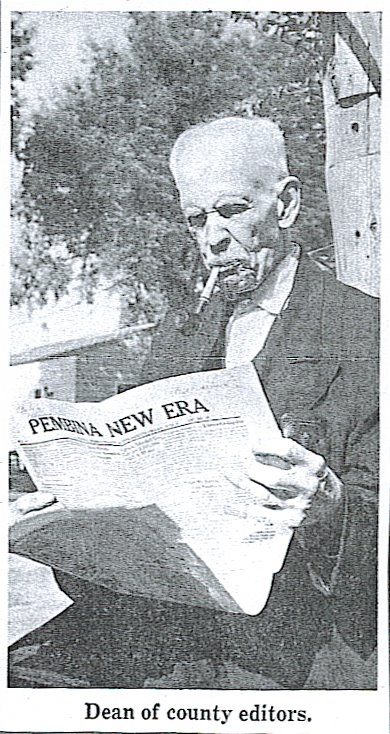
New Era Trivia: Our local paper was one of the very last papers in the country to be hand-set. As recounted in an essay by local school students:
When a person of the younger generation enters the door of this quaint, little, old building, that houses the Pembina New Era, they have a tendency to back out of the door without further inspection. They aren't familiar with the building and its dim lighting. The heavy machines and "The Cases" that he has, are too heavy for the floor to support, therefore, the floors are actually hilly. The whole place has the appearance of being painted black, because of the dirt involved in the printing of the paper. The ceiling of the building is very high with little strings of lights hanging several feet down from them. It is very hard to see anything clearly when you walk into the building, especially if it is sunny outside. Your eyes can't adjust to the sudden change in lighting.
I myself remember this building very well, 'hills' and all, and it was indeed very dim. It was a place from another time, and I was privileged to have a peek into that world...

Sunday, October 01, 2006

Profile: Roy DeFrance

I only met Roy DeFrance a handful of times, and only in passing. He didn't look a lot different than the photo here at the left, as I remember him. He was by then, a very old gentleman, and would soon leave the running of the paper to others, including his daughter Ione.

I was a wee girl, tagging along with my Mom as she visited the Mr. DeFrance's offices to place ads or pay a subscription. I remember having the chance at least once of going behind the counter and seeing the amazing tools he had to use to make the paper. I noticed he wore black armlets, and he explained that was to protect his shirt from the inks on the press. He also pointed out all the little wooden trays with backwards metal letters, and I must have looked flabbergasted to think of all the work he must have to go to, to put a paper 'to bed', because he then said he's been at it for awhile and can go pretty fast. It still amazed me, and does to this day, and when I remember those visits, I also remember my mother saying that it wouldn't be the New Era without at least one misspelling in an issue. Well, I think we could forgive Mr. DeFrance a few errors - who of us could have done better? He sure didn't have a convenient 'spell checker' like we do nowadays!

Ione, one of his children, is the person I most remember and identify with the paper. Every week, Ione would faithfully call around all over the readership area, to get news for each town's section in the paper. It was a time-honored tradition in our area to do this. You couldn't go anywhere or have a good or bad event happen, without it being known in the New Era. It was a good tradition, even though some might think it intrusive; we were able to keep in touch with one another despite life being so busy.

A few months ago I made a point of tracking down Marjorie (DeFrance) Baker. Until then, I didn't even know Marjorie existed. When I was a kid, you don't even think about how many kids an old person may have had, so didn't think Mr. DeFrance had any other children than Ione! Anyways, through Fort Pembina Historical Society contacts, I found out about her in my efforts to do more history about the New Era. Below is a fairly verbatim summary of what transpired during our telephone interview...

She is 96 years old, has a great memory, and was wonderful to speak with. Was great in sharing about the paper and her father, and her involvement with the New Era as a young person.

She said her family was of French Huguenot ancestry, first settling in Pennsylvania, then coming to Minnesota. Her father - Roy DeFrance - was a short man, 5'6". "He always wore a mustache..." and had black curly hair as a young man. He started out as a teacher, and it was at a teacher's convention that he met his future wife. But eventually he went to telegraphy school in St. Paul to make a better future for himself and his family. Later, he taught my great uncle telegraphy in a depot school.

In 1920, Mr. Deacon (seen here at left, in an early photo of the New Era offices when they were in St. Vincent (and the paper was known as The St. Vincent New Era...) sold the paper to her father. Marjorie was unable to say why her father changed careers and went from teaching to being a newspaper man, but going by his later reputation, I would speculate it must have been because Roy DeFrance had the desire and ability to express himself in the way only a newspaper publisher can. He became known for his editorials, and prided himself in providing a needed and appreciated service to his community.

Roy and Eva DeFrance had eight children, three girls and five boys: Norton, who worked as a printer while in the army during WWII, and afterwards worked in various print shops; Melvin, who became a reporter and also has worked as a ghost writer; Roy, who worked in the field of Linotype; Ralph, who lives in San Diego, California and runs the DeFrance Publishing Company; Dilbert, who began professionally at the New Era, then went on to work for the Grand Forks Herald; Ione, who never left the New Era; Majorie herself, a homemaker; and Gladys, their sister (no profession was mentioned for her...)

Marjorie continued by telling me how all of the DeFrance siblings were involved in one way or the other with the family business as they were growing up. Marjorie herself remembers taking singles (plain 12"x15" sheets) and wrapping copies of the paper, addressing them to subscribers, and even making deliveries. Later, she got the chance to do some reporting. She described to me seeing her father, Cecil (aka "Casey") Cleem, and Ione doing the typesetting for the print runs. Speaking of print runs, every print run required them to grease the press, which was quite a job in itself! She said she would help with the print runs sometimes, standing on a stool and feeding the press sheets, which were processed by hand-crank; if you missed a sheet, the bed got over-inked and would gum up...and her Dad would get plenty mad!

Majorie says, if she remembers rightly, one of their old presses is now in a museum, but she couldn't remember if it was the Kittson County Museum in Lake Bronson, Minnesota, or the museum in Cavalier...

We ended our telephone call agreeing I would call her this summer and make plans to meet her. She said she has a lot of memorabilia about her family and the New Era she would like to share with me, and I told her I'd love to see it, and have a chance to talk more with her. Alas, I was not able to make it up home this summer, but will be next summer due to the Humboldt centennial and all-school reunion. Let us hope and pray that I get the chance to see Marjorie then...

Monday, August 28, 2017

Local Veterans of World War I - Part I

We are in the midst of the Centennial years of WWI. Many men from Kittson County fought in the "Great War", or the "War to End All Wars". As we know all too well, sadly it didn't end all wars. If you want to find out more about who fought from Kittson County, you can view online the book that was written all about that - The History of Kittson County in the World War.

A few examples of local WWI veterans; I will be sharing more in the near future...


When I was growing up, I knew Eli Gooselaw as a tall, quiet old man who lived across the pasture from our house, north of the St. Vincent Cemetery.  His house was a 2-storey wood clapboard, the paint long ago weathered off.

Outside nearby, he had a tall wood pile, stacked up in the form of a tipi. From what I could tell, he never used the wood,  nor burned it.  It just stood like a sentinel over the years.

The house had old-fashioned tall, sashed windows, that reflected full-moon moonlight so brightly that you swore Eli  (who never used electric lights) had lights on - especially his upstairs' north bedroom.

But back in 1917, Eli "...enlisted in the Army at East Grand Forks ... because they were drafting men. This was the time of World War I, and most of his two years of service were spent in China. Eli was one of the few people who could say he'd been to the big cities of China - Tientsen, Shanghai, and Chin-huang-taoo, along with Tokyo, Japan, the Philippine Islands and Hawaiian Islands."


Fred Gooselaw was born and raised in St. Vincent.  He was the son of Zeb and Joset (Parenteau) Gooselaw.

He became a barber and ran his own barbershop in St. Vincent, then Humboldt prior to WWI. In October 1918 he was shipped off to France as an Engineer Sapper, as part of the October Automatic Replacement Draft.1

After the war, he carried on being a barber, and eventually moved to Montana, continuing his profession there.

He named his firstborn son, Pershing, born in August 1918, in honor of General Pershing.


James Lang was born in rural Kittson County, Minnesota.  He was the second son of Joseph and Margaret Lang, and farmed with his father.

He then went to fight in the First World War. After returning, he resumed farming until 1955; then he retired. He moved to Humboldt and never married.


Born in Ontario, Canada of German immigrant parents, Christopher A. Thedorf, Jr. came to St. Vincent as a small child.  The Thedorf family lived in the middle of the town, by the house that would eventually be my grandparents' second home after they moved out, when my parents took over the homestead. Chris' father, Mr. Thedorf, was the proprietor of the Thedore Hotel in St. Vincent.

According to the 1910 U.S. Census, Chris was working then as a bartender in a St.Vincent saloon.  As the article to the left states, in July 1917 he volunteered into the military, choosing the Marine Corps.  The United States had declared war in April 1917 but didn't send forces (under General Pershing) until 1918, so Chris was an early participant in the war.

After the war, he married, moved to St. Paul, MN, and began working for the railroad as both a locomotive engineer, and fireman...


Hugh Lucas was a compositor and printer for the Emerson International newspaper in the late 1800s and worked there with J.E. Bouvette. He was also a carpenter and built his first home in St. Vincent with his own hands, or so the story goes.

Why Hugh felt it was important to volunteer in WWI when he was beyond the normal age is not known, but as you can read at left, he was well thought of by his fellow soldiers. He was a veteran when he went into the service again, having been in the cavalry in the late 1800s.

The article to the left states that he went into the Remount Corps upon enlistment, which was part of the Quartermasters Corps.


______________

1 - October Automatic Replacement Draft: It means that a man was scheduled to be a replacement for a battle casualty right from the start. Usually the army waited to see what a man could do or where he was actually needed before assigning him a specific job. By October of 1918 the casualty rate was climbing and they were sending men over at an incredible rate. New draftees were barely receiving any training at all before shipping out. To fill the gaps caused by casualties, they started assigning men to be rifle men just as soon as a block of them were called up (or in this case, an engineer sapper...) The program was initiated in October. Had the war gone on longer, as many thought it would, there would have been many more 'replacement drafts'.