Showing posts sorted by relevance for query fair. Sort by date Show all posts

Thursday, June 19, 2008

Hamilton Fair Loses Carnival

Pembina County Fair - Hamilton, ND
Photo by:  Bruce Wendt
When I was growing up in St. Vincent, we attended the Kittson County Fair in Hallock, and the St. Vincent fair itself in the fall, but we also looked forward to the Hamilton fair, with its harness racing. My Dad and I would attend the races together and have a grand old time cheering them on, Dad taking the opportunity of sharing about his father having seen the great Dan Patch in his time.

Now things are winding down, sadly. Populations grow smaller in the rural areas, and the results are that the fairs are slowly fading...

Hamilton, N.D. -- In the heyday of the Pembina County Fair, about two dozen carnival rides filled up the fairground midway. The Ferris Wheel. The Tilt-A-Whirl. The Octopus.

Neil Fleming saw it all in his 55 years as fair organizer: from food to farm animals, clown shows, girlie shows, freak shows.

"It was really something," he reminisces.

The aroma of funnel cakes, the barnyard odor of fattened farm animals, the resplendent beauty of fancy quilts will still exist at the three-day fair July 10-12. But for the first time in 115 years, there will be no carnival rides on the quarter-mile-long midway.

Saturday, May 11, 2013

Mike Rustad: County Fair Memories


Ah, the perceptions of youth!  In this reminiscence, Mike Rustad takes us back to the Kittson County Fair of a generation ago.  If you're like me, it will resonate strongly with your own memories of that time and place...

I looked forward to the the Kittson County Fair each summer. I enjoyed the rides as well as the carnival. My brother Tony and I collected pop bottles to save for the Fair. We would frequently have 4-H exhibits at the Fair. I remember once we were on a Tilt-a-Whirl (or similar ride) and Tony got sick on the ride. The operator of the ride was a crude man with a number of tattoos including something like "Born Loser." In any case, he would not let us leave until we cleaned up the ride. Since Tony was in no condition to help, it was left up to me. As farm boys, we were somewhat intimidated by the carnival workers. It was quite common for the carnival games to be rigged. I think that we would lose only a $1 or so on these games but they were cheap tuition. I think that the Fair illustrated the seedy side of society as well as the best.

The Fair was like the Tale of Two Cities: the best of times and the worst of times. One of the worst moments was experienced by my Mother. In an essay she wrote for the Scribe Tribe1, she recounted how she placed her glasses case dutifully beside the hole.The case was cylinder shape and began rolling toward the hole because apparently the toilet was not level. In her haste to grab it, the clasp came open. Her glasses and keys went down the the dark smelly abyss. She was embarrassed but decided to take action. She found the Fair Manager and asked him for a flashlight and a shovel. The Manager asked her what she wanted them for. She was stopped numerous times by friends asking what she was doing with the shovel and flashlight. She dragged the odorous privy for a long time without success. For years after the episode, she was asked about how she got home without her glasses and car keys. For my Mother, this was the worst of times. 
The Fair was also the best of times. The lights of the rides were beautiful. For many years the Fair was not complete without a tremendous thunder storm and sometimes funnel clouds in the area. Later, a tornado destroyed the Fair Grandstand only a short time after it was filled to capacity. The severe weather conditions and the lights brought an indescribable excitement to the Fair. The 4-H exhibit hall was a favorite place. I always took time to look at every exhibit. I always wondered how I could never get beyond a red ribbon for my vegetables and insect collection. There were a number of local merchants who had exhibits. One of the highlights of the Fair was when the car dealer would give away a car and also bicycles. I never won but the anticipation of winning such a prize was greater than Publisher's Clearing House. 
My favorite place to eat at the fair was the Larson Family Stand which made the best hamburgers and generally had the best food at the Fair. Joyce Baldwin from Humboldt was a Larson and so many of the Baldwin kids helped out at the "Larson" food stand. Each of the 4-H clubs had special exhibits which depicted our activities for the year. I belonged to the "Stick-To-It" Club which was one of the oldest Kittson County Clubs. We had very good adult supervision. The Gatheridges, Baldwins, Bahrs, Wieses, Diamonds, Clows and many other families were active in the club. I remember that the older kids in the club were very helpful to the younger ones in exhibiting their products. Dennis Diamond was one of those older kids who was always helpful to Scott Clow and I who also showed sheep. Another memory I have is a 4-H parade through Hallock. A very pretty young lady asked me to help control her very large and unruly 4-H calf. I managed to keep the calf from stampeding through the streets of Hallock, but still received only a white ribbon. I can still remember the smell of those hamburgers at the Larson family stand. I hope that other former Kittson County residents will contribute their memories of the Fair and of their "Wonder Years." 
1 - The Scribe Tribe began as a continuing education course in 1966.  The writing class morphed into a club with meetings in homes. These were more than social events - everyone in the club felt a great social pressure to produce writing. It was Dotty Boatz who first suggested that a writing course taught at Humboldt-St. Vincent High School continue on as a club and she was one of the most active members. The Scribe Tribe proved to be a huge success, and Gloria Swanson and Virginia Ott ended up writing a very interesting book on Fred Jones, who was an innovative handyman and inventor who lived in Hallock for many years. The title of the book was Man With a Million Ideas: Fred Jones, Genius/Inventor.

Wednesday, December 06, 2006

Old St. Vincent Fair

A bountiful display of fair exhibits in Reid Hall (town hall)


The photo to the left is a result of a query that was published in a column this week. It was sent to me today by a resident of our area, who said in his accompanying email... 
Hi Trish: Just noticed in today's Kittson County Enterprise you were seeking photos of the St. Vincent Fair. My grandfather William S. Ash was a director of the St. Vincent Fair board I believe at one time. Among his photo albums was this photo. I can only remember as a kid being in the old St. Vincent Fair building once when the fair building was just east of the old grocery store or near the jail building to the best of my memory before they built the new fair building which is still standing in St. Vincent today. If I remember this photo is what I remember of the old fair building now gone. The back of the photo says "St. Vincent Fair". There isn't a date on the photo so your guess is as good as mine. William G. Ash

Monday, February 24, 2014

The “Birdman” of Hamilton

'Birdman' Beachey,  putting on flying show at the Hamilton Fair

[Reprinted with permission]

When Orville and Wilbur Wright first took to the air in 1903, no one could imagine the future aviation would hold for the world. For people living on the flat prairies of North Dakota it would be seven more years before anyone would witness the daring exploits of a “birdman” when Archibald “Arch” Hoxsey gave the first demonstration flight in the state at the Grand Forks fairground July 19, 1910.


First North Dakota flight at Grand Forks Fair, 1910

Hoxsey had met Orville Wright in March of ’10, when Orville opened a school for aspiring aviators in Montgomery, Alabama. It was here Hoxsey learned to fly and joined other pilots in the Wright Exhibition Team, a troupe of flyers scheduled to give flying exhibitions around the country. These flyers would be the first to fly the new Wright Brothers Model B aircraft. Hoxsey’s Grand Forks flight was witnessed by an estimated 10,000 people as he flew 2,500 feet in the air during his 22-minute flight. Hoxsey’s flying career—and his life, at age 26—came to an end that same December during an exhibition flight in Los Angeles when his plane plummeted from a height of 7,000 feet. Hoxsey could not only claim being the first aviator to fly in North Dakota but to also carrying the first (former) United States president when he took Theodore Roosevelt airborne two months earlier in St. Louis.

Residents of Pembina County who had not been present at the Grand Forks exhibition would have to wait an additional three years before the first recorded airplane flight took place in the county. Hillary Beachey—billed as the “World’s Greatest Aviator”—was booked to make an appearance at the 1913 Hamilton Fair. Ads in the Cavalier Chronicle reading “see the dizzy, death-defying aeroplane flights by daredevil aviators every afternoon” drew large crowds to the fairgrounds. After the fair, the Chronicle reported “the program of attractions was perhaps larger and better by far than that of any previous fair held in the county. Perhaps the chief among these were the several flights of Hillary Beachey in his Aero Plane.”

Thursday, April 04, 2013

Mrs. Rasche & the St. Vincent March

Example of another March
written by Mrs. Rasche

[Source:  Library of Congress]


I put to you, dear Reader, a St. Vincent MYSTERY to solve!

Published in the St. Vincent New Era in 1890, is the following news:
Mrs. Rasche, the celebrated Musical composer done St. Vincent the honor of composing a march, entitled "The St. Vincent March" as a souvenir of the Fair of 18901, and done the editor of the ERA the honor of dedicating it to him for which favors St. Vincent and us are enthusiastically grateful.
As you can imagine, to read that an actual musical composition was written for and about St. Vincent is an exciting and unexpected discovery in my ongoing research about my hometown.  Who was this Mrs. Rasche?  Why did she feel compelled to write the piece for this event?  Was the 'Fair of 1890' a special fair moreso than other years?  It is possible that she was just helping the town by being so civic-minded.  It was still trying to grow.  All we have is speculation - I would like to find out the story behind the story!2


What we have found out so far:

Sunday, July 31, 2011

Fading Away

Population 6...plus two big dogs
[Photo: Ghosts of Minnesota]
There are towns even smaller than St. Vincent, but not many.

One of them is Tenney, Minnesota.

Tenney recently dissolved, meaning they are no longer a town.  I can't help but realize that it's only a matter of time before St. Vincent has to face that decision.

When I was growing up, St. Vincent had around 200 people.  It was already in its descendency, a shadow of what it once was.  But there were hints of its glory days, such as the sidewalks - some sections had been maintained well, others were disappearing under encroaching soil and grass.  We still had a general store, a gas station (two, when counting the Junction), a post office, a school, and four churches (St. Anne's Catholic Church, Valley Community Church - later known as St. Vincent Evangelical Free Church - Christ Church, and the Plymouth Brethren Church.  We also still held an annual fall event, the St. Vincent Fair (which was at one time, vying to be the county fair.  Despite Hallock prevailing, St. Vincent continued their fair tradition for many years, and people from around the area continued to enter their produce, livestock, hand work, and baked goods in friendly (but deadly serious) competition!

But I digress.  The point here is, all of that is long gone.  It echos in my mind how my mother and grandmother used to talk wistfully about what the town used to be like, all the life of the town now gone, they said - businesses, families, parks, public concerts and socials.  They pointed out here was where a saloon was, there was where the blacksmith's shop was.  Across the road by that alley - which was actually the old railroad track bed - was where the depot used to be.  On a trip with my father to the nuisance ground, my mother told me that was where the park used to be, and there was a gazebo there, where town brass bands would play on Sunday afternoons.  The fair itself used to be down by the river once, too, but later was held in the downtown.  Exhibits were in the Quonset, near the old temporary holding pens once used by the railroad for livestock, now used for sheep, hogs, etc. at fair time.

Now there are only around 60 souls.  Every block has vacancies, empty space where once stood homes and businesses, where circumstances have, like a cancer, dictated surgical removals.  Natives like myself can walk the streets, seeing and hearing what once was.  Like ghosts bearing witness, it is all too real.  The poignancy is very bittersweet.  I once saw a movie that hit all too close to home, and it made me think how my hometown was headed in that same direction.

Most people don't face a death in the family involving their hometown, but that is how it feels to me.  St. Vincent has never just been where I'm from, it's my family.  All those souls from the past, that I grew up with, related by blood or by just being neighbors, were not merely faces and names to me, but family.  I miss them all, and their memories will never fade from my mind as long as I am alive.  This blog is testimony to them as much as I am able to make it...

Thursday, November 16, 2006

The Rivalry

Lost to the mists of time (except for a few of us who were told about it, and remember...), is the rivalry between St. Vincent and Hallock. My Mom told me that it went way back, but didn't really explain why. But she made it plain there were hard feelings between many due to what was considered back-handedness and unfairness. One episode where such actions and feelings may well have come into play was in 1891, when...
...a group of citizens from St. Vincent, circulated a petition to move the county seat to St. Vincent, with a promise to build an $8,000 courthouse. The petition was dismissed by the county commissioners because of the "unauthorization of the circulation of the petition" and that they had no jurisdiction for this matter.
Another bone of contention between the two towns early on was the county fair. For some years, well into my own youth, both Hallock and St. Vincent ran fairs - Hallock in the summer, and St. Vincent in the fall. By that time, Hallock's fair was known as the county fair, but many in the area still were very loyal to St. Vincent's fair and religiously exhibited there. Towards the end, it was mostly a small-entry fair (vegetables, canned goods, needlework, 4-H club projects, etc.), but there was still a small stock barn and a few livestock shown. The big quonset hut, as we called it, housed the main exhibits, and across the alley road just a tad southeast was the barn, with the little trail by it cutting through the small woods that dissected the north side of town from the south side.

But enough rambling about the little things, at least for now. Memories of the layout of the town shall be for another time...

Saturday, March 14, 2020

St. Vincent Union Industrial Association Fairs

In Minnesota fairs are older than the state itself, having "made their appearance ... in the early 1850's," just at the zenith of the golden age of such institutions in the United States. Compared with later exhibitions the early fairs were primitive indeed, yet they more than justified their existence. They gave the isolated pioneer farmer a chance to meet his fellows, to have a good time; and by showing him late developments in machinery, fine livestock, and new techniques in farming, they gave him an incentive to improve his own farming. - From a talk called, "Early Minnesota Agricultural Societies & Fairs," presented at the Minnesota Historical Society's annual convention, held July 26, 1941.

Walter John Strickland Traill

The first day of the St. Vincent Union Industrial Association Fair was favored with good weather.  

The native pony race was won by Jim, Shylock second, Kate third.  The trotting race was won by Julia, Dan second, Topsey third.  

The judges were Walter J.S. Traill, C.C. Law, and D. Livingstone (The St. Paul Daily Globe, October 10, 1889).


1918 Fair Results-War Gardens
1906 Fair Dates - Always late
Fall, for these local fairs . . .


...and these early fairs, are what were the seeds of our county fairs of today, including the Kittson County Fair in Hallock!


Saturday, January 14, 2006

St. Vincent Fair circa 1952

"Next Wednesday, Sept. 17, the St. Vincent Fair will open its gates to conduct the 68th Annual Fair which will continue this year from Wednesday through Friday the 19th, a three-day run..."
St. Vincent used to be the site of the Kittson County Fair. At some point it was moved to Hallock, which became the official county seat.

The quote is from a September 1952 issue of the Kittson County Enterprise.

According to my family's oral history, St. Vincent was trying to make a name for itself early on, and part of that was vying for county seat. There were tense feelings between some of the early settlers in both St. Vincent and Hallock because of this. Many area persons living further into the county considered St. Vincent unworthy of the honor. Many cast aspersions, to use the old phrase, to the town's capacity for lawfulness, sobriety, and culture. Others felt that St. Vincent had had it's chance, and it's better days were behind it.

This atmosphere of ill will between small towns in a small county is one aspect I will be exploring more as my research (hopefully) reveals more concrete basis for said hostilities. Stay tuned...

Monday, February 28, 2011

Girlie Shows

"Step right up!  See beautiful, exotic women..."
When researching this fascinating subject, I found reference to girlie shows at the Pembina County Fairs of the past, as well as an ad for one at the Kittson County Fair (see image below...)

In the early to mid 20th century - long before the advent of television and the Internet - freak shows and girlie shows were escape for residents of isolated rural areas.  It may have even provided a release valve for lonely souls as they struggled to make human connections.  Whatever they may have been - and whatever the public at large may have thought of them - they were a colorful and complex part of our area's entertainment past...
Recently the Minnesota Federation of Fairs passed a resolution urging member fairs to bar midway strip and girlie shows. Sparked by objections of some youth leaders who objected to a few shows which worked strong, the resolution is certain to serve as a brake on such shows. However, midway revues of objectionable nature will continue to play Minnesota annuals.
From:  Billboard Feb 5, 1949
Established fairs were beginning to dispense with girlie shows, concentrating on rides and games…at smaller fairs and vagabond carnivals in remote areas, however, dancers could get away with more provocative displays, and cooch shows continued with unabated vigor. Into the 1950’s, a few state fairs still offered shows that at least appeared to have lascivious themes.
From:  The American State Fair by By Derek Nelson
"Girl" and "Grind" shows advertised for Kittson County Fair
From:  Billboard, February 2, 1957 [Click to enlarge...]

Wednesday, May 04, 2011

Poem: "Queen River..."

Red River of the North by Apyh P
Red River of the North, by Apyh P

As often happens in my research, I stumble across something when looking for something totally different. The poem below was written about the Red River; I smiled when I first read it, because it's obviously so idealized (at least about the river itself). There are also elements of imperialism and prejudice regarding the aboriginal cultures. Yet, to be fair, there are at the same time paradoxical phrases (such as "priestcraft's snare") that could be taken as condemnations of the eventual results.


by J.C.H.

'Neath high arched skies of clearest sheen,
Sweeping thro' prairies' boundless green,
Where branching elms and poplars throw
Dark shadows of the flood below;
Thro' the great rival nation's land,
Uniting them with silver band,
We greet thee, as we greet a Queen,
Red River of the Northern Plain.


Thy crown is of the azure hue
Of sun-set sky and pearly dew;
Thy tresses of the ivy made,
Twined with the willows, lighter shade;
The Bois de Sioux, the small Marais,
Unite to make thy girdle gay;
The Assiniboine and wild Roseau
Thy fair feet have in Northern Plain.


A Naiad Queen - thy bounteous hand
Refreshes oft the parched land;
The cattle bellow forth thy praise,
The blackbirds land thee in their lays;
The plover, mallard, and wild goose
The slow-paced bear, the antlered moose,
Come, lave and drink, a thankful band,
Queen river of the Northern Plain.


Pray tell us of those ancient men,
The Sioux, the Blackfeet, the Cheyenne,
Whose forms majestic, by thy face
Reflected were - a stately race;
Their children on thy banks still stand,
Sad remnant of a noble band;
Their old renown, their fate, you ken,
Old rover of the Northern Plain.


Then tell us of the men who came
In humble guise and holy name,
Who bore the cross, and taught that loss
Was gain, and gain on earth was loss,
With Him before whose sacred throne
The red and white man count as one;
Good men, ye sought for heaven to tame
The wild men of the Northern Plain.


But ah, my Muse, in shame and tears,
With downcast eyes, of after years
She tells. By lust and lucre nurs'd,
Came wrongs and cruel deeds, that curs'd
The land, sod made the red man fall
And fade, who had been king of all
Canadians - shall the coming years
Redeem from stain our Northern Plain?


Astraean Muse, the tears conceal,
And of the coming years reveal;
"Fair Queen, thy virgin shores shall be
The home of Myriads blest and free;
From despot's rod, from priestcraft's snare
Thy waters pure their freight shall bear,
Thy praise they'll raise, thy glory feel,
Queen River of the Northern Plain."


NOTE: The Bois de Sioux, Marais, Roseau, and Assiniboine are four of the many rivers that drain the northern part of this immense prairie, and fall into the Red River of the North...


From: From Manitoba Free Press November 6, 1875

Tuesday, September 25, 2012

Profile: Velma Isley

This is a memory of Margaret Matthew Patzer about the St. Vincent Fair around 1928. Margaret is referring to Velma McCrystal Isely who was a great teacher and a wonderful person. Velma Isely was the Mother of John (Class of '63) and Elizabeth (Class of '57). She was a woman of great intelligence and compassion. I remember her silencing a group of bullies harrassing a mentally retarded girl with her great moral compass. I think I learned so much about social justice when she stood up for the weak and oppressed that summer day in 1957. I think that I was so impressed by Velma Isely's strong sense of ethics and she was a profile in courage. I have tried always to follow her example in being an advocate for the consumer in my work in law.

- Michael L. Rustad
My cousin transported my pet lamb along with some of his animals to the St. Vincent Fair. The afternoon I was to show my lamb, I convinced a friend to skip afternoon school with me and find a ride to St. Vincent so I could show my lamb. As we entered the gate Velma the lady in charge of registration and who knew me asked what I was doing there on a school day. When I said "to show my lamb" she said it was not registered so she registered it immediately. When it was time for me to show my pet lamb I found us moving closer to the front and finally in first place! I had won a trip to the St. Paul State Fair. When I left later that year my dad emptied his wallet to give me money to help buy food while there (this was about 1933 at the peak of depression) and I felt badly that he had to give me the only money he had.

- Margaret Matthew Patzer
Mrs. Isley was the wife to the agent at the depot in Noyes where my Dad worked. She was also my Kindergarten teacher.

The things I remember about Kindergarten are:

- Mrs. Isley singing Button Up Your Overcoat and encouraging us to sing along

- Learning the letter U's "short" sound - she taught us by using the example of what happened when you tried to lift a bucket full of sand - "...ugh" She had me demonstrate it in front of the class.

Friday, August 26, 2011

Breadcrumbs of a Life: P.N. Tri

From 1920 "Farm Boys & Girls Leader".
Organized in 1919, it was the start of what
would be known as the the 4-H club of the
same name.  It's fun to read the origin of
the club, and the meaning of the name...

I was recently told that "...P.N. Tri was a world renowned beekeeper and featured in apiary magazines. They shipped honey all over the world!"Well, of course that meant I had to see what I could find out.

The online record is slim, but I did find one article where P.N. Tri was quoted as wintering his bees in a potato cellar!  Not much to go on, but interesting...

According to the Red River Valley website, P.N. Tri, or Peter Nicholas Tri, came to St. Vincent in 1915 to be Superintendent of Schools.

Later he worked at the Humboldt School, as you can see in the magazine article clipping at left.  In this 1920 article, the St. Vincent Fair is referred to as the 'county fair'.  I have never been clear if it was officially the county fair at one time or not, but this is one occasion where it appears it may have been...


1 - The little birdie's name was Michael Rustad...

Thursday, September 01, 2011

Triggered Memories

I received an email from Michael Rustad saying my recent post about P.N. Tri brought back some memories of his own, and that he hoped those reading the posts here will share with me any such triggered memories they may have.  That's always been one of my hopes, that people reading these memories and histories, will share their own memories and histories of this little corner of the world.
PN Tri was a major figure in the history of Humboldt and St. Vincent.  I did not know that he was the first advisor to the Humboldt Stick to It Club. 
"Incoming!"
I belonged to the Stick to It Club and it was one of the best 4H clubs in N.W. Minnesota.  We had great leadership.  Marian Anderson from Humboldt won the state 4H dress making competition and was crowned at the State Farm.  Dennis Diamond was a consistent State Farm prize winner.  We had so many innovative parent and teacher advisors over the years.  Earl and Beatrice Bahr helped us immensely when they built our equivalent of the Diamond of Dreams on their farm.  Earl mowed a field so we could practice for our 4H softball team.  The year was 1965 and Humboldt's Stick to It 4H club was a powerhouse softball team.  It was boys and girls who played.  Dee Dee Diamond played on that team on the girl's side.  My brother Tony and I were the stars of the team.  We were the home run hitters, the ringers of the team.  Tony and I practiced softball daily.  We would pitch to each other and invented a game.  A home run was when we hit it over the barn with a towering drive.  A double was a hit into the chicken wire.  The chickens soon learned that they were to go in the barn when we played. We never hit a single chicken despite many hits into the chicken's yard.

Monday, July 14, 2014

Water Cooler IV: Short's Cafe Memories

Circa the late 1940s/early 1950s @ the Short's Cafe...

'The food is not Stranger and we are never Short on customers'

Not long ago, Cleo Bee Jones' photo taken of Short's Cafe not long before it was torn down, triggered a thread on Facebook; in this thread, people shared their memories of Short's Cafe in St. Vincent...

Cleo Bee Jones I took this picture [NOTE:  See Cleo's photo at bottom of this post] of Short's Cafe when I was in the area singing at the Hallock Fair one year...

Deborah Kopylov It's strange to see this old place and that sidewalk knowing that years ago I walked that sidewalk and went into that Cafe that had so much life!!

Trish Short Lewis ‎Deb, I know what you mean. It sure brings home the passage of time as it relates to one's own life...

Eliza "Liza" Stranger Short
James McC Ah, yes...I have many memories of this building. Known affectionately as simply "Ma Short's".

Margie L. White I had my first orange soda float at Ma Short's. What a treat that was!

Cleo Bee Jones I always feel nostalgic when I see this pic, taken the night before I last sang at the Hallock fair...I was at my Aunt Ruby's and walked down by there with my camera in hand and glad that I did.

Trish Short Lewis I'm very glad you did it also, Cleo. It's just a memory now...

Thursday, February 02, 2017

StVHS Sports: 1927/28

Vintage St. Vincent High School pennant from 1920s

[Guest article by Michael Rustad, originally from nearby Humboldt, MN]

In the summer of 1999, my daughter Erica and I visited the town of St. Vincent.

There is no longer a bridge connecting the central business districts of Pembina, North Dakota and St. Vincent. The old bridge connecting the towns that I remember as a child has long been dismantled. The places that I remember in St. Vincent have long since closed. Short's Cafe, Sylvester's Store, the Curling Rink, St. Ann's Catholic Church, and the St. Vincent Fairgrounds. The curling rink is now neglected and in state of decay. The Church is a private residence. The St. Vincent School, too, is in a state of benign neglect. The school is in disrepair and the fire escape slide detached.

It was difficult for me to explain to my daughter that St. Vincent was once a bustling community. We attended catechism each summer in the basement of St. Ann's Catholic Church. We had a large number of ball games in the yard outside the church which is now overgrown and marred by abandoned cars. When my sister and I visited the Kittson County Museum in Lake Bronson, I was amazed to find some high school yearbooks [called Borderlines] from St. Vincent High School. St. Vincent High School closed in the late 1930s and never reopened. Instead, it eventually consolidated its school district with Humboldt from 1957 to 1991.
[Note from Trish:  In-between StVHS closing and St. Vincent consolidating with Humboldt, students had the choice of attending Pembina High School, or other schools in Kittson County like Hallock...]
It was an unexpected joy to find yearbooks from the St. Vincent High School from the 1920s. This was a yearbook from a small town in NW Minnesota prior to the Depression. High school life in St. Vincent was marked by lots of school spirit judging from the many activities. St. Vincent fielded a football team, basketball team, hockey team, track team and baseball team in [school year] 1927/28.

"If you could walk or run, you were in the starting line-up."

Sunday, December 30, 2007

St. Vincent New Era: Oct 1, 1920


I recently received some items in the mail from a Gamble family member (a family who must be packrats, bless their hearts and lucky for us), which included not simply a copy of, but an original issue of, the ST. VINCENT NEW ERA!

Some news from this issue...
WEDDED: Miss Eliza Stranger of this village and Mr. Gail Short of Angus, were united in marriage at the Cathedral at Crookston on Thursday evening of last week. The bride was attended by her sister, Miss Christine and the groom's brother, Mr. Estell Short, performed the duties of groom's man. The bride is the daughter of Mr. Joseph Stranger and Mrs. Delma Stranger of this place and is a popular young lady, whose many friends wish a long life of happiness. The groom is a prosperous young farmer of the Angus section. The young couple left for the Twin City immediately after the ceremony, on a short honeymoon trip. They will reside in Angus.

From LOCAL NEWS

Directors W.G. Ahles and W.R. Turner of the Fair association were chosen superintendents of the stock exhibit today and exhibitors will find them on hand at the Fair grounds to direct the placing of the stock in a manner convenient for judging and for inspection by the public. Supt. Tri of the Humboldt High School, assisted Mr. Clow in the arrangement of the vegetable exhibit at the hall yesterday as well as helping out in making the display in all departments.

The Altar Society of St. Vincent will provide cafeteria lunch at the dance at Reid Hall tonight (Friday).

Vivian Walker Sunday'ed at home.

ADS

Pembina Undertaking Establishment
J.R. Moorhead, Proprietor
Hearse, in connection, furnished free

G.H. Leathers
Veterinary Surgeon
Office at Residence, Phone 65
Pembina, ND

C.B. Harris
Physician and Surgeon
Pembina, ND

Fresh and Cured Meat
Salt Pork, Lard etc.
The best possible service and the best procurable meats is our object.
A.F. Scrimshaw, St. Vincent

Friday, August 08, 2008

Fair Times


The prizes awarded in the open classes at the St. Vincent Fair were recently announced. Percheron Stallion first place went to Sam Johnson, Humboldt and second to Fred McIllraith, Northcote. In Native Ponies, under 14 hands, Malcolm Sugden, Hallock took first and second and L. McGovern, St. Vincent took third.

From the Kittson County Enterprise (October 1932)

Friday, July 27, 2007

Hallock Fair, 1926

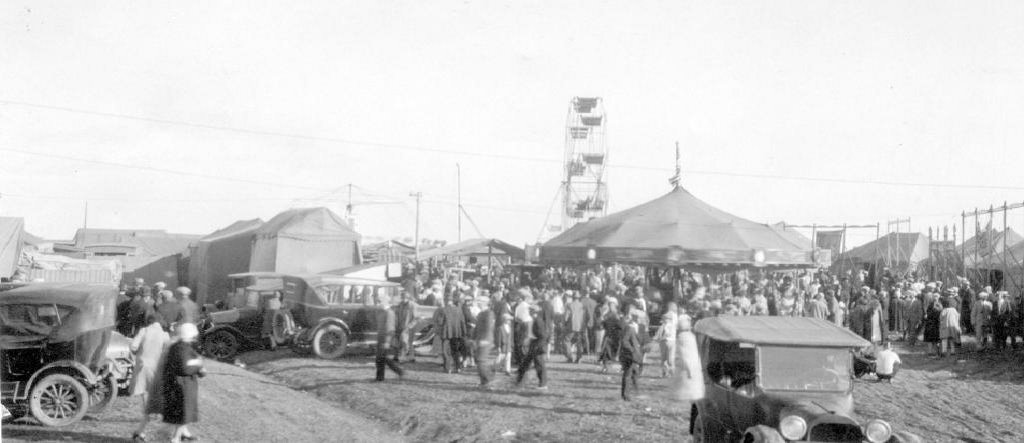
How many times did I walk through this midway? Sometimes with friends, sometimes alone. Sometimes in the day, and sometimes in the night with all the colored lights and the sense of danger. The carnies looked alien and exotic with their greasy hands and tattooed arms.

I never walked though it when it looked like this, however. This is a photograph of the Kittson County Fair's midway in 1926.

Sunday, May 22, 2011

Mike's Memories: Town Ball

After the First World War, Manitoba became a preferred destination for barnstorming  ball teams from the United States. All professionals, these American teams would roll through towns and villages throughout the province playing local amateur and semi-pro squads and often, the barnstormers got themselves whupped.

From:  Home Run

My earliest memories were going to baseball games on hot summer evenings. My home town of Humboldt, Minnesota had first rate baseball teams in the 1920s and 1930s. The entire town would follow the town ball team.

The early teams featured the Diamond brothers: Levi, Herb, and Ikey. Lomas Matthews was another legendary track star and baseball player who hailed from Humboldt. Happy Chandler, later to become the baseball commissioner and Senator from Kentucky played one summer for Humboldt.

Another early legendary player from the Humboldt team was Cal Farley who, like most of the other ball players on the 1910 team, was also interested in track and wrestling and went on to form Cal Farley's Boys Ranch in Texas. The U.S. Government honored him by printing a U.S. stamp named for him. The 1920 team also shows many of the players.

During the late 1940s and early 1950s, Humboldt had an excellent travelling team.

My Dad played first base and my Uncle Burton Turner was a pitcher. Burton's father, Ernest Turner, was a legendary pitcher. Many of the stories of early Humboldt baseball are well documented on this web site.

Who was the greatest player in Kittson County History? Some might say Ernie Turner, Happy Chandler, the Diamond boys, or Clarence Beck. [Note from Trish:  And don't forget Eli Gooselaw...] We don't have videos and it is impossible to compare players across generations. My candidate for player of the Millennium for the County is Humboldt's own native son, Scott Matthew.