Showing posts sorted by date for query St. Vincent Fair. Sort by relevance Show all posts

Tuesday, March 30, 2021

Reid: Bonanza Farmer & St. Vincent Booster


"...With the rapid movement of railroad building into the northern part of the valley, the opening of large farms continued unabated. By 1885 nearly all of the original large farms had been established. The J. J. Hill farm of nearly a township [in size], in Kittson county, is probably the nearest to the International boundary. The Reid farm in the same county is another in point."  [Note: ...and in fact, it was Reid farm that was the nearest to the boundary!]

- Collections of the State Historical Society of North Dakota, Volume III, Tribune, State Printers and Binders, 1910, Page 581
Why did Robert Gillispie Reid invest in land, let alone so much land - 10 sections - in our area?  I did a bit of digging.  Robert married Harriet Duff in 1865 after they met on onboard a ship heading to New Zealand.  Twenty years later, Harriet's relative, David Duff and his family, emigrated from Scotland, finding their way to St. Vincent.  David worked at Reid farm as the foreman (he was kicked in the chest by a horse towards the end of his life; it didn't kill him, but he never fully recovered his health, passing away in 1892 - He was 45 years old...)  Right around that time is when Robert bought up the 10 sections in St. Vincent Township.  I think he did it as an astute investment, with an eye to helping  family.  Upon Robert's death in 1908, it was found that in his will, he had left a quarter section of Reid Farm to David's son, his nephew John Duff.  


https://www.kittsonarea.com/2021/02/12/historical-photo-leads-to-interesting-local-farm-history/ https://www.kittsonarea.com/2021/02/12/historical-photo-leads-to-interesting-local-farm-history/
The 10 sections of land that Sir Robert Reid bought  in 1885  became known as  "Reid Farm".  Along with J.J. Hill's Northcote and Humboldt farms, it was one of Kittson County's early 'bonanza farms', and employed many local people.   

The first manager of Reid Farm was Captain Donaldson.  Then David McCleary.  Next, Walter J.S. Traill managed the farm for Reid.1  The last managers were brothers John & George Lohrs.


The 1901 Townships Map (see below)  showed Reid owning 10 sections in St. Vincent Township, bought originally on June 25, 1885 and owned by Reid until his death - in 1909 the estate divested itself of the rest of the property not given to John Duff.


At Right:  Reid Hall, named in honor of
Sir Robert, was St. Vincent's town hall.
[Seen here during fair time, to house exhibitions...]


1 - Sources:  Kittson County Recorder (original handwritten land deed - excerpt regarding partnership between Reid and Traill, above), and 1901 St. Vincent Township Map.

Saturday, March 14, 2020

St. Vincent Union Industrial Association Fairs

In Minnesota fairs are older than the state itself, having "made their appearance ... in the early 1850's," just at the zenith of the golden age of such institutions in the United States. Compared with later exhibitions the early fairs were primitive indeed, yet they more than justified their existence. They gave the isolated pioneer farmer a chance to meet his fellows, to have a good time; and by showing him late developments in machinery, fine livestock, and new techniques in farming, they gave him an incentive to improve his own farming. - From a talk called, "Early Minnesota Agricultural Societies & Fairs," presented at the Minnesota Historical Society's annual convention, held July 26, 1941.

Walter John Strickland Traill

The first day of the St. Vincent Union Industrial Association Fair was favored with good weather.  

The native pony race was won by Jim, Shylock second, Kate third.  The trotting race was won by Julia, Dan second, Topsey third.  

The judges were Walter J.S. Traill, C.C. Law, and D. Livingstone (The St. Paul Daily Globe, October 10, 1889).


1918 Fair Results-War Gardens
1906 Fair Dates - Always late
Fall, for these local fairs . . .


...and these early fairs, are what were the seeds of our county fairs of today, including the Kittson County Fair in Hallock!


Saturday, September 29, 2018

Union Family


Lena Cameron Mortimer was born into a farming family in St. Vincent, Minnesota.  She became a Socialist Party activist and married the Journeyman Tailors Union of America (JTUA) union leader, John Mortimer in Winnipeg in 1901.  They had several children before he drowned crossing the Red River near Emerson, Manitoba in an accident, in 1908.


LENA MORTIMER:  One Woman's Way of Thinking

As I passed out through the crowd as it was dispersing on Sunday evening after the meeting at which Comrades Pettipiece and Fitzgerald were speaking on the Woman question, I chanced to hear a few remarks from some of the men that had been present at the meeting which struck me as rather amusing.  One of the worthy bunch said in a rather sneering way:  "What!  Give the women a vote?  Not much, their place is stay at home and minding their business, let us men do all the voting." 
To me, of course, it was the same old yarn.  I have heard it so often that I cannot keep silent any longer.  Some of the men do not stop long enough to think just what a very important part a woman does fill in this life.  If we women are fit to be mothers of their children; fit to teach those same children in the schools, and fit to fill most every position in life, then by all that's good and holy we are able to stand shoulder to shoulder with our noble brothers and cast our vote along with them for the one great cause for which we are both fighting, the only cause that will benefit the working men and women of today. 
"Men say that we women do not have sense enough to vote the right way.  Ditto, my brother!  Could we possibly make it any worse than you have made it by your way of voting?"
Men say that we women do not have sense enough to vote the right way.  Ditto, my brother!  Could we possibly make it any worse than you have made it by your way of voting?  Give the woman a chance.  Let her once grasp the situation and see if she won't vote right.  Treat her as an equal and try to help her get hold of a few socialistic ideals.  Help her to see what it all means.  Give her as fair a chance as you would give a man and you will find out that she can grasp the truth just as quick as any man. 
I believe it is up to every woman in...any place on top of this old earth, to get busy, and dig down and find out for herself just where she is at and if some of the men turn up their noses at our feeble efforts, go to it with more heart than ever.  Prove to them that if given a chance we can at least use our vote to as good advantage as they have in the past.  We cannot make matters any worse than they are making them right now.  So go to it, my sisters.  Show them if we are fit to be mothers of the coming generation of Socialists we are fit to march to the ballot-box and vote the right way just as soon as you men give us a chance.  And fit to share equally with you all the comforts that Socialism will bring when the men as well as the women get into their heads sense enough to vote the right way to hasten its coming. 
[Source:  Lena Mortimer, "One Woman's Way of Thinking," Western Clarion (Vancouver, BC), 27 May 1911.]

Thursday, February 02, 2017

StVHS Sports: 1927/28

Vintage St. Vincent High School pennant from 1920s

[Guest article by Michael Rustad, originally from nearby Humboldt, MN]

In the summer of 1999, my daughter Erica and I visited the town of St. Vincent.

There is no longer a bridge connecting the central business districts of Pembina, North Dakota and St. Vincent. The old bridge connecting the towns that I remember as a child has long been dismantled. The places that I remember in St. Vincent have long since closed. Short's Cafe, Sylvester's Store, the Curling Rink, St. Ann's Catholic Church, and the St. Vincent Fairgrounds. The curling rink is now neglected and in state of decay. The Church is a private residence. The St. Vincent School, too, is in a state of benign neglect. The school is in disrepair and the fire escape slide detached.

It was difficult for me to explain to my daughter that St. Vincent was once a bustling community. We attended catechism each summer in the basement of St. Ann's Catholic Church. We had a large number of ball games in the yard outside the church which is now overgrown and marred by abandoned cars. When my sister and I visited the Kittson County Museum in Lake Bronson, I was amazed to find some high school yearbooks [called Borderlines] from St. Vincent High School. St. Vincent High School closed in the late 1930s and never reopened. Instead, it eventually consolidated its school district with Humboldt from 1957 to 1991.
[Note from Trish:  In-between StVHS closing and St. Vincent consolidating with Humboldt, students had the choice of attending Pembina High School, or other schools in Kittson County like Hallock...]
It was an unexpected joy to find yearbooks from the St. Vincent High School from the 1920s. This was a yearbook from a small town in NW Minnesota prior to the Depression. High school life in St. Vincent was marked by lots of school spirit judging from the many activities. St. Vincent fielded a football team, basketball team, hockey team, track team and baseball team in [school year] 1927/28.

"If you could walk or run, you were in the starting line-up."

Sunday, November 27, 2016

Mrs. Roberts Wins History Award

"An annual award, History Educator Hall of Fame is presented to the teachers, one in each county, who are the most effective in teaching history of the region..."
- Education Manitoba - Volume 2 by Eileen Pruden (1975)

Mrs. Martha Marie (Beck) Roberts,
was the recipient of the first annual
Red River Valley History Educator
 Hall of Fame Award
, 1972
[for Kittson County...]
Among the Red River Valley Historical Society's many projects over the years was establishment of liaisons between various historical organizations, educational institutions and individuals, and sponsoring a high school historical essay contest...

[From Red River Valley Historical Society Records collection at The Institute for Regional Studies (NDSU)]

The contest began as the “Historical Research Essay Contest" in 1965.  It was sponsored in the schools of the Red River Valley of Minnesota, North Dakota and Manitoba.

In a letter regarding the 1968 contest the stated purpose was:
“A. To alert youth of the Red River Valley to the wonders of its rich pioneer heritage; 
B. To acquaint our youth, through interviews and other research, with the fascinating lives of those who developed the Red River Valley;
C. To encourage scholarly research and writing among our high school students; and
D. To record matters of historical interest for the benefit of future generations.” 
Most years a specific theme was chosen by the society. In 1966 and 1967 it was biographies of local pioneers or places of historic interest, and in 1968 an artifact of historical interest was added.

In 1965 only four essays were submitted, but quickly grew to well over 100 a year. The first place award the first year went to Theresa Scholand of Mount St. Benedict Academy, Crookston, Minn. The 1966 winner, Rebecca Hole, was the first to be published in the society’s periodical, the Red River Valley Historian. Later years they established winners in junior high and senior high categories Future winners were published in issues of the Historian, succeeded by its Red River Valley Heritage Press. Essay contests continued into the 1990s with submissions after 1987 retained by the Red River Valley Heritage Society at their offices at the Heritage Hjemkomst Interpretive Center in Moorhead, MN.

[From Red River Valley Heritage Society Essay Contest Entries, 1965-1987 collection, Institute for Regional Studies & University Archives, NDSU) Collection number: Mss 5, 44, 69, & 252]

Dennis Matthews
[Senior Portrait 1944]
The inimitable, amazing, Mrs. Roberts. She was a memorable teacher in the best sense of the word. She expected the best and thus propelled you to give your best, time after time. For some of us, with her reputation proceeding her, we arrived in her classroom intimidated. For those that gave her a chance, they found out she was tough but fair. She was definitely...unforgettable.

It was Mrs. Roberts who promoted and inspired the students in her school in Humboldt, Minnesota, to find and preserve their local history via the Historical Essay program.

A portion of all the essays written for this contest - those written by Humboldt-St. Vincent High School students - were preserved by Dennis Matthews on the RED RIVER VALLEY website.

Monday, July 14, 2014

Water Cooler IV: Short's Cafe Memories

Circa the late 1940s/early 1950s @ the Short's Cafe...

'The food is not Stranger and we are never Short on customers'

Not long ago, Cleo Bee Jones' photo taken of Short's Cafe not long before it was torn down, triggered a thread on Facebook; in this thread, people shared their memories of Short's Cafe in St. Vincent...

Cleo Bee Jones I took this picture [NOTE:  See Cleo's photo at bottom of this post] of Short's Cafe when I was in the area singing at the Hallock Fair one year...

Deborah Kopylov It's strange to see this old place and that sidewalk knowing that years ago I walked that sidewalk and went into that Cafe that had so much life!!

Trish Short Lewis ‎Deb, I know what you mean. It sure brings home the passage of time as it relates to one's own life...

Eliza "Liza" Stranger Short
James McC Ah, yes...I have many memories of this building. Known affectionately as simply "Ma Short's".

Margie L. White I had my first orange soda float at Ma Short's. What a treat that was!

Cleo Bee Jones I always feel nostalgic when I see this pic, taken the night before I last sang at the Hallock fair...I was at my Aunt Ruby's and walked down by there with my camera in hand and glad that I did.

Trish Short Lewis I'm very glad you did it also, Cleo. It's just a memory now...

Saturday, May 11, 2013

Mike Rustad: County Fair Memories


Ah, the perceptions of youth!  In this reminiscence, Mike Rustad takes us back to the Kittson County Fair of a generation ago.  If you're like me, it will resonate strongly with your own memories of that time and place...

I looked forward to the the Kittson County Fair each summer. I enjoyed the rides as well as the carnival. My brother Tony and I collected pop bottles to save for the Fair. We would frequently have 4-H exhibits at the Fair. I remember once we were on a Tilt-a-Whirl (or similar ride) and Tony got sick on the ride. The operator of the ride was a crude man with a number of tattoos including something like "Born Loser." In any case, he would not let us leave until we cleaned up the ride. Since Tony was in no condition to help, it was left up to me. As farm boys, we were somewhat intimidated by the carnival workers. It was quite common for the carnival games to be rigged. I think that we would lose only a $1 or so on these games but they were cheap tuition. I think that the Fair illustrated the seedy side of society as well as the best.

The Fair was like the Tale of Two Cities: the best of times and the worst of times. One of the worst moments was experienced by my Mother. In an essay she wrote for the Scribe Tribe1, she recounted how she placed her glasses case dutifully beside the hole.The case was cylinder shape and began rolling toward the hole because apparently the toilet was not level. In her haste to grab it, the clasp came open. Her glasses and keys went down the the dark smelly abyss. She was embarrassed but decided to take action. She found the Fair Manager and asked him for a flashlight and a shovel. The Manager asked her what she wanted them for. She was stopped numerous times by friends asking what she was doing with the shovel and flashlight. She dragged the odorous privy for a long time without success. For years after the episode, she was asked about how she got home without her glasses and car keys. For my Mother, this was the worst of times. 
The Fair was also the best of times. The lights of the rides were beautiful. For many years the Fair was not complete without a tremendous thunder storm and sometimes funnel clouds in the area. Later, a tornado destroyed the Fair Grandstand only a short time after it was filled to capacity. The severe weather conditions and the lights brought an indescribable excitement to the Fair. The 4-H exhibit hall was a favorite place. I always took time to look at every exhibit. I always wondered how I could never get beyond a red ribbon for my vegetables and insect collection. There were a number of local merchants who had exhibits. One of the highlights of the Fair was when the car dealer would give away a car and also bicycles. I never won but the anticipation of winning such a prize was greater than Publisher's Clearing House. 
My favorite place to eat at the fair was the Larson Family Stand which made the best hamburgers and generally had the best food at the Fair. Joyce Baldwin from Humboldt was a Larson and so many of the Baldwin kids helped out at the "Larson" food stand. Each of the 4-H clubs had special exhibits which depicted our activities for the year. I belonged to the "Stick-To-It" Club which was one of the oldest Kittson County Clubs. We had very good adult supervision. The Gatheridges, Baldwins, Bahrs, Wieses, Diamonds, Clows and many other families were active in the club. I remember that the older kids in the club were very helpful to the younger ones in exhibiting their products. Dennis Diamond was one of those older kids who was always helpful to Scott Clow and I who also showed sheep. Another memory I have is a 4-H parade through Hallock. A very pretty young lady asked me to help control her very large and unruly 4-H calf. I managed to keep the calf from stampeding through the streets of Hallock, but still received only a white ribbon. I can still remember the smell of those hamburgers at the Larson family stand. I hope that other former Kittson County residents will contribute their memories of the Fair and of their "Wonder Years." 
1 - The Scribe Tribe began as a continuing education course in 1966.  The writing class morphed into a club with meetings in homes. These were more than social events - everyone in the club felt a great social pressure to produce writing. It was Dotty Boatz who first suggested that a writing course taught at Humboldt-St. Vincent High School continue on as a club and she was one of the most active members. The Scribe Tribe proved to be a huge success, and Gloria Swanson and Virginia Ott ended up writing a very interesting book on Fred Jones, who was an innovative handyman and inventor who lived in Hallock for many years. The title of the book was Man With a Million Ideas: Fred Jones, Genius/Inventor.

Thursday, April 04, 2013

Mrs. Rasche & the St. Vincent March

Example of another March
written by Mrs. Rasche

[Source:  Library of Congress]


I put to you, dear Reader, a St. Vincent MYSTERY to solve!

Published in the St. Vincent New Era in 1890, is the following news:
Mrs. Rasche, the celebrated Musical composer done St. Vincent the honor of composing a march, entitled "The St. Vincent March" as a souvenir of the Fair of 18901, and done the editor of the ERA the honor of dedicating it to him for which favors St. Vincent and us are enthusiastically grateful.
As you can imagine, to read that an actual musical composition was written for and about St. Vincent is an exciting and unexpected discovery in my ongoing research about my hometown.  Who was this Mrs. Rasche?  Why did she feel compelled to write the piece for this event?  Was the 'Fair of 1890' a special fair moreso than other years?  It is possible that she was just helping the town by being so civic-minded.  It was still trying to grow.  All we have is speculation - I would like to find out the story behind the story!2


What we have found out so far:

Sunday, February 24, 2013

Past Resident Memories: John Stranger

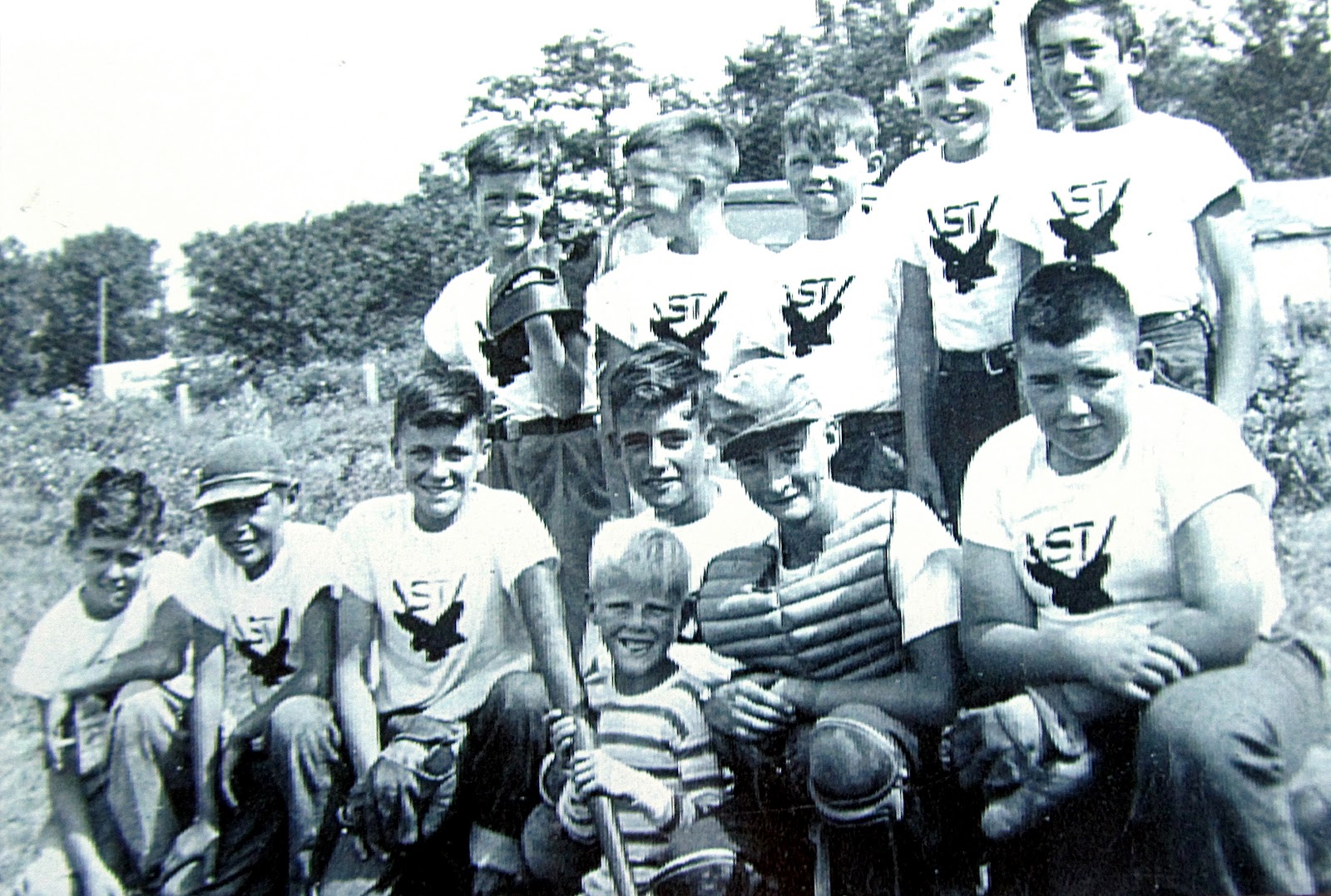
John Stranger - Back row, middle


A MEMOIR OF A LIFE, FOR BETTER OR WORSE
By John A. Stranger

CHAPTER ONE
Beginnings

This all begins in a small town in Minnesota during the 40's when growing up was a struggle without all the things a boy wants and dreams about. Outdoor toilets and dressing behind the oil burner turned up full blast where my brother (4 yrs. Younger) and I learned to dress very fast during the cold Minnesota winters.

My brother was a great kid even though we would have our brotherly confrontations. We had a younger sister too and she learned to hold her own with us boys. Our parents were very strict on almost everything that they thought was for our best interests even though we tried to disagree with our parents at times but trying to obey seemed better than a beating, (most we probably had coming).

Tuesday, September 25, 2012

Profile: Velma Isley

This is a memory of Margaret Matthew Patzer about the St. Vincent Fair around 1928. Margaret is referring to Velma McCrystal Isely who was a great teacher and a wonderful person. Velma Isely was the Mother of John (Class of '63) and Elizabeth (Class of '57). She was a woman of great intelligence and compassion. I remember her silencing a group of bullies harrassing a mentally retarded girl with her great moral compass. I think I learned so much about social justice when she stood up for the weak and oppressed that summer day in 1957. I think that I was so impressed by Velma Isely's strong sense of ethics and she was a profile in courage. I have tried always to follow her example in being an advocate for the consumer in my work in law.

- Michael L. Rustad
My cousin transported my pet lamb along with some of his animals to the St. Vincent Fair. The afternoon I was to show my lamb, I convinced a friend to skip afternoon school with me and find a ride to St. Vincent so I could show my lamb. As we entered the gate Velma the lady in charge of registration and who knew me asked what I was doing there on a school day. When I said "to show my lamb" she said it was not registered so she registered it immediately. When it was time for me to show my pet lamb I found us moving closer to the front and finally in first place! I had won a trip to the St. Paul State Fair. When I left later that year my dad emptied his wallet to give me money to help buy food while there (this was about 1933 at the peak of depression) and I felt badly that he had to give me the only money he had.

- Margaret Matthew Patzer
Mrs. Isley was the wife to the agent at the depot in Noyes where my Dad worked. She was also my Kindergarten teacher.

The things I remember about Kindergarten are:

- Mrs. Isley singing Button Up Your Overcoat and encouraging us to sing along

- Learning the letter U's "short" sound - she taught us by using the example of what happened when you tried to lift a bucket full of sand - "...ugh" She had me demonstrate it in front of the class.

Sunday, July 08, 2012

Memories: Alan E. Wilwand

As a youngster growing up in Pembina, I had a second town - St. Vincent.

Wallace & Matilda Cameron's
Home during 1950 flood

[Photo:  Turner Family Collection]
My grandparents, Wallace and Matilda Cameron lived there.  I was crossing that old Red River bridge whenever I got the chance.  I loved my grandparents.  Grandma made the greatest date-filled cookies!  The house where they lived was north of Short's Cafe.  The house is gone now, but the memories linger on.  My grandmother was a seamstress and speculator.  She gave me the deeds to about half of the places that she had bought in St. Vincent.  Who knows?  I may own half of the town!

After WW II, my Uncle Ralph (Ike) Cameron worked at Short's Cafe.  He would give me those double ice cream cones, one side vanilla and the other cohcolate or strawberry, heaping the helpings.  Ma Short was taking a big loss on ice cream with those!

If walls could talk:  the
St. Vincent jail today...
I remember so many things about St. Vincent.  My Grandfather was the town constable.  I believe the old jail is still standing.  He gave me the big lock and key for it.  He also gave me the pair of handcuffs that he used.  I donated his daily log that he carried in his breast pocket, to the Kittson County Museum in Lake Bronson.  That diary saved his life the time that he was shot.  I believe the museum also has one of my paintings that I did of the old fire hall.  I remember the fire hall well.  This is where he set up his office once in awhile.  The depot that was established in 1878 was close by.  My grandparents' big barn floated down the Red River in the flood of 1948.

Sunday, March 04, 2012

Interview: Beth Lapp

Elizabeth Lapp in 1948
[Courtesy:  Digital Archive, UMC] 
Thanks to Kristine Baldwin Ohmann, who facilitated our get together, I interviewed one of the oldest living natives (and a resident) of St. Vincent last weekend.

Elizabeth Lapp, better known as Beth, was raised in St. Vincent.  Her parents, Richard (Dick) and Lillian Lapp, met in 1926 when her mother came to town to teach at the school. Dick's parents were early settlers of St. Vincent, arriving in 1879 from Canada.

I share with you here the interview in its entirety, as it happened.  As you will read, there are a lot of clues for further stories, which I intend to explore in future posts...

1. Her earliest memory is of getting ill and vomiting on her workbook at school. In those days, you only got one workbook to use for your schoolwork, so she was mortified. She was sitting near chalkboard at the time. Her teacher was Miss Penovich.

2. Some of her other teachers were: Elaine Bergh, Gunda Hanson, Mrs. Isley, and Mrs. Monte(gue) Clinton.

3. The year she had Mrs. Clinton, “we didn’t learn anything”. Math and Science were "sacrificed for art". All she remembers is Mrs. Clinton having the class place chairs facing west and looking out towards Christ Church and drawing what they saw…

4. When it came time to go to high school, students during her time had three choices: Hallock, Pembina, or Crookston. Hallock and Pembina were public school (free) while Crookston was a boarding school and charged tuition. This was during the 1940’s and into the 1950’s.

Northwest School of Agriculture Crookston MN
[Photo Courtesy Digital Archive, UMC]
5. Crookston was called the ‘Ag School’. It's actual name was the Northwest School of Agriculture.  Several area natives attended it, including Beth and her siblings.

Wednesday, December 14, 2011

News from the Past: St. Vincent New Era

Rev. Beer did his best to nurture the small church in St. Vincent;
He later went on to start missions in far off Alaska...
March 28, 1890 News Snippets

There has been a butter famine at St. Vincent lately...Water is accumulating on the sides of the Red River...The carpenters are altering part of the station to make it into a residence for Agent Grasse and family...Rector Beer gave a dinner party on Monday evening to several friends who met Professor Hazen before his departure for Washington.
________________

June 28, 1890 News

As neither Hallock, Northcote, Humboldt, or Pembina is celebrating the glorious 4th, the people of St. Vincent determined to do so. Kennedy on the South and St. Vincent on the North ends of the county will take care of all their neighbors and in friendly rivalry will endeavor to surpass each other in a hearty welcome to all visits, and will extend a "Highland" welcome to their friends on that day.

The St. Vincent Council appropriated a liberal sum and a most excellent committee has charge of the days sports, whose names are a guarantee that fair treatment will be accorded to all competitors and that nothing will be left undone to make the day a pleasant holiday.

The merchants and citizens intend to decorate the front of their stores and residences with trees, flowers and bunting, thus adding to the natural beauty of the loveliest village in the Northwest, and at night the two large rooms of the District School House will be used to dance in.
________________

July 25, 1890 News

Mayor E.M. Nixon and other influential Pembina citizens are proposing to build a pontoon bridge across the Red River and make it a free bridge. It is a good scheme and should be encouraged.

First Bridge:  Pontoon Bridge looking east towards St. Vincent...
________________

December 26, 1930 Ads

"The Unholy Three" - Hear Lon Chaney Talk, also two reel comedy at the Grand Theatre, Hallock, Thursday and Saturday, Jan 1-3, Admission 15, 25, and 40 cents.

If you don't happen to have the cash to send in on your subscription, remember we will take chickens, turkeys, pork, beef, eggs, butter, or stove wood in exchange. These articles cost money and they are as good as cash to us, but don't forget it - Let's hear from you, at once.

Thursday, September 01, 2011

Triggered Memories

I received an email from Michael Rustad saying my recent post about P.N. Tri brought back some memories of his own, and that he hoped those reading the posts here will share with me any such triggered memories they may have.  That's always been one of my hopes, that people reading these memories and histories, will share their own memories and histories of this little corner of the world.
PN Tri was a major figure in the history of Humboldt and St. Vincent.  I did not know that he was the first advisor to the Humboldt Stick to It Club. 
"Incoming!"
I belonged to the Stick to It Club and it was one of the best 4H clubs in N.W. Minnesota.  We had great leadership.  Marian Anderson from Humboldt won the state 4H dress making competition and was crowned at the State Farm.  Dennis Diamond was a consistent State Farm prize winner.  We had so many innovative parent and teacher advisors over the years.  Earl and Beatrice Bahr helped us immensely when they built our equivalent of the Diamond of Dreams on their farm.  Earl mowed a field so we could practice for our 4H softball team.  The year was 1965 and Humboldt's Stick to It 4H club was a powerhouse softball team.  It was boys and girls who played.  Dee Dee Diamond played on that team on the girl's side.  My brother Tony and I were the stars of the team.  We were the home run hitters, the ringers of the team.  Tony and I practiced softball daily.  We would pitch to each other and invented a game.  A home run was when we hit it over the barn with a towering drive.  A double was a hit into the chicken wire.  The chickens soon learned that they were to go in the barn when we played. We never hit a single chicken despite many hits into the chicken's yard.

Friday, August 26, 2011

Breadcrumbs of a Life: P.N. Tri

From 1920 "Farm Boys & Girls Leader".
Organized in 1919, it was the start of what
would be known as the the 4-H club of the
same name.  It's fun to read the origin of
the club, and the meaning of the name...

I was recently told that "...P.N. Tri was a world renowned beekeeper and featured in apiary magazines. They shipped honey all over the world!"1 Well, of course that meant I had to see what I could find out.

The online record is slim, but I did find one article where P.N. Tri was quoted as wintering his bees in a potato cellar!  Not much to go on, but interesting...

According to the Red River Valley website, P.N. Tri, or Peter Nicholas Tri, came to St. Vincent in 1915 to be Superintendent of Schools.

Later he worked at the Humboldt School, as you can see in the magazine article clipping at left.  In this 1920 article, the St. Vincent Fair is referred to as the 'county fair'.  I have never been clear if it was officially the county fair at one time or not, but this is one occasion where it appears it may have been...


1 - The little birdie's name was Michael Rustad...

Sunday, July 31, 2011

Fading Away

Population 6...plus two big dogs
[Photo: Ghosts of Minnesota]
There are towns even smaller than St. Vincent, but not many.

One of them is Tenney, Minnesota.

Tenney recently dissolved, meaning they are no longer a town.  I can't help but realize that it's only a matter of time before St. Vincent has to face that decision.

When I was growing up, St. Vincent had around 200 people.  It was already in its descendency, a shadow of what it once was.  But there were hints of its glory days, such as the sidewalks - some sections had been maintained well, others were disappearing under encroaching soil and grass.  We still had a general store, a gas station (two, when counting the Junction), a post office, a school, and four churches (St. Anne's Catholic Church, Valley Community Church - later known as St. Vincent Evangelical Free Church - Christ Church, and the Plymouth Brethren Church.  We also still held an annual fall event, the St. Vincent Fair (which was at one time, vying to be the county fair.  Despite Hallock prevailing, St. Vincent continued their fair tradition for many years, and people from around the area continued to enter their produce, livestock, hand work, and baked goods in friendly (but deadly serious) competition!

But I digress.  The point here is, all of that is long gone.  It echos in my mind how my mother and grandmother used to talk wistfully about what the town used to be like, all the life of the town now gone, they said - businesses, families, parks, public concerts and socials.  They pointed out here was where a saloon was, there was where the blacksmith's shop was.  Across the road by that alley - which was actually the old railroad track bed - was where the depot used to be.  On a trip with my father to the nuisance ground, my mother told me that was where the park used to be, and there was a gazebo there, where town brass bands would play on Sunday afternoons.  The fair itself used to be down by the river once, too, but later was held in the downtown.  Exhibits were in the Quonset, near the old temporary holding pens once used by the railroad for livestock, now used for sheep, hogs, etc. at fair time.

Now there are only around 60 souls.  Every block has vacancies, empty space where once stood homes and businesses, where circumstances have, like a cancer, dictated surgical removals.  Natives like myself can walk the streets, seeing and hearing what once was.  Like ghosts bearing witness, it is all too real.  The poignancy is very bittersweet.  I once saw a movie that hit all too close to home, and it made me think how my hometown was headed in that same direction.

Most people don't face a death in the family involving their hometown, but that is how it feels to me.  St. Vincent has never just been where I'm from, it's my family.  All those souls from the past, that I grew up with, related by blood or by just being neighbors, were not merely faces and names to me, but family.  I miss them all, and their memories will never fade from my mind as long as I am alive.  This blog is testimony to them as much as I am able to make it...

Sunday, May 22, 2011

Mike's Memories: Town Ball

After the First World War, Manitoba became a preferred destination for barnstorming  ball teams from the United States. All professionals, these American teams would roll through towns and villages throughout the province playing local amateur and semi-pro squads and often, the barnstormers got themselves whupped.

From:  Home Run

My earliest memories were going to baseball games on hot summer evenings. My home town of Humboldt, Minnesota had first rate baseball teams in the 1920s and 1930s. The entire town would follow the town ball team.

The early teams featured the Diamond brothers: Levi, Herb, and Ikey. Lomas Matthews was another legendary track star and baseball player who hailed from Humboldt. Happy Chandler, later to become the baseball commissioner and Senator from Kentucky played one summer for Humboldt.

Another early legendary player from the Humboldt team was Cal Farley who, like most of the other ball players on the 1910 team, was also interested in track and wrestling and went on to form Cal Farley's Boys Ranch in Texas. The U.S. Government honored him by printing a U.S. stamp named for him. The 1920 team also shows many of the players.

During the late 1940s and early 1950s, Humboldt had an excellent travelling team.

My Dad played first base and my Uncle Burton Turner was a pitcher. Burton's father, Ernest Turner, was a legendary pitcher. Many of the stories of early Humboldt baseball are well documented on this web site.

Who was the greatest player in Kittson County History? Some might say Ernie Turner, Happy Chandler, the Diamond boys, or Clarence Beck. [Note from Trish:  And don't forget Eli Gooselaw...] We don't have videos and it is impossible to compare players across generations. My candidate for player of the Millennium for the County is Humboldt's own native son, Scott Matthew.

Monday, March 14, 2011

Letter to Rusty


The letter below was received by Alfred "Rusty" Rustad while he was in the service during WWII. It was written by a local representative of the Red Cross; the introduction is from an article that featured the letter, which appeared in the Kittson County Enterprise a few years ago. It paints a unique picture of his hometown area around Humboldt, capturing the people and events of that time...
Another View
by Rev. Hugh Bell
It's been almost one year since my last "View" so when I received a copy of this enclosed letter I thought it a most opportune time to catch up on correspondence in the Enterprise.
The enclosed letter was sent to Alfred Rustad, Jr. "Rusty" 60 years ago this month. For those of us old enough to remember WWII, we remember a time when just about everyone was in the same boat. It was a time of sacrifice and unbelievable hardship. It was also a time of great family support and great national support. Something that perhaps is lacking in the most recent of our wars including the present day battle in Iraq and Afghanistan. WWII was a time when the whole country pulled together for a common good. Today it seems as tho more energy is put into political rhetoric and profit seeking than into freedom in the Middle East. If we could just stop blaming others for our problems, wouldn't it be a wonderful world. Enough sermon, now to Rusty's letter.

Thursday, December 16, 2010

Salt

Once found in Minnesota, but
now is evidently extinct here...

In 1823, Mr. Keating noticed the Salt springs in Minnesota State and Dacotah Territory, far south of the boundary line.  Even at that early period in the history of the Settlements on Red River, five hundred dollars were cleared by one individual during one winter from the sale of the salt he had manufactured from springs near Pembina.  The price of salt in the Settlement was then six dollars per barrel weighing eighty pounds.  At a spring on Saline River, south of the boundary line, Major Long's party found the Salicornia herbacea growing very abundantly around it.  "Mr. Schweinitz states, on the authority of Mr. Nuttal, that this is the only inland locality of this plant, besides the Onondaga Salt Springs in the State of New York."

- From Report of the Exploration of the Country between Lake Superior and the Red River Settlement (1859)

Early in the exploration period of Minnesota, note was made of a potential bonanza.  It wasn't about gold, but...salt.1

Tuesday, February 02, 2010

Fan Mail II: "...that little town"

This blog generates its fair bit of fan mail, which is very gratifying. I love knowing that people read, enjoy, even learn from it - that's the whole reason I do this.

Today I received a note from someone who came into our area from the outside. She wasn't born there, and she didn't stay there, but while she was there, our communities made her feel very welcome. Anyone reading this from up home, I am SO proud of you guys! That so sounds like our people...
I just wanted to thank you for posting Dick Cleem pic and some history...I was married to his son John Cleem and we have a son Johnny Cleem...It was nice for him to find this bit of info.

I was good friends with Esther Cleem (Dick's wife)...As you know there was a lot of trouble in the Cleems and with the murder of Dick it all made life hard for the family. So it was really nice to see his pic with some history - wow.

I later married Gary Karol (St Vincent) and we live in Stephen Mn but I often think about St Vincent I did love that little town.

Thank you
Cindy Karol
I wrote her back to ask permission to publish her comments...
Thanks for the email..it was so neat to hear from you!

I grew up with the Karols in school, knew the whole family. At one point they lived in a house on main street by my Grandma's house, Elizabeth Fitzpatrick, the old Hughes' home.

Anyways, glad you enjoy the blog. I try to accomplish two things with it - first, to provide lots of real, factual history of our area, and second, to provide information, old or new, that current residents, or expatriates who like to keep in touch, will find fun and/or useful.

Would it be OK to post a quote of your comments?

(I am curious - did you grow up in the area also? what was your maiden name - should I know you?)
Her response:
I am [originally] from Winnipeg, my maiden name was Poulton . I was working in Emerson when I met John Cleem about 25 years ago back in the day people went over the border to buy milk or bread because nothing was open in Emerson. Little did I know that I would fall in love with the town of St Vincent and the people. I was married to John Cleem maybe 5 years and been married to Gary Karol for 12 yrs...There were a few years that I was a single Mom in St Vincent and a lot of people helped me from town like babysitting evenings because that was the only time I could get work (Happy Harry Duty Free) and then the Depot Restaurant both in Pembina. There was always help around the corner from rides to work to helping out at Christmas. Even at the hardware store back in the 80s this fellow taught me how replace the caulking around my windows and how install a new sink. I just thought that's how people were -boy, was I wrong LOL. I learned so much from the special breed of people that were there and still are...There was always droplets of love all over and home made soup, church goings-on , phone ringing up half the evening because it was storming out and they were worried about us (me and Johnny) to see if we made it home. Just so many things and caring and even to this day. Gary's Mom did died in that house on Main Street many years ago I think 14 yrs. When Gary and I got engaged Gary wanted me to move to Stephen so I did and I must say I will always miss the little town called St Vincent
You're not the only one, Cindy, you're not the only one...