Showing posts sorted by relevance for query hallock fair. Sort by date Show all posts

Saturday, May 11, 2013

Mike Rustad: County Fair Memories


Ah, the perceptions of youth!  In this reminiscence, Mike Rustad takes us back to the Kittson County Fair of a generation ago.  If you're like me, it will resonate strongly with your own memories of that time and place...

I looked forward to the the Kittson County Fair each summer. I enjoyed the rides as well as the carnival. My brother Tony and I collected pop bottles to save for the Fair. We would frequently have 4-H exhibits at the Fair. I remember once we were on a Tilt-a-Whirl (or similar ride) and Tony got sick on the ride. The operator of the ride was a crude man with a number of tattoos including something like "Born Loser." In any case, he would not let us leave until we cleaned up the ride. Since Tony was in no condition to help, it was left up to me. As farm boys, we were somewhat intimidated by the carnival workers. It was quite common for the carnival games to be rigged. I think that we would lose only a $1 or so on these games but they were cheap tuition. I think that the Fair illustrated the seedy side of society as well as the best.

The Fair was like the Tale of Two Cities: the best of times and the worst of times. One of the worst moments was experienced by my Mother. In an essay she wrote for the Scribe Tribe1, she recounted how she placed her glasses case dutifully beside the hole.The case was cylinder shape and began rolling toward the hole because apparently the toilet was not level. In her haste to grab it, the clasp came open. Her glasses and keys went down the the dark smelly abyss. She was embarrassed but decided to take action. She found the Fair Manager and asked him for a flashlight and a shovel. The Manager asked her what she wanted them for. She was stopped numerous times by friends asking what she was doing with the shovel and flashlight. She dragged the odorous privy for a long time without success. For years after the episode, she was asked about how she got home without her glasses and car keys. For my Mother, this was the worst of times. 
The Fair was also the best of times. The lights of the rides were beautiful. For many years the Fair was not complete without a tremendous thunder storm and sometimes funnel clouds in the area. Later, a tornado destroyed the Fair Grandstand only a short time after it was filled to capacity. The severe weather conditions and the lights brought an indescribable excitement to the Fair. The 4-H exhibit hall was a favorite place. I always took time to look at every exhibit. I always wondered how I could never get beyond a red ribbon for my vegetables and insect collection. There were a number of local merchants who had exhibits. One of the highlights of the Fair was when the car dealer would give away a car and also bicycles. I never won but the anticipation of winning such a prize was greater than Publisher's Clearing House. 
My favorite place to eat at the fair was the Larson Family Stand which made the best hamburgers and generally had the best food at the Fair. Joyce Baldwin from Humboldt was a Larson and so many of the Baldwin kids helped out at the "Larson" food stand. Each of the 4-H clubs had special exhibits which depicted our activities for the year. I belonged to the "Stick-To-It" Club which was one of the oldest Kittson County Clubs. We had very good adult supervision. The Gatheridges, Baldwins, Bahrs, Wieses, Diamonds, Clows and many other families were active in the club. I remember that the older kids in the club were very helpful to the younger ones in exhibiting their products. Dennis Diamond was one of those older kids who was always helpful to Scott Clow and I who also showed sheep. Another memory I have is a 4-H parade through Hallock. A very pretty young lady asked me to help control her very large and unruly 4-H calf. I managed to keep the calf from stampeding through the streets of Hallock, but still received only a white ribbon. I can still remember the smell of those hamburgers at the Larson family stand. I hope that other former Kittson County residents will contribute their memories of the Fair and of their "Wonder Years." 
1 - The Scribe Tribe began as a continuing education course in 1966.  The writing class morphed into a club with meetings in homes. These were more than social events - everyone in the club felt a great social pressure to produce writing. It was Dotty Boatz who first suggested that a writing course taught at Humboldt-St. Vincent High School continue on as a club and she was one of the most active members. The Scribe Tribe proved to be a huge success, and Gloria Swanson and Virginia Ott ended up writing a very interesting book on Fred Jones, who was an innovative handyman and inventor who lived in Hallock for many years. The title of the book was Man With a Million Ideas: Fred Jones, Genius/Inventor.

Thursday, June 19, 2008

Hamilton Fair Loses Carnival

Pembina County Fair - Hamilton, ND
Photo by:  Bruce Wendt
When I was growing up in St. Vincent, we attended the Kittson County Fair in Hallock, and the St. Vincent fair itself in the fall, but we also looked forward to the Hamilton fair, with its harness racing. My Dad and I would attend the races together and have a grand old time cheering them on, Dad taking the opportunity of sharing about his father having seen the great Dan Patch in his time.

Now things are winding down, sadly. Populations grow smaller in the rural areas, and the results are that the fairs are slowly fading...

Hamilton, N.D. -- In the heyday of the Pembina County Fair, about two dozen carnival rides filled up the fairground midway. The Ferris Wheel. The Tilt-A-Whirl. The Octopus.

Neil Fleming saw it all in his 55 years as fair organizer: from food to farm animals, clown shows, girlie shows, freak shows.

"It was really something," he reminisces.

The aroma of funnel cakes, the barnyard odor of fattened farm animals, the resplendent beauty of fancy quilts will still exist at the three-day fair July 10-12. But for the first time in 115 years, there will be no carnival rides on the quarter-mile-long midway.

Thursday, November 16, 2006

The Rivalry

Lost to the mists of time (except for a few of us who were told about it, and remember...), is the rivalry between St. Vincent and Hallock. My Mom told me that it went way back, but didn't really explain why. But she made it plain there were hard feelings between many due to what was considered back-handedness and unfairness. One episode where such actions and feelings may well have come into play was in 1891, when...
...a group of citizens from St. Vincent, circulated a petition to move the county seat to St. Vincent, with a promise to build an $8,000 courthouse. The petition was dismissed by the county commissioners because of the "unauthorization of the circulation of the petition" and that they had no jurisdiction for this matter.
Another bone of contention between the two towns early on was the county fair. For some years, well into my own youth, both Hallock and St. Vincent ran fairs - Hallock in the summer, and St. Vincent in the fall. By that time, Hallock's fair was known as the county fair, but many in the area still were very loyal to St. Vincent's fair and religiously exhibited there. Towards the end, it was mostly a small-entry fair (vegetables, canned goods, needlework, 4-H club projects, etc.), but there was still a small stock barn and a few livestock shown. The big quonset hut, as we called it, housed the main exhibits, and across the alley road just a tad southeast was the barn, with the little trail by it cutting through the small woods that dissected the north side of town from the south side.

But enough rambling about the little things, at least for now. Memories of the layout of the town shall be for another time...

Sunday, May 22, 2011

Mike's Memories: Town Ball

After the First World War, Manitoba became a preferred destination for barnstorming  ball teams from the United States. All professionals, these American teams would roll through towns and villages throughout the province playing local amateur and semi-pro squads and often, the barnstormers got themselves whupped.

From:  Home Run

My earliest memories were going to baseball games on hot summer evenings. My home town of Humboldt, Minnesota had first rate baseball teams in the 1920s and 1930s. The entire town would follow the town ball team.

The early teams featured the Diamond brothers: Levi, Herb, and Ikey. Lomas Matthews was another legendary track star and baseball player who hailed from Humboldt. Happy Chandler, later to become the baseball commissioner and Senator from Kentucky played one summer for Humboldt.

Another early legendary player from the Humboldt team was Cal Farley who, like most of the other ball players on the 1910 team, was also interested in track and wrestling and went on to form Cal Farley's Boys Ranch in Texas. The U.S. Government honored him by printing a U.S. stamp named for him. The 1920 team also shows many of the players.

During the late 1940s and early 1950s, Humboldt had an excellent travelling team.

My Dad played first base and my Uncle Burton Turner was a pitcher. Burton's father, Ernest Turner, was a legendary pitcher. Many of the stories of early Humboldt baseball are well documented on this web site.

Who was the greatest player in Kittson County History? Some might say Ernie Turner, Happy Chandler, the Diamond boys, or Clarence Beck. [Note from Trish:  And don't forget Eli Gooselaw...] We don't have videos and it is impossible to compare players across generations. My candidate for player of the Millennium for the County is Humboldt's own native son, Scott Matthew.

Monday, July 14, 2014

Water Cooler IV: Short's Cafe Memories

Circa the late 1940s/early 1950s @ the Short's Cafe...

'The food is not Stranger and we are never Short on customers'

Not long ago, Cleo Bee Jones' photo taken of Short's Cafe not long before it was torn down, triggered a thread on Facebook; in this thread, people shared their memories of Short's Cafe in St. Vincent...

Cleo Bee Jones I took this picture [NOTE:  See Cleo's photo at bottom of this post] of Short's Cafe when I was in the area singing at the Hallock Fair one year...

Deborah Kopylov It's strange to see this old place and that sidewalk knowing that years ago I walked that sidewalk and went into that Cafe that had so much life!!

Trish Short Lewis ‎Deb, I know what you mean. It sure brings home the passage of time as it relates to one's own life...

Eliza "Liza" Stranger Short
James McC Ah, yes...I have many memories of this building. Known affectionately as simply "Ma Short's".

Margie L. White I had my first orange soda float at Ma Short's. What a treat that was!

Cleo Bee Jones I always feel nostalgic when I see this pic, taken the night before I last sang at the Hallock fair...I was at my Aunt Ruby's and walked down by there with my camera in hand and glad that I did.

Trish Short Lewis I'm very glad you did it also, Cleo. It's just a memory now...

Thursday, September 01, 2011

Triggered Memories

I received an email from Michael Rustad saying my recent post about P.N. Tri brought back some memories of his own, and that he hoped those reading the posts here will share with me any such triggered memories they may have.  That's always been one of my hopes, that people reading these memories and histories, will share their own memories and histories of this little corner of the world.
PN Tri was a major figure in the history of Humboldt and St. Vincent.  I did not know that he was the first advisor to the Humboldt Stick to It Club. 
"Incoming!"
I belonged to the Stick to It Club and it was one of the best 4H clubs in N.W. Minnesota.  We had great leadership.  Marian Anderson from Humboldt won the state 4H dress making competition and was crowned at the State Farm.  Dennis Diamond was a consistent State Farm prize winner.  We had so many innovative parent and teacher advisors over the years.  Earl and Beatrice Bahr helped us immensely when they built our equivalent of the Diamond of Dreams on their farm.  Earl mowed a field so we could practice for our 4H softball team.  The year was 1965 and Humboldt's Stick to It 4H club was a powerhouse softball team.  It was boys and girls who played.  Dee Dee Diamond played on that team on the girl's side.  My brother Tony and I were the stars of the team.  We were the home run hitters, the ringers of the team.  Tony and I practiced softball daily.  We would pitch to each other and invented a game.  A home run was when we hit it over the barn with a towering drive.  A double was a hit into the chicken wire.  The chickens soon learned that they were to go in the barn when we played. We never hit a single chicken despite many hits into the chicken's yard.

Thursday, April 04, 2013

Mrs. Rasche & the St. Vincent March

Example of another March
written by Mrs. Rasche

[Source:  Library of Congress]


I put to you, dear Reader, a St. Vincent MYSTERY to solve!

Published in the St. Vincent New Era in 1890, is the following news:
Mrs. Rasche, the celebrated Musical composer done St. Vincent the honor of composing a march, entitled "The St. Vincent March" as a souvenir of the Fair of 18901, and done the editor of the ERA the honor of dedicating it to him for which favors St. Vincent and us are enthusiastically grateful.
As you can imagine, to read that an actual musical composition was written for and about St. Vincent is an exciting and unexpected discovery in my ongoing research about my hometown.  Who was this Mrs. Rasche?  Why did she feel compelled to write the piece for this event?  Was the 'Fair of 1890' a special fair moreso than other years?  It is possible that she was just helping the town by being so civic-minded.  It was still trying to grow.  All we have is speculation - I would like to find out the story behind the story!2


What we have found out so far:

Saturday, January 14, 2006

St. Vincent Fair circa 1952

"Next Wednesday, Sept. 17, the St. Vincent Fair will open its gates to conduct the 68th Annual Fair which will continue this year from Wednesday through Friday the 19th, a three-day run..."
St. Vincent used to be the site of the Kittson County Fair. At some point it was moved to Hallock, which became the official county seat.

The quote is from a September 1952 issue of the Kittson County Enterprise.

According to my family's oral history, St. Vincent was trying to make a name for itself early on, and part of that was vying for county seat. There were tense feelings between some of the early settlers in both St. Vincent and Hallock because of this. Many area persons living further into the county considered St. Vincent unworthy of the honor. Many cast aspersions, to use the old phrase, to the town's capacity for lawfulness, sobriety, and culture. Others felt that St. Vincent had had it's chance, and it's better days were behind it.

This atmosphere of ill will between small towns in a small county is one aspect I will be exploring more as my research (hopefully) reveals more concrete basis for said hostilities. Stay tuned...

Thursday, February 02, 2017

StVHS Sports: 1927/28

Vintage St. Vincent High School pennant from 1920s

[Guest article by Michael Rustad, originally from nearby Humboldt, MN]

In the summer of 1999, my daughter Erica and I visited the town of St. Vincent.

There is no longer a bridge connecting the central business districts of Pembina, North Dakota and St. Vincent. The old bridge connecting the towns that I remember as a child has long been dismantled. The places that I remember in St. Vincent have long since closed. Short's Cafe, Sylvester's Store, the Curling Rink, St. Ann's Catholic Church, and the St. Vincent Fairgrounds. The curling rink is now neglected and in state of decay. The Church is a private residence. The St. Vincent School, too, is in a state of benign neglect. The school is in disrepair and the fire escape slide detached.

It was difficult for me to explain to my daughter that St. Vincent was once a bustling community. We attended catechism each summer in the basement of St. Ann's Catholic Church. We had a large number of ball games in the yard outside the church which is now overgrown and marred by abandoned cars. When my sister and I visited the Kittson County Museum in Lake Bronson, I was amazed to find some high school yearbooks [called Borderlines] from St. Vincent High School. St. Vincent High School closed in the late 1930s and never reopened. Instead, it eventually consolidated its school district with Humboldt from 1957 to 1991.
[Note from Trish:  In-between StVHS closing and St. Vincent consolidating with Humboldt, students had the choice of attending Pembina High School, or other schools in Kittson County like Hallock...]
It was an unexpected joy to find yearbooks from the St. Vincent High School from the 1920s. This was a yearbook from a small town in NW Minnesota prior to the Depression. High school life in St. Vincent was marked by lots of school spirit judging from the many activities. St. Vincent fielded a football team, basketball team, hockey team, track team and baseball team in [school year] 1927/28.

"If you could walk or run, you were in the starting line-up."

Sunday, July 31, 2011

Fading Away

Population 6...plus two big dogs
[Photo: Ghosts of Minnesota]
There are towns even smaller than St. Vincent, but not many.

One of them is Tenney, Minnesota.

Tenney recently dissolved, meaning they are no longer a town.  I can't help but realize that it's only a matter of time before St. Vincent has to face that decision.

When I was growing up, St. Vincent had around 200 people.  It was already in its descendency, a shadow of what it once was.  But there were hints of its glory days, such as the sidewalks - some sections had been maintained well, others were disappearing under encroaching soil and grass.  We still had a general store, a gas station (two, when counting the Junction), a post office, a school, and four churches (St. Anne's Catholic Church, Valley Community Church - later known as St. Vincent Evangelical Free Church - Christ Church, and the Plymouth Brethren Church.  We also still held an annual fall event, the St. Vincent Fair (which was at one time, vying to be the county fair.  Despite Hallock prevailing, St. Vincent continued their fair tradition for many years, and people from around the area continued to enter their produce, livestock, hand work, and baked goods in friendly (but deadly serious) competition!

But I digress.  The point here is, all of that is long gone.  It echos in my mind how my mother and grandmother used to talk wistfully about what the town used to be like, all the life of the town now gone, they said - businesses, families, parks, public concerts and socials.  They pointed out here was where a saloon was, there was where the blacksmith's shop was.  Across the road by that alley - which was actually the old railroad track bed - was where the depot used to be.  On a trip with my father to the nuisance ground, my mother told me that was where the park used to be, and there was a gazebo there, where town brass bands would play on Sunday afternoons.  The fair itself used to be down by the river once, too, but later was held in the downtown.  Exhibits were in the Quonset, near the old temporary holding pens once used by the railroad for livestock, now used for sheep, hogs, etc. at fair time.

Now there are only around 60 souls.  Every block has vacancies, empty space where once stood homes and businesses, where circumstances have, like a cancer, dictated surgical removals.  Natives like myself can walk the streets, seeing and hearing what once was.  Like ghosts bearing witness, it is all too real.  The poignancy is very bittersweet.  I once saw a movie that hit all too close to home, and it made me think how my hometown was headed in that same direction.

Most people don't face a death in the family involving their hometown, but that is how it feels to me.  St. Vincent has never just been where I'm from, it's my family.  All those souls from the past, that I grew up with, related by blood or by just being neighbors, were not merely faces and names to me, but family.  I miss them all, and their memories will never fade from my mind as long as I am alive.  This blog is testimony to them as much as I am able to make it...

Friday, July 27, 2007

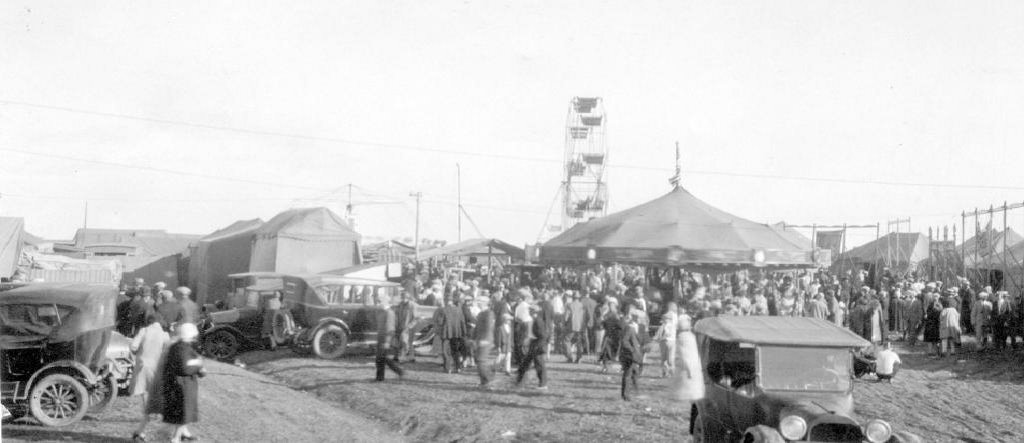
Hallock Fair, 1926

How many times did I walk through this midway? Sometimes with friends, sometimes alone. Sometimes in the day, and sometimes in the night with all the colored lights and the sense of danger. The carnies looked alien and exotic with their greasy hands and tattooed arms.

I never walked though it when it looked like this, however. This is a photograph of the Kittson County Fair's midway in 1926.

Saturday, March 14, 2020

St. Vincent Union Industrial Association Fairs

In Minnesota fairs are older than the state itself, having "made their appearance ... in the early 1850's," just at the zenith of the golden age of such institutions in the United States. Compared with later exhibitions the early fairs were primitive indeed, yet they more than justified their existence. They gave the isolated pioneer farmer a chance to meet his fellows, to have a good time; and by showing him late developments in machinery, fine livestock, and new techniques in farming, they gave him an incentive to improve his own farming. - From a talk called, "Early Minnesota Agricultural Societies & Fairs," presented at the Minnesota Historical Society's annual convention, held July 26, 1941.

Walter John Strickland Traill

The first day of the St. Vincent Union Industrial Association Fair was favored with good weather.  

The native pony race was won by Jim, Shylock second, Kate third.  The trotting race was won by Julia, Dan second, Topsey third.  

The judges were Walter J.S. Traill, C.C. Law, and D. Livingstone (The St. Paul Daily Globe, October 10, 1889).


1918 Fair Results-War Gardens
1906 Fair Dates - Always late
Fall, for these local fairs . . .


...and these early fairs, are what were the seeds of our county fairs of today, including the Kittson County Fair in Hallock!


Monday, March 14, 2011

Letter to Rusty


The letter below was received by Alfred "Rusty" Rustad while he was in the service during WWII. It was written by a local representative of the Red Cross; the introduction is from an article that featured the letter, which appeared in the Kittson County Enterprise a few years ago. It paints a unique picture of his hometown area around Humboldt, capturing the people and events of that time...
Another View
by Rev. Hugh Bell
It's been almost one year since my last "View" so when I received a copy of this enclosed letter I thought it a most opportune time to catch up on correspondence in the Enterprise.
The enclosed letter was sent to Alfred Rustad, Jr. "Rusty" 60 years ago this month. For those of us old enough to remember WWII, we remember a time when just about everyone was in the same boat. It was a time of sacrifice and unbelievable hardship. It was also a time of great family support and great national support. Something that perhaps is lacking in the most recent of our wars including the present day battle in Iraq and Afghanistan. WWII was a time when the whole country pulled together for a common good. Today it seems as tho more energy is put into political rhetoric and profit seeking than into freedom in the Middle East. If we could just stop blaming others for our problems, wouldn't it be a wonderful world. Enough sermon, now to Rusty's letter.

Thursday, November 28, 2019

Water Cooler V: Aunt Mildred's "Books"

In this edition of the "Water Cooler":  A wonderful visit among old friends and neighbors brings up some interesting recollections and memories - plus a tantalizing clue about Aunt Mildred's "books" that could provide a treasure trove of local Humboldt history!  Read on...
Darlene Liedle Daugherty What are you doing up? 
Cleo Bee Jones Same ol' same ol'...it gets old, doesn't it?  
John Nelson Home on the prairie. Homesick! 
Geo Howry Did you attend classes in the Elevator or the grain storage buildings? 
Cleo Bee Jones Actually, George it was in Selmer Locken's restaurant! I studied Buddy Holly's music... 
Bernie Marek I think my dad went to school there. 
Cleo Bee Jones Bernie, what is your Dad's name ? 
Keith Finney George, I later studied at the elevator with Punky. 
Bob Bockwitz Selmer's restaurant goes back a couple years... 
Michael Rustad Selmer - Selmer and Sandra Locken. The old bank building made a pretty good restaurant. I wonder why they tore it down as it was a brick building. And when was Selmer's restaurant torn down? Who remembers the It Cafe? Dotty Boatz had an amusing story about Bob going for lunch there until he discovered one of the kids pounding out hamburger patties with their feet! I remember that the Voits ran the It cafe and conceived of it as a dinner supper club with music. It missed the mark. I wonder what years that Ward and Ruby Finney had the restaurant. The Voits had it in the mid-sixties. Does anyone know what year Mayme's Fairview Grocery Store closed? The building stood for a decade of so after the closing. 
Cleo Bee Jones Keith, we are waiting for you to tell us... 
Bob Bockwitz Yes, Keith, we're waiting... 
Harry, when he worked for the Great Northern 
Bob Bockwitz The years back then all seem to turn to mush in my head, but I would say that the It CafĂ© would have been open through '63 and '64. Run by Kenny and Jean Voit. Kenny helped my dad for a short period of time. My dad and Harold Borg would take the football team there for hamburgers. Ward and Ruby would have been in there about '60-'61. Years may be a little off, but would be pretty close, based on 1964, when I graduated. Ruby had a pin-ball machine with a corner broken out of the glass. On the wall next to the machine hung a 'tool' made out of a coat hanger. The tool was bent just right to reach through the hole in the glass to give yourself a couple of games to start with. Ruby (bless her heart) thought it was cute, and never took away the 'tool'. I remember, too, Warren Reese. Warren had lost his legs and as we went to school in the morning, we would pick him up and carry him into the cafĂ©. These conversations trigger a lot of memories. 
Bob Bockwitz I think Mayme would have closed at the very tail end of the sixties...? 
Cleo Bee Jones I recall Warren Reese when he had the little tiny restaurant in Pembina, the best malts ever, way before your time...! It was across from the Immigration bldg. Just a tiny little hole in the wall ! I wonder what happened to her [Aunt Mildred] "books", journals, as with Viola gone, too. 
Bob Bockwitz You got me there. I wasn't even aware he had a cafĂ©. All I really remember of him is carrying him in and out of the cafĂ© in Humboldt. I have a book that I acquired after Mom got killed. She had written almost everything about the family in it. Mostly family, though, and not so much about the community at large. I'll have to dig it out again and read through it to see what tidbits I can find. I know Ruby is mentioned because they were such close friends. 
Cleo Bee Jones I am trying to recall if he was son of Sid and Hattie Reese? Was Lorraine his sister...my story about her, I was singing at the Golden Nugget in Vegas and got a note that said, Do a song for the gal from across the "big ditch"...it was from her, as she and her husband had known I was there and come over to Vegas from LA (I think it was) to see me. I loved it. She was friends with Virginia and the family and I thought she was beautiful... 
Bob Bockwitz I think you're right. For some reason I don't recall Lorraine, though. Rodney is at the lake, so I can't ask him. I really need to get him talking some time and take notes. 
Cleo Bee Jones It was always sort of a joke, about Aunt Mildred's "books" as she must have stayed awake 24 hrs a day, to know everybody's moves in Humboldt, but I thought the world of her, even until she was quite up in age, as she really liked my late hubby...I know I have talked about this before, but worth another stab at it...after an appearance at Hallock Fair she got right up on the stage to visit with him. I was just so surprised and loved it. Quite a gal!! 
Michael Rustad Thanks everyone. Now this is one of the really useful and brilliant forms of communication on Facebook. 
Bob Bockwitz I know. I can look in Mom's book and see what day in 1954 she got a new sewing machine, or the day I got my hand in the lawn mower. Unfortunately, she didn't write too much about out in the community, even though she loved the community so much. 
Keith Finney I think Mildred knew when the Pope Pooped. She wrote everything down. 
Trish Short Lewis This has turned into another Water Cooler post, Michael...!

Wednesday, December 14, 2011

News from the Past: St. Vincent New Era

Rev. Beer did his best to nurture the small church in St. Vincent;
He later went on to start missions in far off Alaska...
March 28, 1890 News Snippets

There has been a butter famine at St. Vincent lately...Water is accumulating on the sides of the Red River...The carpenters are altering part of the station to make it into a residence for Agent Grasse and family...Rector Beer gave a dinner party on Monday evening to several friends who met Professor Hazen before his departure for Washington.
________________

June 28, 1890 News

As neither Hallock, Northcote, Humboldt, or Pembina is celebrating the glorious 4th, the people of St. Vincent determined to do so. Kennedy on the South and St. Vincent on the North ends of the county will take care of all their neighbors and in friendly rivalry will endeavor to surpass each other in a hearty welcome to all visits, and will extend a "Highland" welcome to their friends on that day.

The St. Vincent Council appropriated a liberal sum and a most excellent committee has charge of the days sports, whose names are a guarantee that fair treatment will be accorded to all competitors and that nothing will be left undone to make the day a pleasant holiday.

The merchants and citizens intend to decorate the front of their stores and residences with trees, flowers and bunting, thus adding to the natural beauty of the loveliest village in the Northwest, and at night the two large rooms of the District School House will be used to dance in.
________________

July 25, 1890 News

Mayor E.M. Nixon and other influential Pembina citizens are proposing to build a pontoon bridge across the Red River and make it a free bridge. It is a good scheme and should be encouraged.

First Bridge:  Pontoon Bridge looking east towards St. Vincent...
________________

December 26, 1930 Ads

"The Unholy Three" - Hear Lon Chaney Talk, also two reel comedy at the Grand Theatre, Hallock, Thursday and Saturday, Jan 1-3, Admission 15, 25, and 40 cents.

If you don't happen to have the cash to send in on your subscription, remember we will take chickens, turkeys, pork, beef, eggs, butter, or stove wood in exchange. These articles cost money and they are as good as cash to us, but don't forget it - Let's hear from you, at once.

Friday, August 08, 2008

Fair Times


The prizes awarded in the open classes at the St. Vincent Fair were recently announced. Percheron Stallion first place went to Sam Johnson, Humboldt and second to Fred McIllraith, Northcote. In Native Ponies, under 14 hands, Malcolm Sugden, Hallock took first and second and L. McGovern, St. Vincent took third.

From the Kittson County Enterprise (October 1932)

Sunday, March 04, 2012

Interview: Beth Lapp

Elizabeth Lapp in 1948
[Courtesy:  Digital Archive, UMC
Thanks to Kristine Baldwin Ohmann, who facilitated our get together, I interviewed one of the oldest living natives (and a resident) of St. Vincent last weekend.

Elizabeth Lapp, better known as Beth, was raised in St. Vincent.  Her parents, Richard (Dick) and Lillian Lapp, met in 1926 when her mother came to town to teach at the school. Dick's parents were early settlers of St. Vincent, arriving in 1879 from Canada.

I share with you here the interview in its entirety, as it happened.  As you will read, there are a lot of clues for further stories, which I intend to explore in future posts...

1. Her earliest memory is of getting ill and vomiting on her workbook at school. In those days, you only got one workbook to use for your schoolwork, so she was mortified. She was sitting near chalkboard at the time. Her teacher was Miss Penovich.

2. Some of her other teachers were: Elaine Bergh, Gunda Hanson, Mrs. Isley, and Mrs. Monte(gue) Clinton.

3. The year she had Mrs. Clinton, “we didn’t learn anything”. Math and Science were "sacrificed for art". All she remembers is Mrs. Clinton having the class place chairs facing west and looking out towards Christ Church and drawing what they saw…

4. When it came time to go to high school, students during her time had three choices: Hallock, Pembina, or Crookston. Hallock and Pembina were public school (free) while Crookston was a boarding school and charged tuition. This was during the 1940’s and into the 1950’s.

Northwest School of Agriculture Crookston MN
[Photo Courtesy Digital Archive, UMC]
5. Crookston was called the ‘Ag School’. It's actual name was the Northwest School of Agriculture.  Several area natives attended it, including Beth and her siblings.

Sunday, January 13, 2008

An 1890 Traveller's View

In the last two decades of the 19th century, St. Vincent and it's neighbors were growing by leaps and bounds. Even from as far away as New York City, people could see that amazing things were happening on the developing frontiers of our country; they were coming of age.

From a New York Times archive article comes this excerpt, of a man traveling through our area in 1890...
At the Kittson County Fair held at Hallock Oct. 3, there were cabbage heads and cauliflowers which measured 22 inches in diameter, beets and turnips which weighed 20 pounds apiece, and potatoes a foot long. Eight-rowed white corn was shown which ripened on the stand, and savory peppers, large and pungent. Creameries are established at prominent points, and cheese and butter are produced in considerable quantities. A good deal of attention is paid to beef and horse stock. There are some flocks of sheep. The exhibit of fine stallions exceeded any similar collection on record elsewhere.

It is cheering to note the hopefulness which pervades the Red River Valley at this time. It seems to be the reflex of a like feeling which possesses the whole Northwest. There is no doubt that the entire region is on the threshold of another great advance. The promise is in the air. A remarkable business year is anticipated for 1891.

Monday, August 08, 2011

Memories of a Humboldt Native


Anthony "Tony" Merck
Humboldt Depot agent
This reminicense by Margaret Matthew Panzer is full of memories and names of old Humboldt in the way a poem about the town was.  As you will read, there was a lot of community and fellowship as people strove to make a good life for themselves and their families, but there were also hard times (such as during the Depression)...
...My parent's farm was a little over a mile south along Highway 75 and we often walked to town and even to church on Sunday morning when the weather was pleasant.

Though my dad had a hitching post in our yard the only time I really remember a sleigh ride was on Thanksgiving when we went cross country to Len Sylvester's farm to enjoy the day. Lots of good food and crowding around her pot belly stove, playing the piano and working on the Charleston steps were all fun.

We did ride in a school bus in nice weather and a large sled during the winter weather.

Humboldt had been built on both sides of the main highway. East of the highway was really only about four large blocks. There seemed to be wide spaces between homes as some blocks had a home only on the corner.

Friday, December 08, 2006

Profile: Angelica Zasta Gooselaw


At left, a May 20, 1923 article from the Minneapolis Sunday Tribune, concerning Angelica...


I wrote an earlier post about the Gooselaw family, which basically consisted of a scan of two pages from the 1928 Borderlines that was dedicated to their Matriarch, Angelica Gooselaw. However, that post was, I have recently learned, mainly taken from a newspaper article published on Sunday, May 27, 1923 in the St. Paul Pioneer Press. Below is the entire article, with links I have provided on certain key words you might find of additional interest...


Indian Woman, 98 Years Old Still Lives in Log Home, Her Minnesota Abode for More Than Eighty Years

Mme. Angelica Gooselaw, Born on Site of Winnipeg Sees Wilderness Won by Her Descendants; Recalls Visit of General Dickson*, and Says He Left Without Raising Half-Breed Army.

By August J. Lindvall

In a log house tucked into the northwest corner of Kittson county, which gives the dwelling the distinction of being nearest of any home to that angle of Minnesota's northern boundary, lives Mme. Angelica Zaste Gooselaw, 98 years old. The farmhouse of the Gooselaw house is two miles north of St. Vincent, and it was there, on May 21, that I obtained the photograph accompanying this article and got from her the story of her life.

In this connection I inquired of her whether she could recall anything about the expedition of a character calling himself General Dickson* of the Indian Liberating Army, who in 1836, arrived alone in Pembina, and who announced that his purpose was to obtain about 200 young half-breeds to go with him to the far southwest, there to establish an Indian kingdom of which he would be king.


Mrs. Gooselaw informed me that she remembered General Dickson quite well; that he stayed in Pembina less than a year, but, unable to speak the Cree language, or any of the vernacular languages of the aborigines in that region, he failed to impress the people seriously, finally departing abruptly. Where he had come from, or where he went thereafter, no one knew.

Born in October 1824

Mme. Gooselaw was born at St. Xavier Mission, now the City of Winnipeg, Manitoba, in the month of October 1824. Her parents were Joseph Zaste and Angelica Parisien, both of the Cree Indian nation, which had dwelt at the head of the Great Lakes toward the north and west, and south along both sides of the Red River of the North, since time immemorial.

Here her parents continued to dwell until she passed her fourteenth year, when they, together with other people of their kindred, moved south and made settlement on both sides of the Red River, making permanent settlements at what are now the cities of St. Vincent, Minn., and Pembina, N.D. These settlements, in the summer of 1838, were largely in charge - spiritually, at least - of the French Jesuit missionaries whose zeal and devotion for the conversions of all peoples to the Christian religion are so well known to all.

Here the Cree maiden grew up to womanhood, and here together with others of her coevals and kindred she became a catechumen of the Rev. Fr. Belcourt, a most zealous Jesuit missionary, who built the first mission chapel, about one mile north of the present Pembina, on the west side of the Red River, now known as Old Pembina.

The Zaste family, being devout Catholics, did not a little to help organize the first nucleus of a Cree parish, a mission congregation, as well as the first permanent settlement of the Cree people within our state.

Romance of Wilderness

It was here the Cree maiden met the youth of her choice, a M. Augustine Gooselaw, pioneer and frontiersman of French-Canadian descent. Their intimacy ripened into love, and on May 15, 1842, their marriage was solemnized in the Mission chapel, above mentioned, by the Rev. Fr. Belcourt. "She less than eighteen and the swain in his twentieth." Although but a frontier chapel, this marriage was solemnized with all the solemnity of the Catholic church, both the contracting parties being members of the mission parish.

Their home, a frontier two-story log cabin, already built on the east side of the Red River, less than a mile from the chapel, has been the family domicile throughout all the intervening years.

This family was blessed with twelve children as follows: Jean Baptiste, Henry, Xavier, Angelica, Marie Rose, William, Alexander, Frank, Jerome, Rogers, Augustine, and Emma - nine boys and three girls. At the present writing all are living but Jean Baptiste, the oldest boy, who was drowned in the Red River while in his fourteenth year. Nine are living in Minnesota, while two daughters, Angelica and Emma, are residents of Canada, just north of the family homestead. At the present writing, there are fifty-four grand and great-grandchildren living and thirteen dead. A great number of the Gooselaw descendants are farmers, hunters, and fishermen, while others are merchants and mechanics and quite a few in the professions.

We must not forget to show the loyalty of the Gooselaw family, of which they may well be proud. In our late World war the following grand and great-grandsons served in United States forces overseas: Peter, George, Henry, Frederic, Ely, Alfred, and Joseph. Also a Daniel and John Gooselaw, youths in their teens, enlisted at the close of the war - all ready to defense their country, come what may. One grandson, a Philip Godon, served in His Majesty's forces overseas.

But few people living within the borders of our state - if any there be - can antedate this venerable pioneer family.

M. Augustine Gooselaw died on August 18, 1904.

Husband Walked to St. Paul

Mme. Gooselaw recalls many incidents of real pioneer life. At the invitation of Governor Sibley, Augustine Gooselaw walked to St. Paul in 1841 to discuss matters relating to their settlement.

Her husband hunted the bison on the Dakota plains and was one of the purveyors of buffalo meat for the United States garrison at Fort Pembina. Her served also as United States mail carrier for the outlying settlements and trading posts, particularly Koochiching, Red Lake, Lake of the Woods, Turtle Mountains (St. John's, N.D.)

The weary traveler, the wayfarer and prospector, always found welcome at the Gooselaw cabin, and it can truly be said, "all claim a kindred" and encore the poet:
Just where the woodlands meet the flowery
surf of the Prairies,
Dwelt they in love of God and of man.
Alike were they free from
Fear, that reigns with the tyrant, and envy,
the vice of republics.
Neither locks had they to their doors, nor
bars to their windows;
But their dwellings were open as day and
the hearts of the owners;
There the richest was poor, and the poorest
lived in abundance.
Mme. Gooselaw also related to me how she became an American as distinguished from a Canadian. I seems that when the Crees migrated southward they had no intention of leaving Her Majesty's domain. This was prior to the survey of the International boundary. The present cities of St. Vincent and Pembina were then laid out by a M. Cavalier, south of the International boundary. A few pioneer Cree families settled two miles north of these settlements, thinking they would be in Canada. Dame Fortune destined it otherwise, however, the local surveyors and astrologers losing out. When the real survey came they were all south of the boundary, and Minnesota gained in worthy citizens. Mme. Gooselaw's two oldest sons, Henry and Xavier, worked with the surveyors from the crossing of the Red to the Lake-of-the-Woods.

During all her varied life Mme. Gooselaw has "seen the wilderness bloom into a fruitful garden." Her duty toward family, God and country always has been uppermost in her daily life. Her parents, converts of the Rev. Father Belcourt, the Jesuit pioneer missionary, herself and husband devout Roman Catholics, she brought up her children to be members and attendants of, the mother church. Mme. Gooselaw always refers with reverence to the early Jesuits, particularly Father Belcourt, and later a Rev. Father Andree, regarding how they labored with her people - the zeal and devotion and self-denial they displayed; both familiar with the language and custom of the Cree people; their only aim being the conversion of all to the Christian religion. Although passed her ninety-eighth year, Mme. Gooselaw attends mass regularly at the St. Vincent Catholic church, now served by a Rev Father Baux.

As a linguist she can read and speak Cree, English, and French fluently. We are told that her French is most scholarly. She is also familiar with the language of her kinspeople, the Chippewas and the Assiniboines.

She remembered how the old Red River had at times gone on the warpath - its water causing a deluge to adjacent land. How some sixty-two years ago they all had to leave their homes and flee to higher ridges, particularly Ridgeville, Manitoba, just north of the Bamdarg. The water did not recent till June 10 and no crops were harvested that year.

Age Kind to Her

In the summer of 1920, Mme. Gooselaw was a witness in Minnesota District court at Hallock, Minn., presided over by the Hon. Andrew Grindeland. Despite the fact that she was then in her ninety-seventh year, the court complimented her on her intelligence as a witness.

When I saw her but a few days ago, she was in perfect health - reading, sewing and crocheting without the aid of glasses. Her mental faculties, particularly her memory, as of the very best - she could relate the smallest details of her early life. She also attends her family household to a certain extent. However, two granddaughters are always with her of late years. Her excellent health continues, and if nothing unforeseen occurs, she bids fair to reach the century mark.

We are sorry to relate, that at the close of so eventful a life, the title to the family homestead is contested - the home she has occupied some eighty years and more. The case is now in the United States court.

_________________________________

* Concerning "General Dickson"...

Although considerable research still needs to be done in the area of "Metis uprisings" in the United States, there is at least two episodes in which attempts were made by allied groups of Indians and half-breeds to form a "native" state. The first, in 1826-27 involved the formation of a United Nations of Indians and the establishment of the Republic of Fredonia at Nacogdoches between the Canadian River and the Red River (U.S.A.) near the Mexican border in what is now Texas. The movement included remnants of the Tecumseh Confederacy, and dissatisfied Cherokee (who were predominantly mixed blood). The leadership of the movement was assassinated in a plot launched by the founder of Texas, Stephen Austin.

The second episode, in 1836, apparently died in the planning stages but included an even more widespread plot. A well-financed half-breed named James Dickson traveled between Montreal, Buffalo, Sault Ste. Marie and Red River (Canada) recruiting half-breeds for an Indian Liberation Army. The plan was to join up with a larger group of Cherokees and form an expedition to California where an independent state would be established.

Hudson's Bay Company officials interfered with Dickson's finances and the plan ground to a halt. In a final meeting before he left the Red River area, Dickson presented Cuthbert Grant with his sword and epaulets. These episodes are highlighted here, both to indicate the need for research on an continental basis on Metis issues, and to at least indicate that the concept of nationhood is not exclusive to the Red River area.

From: Pre & Post-Red River Metis Communities

While Houston was still fighting for the Texas Revolution, a poet-warrior named James Dickson appeared in Washington, proclaiming himself as Moctezuma II, determined to go out to the region west of the Great Lakes, where he would recruit an "Indian Liberation Army" that would move down across the Rockies, to conquer California for a new republic where only Indians would be permitted to own lands. He did recruit a few supporters in the East, he did go West, but he there found himself with his words growing thin in the cold air. He faced local opposition from the Hudson's Bay Company. Most of his followers drifted away. In the middle of the winter, he headed toward the mountains. Nobody heard from him again.

From: The Deluded White Chieftains and Elizabeth Arthur, "Dickson, James," Dictionary of Canadian Biography