Showing posts with label Ferry Command. Show all posts

Thursday, February 25, 2016

Ferry Command Article

Pembina’s brief moment of world attention, then, was part of the demise of American innocence. 
- "Earth Angels Rising", by Ted Beaudoin
It has been reported that the opening scenes of the 1941 Tyrone Power-Betty Grable movie, “A Yank in the RAF,” shows airplanes on the Pembina border being hauled into Canada. The narrator says, the way to get around neutrality restrictions is “Yankee ingenuity and a stout rope.” 
- Horse-drawn planes part of N.D. history (Bismarck Tribune, Jan. 16, 2011)

Emerson International Airport
by Bill Zuk (Nov 3, 2012)
Copyright © 2015 CAHS

Prince & Fred help make history! 
January 15, 1940 - It was miserably cold that morning when Joe Wilson hitched his team of horses to a wagon. He looked up in the sky to see two aircraft circling overhead. Joining a procession of cars and a truck laden down with fuel barrels, he lumbered his way to the front, coaxing his workhorses, Prince and Fred, forward along the wind-swept field. The assembled crowd began to gesture at the swooping twin-engine planes now clearly in view. Piling out of one of the lead cars was a film crew that hastily set up a tripod and movie camera.

Approaching the 'landing strip'
on Pembina side of the border.
Jimmy Mattern, the famous test pilot, peered out the side cockpit, astonished at the sight below. It was a wind sock planted in the middle of the prairies. After the long cross-country excursion from Burbank with numerous stops along the way, he was nearly at the end of his ferry flight. Lining up for an approach, he maneuvered the Lockheed Hudson bomber downwind for a landing short of the international border that straddled his landing site. Following closely behind was an identical Hudson bomber, also painted in a dark drab, with only civilian markings on the underside of the wings to identify it. The subsequent touchdown was hard, the second bomber swerving off the improvised runway and nearly tipping on its nose, before righting itself.

Monday, October 19, 2015

Pembina Ferry Command Video

Although mislabeled, the video below is indeed a very brief clip of a Ferry Command operation, towing planes across the US/Canadian border at Pembina ND/Emerson MB.  We didn't know it existed until recently.  A real treasure of a find!

The man in the long coat at the beginning of the film is Harry Wood, of Pembina ND, as identified by his granddaughter, Lori Wood Goertzen.

Tuesday, October 26, 2010

Ferry Command Revisited III

Click to view larger...

I stumbled across the story at left today when going through archived newspapers.  It's on the backside of an article about my mother that appeared in a February 1940 issue of the Pembina New Era.

What's interesting about this article (although the term is never mentioned in the article itself), is that it's talking about Ferry Command.

I get a big chuckle out of how it's repeatedly stated that NO airplanes are being flown across the border.  That is literally true.  But what is not mentioned is that there had been planes towed across the border just the month before, thus not breaking the letter of the Neutrality Act of 1939...

Wednesday, June 16, 2010

Ferry Command Revisited II


A film was made about the Ferry Command operations...

I have written about Ferry Command several other times here on this blog. There is an important update on the books being written about it, and our area's important role within the operation.

As Ted Beaudoin - the author of an upcoming book on the subject - states below, we owe a LOT to the men and women who were part of this effort 70 years ago. My own mother witnessed the events that happened in Pembina/Emerson, two of the locations involved in this massive and critical operation during a dark time for the world. Our communities were two links in a very large and long chain that meant the difference. Ted does not overstate the importance of what this meant. I urge you to read this synopsis of what his book will be about - it's truly awe-inspiring!

Sunday, January 24, 2010

Ferry Command Revisited

I was contacted again by Ted Beaudoin about his latest book, EARTH ANGELS RISING, which will be the second book in his aviation trilogy, Walking on Air. If you remember, this subject was covered in previous posts including this one. Ted wrote to share the latest on his book because he's heading into the homestretch on completing the manuscript, and is about to write up some details on Pembina's part in the story...

Tuesday, October 28, 2008

Ferry Command: First Delivery

On 15 January, 1940 just west of Emerson, the silence of the early morning was broken by the sound of aircraft. A truck, loaded with 45-gal fuel drums, several cars, their motors running, a team of horses and half a dozen people, some with newsreel cameras, were waiting in the freezing cold. The bundled individuals were looking skyward just to the southern horizon. Suddenly two twin-engine planes became visible. They were the first of a consignment of eighteen planes. They came in low. The cameraman started shooting film. The planes circled, the pilots clearly visible in the cockpits. After a quick check of the wind sock they circled to the south and began their final decent. Touching down on the US side of the field, the dark camouflaged Lockheed Hudson bombers, without markings or ordnance, taxied up to the boundary line.

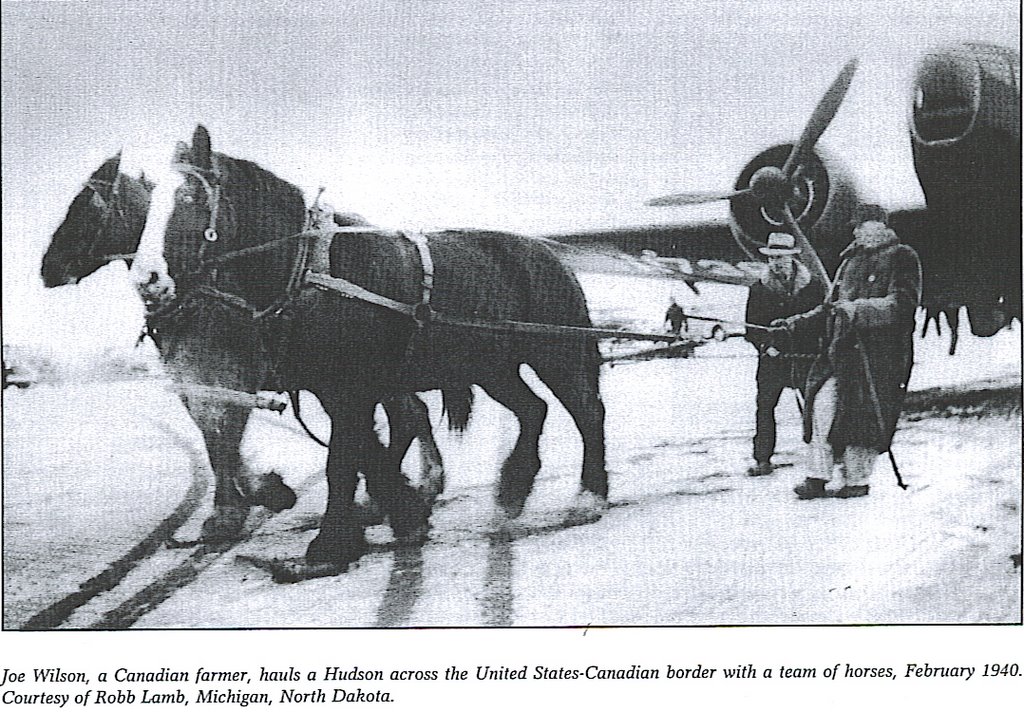
Joe Wilson, a local Emerson farmer, guided his team of horses, Prince and Fred, toward the planes. He attached a hook and tow rope to the aircraft’s wheel and dragged the bomber into Canada. The newsreel cameras rolled and newspaper photographers popped their flash bulbs. The sudden rush and the flashes were a slight annoyance to the team of horses, but Joe was an efficient teamster and within a matter of minutes both planes were on Canadian territory. The truck rolled up and the driver and a helper dressed in military-style coveralls, started filling the craft with fuel from the 45-gal drums. Moments after the planes were fueled up the flight crew emerged from the idling waiting cars. The engines roared into life and the Hudsons lumbered down the airstrip. Becoming airborne they circled once over the airfield and headed north for Winnipeg’s Stevenson Field.


Stevenson's Field circa 1929
- Excerpt from “Bombers Across the Border” by James McClelland. Royal Aviation Museum of Western Canada Review, June 1996

Monday, October 27, 2008

The Civilians of Ferry Command

I received an email from a local resident of Emerson this weekend asking for our help. Yes, you read right - OUR help. This email was not only directed at me, but to all who read this blog.

As you will read below, help is being requested on collecting all extent information - oral, written, photographic, or film - on an event I covered previously - but obviously has a lot more to it.
Hello Trish

It has been awhile since we were in contact. I have a request for some information regarding some events that took place in Pembina back in 1940. I was hoping that you might be able to post it on your page.

Specifically the story goes like this:

In 1940, prior of the United States entry into World War II, a number of military aircraft were flown from California to the Pembina Airport. These planes were later flown to the border just west of Emerson, Manitoba. At that point they were towed with a team of horses into Canada (see this article regarding why...)

These events occurred in January 1940. Now the reason for my interest is that I am acting as liaison for Ted Beaudoin. These events are part of story that Mr. Beaudoin is writing.

He is an Ontario-based writer and the author of a three–volume set of books dealing with Canadian and international military/civilian aviation history adventure. He is also working on the production of a movie Earth Angels Rising. Mr. Beaudoin's purpose is to pay tribute to the civilian men and women who came to rescue of the Allied governments between 1939 and 1945. These individuals gave life to an organization known as Ferry Command. The aircraft that arrived in Pembina in 1940 may have been part of over 10,000 bombers and fighter aircraft that were ferried across six ocean bridges to various theatres of war.

Mr. Beaudoin would like to hear from any from anyone who might have information or pictures of these events. In 1940 the Pembina New Era was covering these events extensively and he was also hoping that these files might be available for research.

If any one can help they should contact Mr. Beaudoin directly or myself at:

Ted Beaudoin
52-C Empire St
Welland, ON L3B 2L4
Canada
Tel.: 905– 714-1788
E-mail: jw-dunn@hotmail.com

James McClelland
Box 301
Emerson MB R0A 0L0
Canada
Tel: 204-373-2544
E-mail: djmcclnd@mts.net
From the Montreal Gazette (July 19, 2003)

The photo accompanying this post is a picture of one of the aircraft landing along the border west of Emerson/Pembina . The aircraft is on the US side and is taxiing up to the border.


Monday, July 30, 2007

WW II Planes Cross Border by Pembina


Joe Wilson, farmer near Emerson, Manitoba, hauls a Lockheed Hudson bomber across the border at Pembina, circa February 1940.

My Mom - along with many other St. Vincent, Pembina, and Emerson locals - witnessed this event. It was big news and brought a lot of pride into the communities to be involved with this important war effort. She took photographs of the planes, and wrote down her memories on them, and years later shared them with me. I always wanted to find out more, so I started digging...


Transcription of above article:

Robert E. Gross, president of Lockheed Aircraft Corp., described yesterday the manner in which his firm is delivering warplanes to the Canadian government.

“Lockheed Aircraft,” he said, “has purchased for $5,000 a sizeable piece of acreage on the northern outskirts of Pembina, N.D., adjoining the international boundary. It will be immediately converted into a modern airport with runways and the necessary hanger facilities, as the field is being used for the delivery of a fleet of Lockheed planes consigned to the Canadian government at Ottawa.

“The shipment consists of 16 bombers, part of 200 recently ordered by the British Air Ministry. Since the invocation of the Neutrality Act, eight of this group have been delivered.

“Method of delivery in all respects strictly complies with the existing neutrality ruling. A Lockheed crew, consisting of pilot and mechanics flies each plane from Burbank to Pembina with stops at Albuquerque, N.M. and Omaha, Neb. At Pembina, a landing is made on the American side of the line, where title is passed and customs officers verify the transaction as in accordance with neutrality laws.

“The pilot then taxis the plane up to the border, where a Canadian representative attached a tow line and hauls the plane across the boundary.

“Acting with the express permission of the U.S. State Department, the Lockheed pilot and mechanics then fly the airplane to Winnipeg where it is turned over to another Lockheed crew which flies it to Ottawa and turns it over the Royal Canadian Airforce, after which the American crew immediately returns to the United States.

“All the flights by American pilots in Canada in connection with these deliveries have the approval of the U.S. State Department.”

Lockheed said the Pembina airdrome would be available to other American firms for similar purposes.

Thursday, May 11, 2006

"...brief moment of world attention..."

Photo by Robb LambNorth Dakota was...the site of one of the first publicized actions taken in favor of the Allies. This came to the world’s attention when some unusual photographs appeared in early 1940, showing, of all things, a few airplanes being pulled by a horse team across the Canadian border near Pembina, North Dakota.

My mother was a senior in high school in 1940, when the event the quote above happened. She showed me photos she had taken herself of the event. She got the basic facts right, too, from what I recently learned. But the broader story is even more interesting than the overview.

A regional historian, Tom Shoptaugh, wrote an article about 12 or so year ago, that fills in the details...
The transport of military aircraft at Pembina...provided evidence that another belief was no longer valid: the oceans could not provide enough distance to protect America from harm. If Hudsons could be flown in stages from California to England, then it could not be long before other, perhaps hostile, bombers could fly over American soil. In December 1941, Japanese aircraft did just that, putting an end to the myths of American isolation and security.

Pembina’s brief moment of world attention, then, was part of the demise of American innocence. Neither the small town nor the great nation could remain isolated from the course of world events in modern times.