Showing posts with label clubs. Show all posts

Sunday, February 24, 2013

Past Resident Memories: John Stranger

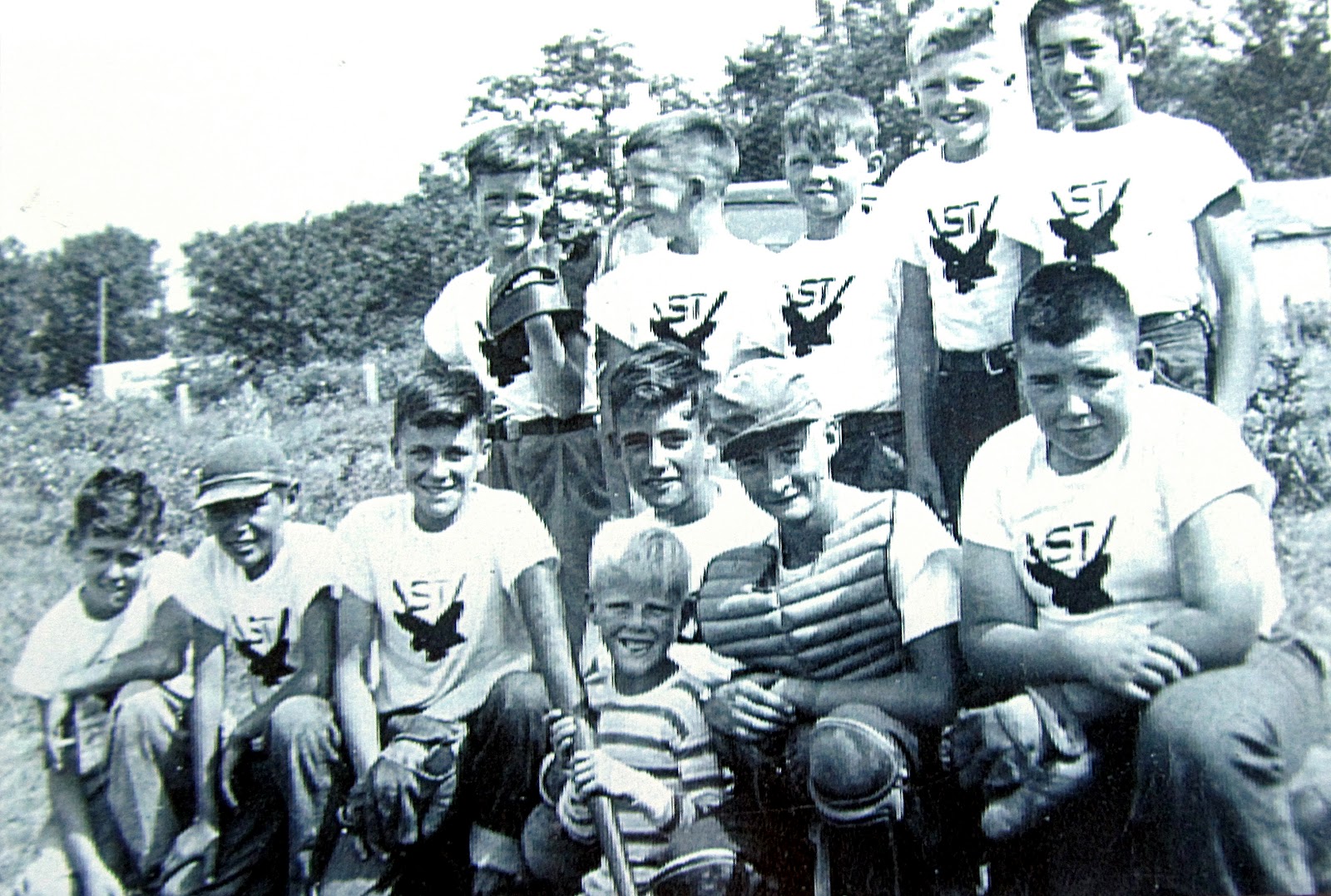
John Stranger - Back row, middle


A MEMOIR OF A LIFE, FOR BETTER OR WORSE
By John A. Stranger

CHAPTER ONE
Beginnings

This all begins in a small town in Minnesota during the 40's when growing up was a struggle without all the things a boy wants and dreams about. Outdoor toilets and dressing behind the oil burner turned up full blast where my brother (4 yrs. Younger) and I learned to dress very fast during the cold Minnesota winters.

My brother was a great kid even though we would have our brotherly confrontations. We had a younger sister too and she learned to hold her own with us boys. Our parents were very strict on almost everything that they thought was for our best interests even though we tried to disagree with our parents at times but trying to obey seemed better than a beating, (most we probably had coming).

Thursday, September 01, 2011

Triggered Memories

I received an email from Michael Rustad saying my recent post about P.N. Tri brought back some memories of his own, and that he hoped those reading the posts here will share with me any such triggered memories they may have.  That's always been one of my hopes, that people reading these memories and histories, will share their own memories and histories of this little corner of the world.
PN Tri was a major figure in the history of Humboldt and St. Vincent.  I did not know that he was the first advisor to the Humboldt Stick to It Club. 
"Incoming!"
I belonged to the Stick to It Club and it was one of the best 4H clubs in N.W. Minnesota.  We had great leadership.  Marian Anderson from Humboldt won the state 4H dress making competition and was crowned at the State Farm.  Dennis Diamond was a consistent State Farm prize winner.  We had so many innovative parent and teacher advisors over the years.  Earl and Beatrice Bahr helped us immensely when they built our equivalent of the Diamond of Dreams on their farm.  Earl mowed a field so we could practice for our 4H softball team.  The year was 1965 and Humboldt's Stick to It 4H club was a powerhouse softball team.  It was boys and girls who played.  Dee Dee Diamond played on that team on the girl's side.  My brother Tony and I were the stars of the team.  We were the home run hitters, the ringers of the team.  Tony and I practiced softball daily.  We would pitch to each other and invented a game.  A home run was when we hit it over the barn with a towering drive.  A double was a hit into the chicken wire.  The chickens soon learned that they were to go in the barn when we played. We never hit a single chicken despite many hits into the chicken's yard.

Friday, August 26, 2011

Breadcrumbs of a Life: P.N. Tri

From 1920 "Farm Boys & Girls Leader".
Organized in 1919, it was the start of what
would be known as the the 4-H club of the
same name.  It's fun to read the origin of
the club, and the meaning of the name...

I was recently told that "...P.N. Tri was a world renowned beekeeper and featured in apiary magazines. They shipped honey all over the world!"Well, of course that meant I had to see what I could find out.

The online record is slim, but I did find one article where P.N. Tri was quoted as wintering his bees in a potato cellar!  Not much to go on, but interesting...

According to the Red River Valley website, P.N. Tri, or Peter Nicholas Tri, came to St. Vincent in 1915 to be Superintendent of Schools.

Later he worked at the Humboldt School, as you can see in the magazine article clipping at left.  In this 1920 article, the St. Vincent Fair is referred to as the 'county fair'.  I have never been clear if it was officially the county fair at one time or not, but this is one occasion where it appears it may have been...


1 - The little birdie's name was Michael Rustad...

Monday, September 22, 2008

Freemasonry in Pembina: The Northern Light Lodge

The first Lodge of Ancient Free and Accepted Masons to organise in what is now the Province of Manitoba was authorised by M. W. A. T. C. Pierson, Grand Master of the Grand Lodge of Minnesota, under a Dispensation dated September 13, 1863. It reached Canada by way of Pembina, Dakota Territory, and Fort Garry, now Winnipeg, in what was then known as the Red River Settlement in the Canadian Northwest. In his address to the Grand Lodge of Minnesota at the eleventh Annual Communication held at St. Paul on October 2, 1863, M. W. Bro. Pierson, Grand Master of Minnesota, made the following statement: "About the middle of last month I received an Application signed by W. Bro. C. W. Nash, Bro. J. L. Armington, Bro. A. T. Chamblin, Bro. Charles H. Mix, and eight others, who were en route for Pembina, Dakota Territory, for a Dispensation authorising them to open and Work a Lodge.
Pembina is the most northern point in the territory of the United States, a great central point where concentrates a large amount of emigration and of travel between the two oceans. The want of a Lodge at that place has been long felt and often expressed; and as the Brethren named were active, well informed, and discreet Masons, the first two, former Masters, and the latter, Wardens of Lodges within this jurisdiction, and as they expected to remain in that hyperborean region for at least two years, I granted a Dispensation to establish a Lodge at Pembina." Prior to holding the first meeting, it was discovered, however, that no name had been given the Lodge in the Dispensation. "How it was settled," says M. W. Bro. William G. Scott, Past Grand Master of the Grand Lodge of Manitoba, in his article " Early Masonry in Manitoba," " I will leave Bro. Nash to describe." The following description was then given " I wrote to the Grand Master calling his attention to the omission, and took occasion to suggest what I thought would be a proper and very appropriate name, and in case it met with his approval to so advise me and direct that I insert it in the Dispensation. The name that was suggested met with his cordial approval and was thus named. It came about in this way: It was at night that I was writing the Grand Master, and going out of my quarters I observed the grandest display above me that it was ever my pleasure to behold. I never witnessed such grandeur of this character before, and I never expect to again. It was an exhibition of Northern Lights. The celestial globe was grand and beautiful in the extreme, and for a long time my eyes feasted upon the sight with delight. It was witnessed by many in our cantonment. On returning to my quarters to complete my letter to the Grand Master, I narrated the circumstances; hence the name, Northern Light Lodge, was given." The Lodge held its first meeting about the middle of January 1864. During the few months that it remained active in Pembina, several residents of Fort Garry and the vicinity made applications for membership, were accepted, and received the Three Degrees of Freemasonry. Among those who became members at that time were Bro. A. G. B. Bannatyne, Bro. W. B. Hall, and Bro. William Inkster. Then, in the early part of that year, application was made to M. W. Bro. Pierson, Grand Master of Minnesota, for a continuance of the Dispensation and for authority to transfer it to Fort Garry. This request was granted. In his address to the Grand Lodge at the twelfth Annual Communication held in St. Paul on October 12, 1864, the M. W. the Grand Master reported as follows: " I also renewed the Dispensation of Northern Light Lodge, removing it to the Red River Settlement." The first meeting of the Lodge in Fort Garry was held on November 8, 1864, in a room over the trading‑house of Bro. A. G. B. Bannatyne. In a letter to the Grand Lodge of Manitoba, written in 1895, W. Bro. Schultz described that meeting in the following words And a novelty it was, indeed, in this country at that time! It was spoken of far and wide, and the descriptions, which did not decrease in detail or increase in accuracy, as to what was done therein were listened to with much curiosity, and in some cases, with awesome wonder, which was enhanced by the jocoseness of Bro. Bannatyne's clerks, who spoke knowingly of the whereabouts and propulsive propensities of the goat, and who pointed out from the room below (to wit, the trading‑house), exactly in what part of the upstairs room the W. M. hung his hat while the Lodge was at Work. The Lodge Room itself was made as tasteful as the circumstances of that day would admit, and it may interest the curious to know the exact cost of some of its furniture, as given in a memorandum which I happen to have near me, in the sterling money of the day, namely: tables, 19/6; inner door, 15/; altar, 19/6; wall‑paper, 39/, 24 black beads, 1 /6; 24 white beads, i /; 100 copies of the by‑laws, 40 /. And it may be inferred that the Craft were not always at Work, for I find the following on the same list: 15 tin plates, 15 iron tablespoons, 15 teaspoons, 12 cups and saucers, 1 tin pan, 4 cans of pickled oysters, 1 pound of butter, 1 pound of coffee, and 2 pounds of sugar. This would seem to show that there were intervals for refreshment. The jewels were borrowed ones from the Pembina Lodge; they were used until the following January, the Lodge having commenced Work in November 1864. They were then replaced by finer ones from Chicago, through the good offices of N. W. Kittson.

Sources:  Manitoba Historical Society
, Gould's History of Freemasonry Throughout the World Vol. 4 (1936), Northern Light Lodge history (Red River Valley website), and Proceedings of the Grand Lodge of Minnesota at its Grand Annual Communications in the City of St. Paul (1869)