Showing posts with label bison. Show all posts

Saturday, December 12, 2009

Sea of the North / Agnes Christina Laut

QUOTE:

Pierre de la Vérendrye had heard of a region to the south much frequented by the Assiniboine Indians, who had conducted Radisson to the Sea of the North fifty years before—the Forks where the Assiniboine River joins the Red, and the city of Winnipeg stands to-day.

AND

When the Sautaux were at war with the Crees, he met the Crees and heard of the great salt sea in the north. Surely this was the Sea of the North—Hudson Bay—of which the Nipissing chief had told Groseillers long ago.

AND

When Radisson came back from Onondaga, he found his brother-in-law, Groseillers, at Three Rivers, with ambitious designs of exploration in the unknown land of which he had heard at Green Bay and on Lake Nipissing. Jacques Cartier had discovered only one great river, had laid the foundations of only one small province; Champlain had only made the circuit of the St. Lawrence, the Ottawa, and the Great Lakes; but here was a country—if the Indians spoke the truth—greater than all the empires of Europe together, a country bounded only by three great seas, the Sea of the North, the Sea of the South, and the Sea of Japan, a country so vast as to stagger the utmost conception of little New France.

SOURCE:

Title: Pathfinders of the West Being the Thrilling Story of the Adventures of the Men Who Discovered the Great Northwest: Radisson, La Vérendrye, & Lewis and Clark by Agnes Christina Laut
__________

QUOTE:

I question if Norse heroes of the sea could boast more thrilling adventure than the wild buffalo hunts of American plain-rangers. A cavalcade of six hundred men mounted on mettlesome horses eager for the furious dash through a forest of tossing buffalo-horns was quite as imposing as any clash between warring Vikings. Squaws, children and a horde of ragged camp-followers straggled in long lines far to the hunters' rear. Altogether, the host behind the flag numbered not less than two thousand souls. Like any martial column, our squad had captain, color-bearer and chaplain. Luckily, all three were known to me, as I discovered when I reached Pembina.

SOURCE:

Title: Lords of the North
Author: A. C. Laut

Agnes Christina Laut(1871–1936). The prolific Canadian author Agnes Christina Laut wrote fiction and nonfiction mostly about the exploration and early settlement of Canada. Her topics included explorers, fur trapping and trading, gold prospecting, and other aspects of Canadian life in the era of European settlement.

Like so many other adventurous women at the turn of the century, Agnes C. Laut knew a passion for travel as well as a "gipsy yearning for the wilds." Fortunately she lived and worked at a time when the sphere of women´s lives was widening significantly. She was born the youngest of eight children in Ontario´s Huron County on February 11, 1871, just one year after Manitoba, amidst the troubles on the prairies, became the first province of the new Dominion of Canada. Her father was John Laut, a merchant from Glasgow and her mother was Eliza George, the daughter of Rev. James George, Chair of Logic and Mental and Moral Philosophy and vice-principal of Queen´s University from 1853 to 1857.

When Laut was two years old, she and her family moved to Winnipeg, which had just been incorporated as a city. In 1907 Laut recalled the importance of her early childhood years: "It was my good luck to have spent the first seven years of life on a farm enjoying all the fun of the real thing; riding real horses, not rocking horses; sailing real rafts on real creeks, not just blowing paper boats on a bath tub; hunting the secret nooks of live, real, woodland things ..."

Laut acknowledges some of the pioneering historians whose works inform her fiction: Alexander Ross, author of The Fur Hunters of the Far West (1855); George Bryce, author of Manitoba: Its Infancy, Growth, and Present Condition (1882) and The Remarkable History of the Hudson´s Bay Company (1900); and Donald Gunn, co-author of History of Manitoba (1880).

SOURCE:

Lords of the North

TRIVIA:

Agnes Christina Laut, 1871-1936, (Herstory 1985), was a novelist and historian who based many of her works, such as Lords of the North, and The Conquest of the Great Northwest (1908), on the Hudson's Bay Company's records of the fur trade. She was the first historian allowed access the the HBC archives, then in London, England.

Monday, August 31, 2009

Mystery Englishman Revealed?

There was always reason to fear danger from an Indian attack in hunting on the plains. In 1856, the Pembina hunters were attacked by the Yanktons, near Devils Lake, and their horses, buffalo meat and supplies were taken from them, the Yanktons claiming the parties were hunting in their country without their permission and not for their own food, but for commerce, which they would not tolerate.

In 1860 Sir Francis Sykes spent the summer hunting in the Devils Lake region, and the next summer a wealthy Englishman of the name of Handberry organized a party for the same purpose. He was accompanied by Captain Calvert, Malcolm Roberts, William Nash, and Charles E. Peyton. George W. Northrup was the interpreter and guide. Their entire outfit was destroyed or carried away and the party taken prisoners by the Tetons, but they were released the next day through the friendly offices of the Yanktons, it being represented to them that Mr. Handberry was a British subject and only passing through their country. They were allowed one team by the Indians and escorted beyond the danger line, but the other animals and their outfit and supplies were retained.

From Early history of North Dakota: Essential Outlines of American History By Clement Augustus Lounsberry

Is Handberry the mysterious "wealthy Englishman" mentioned in The Buffalo Hunters of the Pembinah? An intriguing theory, but can it be proven? Doubtful...but just in case, I did pass on the clue and its source to Professor Heather Devine. If anything comes of it, I'll be sure and let you know!

Friday, August 28, 2009

Early Pembina: In Their Own Words

Collections of the State Historical Societyof North Dakota, Volume 2FOUNDING OF PEMBINA

Pembina Post Established

The Park River Post having been abandoned May 4, 1801, and the Langlois party having joined Henry's, the reunited Red River Brigade moved down the river to the spot selected originally by Chaboillez, and established the post at Pembina. Chief Tabishaw and other Indians arrived on the 8th. Nothing was then seen of the Indian settlement that was said to have been near the old Fort Panbian, erected by Chaboillez, which had entirely disappeared.

The Post Named

May 17, 1801, Alexander Henry selected the spot for building a fort at Pembina. The post was completed October 1, 1801, and thereafter Henry's scattered forces made their headquarters at Pembina.

The post was name "Fort Panbian," and was later called the "Pembina House." It was built on the north side of the Penbian River - afterward changed to Pembina - between that and the Red River, 100 paces from each, on land afterwards entered by Joseph Rolette, and in 1870, James J. Hill, subsequently president of the Great Northern Railroad, purchased of Mr. Rolette the identical ground on which the establishment stood, embracing five acres, where he built a bonded warehouse for trade with the Indians and settlements in Manitoba.

Norman W. Kittson, a later trader at Pembina, and identified with transportation and other interests of the Red River country and of Minnesota, was a relative of Alexander Henry. Henry's post consisted of a storehouse, 100x20 feet, built of logs. Later a stockade and other buildings, including store rooms, shops, warehouses and a stable for fifty horses, were added.

The Hudson's Bay Company built, the fall of 1801, a post on the east side of the Red River, near Peter Grant's old post, and the X.Y. Company built a post, also on the Pembina River at the Grand Passage, which was destroyed by fire April 1, 1803.

The name of Pembina, applied to the post and the mountains, previous to 1801 known as the Hair Hills, is claimed by recognized authorities to be derived from the Chippewa words anepeminan sipi, a red berry known among the whites as the "high bush cranberry."

The early efforts to create the "Territory of Pembina" were antagonized because it was alleged that the word was insignificant, when in the debates in Congress it was pronounced "Pembyny," by a usually well informed congressman, all efforts in that direction ceased. Early in 1882, the Bismarck Tribune, then edited by the author of these pages, used "North Dakota" in the date line of that paper, and from that time the friends of "North Dakota" were united in their efforts to secure "North Dakota" for the name of the proposed new state. Dakota had become noted for its great wheat fields, and it was desired, also, to retain whatever benefit might accrue from that fact, as the famous farms were in the northern part of the territory.

Michael Langlois

Michael Langlois of the Red River Brigade, after the trading post was established the fall of 1801, on the Pembina River, was sent to the Pembina Mountains, then known as Hair Hills, to establish a post at the foot of the steep, sandy banks, where the river first issues from the mountains, and the X.Y. Company sent four men there to build alongside of his establishment; also, aside from the two houses mentioned, there was another trading post in the Pembina Mountains, known as the De Lorme House, where Henry called on his rounds, visiting his several outlying posts that winter. These trips were made with dog sledges and snow shoes.

The following winter of 1801-02, Michael Langlois took at the Pembina Mountaints, 200 beaver skins, 24 black bear, 5 brown bear, 160 wolf, 39 fox, 14 faccoon, 57 fisher, 5 otter, and 15 mink. In September, 1802, he was ordered by Mr. Henry to Red Lake, but ailing to make that point, spent the winter at Leech Lake, accompanied by Hoseph Duford. The winter of 1803-04, he passed at the Pembina Mountains post with Le Sieur Toussaint and turned in 182 beaver skins, 51 bear, and 148 wolf. Maymiutch, Carlo's brother, an Indian who went up the river with the "brigade," while under the influence of liquor, shot at Michael Langlois December 21, 1803. The following season, 1804-05, Langlois was in charge of the same station with ames Caldwell. The returns of catch are as follows: 16 beaver skins, 37 bear, 251 wolf.

Other employees at Fort Pembina in 1801, or about that period, who conducted the work of the post, were Jean Baptiste Le Duc (possibly Larocque), Joachim Daisville, Andre La Grosser, Andre Beauchemin, Jean Baptiste Larocque, Jr., Etienne Roy, Francois Sint, Joseph Maceon, Charles Bellgarde, Joseph Hamel, Nicholas Pouliotte and Hoseph Dubois - all of Henry's Red River Brigade.

You can read more about the founding of Pembina, and what daily life was like in the early years of 1801 and onwards here, in Alexander Henry's own words. It's amazing the hard work that it, and the fascinating to read of the cultural differences, clashes, and sometimes harmony of the natives with the explorers, fur traders, and others coming into the country from afar. Everyone had their own motives and goals, and most of them were more gray than black and white. People will always be people, and there's no getting around that. When you actually read about ordinary people going about their ordinary lives, you find out a LOT more than reading so-called history books. I'd love to find some history written by the natives, and I'll be the first to share it, if I find it!

Running the Buffalo

Charles Cavileer spent over fifty years of his life in the Red River Valley. Mrs. Cavileer, his widow, is a grand-daughter of Alexander Murray, one of the Selkirk settlers, and a survivor of the Seven Oaks massacre; a daughter of Donald Murray, one of the early merchants of Winnipeg, and on her mother's side, a grand-daughter of James Herron, an old-time trader. Speaking of running the buffalo, she said:
"I can see them now as they started on the hunt. I can see them rushing into the herd of buffalo, the hunter with his mouth filled with balls, loading and firing rapidly. Loose powder was quickly poured into the muzzle of the gun and a ball dropped into place, and the point of the gun lowered and fired, resulting often in explosion, for the reason that the ball had not reached the powder, or had been thrown out of place by the quick movement of the gun. Riding alongside of the herd, which was on the run with all the desperation possible in frightened animals, they were hot down by the thousands in a single day, and then the work of pemmican making commenced, on the ground where they animals were slain."
Check out book in my Google library called “Early History of North Dakota” for references on Pembina’s early settlement – pretty interesting stuff in there! P. 31, 39 (chapter on founding of Pembina), etc. P. 42 has many interesting facts about oral history, firsts, etc.

Monday, August 24, 2009

Historical Essay Spotlight: Bouvettes

This historical essay, one of many written by hundreds of Red River Valley students, is about a local area family many of us know first-hand, knowing their descendants to this day. It is one of the more informative essays, with many trivia about the family it is specifically about, as well as general history of the native peoples, which I find incredibly fascinating. There is much, much more to the cultures, traditions, and tribal knowledge of the aboriginals of our area than most of us can imagine; the family that this essay is about, was part of that knowledge in their intersection with the natives through marriage and friendship...

The Bouvette Family & Their History As Members Of The Red River Valley
by Mary Ann Bernath

The nineteenth century found the Red River Valley much different from what it is today. There was no civilization with the exception of Fort Snelling, Fort Abercrombie, Fort Totten, Sauk Center, St. Cloud, and Fort Pembina. It was to these wilderness areas that men came, looking for newer and richer lands to make their homes on. There were no roads to follow, only the trails made by the Red River ox carts. The Red River Valley was the home of the Sioux and Chippewa Indians, vast herds of buffalo, and many other types of wild game.

Because there was so much wild game in the Red River Valley, many fur trading companies were established in the area. It was due to the formation of one of these companies in this area that brought one of the present families of the Red River Valley into the area; namely, the Bouvettes.

The Bouvette family first came from France. Francois Bouvette and his wife came from France to Quebec, Canada in the early 19th century. Their oldest son, who was also named Francois, was the Bouvette who was to bring this family into the Red River Valley. Francois married Mary Goudrie in Quebec and they moved to St. Boniface in the early 1840's. They lived there for a time and had three children. Francois (Frank) born in 1846, Nora, and Caroline. It was during the years that they lived here that Francois bought some land in Winnipeg on which he established a wharf. The land he acquired consisted of all of Portage Avenue, and all of what is known as Armstrong Point. It was called Bouvette's Landing. One time, when he was taking a barge loaded with cans containing nitroglycerin to his landing the authorities wouldn't let him land. Francois had considerable trouble finding a spot at which the explosive material could be landed. The nitro was to be used in the construction of the Canadian Pacific Railroad. The nitroglycerin had been transported by Red River carts to the headwaters of the Red River. After the spring freshet was over and the water had subsided somewhat, the barge was cut loose and was permitted to float to Winnipeg. When Francois was finally able to land his barge, he sold the big logs that made up the framework of the barge for $1.00 per foot and these logs were used to build foundations for houses.The Bouvette's moved from St. Boniface to St. Cloud in what is now Minnesota in the late 1850's. It was here that Francois obtained a job working for Norman Kittson's Northwest Fur Company [post]. Francois was a captain in Kittson's Red River Ox Cart Train and he made frequent trips to Fort Snelling, Fort Abercrombie, Fort Totten, St. Peter (St. Paul), Fort Pembina, and Fort Gary in Winnipeg. While living here, the Bouvette's had two more children. Elizabeth, and Joseph who was born in 1866.

In 1869, Francois decided to move his family back to St. Boniface where he could still continue his ox cart driving and yet be nearer his wharf. On the trip back at approximately a point between Pembina and the Canadian border, the ox cart and wagon train in which they were traveling was attacked by Louis Riel of Canada. Riel who was quite an outlaw during this time and he preyed upon settlers, killing them and stealing their cattle. It was a serious offense to steal cattle in those days because they were so scarce and milk was hard to find. Riel stopped this group and held them prisoners in a log building which is presently erected in the Emerson, Manitoba Park. When Riel found out that a company of soldiers were on their way to free these people, he left and escaped into Canada. Francois, after being released by the Pembina soldiers, decided he didn't want to run into Riel and his gang again. To prevent this, he took his family back to Fort Pembina and they settled there.

Two children were born to the Bouvette family while they lived in Pembina. They were Albert and Emma. As a young boy, Joseph had an important job. Every day he took fresh bread out to the soldiers at Fort Pembina. He traveled in a sleigh pulled by a big Saint Bernard dog. Each morning, as soon as the bread came out of the ovens, Joseph was seated in the bottom of a sleigh and the bread was piled around him. Then, over top of all the bread and Joseph, a large buffalo hide was put down. Even it is was storming, Joseph would take bread out to the fort because the dog knew every inch of the way.

Joseph was raised with Indians as his neighbors and he learned both the Chippewa and Sioux languages from the children. Because of his relationship as a playmate of the Indians, he learned many of their customs. One of these customs was the way in which the squaws diapered their babies. First, the Squaws would soft tan a deer skin until it was as soft as chamois. They would then cut this skin into the proper dimensions and line it with cat tail down which they had harvested in the fall. This material was very absorbent and they placed a layer of several inches in the skin diaper and then wrapped the child in it. To clean it, they only had to shake the down out of the skin and replace it with fresh cut cat tail down. Inventiveness was a trait which the Indians put to good use. For a powder, they ground up rotten bark from decayed trees. They ground it until it was the consistency of face powder and this was used as powder to dress an infant when changing its diaper. The late Dr. A. W. Shaleen, doctor in Hallock, Minnesota and friend of the Bouvette family, upon hearing this story said the rotten bark contained a high percentage of penicillin, and since that drug is a mold, it must have contained great healing qualities and prevented the babies from getting rashes.

Mr. Joseph Bouvette attended the first public school in the state of North Dakota. One of his classmates at that school, located in Pembina, was the late Governor Welford of North Dakota.

In those early days of setting up restrictions between Canada and the United States, customs officials were Presidential appointees.

Joseph served as Inspector of Customs under the administration of Benjamin Harrison during the years 1889-1893. After the administration changed, he was discharged from his job and he then had to find another job. Joseph then moved to Hallock, Minnesota where he bought out the Kittson County Enterprise from Ed Love in 1893. Mr. Bouvette then became its editor and went to work trying to make a real success as previous owners hadn't been able to. Joseph was well qualified to operate a newspaper because as a young man he had worked for Mr. Wardwell who published the Pembina Pioneer Express. He had learned printing and how to run presses there.

Mr. Bouvette was married to Ellen Chevins in 1895. She was born in Landon, Ontario, Canada in 1873 and had moved to Emerson, Manitoba when only three years old. It was here that she met Joseph Bouvette. They had four children, one a son who died in infancy, followed by Clifford, Mildred, and Calvin.

Albert Bouvette, Joseph's younger brother, was an excellent speed skater and had raced Norval Baptie for the championship of the world. Albert, his brother Joseph, and Norval had all skated together as boys and all of them were accomplished skaters. Albert was defeated by Norval Baptie in the championship race when Baptie came in ahead of him with a lead of a few inches.

Clifford, son of Joseph, was very interested in his father's work as a boy. He learned to set type by hand when he was only 10 years old. By the time he was 14 years old, he could operate the press himself.

In 1943, the publishers of the Enterprise put out a 50th anniversary edition. It was a large paper containing many historical points of interest about people, towns, churches, and places of business. It took a lot of work to compile a paper like this and the editor was one of the best qualified to do it. Skilled in the art of drawing, Joseph Bouvette took over the responsibility of drawing the cover and many of the Fort Pembina and Pembina town sketches.

Mr. Bouvette edited the paper for a total of 52 years until his death in 1945 at which time his son Clifford became its editor. Calvin and Clifford both own half interests in the paper and while Clifford is the Editor, Calvin is the papers Business Manager. Clifford has been associated with the KITTSON COUNTY ENTERPRISE for 61 years now.

Clifford was a State Legislator in the year 1937. He only served one term because he was needed at home.

The Bouvette family was one of the first pioneer families to come into the Fort Pembina area. They have contributed to the growth and development of that area in such a way that they will always be remembered.


Bibliography

Bouvette, Clifford. Interview on January 31, 1968
Bouvette, Clifford. Information by letter correspondence on Feb. 6, 1968
Bouvette, Clifford. Interview on February 13, 1968
Mortenson, Mildred. Information by letter correspondence, Feb. 29, 1968

Monday, June 08, 2009

Metis Buffalo Hunters Diary Mystery


I am once again on the research trail for more stories about our area. One such story I have come across, is the mystery of the manuscript found by George Keeney - purported to be transcribed from a very real diary of an anonymous Englishman - called "The Buffalo Hunters of the Pembinah..."

I am currently reading a book called "The Long Journey of a Forgotten People: Metia Identities & Family Histories, edited by Ute Lischke & David T. McNab. It's a collection of essays and articles, including one by Heather Devine on this very mystery. In her article, entitled "New Light on the Plains Metis: The Buffalo Hunter of Pembina, 1870-71", Dr. Devine explains how she became involved with this manuscript, and how she began a process of proving its provenance that continues through this day.

I was thrilled to read she was involved, because as I recently began reading the diary myself (from microfilm at NDSU's Institute for Regional Studies here in Fargo) it became apparent this was a rare find. I had requested the microfilm of this work back in December, totally ignorant of what it meant, finding a reference to it in the State Historical Society's online databases. A little over a week ago, I had my first opportunity to peruse my request (one of many items brought from Bismarck just for me, during the Institute's annual trip where they literally bring the physical items requested from Bismarck to Fargo for patrons requesting them; these are items normally NOT available for circulation...)

The article below outlines the discovery and what it may portend, even beyond its local connection, which is amazing. NOTE: I will be providing excerpts from the diary, and updates on the progress of the diary's provenance as it happens and details become available...
The Riel mystery - Recovered diary may shed light on Metis leader
By Kevin Rothbauer, Gauntlet Staff
Thursday, December 05, 2002

Few figures in Canadian history have captured the attention of historians, politicians and the general public the way Louis Riel has. Despite all the research done about the Metis leader, there is a period in his life that remains a mystery. Between the rebellions of 1869-70 and 1885, Riel disappeared. A diary discovered by a University of Calgary professor may provide clues into Riel's whereabouts during that time.

Canadian Studies professor Dr. Heather Devine found a transcript of a diary kept by a British man who travelled the Great Plains during the early 1870s. While nothing can be confirmed yet, the man's guide appears to have been Riel, working under an assumed name.

"It is important to stress from the outset that before this diary can be useful to scholars, I will first have to establish its authenticity," Devine stated. "It could take some time, or even prove impossible, to establish its provenance, or whether any of the apparent connections to Louis Riel are legitimate."

The original diary was discovered by one of the founding fathers of Fargo, North Dakota, in 1872 or 1873. Gordon Keeney took shelter in a Metis man's home during a storm and found the diary hidden in the attic. After failing to find the diary's author, he held on to it, then had it transcribed in 1909. The original diary went missing, and the transcript ended up in a California garbage can in the early 1980s. A passerby discovered it, and over the next few years it changed hands a few times before landing in the North Dakota State Archives in 1984.

Devine describes the transcript as a "dog's breakfast," and she is currently in the process of sifting through its approximate 700 pages, looking for a way to verify its authenticity. Whether the man in the journal is Riel or not, the information contained in the transcript could still prove valuable.

"There are lots of interesting things in it," Devine insists, noting the Englishman's documentation of the activities of women and children, which have been sorely missing from the historical record.

While it is possible that Keeney wrote the book himself--his notes suggest that he wanted to publish the journal as a children's book--Devine is convinced that the diary is genuine. The Metis of the Pembina area, where the Englishman travelled, had started dispersing before 1872. Pembina is nowhere near Keeney's hometown of Fargo, so it would have been difficult for him to research the Metis extensively. As well, the author's adventures wouldn't have held much appeal for children.

"The Englishman isn't particularly heroic," Devine laughs. "[Keeney's] comments indicate to me that this is what it purports to be."

Friday, December 12, 2008

Bones


"I could see for miles and miles, and the prairie was black with them, and only here and there I could see spots of snow...there were simply millions upon millions of them." - Charles Cavileer (1851)

"We found immense herds of buffalo which appeared to touch the river and extend westward on the plans as far as the eye could reach. The meadows were alive with them." - Alexander Henry (1804)

"...buffalo bones were very thick on the prairie...early settlers collected the bones to be sold for cash. This money frequently proved to be a very important part of their first year's income. These bones were later made into carbon black used in sugar processing. Many merchants in the area accepted bones in payment for merchandise sold. Both the Northern Pacific and the Great Northern Railroads had facilities to handle the huge piles of bones which, in the early days of settlement, appeared in the railroad yards. At least one yard received over 100 wagon-loads of buffalo bones a day for several months." From Challenge of the Prairie, by Hiram M. Drache

Thursday, December 04, 2008

Marie Anne: An Extraordinary Story

Marie Anne herself
Marie-Anne Gaboury Lagimodière: Louis Reil's grandmother
The party arrived at Red River in the midst of a prairie fire, an annual event, and saw blinded buffalo with their hair singed off stumbling into rocks and creeks. At Fort Pembina (on a bend in the Red River now in North Dakota) they arrived at the mini kingdom of Alexander Henry the younger, whose entourage included his wife, a Salteux princess, two black servants from the West Indies, and a tame black bear.

From a new book, Marie Anne: The Extraordinary Story of Louis Riel's Grandmother
Marie Anne's husbandGABOURY, MARIE-ANNE (Lagemodière), first white woman resident in the west, grandmother of Louis Riel; b. 2 Aug. 1780 in Maskinongé, diocese of Trois-Rivières, Quebec, fifth child of Charles Gaboury (Gabourie) and Marie-Anne Tessier (Thésié); d.14 Dec. 1875 at Saint-Boniface, Man.

It was a long and arduous journey for a young woman and did not end until her arrival at a Métis encampment on the Pembina River in the autumn. At Fort Daer (Pembina, N.D.), on 6 Jan. 1807, her first child was born.

Saturday, November 08, 2008

Eyewitness to a Hunt


The Red River Buffalo hunt was unique in North America. In the story of the westward march of civilization across the continent no other people organized themselves so efficiently and so extensively for a systematic assault on the buffalo herds.

These large organized hunts began in the early 1820s and continued until the early 1870s, though with gradually diminishing enthusiasm and extent as the herds dwindled and withdrew farther and farther westward. Probably no comparable community depended for so long a time and to such an extent on the "plains provisions" which the great hunts provided.

This excerpt, taken from Red River Settlement is of the spring hunt of 1840. At this time the importance of the buffalo to the economy of Red River would be hard to exaggerate. Though this account is of particular events which the writer witnessed, everything that he tells us may be considered typical of most of the great hunts.


From Manitoba Historical Society introduction notes to the following account...
___________________________

On the 15th day of June 1840, carts were seen to emerge from every nook and corner of the settlement, bound for the plains.

From Fort Garry the cavalcade and camp-followers went crowding on to the public road, and thence, stretching from point to point, till the third day in the evening, when they reached Pembina, the great rendezvous on such occasions.

Here the roll was called, and general muster taken, when they numbered, on this occasion, 1,630 souls; and here the rules and regulations for the journey were finally settled. The officials for the trip were named and installed into office; and all without the aid of writing materials.

The camp occupied as much ground as a modern city, and was formed in a circle; all the carts were placed side by side, the trains out-ward. These are trifles, yet they are important to our subject. Within this line of circumvallation, the tents were placed in double, treble rows, at one end; the animals at the other in front of the tents. This is in order in all dangerous places; but where no danger is apprehended, the animals are kept on the outside. Thus the carts formed a strong barrier, not only for securing the people and their animals within, but as a place of shelter against an attack of the enemy without.
In 1820, the number of carts assembled here for the first trip was 540

In 1825, 680

In 1830, 820

In 1835, 970

In 1840, 1210
From this statement it is evident that the plain hunters are rapidly increasing ... The first step was to hold a council for the nomination of chiefs or officers, for conducting the expedition. Ten captains were named, the senior on this occasion being Jean Baptiste Wilkie, an English half-breed, brought up among the French; a man of good sound sense and long experience, and withal a fine bold-looking and discreet fellow; a second Nimrod in his way. Besides being captain, in common with the others, he was styled the great war chief or head of the camp; and on all public occasions he occupied the place of president. All articles of property found, without an owner, were carried to him, and he disposed of them by crier, who went around the camp every evening, were it only an awl. Each captain had ten soldiers under his orders; in much the same way that policemen are subject to the magistrate. Ten guides were likewise appointed; their duties were to guide the camp, each in his turn — that is day about — during the expedition. The camp flag belongs to the guide of the day; he is therefore standard-bearer in virtue of his office.

The raising of the flag every morning is the signal for raising camp. Half an hour is the full time allowed to prepare for the march; but if any one is sick, or their animals have strayed, notice is sent to the guide, who halts till all is made right. From the time the flag is hoisted, however, till the hour of camping arrives, it is never taken down. The flag taken down is the signal for encamping. While it is up, the guide is chief of the expedition. Captains are subject to him, and the soldiers of the day are his messengers; he commands all. The moment the flag is lowered, his functions cease, and the captains' and soldiers' duties commence. They point out the order of the camp, and every cart, as it arrives, moves to its appointed place. This business usually occupies about the same time as raising camp in the morning; for everything moves with the regularity of clock-work.

All being ready to leave Pembina, the captains and other chief men hold another council, and lay down the rules to be observed during the expedition; those made on the present occasion were:

1. No buffalo to be run on the Sabbath-day.

2. No party to fork off, lag behind, or go before, without permission.

3. No person or party to run buffalo before the general order.

4. Every captain with his men, in turn, to patrol the camp, and keep guard.

5. For the first trespass against these laws, the offender to have his saddle and bridle cut up.

6. For the second offence, the coat to be taken off the offender's back, and be cut up.

7. For the third offence, the offender to be flogged.

8. Any person convicted of theft, even to the value of a sinew, to be brought to the middle of the camp, and the crier to call out his or her name three times, adding the word "Thief" at each time.
From Alexander Ross, The Red River Settlement: Its Rise, Progress, and Present State (Edmonton: Hurtig Publishers, 1972), pp. 245, 248-250

Wednesday, October 08, 2008

The Pemmican War

There have been some strange instigators for war over the course of human history. In North America, for example, a small war was fought over a food called Pemmican...and part of it was fought in our neck of the woods...
For a brief period, the momentum was with the HBC, who in 1816 rashly seized and captured the NWC post at Pembina, and later the NWC Fort Gibraltar at The Forks. This continuing conflict eventually led to the massacre of Hudson’s Bay Company Governor Semple and twenty of his men at Seven Oaks on 19 June 1816.

From the 1814 Pemmican War

Largely because of the threatened hostilities, on 7 November two boat-loads of Selkirk Settlers were sent south to Fort Daer on the Red River at the present site of Pembina, immediately south of the 49th parallel. (Fort Daer, built in 1812 by the first group of Red River settlers, had been named for Lord Selkirk, Baron Daer.)

From The Sacking of Peter Fidler’s Brandon House, 1816

January 8: Miles MacDonnell, (1769-1828) of the Hudson Bay Company, under authority of the British/Scots, prohibited the export of provisions from Pembina (Red River). No persons whatsoever shall take any provisions, either flesh, fish or vegetables procured or raised within the said Territory, without a license from the Governor, and whosoever shall be detected in attempting to convey shall be taken into custody and prosecuted as the law in such case directs. As an example, he seized the pemmican at the Canadian North West Company Post of La Souris. It is noteworthy that he also seized some pemmican stored at a nearby Hudson Bay Post. Most of the suppliers of pemmican at Red River are free trader Metis. Miles also served notice to quit on the other Canadian North West Company Forts, including the Canadians at River Winnipeg, Turtle River, Brandon House, Carlton House, Fort Dauphlin Portage des Prairies and River Qu Appella. It is amazing that the 'Pemmican War' did not breakout on this very day, based on British arrogance. The Metis Nation had an instinctive hostility towards Englishmen, Orkney men and Scots of the British Hudson Bay Company (or the North West Company for that matter). They formed the first Canadian Mounted Cavalry Division of the Red River Metis Nation, who watched, with increasing resentment, the actions of Miles MacDonnell (1769-1828). Miles MacDonnell (1769-1828) prohibited the running of buffalo by horsemen near the settlement because it drove the herds out of reach of the colonists. It would appear that Miles MacDonnell (1769-1828) had been commissioned to instigate a war so as to draw British armed forces into the region to secure the Hudsons Bay Company's fragile claim to the region. The Metis of Red River are angered by the British pemmican proclamation. Miles MacDonell (1769-1828) ordered the arrest of the Metis for running the buffalo with horses, and those who defied his authority included Bostonnais Pangman and Cuthbert Grant. It is noteworthy that the running of buffalo with horses is a tradition that predates the arrival of the H.B.C. in this region of Metis Country.

From the amazing website of Canadian history, particularly Metis history, by Richard Garneau

It all started this way:

In January 1814, Miles Macdonnell, the governor of the colony issued the "Pemmican Proclamation" stating that no provisions could be taken out of the boundaries of the territory. This action was needed because there were no guarantees that the next crop would be good, and another group of settlers were expected that year. The NWC and local Métis considered this a direct attack to their livelihood. It was tantamount to a declaration of war! The chief partners decided that it was imperative that the settlement fails for the Company to survive.

In 1814, the NWC and Métis started a campaign of terror. There were many shootings, skirmishes and fires to try to pursuade the colonists to give up and leave the country. Duncan Cammeron, one of the NWC partners came to the Red River settlement in the winter of 1814-15, played on their fear and convinced 133 settlers to relocate to Upper Canada. The NWC even offered them free passage in the spring. Jean-Baptiste Desautels dit Lapointe was returning to Canada himself in 1815 as his first contract had expired. Maybe he helped to transport these families?

In June of 1815 the remaining settlers were driven away by force and treat of violence. Archibald Norman Macleod of the NWC arrested the governor, Miles Macdonnell, and sent him to Fort William. The settlers fled to Jack River at the north end of Lake Winnipeg where the HBC had a trading post. The Métis moved in, razed Fort Douglas, looted everything of value, and burned the settlement.

In August, Colin Robertson, a Bay man, led the settlers back to Red River. He quickly worked to calm the Métis, seized the Nor’Wester’s Fort Gibraltar, and rebuilt Fort Douglas.

In the fall of 1815, a new governor, Robert Semple, arrived in the colony with a new group of settlers. The NWC continued to harass the settlers that winter. When the residents started hearing rumours of an attack being planned on the colony, the majority of the settlers sought safety within the walls of Fort Douglas.

In the winter of 1815-16, Jean-Baptiste Lagimodière, an independent trader and friend of the settlement carried letters by snowshoe from Red River to Lord Selkirk who was in Montreal. The letters told Selkirk of the atrocities and deportations of 1815 and convinced the Lord that the settlement needed protection or it would be destroyed once again. Selkirk recruited 30 voyageurs and 104 discharged soldiers of the War of 1812 to come with him to Red River to protect the colony. These soldiers were mostly Swiss mercenaries from the regiments of Des Meurons and Watteville. Selkirk promised them free land at Red River, or free passage back to Europe in return for their services.
From Jean-Baptiste Desautels dit Lapointe, by Marc Jolicoeur (February 2000)

Monday, September 15, 2008

Fort Pembina Revealed

Click to enlarge
Dear Readers, some of you may wonder, where in the world does this woman find this stuff? Well, let me tell you, I find this stuff in the most unlikely places sometimes. I'll give you a hint - I search just about every available database and under about every subject related to our area. You just never know what you will find. Such was the case with today's post.

I found a book on the forts of the frontier in our area, that had a very detailed description of Fort Pembina when it was located near the confluence of the Pembina and Red Rivers (see recent post about that...) Normally I jot down my sources but for whatever reason I did not do so in this case, much to my shame. It was an old book, and that's all I can tell you. That's what happens when you do the research but don't look at it until months or years later!

One thing I'm curious about that is mentioned below, and that is the post's cemetery, which sounds like it is somewhere in what is commonly known as South Pembina. Has anyone ever located it...?
________________________________

Fort Pembina, Dakota Territory, is located at the extreme northeast point of the Territory; latitude, 48 degrees, 56' 46". 3 north; logitude, 20 degrees, 10' west. It is about two hundred miles north of the watershed which divides the Mississippi Valley from the valley fo the Red River of the North, and is situated on the west or left bank of the river. It is one mile south of the village of Pembina, Dak., and about three and one-half miles south of the boundary-line between the United States and the Dominion of Canada, as established by the International Boundary Commission in September, 1872. Sixty-six miles north of the fort is the town of Winnipeg, (Fort Garry,) a rapidly growing place, with a population of three thousand. Thirty miles westward is a range of tableland extending irregularly north and south for many miles, with an abrupt front of several hundred feet in height on the eastern border, called the Pembina Mountain. This is the nearest high land to the post. Eastward, in Minnesota, is a prairie region with many swamps, and impassable except during the winter.

There is no mineral formation, no stones or sand in the vicinity. Sand is brought from the base of Pembina Mountain, and limestone is found near Fort Garry. The surface soil consists of a black clayey loam from 1 1/2 to 2 1/2 feet deep, and very fertile. Beneath this is a white clay slightly mixed with marl, but which makes good brick of a cream color, like the Milwaukee brick. This stratum is underlaid by a stiff, moist, blue clay, at least sixty feet in depth.

There are no springs or ponds on the reservation. Water is generally found by digging wells to the depth of 10 to 25 feet, but is not universally distributed at that depth. It seems to flow in veins among the strata of blue clay; and will sometimes be met at a depth of 12 feet, while at no great distance it is not found at the depth of 40 feet.

The site of the fort is 30 feet above low water in the Red River, and is subject to overflow at irregular intervals. In 1826 there was a very destructive flood, which carried away houses and barns, and again in 1852 and 1861 there were great freshets.

The climate is dry and cold, and severe gales of wind are not uncommon. Winter begins in November, and spring in May; and by the 15th of the latter month the grass is fairly started on the prairie.

Planting is done in May and the first ten days of June. The hardy Indian ponies, and even mules, live through the winter without shelter. They reach the dead prairie grass by pawing away the snow, and quench their thirst by eating the latter.

Cattle cannot endure the exposure, and require to be fed eight months of the year. Sheep thrive well, and are raised in considerable numbers near Fort Garry. The climate is too cold for swine, which are unprofitable except where they have access to oak woods.

The principle indigenous plants of the vicinity are the following: The wild strawberry ripens the second week in June, continues in season three weeks, and is immediately succeeded by the wild raspberry. The wild black currant and high bush blueberry ripen in July; the wild red plum and chokecherry in August. The hazel-nut, wild grape, and bush cranberry ripen in September. These fruits form the principal food of the Indians during the summer.

The chief forest trees are the oak, ash, elm, basswood, cottonwood, and willow.

The wild animals of this region are the moose, elk, red deer, black bear, wolf, red fox, cross fox, silver fox, raccoon, black marten, prairie gray squirrel, ground-squirrel, flying-squirrel, rabbit, skunk, beaver, otter, milk, and muskrat. The buffalo, which a few years ago roamed in vast herds over the plains of Dakota, has not been seen in this vicinity since 1867. Hunters still start from Pembina to follow them to their retreats; and at Wood Mountain, five hundred miles westward, there is a settlement of nearly one hundred families who still live by hunting the buffalo.

Of birds, the bald-headed eagle, kestrel, hawk, shrike, whip-poor-will, woodpecker, chimney swallow, and martin spend the summer in this region, arriving in April and May, and returning southward in October and November. The crane, loon, cormorant, swan, pelican, wild goose, white brant, ducks, mallard, widgeon, blue and green winged teal, and muganser are also summer visitors. The wild pigeon arrives in April, hatches in July, and departs in September. The prairie-chicken remains all the year. They are hatched in July, and are large enough to kill in the latter part of August.

Sturgeon are caught in the Red River weighing from fifty to two hundred pounds. Their flesh is highly esteemed; and the oil is a favorite domestic remedy for contusions and sprains. The pickerel, wall-eyed pike, (a species of salmon,) the cat-fish, and the gold-eye, (a small species of white-fish,) are also caught in great quantities for food.

Reptiles are few in number, small and harmless. Not so are the insects. The horse-fly is extremely numerous and troublesome in July and August. A large fly, called here the "bull-dog," caused great annoyance to the stock of the boundary commission near the Lake of the Woods; but is not very numerous near this post. The mosquitoes swarm in myriads in summer both day and night. They have been known to kill cattle by filling the trachea and causing suffocation. The hardy Canadian voyageurs have been so prostrated by the torture of their bites in crossing the prairies, that they have lain down and wept.

Every year, since the establishment of the post, vast swarms of winged ants have been observed about the 20th of August moving northward. They presented the appearance of dark quivering masses several hundred feet from the ground, were several hours in passing, and the sound of their wings was like the hum of innumerable swarms of bees. They never alighted in the vicinity of Pembina, but occasional stragglers reached the ground. In each instance there was found a large brown female ant one-third of an inch in length, heavy with eggs. Upon her back was mounted a small black male ant, in the act of impregnation.

Grasshoppers have been observed in the Northwest ever since the first settlement of the country, and, although sometimes absent for several years, their reappearance is only a question of time, and is looked for with dread.

The inhabitants above Saint Joseph's, Dak., and a large portion of the settlers in Manitoba, refrained from planting seed in 1873, fearing the their labor would be in vain. The grasshoppers hatched in immense numbers in Manitoba, and began flying south in July, and on twelve different days were observed at the post in the air. They alighted in the vicinity on several days and destroyed a quantity of growing grain by eating off the stalks near the head; but they soon resumed their flight southward.

On the 25th of March, 1870, a special order (No. 43) was issued from headquarters Department of Dakota, detailing Companies I and K, Twentieth Infantry, to establish a new military post at or near Pembina, Dak. In compliance with this order, Company I, commanded by Capt. Loyd Wheaton1, and accompanied by Asst. Surg. Ezra Woodruff, as medical officer, left Fort Abercrombie, then an extreme frontier post, in May, embarking on two flat-boats, to float to their destination by the current of the Red River. The region to be traversed was a wilderness with only three small settlements. Twenty-two miles from Abercrombie was passed the Mission of the Holy Cross, where a few Indians and half-breeds were gathered under the care of a priest. Twenty-eight miles farther appeared Georgetown, a Hudson's Bay trading post of two or three houses; and thence to Grand Forks, one hundred miles from Abercrombie, there was not a single habitation. Grand Forks, where the principal affluent of the Red River entered, had but a single hut, occupied by one Mick Hoffman, and used by the mail-carriers as a station. The wide prairie, clothed with young grass, showed not a sign of life, except an occasional bird and millions of minute grasshoppers just hatched. Thence to Pembina there was not a single house. At that time the trade of Fort Garry, singular vehicles were composed entirely of wood, and consisted of two wheels near six feet in diameter, with very broad tires, and a small body resting on the axle and shafts. Both ponies and oxen were used to draw them, attached by a peculiar harness of raw-hide. Those carts would carry from six hundred to eight hundred pounds, and one man could drive five or six of them in a train. No grease was used, and as a long train crept over the prairie and indescribable noise was made by the creaking of the wheels. It was estimated that three thousand of these carts passed south through Pembina in one season, carrying furs as freight, and returned loaded with various supplies. The broad felloes of the wheels prevented their sinking in the soft ground, and the driver, with only the most primitive tools, could at any time or place repair a broken cart or even construct a new one. When progress was interrupted by a swollen stream, the cart could be taken to pieces and floated across. The irregular mails were transported on these carts during the summer, and through the long winter they arrived by dog-trains, or on the back of a hardy half-breed voyageur.

During the past four years the Red River country has vied with any other portion of the West in the rapidity of its progress. There are now thousands of swellings where in 1870 there were not more than half a dozen, and every lot of land along the river from Grand Forks to Pembina is said to be taken up by actual settlers. Five steamboats ply upon the Red River, reaching Moorhead, the crossing of the Northern Pacific Railroad, during high water, but are unable to ascend so far during the direst part of summer.

In September, 1871, the Minnesota Stage Company established a line of stages, running thrice a week from Fort Abercrombie to Fort Garry. The Saint Paul and Saint Vincent Railroad was, in the spring of 1874, graded within nine miles of Pembina, but the rails were not then laid beyond the crossing of Red Lake River. A telegraph line was completed in the autumn of 1872, crossing the parade at Fort Pembina. Thousands of Canadian emigrants have within the last few years passed this place to settle in the bleak regions of the Assinaboine and the Saskatchewan, and are rapidly populating the country between this point and Winnipeg.

Captain Wheaton, with Company I, Twentieth Infantry, arrived at Pembina on the 19th of May. They were joined soon after by Company K from Fort Totten, under command of Capt. A.A. Harbach. The site selected was within the angle formed by the confluence of the Pembina and Red Rivers. The reservation extends three miles along the former and one mile on the latter. It is a level prairie, except the northwest corner, crossed by the Pembina River, which is skirted with Timber.

The fort is four miles south of the boundary-line between the United States and the British possessions, as established by Capt D.P. Heap, United States Engineers, in May, 1870, and three miles south of the old and still-recognized line surveyed by Major Long in 1823. The fort is located in the northeast angle of the reservation, about two hundred yards from the bank of the Red River, from which it is subject to overflow at irregular intervals.

The buildings are arranged in the form of a rectangle and face the parade-ground, 386 by 280 feet. The whole is surrounded by a wooden palisade fence, and has capacity for two companies of infantry. All the buildings are of wood, except the magazine, which is of brick. The other buildings consisted of four double sets of officers' quarters; two company barracks, with separate kitchens; guard house, hospital, bake-house, storehouse, and stable.

The hospital and buildings for quarters are constructed in the same manner. Planks three inches thick are laid upon the ground, on which are placed oak posts. Upon these a balloon frame is erected.

The outside is covered with inch boards, tarred felt, and pine sheathing; the inside is lathed and plastered with two coats, the officers' quarters and hospital being also hard-finished. The roofs are covered with inch boards, tarred felt, and shingles; the floors are double, with tarred felt between the courses.

The officers' quarters are four double frame buildings, for the accommodation of eight officers. They are situated on the south side of the parade, and face the north; are one and a half stories high, 46 1/2 by 30 feet, each traversed by a hall in the center from front to rear, 7 feet wide. From this hall the stairway ascends to the attic. The ceiling of the first floor is 11 feet high; of the attic 4 1/2 at the sides and 9 feet in the center. The lower story is divided in parlor, 12 by 16 feet, sitting room 14 by 15 feet, dining room 11 by 15 feet, and kitchen 10 by 13 feet. The attic contains two large bedrooms and two closets.

There is an open fire-place in the parlor; the other rooms have flues for stoves. The rooms are well lighted, and ventilation is secured by registers in the flues.

The company barracks, two in number, built on the plan above described, are located on the north side of the parade. Each building is 178 by 25 feet, and 14 feet from the floor to ceiling. Along the south front is a piazza eight feet in width. The center of the building is occupied by two orderly-rooms, 14 by 15 feet. The remainder consists of two dormitories or squad-rooms. Each squad room is lighted by six windows; ventilated by the chimney-flues and cold air boxes opening in the floor. In contains one open fire-place and a flue for stove. One 35-inch box heating-stove, with drum, is found sufficient to warm the room. Iron bedsteads are used. There is no wash-room or bath-room. The sinks are in rear of the barracks, and are pits 10 feet deep covered with houses. Fifteen feet in rear of each barrack is a commodious and well-furnished building, 53 by 20 feet, comprising the company kitchen, mess-room, and two pantries.

A substantial log building, 60 by 212 feet, and divided into three equal rooms, is used as quarters for laundresses.

The guard-house is located north of the company kitchens, and consists of a wooden building 38 by 25 feet. A hall, 5 feet wide, passes through the center north and south, from which doors open into the guard-room and prison-rooms. The former is 15 by 24 feet, and of the latter, one is 14 by 16, the other 9 1/2 by 16 feet. The height of the ceiling is 10 feet. In the guard-room is an open fire-place, and in the prison rooms flues for stoves. The former has two windows and each of the latter, one. Registers are placed in the flues for ventilation. The average occupancy in 1873 was 10.51.

The hospital, situated in the southwestern corner of the garrison, consists of an administration building and a ward. The former is one and one-half stories high, 37 feet square, with an L on the western side, 21 by 14 feet, for kitchen and pantry. The first floor is crossed by two halls at right angles, having four rooms, viz: dispensary, office, store-room, and dining room. A stairway with one landing, ascends to the attic; which contains four rooms, entered from a central hall 7 feet wide. One of these rooms is assigned to attendants, one as steward's room, and a third for a dead room. It had no special fixtures for post-mortem examinations. The ward is one room, 45 by 25 feet, outside measurement. Attached to the southwest corner of the ward, is a room 10 by 13 feet, built for a bath-room and water-closet. It has no furniture save one tin bath-tub. The ward is lighted by ten windows, four on each side and two in the south end. All the windows in the hospital on the first floor are hung with weights. The ventilation of the administration building is by flues containing registers, and is ample. The ward is ventilated by a cold-air box opening in the center of the floor, over which is placed a ventilating-stove. A special ventilating-chimney is built at the south end of the ward, with a register near the ceiling. There are also registers in the chimneys at the north end of the ward. The extreme coldness of the climate renders these provisions sufficient, it being extremely difficult to keep the cold air out. The hospital is warmed entirely by stoves. Two 31-inch box heating-stoves suffice to keep the air in the ward at a proper temperature. The ward is an airy, cheerful-looking apartment, the dispensary neatly fitted up and well furnished. The sink is a double apartment built over a pit 12 feet deep, and is neatly policed. It is in rear of the southern end of the ward, and is reached by a door from the bath-room.

The bakery is in the northeastern portion of the fort, twenty-five feet north and in rear of the company-kitchen. It contains two large ovens and is in good order.

There is no school-room, chapel, or laundry.

The stable is situated about three hundred yards southeast of the fort, near the river-bank. It is a frame building, 140 by 30 feet, raised 2 feet from the ground on posts, and contains stalls for fifty-six horses. It is covered with inch boards and sheetings, and roofed with shingles. No tarred felt is used. The floor is of 2-inch pain plank.

Water is hauled from the river in barrels in winter and in a tank in summer. The supply is ample and the quality good. There are twelve galvanized-iron cisterns, each of a capacity of one hundred and ten barrels. They are sunk into the ground, one at each set of officers' quarters, one at each barrack, one at the hospital, and one at the storehouse. They are useless in winter.

An examination of the Red River water was made in December, 1874, by Asst. Surg. V. Havard, U.S.A., at a time when the river was covered with thick ice. The result showed (grains per gallon):

Organic matters as obtained by incineration, 4.90
Oxidizable organic matter, as obtained by the permanganate of potassa test, 4.12
Carbonate of lime, 10.09
Chloride of sodium, 1.92
Sulphates (approximate), 2.00
Phosphates, a trace
Magnesia, a comparatively large quantity, no precisely determined

The suspended matters, mostly sand and clay, with some organic impurities, estimated from 2-4 grains per gallon.

The water when shaken has a reddish-yellow tint, but after settling is, at this season, perfectly clear. It is without taste and no complaint has ever been traced to its use.

There are no facilities for bathing at the post in winter. The river is used in summer.

Slops, offal, and excreta are carted away in barrels and emptied on the bank of the river at a distance from the post.

The cemetery is one-third of a mile south of the post, on the Fort Abercrombie road. It is two acres in extent, inclosed by a wooden fence, and thus far contains three graves.

A plat of eight acres in extent, lying southeast of the post, has been enclosed with a rail-fence, and plowed for a post garden. This piece of ground, owing to unskillful management, has yet produced but little. A smaller tract has also been cultivated. The principal products have been potatoes, onions, beets, carrots, parsnips, radishes, green peas, and beans. The supply has never been sufficient for the wants of the garrison. A hospital garden was to be commenced in 1874. There are no officers' gardens. Summer vegetables can be procured in limited quantities from the settlers in the vicinity.

The soldiers have an out-door gymnasium for summer practice, and have started a dramatic association, which furnishes much amusement, and is a source of relaxation to the men.

Lloyd Wheaton1 - Colonel Lloyd Wheaton was born in Calhoun County, Michigan, July 15, 1838. He came to Llinois at the age of fifteen, and settled at Peoria. he learned civil engineering from his father, and followed his profession until the breaking out of the war, when he joined the first company of volunteers raised in Peoria. The company was mustered into the 8th infantry on its original organization at Springfield. When the regiment was mustered for three years' service he was made First Lieutenant. At the battle of Shiloh, where he was seriously wounded, he won his promotion to the captaincy, and from that passed step by step to the colonelcy of the regiment; gaining his promotion through every grade by gallant and meritorious conduct. He was one of the first men to enter the rebel works at Fort Blakely, and was always in the front when danger was near. That was Lloyd Wheaton leading up to establishing Fort Pembina; later in life, he would become Brigadeer General Wheaton, and play a major role in the Spanish-American War in the Philipines...

Saturday, September 06, 2008

Buffalo Hunt - PART II

Minnsota Buffalo Hunt - Butchering
Camping amongst the Slain. — Wholesale Slaughter. — A Sick Guide. — Parting from the Half-breeds. — A False Alarm. — Dismal Night's Lodging. — Dreadful Position. — Stinking River. — Death of the Guide. — Paternal Government. — The Fire - Water Curse.

OUR camp was now moved to the field of slaughter, for the greater convenience of collecting the meat. However lightly I wished to think of my fall, I found myself the next day suffering considerably from the effects of it, and the fatigue I had undergone. The man whom I had brought with me as a guide was also suffering much from an attack of the measles. Next day our hunters sighted and chased another large band of bulls with good success. At night we were annoyed by the incessant howling and fighting of innumerable dogs and wolves that had followed us to the hunt, seemingly as well aware of the feast that was preparing for them as we could be ourselves. The plain now resembled one vast shambles : the women, whose business it is, being all busily employed in cutting the flesh into slices, and hanging them in the sun on racks, made of poles tied together.

In reference to the immense number of buffaloes killed, I may mention that it is calculated that the half-breeds alone destroy thirty thousand annually. Having satisfied myself with buffalo hunting amongst the half-breeds, I was anxious to return to the settlement, in order to prosecute my journey. On proposing to set out I found my guide so unwell, that I feared he would not be able to travel. I tried to procure one of the hunters to take his place and return with me, but none of them would consent to travel alone over so large a tract of country, from fear of the Sioux, in whose territory we then were; and who they dreaded, from the late occurrence, would be watching to cut off any stragglers. Being unable to procure a fresh man, I was about to start alone, when my guide, who thought himself better, proposed to accompany me, on condition that he should ride in the cart, and not be expected to attend to the horses or cooking. This I readily agreed to, as his services as guide were of the utmost importance.

We started next morning for the settlement, a distance which I supposed to be somewhat over two hundred miles. A party of twenty of the hunters escorted us for eight or ten miles, to see that there were no Sioux in the immediate vicinity. We then parted, after taking the customary smoke on separating from friends. I could not avoid a strong feeling of regret at leaving them, having experienced many acts of kindness at their hands, hardly to be expected from so wild and uncultivated a people. We found a great scarcity of water on our return, most of the swamps that had supplied us on our way out being now dried up by the heat of the season.

We fell in with a great many stray dogs and wolves, which appeared to be led on by the scent of the dead carcases. After hobbling the horses, putting up my tent, and cooking the supper, I then turned in for the night, not without some apprehensions of a hostile visit from the Sioux, as we were still on their hunting grounds, and in the territory of the United States, being still a few miles south of the boundary line. During the night my guide, who was very ill and feverish, cried out that the Sioux were upon us. I started up with my gun in my hand, for I slept with it by my side, and rushing out in the dark, was near shooting my own horse, which, by stumbling over one of the tent pins, had alarmed my companion.

We travelled on the next day with as great rapidity as the ill health of my guide would permit, and on the evening of the 30th of June, we encamped on the bank of the Pambinaw. I lost considerable time next morning in catching the horses, as they are able from habit to run a considerable distance, and pretty fast, in spite of their hobbles. In the afternoon we arrived at the Swampy Lake, about fourteen miles across. A little before sunset we reached about the middle of it, but my guide complained so much that I could not proceed further.

I succeeded in finding a small dry spot above water large enough for me to sit on, but not affording room for my legs, which had to remain in the water, there being no more room in the small cart than was necessary for the sick man. Having no means for cooking, I was compelled to eat my dried meat raw. I tried to compose myself to sleep, but found it impossible, from the myriads of mosquitoes which appeared determined to extract the last drop of blood from my body. After battling with them until 4 o'clock next morning, my eyes almost blinded by their stings, I went in search of the horses, which had strayed away to some distance into deeper water, tempted by some sort of flags growing there. I had to wade up to my middle in pursuit of them, and it was not until 9 o'clock that we were able to proceed.

After leaving this dismal swamp we were within a day's march of the settlement ; and my guide, believing himself to be much better, insisted upon my leaving him to drive the cart, whilst I proceeded at a more rapid rate on horseback. This, however, I would not do until I had seen him safe across Stinking River, which the horses had almost to swim in crossing.

Having got him over safely, I left him, and proceeded onwards in the direction of the fort. But I had not gone far before I encountered one of the numerous swampy lakes that abound in this region, and render travelling extremely difficult. I had no doubt got on a wrong track, for in endeavouring to cross, my horse quickly sank up to his neck in mud and water. Seeing that I could neither advance nor recede, I dismounted, and found myself in the same predicament, scarcely able to keep my head above the surface. I managed, however, to reach the dry land ; and, with the lasso, or long line, which every voyageur in these parts invariably has attached to his horse's neck, succeeded In getting the animal out. I remounted, and endeavoured to cross in another direction, but with no better success. I now found myself surrounded on all sides, as far as I could see, with nothing but swamp. My horse refused to be ridden any further. I had therefore, to dismount, and drag him along as best I could, wading up to my very middle in mud and water abounding with reptiles.

That I had lost my way was now certain; and as it was raining hard, I could not see the sun, nor had I a compass. I, however, determined to fix upon one certain course, and keep that at all hazards, in hopes that I might reach the Assiniboine River, by following which I could not fail to reach the settlement. After travelling in uncertainty for ten or twelve miles, I had at length the satisfaction of reaching the river, and in two hours afterwards I arrived safe at Fort Garry. The next morning I learned that my guide had been brought in by two men who were looking for stray horses. The poor fellow had got rapidly worse after my leaving, and had only proceeded a short distance when he was compelled to stop. He only survived two days after his arrival.

Fort Garry is one of the best built forts in the Hudson's Bay territory. It has a stone wall, with bastions mounted with cannon, inclosing large storehouses and handsome residences for the gentlemen of the establishment. Its strength is such that it has nothing to fear from the surrounding half-breeds or Indians. The gentleman in charge was Mr. Christie, whose many acts of kindness and attention I must ever remember with feelings of grateful respect.

The office of Governor of the Red River Settlement is one of great responsibility and trouble, as the happiness and comfort of the whole settlement depend to a great extent upon the manner in which he carries out his instructions. The half-breeds are much inclined to grumbling, and although the Company treat them with great liberality, they still ask almost for impossibilities ; indeed, as far as the Company is concerned, I cannot conceive a more just and strict course than that which they pursue in the conduct of the whole of their immense traffic. In times of scarcity they help all around them, in sickness they furnish them with medicines, and even try to act as mediators between hostile bands of Indians. No drunkenness or debauchery is seen around their posts, and so strict is their prohibition of liquor, that even their officers can only procure a small allowance, which is given as part of their annual outfit on voyages.

Without entering into the general question of the policy of giving a monopoly of the fur trade to one company, I cannot but record, as the firm conviction which I formed from a comparison between the Indians in the Hudson's Bay Company territories and those in the United States, that opening up the trade with the Indians to all who wish indiscriminately to engage in it, must lead to their annihilation. For while it is the interest of such a body as the Hudson's Bay Company to improve the Indians and encourage them to industry, according to their own native habits in hunting and the chase, even with a view to their own profit, it is as obviously the interest of small companies and private adventurers to draw as much wealth as they possibly can from the country in the shortest possible time, although in doing so the very source from which the wealth springs should be destroyed. The unfortunate craving for intoxicating liquor which characterises all the tribes of Indians, and the terrible effects thereby produced upon them, render it a deadly instrument in the hands of designing men.

It is well known that, although the laws of the United States strictly prohibit the sale of liquor to the Indians, it is impossible to enforce them, and whilst many traders are making rapid fortunes in their territories, the Indians are fast declining in character, numbers, and wealth, whilst those in contact with the Hudson's Bay Company maintain their numbers, retain native characteristics unimpaired, and in some degree share in the advantages which civilisation places within their reach.

From Wanderings of an Artist Among the Indians of North America, by Paul Kane

Sunday, August 31, 2008

Buffalo Hunt - PART I

Buffalo Hunt by Paul KanePlain of Roses. — A Desert Filter. — Making Pimmi-kon. — Canine Camp-followers. — Dry Dance Mountain. — Vigils of the Braves. — Death at the Feast. — Successful Ambush. — The Scalp Dance. — A Hunter's Appetite. — The Grand Chase. — Marking the Game. — Head over Heels. — Sketching under Difficulties. — A Troublesome Tenant.
I ARRIVED at Fort Garry about three days after the half-breeds had departed ; but as I was very anxious to witness buffalo hunting, I procured a guide, a cart for my tent, and a saddle horse for myself, and started after one of the bands. We travelled that day about thirty miles, and encamped in the evening on a beautiful plain covered with innumerable small roses. The next day was anything but pleasant, as our route lay through a marshy tract of country, in which we were obliged to strain through a piece of cloth all the water we drank, on account of the numerous insects, some of which were accounted highly dangerous, and are said to have the power of eating through the coats of the stomach, and causing death even to horses.

The next day I arrived at the Pambinaw [Pembina] River, and found the band cutting poles, which they are obliged to carry with them to dry the meat on, as, after leaving this, no more timbered land is met with until the three bands meet together again at the Turtle Mountain, where the meat they have taken and dried on the route is made into pim-mi-kon. This process is as follows: — The thin slices of dried meat are pounded between two stones until the fibres separate; about 501bs. of this are put into a bag of buffalo skin, with about 401bs. of melted fat, and mixed together while hot, and sewed up, forming a hard and compact mass; hence its name in the Cree language, pimmi signifying meat, and kon, fat. Each cart brings home ten of these bags, and all that the half-breeds do not require for themselves is eagerly bought by the Company, for the purpose of sending to the more distant posts, where food is scarce. One pound of this is considered equal to four pounds of ordinary meat, and the pimmi-kon keeps for years perfectly good exposed to any weather.

I was received by the band with the greatest cordiality. They numbered about two hundred hunters, besides women and children. They live, during these hunting excursions, in lodges formed of dressed buffalo skins. They are always accompanied by an immense number of dogs, which follow them from the settlements for the purpose of feeding on the offal and remains of the slain buffaloes. These dogs are very like wolves, both in appearance and disposition, and, no doubt, a cross breed between the wolf and dog. A great many of them acknowledge no particular master, and are sometimes dangerous in times of scarcity. I have myself known them to attack the horses and eat them.

Our camp broke up on the following morning, and proceeded on their route to the open plains. The carts containing the women and children, and each decorated with some flag, or other conspicuous emblem, on a pole, so that the hunters might recognise their own from a distance, wound off in one continuous line, extending for miles, accompanied by the hunters on horseback. During the forenoon, whilst the line of mounted hunters and carts were winding round the margin of a small lake, I took the opportunity of making a sketch of the singular cavalcade.

The following day we passed the Dry Dance Mountain [aka Dry Dance Hill or Ne-Jank-wa-win], where the Indians, before going on a war party, have a custom of dancing and fasting for three days and nights. This practice is always observed by young warriors going to battle for the first time, to accustom them to the privations and fatigues which they must expect to undergo, and to prove their strength and endurance. Should any sink under the fatigue and fasting of this ceremony, they are invariably sent back to the camp where the women and children remain.
Pembina Mountain rises on the north and east in a series of table-lands, each table about half a mile in width, sparsely timbered, and bountifully supplied with springs. On its western slope, at the base of which runs the Pembina River, the mountain terminates abruptly. Across the stream, flowing deep below the surface in a narrow valley, the banks remain of about an equal height with the mountain, stretching away toward the Missouri in a bare, treeless plain, broken only by the solitary elevation in the dim distance of Ne-Jank-wa-win (Dry Dance Hill). - From A Great Buffalo "Pot-Hunt" by H.M. Robinson
After leaving this mountain, we proceeded on our route without meeting any buffalo, although we saw plenty of indications of their having been in the neighbourhood a short time previously. On the evening of the second day we were visited by twelve Sioux chiefs, with whom the half-breeds had been at war for several years. They came for the purpose of negotiating a permanent peace, but, whilst smoking the pipe of peace in the council lodge, the dead body of a half-breed, who had gone to a short distance from the camp, was brought in newly scalped, and his death was at once attributed to the Sioux. The half-breeds, not being at war with any other nation, a general feeling of rage at once sprang up in the young men, and they would have taken instant vengeance, for the supposed act of treachery, upon the twelve chiefs in their power, but for the interference of the old and more temperate of the body, who, deprecating so flagrant a breach of the laws of hospitality, escorted them out of danger, but, at the same time, told them that no peace could be concluded until satisfaction was had for the murder of their friend. Exposed, as the half-breeds thus are, to all the vicissitudes of wild Indian life, their camps, while on the move, are always preceded by scouts, for the purpose of reconnoitring either for enemies or buffaloes. If they see the latter, they give signal of such being the case, by throwing up handfuls of dust; and, if the former, by running their horses to and fro.

Three days after the departure of the Sioux chiefs, our scouts were observed by their companions to make the signal of enemies being in sight. Immediately a hundred of the best mounted hastened to the spot, and, concealing themselves behind the shelter of the bank of a small stream, sent out two as decoys, who exposed themselves to the view of the Sioux. The latter, supposing them to be alone, rushed upon them, whereupon the concealed half-breeds sprang up, and poured in a volley amongst them, which brought down eight. The others escaped, although several must have been wounded, as much blood was afterwards discovered on their track. Though differing in very few respects from the pure Indians, they do not adopt the practice of scalping ; and, in this case, being satisfied with their revenge, they abandoned the dead bodies to the malice of a small party of Saulteaux who accompanied them.

The Saulteaux are a band of the great Ojibeway nation, both words signifying "the Jumpers," and derive the name from their expertness in leaping their canoes over the numerous rapids which occur in the rivers of their vicinity. I took a sketch of one of them, Peccothis, "the Man with a Lump on his Navel." He appeared delighted with it at first ; but the others laughed so much at the likeness, and made so many jokes about it, that he became quite irritated, and insisted that I should destroy it, or, at least, not show it as long as I remained with the tribe.

The Saulteaux, although numerous, are not a warlike tribe, and the Sioux, who are noted for their daring and courage, have long waged a savage war on them, in consequence of which the Saulteaux do not venture to hunt in the plains except in company with the half-breeds. Immediately on their getting possession of the bodies, they commenced a scalp dance, during which they mutilated the bodies in a most horrible manner. One old woman, who had lost several relations by the Sioux, rendered herself particularly conspicuous by digging out their eyes and otherwise dismembering them.

The following afternoon, we arrived at the margin of a small lake, where we encamped rather earlier than usual, for the sake of the water. Next day I was gratified with the sight of a band of about forty buffalo cows in the distance, and our hunters in full chase ; they were the first I had seen, but were too far off for me to join in the sport. They succeeded in killing twenty-five, which were distributed through the camp, and proved most welcome to all of us, as our provisions were getting rather short, and I was abundantly tired of pimmi-kon and dried meat. The fires being lighted with the wood we had brought with us in the carts, the whole party commenced feasting with a voracity which appeared perfectly astonishing to me, until I tried myself, and found by experience how much hunting on the plains stimulates the appetite.

The upper part of the hunch of the buffalo, weighing four or five pounds, is called by the Indians the little hunch. This is of a harder and more compact nature than the rest, though very tender, and is usually put aside for keeping. The lower and larger part is streaked with fat and is very juicy and delicious. These, with the tongues, are considered the delicacies of the buffalo. After the party had gorged themselves with as much as they could devour, they passed the evening in roasting the marrow bones and regaling themselves with their contents.

For the next two or three days we fell in with only a single buffalo, or small herds of them; but as we proceeded they became more frequent. At last our scouts brought in word of an immense herd of buffalo bulls about two miles in advance of us. They are known in the distance from the cows, by their feeding singly, and being scattered wider over the plain, whereas the cows keep together for the protection of the calves, which are always kept in the centre of the herd. A half-breed, of the name of Hallett, who was exceedingly attentive to me, woke me in the morning, to accompany him in advance of the party, that I might have the opportunity of examining the buffalo whilst feeding, before the commencement of the hunt. Six hours' hard riding brought us within a quarter of a mile of the nearest of the herd. The main body stretched over the plains as far as the eye could reach. Fortunately the wind blew in our faces : had it blown towards the buffaloes, they would have scented us miles off.

I wished to have attacked them at once, but my companion would not allow me until the rest of the party came up, as it was contrary to the law of the tribe. We, therefore, sheltered ourselves from the observation of the herd behind a mound, relieving our horses of their saddles to cool them. In about an hour the hunters came up to us, numbering about one hundred and thirty, and immediate preparations were made for the chase. Every man loaded his gun, looked to his priming, and examined the efficiency of his saddle-girths.

The elder men strongly cautioned the less experienced not to shoot each other; a caution by no means unnecessary, as such accidents frequently occur. Each hunter then filled his mouth with balls, which he drops into the gun without wadding; by this means loading much quicker and being enabled to do so whilst his horse is at full speed. It is true, that the gun is more liable to burst, but that they do not seem to mind. Nor does the gun carry so far, or so true ; but that is of less consequence, as they always fire quite close to the animal.

Everything being adjusted, we all walked our horses towards the herd. By the time we had gone about two hundred yards, the herd perceived us, and started off in the opposite direction at the top of their speed. We now put our horses to the full gallop, and in twenty minutes were in their midst. There could not have been less than four or five thousand in our immediate vicinity, all bulls, not a single cow amongst them.

The scene now became one of intense excitement ; the huge bulls thundering over the plain in headlong confusion, whilst the fearless hunters rode recklessly in their midst, keeping up an incessant fire at but a few yards' distance from their victims. Upon the fall of each buffalo, the successful hunter merely threw some article of his apparel — often carried by him solely for that purpose — to denote his own prey, and then rushed on to another. These marks are scarcely ever disputed, but should a doubt arise as to the ownership, the carcase is equally divided among the claimants.

The chase continued only about one hour, and extended over an area of from five to six square miles, where might be seen the dead and dying buffaloes, to the number of five hundred. In the meantime my horse, which had started at a good run, was suddenly confronted by a large bull that made his appearance from behind a knoll, within a few yards of him, and being thus taken by surprise, he sprung to one side, and getting his foot into one of the innumerable badger holes, with which the plains abound, he fell at once, and I was thrown over his head with such violence, that I was completely stunned, but soon recovered my recollection. Some of the men caught my horse, and I was speedily remounted, and soon saw reason to congratulate myself on my good fortune, for I found a man who had been thrown in a similar way, lying a short distance from me quite senseless, in which state he was carried back to the camp.

I again joined in the pursuit; and coming up with a large bull, I had the satisfaction of bringing him down at the first fire. Excited by my success, I threw down my cap and galloping on, soon put a bullet through another enormous animal. He did not, however, fall, but stopped and faced me, pawing the earth, bellowing and glaring savagely at me. The blood was streaming profusely fusely from his mouth, and I thought he would soon drop. The position in which he stood was so fine that I could not resist the desire of making a sketch. I accordingly dismounted, and had just commenced, when he suddenly made a dash at me. I had hardly time to spring on my horse and get away from him, leaving my gun and everything else behind.

When he came up to where I had been standing, he turned over the articles I had dropped, pawing fiercely as he tossed them about, and then retreated towards the herd. I immediately recovered my gun, and having reloaded, again pursued him, and soon planted another shot in him ; and this time he remained on his legs long enough for me to make a sketch. This done I returned with it to the camp, carrying the tongues of the animals I had killed, according to custom, as trophies of my success as a hunter.
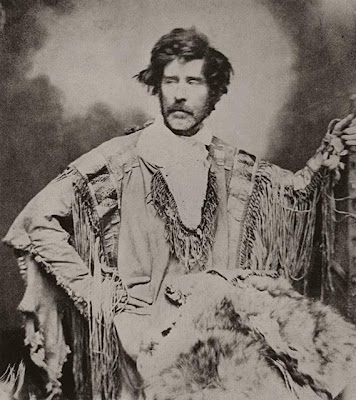
Paul Kane, circa late 1850s
PAUL KANE

I have often witnessed an Indian buffalo hunt since, but never one on so large a scale. In returning to the camp, I fell in with one of the hunters coolly driving a wounded buffalo before him. In answer to my inquiry why he did not shoot him, he said he would not do so until he got him close to the lodges, as it would save the trouble of bringing a cart for the meat. He had already driven him seven miles, and afterwards killed him within two hundred yards of the tents. That evening, while the hunters were still absent, a buffalo, bewildered by the hunt, got amongst the tents, and at last got into one, after having terrified all the women and children, who precipitately took to flight. When the men returned they found him there still, and being unable to dislodge him, they shot him down from the opening in the top.

From Wanderings of an Artist Among the Indians of North America, by Paul Kane