Showing posts with label wildlife. Show all posts

Friday, August 02, 2013

Guest Post: Gopher v. Man

I'm pretty sure you can trace the historic failings of the University of Minnesota sports teams to their choice of name:  Gophers.  In Minnesota lingo, at some point the teams started being called the "Goofers".  I think the football team last won the Big 10 championship and got to go to the Rose Bowl in about 1963, and I'm pretty sure they lost.  Basketball, baseball, wrestling, swimming, soccer -- quick, name me one national title the U of M teams have won in the last fifty or sixty years, even when they had Dave Winfield on both the basketball team and the football team ... .  
I thought so.
I'm pretty sure the Goofers could win a Foosball championship if the NCAA sanctioned it.  Those long winter nights, indoor activities fueled by camaraderie and beer, have definitely produced some bad-ass Foosball players.  Hit me with your best shot.
Gophers are not really vermin, but they are pests. They don't spread disease to humans, but they still wreak havoc.  They build these complex subterranean family homes, and spread the dirt in piles all over fields, gardens, and lawns.  They're kinda small, have nubby little tails, front feet with nails on the paws for scratching and digging, and goofy little curved yellow teeth that curl out of their lips -- also, I guess, for digging holes and tunnels and tearing up roots and destroying gardens.  One of their admirable qualities is industriousness, which is why they are also a bane.
Cute?  Do not be fooled!
Here is a picture of a gopher, in case you've never seen one up close. Notice the whiskers, the little beady eyes, the small pinned-back ears, and the yellow teeth.  Ugh.  Somebody ought to teach this guy some dental hygiene.  I've seen meth addicts with better teeth than that.

My dad hated Gophers.  Not as much as he hated Dick Cheney, but still, when he was creating his picture of the perfect hell for Dick Cheney I'm pretty sure there were gophers in there to torment the guy.

Sunday, November 06, 2011

Cheer(io) the Crow

Nancy gives Cheer a treat...
[Diamond Family Collection]


I recently posted a story about a crow who was raised by humans, and therefore had an unusual relationship with them and the the other residents of their small town. I wondered, did anyone have a photo of him? Turns out, someone did...

Growing up in a farm community it was not common for people to have actual pets.  We had several dogs and one was Dennis’s pet and there were always cats in the barn. 
When I was about 10, Dennis and Mickey Boatz robbed a crow’s nest up at the north farm and came home with three baby crows.  Dennis, Marlys and I adopted them, and kept them in a small wooden chicken cage in the yard.  We hand-fed them a diet of raw liver and dry food.  I named mine “Cheer” because he loved to eat Cheerios cereal. Cheer was the only one that survived.
When he got big enough to fly he roamed the town of Humboldt and actually got to be a pest.  He learned to peck on windows and wake people up as he was ready for food.  Jamie Rustad has a photo of him sitting on her playpen and he would steal her food.   So Dad decided we needed to remove him from town. We captured him and he took him back to the north farm and let him go.  I remember being so upset about losing my pet. 
Well, Cheer beat Dad back to town!!  He would sometimes come when I called his name and land on my head.  They are a pretty large bird when full grown so you knew he was sitting on your head. 
I was concerned how he would survive the winter but he met with an accident late that fall and died.   I have fond memories of my pet crow and a summer of adventure in Humboldt. 
Nancy
Cheer the Crow pays a visit to little Jamie Rustad
[October 1956 - Rustad Family Collection]

Thursday, October 20, 2011

Humboldt Stories: Cheer(ios) the Crow


The other day, I mentioned crows, which brought up some interesting responses.  My cousin told me how our Grandpa and Grandma Fitzpatrick had a pet crow of sorts that lived on the farm.  Someone had split its tongue so it could talk.  It wasn't kept captive, but hung around the farm, picking up human speech, and evidently would spout off some phrases once and awhile.  That sparked a memory from Mike Rustad...
We love crows in Vermont too. They are intelligent, loyal, and wonderful birds. I love them and feed them! Ever since the Diamond's crow Cheer (named because he like Cheerios) graced our life, I've loved crows. He  was an amazing pet crow that would sometimes take crackers from my baby sister's hand. Very gently. But Harvey Diamond had a lot of neighbor complaints and decided to drive Cheer out into the country. He shed a tear, but never fear - When he returned to his home in Humboldt, Cheer was waiting for him. Cheer lived a long life, but died in a tragic accident. He would perch on the Diamond's children's playhouse. One day a burst of wind caused the window to fall on Cheer and he was killed instantly. I remember crying because I lost a my dear bird friend.

Friday, April 01, 2011

Pembina: Unique

Masthead - The paper was started by Horace Greeley

The article below - part of a series on new states in the Union - was written by an east coast newspaper  journalist sent to report onsite.  It offers an interesting 'snapshot' view of one year in the life of the Pembina/St. Vincent area, in 1889.

At that time, it was a few years into the intense settlement period. The area had been opened up; gone were the old fur trading, mission, and exploration days. It was a time of rapid growth and change. Read about how it looked to an outsider...

Tuesday, March 02, 2010

A Sense of Place

From MINNESOTA GEOGRAPHIC NAMES: Their Origin and Historical Significance by Warren Upham (Minnesota Historical Society, 1920/1969)
Caribou township, organized January 8, 1908, had a few reindeer, of geographic limitation in the wooded and partly swampy region of northern Minnesota and Canada, named Rangifer caribou. The second word of the name is of Algonquin Indian origin, meaning a pawer or scratcher, in allusion to the habit of this animal in winter, pawing in the snow to eat the reindeer moss beneath.

Clow township commemorates several brothers of that name, early settlers there, who came from Prince Edward island. [NOTE: My great grandmother was Elizabeth Jane Clow, daughter of Samuel Clow, one of those brothers...]

Information has been gathered from "History of the Red River Valley," two volumes, 1909, the chapter for this county, by Edward Nelson, former register of deeds, being pages 923-966; and from interviews with Mr. Nelson and Axel Lindegard, a merchant in Hallock, the county seat, during a visit there in August 1909, and Edward A. Johnson, clerk of court, and gain with Mr. Lindegard, in a second visit there, September 1916.

Noyes, a station of the Great Northern and Soo railways adjoining the international boundary, was named in honor of J.A. Noyes, the U.S. customs collector there.

St. Vincent, organized March 19, 1880, is opposite to Pembina, N.D. Its name had been earlier given, before 1860, to a post of fur traders here, in honor of the renowned St. Vincent de Paul, founder of missions and hospitals in Paris, who died September 27, 1660, at the age of eighty years.
As Greg Breining says in his article A Sense of Place, "Good place names are like that--they may describe a place's shape or the animals that inhabit it. They may tell stories, of the people who settled it, who shaped it, and who fought for it."

Of Warren Upham, writer of the above-quoted book, Greg says, "Our sense of place is richly expressed in our names for places. In this regard, Minnesota was fortunate to have Warren Upham, geologist, archaeologist, librarian, and pack rat of obscure facts. It would be hard to imagine anyone better suited to the task of accounting for thousands of state place names."

Saturday, February 28, 2009

Profile: Putnam Burton Peabody

Six months ago I posted a photograph of of a man whose identity I didn't know, asking readers to comment if they thought they knew who he was. Today, I got my first response...
I think the photo of the man in a buggy outside the Episcopal church in St. Vincent is the Rev. Putnum B. Peabody, the minister there until about 1904. (I was surprised to see nothing about him on your St. Vincent web pages since he was such an important figure in its pre-1900 history.) I can't, of course, be certain it is him since the image of him in the photo is so small, but attached is a set of comparison images -- three of Peabody plus a vignette from your image. I note especially the shape of the head, the mustache, the nose, the expression, and in particular the ears all resemble Peabody. That being said, I actually cannot tell if the man in the buggy has a beard... I have no genealogical or traditional connection to St. Vincent; only an intense provincial appreciation of all things Minnesota. I have explored the Pembina Trail from St. Paul to the Canadian border, driven across Roseau and Kittson counties in search of birds and history, and camped in the woods throughout the northern counties. David Thompson would be my mentor. The Reverend Putnam Burton Peabody was a minister in St. Vincent and Hallock before leaving Minnesota about 1903. Peabody (1856–1937) was an ornithologist, Knight Templar, photographer, military captain, Episcopalian minister, Ancient Free and Accepted Mason, author, composer, oologist, nidiologist, and naturalist. He was also one of the pioneer ornithologists of Minnesota. He was a well-known authority on the Yellow Rail and he found the state’s only nesting records of White-faced Ibis. Throughout his life, he published numerous papers on the birds he observed in the places he visited. His notes appeared in The Auk, The Condor, The Oologist, Bird-Lore, The Ornithologist and Oologist, The Nidiologist, The Wilson Bulletin, The Journal of Field Ornithology, and The Warbler, among others. Though born in Wisconsin, Peabody’s spent his first 45 years in Minnesota where he studied birds, their nests, and their eggs. He lived in the towns of Faribault, Owatonna, Wilder, St. Vincent, and Hallock. He also frequented Heron Lake, the Roseau Bog, Mille Lacs, and other well known birding locations where he collected extensively. On 7 July 1890, Peabody married Anna Fulton Graham. They had three children, Lloyd Graham, born 12 April 1891, died 14 April 1891; Donald Francis, born 3 July 1892, died in 1899; and Vivian May, born 5 June 1896. In 1903, the family of three left Minnesota for Wyoming, but they eventually settled in Kansas in 1905. Peabody is an under-appreciated, forgotten pioneer of unusual significance in Minnesota's avifaunal history.
NOTE: The individual who contacted me wishes to remain anonymous...


Thursday, February 12, 2009

Red River Catfish

Not being a fisherman, I didn't know that the Red River of the North has the "...largest average size of channel catfish in the world." I knew they were in the river, but not much else.

Seen here, an illustration of a catfish, circa 1821, shows a powerful, fork-tailed fish with whisker-like barbells. Historically, this fish has been the most prized catch from the Red River. [Source: Library and Archives Canada]

Tuesday, December 30, 2008

Profile: Charles Hallock

One of the most signal projects which he has yet undertaken was instituted in 1879. It was the establishment of a Farm Colony for Sportsmen, in the extreme northwestern county of Minnesota, adjoining the Manitoba line. There, in the midst of the finest game and grain-producing region in America, he gathered around him many old friends of the rod and gun, and erected a large hotel at a cost of $12,000, which he hoped would become a stated resort for sportsmen during the summer and autumn seasons. His location was on the St. Paul, Minneapolis & Manitoba Railroad, and was called Hallock. It is the county seat of a rapidly developing section. He attempted to place the enterprise in the hands of a stock company because Jim Hill had frozen his tourists out. His scheme included a sylvan park of primitive forest, beautified by a winding river, where sportsmen might locate summer cottages and escape from periodical heated terms, but it failed. Carnegie would not assist. In 1892, Christmas night, the hotel burned up without insurance.

From An Angler's Reminiscences by Charles Hallock

The Hallock Hotel during its heyday

Saturday, November 08, 2008

Eyewitness to a Hunt


The Red River Buffalo hunt was unique in North America. In the story of the westward march of civilization across the continent no other people organized themselves so efficiently and so extensively for a systematic assault on the buffalo herds.

These large organized hunts began in the early 1820s and continued until the early 1870s, though with gradually diminishing enthusiasm and extent as the herds dwindled and withdrew farther and farther westward. Probably no comparable community depended for so long a time and to such an extent on the "plains provisions" which the great hunts provided.

This excerpt, taken from Red River Settlement is of the spring hunt of 1840. At this time the importance of the buffalo to the economy of Red River would be hard to exaggerate. Though this account is of particular events which the writer witnessed, everything that he tells us may be considered typical of most of the great hunts.


From Manitoba Historical Society introduction notes to the following account...
___________________________

On the 15th day of June 1840, carts were seen to emerge from every nook and corner of the settlement, bound for the plains.

From Fort Garry the cavalcade and camp-followers went crowding on to the public road, and thence, stretching from point to point, till the third day in the evening, when they reached Pembina, the great rendezvous on such occasions.

Here the roll was called, and general muster taken, when they numbered, on this occasion, 1,630 souls; and here the rules and regulations for the journey were finally settled. The officials for the trip were named and installed into office; and all without the aid of writing materials.

The camp occupied as much ground as a modern city, and was formed in a circle; all the carts were placed side by side, the trains out-ward. These are trifles, yet they are important to our subject. Within this line of circumvallation, the tents were placed in double, treble rows, at one end; the animals at the other in front of the tents. This is in order in all dangerous places; but where no danger is apprehended, the animals are kept on the outside. Thus the carts formed a strong barrier, not only for securing the people and their animals within, but as a place of shelter against an attack of the enemy without.
In 1820, the number of carts assembled here for the first trip was 540

In 1825, 680

In 1830, 820

In 1835, 970

In 1840, 1210
From this statement it is evident that the plain hunters are rapidly increasing ... The first step was to hold a council for the nomination of chiefs or officers, for conducting the expedition. Ten captains were named, the senior on this occasion being Jean Baptiste Wilkie, an English half-breed, brought up among the French; a man of good sound sense and long experience, and withal a fine bold-looking and discreet fellow; a second Nimrod in his way. Besides being captain, in common with the others, he was styled the great war chief or head of the camp; and on all public occasions he occupied the place of president. All articles of property found, without an owner, were carried to him, and he disposed of them by crier, who went around the camp every evening, were it only an awl. Each captain had ten soldiers under his orders; in much the same way that policemen are subject to the magistrate. Ten guides were likewise appointed; their duties were to guide the camp, each in his turn — that is day about — during the expedition. The camp flag belongs to the guide of the day; he is therefore standard-bearer in virtue of his office.

The raising of the flag every morning is the signal for raising camp. Half an hour is the full time allowed to prepare for the march; but if any one is sick, or their animals have strayed, notice is sent to the guide, who halts till all is made right. From the time the flag is hoisted, however, till the hour of camping arrives, it is never taken down. The flag taken down is the signal for encamping. While it is up, the guide is chief of the expedition. Captains are subject to him, and the soldiers of the day are his messengers; he commands all. The moment the flag is lowered, his functions cease, and the captains' and soldiers' duties commence. They point out the order of the camp, and every cart, as it arrives, moves to its appointed place. This business usually occupies about the same time as raising camp in the morning; for everything moves with the regularity of clock-work.

All being ready to leave Pembina, the captains and other chief men hold another council, and lay down the rules to be observed during the expedition; those made on the present occasion were:

1. No buffalo to be run on the Sabbath-day.

2. No party to fork off, lag behind, or go before, without permission.

3. No person or party to run buffalo before the general order.

4. Every captain with his men, in turn, to patrol the camp, and keep guard.

5. For the first trespass against these laws, the offender to have his saddle and bridle cut up.

6. For the second offence, the coat to be taken off the offender's back, and be cut up.

7. For the third offence, the offender to be flogged.

8. Any person convicted of theft, even to the value of a sinew, to be brought to the middle of the camp, and the crier to call out his or her name three times, adding the word "Thief" at each time.
From Alexander Ross, The Red River Settlement: Its Rise, Progress, and Present State (Edmonton: Hurtig Publishers, 1972), pp. 245, 248-250

Wednesday, October 29, 2008

Return of the Elk


Elk have been returning to Kittson County for awhile now, but it wasn't until this year that it was felt they were sufficient in numbers to once again allow their hunting.

This is the zone it covers...

Saturday, September 06, 2008

Buffalo Hunt - PART II

Minnsota Buffalo Hunt - Butchering
Camping amongst the Slain. — Wholesale Slaughter. — A Sick Guide. — Parting from the Half-breeds. — A False Alarm. — Dismal Night's Lodging. — Dreadful Position. — Stinking River. — Death of the Guide. — Paternal Government. — The Fire - Water Curse.

OUR camp was now moved to the field of slaughter, for the greater convenience of collecting the meat. However lightly I wished to think of my fall, I found myself the next day suffering considerably from the effects of it, and the fatigue I had undergone. The man whom I had brought with me as a guide was also suffering much from an attack of the measles. Next day our hunters sighted and chased another large band of bulls with good success. At night we were annoyed by the incessant howling and fighting of innumerable dogs and wolves that had followed us to the hunt, seemingly as well aware of the feast that was preparing for them as we could be ourselves. The plain now resembled one vast shambles : the women, whose business it is, being all busily employed in cutting the flesh into slices, and hanging them in the sun on racks, made of poles tied together.

In reference to the immense number of buffaloes killed, I may mention that it is calculated that the half-breeds alone destroy thirty thousand annually. Having satisfied myself with buffalo hunting amongst the half-breeds, I was anxious to return to the settlement, in order to prosecute my journey. On proposing to set out I found my guide so unwell, that I feared he would not be able to travel. I tried to procure one of the hunters to take his place and return with me, but none of them would consent to travel alone over so large a tract of country, from fear of the Sioux, in whose territory we then were; and who they dreaded, from the late occurrence, would be watching to cut off any stragglers. Being unable to procure a fresh man, I was about to start alone, when my guide, who thought himself better, proposed to accompany me, on condition that he should ride in the cart, and not be expected to attend to the horses or cooking. This I readily agreed to, as his services as guide were of the utmost importance.

We started next morning for the settlement, a distance which I supposed to be somewhat over two hundred miles. A party of twenty of the hunters escorted us for eight or ten miles, to see that there were no Sioux in the immediate vicinity. We then parted, after taking the customary smoke on separating from friends. I could not avoid a strong feeling of regret at leaving them, having experienced many acts of kindness at their hands, hardly to be expected from so wild and uncultivated a people. We found a great scarcity of water on our return, most of the swamps that had supplied us on our way out being now dried up by the heat of the season.

We fell in with a great many stray dogs and wolves, which appeared to be led on by the scent of the dead carcases. After hobbling the horses, putting up my tent, and cooking the supper, I then turned in for the night, not without some apprehensions of a hostile visit from the Sioux, as we were still on their hunting grounds, and in the territory of the United States, being still a few miles south of the boundary line. During the night my guide, who was very ill and feverish, cried out that the Sioux were upon us. I started up with my gun in my hand, for I slept with it by my side, and rushing out in the dark, was near shooting my own horse, which, by stumbling over one of the tent pins, had alarmed my companion.

We travelled on the next day with as great rapidity as the ill health of my guide would permit, and on the evening of the 30th of June, we encamped on the bank of the Pambinaw. I lost considerable time next morning in catching the horses, as they are able from habit to run a considerable distance, and pretty fast, in spite of their hobbles. In the afternoon we arrived at the Swampy Lake, about fourteen miles across. A little before sunset we reached about the middle of it, but my guide complained so much that I could not proceed further.

I succeeded in finding a small dry spot above water large enough for me to sit on, but not affording room for my legs, which had to remain in the water, there being no more room in the small cart than was necessary for the sick man. Having no means for cooking, I was compelled to eat my dried meat raw. I tried to compose myself to sleep, but found it impossible, from the myriads of mosquitoes which appeared determined to extract the last drop of blood from my body. After battling with them until 4 o'clock next morning, my eyes almost blinded by their stings, I went in search of the horses, which had strayed away to some distance into deeper water, tempted by some sort of flags growing there. I had to wade up to my middle in pursuit of them, and it was not until 9 o'clock that we were able to proceed.

After leaving this dismal swamp we were within a day's march of the settlement ; and my guide, believing himself to be much better, insisted upon my leaving him to drive the cart, whilst I proceeded at a more rapid rate on horseback. This, however, I would not do until I had seen him safe across Stinking River, which the horses had almost to swim in crossing.

Having got him over safely, I left him, and proceeded onwards in the direction of the fort. But I had not gone far before I encountered one of the numerous swampy lakes that abound in this region, and render travelling extremely difficult. I had no doubt got on a wrong track, for in endeavouring to cross, my horse quickly sank up to his neck in mud and water. Seeing that I could neither advance nor recede, I dismounted, and found myself in the same predicament, scarcely able to keep my head above the surface. I managed, however, to reach the dry land ; and, with the lasso, or long line, which every voyageur in these parts invariably has attached to his horse's neck, succeeded In getting the animal out. I remounted, and endeavoured to cross in another direction, but with no better success. I now found myself surrounded on all sides, as far as I could see, with nothing but swamp. My horse refused to be ridden any further. I had therefore, to dismount, and drag him along as best I could, wading up to my very middle in mud and water abounding with reptiles.

That I had lost my way was now certain; and as it was raining hard, I could not see the sun, nor had I a compass. I, however, determined to fix upon one certain course, and keep that at all hazards, in hopes that I might reach the Assiniboine River, by following which I could not fail to reach the settlement. After travelling in uncertainty for ten or twelve miles, I had at length the satisfaction of reaching the river, and in two hours afterwards I arrived safe at Fort Garry. The next morning I learned that my guide had been brought in by two men who were looking for stray horses. The poor fellow had got rapidly worse after my leaving, and had only proceeded a short distance when he was compelled to stop. He only survived two days after his arrival.

Fort Garry is one of the best built forts in the Hudson's Bay territory. It has a stone wall, with bastions mounted with cannon, inclosing large storehouses and handsome residences for the gentlemen of the establishment. Its strength is such that it has nothing to fear from the surrounding half-breeds or Indians. The gentleman in charge was Mr. Christie, whose many acts of kindness and attention I must ever remember with feelings of grateful respect.

The office of Governor of the Red River Settlement is one of great responsibility and trouble, as the happiness and comfort of the whole settlement depend to a great extent upon the manner in which he carries out his instructions. The half-breeds are much inclined to grumbling, and although the Company treat them with great liberality, they still ask almost for impossibilities ; indeed, as far as the Company is concerned, I cannot conceive a more just and strict course than that which they pursue in the conduct of the whole of their immense traffic. In times of scarcity they help all around them, in sickness they furnish them with medicines, and even try to act as mediators between hostile bands of Indians. No drunkenness or debauchery is seen around their posts, and so strict is their prohibition of liquor, that even their officers can only procure a small allowance, which is given as part of their annual outfit on voyages.

Without entering into the general question of the policy of giving a monopoly of the fur trade to one company, I cannot but record, as the firm conviction which I formed from a comparison between the Indians in the Hudson's Bay Company territories and those in the United States, that opening up the trade with the Indians to all who wish indiscriminately to engage in it, must lead to their annihilation. For while it is the interest of such a body as the Hudson's Bay Company to improve the Indians and encourage them to industry, according to their own native habits in hunting and the chase, even with a view to their own profit, it is as obviously the interest of small companies and private adventurers to draw as much wealth as they possibly can from the country in the shortest possible time, although in doing so the very source from which the wealth springs should be destroyed. The unfortunate craving for intoxicating liquor which characterises all the tribes of Indians, and the terrible effects thereby produced upon them, render it a deadly instrument in the hands of designing men.

It is well known that, although the laws of the United States strictly prohibit the sale of liquor to the Indians, it is impossible to enforce them, and whilst many traders are making rapid fortunes in their territories, the Indians are fast declining in character, numbers, and wealth, whilst those in contact with the Hudson's Bay Company maintain their numbers, retain native characteristics unimpaired, and in some degree share in the advantages which civilisation places within their reach.

From Wanderings of an Artist Among the Indians of North America, by Paul Kane

Sunday, August 31, 2008

Buffalo Hunt - PART I

Buffalo Hunt by Paul KanePlain of Roses. — A Desert Filter. — Making Pimmi-kon. — Canine Camp-followers. — Dry Dance Mountain. — Vigils of the Braves. — Death at the Feast. — Successful Ambush. — The Scalp Dance. — A Hunter's Appetite. — The Grand Chase. — Marking the Game. — Head over Heels. — Sketching under Difficulties. — A Troublesome Tenant.
I ARRIVED at Fort Garry about three days after the half-breeds had departed ; but as I was very anxious to witness buffalo hunting, I procured a guide, a cart for my tent, and a saddle horse for myself, and started after one of the bands. We travelled that day about thirty miles, and encamped in the evening on a beautiful plain covered with innumerable small roses. The next day was anything but pleasant, as our route lay through a marshy tract of country, in which we were obliged to strain through a piece of cloth all the water we drank, on account of the numerous insects, some of which were accounted highly dangerous, and are said to have the power of eating through the coats of the stomach, and causing death even to horses.

The next day I arrived at the Pambinaw [Pembina] River, and found the band cutting poles, which they are obliged to carry with them to dry the meat on, as, after leaving this, no more timbered land is met with until the three bands meet together again at the Turtle Mountain, where the meat they have taken and dried on the route is made into pim-mi-kon. This process is as follows: — The thin slices of dried meat are pounded between two stones until the fibres separate; about 501bs. of this are put into a bag of buffalo skin, with about 401bs. of melted fat, and mixed together while hot, and sewed up, forming a hard and compact mass; hence its name in the Cree language, pimmi signifying meat, and kon, fat. Each cart brings home ten of these bags, and all that the half-breeds do not require for themselves is eagerly bought by the Company, for the purpose of sending to the more distant posts, where food is scarce. One pound of this is considered equal to four pounds of ordinary meat, and the pimmi-kon keeps for years perfectly good exposed to any weather.

I was received by the band with the greatest cordiality. They numbered about two hundred hunters, besides women and children. They live, during these hunting excursions, in lodges formed of dressed buffalo skins. They are always accompanied by an immense number of dogs, which follow them from the settlements for the purpose of feeding on the offal and remains of the slain buffaloes. These dogs are very like wolves, both in appearance and disposition, and, no doubt, a cross breed between the wolf and dog. A great many of them acknowledge no particular master, and are sometimes dangerous in times of scarcity. I have myself known them to attack the horses and eat them.

Our camp broke up on the following morning, and proceeded on their route to the open plains. The carts containing the women and children, and each decorated with some flag, or other conspicuous emblem, on a pole, so that the hunters might recognise their own from a distance, wound off in one continuous line, extending for miles, accompanied by the hunters on horseback. During the forenoon, whilst the line of mounted hunters and carts were winding round the margin of a small lake, I took the opportunity of making a sketch of the singular cavalcade.

The following day we passed the Dry Dance Mountain [aka Dry Dance Hill or Ne-Jank-wa-win], where the Indians, before going on a war party, have a custom of dancing and fasting for three days and nights. This practice is always observed by young warriors going to battle for the first time, to accustom them to the privations and fatigues which they must expect to undergo, and to prove their strength and endurance. Should any sink under the fatigue and fasting of this ceremony, they are invariably sent back to the camp where the women and children remain.
Pembina Mountain rises on the north and east in a series of table-lands, each table about half a mile in width, sparsely timbered, and bountifully supplied with springs. On its western slope, at the base of which runs the Pembina River, the mountain terminates abruptly. Across the stream, flowing deep below the surface in a narrow valley, the banks remain of about an equal height with the mountain, stretching away toward the Missouri in a bare, treeless plain, broken only by the solitary elevation in the dim distance of Ne-Jank-wa-win (Dry Dance Hill). - From A Great Buffalo "Pot-Hunt" by H.M. Robinson
After leaving this mountain, we proceeded on our route without meeting any buffalo, although we saw plenty of indications of their having been in the neighbourhood a short time previously. On the evening of the second day we were visited by twelve Sioux chiefs, with whom the half-breeds had been at war for several years. They came for the purpose of negotiating a permanent peace, but, whilst smoking the pipe of peace in the council lodge, the dead body of a half-breed, who had gone to a short distance from the camp, was brought in newly scalped, and his death was at once attributed to the Sioux. The half-breeds, not being at war with any other nation, a general feeling of rage at once sprang up in the young men, and they would have taken instant vengeance, for the supposed act of treachery, upon the twelve chiefs in their power, but for the interference of the old and more temperate of the body, who, deprecating so flagrant a breach of the laws of hospitality, escorted them out of danger, but, at the same time, told them that no peace could be concluded until satisfaction was had for the murder of their friend. Exposed, as the half-breeds thus are, to all the vicissitudes of wild Indian life, their camps, while on the move, are always preceded by scouts, for the purpose of reconnoitring either for enemies or buffaloes. If they see the latter, they give signal of such being the case, by throwing up handfuls of dust; and, if the former, by running their horses to and fro.

Three days after the departure of the Sioux chiefs, our scouts were observed by their companions to make the signal of enemies being in sight. Immediately a hundred of the best mounted hastened to the spot, and, concealing themselves behind the shelter of the bank of a small stream, sent out two as decoys, who exposed themselves to the view of the Sioux. The latter, supposing them to be alone, rushed upon them, whereupon the concealed half-breeds sprang up, and poured in a volley amongst them, which brought down eight. The others escaped, although several must have been wounded, as much blood was afterwards discovered on their track. Though differing in very few respects from the pure Indians, they do not adopt the practice of scalping ; and, in this case, being satisfied with their revenge, they abandoned the dead bodies to the malice of a small party of Saulteaux who accompanied them.

The Saulteaux are a band of the great Ojibeway nation, both words signifying "the Jumpers," and derive the name from their expertness in leaping their canoes over the numerous rapids which occur in the rivers of their vicinity. I took a sketch of one of them, Peccothis, "the Man with a Lump on his Navel." He appeared delighted with it at first ; but the others laughed so much at the likeness, and made so many jokes about it, that he became quite irritated, and insisted that I should destroy it, or, at least, not show it as long as I remained with the tribe.

The Saulteaux, although numerous, are not a warlike tribe, and the Sioux, who are noted for their daring and courage, have long waged a savage war on them, in consequence of which the Saulteaux do not venture to hunt in the plains except in company with the half-breeds. Immediately on their getting possession of the bodies, they commenced a scalp dance, during which they mutilated the bodies in a most horrible manner. One old woman, who had lost several relations by the Sioux, rendered herself particularly conspicuous by digging out their eyes and otherwise dismembering them.

The following afternoon, we arrived at the margin of a small lake, where we encamped rather earlier than usual, for the sake of the water. Next day I was gratified with the sight of a band of about forty buffalo cows in the distance, and our hunters in full chase ; they were the first I had seen, but were too far off for me to join in the sport. They succeeded in killing twenty-five, which were distributed through the camp, and proved most welcome to all of us, as our provisions were getting rather short, and I was abundantly tired of pimmi-kon and dried meat. The fires being lighted with the wood we had brought with us in the carts, the whole party commenced feasting with a voracity which appeared perfectly astonishing to me, until I tried myself, and found by experience how much hunting on the plains stimulates the appetite.

The upper part of the hunch of the buffalo, weighing four or five pounds, is called by the Indians the little hunch. This is of a harder and more compact nature than the rest, though very tender, and is usually put aside for keeping. The lower and larger part is streaked with fat and is very juicy and delicious. These, with the tongues, are considered the delicacies of the buffalo. After the party had gorged themselves with as much as they could devour, they passed the evening in roasting the marrow bones and regaling themselves with their contents.

For the next two or three days we fell in with only a single buffalo, or small herds of them; but as we proceeded they became more frequent. At last our scouts brought in word of an immense herd of buffalo bulls about two miles in advance of us. They are known in the distance from the cows, by their feeding singly, and being scattered wider over the plain, whereas the cows keep together for the protection of the calves, which are always kept in the centre of the herd. A half-breed, of the name of Hallett, who was exceedingly attentive to me, woke me in the morning, to accompany him in advance of the party, that I might have the opportunity of examining the buffalo whilst feeding, before the commencement of the hunt. Six hours' hard riding brought us within a quarter of a mile of the nearest of the herd. The main body stretched over the plains as far as the eye could reach. Fortunately the wind blew in our faces : had it blown towards the buffaloes, they would have scented us miles off.

I wished to have attacked them at once, but my companion would not allow me until the rest of the party came up, as it was contrary to the law of the tribe. We, therefore, sheltered ourselves from the observation of the herd behind a mound, relieving our horses of their saddles to cool them. In about an hour the hunters came up to us, numbering about one hundred and thirty, and immediate preparations were made for the chase. Every man loaded his gun, looked to his priming, and examined the efficiency of his saddle-girths.

The elder men strongly cautioned the less experienced not to shoot each other; a caution by no means unnecessary, as such accidents frequently occur. Each hunter then filled his mouth with balls, which he drops into the gun without wadding; by this means loading much quicker and being enabled to do so whilst his horse is at full speed. It is true, that the gun is more liable to burst, but that they do not seem to mind. Nor does the gun carry so far, or so true ; but that is of less consequence, as they always fire quite close to the animal.

Everything being adjusted, we all walked our horses towards the herd. By the time we had gone about two hundred yards, the herd perceived us, and started off in the opposite direction at the top of their speed. We now put our horses to the full gallop, and in twenty minutes were in their midst. There could not have been less than four or five thousand in our immediate vicinity, all bulls, not a single cow amongst them.

The scene now became one of intense excitement ; the huge bulls thundering over the plain in headlong confusion, whilst the fearless hunters rode recklessly in their midst, keeping up an incessant fire at but a few yards' distance from their victims. Upon the fall of each buffalo, the successful hunter merely threw some article of his apparel — often carried by him solely for that purpose — to denote his own prey, and then rushed on to another. These marks are scarcely ever disputed, but should a doubt arise as to the ownership, the carcase is equally divided among the claimants.

The chase continued only about one hour, and extended over an area of from five to six square miles, where might be seen the dead and dying buffaloes, to the number of five hundred. In the meantime my horse, which had started at a good run, was suddenly confronted by a large bull that made his appearance from behind a knoll, within a few yards of him, and being thus taken by surprise, he sprung to one side, and getting his foot into one of the innumerable badger holes, with which the plains abound, he fell at once, and I was thrown over his head with such violence, that I was completely stunned, but soon recovered my recollection. Some of the men caught my horse, and I was speedily remounted, and soon saw reason to congratulate myself on my good fortune, for I found a man who had been thrown in a similar way, lying a short distance from me quite senseless, in which state he was carried back to the camp.

I again joined in the pursuit; and coming up with a large bull, I had the satisfaction of bringing him down at the first fire. Excited by my success, I threw down my cap and galloping on, soon put a bullet through another enormous animal. He did not, however, fall, but stopped and faced me, pawing the earth, bellowing and glaring savagely at me. The blood was streaming profusely fusely from his mouth, and I thought he would soon drop. The position in which he stood was so fine that I could not resist the desire of making a sketch. I accordingly dismounted, and had just commenced, when he suddenly made a dash at me. I had hardly time to spring on my horse and get away from him, leaving my gun and everything else behind.

When he came up to where I had been standing, he turned over the articles I had dropped, pawing fiercely as he tossed them about, and then retreated towards the herd. I immediately recovered my gun, and having reloaded, again pursued him, and soon planted another shot in him ; and this time he remained on his legs long enough for me to make a sketch. This done I returned with it to the camp, carrying the tongues of the animals I had killed, according to custom, as trophies of my success as a hunter.
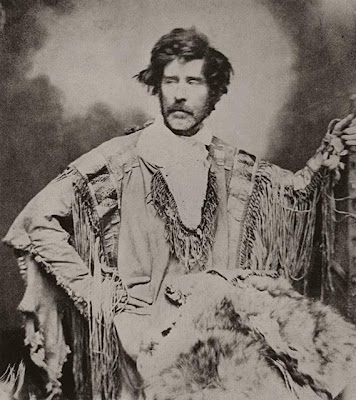
Paul Kane, circa late 1850s
PAUL KANE

I have often witnessed an Indian buffalo hunt since, but never one on so large a scale. In returning to the camp, I fell in with one of the hunters coolly driving a wounded buffalo before him. In answer to my inquiry why he did not shoot him, he said he would not do so until he got him close to the lodges, as it would save the trouble of bringing a cart for the meat. He had already driven him seven miles, and afterwards killed him within two hundred yards of the tents. That evening, while the hunters were still absent, a buffalo, bewildered by the hunt, got amongst the tents, and at last got into one, after having terrified all the women and children, who precipitately took to flight. When the men returned they found him there still, and being unable to dislodge him, they shot him down from the opening in the top.

From Wanderings of an Artist Among the Indians of North America, by Paul Kane

Wednesday, April 09, 2008

Minnesota Safari: Kittson County

In a recent article, a heretofore unknown project was featured. It is the passion and some would say, life's work, of a Kittson County resident, and something I am proud to say our county has been a part of.

The natural world is precious, as we all know only too well in this modern world. Our home county has a great diversity, being both open plain and wooded in parts. On top of that, we have plenty of marshes, sloughs, and the Red River itself, which is very good indeed considering we're on a major migration route for waterfowl in North America (as well as Monarch butterflies...)

Thanks to William Ash for alerting me to this information