Showing posts with label railroads. Show all posts

Saturday, June 05, 2021

J.J. Hill Obituary


J. J. Hill Dead In St. Paul Home At The Age of 77 

Special to THE NEW YORK TIMES

ST. PAUL, May 29--James J. Hill, builder of the "Northwest Empire," died at 9:30 A.M. today at his house, 240 Summit Avenue.

In his room, in the southeast corner on the second floor of the brownstone house, overlooking the city to which he came sixty years ago as a clerk, the end came. His age, 77 years, was a handicap in combating the hemorrhoidal infection, which dates from May 17.

At the bedside were the children, hastily summoned from homes throughout the nation, the only member of the immediate family not present being Mrs. Anson M. Beard of New York. Kneeling at the bed, her hands clasping the hand of the man whose wife and helpmate she had been since 1867, was Mrs. Hill. Nearby was the Rev. Thomas J. Gibbons, Vicar General of the Catholic Diocese of St. Paul, Mr. Hill having for years been on intimate terms with the clergy here, though not a member of the Church to which his wife belongs.

The Mayo Brothers attended Hill during his last days...

Dr. Hermann M. Biggs, who was called into consultation during the last illness of the financier, was the only physician present as the end approached. Drs. William F. and Charles H. Mayo had gone; there was no more they could do.

John J. Toomey, Mr. Hill's confidential business agent for many years, left the Hill residence twenty minutes after his chief died. Shortly afterward came Ralph Budd, assistant to Louis W. Hill, President of the Great Northern. Then came Louis W. Hill. The latter walked between the Rev. Father Gibbons and George A. MacPherson, intimate friend of the family. Grief, showing plainly in the faces of all the men, was most poignant in the face of the son, Louis, who will take up the generalship of the interests his father built and husbanded.

The funeral will be held at his Summit Avenue home at 2 P.M. Wednesday. Interment will be in a private mausoleum to be erected at North Oaks, long the summer home of the Empire Builder.

The general public will not have an opportunity formally to pay tributes to the leading citizen of the Northwest, but Mr. Hill's associates and the faithful employes who made possible his great achievements will be admitted to the house to view the body before the funeral services. The family statement includes a request that no flowers be sent. The Rev. Thomas J. Gibbons, vicar general of the Catholic diocese of St. Paul, who attended Mr. Hill during his last few hours, will officiate at the funeral.

The family statement was as follows:

Sunday, September 13, 2020

A Lifetime of a Depot: NOYES

Depot built 1906 (joint GN/SOO Depot) - 30' x 137' frame. 
Depot remodeled 1912. 
Burned 1921. 
Depot 30' x 138' rebuilt 1922.  
10' x 20' addition added 1924.
Remodeled 1943. 
North 32 feet of Depot removed in 1966 and Depot rebuilt 1967 (after 1966 flood) - platforms removed, landscaping built up to accommodate dike around town.

Torn down/demolished:  August 2020.


Monday, September 02, 2019

St. Vincent Railway Post Offices


The railway mail service was...

The state’s first international RPO, the St. Vincent & Winnipeg, initiated service from that Kittson County town to Canada in August 1881.

My great uncle, Charlie Fitzpatrick, and later his brother, Dick Fitzpatrick, both worked at the St. Vincent depot, and one of their daily responsibilities would be to switch out the mailbags, both incoming and outgoing.  Some of the sorting for the various towns on the particular RPO was done on the trains, separating for each town they were responsible for.  Once delivered to St. Vincent, for example, then the town's postmaster would do the final sort for each postal customer.


Sunday, June 09, 2019

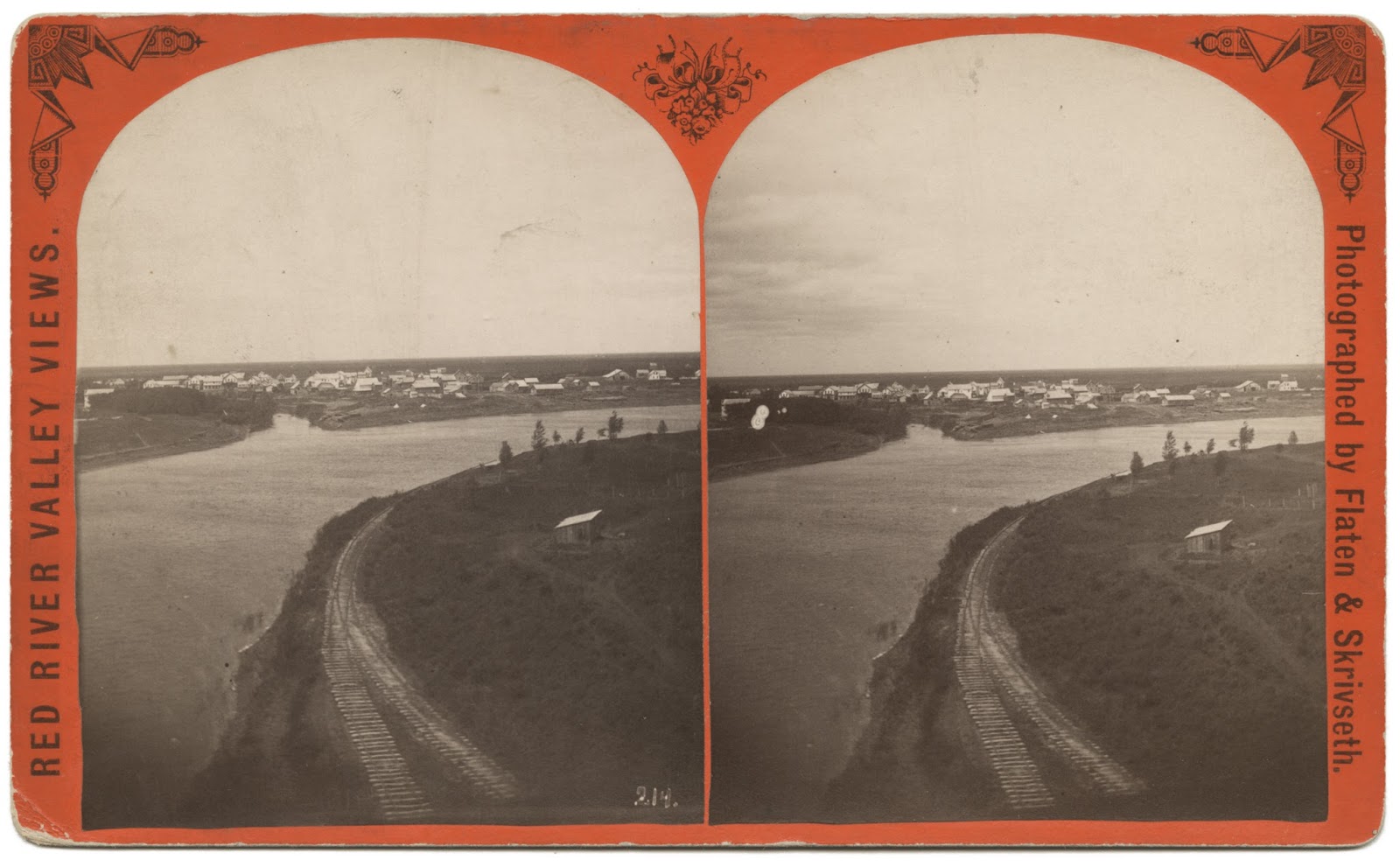
"...reserved a right-of-way along the top of the river bank"

PHOTO INFO: A stereoview showing the railroad track along the eastern bank of the Red River in St. Vincent.  This track is the continuation of the one coming in from the east into town from the "Y".  This was laid down early on in anticipation of the main line going through town and over the river, but a rail bridge was never built.

Swan Anderson would get fan mail from people far and wide that had once lived in St. Vincent and the surrounding area, generated from his newspaper columns for the Enterprise, and even from his toll-free phone number into his home. Swan kept sharing history even when he was in the nursing home. And thank goodness he did.

Speaking of fan mail, let me share with you a letter Swan received from the LeMasuriers of Ontario, California; as many reading this may remember, the LeMasurier family lived in St. Vincent at one time.  This letter shares some more history about St. Vincent and the railroads. Please note that the story told in the letter is second-hand, being told to the LeMasurier family by George (aka "Shorty") and Bessie Cowan. That does not make it any less true, but I wanted to be sure everyone knows the chain of how the story came to us.

Read on...

Before the turn of the century and when the railroad from Winnipeg east wasn't finished, St. Vincent was a booming railroad town. The round house was out by Lake Stella and had a turntable to turn the engines around. The long depot in St. Vincent housed the Customs and Immigration offices. There was also a Signal House. In 1901 William LeMasurier bought it and moved it to his farm north of St. Vincent. He and his bride, the former Maggie Easter, started housekeeping there in 1902. The land north of St. Vincent and west of the Emerson road was all railroad land. Phillip LeMasurier bought some and later sold it to his sons, William and Arthur. John and George Cowan bought some, also Mose Parenteau and Austin Griffith. The railroad reserved a right-of-way along the top of the river bank. Bessie Cowan told me at one time the railroad had planned to build a bridge across the Red River on Shorty's land.

The land that the railroad bridge would have crossed into/from is located on this plat map in the northwest corner of Section 35, labeled George Cowan . . .
The Great Northern Hotel was a three-story building with a ballroom on the third floor. Bessie Cowan gave us a picture of it and we left it with the Pembina Museum when we left St. Vincent. When the hotel was torn down, the attached section that was the kitchen was bought by the Russells and made into their home. Later, Harold Easton bought it and finally Milton Gregoire bought it and tore it down, and built what is now known as the Nellie Blair house.

There was a strip of land from the Red River to the Emerson road, 137 acres in the Village of St. Vincent on its north side. Austin Griffith bought the 36 acres next to the Emerson road and Charlie LeMasurier bought the rest from Peter Monro. Harris remembers when Charlie had a lot cleared along the river. The man doing the work used oxen. Mrs. Morrow, who lived in St. Vincent, used to pick roots and would give Harris fifty cents to haul a load to town for her.

Tuesday, May 14, 2019

Working on the St. Vincent Extension

Recently, I came across an online post by someone who mentioned that his grandfather had worked on the St. Vincent Extension line.  While the original line was finished in 1878, there were modifications to, as well as major maintenance of, thereafter.  It was a few years later, that his grandfather worked in our area.  I asked him if he had any stories or photographs of that time period, and he shared this with me...
This is my paternal grandparent's family -- Charles & Mary [Hendrickson] Torrin, Hilma the oldest, My father, Oscar in the back, with Maybelle behind Mary. The little girl in front, Luella, helps us date the picture; she was born in Roseau County, on the newly purchased farm, in 1901. She died of diphtheria in 1908, just weeks after her little sister was born. Charles was functionally blind from railroad work accidents, and was about 46 when he moved north and purchased the farm near Fox, between Badger and Roseau MN. 
St. Paul Daily Globe, November 29, 1893
My grandfather, Charles Torrin, was a line foreman laying track. In 1891, a sliver of steel flew up into his eye. A year later, he was back at work, and a similar event pierced his other eye, leaving him functionally blind. The family returned to Alexandria to recover. The event was noted in a St Paul paper at the time. 
The story only just begins here. After several years in Douglas county, at the age of 46 and blind, he bought a farm in Roseau Co, in 1901, and raised his family there until his death in 1929. 
His father, Oscar Torrin was born in St. Vincent in 1891 while his grandfather was working on the St. Vincent Extension.


Friday, April 27, 2018

The Litchfield Brothers - "...Minnesota beckoned them in 1862"

Electus Backus Litchield
"Flagrantly & monumentally impudent"
How did the St. Vincent Extension (which was the rail line between east St. Cloud and St. Vincent) get made?  Well, it so happens that St. Vincent had its own version of "Hell on Wheels"... 

In the course of his various "business enterprises", E.B. Litchfield is said to have bought many an elected official. Except for one: Populist Congressman Ignatius Donnelly of Minnesota. While Donnelly worked for all the railroads in Minnesota at one time or another, he refused to continue working for E.B. Litchfield and the First Division St.P&P RR.

While lobbying Congress to expand the St.P&P RR land grant to 10 sections (square miles) per mile of track built, E.B. needed the help of members of Congress. Railroads would sometimes hire sitting members of Congress (and other elected officials) to serve as their "legal counsel".

In 1868, Donnelly wrote to E.B. regarding his $1,000 "retainer" and position as legal counsel to the First Division: "The matter has given me no little uneasiness of conscience. I have been laboring under the fear and dread I might instinctively be willing to do more for your company as attorney than I would if I did not hold that relation to it." Donnelly even offered to return the $1,000 or perform some actual legal services for the money.


Electus was just one of five Litchfield brothers, all involved in one way or another with the railroad business.  Their main involvement: Investment.

Edwin Clark Litchfield was put in charge of the First Division.  He agreed to finance the branch line from St. Paul to St. Cloud.  To the Associates1, he was a greatly vexed investor, "a wary old bird".  The Associates had trusted allies in Horace Thompson and Edmund Rice, who promised to "leave no stone unturned to bring about a reconciliation" between the contending parties.  If they failed, the Associates had contingency plans "to handle, with or without gloves on," Litchfield, Becker, Farley, and anyone else who got in the way.  They had not come this far only to lose the much-coveted land grant from St. Paul to the Canadian Border.

Source:  Google Books
A second act, one of the many "special acts" of the Minnesota legislature appropriating funds to further build out the railway lines, provided for another land-grant line - an extension branch from St. Cloud to Minnesota's northern border at the town of St. Vincent.

1867 was the year the British North America Act granted Canadians their political independence.  "Knowing that newly independent Canadians would soon embark on their own transcontinental railroad schemes, SP&P directors held a special stockholders meeting to map out ways to pull northern wheat-growing riches down a proposed Canadian Pacific Railroad (CPR) branch line from Winnipeg to the international border, through St. Vincent, and then down into St. Paul.  On the strength of this scheme, the state legislature gladly renegotiated the land grants, rescheduling their completion for 1878."

The plan was for SP&P to construct a northern extension, connecting first with the NPR main line near Fargo, then with the proposed CPR branch line at St. Vincent.

Elisha Cleveland Litchfield
One of the brothers who swooped in, bought up several
railroads,  and sold them for profit as fast as possible. . .
Erasmus Darwin Litchfield - genially called "the old rat"...was "ornery" and "obstreperous")

Egbert Savage Litchfield (youngest brother) - Sent to St. Paul at one point to oversee and manage the brothers' investments in the railroad.  In 1868, Egbert became James J. Hill's early partner.  Soon, Hill began emerging as a businessman in his own right.

"The Litchfields' capital propped up the railroad's coffers and accelerated construction into the the state's already populated agricultural regions," and towards the Red River Valley (which the state legislature had recently approved a special act securing $3 million in bonds for railway construction projects...)

TriviaNP used contractors to build the St. Vincent Extension.

To break it down to its simplest terms, the Litchfield brothers simply "went where the money was". [See the Brooklyn Historic Railway Association's incredible article about the slippery Litchfield Brothers, and their particular involvement with the building of the railroad that eventually included the St. Vincent Extension...]
Question: Where did all the money the Litchfields stole from Brooklyn go? 
Answer: To an attempt to take over the lands and railroads of the northwestern United States (Minnesota) via federal railroad land grants and other financial tools, and then mortgage this wilderness property to unwary European investors (the Dutch) at vastly inflated sums.
No doubt E. B. Litchfield used his brother E. Darwin Litchfield, then a London banker, to launder the money hijacked from Brooklyn to acquire all the stock of the St. Paul & Pacific Railroad First Division, their new land and railroad speculation entity in Minnesota, which already owned 307,200 acres (480 square miles) of federal land grants. The Brooklyn loot was likely used as seed money to construct more track in Minnesota, thereby leveraging more massive federal land grants, which in turn enabled E. B. Litchfield to issue more St. Paul & Pacific securities in Holland with these land grants used as collateral.
It should be noted, that the activities of the Litchfield brothers, as well as that of governmental officials, was quite the norm for the time period. In fact, "Robber Baron" business practices as well as "Urban Machine Politics" are considered to be two of the three "antecedents" of Organized Crime in the United States. (See Organized Crime by Howard Abadinsky, 1997, pg 39-69.)

Trivia: The construction of the St. Vincent extension was promptly put under contract, and large quantities of rails and fastenings for track were imported from England. These were of iron, weighing 30 pounds per linear yard, and went from Buffalo to Duluth by lake. Their cost at the latter point was reckoned at about 90 per ton. Construction proceeded with vigor, and, for the methods of those times, with rapidity, until shortly after the financial collapse in 1873. [Source:  Minnesota Historical Society, James J. Hill Papers "The Great Northern Railway System"]

1 - The Associates were George Stephen, Donald Smith, James J. Hill, Norman Kittson, and E.S. Litchfield. Hill enlisted the support of Donald Smith and his equally wealthy cousin, George Stephen, of the Bank of Montreal, in getting control of the steamboat business on the Red River, the route to Winnipeg. Their syndicate, “George Stephens and Associates,” comprised Stephen and Smith, as the financiers, Norman Kittson, The Hudson’s Bay Company’s Minnesota agent, operating the steamboat line, and Hill, their St Paul freight forwarder. Once in control of steam navigation on the Red River, the Associates then went after the bankrupt St. Paul and Pacific Railroad which they intended to complete to the Red River and a connection with Kittson’s steamboats.

Thursday, January 25, 2018

The St. Vincent Depot Interviews

Photograph of St. Vincent depot, as described in the article below...
One of the great things about our readers is how they participate in discovering and sharing our local history.  

I was recently contacted by such a reader, who found an article written by Maribel Berg for the Scribe Tribe, published by the Kittson County Enterprise in 1976...


Monday, January 15, 2018

Map of Abandoned Railroad Lines: The St. Vincent Extension

This is a working map primarily of abandoned railroad lines across North America, with layers to include abandonments in other countries, interesting railroad sites, abandoned towns, and interesting or unique railroad crossing signals. 
St. Vincent's abandoned extension line has been added to Andrew Grigg's North American Abandoned Railroad Rights-of-Way Map (I submitted it along with supporting documentation...)  I'm pleased to see this bit of transportation history acknowledged in this wonderful historical railway map on Google!


Sunday, June 14, 2015

1878 Photo of St. Vincent & Pembina


VERY large scan of an 1878 stereograph of St. Vincent and Pembina, taken from Minnesota side of the Red River of the North.

Note the two railroad tracks merging into one, going along the the high bank of the Red River of the North.  This is on what is the far west side of town, as the river curves north.  There is no slope or erosion as there is now, let alone river woods all up and down the banks as we're used to, today. And take a close look at Pembina in the background - Click on the image to open, then click on it again to maximize it, to see as much detail as possible.

This is the earliest known photograph of our St. Vincent and Pembina that I am aware of.  I am hoping to print this in the size of a stereograph and view it in one of my stereoscopes, in hopes that seeing it in 3-D might bring further clarity to the details...

Monday, April 13, 2015

Mansion on the Prairie

[Courtesy:  Kittson County History Center & Museum]
At the Zenith of its production years, the early elevated view seen above of the mansion and surrounding farm buildings - taken from the top of the farm's nearby grain elevator - comprised the 'Northcote Division' of the Humboldt bonanza farm.  At its height, J.J. Hill owned over 45,000 acres of Kittson County farm land, and had over half of it under cultivation at any given time. 
Elevated view looking over Northcote, Minn. bonanza farm.  Visible is a
large two-story brick house with hip roof, several barns, and a water tower.

[Source: Institute for Regional Studies, NDSU, Fargo, ND (2023.42.11)]
Swathing & Bundling during harvest, at the Hill Farm
[Source:  Minnesota Historical Society]
Hill's personal train, often used to travel to Northcote farm
[Source:  Minnesota Historical Society]

Until I track down interior photos of the Walter Hill home (hopefully in its prime, before modifications), my old school friend Dee Dee Giffen Bakken has graciously agreed to share her memories of inside the mansion:
I cleaned for Marva and Byron Hanson who owned the house [until 2004]. 
The front of the house as you come to it from the road is actually the back of the house. When Walter Hill lived there the road came to what is now the back close to the river and came around in a circular drive. That face of the house is the grand entrance with a fancy little roofed porch. 
You enter into an entry with the staircase facing going upstairs. to your left is the great room with a fireplace, a very large room. Behind that is a porch which was open in Walter's day but is now enclosed. To the north of it is an office and bathroom. To your right of the entrance is the dining room with a beautiful chandelier and wood paneling. 
Almost all of the woodwork in the house has unfortunately been painted as Marva told me there were many different varieties of wood used on the doors, paneling, trim and so on. I don't think the paneling in the dining room is painted, but don't remember for sure. 
Beyond the dining room to the east is a sun room which overlooks where the pool was. Going north from the dining room is a huge kitchen which in Walter's day was sectioned off with part of it being the butler's pantry where the food was prepared for serving. It is now a homey big kitchen with a table. 
To the west of the kitchen is an entry where guests come in now with beautiful old tile floors. The entry also has a door going to the hallway which leads to the bathroom, and an office to the north of the great room with some built in closets. The kitchen is now linoleum.  I don't know what it was before [possible wood flooring originally]. In the kitchen as well is a door that leads to a staircase upstairs; this was once a servant's staircase that now leads to a small sewing room and bathroom. Originally, this would have been a servant's bedroom. 
As you go up the grand staircase to the upstairs, you come to a landing which goes to your left then rises to the top floor. As you go to your left you can go northeast which goes  to the servants bedroom. Direct left is the master bedroom with a beautiful fireplace with tiles from either Belgium or Italy. Off this room to the east is a sun porch.  To the north is a huge walk-in closet. To the west is the master bath with a shower made of marble. It is walk-in and huge. There is a tub the size of a Buick and old fashioned toilet and pedestal sinks. The floor is white octagon tile. 
To the right of the staircase is a den or possible bedroom. I think it may have been the library. Down the hall at the end is a woman's bedroom with a fireplace with blue tiles of sailing ships (I think) that came again from either Belgium or Italy. I believe the library had a fireplace too. It's a large room with a walk-in closet. A door to the north leads to a sun porch that is shared by another large bedroom that has a huge bathroom that is attached to it. Again, there is a Buick sized tub and old sinks and white tiles. 
I don't remember how you get up to the attic from the upstairs, it's been a long time. But I was up there a few times and it is as big as the house. Marva told me the boys in Walter's family slept up there and there is a big space in the middle that they held dances in I think. There is a huge basement where they have a pool table from the old pool hall in Hallock here. (Of course I forget the name but I think it was Blado's Billards & Restaurant. It was in the basement of a building near where our business is today.) 
The window wells for the basement have squares of amethyst. Sadly, many people have chipped pieces out for souvenirs over the years. 
Marva's son Marvin was a Minnesota state senator.  In conjunction with his political activities, they held parties at the mansion; even Hubert Humphrey was once there for an event.
NOTE:  The Hanson family moved to the Hill farm in 1967 and their grand daughter Kate lives there part-time, to this day. Check here for more photographs and information about the farm itself...

The amethyst glass blocks are still over the basement window wells
at the Northcote Hill Mansion to this day, a very innovative design

A brief overview of the farm the mansion was part of:

The J.J. Hill Mansion was really Walter Hill's mansion (J.J.'s son) although J.J. Hill probably financed it. Northcote Hill farm was a subdivision off of the Humboldt Farm or Humboldt Division (subdivided in 1910). Before that, it was part of Humboldt Farm.

There is a dam on the Two Rivers, west of the house, downriver. It is small and old, and beginning to fall apart, but still working. By it on the north bank is a falling-down brick building, possibly a mill house.

Over the basement windows were coverings of concrete and glass with a brass sign labeling it as made by the American Luxfer Prism Co (Boston, New York, & Chicago)

UPDATE 10/5/2019:


Found in an old issue of a regional small press paper, "Our Northwest Corner"
recently, is the only interior photograph of the Northcote J.J. Hill mansion...
Recently discovered by collector Brandon Lee Legvold, this 1909 RPPC
shows what appears to be the same image as the one from NDSU shown
at the top of this post, although more complete and it has more clarity. 
Still not a perfect copy, but definitely better!  

Thursday, September 05, 2013

"Hell on Wheels" - St. Vincent Style

The early spur track into St. Vincent went down to the river,
then followed it some ways north.  In this stereoview, you
can see Pembina in the background looking west, and the
Pembina River tributary  (Date Unknown)1
[Click to Enlarge...]


Three things defined St. Vincent from its beginning:  The river that ran by it, the land that surrounded it, and later, the railroad that was built through (and by) it.

I wanted to share the story of how the railroad came to St. Vincent.  No one that lived during that time is left to share that story with us, so we must go to the records of history and pull the story out, to shed light on it, to let it tell us why it happened, how it affected us, and what the legacy of it once being here is.

Please, dear Reader, read on!  This is just the tip of a much larger iceberg, a tiny paragraph of a much larger story of how the iron horse not only changed St. Vincent, but our entire country!


...to be technically known as the St. Vincent Extension of the St. Paul & Pacific Railroad, from St. Cloud, 375 miles, to Pembina, near the northwestern corner of Minnesota, and on the border of the British Province of Manitoba. This is to be completed before the close of 1872. It will drain the richest portion of the Red River valley and open direct communication with the British settlements of Winnipeg and the productive valley of the Saskatchewan. It will also serve as the southeastern arm of the Northern Pacific road, reaching to St. Paul and Minneapolis.
Source: Scientific American, Volume XXVI, Number 13, New York, 23 March 1872
Just as construction crews completed the line to St. Vincent, and the Associates eliminated the NPR as a competitor for the CPR contract, the Canadian government slapped up a tariff wall that virtually halted business between St. Paul and Winnipeg.
Source: Boosters Hustlers and Speculators: Entreprenurial Culture and the Rise of Minneapolis and St Paul, 1849-1883, by Jocelyn Wills
In 1857, the Minnesota and Pacific Railway Company was formed with the goal of constructing a mainline from Stillwater to Breckenridge...and a branch line to St. Vincent near the mouth of the Pembina River

After the mainline was completed, the Northern Pacific began construction on the St. Paul and Pacific branch line to St. Vincent, but 1872 witnessed a sluggish market for securities.  This decline was compounded by the Panic of 1873, and the NP was forced to relinquish control of the St. Paul and Pacific.  It went into receivership in August 1873 to a Jesse P. Farley.2

NOTE:  During this time, there was much economic instability in the country, and deep concerns by investors, resulting in the Minnesota legislature enforcing conditions of repayment and investor lawsuits.  This resulted in the Associates stepping in...

The Associates2 raised finances, rights to routes, and secured Dutch bonds, thus making it possible to lease the St. Vincent Extension from Farley [in September 1876], and the contract for completing the line to the Red River and Manitoba.  The St. Vincent Extension [into St. Vincent itself] wasn't constructed until 1878, and was required to be finished by the end of that year.  December 2, 1878 saw the final spike driven in the Extension, and four days later first train of the St. Paul & Pacific travel from St. Paul to Winnipeg via the St. Vincent Extension.
Source: Railroad Development in Minnesota, 1862-1956
The first Minnesota railways going east to west, south to north...
[Click to Enlarge]
To expedite construction, Hill had John S. Kennedy try to convince Farley to lease the St. Vincent Extension to the Red River & Manitoba Railway and to grant Hill and Kittson the contract for laying rails on the unfinished portions of that line.  "The lease would give the Associates control of all operations on the Extension, free them to run it in such way as to facilitate construction, and enable them to channel earnings into the corporation they managed."

But, Farley initially resisted.  The Associates worried because they perceived Farley as being slow in getting the work done.  "Alert to the possibility of losing the land grant, Hill traveled often to the end-of-the-track with Farley, whom he regarded as dilatory and inefficient.  Under stern pressure from the Associates, Farley finally agreed to let Hill and Kittson take over responsibility for construction of the St. Vincent Extension in September 1878."

Yet, rather than being controlled, the work seemed to do the controlling.  Suppliers lagged in delivering materials; October floods covered land and track; construction trains were delayed when locomotives were deprived of water because balky windmills failed; workmen drifted off the job; and snow, with extreme cold, came early.

Construction crews of the St. Paul, Minneapolis and Manitoba
(predecessor of the Great Northern Railway), moving up to the
rail-head; accompanied by soldiers who are on the lookout for
hostile Indians. The 3-story cars were dormitories for men.

[Source:  NDSU Institute for Regional Studies]


Despite frustrating delays, the First Division met the legislative deadlines in 1878.  The nearly 105 miles added in one year was more new track than had been laid by the St. Paul & Pacific companies for some seasons...Soon track-laying was completed from Warren to St. Vincent...and on November 10, 1878, the first train from St. Vincent pulled in to St. Paul.
Source:  The Great Northern Railway: A History
The line from St. Vincent to the St. Vincent Junction was removed in 1952. Railway Service to St. Vincent was over...
_______________

1 - The photograph that was used to create this stereoview was taken by Jacob Skrivseth. In the fall of 1879, Skrivseth became a partner of O. E. Flaten in Moorhead, Minnesota. The two men built a traveling wagon with a built-in darkroom. Flaten stayed in Moorhead, and Skrivseth traveled throughout the Red River Valley shooting town and farm scenes. Flaten & Skrivseth also were the official photographers for the St. Paul, Minneapolis, & Manitoba Railroad (which later became the Great Northern Railway...)

2 - Jesse Farley had two decades of experience in railroading, but he also had liabilities...He had next to no political influence in Minnesota,...he was nervous, jealous, and often tactless.  Farley nevertheless worked hard to carry out an almost impossible task.  The northern 104 miles of the St. Vincent Extension were a great worry.  Earlier, the First Division had laid track from south of Glyndon, where it crossed the NP, to north of Crookston, ending there in "...an uninhabited prairie with no human habitation in sight." [Source:  The Great Northern Railway, by Muriel E. Hidy]

3 - The Associates were Donald Smith (Hudson Bay Company), James J. Hill, John S. Kennedy, Norman Kittson, and George Stephen (Bank of Montreal), formed in 1877. They made sure the Dutch investors got paid, the St. Paul & Pacific got good management, and remained solvent.  Later, the CPR Syndicate was formed in 1881 by Hill with Stephen, Smith, and Richard Angus; their original investment of $100,000 yielded an eventual 17 million dollars after 4 years.

Sunday, June 23, 2013

What Could Have Been

From the 1893 Plat Atlas - Click to Enlarge
[Map Credit:  Library of Congress]

In the section of Pembina shown above - part of the 1893 Plat Map of Pembina County - you can see how the railroad was set up to come in north/south, but had a spur going southeast towards St. Vincent. In a stereoview of St. Vincent, it shows a spur coming up from the main track into town from the east, that then turn north and goes along the river to the exact point across the Red from the Pembina spur. At that time, the only thing needed was a railway bridge over the river, but that never happened, and that was one reason of many that discouraged more growth in St. Vincent. There was some serious missed opportunities, poorly thought-out politicking, etc. that went into it all. The nail in the coffin came around the infamous 1897 flood, after which J.J. Hill wanted to move the town out to the wye, aka the Junction and higher ground.  But Mayor Deacon said no to the offer, without discussing it with any other city council member, let alone the townspeople.  We can only speculate as to his reasons.

St. Vincent Spur that once went round north to opposite bank
from Pembina's spur, meant to cross river via bridge never
built, every likely thanks to William Deacon's fateful decision


Sunday, March 24, 2013

1857 Incorporation

As I have earlier hypothesized when discussing St. Vincent's earlier incorporation (the first of two), it appears I was right -  it was most definitely linked to Minnesota's "impending statehood"...
Impending statehood stirred speculative interest in the future of the area's northwestern reaches. That interest was reflected in the 1857 sessions of the legislature, where a remarkable number of acts benefiting the Red River area were passed.

Among the 49 towns incorporated during the extra session alone, seven were located in the valley. One of them, St. Vincent, was situated on the Red River just south of the international border. For it the legislature chartered a ferry and authorized the construction of a branch railroad1 as well as telegraph lines to terminate there. Although it was located on land that still belonged to the Ojibwe, a St. Paul firm sent Charles W. Iddings2 to St. Vincent in the summer of 1857 to survey the new town site along with that of Pembina on the opposite shore of the Red. By February 1858, the two towns had been platted with streets named for well-known fur traders and legislators.

- Minnesota's Boundary With Canada: Its Evolution Since 1783, by William E. Lass
Sewall & Iddings 1860 Map
[Copyrighted 1857]

1 - May 22, 1857, the Territory accepted the grant and conferred it upon the Minnesota and Pacific Railroad Company.  Breckenridge, at the mouth of the Sioux Wood River, and St. Vincent, on the Red River of the North, were designated as the western termini of the main and branch lines respectively (Law of Minnesota, Minnesota Territorial Legislature extra session 1857, p.3)  The Minnesota & Pacific Railroad Company was one of four such companies created to take advantage of the eventual  federal land grant act. It eventually reorganized as the St. Paul & Pacific Railroad Company, which in turn became part of James J. Hill's Great Northern Railway Company. 

2 - Charles W. Iddings was a surveyor living over the post office in St. Paul in 1856. After the Densmore expedition he was associated with Joseph S. Sewall of St. Paul, the engineer who built the Wabasha Street bridge. During this connection the two men published a map of Minnesota which is known as the Sewall and Iddings map of 1860.

Sunday, September 23, 2012

Depot Memories: Circus Train

"The Greatest Show on Earth..."
One of my earliest memories is of one night my father working a late shift at the depot, and calling Mom to hurry and come over there. Very unusual for him to do. Mom didn't tell me why, wanting to surprise me.

When we got there, he took us out back, onto the platform by the tracks. It was pitch black, but a clear night with stars twinkling overhead as I looked up. As my eyes adjusted, I looked straight ahead and noticed a stopped train. I could hear the engine down the line idling, and once and awhile I could hear a car shift and bang against the next one. I soon could make out smells like a farm, and colorful pictures on the sides of the cars.

"It's the circus train," my Dad said, a smile in his voice.

"Really?" I exclaimed, all wide-eyed.

"Yep...it's the Barnum and Bailey, Ringling Brothers, too - the Greatest Show on Earth - see it on the train?"

There it was, in large bold letters, along with pictures of elephants and clowns and horses.

"Can we go closer, Dad?" I asked.

"Sorry, but it's just made a quick stop before going into Canada. You can't board, and it's too dangerous to go closer."

I was disappointed, but that passed quickly. Just to get a chance to see the train was magical. I knew it even then...

Sunday, May 06, 2012

Hill Farms II


Threshing at the Walter Hill Farm in Northcote (1900);  this was
the year my grandmother began working in the farm's dairy.

[Click on photo to see large version]

J.J. Hill was a busy man with a wide variety of interests.  His business savvy was renowned, which brought him notoriety and admiration from a wide variety of people.  My grandmother and mother talked about him with tones of reverence when recounting his heavy influence on the region in which we lived.

Settlers in our little corner of northwestern Minnesota often found  stepping stones of employment thanks to Mr. Hill.  Elizabeth Fitzgerald, my grandmother, was one of them.  She wasn't able to have any schooling past third grade.  With 10 siblings at that time (eventually there would be 13), she was needed at home after that; eventually, in 1900, she found work on the Hill's Humboldt farm working in the dairy, among other responsibilities.  Such young women who did a variety of tasks were commonly called 'hired girls'.

Hill's interest in farming was tied directly to his building of the railroads.  Development of the surrounding land was their key to success.  Settlement was encouraged, but it was also necessary to supply motivation for settlers to come.  The land itself was rich with potential, but Hill was smart enough to know that he had to lead by example.  He started farms that were practical demonstrations of how it "could be done".  One of them was the Humboldt farm, its genesis in 1881, that became a bonanza farm, eventually splitting off 3,000 acres to create the Northcote division in 1910 (although it was part of the Humboldt farm prior to then...)

The Northcote division was created for his son, Walter, in hopes that it would give him focus.  The article below announces the completion of the mansion, as my grandmother called it.

WALTER HILL MANAGING 45,000-ACRE FARM 
Walter Jerome Hill, around the
time he took over the farm . . .
October 10, 1913 - Walter J. Hill, son of James J. Hill, has just completed a $50,000 residence on the 45,000-acre Hill farm in Hampden township, about seven miles west of Lancaster, between Hallock and Humboldt, in the extreme northwestern part of Minnesota.
Mr. Hill is now erecting a cow-barn 204 feet long and about 140 feet wide to hold 1,000 head of stock. The foundation pillars and floors are of reinforced concrete. The walls are of brick facing and double tile lining. The roof will be metal, supported on steel girders. The building will be equipped with a good ventilating system and with the most up-to-date devices in caring for stock. Adjoining this building will be two large silos and a feed house. In addition to these buildings, Mr. Hill has under construction at the present time an up-to-date blacksmith shop, cattle corral, and a complete hot and cold water system to all the buildings.

He is not putting in a vast sum of money in building for the fun of it. With him it is a business proposition. He is no idle guesser, but has spent some time in keen observation and cold-blooded figuring. He would not be a member of the Hill family if he didn't do this. He has it figured out that the big money for Kittson county farmers in the present as well as for the future lies in raising stock, making this a leading feature of the farming business.

It would do our Iowa, Illinois and Nebraska farmers and renters of high-priced land considerable good to see Mr. Hill's alfalfa, clover, timothy and fodder corn crop this year. It is absolutely necessary to raise these fodder crops to make stock raising a paying industry. This cannot be done in the dry, arid countries, and if the farmers of highpriced land can make money raising these crops to feed stock the farmers of Kittson county will get rich in a few years.

From Commercial West, Volume 24

Saturday, November 19, 2011

Hill Farms

Co-Workers of my Grandpa Fitzpatrick at
Humboldt Hill Farm:  'Illegal' Canadians?
We often hear about illegal aliens working in America nowadays.  We normally think of them as coming from Mexico, South America, or even refugees that have entered the country illegally.

This problem is nothing new.  About a century ago, Kittson County Sheriffs faced the same problem, except the illegal aliens were coming from the north - Canada.  The irony of it is, manpower was in short supply in the local area, and these Canadian men were more than willing to work, yet the law sought to kick them out back to Canada.
In two cases involving Canadian employees on the Red River Valley estates, Hill tried and failed to leverage support from Minnesota's former governor, Senator Knut Nelson. The first problem began in 1913 when Walter Hill, at his father's insistence, hired a Canadian veterinarian recommended by Thomas Shaw and ran into problems with the Immigration Bureau.  In March 1914 James Hill wrote to Nelson, asking him to intervene, but with no success.  A similar conflict arose in 1915 on Hill's bonanza estate at Humboldt, which had remained primarily a productive wheat farm, raising extensive crops under hired management.  In 1915 problems emerged with the farm's traditional Canadian labor force when the sheriff arrived in the middle of harvest and "took away four...shockers."  They were charged as illegal aliens, but Hill's manager asserted that the men had been working on the farm without trouble for fifteen years. Hill again turned to Senator Nelson for help, but despite his protestations, the men were deported back to Canada.  Hill did not let the matter rest.  He asserted that immigration officials aimed to "make fees" by bothering "a number of poor men who...are trying to earn a living." The acting secretary of labor,  J.B. Densmore, corrected Hill, pointing out that the agents did not profit from arrests; he then closed the case and refused to make further inquiries.  Thus, by 1915 Hill's political influence had virtually vanished. Without the muscle of the railroad and with few federal connections, Hill found himself in the uncomfortable role of a private citizen...
From Profiting from the Plains: The Great Northern Railway By Claire Strom

Saturday, February 19, 2011

Immigration Chaos


From a traveler's observation of an immigrant train arriving in St. Vincent comes this account...
It was a dull rainy evening when we bade farewell to Pembina, and were ferried across the shallow muddy river to St. Vincent. I suppose it is called the Red River because the water is of a whitey-brown color. At the railway station confusion reigned. A large party of immigrants had just arrived with through tickets by the steamboat line to Winnipeg. But owing to the lowness of the water, and an accident which occurred a few weeks before, there was no boat ready to go down the river. The party must go on by rail, and the officers of the branch line from St. Vincent to St. Boniface, opposite Winnipeg, refused to make any allowance for the steamboat tickets. Despair ruled in the crowded, murky car into which we were packed. Many of the poor immigrants could ill afford the additional cost. We had to pay $3.25 for riding over sixty-five miles of wretched track at the rate of ten miles an hour. The road-bed is so rough that when they run at higher speed, the engine bell is rung by the oscillation.

Long after midnight we were landed in the mud at St. Boniface. Here we fell into the hands of the custom-house Philistines. Never have I seen courtesy and intelligence so successfully concealed under the veil of rude stupidity...
From: Harper's Magazine (May 1880)

Friday, January 21, 2011

Humboldt Depot

Humboldt, MN Great Northern depot looking SW (June 1969)
Source:  Great Northern Railway Historical Society 
I can't say I remember the depot in Humboldt that well, although it obviously still existed in my lifetime.  Looking at this photograph now brings back some recollection.

I see it was two-stories in the main part of the building, which leads me to believe it had living quarters over the offices for the depot agent, (and his family, if he had one.)  The attached single-storey portion is probably the freight office.

I did a little digging online and found that one of the those families were the Merck's.