Showing posts with label Place. Show all posts

Saturday, November 30, 2013

Thankful


This week, as many celebrated Thanksgiving in the USA, I would like to say how thankful I am to have been born in St. Vincent, Minnesota.

While there are many places in the world where people care about one another, and people hold these places just as dear to their hearts as I do St. Vincent, this is my hometown, and thereby all of you (meaning those born there also, or in the neighboring area) are part of my extended family. You are all part of the rich and amazing tapestry that is my life.

You who taught me, who scolded me, who teased me, who quietly helped me when I didn't even know it, who served me behind a counter, who waved at me as I rode past on my horse, who gave me a first job as a young girl, etc. - to all of you I say thank you. Thank you for being you, and I love you all...

Sunday, July 31, 2011

Fading Away

Population 6...plus two big dogs
[Photo: Ghosts of Minnesota]
There are towns even smaller than St. Vincent, but not many.

One of them is Tenney, Minnesota.

Tenney recently dissolved, meaning they are no longer a town.  I can't help but realize that it's only a matter of time before St. Vincent has to face that decision.

When I was growing up, St. Vincent had around 200 people.  It was already in its descendency, a shadow of what it once was.  But there were hints of its glory days, such as the sidewalks - some sections had been maintained well, others were disappearing under encroaching soil and grass.  We still had a general store, a gas station (two, when counting the Junction), a post office, a school, and four churches (St. Anne's Catholic Church, Valley Community Church - later known as St. Vincent Evangelical Free Church - Christ Church, and the Plymouth Brethren Church.  We also still held an annual fall event, the St. Vincent Fair (which was at one time, vying to be the county fair.  Despite Hallock prevailing, St. Vincent continued their fair tradition for many years, and people from around the area continued to enter their produce, livestock, hand work, and baked goods in friendly (but deadly serious) competition!

But I digress.  The point here is, all of that is long gone.  It echos in my mind how my mother and grandmother used to talk wistfully about what the town used to be like, all the life of the town now gone, they said - businesses, families, parks, public concerts and socials.  They pointed out here was where a saloon was, there was where the blacksmith's shop was.  Across the road by that alley - which was actually the old railroad track bed - was where the depot used to be.  On a trip with my father to the nuisance ground, my mother told me that was where the park used to be, and there was a gazebo there, where town brass bands would play on Sunday afternoons.  The fair itself used to be down by the river once, too, but later was held in the downtown.  Exhibits were in the Quonset, near the old temporary holding pens once used by the railroad for livestock, now used for sheep, hogs, etc. at fair time.

Now there are only around 60 souls.  Every block has vacancies, empty space where once stood homes and businesses, where circumstances have, like a cancer, dictated surgical removals.  Natives like myself can walk the streets, seeing and hearing what once was.  Like ghosts bearing witness, it is all too real.  The poignancy is very bittersweet.  I once saw a movie that hit all too close to home, and it made me think how my hometown was headed in that same direction.

Most people don't face a death in the family involving their hometown, but that is how it feels to me.  St. Vincent has never just been where I'm from, it's my family.  All those souls from the past, that I grew up with, related by blood or by just being neighbors, were not merely faces and names to me, but family.  I miss them all, and their memories will never fade from my mind as long as I am alive.  This blog is testimony to them as much as I am able to make it...

Saturday, May 07, 2011

Poem about Humboldt

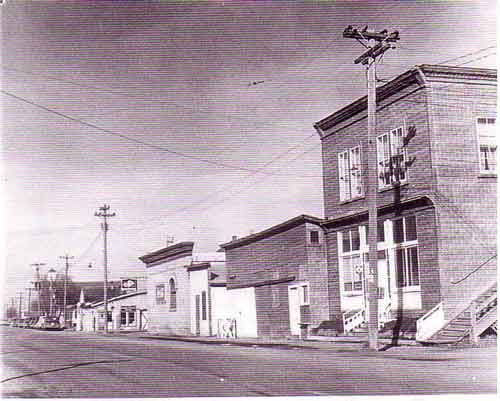
Downtown Humboldt around the time the poem was written...

Ode to the North
[With apologies to Longfellow, and
acknowledgement to the Franssens]
Author anonymous
(Written circa 1938)

I
In the old Red River Valley,
Near the muddy, rusty, river
There’s a town by the name of Humboldt
Little town, quite far from St. Cloud!
Up, far up into the Northland
Where the people are dirt farmers
Strong and handsome sidewalk farmers.
Farm one farm and then another
Farms the whole damn country round them
Rent the land by sections, even
When we farm only 100 acres!

II
Much the things they do there different
All use tractors ‘stead of horses
Trucks and trailers ‘stead of wagons
People there are great on motors,
All got cars and big machineries
Packards, Plymouths, Dodges Chevies
Buicks, Fords what got the shimmies
Deering, Farmalls, Allis Chalmers,
Bradley, Deere John, and Missus Harris
All own combines, lusty swathers,
But they don’t have cultivators
Cause they don’t grow corn way up there.

III
In the springtime comes the rainstorms
Rains and rains and comes the gumbo
Slippery, slimey, black and dirty
Charlsie scrapers and calls it cowshit
Cause its all so smooth and stickey
Trucks get stuck, must be pulled out
By the fat man’s caterpillar
Gum gets tracked in the houses
Housewives have to clean and scrub them
But they do these little labors
Think not much of little labors
Glad to live up in the Northland.

IV
Up from St. Cloud comes the girlies
Stay to sport away vacation
With Aunt Pearl and Uncle Ollie (Berg)
Tear around with neighbor laddies,
Goes to shows with Wimp and Gordy
Vamps around and goes to Bronson
Have themselves a plenty good time
Play the checkers and the ping-pong
Drink root beer and eats the pop corn
Rides in trucks and on the combine
Drive Joe Diamond's “Master Chevie”
And with his beloved, Jerry!

V
In the town there is the people
Leonard, Herb and Lawrence Diamond
Big B’S-ers, them three fellows
Like to tease and tell big stories
All in fun does Ikey do it
Him the Cop, - - - the Chief of Police
Him the Fire Sergeant also,
But not the Mayor,
Him is Tom Brown.
Squirty little duck, the mayor,
All for work and money getter.

VI
Bumped his head on Bud’s truck mirror
Wondered what the hell had happened
Looked around and pulled his whiskers
Bud and Donnie blowed a tire
Knocked the cap from Uncle Bud off
Blew the cigarette from his mouth out
Donnie Brown rolled over backwards
Laughed & laughed and rubbed his stomach
Him the kid that can fry “burgers”
Juicy, greasy hot hamburgers
He displayed his art one winter
At Aunt Pearl’s and Buds Household

VII
Also for Tom, works Sylvester,
Fat and happy Slim Sylvester,
Went with teacher from the "Hoc Schule"
Drives himself a pretty Chevie
Scoots around with old "Shell" gas truck
Round town and in the country
Bringing gasses to the farmers
Much he teases little Mary
Also Pete and sassy Jerry

Tuesday, March 02, 2010

A Sense of Place

From MINNESOTA GEOGRAPHIC NAMES: Their Origin and Historical Significance by Warren Upham (Minnesota Historical Society, 1920/1969)
Caribou township, organized January 8, 1908, had a few reindeer, of geographic limitation in the wooded and partly swampy region of northern Minnesota and Canada, named Rangifer caribou. The second word of the name is of Algonquin Indian origin, meaning a pawer or scratcher, in allusion to the habit of this animal in winter, pawing in the snow to eat the reindeer moss beneath.

Clow township commemorates several brothers of that name, early settlers there, who came from Prince Edward island. [NOTE: My great grandmother was Elizabeth Jane Clow, daughter of Samuel Clow, one of those brothers...]

Information has been gathered from "History of the Red River Valley," two volumes, 1909, the chapter for this county, by Edward Nelson, former register of deeds, being pages 923-966; and from interviews with Mr. Nelson and Axel Lindegard, a merchant in Hallock, the county seat, during a visit there in August 1909, and Edward A. Johnson, clerk of court, and gain with Mr. Lindegard, in a second visit there, September 1916.

Noyes, a station of the Great Northern and Soo railways adjoining the international boundary, was named in honor of J.A. Noyes, the U.S. customs collector there.

St. Vincent, organized March 19, 1880, is opposite to Pembina, N.D. Its name had been earlier given, before 1860, to a post of fur traders here, in honor of the renowned St. Vincent de Paul, founder of missions and hospitals in Paris, who died September 27, 1660, at the age of eighty years.
As Greg Breining says in his article A Sense of Place, "Good place names are like that--they may describe a place's shape or the animals that inhabit it. They may tell stories, of the people who settled it, who shaped it, and who fought for it."

Of Warren Upham, writer of the above-quoted book, Greg says, "Our sense of place is richly expressed in our names for places. In this regard, Minnesota was fortunate to have Warren Upham, geologist, archaeologist, librarian, and pack rat of obscure facts. It would be hard to imagine anyone better suited to the task of accounting for thousands of state place names."

Tuesday, July 22, 2008

Cemetery Lists

Marcy Johnson has been in touch again, and has kindly shared all her cemetery projects with us. This time, she shared the entire St. Vincent Cemetery, Joe River Cemetery, and Humboldt Clow Cemetery listings, through 2007. Listings like this can be invaluable in tracking down individuals for family history or town history purposes.

Take a look, and let us know of any corrections/additions you are aware of...

St. Vincent Cemetery Listing

Joe River Cemetery Listing

Humboldt Clow Cemetery Listing

Thursday, July 17, 2008

Nuisance Ground

Alec Mason, a past resident of St. Vincent, used to haul unburnable trash to the local nuisance ground with his horse and wagon. Back in the day, everyone burned their trash - many would compost peelings and leftover fruit and veg - and before there was such a thing known as recycling, people returned bottles for deposit refunds, etc.

When I was a little girl, I looked forward to a run to the nuisance grounds with my Dad. It always meant we would drive there in the '50 Chevy, my grandparents' old car, and use the trailer; the trailer was made out of the bed of an old Ford Model A pickup truck. As we'd drive down our road Dad would let me put my arms out of the car to touch the foxtails as they whipped past. It was as much fun to me as going to the fair to ride a merry-go-round.

Once we got down into town, we'd turn right (going west) to head for the river. The sloping river banks of the Red River of the North was where St. Vincent's nuisance grounds were. I always wanted to hunt around to find treasures, but Dad warned me it was too dangerous for me, so I heeded him despite my curiousity. Once he dumped everything, then I got to ride in the back of the trailer all the way home, a real treat for me!

When the nuisance ground got 'full', or fall came around (whichever came first), the town would have someone bulldoze the whole mess into the river; heaven knows what explorers might find at the bottom of the red near the confluence of the Pembina and Red rivers!

Wednesday, April 23, 2008

Featured: Placeblogger


I was recently approached to be interviewed for the website Placeblogger. The above is a screenshot and excerpt of that interview...

It gave me an opportunity to express why I do what I do, how special my hometown is to me, and all the wonderful people from it and around the area.

Saturday, April 19, 2008

Treaty of Old Crossing

Outlined land, colored in yellow, ceded in 1863 Old Crossing Treaty
I grew up with many of the descendants of the early Metis and indigenous peoples. By my time, there were far fewer living in our area than in my grandmother's or even my mother's time, but there were some families still here. The names Jerome, Gooselaw, Parenteau, LeMasurier, Monette, and LaPeire (to name only a few) were not only familiar, but I went to school with some of them.

Since beginning this blog, I have started thinking more deeply about who we were, and who we are as a result. For these families, I wanted to know about what happened to their ancestors on the indigenous side, why, and when. So I started digging...

According to this website, the original tribes in our area were the Arapaho, Cheyenne, Chippewa (or Ojibway), and Dakota (part of the Sioux nation). Also, due to our close proximity to Canada, there are many families with bloodlines from the Manitoba tribes, which included many found in the U.S., but also the Cree and Assiniboine.

Going back to the early days of settlers and natives mixing, it was mostly cordial (I say mostly because human nature always gets all of us in trouble sooner or later!) The more the settlers came, the more the different communities were stressed. One group pushed, the other pushed back. Terrible consequences befell the native peoples, many succumbing or closely succumbing to starvation. Out of this (and other issues) came the 1862 uprising. Not coincidentally, I assume, more aggressive treaties were the result.

One such treaty was the Treaty with the Chippewa-Red Lake and Pembina Bands, 1863 - or as it is otherwise known as, the Treaty of Old Crossing.

You can read the treaty itself here...

NOTE: A very interesting blog post about conditions on North Dakota reservations got the writer banned from the Turtle Mountain Indian Reservation (and rightly so).  While there were insulting comments left on the article, there was also a lot of great discussion on it on many relevant topics concerning the native populations living on them today, as a direct result of the treaty above and others like it. The original blog post was deleted but the link at the beginning of this note has it in-full along with the comments...

Thursday, November 08, 2007

Border Lines

For those of us who grew up on the US/Canadian border, John Mahoney's Border Lines rings a very familiar bell.

John also does a local news and history blog for his area in northern Vermont and touches on the Quebec area he borders. I definitely feel a kindred soul in John. Be sure and check him out!

Tuesday, August 21, 2007

The Spot

The Spot in Pembina, ND (still in existence, as far as I know...), in its heyday (circa 1960's)

Places like The Spot, and Dick's Corner, were like another country for me as a kid. It wasn't just that I was a kid and couldn't get into them. There was also the matter of my being brought up in a church-going, born-again, evangelical-before-it-was-a-dirty-word family. Even if I was 21, I still wouldn't have dared explore that unknown territory. Except for one brief night in 1992 when a few of my old classmates gathered at The Spot - lights dim, music blaring - I never did explore them. Dick's Corner is still a land of mystery, and The Spot wasn't looking as good as the photo above, worse for the wear of 30 plus years. But then, so am I...

Saturday, November 18, 2006

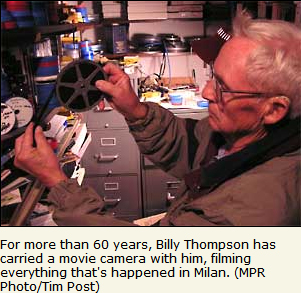
Small Town Movies

There are others who see value in what Thompson has captured on film. The University of Minnesota at Morris recently digitized 100 hours of Thompson's aging films. The university thinks someday researchers may take an interest in Thompson's studies of life in a small town.
The fellow small town film historian this quote is talking about inspires me in my own work here.


An amazing story about one man's passion in telling his small town's story...

Friday, November 03, 2006

Humboldt Stories: Pop Bottles


The Roadside Hunters: Lessons from Ditch Chickens, Pop Bottle Hunting, and Trading Cards
By Tony Rustad

The glint of sunlight on the green glass butt of the 7-up bottle captured a momentary emerald sparkle as it protruded through weeds and grass at the waters edge of the roadside ditch. I stealthily crept forward, on hands and knees. But in that lapse of attention while I was observing the unnatural jewel set partially under water amongst the green and golden strings of dead grass and black gumbo along the edge, the fist sized bull frog I had been watching carefully, suddenly leapt into the warm pool and disappeared. Despite the unusually amber clarity, the visual acuity was warped of the reflection of the sun off the circular ripples caused by the splash and the unusually large amphibian squeezed into a hidden pocket somewhere beneath.

"Ditch chicken! He just disappeared to his hideaway. Raymond, Come're en help me watch, he'll come back up again. That was the biggest ditch chicken I've ever seen. His legs were like this." I showed Raymond my index finger and thumb in a circle representing a plump thigh, unlike most of the medium sized frogs we had already collected. It was the middle of the summer and the frogs had grown large enough so eight or ten of them made a nice meal for one 6 year old and one seven year old boy. They would soon be pan fried like chicken, in butter or Crisco, on a home made brick grill in the dirt alley between Rustad’s and Tri's . We would soon be sharing our main meal, along with a quart mayonnaise jar of cherry Kool-Aid and a bag of Old Dutch.

"How bout if I throw this ole bottle at em." I said as I raised the 7-up bottle out of the ditch bottom, draining its contents in the grass so as not to disturb the water.

"It's too deep, we might lose it. My mom will give me a tanning if I get wet again today. Sides, Mayme will give us 3 cents a piece for any pop-bottle we bring in. Have you ever brought her bottles? She's real good."

"Any bottle?"
"Naw, Just pop-bottles."
"Three cents a-piece."
"Three Cents"
"Share."
“Share.”

The roadside hunters found game and other valuable bounty, worthwhile nougats, and bits of experience with which they would ever be grateful.

Telling this story to a colleague at the financial services firm where I'm now employed, ignited memories and experiences about growing up in our rural Midwest towns. He also recalled learning specialized skills in his youth, becoming an avid roadside hunter and trader. Decades have passed and later generations of children have missed the opportunity of earning real money by marketing discarded bottles. Yet for me, it was pop bottle collecting that was the genesis of a frugal career in marketing and trading.

Click to Enlarge. You can see Elmer 
in the shade [Photo:  David Stewart]
The enterprise commenced before I could read and continued until I entered the rigors of high school. I owned several miles of country road ditches and the bottoms of each side of Highway 75 North and South of our little Northwest Minnesota town of Humboldt. My early experience collecting and selling pop bottles can best be described as an emerging commodities business, serving not only pocket change but also valuable lessons for my emerging career in the field of financial services. My most vivid childhood memories were the happy hours spent collecting and selling the discarded glass at Mayme's General Store located next to Highway 75 which ran through the heart of Humboldt, and at Elmer's Standard Station located several blocks to the north along the highway. I quickly learned that the pop bottle business was a diversified and complex venture, at least for a six year old. I discovered there was a value in spending the extra time classifying the bottles according to condition.

Mayme Jury’s store represented the high end of the business. She used more discretion in purchasing bottles, rejecting those containing chips and cracks, flaws which inevitably destroyed all commercial value. Mayme, who was a kind but practical business person, quickly pointed out: “We purchase the bottles as a service. It is a small monetary remuneration in lieu of the previously paid deposit given when the bottles of soda were originally purchased. I'm not really a bottle dealer.”

Mayme always willingly provided the incentive for clean and flawless bottles, ringing up the full three cents deposit. The small, kind, elderly proprietor always measured her speech, carefully noticing intricate details that a business person should be aware of. She was personally clean and carefully groomed. Like my grandmother and many middle aged women in that age, her graying hair as wrapped in a bun on the back of her head. Her thin black glasses covered sparkling eyes. Mayme did not often frown.

Mayme also had a penchant for remembering each child's name and saying it often. She cared deeply for the welfare of her clientele and warmly received each child who entered her store. She asked to know each detail that the children shared about their lives and often remembered to allude to earlier conversations with them. Children were trusted to go behind the counter to the candy shelves and hand choose the tasty selection. This custom was among carefully formulated, clear and understandable guidelines about our conduct in her domain. Children did not take candy without paying for it, and Mayme's voice did not have to become harsh. Mayme’s method of redeeming pop-bottles insured that she would be reimbursed for every bottle she purchased from the children of the village of Humboldt. The condition of the bottles and which brands she would accept were quite understood and often repeated. Mayme’s rule of reason had the virtue of being a bright-line model easily understandable by every Humboldt kid in the 1950s and 1960s.

The bottles that Mayme refused could often be sold to Elmer Maxwell, whose business model was not based upon profit maximization. Elmer, the gentle proprietor of the little Standard gas station on the North side of town, would open a worn leather purse to produce two cents for each of the bottles. The kind and demure old man seemed heedless to their condition. He often took time to have a mature conversation with us: “Say, how bout that Whitey Ford. Do you think there' s any better pitcher in baseball.” Sporting News says he'll lead the Yanks to another pennant.

“Warren Spahn's my favorite.”

“Is that so. Are the Braves your favorites? That Aaron and Mathews are almost as good as Mantle and Yogi. I have something to show you.” Then Elmer would amble into the shack and point to an article or a statistic in his favorite magazine (Sporting News). As I reflect back, I know we were his closest acquaintances. He purchased every bottle even if they appeared to have been retrieved after lying for a decade in the swamp water of a ditch near town. Elmer’s humble gas station was formerly a tar-hut railroad car placed only about fifteen yards in front of his home on Highway 75 near the north side of Humboldt. Elmer’s Standard Oil franchise did not have a bathroom, but if you asked he would let you use his outhouse. His station had so little clearance between the pump and his shack that a large car would refuel with great difficulty. Elmer kept his returnable bottles out in the open, haphazardly stacked in wooden Coca-Cola crates on the south side of the station hut. Some of those bottles remained there for many years and were obviously never redeemed. I recognized some of them from the distinguishing flaws. Decades later, I recalled a memory of a specific Nesbitt orange bottle by the chips of glass on the rim and a Canadian dry bottle by the cracks on its characteristic thick bottom side. Elmer’s business model was built on good will rather than fastidiousness. Only rarely did the white haired old gentleman press the appropriate discount because of the depreciated market value of a chipped bottle was lower than a clean and perfect bottle. Many were worthless. He often purchased bottles found on roadsides that had originated from neighboring Canada, glass that would eventually become an ornament memory of his generous nature.

Thus, the bottle market then consisted of two principal buyers with different criteria for cleanliness and condition. My response to this bifurcated pop bottle market was to clean all of the bottles to the best of my ability for the return of earning three cents per bottle. From this early experience with pop bottles, I learned the value of economy and time management in cleaning them. Among my earliest memories of the roadside hobby were the occasions I found a half-full ditch of semi-clear water where I quickly discovered I could clean the bottles most efficiently. The work was enhanced by the ambiance of the countryside, the amber colored water reflecting the sun and making the plants, small stones, and insects appear as jewels sparkling on the bottom of the ditch. I plunged the bottle into this warm and enticing pool, filling it half full. Then I inserted my index finger into the opening until it almost formed a plug. When I shook the bottle, it often resulted in the tepid water spraying in my face and over my clothes. I viewed this as a cost of doing business. I attempted to reduce this problem by developing a better technique for cleaning the bottles. Eventually, I fell upon the most efficient method, which was to plant my thumb squarely over the lip of the bottle and then shake it with all my might. That generally loosed the particles of dirt and unidentified debris from the inside of the bottle. If I shook them enough, and the stains were not obvious, they might pass Mayme’s merchantability test and be worth as much as three cents apiece at her grocery store. If the bottles did not clean up well, they went to the North market, Elmer’s Station, for two cents. I learned to maximize my profits by understanding the differentiated buyer’s market.

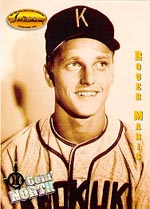
The money I earned from pop bottle collecting was usually invested in another market, baseball and football cards. Even as a child I sought “diversification and balance” in my collection keeping players from every team. I enjoyed organizing according to position and appearance and reading and memorizing the statistics. When I was not spending time sorting and playing with the cards, I carried them in my back pocket tied by a rubber band with cover cards and team cards on the outside edges. I learned how to protect my favorite cards (this was the day before cards had value) by holding them out of any floor games. I learned that the cards that slid along the floor better lost their edge after being used several times. I wanted my favorites like Willie Mays, Mickey Mantle, Roger Maris and Hank Aaron to hit the homer, but eventually the harder push would wear out the card and make them less desirable as a trading commodity. For that reason, I benched my favorites and played cards which I did not like very much such as Marv and Faye Thornberry. Willie, Roger, Harmon, Hank and the Mick were used as pinch hitters at appropriate times in the game, but it was Marv and Faye Thornberry that saw the floor action. Later in life I observed that my habit of saving the stars for special occasions was a technique used by major league managers to get the most out of aging stars. The aging stars did not play every day and sometimes only were put in the lineup in the hopes that their special magic would ignite a rally.

Each year in those halcyon days, fall would arrive and the World Series would be settled. Yes, it was usually the Yankees and not my Dodgers who prevailed. After each baseball season, my brother Mike, Jeff and Brian Lofberg, Jay Hoglin, David Boatz, Keith Finney, and other Humboldt friends would put away our baseball cards and began trading, collecting, and playing with our football card collections. We designed and played football slide games with the fall icons, learning how to push the best players through the line for a long run and claimed the great sweeps were impressive touchdowns. Jeff presented the most memorable play-by-play, describing the impressive qualities of each player in the most realistic sports terminology like radio announcers he listened to so often. Jeff later became a sports announcer in local radio stations. Like the baseball cards, the best football players often became worn out prematurely because of hard use with our floor games. We often traded to get a back-up card of our favorites. Players like Jim Brown, Jim Taylor, and Paul Hornung were among my favorites. I still have a few of the old classics and the collection grew enormously in the 90's when it became the “family hobby.” Today I still own an almost perfect card of Paul Horning of the Green Bay Packers, my favorite football player before our Minnesota Vikings entered the league in the early sixties. I am aware that the card is worth about twenty-five dollars in many card-trading and selling markets. Being the conservative investor that I am, I am going to continue to hold the card until the Pack is back on top. I expect that the Hornung and Taylor cards will rebound in price, which is based upon past empirical research.

As I look back on my pop bottle and card trading days, I realize how I am indebted to the lessons I learned about the operation of the market. My present profession requires personal qualities such as negotiation, sales, and discretion. The lessons I learned from Mayme and Elmer were to be honest, have clear guidelines and refrain from taking advantage of those with less knowledge or experience. I carried over these qualities from my card trading experiences. I remember asking younger kids like Keith Finney, Danny Turner, or Guy Getschell whether the deal was good for them as well. In every trade, I always asked if they were certain that they wanted to trade a given card or cards for the one I wanted. My professional reputation as a trader was at stake. In a small town or in a large city, your professional reputation is your stock in trade. The most important lesson I learned was about the morality of the marketplace. Six principles were learned from the pop bottle business and trading in baseball and football cards: (1). Work hard to get ahead and don't be afraid to get dirty once in a while. (2). Save and invest, do not consume all that you earn and you will get ahead. (3). Develop a keen eye for the best players and trade old stars for the rookies that appear to be doing well. (4). Too much greed is not good for business; (5). Be broadly diversified and balanced. Just as you should not have baseball or football preferences for too many teams, choose selective sectors of the market based upon research and (6). Just as you should never discard a baseball or football card of a legend, don’t give up on the market. Never give up, stay in the market, and be cautious about throwing in the towel during market corrections. Eventually the market will always be higher, just like the value of the old sports rookie card. I learned business principles and lessons from collecting pop bottles along the roadsides near Humboldt, wisdom from time spent quietly visiting with Elmer Maxwell and Mayme Jury and prudence from the management of the few cents I acquired, investing in sports cards. As I reflect upon the business principles, lessons, wisdom, and prudence, they are striking similar to advice I give to clients today.

Editor's Note: Anthony [Tony] Rustad works as a financial advisor in Grand Forks, ND

Tuesday, July 25, 2006

A Book About a Place, & Its People...


I'm currently reading Forgetting Ireland, a local history book written by a woman who grew up in the area written about (Graceville, Minnesota...) She not only grew up there, but is part of the story, in a way.

It makes fascinating reading because many of the types of people in her story, how they related to one another, and the petty squabbles between villages all seem very, very familiar...!