Showing posts with label communication. Show all posts

Monday, September 02, 2019

St. Vincent Railway Post Offices


The railway mail service was...

The state’s first international RPO, the St. Vincent & Winnipeg, initiated service from that Kittson County town to Canada in August 1881.

My great uncle, Charlie Fitzpatrick, and later his brother, Dick Fitzpatrick, both worked at the St. Vincent depot, and one of their daily responsibilities would be to switch out the mailbags, both incoming and outgoing.  Some of the sorting for the various towns on the particular RPO was done on the trains, separating for each town they were responsible for.  Once delivered to St. Vincent, for example, then the town's postmaster would do the final sort for each postal customer.


Saturday, April 21, 2012

An Arduous Journey


I've been reading this book about Enos Stutsman titled Attorney for the Frontier. Ever since I came across "Stuts", as his contemporary friends called him, I've been fascinated by the man.  To my knowledge,  Attorney for the Frontier is the only book ever written about him, and it includes an entire chapter about his time in Pembina, his last home base.

Below is a letter he wrote to his supervisors.  As a past federal government employee myself, I am well-acquainted with the paperwork involved whenever you go away from the office.  Reports must be filed!  Read below on what this particular early government employee went through just to get from Point A to Point B; you'll note he has a pretty wry sense of humor, which I guess you had to have when encountering such difficulties.  All in all, if you take the time, you'll discover it's quite illuminating, and an enjoyable read...

Saturday, February 11, 2012

History for Sale

Starting in 1852, Pembina provided regular mail service to not
only Pembina residents, but also to the Red River Settlement

FOR SALE: Canada, 1859, Prince Albert, 10¢ red lilac (Unitrade 17), used with 5¢ vermilion (15), both tied by concentric-ring cancels on 1862 cover with "W. Couper, Naturalist" sender's label and addressed to "Mr. Mactavish Esq., F.B.S.C., Chief Factor, Governor of Assiniboia, Secretary of Institute of Rupert's Land, Red River Settlement, Northwest", light strike of "Quebec L.C., AP 11" origin c.d.s., reverse with Montreal (4.15) c.d.s.; the cover has a few tears at top around, but not affecting stamps, and at bottom, crossing through origin c.d.s, nevertheless Fine;. A Fine and rare use at the 10¢ rate to Red River Settlement overpaid by 5¢, with the 2½¢ service fee from Pembina to be paid on delivery. Scott 17. Estimate 3,000 - 4,000. Provenance: de Volpi, Robertson.

SOLD for $2,200.00


FOR SALE:  [Canada Beaver Stamps used from Red River Settlement via Pembina and the U.S. Mails] buff cover to Ottawa with two singles Canada 1852 3d Red (#4), both with large margins all around, tied by light strike of "Pembina, Min/Apr 27" (1862) datestamp, with bold strike of postmark repeated at right, blue arced "U. States/10" exchange office handstamp, Prescott transit and "City of Ottawa, U.C./My 19, 1862" arrival backstamps, then forwarded to Almonte with straightline "Forwarded" handstamp and Franktown and Almonte backstamps, extremely fine and handsome; one of only two recorded covers franked by the Canadian 3d "Beaver" stamp on mail originating from the Red River Settlement, a very evocative association cover with the beaver stamp being used from a beaver trapping center; ex-Jarrett, Dr. Chan, Nickle and K.L. Estimate $10,000-15,000.

SOLD for $20,000

Thursday, March 17, 2011

Letters from Fort Pembina


Found amongst archived auctions comes this image and description of letters sold in 2007 that were written by residents of Fort Pembina in the 1880's...
Four letters - 3 written by a soldier with the last name of Dean, to his brother in Liberty, Mo. The 4th letter is written by the daughter of a man working at the fort, to Alice Warner in Wooster, Ohio. One letter from Dean to his brother states:   
We are situated on the Red River of the North which is frozen over with ice 28" thick...The public use the rivers in the winters for wagon roads or sleigh roads rather and they run the cars across on the ice also up in Pembina city, which is a mile & 1/2  - a lively little town too - it has 3000 population and is growing very rapidly.  Hunting is not as good as it was in Garland, Colorado, but there are some elk and plenty of geese, ducks, prairie chickens & grey wolves. 36 below zero... 

Tuesday, January 18, 2011

KCND's Past in Photos

More photos from KCND's past have been found...
[Click to enlarge]
I was going through my files of St. Vincent and Pembina photos and documents that are in 'rough draft', i.e., I haven't done additional research and posted them yet. I found the above behind-the-scenes images from KCND's early days in the 1960's.

It's fun to see what it looked like behind-the-scenes at Channel 12 during its hey day.  I get a big kick out of reading the notes with the photographs of how the equipment featured in them are state-of-the-art for that time (as I'm sure they were) - we've come such a long way since then! (I don't recognize any of the staff in these particular photos.  If anyone reading this does, let me know and I'll update this post.)

I am ashamed to have to admit this, but I didn't have any notes attached that provides credit for these images. I am guessing that they may be from a scrapbook either put together by the Pembina Historical Society, or from a private collection (maybe connected to the 1997 Pembina Bicentennial celebration). If anyone out there knows, please contact me.

[I apologize that the images aren't more clear, but they are photocopies of the originals, the best I have...]

Tuesday, December 28, 2010

In Their Own Words: Charles Cavileer

Source:  State Historical Society of North Dakota
[Click to enlarge...]
THE OLD-TIME POST OFFICE AT PEMBINA
By Charles Cavileer

Cavileer
I came here (Pembina) in 1851, in company with N.W. Kittson and others. After being here a few days Mr. Kittson asked me to act as assistant postmaster, he having been appointed postmaster some time in 1849. Joseph R. Brown was contractor to carry the mail from Pembina, Wisconsin Territory1, to Crow Wing in the same territory, via Thieving River, at its mouth at Red Lake River, thence by land and canoe to Red Lake Village, making short portages, thence making short portages between small lakes to Cass Lake and then by the same order of travel to Leach Lake and so on to Crow Lake and to the end of the route at Crow Wing Village, which was the headquarters of the North-West Fur Company for all that section of the country claimed by the Chippewas from Crow Wing to Pembina northwest and northeast to Sandy Lake, and Fond du Lac.

The contract was a go-as-you-please, on foot, horse back, cart or canoe, anyway-to-get-there affair. The contract price for carrying it was $1,100 a year. Kittson, being postmaster, could not act as sub-agent. He appointed me as assistant postmaster, and I ran the machine until some time in 1853 or '54. I did all the business of the office, made the quarterly returns and deposit of funds due the department, attending to every detail of the office, which at that time was no child's play as every letter and package had to be tied up in wrappers, waybilled and addressed to its destination. St. Paul packages contained nearly all of Minnesota, Chicago, Detroit and east and west exchange.

An example of an 1868 letter with U.S. postage
sent from Red River to St. Paul via Pembina
.
Source: The Minnesota Territory in Postmarks

Letter rates of postage ran 6 1/4, 12 1/2, 18 3/4, to 25 cents, according to distance, from 6 1/4 for short distances to 25 for 500 miles and over. Every letter and package had to be wrapped and addressed. Even single letters had to be wrapped and addressed to their proper offices. All wrappers had to be saved and used as long as they would hold together and an address could be put on without showing another.

But when it came to making out the quarterly reports the dance had just commenced. Every letter received and dispatched must be returned from the records kept on bills for that purpose, and it made a package about the size of a family Bible, and the footing up of columns with the amounts running from 6 1/4, 12 1/2, 18 3/4 to 25, was a corker. And right here let me tell you, with a feeling of pride, that I never had a quarterly return come back to me for correction.

Let me give you a sketch of the business at that early day, and the hardships and tricks of some of our carriers.

Wednesday, December 22, 2010

St. Vincent WWI Veterans

'Casualty' does not always mean 'Killed in Action'
It can also mean 'Wounded' - I knew at least one of 
the men in the list when I was growing up; he was
very much alive for many years after the Great War
[Click to enlarge]

I discovered a blog today with a 'casualty listing' for Kittson County World War I veterans on it.  I excerpted from it all veterans from St. Vincent in the list you see to the left.  This type of listing only contain names of those killed or wounded in action; it's not a comprehensive list of everyone who served (so far I haven't found one that includes all who served...)

I was interested to see that one of my great uncles is listed...William Samuel Fitzgerald.  I had known he was in WWI, but nothing about his experiences. He definitely didn't die in the war, but must have been WIA.

William S. Fitzgerald's draft registration card
The Selective Service Act was only passed
the month before in May 1917...
One St. Vincent veteran of WWI that is not on the list is William's younger brother (because he wasn't a 'casualty').  Below is an image of a postcard sent by my great uncle Edward Fitzgerald, to his sister (and my grandmother) Elizabeth Jane (Fitzgerald) Fitzpatrick, while he was in basic training. Transcription of the card says: 
4/13/1918 
Co J Camp Ross, Great Lakes, Ill.  
Dear Sister:  
This is what a person can see every Wednesday afternoon at Main Comp (Company?) Notice all the visitors along the right of the picture.  
The review we had last Wednesday when Secretary Daniels was here, there was about twice as many "jackies" on the field.  
Ed 
(on the other side was a photograph of service men in review...)
While William was in the Army, his younger brother Ed was in the Navy.

Friday, May 07, 2010

BORDERTOWNS: Chapter 21

January turned cold and blustery, with nagging winds and a heavy depth of snow. Drifts to the south created rail delays and often a day or two went by without the arrival of a train. When the trains did get through, the clanking and rumbling as cars were coupled or uncoupled became commonplace. On the calm, frigid, below-zero nights, the mournful whistle of engines carried for miles.

Patrick realized the firewood was going fast and was thankful for the huge pile remaining near the barn. The railroad had recently begun to haul in coal from Duluth, selling it for six dollars a ton. In Duluth it cost only two dollars.

Bob Wilson, the sutler at the fort, visited the McLarens occasionally. He reported that many soldiers at the fort were suffering from frozen fingers, toes and ears, an indication that the wool uniforms provided by the military were inadequate for the frigid Dakota winters. Most soldiers bought toques and sheep-lined mittens from the merchants in town and covered their winter boots with layers of oversize socks. The officers disregarded the strange uniforms that appeared whenever the men worked out-of-doors. Every effort was made by Captain Collins to purchase potatoes, cabbages, onions and other vegetables to prevent an outbreak of scurvy.

Jerold and Knute formed a partnership and purchased a half-section of land a few miles to the east, adjoining the railroad. The previous owner had become drunk in St. Vincent, and lost his way home. He was found the next day, frozen to death. His wife, left with three children to support, was glad to sell and return to Minneapolis.

In addition to his employment with the railroad, Ian again began to purchase furs. Long buying trips were out of the question, greatly reducing his profit. Even so, when he finally turned the furs over to the Abram's representative from St. Paul, he found he had realized three times more than his original investment.

With the many cattle on hand, most of the short winter days were spent feeding, milking and cleaning the barn. The coats on the horses and mules were heavy, nature's way of protecting them from the cold. When mild weather came during the first days of February, Patrick, Jerold and Knute began cutting oak timber for their next winter's firewood.

It became obvious to Patrick that Maggy missed Mary's company, for she often took baby Kate and visited Susan, sometimes spending the entire afternoon. When he teased her about it, Maggy excused herself. "I've been helping Susan paint the interior of the house. The carpenter left all the decorating for her to do."

Toward the end of February Susan realized she was finally pregnant. She laughingly conspired with Maggy. "I think I've beaten Mary to it. Our new addition should arrive about the end of October, give or take a few days."

"Oh, my gosh! Have you told Ian yet?" Maggy was instantly excited.

"No, but I think he suspects something is wrong. He looked at me strangely when I had to leave the breakfast table this morning." She looked sheepish. "I darn near threw up the oatmeal on the table.” Rising to get the kettle from the stove, she added, "I've felt squeamish this past week, but I’m sure now. I'll tell him tonight. He wants a boy, and so do I. Still, a girl would be nice." She laughed lightly, "Guess we'll settle for whatever we get."

The evenings were quiet and lonely, for the boys were often out, visiting neighbors or at house parties. Ice-skating became popular, as clamp-on skates were cheap and could be mounted on any shoe or boot. Patrick often sat near the parlor stove while he carved wood duck decoys. Maggy spent her evenings in her rocking chair, either crocheting or knitting for Susan's baby. Frequently she tutored Mike in his first book. He was having trouble memorizing his multiplication tables. Light from the lone kerosene lamp was augmented somewhat by the parlor stove, which had isinglass windows in the door. The flickering flame seemed to add a warm, cozy glow to the room.

It was in late February when Patrick and Maggy received a surprise visit from Charley Brown. They were about to eat dinner when they heard a knock on the back door. When Jerold arose to open the door, he was surprised to see the sheriff. "Just in time for dinner, Sheriff! What are you doing out on this cold day?"

Charley stepped by Jerold and began taking off his heavy coat. Turning to Patrick, he dropped his bombshell. "I bring good news in a way, if you can call Brogan good news. He won't bother anyone any more. He's dead!"

Excited questions flew until Charley held up his hand. "He and another man showed up in Pembina last night and got pretty well oiled. Somehow they got to St. Vincent, and then decided to go to Emerson. Not having a ride, they stole a section hand car from the yard. Nearing Emerson, they were struck by a C.P.R. engine backing from the St. Vincent junction to Emerson. As you know, the C.P.R. locomotives don't have a light on the rear of their engines as ours do. I guess that with the noise of the north wind they were bucking, they never heard the engine approaching them from behind. Charley added wryly, "Booze probably had something to do with it, too. At any rate, the man facing south on the handcar saw the engine in time to jump clear, but Brogan didn't. He was badly mangled1 and the handcar was destroyed. I just came from Emerson where I viewed the body. It's Brogan, without a doubt. Incidentally, I stopped to tell Ian about it. He's going over to see the corpse -- just why, I don't know -- said he could hardly believe the man is dead."

Maggy murmured aloud, "I disliked the man, but I wouldn't wish death on anyone. The Lord does work in mysterious ways though."

Ian had one purpose in mind when he rode to Emerson. He wanted peace of mind -- to know if the crooked-necked Brogan was really the man who attempted to rape his sister. Brogan had been on his mind ever since Mary had told of being accosted by a heavily bearded man after leaving Mrs. Traynor’s store the previous winter.

Entering the warming room of the Emerson Railroad Depot, he found the stationmaster engaged in a card game with three other men. Because the huge waiting room was difficult to heat, the players were huddled near the potbelly stove. Ian spoke to the stationmaster. "Frank, where did they put Brogan's body?"

He looked up. "Come to pick it up?"

"No, just wanted to see if it's really him."

"It's him all right, we all know the bastard. He finally got what was coming to him." He nodded, "He's in cold storage -- in the north freight room. If you want to see the body I'll have to come with you -- railroad rules. I hope you're the last to ask for a glimpse. Hell, I've already had to open up for Jack Bell and that sheriff from Pembina."

It was obvious to Ian that Frank was reluctant to accompany him to the freight room, seeing the great to-do he made of putting on his heavy coat and overboots. Ian waited patiently while the stationmaster unlocked the storage room, then he stepped forward to assist him in sliding the heavy door open. The inside of the huge room was stacked with crates and barrels, but a lone four-wheeled baggage cart stood near the door. Moving to the cart, the depot agent grasped the edge of a tarp and flung it back.

Even in the dim light Ian's stomach nearly revolted. The body was in pieces, but the head was still connected to a remaining portion of chest. Forcing himself, he examined Brogan's neck, but could see no sign of any external damage or scar. The head still held the same unnatural angle that it had when the man was alive. Ian decided it must have been a congenital deformity. One of the severed legs had a dangling shoe still attached. It was a huge shoe, easily a size 12 or larger, but it was old, with rounded edges and a run down heel. Ian realized it would not match the boot prints Pete had found in his wheat field. Satisfied, he tugged the tarp back over the corpse and faced the agent. "I've seen enough, Frank. Thanks for allowing me to look him over."

Both men grasped the door to slide it shut, the stationmaster quickly affixing the padlock. He abruptly turned without another word and hurried back to his card game. When Ian mounted his horse, he was momentarily confused. Although he had examined Brogan closely, he had no positive way of knowing whether or not he was the man who had attacked Mary at the bridge. Perhaps the man's neck had healed without leaving a scar. While tightening the scarf around his coat collar, he decided to see Charley in Pembina. Perhaps the sheriff could cast more light on the situation. He might even be able to get the Canadian authorities to do an autopsy on the body. Then he realized the unlikelihood of this, since it was an accident, cut and dried.

Entering Kabernagle and Brown's saloon an hour later, he found Charley the only occupant. He was behind the bar washing the previous night's glassware. As Ian removed his cap and coat, the sheriff tossed him a towel. "You wipe, and when we're done, I'll beat you in a game of pool."

While Ian wiped beer glasses, he related his problem. His evasiveness in skirting Mary's involvement drew Charley's suspicion.

"Level with me, Ian; it'll go no farther."

Ian went so far as to tell Charley that Mary had been attacked near their home in Orillia, and that he had struck the guilty man with a track splice-plate, thinking he had killed him. "When Dad and I returned the next morning, we found a pool of blood, but no body. The thing that has bothered me this past year is that Brogan's head was canted to the left, and he might have been the man I struck. Then, too, I had heard he arrived here from Eastern Canada shortly after we did. I examined his neck but could see no scar. Also, although his one remaining boot was large, it was badly worn. It wouldn't have matched the prints we found in my wheat field last fall."

For moments Charley seemed lost in thought, and then he said, "We know that he and Murphy were close, as were those other three men. Incidentally, Bell is attempting to find the names of the three. When I saw Mike Ryan last fall, he mentioned making a new pair of boots for Murphy -- even said Murphy still owed on them." He mused, "New boots would have left sharp outlines like the ones we found in your field. Murphy's boots were practically new at the time. There are a couple of other things that also fit. Murphy was at Roseau Crossing when that Indian child was abused and strangled. Also, Rosie informed me that Murphy mistreated one of her girls. I've heard that he acts weird at times and often talks to himself. He could be demented."

Ian suddenly recalled the day he and Susan had dropped Marguerite off on the hill leading down to the ferry and he had seen the heavily bearded, fully dressed man washing in the river. He mentioned it to Charley.

"It could have been Murphy. You say he was a big man with a full beard? Maybe he's the man with the scar and is hiding it. Yet, why would he hide it unless he suspects someone from the Orillia area would put two and two together?" Charley suddenly stared at Ian. "You suppose he knows or suspects your sister is the one he attacked and that she might recognize him, and that either you or your father might have been the one who struck him? If so, you and your family are in danger."

Ian's mind began to race. "Last year, in December, Mary was stopped at dusk on the Emerson sidewalk by a huge, bearded man. He said to her, "I know you from somewhere." Do you suppose it could have been Murphy?"

"I'll just bet it was; now to find him! The problem still remains; we have no firm evidence. We’ve a lot of guesses, but all are circumstantial. Still, it's beginning to fit together. I'll get telegrams out and see if we can locate him. He's probably somewhere along the railroad line in Minnesota, or maybe in St. Paul or Minneapolis. The problem as I see it is that the demand for labor is such that he could be working anywhere.

"Ian, the more I think of it, the more I believe he's the man who attacked your sister. Why my horse was damaged and finally destroyed in the fire, I can't justify. No doubt it is related to the whipping I gave Brogan. They were probably helping each other. Then, there are the missing two soldiers. I believe they're dead, probably murdered for their pay. I've been told Murphy didn't have employment at the time. He might have needed money badly, and those soldiers had just signed the Army payroll. You be watchful and tell your family to be on guard. That man might be vengeful enough to return."

Mary made it a policy to write her father, mother and the boys each Sunday. It was the letter that arrived in mid-April that really excited the family.
Easter Sunday.

Dear Father, Mother and all,

Two days ago I heard a knock on our door and found a well-dressed couple smiling at me. I was puzzled until the woman said, "You've got to be Mary. Kirby has described you in every detail."

I felt like a fool, for the few moments it took me to realize these folks were Kirby's father and mother. Although our house is small, thank goodness it was clean. At first, after inviting them in, I was tongue-tied, but after a short while I realized they were down to earth people like you and father. They were charming and instantly made me feel that I was one of them. They told me they were staying in the railroad yard, and it wasn't until a few minutes later that I realized they had arrived at Leavenworth in a private railroad car. Kirby had said his parents were well off, but he had never been explicit. To put it mildly, I felt like an idiot.

They are lovely, sincere people, and seem to like me. When I suggested tea, Kirby's mother countered by asking me to accompany them back to their railroad car. "We can have tea there," she said, "and what is more important, our daughter Laura is anxious to meet you." I knew Kirby wouldn't be home until suppertime so I left a note telling where I would be, and then Kirby's father added a postscript to my message.

Laura, an attractive brown-haired girl, met us just outside the car. She is Kirby's younger sister and I liked her from the moment we met. She is single and two years older than me.

I had been apprehensive about Easter, knowing Kirby's folks were coming to visit us. I no longer have any qualms; they have accepted me as Kirby's wife. Mr. Ralston seems much interested in our life in Minnesota, and in Jim Hill's railroad. It seems he is the director or manager of a railroad operating out of Washington.

Kirby's older sister, Marlene, is married and has two children, a boy and girl. They live in Richmond, Virginia.

The Ralston's railroad car has a living room with a rear, outdoor vestibule. Then to the front, what they call a dinette, then several small cubicles for bedrooms. It seems like a magnificent hotel suite outfitted with crystal lamps, polished brass fittings and several lovely paintings, which Mrs. Ralston said she purchased in Paris. They have an elderly couple that prepare meals and serve the family needs. They are treated more like members of the family, than servants. Kirby made a special fuss over them when he arrived just before the supper hour.

The Ralston’s have been here the past two days and will leave for home the day after tomorrow. They have invited me to accompany them to their home for a visit, but I won't leave Kirby alone. Poor little me -- a farm girl -- mixing with the wealthy! At any rate, we will continue to live on Kirby's pay -- he insists upon that! His father's pride in him is evident. They have been so kind to me. Now I really feel accepted!

That first night after their arrival, when Kirby and I went to bed, he remarked, "They've taken to you like a duck takes to water! I knew they'd love you!"

I am so happy!

Love to all, Mary Ralston.

P.S. I like my new name!
1 - My great grandfather died in a similar fashion, i.e., drunk and run over by a train. The details, as given by the newspapers of the time in 1913, went like this: Mr. Fitzgerald was known to be a man of intemperate means. Having visited Emerson, it was assumed when coming back across the border on foot, he stumbled into or lay down unto the tracks, whereupon the next train ran him over. The accounts were vivid (or gruesome, depending on how you read it) in their descriptions, stating that his body was decapitated, and his remains had to gathered up in a bag. An American coroner that was called stated he had no jurisdiction because in his opinion the accident took place on the Canadian side of the border. Searches made by the author years later in all possible provinces and states has yet to yield a death certificate...

Tuesday, August 12, 2008

Apology in Latin


A century ago, this was the Pembina River at Pembina...

- From a postcard, posted on October 18, 1908, which read on the other side:
Ethel -

Verite, dabo consensum. Mea culpa erit. Omnia bona bonis! Pax vobiscum.

Lovingly,
Mae H.
It was addressed to a Miss Ethel Benson, Goheen Hall, Hamline University, Hamline, Minn.

Roughly (very roughly) translated, it means "Truthfulness , blot out agreement. My fault will be. Omnia good qualities bavis! Peace unto you." I'm guessing Mae was apologizing to Ethel, one student to another, in a very collegiate manner.

Please feel free, anyone, to correct my Latin translation! I give you the handwriting below, which may or may not be correct Latin. Who knows, maybe Mae didn't spell it right in the first place. But anyone knowing Latin well might be able to figure it out despite that...

Sunday, October 21, 2007

A Little Independent TV Station

A reader contacted me this week about my posts on KCND-TV. I've gotten several responses about those posts; evidently that little independent station touched many people's lives...
Hello, I came across your blog while searching for KCND-TV again. It was me who edited and/or put in some information about the switchover from KCND to CKND, especially regarding the signal going off on Sunday August 31, 1975. I remember the day when the screen went black - I was 14 years old then. I think it may have been me who sent in a KCND logo but Im not sure.

This is probably an unusual request but would you have any North Dakota newspaper articles on computer you would be willing to email me about this. I found some neat articles at the Newspaperarchive website that I was able to download and save. Two, since you might be interested, are in an attachment.
Indeed, I am, and many thanks for sharing with us.

By the way, if anyone reading this knows of any existing video of KCND broadcasts, I'd love to get ahold of some clips!

Saturday, September 29, 2007

The Maggie Neill Letters


The Gamble family will forever fascinate me. They are second only to my own families - the Clow, the Fitzpatrick, the Fitzgerald, and the Short families - in the comprehensiveness of what I know about them as people. Due to the letters, we've been priviledged to entered into a real slice of 19th and early 20th century life of those individuals. Thank goodness for packrats...!

I have recently received correspondence from yet another Gamble/Griffith descendent. Her family saved letters from Maggie Neill. Maggie was a member of the Gamble family through adoption (details of the adoption are not known to me at this time...) While most members of the Gamble family moved on and settled farther west and south, leaving their original Ontario home after initial migration, Maggie stayed at the old place alone, growing into old age. Her connection with those who left was through her letters to them, of which is an example below.

I will let the letters speak mostly for themselves, but from time to time will include comments from the family of what is known about them or the writer...
June 1, 1928

To Mrs. P. Edkins

My Dear Alice,

I received a card from you at Christmas time, but as you spoke of writing one a letter later on I waited for it, but of course it never came;
so I decided to write you one instead. I did not hear from little Jean for months, but I owe her one now. Kathleen still writes to me. I was sorry to hear from her that Willie had left his farm.

I hope this Spring was more favorable for seeding than last Spring was out there. We had a cold dry Spring here. The leaves on the trees were a week late coming out, and the ice on the lake was late in breaking up. We can stand fires in our stoves most of the time yet. Indeed I might say we need them most of the time.

Seeding here was quite late, and a nice warm rain would do the crops good. But there were frosts lately instead. My garden looks rather nice now. There are Lily of the Valley and Narcissus and Bleeding Heart and Forget-Me-Not and Columbines etc. etc. blooming now. It looks too nice for some people, for they would like to get it away from one if they could. Of course, the buildings are old now, but it is the site they covet of course.

The street is paved like the City streets now. There is only a strip of grass on each side - where the maples grow and it is near the schools and R.R. stations and stores etc. The Council said if I would will the place to them they would not bother me for taxes - the taxes are very high here now - but I sent them word I would pay what I could and the rest could run on. I was sixty-eight last January and far from strong, and don’t expect to live many more years. There is a young couple in the other house the last two years with three little children.

I hope you and your little ones are quite well. I must now say goodbye,

from yours affectionately,
Margaret Neill
From Gamble descendent Lori Bianco come these comments on this Neill letter:
"Little Jean" would be Barb's mother, Jean (Gamble) Maloney, and "Kathleen" would be her (& my grandfather's) older sister, Kathleen Gamble Jaynes Weber. "Willie" is my great-grandfather, Alexander & Mary Ann's son -- he lost his farm during the Depression.

Friday, August 17, 2007

KCND-TV Channel 12

Boyd Christenson. Dick Vincent. Richard Andrews. What do all these people have in common? They worked as announcers and newscasters at KCND-TV Channel 12 Pembina.

I came across a new Wikipedia entry on KCND today, and they had the old logos included. Boy, did THAT bring back memories!

Sunday, July 08, 2007

Documentary Has Regional Connection

It's not often that the voices of the everyday man and woman get heard, but heard they will be this fall when a new documentary by Ken Burns airs on PBS.

In a small town - not that different from St. Vincent - called Luverne, Minnesota, there was a man named Al McIntosh who ran the paper. He made sure that those who left, as well as those left behind, were kept in touch, so the waiting didn't feel quite so long...
Burns Film Uses MN Newspaper Editor
By Barbara Bedway
Editor & Publisher magazine (June 10, 2007)

When Ken Burns’ 14-hour documentary on the American experience of World War II airs in September on PBS, viewers of every episode will meet Al McIntosh, editor and publisher of the Rock County Star Herald.

The filmmaker of “The War” has said McIntosh’s columns in some ways might turn out to be “the single greatest archival discovery we have ever made.”

Excerpts are read by actor Tom Hanks, who was so impressed by them that he inspired Burns and his researchers to go back to the paper’s archives to find more.

Using passages from McIntosh’s column, “More or Less Personal Chaff,” which chronicled life in Luverne, Minn. (population 3,100), Burns has used the editor – who died in 1979 – as a kind of “one-man Greek chorus,” as he has put it.

The discovery was pure serendipity.

“We chose the town for other reasons – it was the hometown of a famous pilot (Quentin C. Aanenson) who wrote a memoir, then came upon his writing on microfilm,” says Geoffrey C. Ward, who wrote the script for this and most of the previous Burns productions.

The forthcoming Knopf book (“The War: An Intimate History, 1941-1945”) by Ward, with an intro by Burns, features McIntosh’s writing in every chapter.

McIntosh had just purchased the paper in 1940, but “somehow got his finger on the pulses of life in his town,” marvels Ward. “He’s an amazing writer; he manages to make drama out of the daily events in a really interesting way.

(His column) is the most modest look at what happened that week, but there’s something about hearing him describe the telegrams getting delivered, saying that someone had died or was missing – or watching someone get off the bus when they came home, a father sneaking in the back door to surprise his children – those are the ones that get to me.”

The documentary examines World War II through the personal accounts of a handful of men and women from four American towns. They are, besides Luverne: Waterbury, Conn. (known then as the brass capital of the world, with a large immigrant population); Mobile, Ala. (a major shipbuilding center); and Sacramento, Calif., site of a large Japanese-American population, many of whom were interned during the war after Roosevelt issued Executive Order 9066.

The focus throughout is on people who lived through the period and soldiers who saw serious combat – no historians or generals were interviewed.

The narrative, the result of two years of research involving submissions by historical societies and material that came to light through newspaper stories about the project, includes home movies as well as combat footage.

Woven throughout the series are McIntosh’s reporting and reflections, an Our Town of families trying to maintain farms and businesses and everyday lives, set against the backdrop of global catastrophe.

Of D-Day, McIntosh wrote (and is quoted in the series):

“When we stumbled sleepily down the hall to answer the ringing telephone, we made a mental note that it was shortly before 3 a.m. We picked up the receiver, thinking it was Sheriff Roberts calling to say there had been an accident. Instead, it was Mrs. Lloyd Long, playing the feminine counterpart of Paul Revere, saying, ‘Get up, Al, and listen to the radio. The invasion has started.’

“We sat by the radio for over an hour, listening to the breathtaking announcement. And then we went to bed, to lie there for a long time, wide-eyed and in the darkness, thinking, ‘What Rock County boys are landing on French soil tonight?’ ”

Speaking of the entire series, Ward reveals, “One thing you learn is how terribly important newspapers were. People really spent time with papers, and the paper was mailed overseas to everybody in the Armed Forces. McIntosh was sort of a clearing house for the town about the war, and about the home front for the boys.

Sometimes he writes letters to the boys overseas, telling them how the crops are coming in, how the seasons are changing. Soldiers wrote home, and the families would pass on the letters and say, ‘Please give them to Mr. McIntosh to publish in the paper.’ ”

McIntosh was born a preacher’s son in North Dakota and worked at newspapers while still a student in college. As a reporter and photographer for the Lincoln (Neb.) Star and then the rival Lincoln Journal, he “fit the times like a glove,” noted one colleague, who described him as a “dapper, redheaded Scotsman with a matching thermal point of indignation.”

He covered bank robbers’ trials and hauled his 4-by-5 Speed Graphic camera on police raids. He also used it to photograph Amelia Earhart, the Queen of England and the spectacular Lincoln bank robbery of 1930. Eventually job offers arrived from such big-city papers as The Kansas City Star and The Washington Post, but McIntosh was determined to own his own newspaper.

“Al was quite the reporter and man about town,” recalls his only child, Jean Vickstrom. She acknowledges that she was shocked when the Burns people contacted her: “I was especially surprised when they told me they were giving Al so much coverage.”

She notes that her father promised the Lincoln businessman who loaned him the money to buy the weekly Rock County Star in 1940 (he bought the Rock County Herald in 1942 and merged it with the Star) that “he would go on to do greater things than own a rural paper in Minnesota.”

It never happened.

Vickstrom notes, “Of course, my mother happened to be there when he walked through the door on his first day.” McIntosh married her in 1948, and remained as editor and publisher for almost 30 years.

“In this office, we have always looked back at Al as a good, solid newspaperman who was also very good at business,” says Sarah Quam, the Star Herald’s assistant editor. “We never thought he’d bring us attention, but we knew he was worthy of it.”

McIntosh gained national prominence in his later years as president of the National Newspaper Association and as the winner of four Freedom Foundation medals. The Al McIntosh Distinguished Service to Journalism Award is presented annually by the Minnesota Newspaper Association.

In September, Minnesota-based MBI Publishing Co. will bring out McIntosh’s wartime columns in a book titled “Selected Chaff.”

In his farewell column in 1968, McIntosh wrote: “You seldom see a good community without a good newspaper. The Star Herald has tried to be a good newspaper – an honest newspaper … that mirrored truthfully the happenings of this tri-state area, the moving finger of history.”

Barbara Bedway is a frequent contributor to Editor & Publisher, a magazine for the newspaper industry. This article first appeared in the June 10 edition.

Friday, July 06, 2007

Saturday, May 12, 2007

Can't Blame Him For Trying?!

135 U.S. 550
10 S.Ct. 841
34 L.Ed. 258

UNITED STATES
v.
VOORHEES

May 19, 1890


Assistant Attorney General Maury, for plaintiff in error.
John L. Webster, for defendant in error.

This was an action at law brought in the court below by the United States against Luke Voorhees, to recover the sum of $14,342.52, alleged to have been illegally paid him for carrying the mails. The amended petition, filed on the 13th of July, 1886, alleged substantially as follows: In the year 1878 a contract was entered into between the postmaster general and the defendant, by the terms of which the latter agreed to carry the mails of the United States over route No. 35,040, from Fargo to Pembina, Dak., and back, six times a week, on a schedule of 62 hours a trip, for the sum of $17,000 a year. On the 30th of July, 1878, by reason of certain requests and a petition obtained by the defendant and his agents and employes acting for him, representing that the business interests of the country along the route demanded the expediting of the schedule time to 40 hours, which were forwarded to the postmaster general by or at the solicitation of the defendant, an order was made by that officer, to take effect August 1, 1878, expediting the schedule, and reducing the running time upon which the mail was required to be carried over the route to 43 hours in summer, and 50 hours in winter, and allowing an additional sum therefor of $8,500. So much of the aforesaid order as allowed the defendant the additional pay (which he afterwards received from time to time) was made upon the basis of his sworn statement, as follows: 'I hereby certify that it will take fifty per cent more men and horses to perform mail service on route 35,040 from Fargo to Pembina, on a reduced schedule from sixty-two hours to forty-three hours in summer and fifty hours in winter.' The petition then alleged that from the beginning of the mail service on the aforesaid route, under the defendant's contract, the mail was in fact carried over the route on a schedule of less than 43 hours, and was so being carried at the time the order expediting the service was made; that the defendant was engaged in running a line of stage coaches over the route, and carried the mail upon his stages, upon a schedule of less than 43 hours, for his own convenience and advantage; and that no additional stock and carriers were employed or rendered necessary, over and above the number actually employed and used by the defendant in performing the service under the original contract, by reason of the order expediting the service as...

Sunday, January 28, 2007

News from the Past IV


Washington Post (1877-1954)

Freezing to Death Out West (ST. PAUL, Minn., Dec. 25, 1879) -- At Pembina at 7 o'clock yesterday morning the mercury was fifty-eight degrees below. Last night was the coldest for sixteen years. A car-load of horses and household goods came in from Winnipeg yesterday and were transferred to the Chicago, Milwaukee & St. Paul track, when it was discovered the horses were freezing.

June 14, 1893 - An Indian outbreak at Fort Pembina, N. D., is threatened. A telegram received at the War Department yesterday afternoon from Gen. Merritt states that the accidental killing of an Indian by the Indian agent at this reservation has greatly excited the rest of the tribe, and as a precautionary measure against an outbreak he recommended that additional troops be sent to the reservation.

Alleged Basis of Kidnapping Charge Against American Officer (St. Paul, Minn., Mar. 13, 1908) -- George Foulkes, the American under indictment and bail for kidnapping, at Winnipeg, Canada, is a customs inspector of the frontier at Pembina, N. Dak., and according to the information at hand in the United States district attorney's office here, he had received information that Canadian farmers were in the habit of smuggling grain across the border into North Dakota.
____________________________

Lakota Herald news briefs published between Dec 1, 1899 and Aug 10 1906

December 1899

A dividend of 20 per cent will be paid the depositors of the First National bank in Pembina.

The ice harvest in the northern part of the state has begun. Up in Pembina County the ice averages over a foot thick and grades A1.

The postoffice at Pembina has been assigned to the presidential class, to take effect January 4. Salary of postmaster increased to $1,000.

Hallock is having a diphtheria epidemic.

March 30, 1900

Fred Hoisington, general appraiser of abandoned military reservations has been at old Fort Pembina this week, and will tackle Fort Buford next.

April 13, 1900

Little Tommy Shoemaker of Pembina was left in charge of his three-year-old brother the other day while his mother went shopping. Tommy became interested in a book, and the baby went on an exploring expedition. He found a match and a pretty pink candle, but the neighbors put out the fire before much damage was done.
_________________________________

Hansboro News (Towner County, ND)

November 14, 1919

Pembina - Petitions are being circulated here for the erection of a steel bridge over the Red River between this city and St. Vincent.

July 21, 1911

CAVALIER IS COUNTY SEAT

The County Seat Has Been at Pembina Many Years

Bismarck, North Dakota - July 20.

This afternoon the supreme court handed down its decision in the famous Pembina County seat case awarding the county seat to Cavalier. The county seat has been a Pembina for many years and the change was made by a popular vote at the last election. The result of the election was contested and carried to the courts.

November 30, 1917

Canadian recruiting officers are touring North Dakota to enlist British subjects, resident in the United States. In Walsh County there are 46 British subjects of draft age and in Pembina County there are 83 British subjects.

July 30, 1920

Pembina - Officials who have been looking for the strange man who assaulted Jay Kneeshaw with a knife because he failed to comply with his demands to give him money, have given up hopes of finding him and are under the impression that he has escaped into Canada.
___________________________

Hansboro Pioneer Newspaper

April 18, 1907

Peter Hogan of Pembina attempted to cross the Red River. He was fished out by some friends.

Pembina in enjoying high water.

The people of Pembina are proud of the band, which is said to be a crack musical organization.

Monday, January 01, 2007

...And you think the mail is slow nowadays!


From the August 28, 1860 issue of the Nor'Wester newspaper comes this article... The article mentions a courier service, which makes sense in the days before the railroad was established. Obviously it wasn't as fast as the fabled Pony Express!

And we think our mail is slow sometimes nowadays...

Mail was just one of the reasons settlers north of Pembina/St. Vincent were unhappy. In 1870, "...As the disaffection of the Red River colonists continued, a motion to annex the colony to the United States was introduced in the United States Congress. It was suggested that the Americans send commissioners to the territory to negotiate terms with the settlers directly. The motion was defeated." [Glenbow Archives]

Sunday, October 01, 2006

Profile: Roy DeFrance

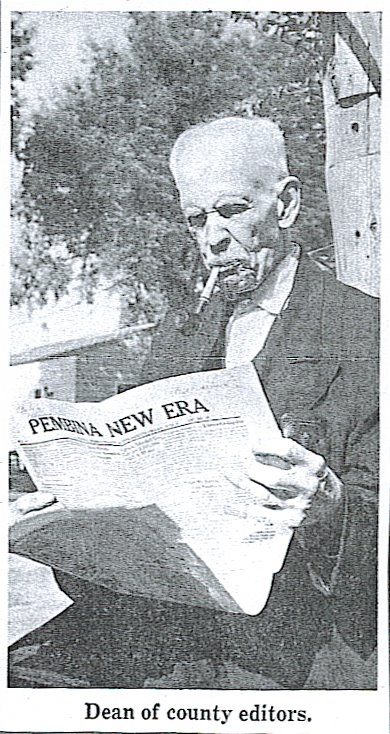
I only met Roy DeFrance a handful of times, and only in passing. He didn't look a lot different than the photo here at the left, as I remember him. He was by then, a very old gentleman, and would soon leave the running of the paper to others, including his daughter Ione.

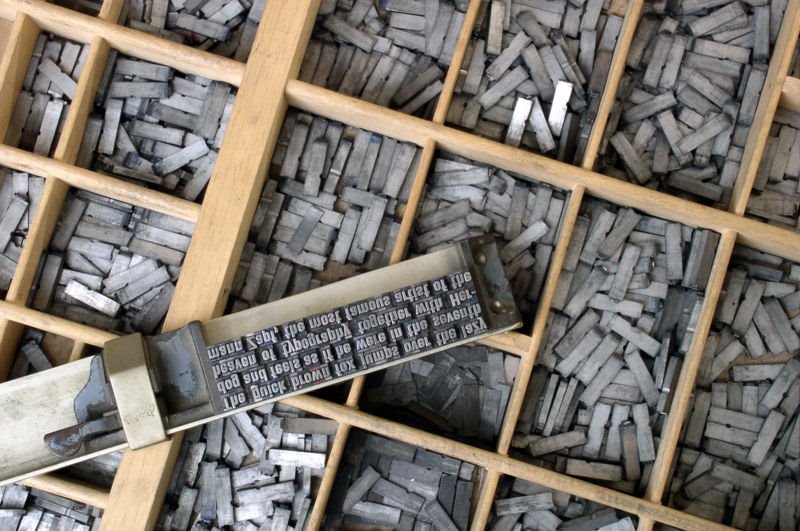
I was a wee girl, tagging along with my Mom as she visited the Mr. DeFrance's offices to place ads or pay a subscription. I remember having the chance at least once of going behind the counter and seeing the amazing tools he had to use to make the paper. I noticed he wore black armlets, and he explained that was to protect his shirt from the inks on the press. He also pointed out all the little wooden trays with backwards metal letters, and I must have looked flabbergasted to think of all the work he must have to go to, to put a paper 'to bed', because he then said he's been at it for awhile and can go pretty fast. It still amazed me, and does to this day, and when I remember those visits, I also remember my mother saying that it wouldn't be the New Era without at least one misspelling in an issue. Well, I think we could forgive Mr. DeFrance a few errors - who of us could have done better? He sure didn't have a convenient 'spell checker' like we do nowadays!

Ione, one of his children, is the person I most remember and identify with the paper. Every week, Ione would faithfully call around all over the readership area, to get news for each town's section in the paper. It was a time-honored tradition in our area to do this. You couldn't go anywhere or have a good or bad event happen, without it being known in the New Era. It was a good tradition, even though some might think it intrusive; we were able to keep in touch with one another despite life being so busy.

A few months ago I made a point of tracking down Marjorie (DeFrance) Baker. Until then, I didn't even know Marjorie existed. When I was a kid, you don't even think about how many kids an old person may have had, so didn't think Mr. DeFrance had any other children than Ione! Anyways, through Fort Pembina Historical Society contacts, I found out about her in my efforts to do more history about the New Era. Below is a fairly verbatim summary of what transpired during our telephone interview...

She is 96 years old, has a great memory, and was wonderful to speak with. Was great in sharing about the paper and her father, and her involvement with the New Era as a young person.

She said her family was of French Huguenot ancestry, first settling in Pennsylvania, then coming to Minnesota. Her father - Roy DeFrance - was a short man, 5'6". "He always wore a mustache..." and had black curly hair as a young man. He started out as a teacher, and it was at a teacher's convention that he met his future wife. But eventually he went to telegraphy school in St. Paul to make a better future for himself and his family. Later, he taught my great uncle telegraphy in a depot school.

In 1920, Mr. Deacon (seen here at left, in an early photo of the New Era offices when they were in St. Vincent (and the paper was known as The St. Vincent New Era...) sold the paper to her father. Marjorie was unable to say why her father changed careers and went from teaching to being a newspaper man, but going by his later reputation, I would speculate it must have been because Roy DeFrance had the desire and ability to express himself in the way only a newspaper publisher can. He became known for his editorials, and prided himself in providing a needed and appreciated service to his community.

Roy and Eva DeFrance had eight children, three girls and five boys: Norton, who worked as a printer while in the army during WWII, and afterwards worked in various print shops; Melvin, who became a reporter and also has worked as a ghost writer; Roy, who worked in the field of Linotype; Ralph, who lives in San Diego, California and runs the DeFrance Publishing Company; Dilbert, who began professionally at the New Era, then went on to work for the Grand Forks Herald; Ione, who never left the New Era; Majorie herself, a homemaker; and Gladys, their sister (no profession was mentioned for her...)

Marjorie continued by telling me how all of the DeFrance siblings were involved in one way or the other with the family business as they were growing up. Marjorie herself remembers taking singles (plain 12"x15" sheets) and wrapping copies of the paper, addressing them to subscribers, and even making deliveries. Later, she got the chance to do some reporting. She described to me seeing her father, Cecil (aka "Casey") Cleem, and Ione doing the typesetting for the print runs. Speaking of print runs, every print run required them to grease the press, which was quite a job in itself! She said she would help with the print runs sometimes, standing on a stool and feeding the press sheets, which were processed by hand-crank; if you missed a sheet, the bed got over-inked and would gum up...and her Dad would get plenty mad!

Majorie says, if she remembers rightly, one of their old presses is now in a museum, but she couldn't remember if it was the Kittson County Museum in Lake Bronson, Minnesota, or the museum in Cavalier...

We ended our telephone call agreeing I would call her this summer and make plans to meet her. She said she has a lot of memorabilia about her family and the New Era she would like to share with me, and I told her I'd love to see it, and have a chance to talk more with her. Alas, I was not able to make it up home this summer, but will be next summer due to the Humboldt centennial and all-school reunion. Let us hope and pray that I get the chance to see Marjorie then...