Showing posts with label teachers. Show all posts

Tuesday, July 10, 2018

Water Cooler VII: School Memories - Bullying

Humboldt-St. Vincent School, like any other school, had its share of bullying and bullies...

Michael Rustad: I remember when Dave Boatz sang the Beatle's song, "He is a real nowhere man." He adapted it to Walter Petruska. "He's a real no-hair man!" Dave was a comedic genius. When we were altar boys together, he did his best to get me to laugh at the most inopportune times. He would have a running commentary on the qualities of the tongues at communion time. When Mrs. Friebohl (Grandma) and Toots Ryan went for communion, he had me in stitches with his descriptions!

Dave was never mean-spirited but did these pranks always in a spirit of fun. Ok, he went a step too far in dropping cherry bombs in the boy's toilet or putting Elmer's Glue in Martha Roberts lotion bottle. Martha would often use moisturizing cream and then wipe with her hanky She did this by habit not realizing that Dave had substituted glue for lotion! The class did not dare laugh, but did after class. He would also pick vegetables and flowers from neighbor's gardens and then with his angelic smile try to sell them back! I can tell you so many stories about Dave. Dave had a moral compass in always sticking up for any person with a handicap,. His brother Stevie was profoundly developmentally undeveloped and I think that his love for his brother was key in being empathetic. Randy Younggren, who as deaf and had difficulty speaking, was a case in point. Dave was so good to Randy and he had Randy drive out to our farm on his motorcycle nearly every evening. He was just happy to see us and it did not matter whether he could not speak many words.

Steve Ritter: No Way! Dave never did any of those things! Lol! Dave is one of the best...He has a heart of Gold!

Michael Rustad: I also think that Velma Isely did a great deal to stand up for those being bullied. There was bullying in Humboldt. When we moved to the farm when I was 7, I had to ride the bus and it was an ordeal. They took my stocking hat, did not leave a seat open, etc. It was relentless until around 6th grade. I could name each of the bullies and some were older girls with no moral compass.

Trish Short Lewis: You are so right, Mike. I was bullied a LOT by both peers and older kids, when I was little and up until junior high. My mom went to bat for me, but she also told me to ignore them, which was very hard but I did it so they had no satisfaction. To cope, I withdrew into myself, humming tunes, saying words or phrases over and over, closed my eyes, plugged my ears, read books, etc.

Michael Rustad: Our school bus was parked outside the Post Office and everyone was picking on Barbara Norberg. Mrs. Isely boarded the bus and essentially told everyone how ashamed she was and gave a long speech about compassion. She eluded authority and people stopped bullying her after she deboarded the bus and were off to Lake Bronson. I remember well how I dreaded the bus because Tony and I were bullied.

Steve Ritter: I think when we're young we all say things a little quickly. I am certainly not innocent. Sometimes it's a misunderstanding between young kids. Sometimes the physical side is how many of us have learned to deal with issues. I know that some of the meanest things I've heard came out of the mouth. I remember recesses when I was young being tormented by older kids. Being dogpiled and being on the bottom of several. It was not as much fun as people would think. I finally stood up and took on one of these people. I knew it would let my parents down if I got into a fight because my father and mother didn't believe in physical violence of any kind. But I'd had enough. I did get in trouble and was grounded for a period of time. but no one bothered me again. No one dogpiled me again. It's too bad people treat others in a negative fashion but sometimes and for whatever reason it happens. Most of the time it happens just straight out of ignorance and sometimes pain. Mrs Isley was a wonderful person!!

Trish Short Lewis: I agree with *most* of what you say, but I also think some people are just plain mean. Many who are mean got it from their role models, i.e., their parents. Either their parents are authoritarian, or abusive, or both. I wasn't perfect - I was a chatty girl who never knew enough to keep her mouth shut sometimes (not always) and that would get me in 'trouble' - it wasn't being mean, it was being inappropriate, interruptive, and/or loud. I definitely feel that is a LOT different than saying unkind and downright mean things to someone, or physically hurting someone, etc. That's a horse of another color entirely. So the bullying I and others suffered was mean and wrong. Period.

Thursday, February 02, 2017

StVHS Sports: 1927/28

Vintage St. Vincent High School pennant from 1920s

[Guest article by Michael Rustad, originally from nearby Humboldt, MN]

In the summer of 1999, my daughter Erica and I visited the town of St. Vincent.

There is no longer a bridge connecting the central business districts of Pembina, North Dakota and St. Vincent. The old bridge connecting the towns that I remember as a child has long been dismantled. The places that I remember in St. Vincent have long since closed. Short's Cafe, Sylvester's Store, the Curling Rink, St. Ann's Catholic Church, and the St. Vincent Fairgrounds. The curling rink is now neglected and in state of decay. The Church is a private residence. The St. Vincent School, too, is in a state of benign neglect. The school is in disrepair and the fire escape slide detached.

It was difficult for me to explain to my daughter that St. Vincent was once a bustling community. We attended catechism each summer in the basement of St. Ann's Catholic Church. We had a large number of ball games in the yard outside the church which is now overgrown and marred by abandoned cars. When my sister and I visited the Kittson County Museum in Lake Bronson, I was amazed to find some high school yearbooks [called Borderlines] from St. Vincent High School. St. Vincent High School closed in the late 1930s and never reopened. Instead, it eventually consolidated its school district with Humboldt from 1957 to 1991.
[Note from Trish:  In-between StVHS closing and St. Vincent consolidating with Humboldt, students had the choice of attending Pembina High School, or other schools in Kittson County like Hallock...]
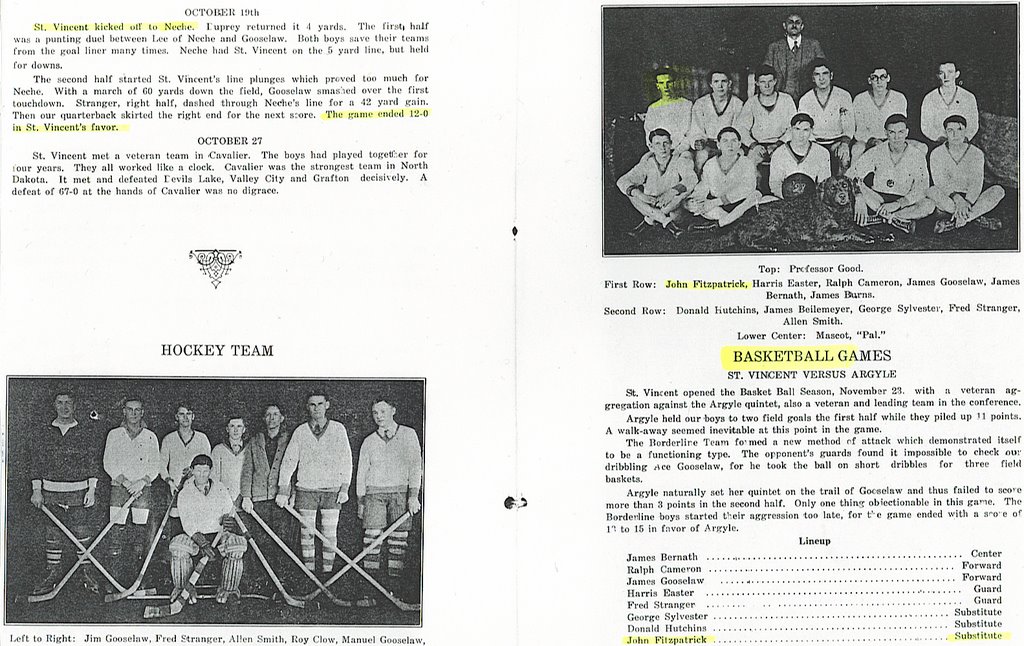
It was an unexpected joy to find yearbooks from the St. Vincent High School from the 1920s. This was a yearbook from a small town in NW Minnesota prior to the Depression. High school life in St. Vincent was marked by lots of school spirit judging from the many activities. St. Vincent fielded a football team, basketball team, hockey team, track team and baseball team in [school year] 1927/28.

"If you could walk or run, you were in the starting line-up."

Sunday, November 27, 2016

Mrs. Roberts Wins History Award

"An annual award, History Educator Hall of Fame is presented to the teachers, one in each county, who are the most effective in teaching history of the region..."
Education Manitoba - Volume 2 by Eileen Pruden (1975)

Mrs. Martha Marie (Beck) Roberts,
was the recipient of the first annual
Red River Valley History Educator
 Hall of Fame Award
, 1972
[for Kittson County...]
Among the Red River Valley Historical Society's many projects over the years was establishment of liaisons between various historical organizations, educational institutions and individuals, and sponsoring a high school historical essay contest...

[From Red River Valley Historical Society Records collection at The Institute for Regional Studies (NDSU)]

The contest began as the “Historical Research Essay Contest" in 1965.  It was sponsored in the schools of the Red River Valley of Minnesota, North Dakota and Manitoba.

In a letter regarding the 1968 contest the stated purpose was:
“A. To alert youth of the Red River Valley to the wonders of its rich pioneer heritage; 
B. To acquaint our youth, through interviews and other research, with the fascinating lives of those who developed the Red River Valley;
C. To encourage scholarly research and writing among our high school students; and
D. To record matters of historical interest for the benefit of future generations.” 
Most years a specific theme was chosen by the society. In 1966 and 1967 it was biographies of local pioneers or places of historic interest, and in 1968 an artifact of historical interest was added.

In 1965 only four essays were submitted, but quickly grew to well over 100 a year. The first place award the first year went to Theresa Scholand of Mount St. Benedict Academy, Crookston, Minn. The 1966 winner, Rebecca Hole, was the first to be published in the society’s periodical, the Red River Valley Historian. Later years they established winners in junior high and senior high categories Future winners were published in issues of the Historian, succeeded by its Red River Valley Heritage Press. Essay contests continued into the 1990s with submissions after 1987 retained by the Red River Valley Heritage Society at their offices at the Heritage Hjemkomst Interpretive Center in Moorhead, MN.

[From Red River Valley Heritage Society Essay Contest Entries, 1965-1987 collection, Institute for Regional Studies & University Archives, NDSU) Collection number: Mss 5, 44, 69, & 252]

Dennis Matthews
[Senior Portrait 1944]
The inimitable, amazing, Mrs. Roberts. She was a memorable teacher in the best sense of the word. She expected the best and thus propelled you to give your best, time after time. For some of us, with her reputation proceeding her, we arrived in her classroom intimidated. For those that gave her a chance, they found out she was tough but fair. She was definitely...unforgettable.

It was Mrs. Roberts who promoted and inspired the students in her school in Humboldt, Minnesota, to find and preserve their local history via the Historical Essay program.

A portion of all the essays written for this contest - those written by Humboldt-St. Vincent High School students - were preserved by Dennis Matthews on the RED RIVER VALLEY website.

Wednesday, July 24, 2013

Last Hurrah for a Rural School

Controlled Burn:  Older section of school
There were no girls in the senior class of 1987, forcing Humboldt-St. Vincent to do without a homecoming queen. Things improved this year, when all three girls in the class vied for the honor.

Classes don't come any smaller than in Humboldt-St. Vincent. It's a school with 65 students in kindergarten through 12th grade, including one fourth-grader. The average grade has five students.

That's too small for state officials, who see nothing romantic about the arrangements and are happy that the school district is finally ready to close shop. For Education Commissioner Gene Mammenga, the tiny school in Kittson County is a prime example of public education gone awry.

Humboldt-St. Vincent, 410 miles northwest of the Twin Cities, ranks as the state's smallest K-12 school district and spends $11,381 each year to educate a single student. That's the highest of any K-12 district in Minnesota and more than twice the state average. A state study called the spending astronomical.

Moreover, the district holds classes in an 85-year-old school that violates state codes and is faced with a financial crisis after piling up debt for four years. A lack of money and students makes it difficult to offer many electives.

"It's a waste of money, but more important than that, it's a waste of human potential, with young people who had a limited academic experience," Mammenga said.

Those are fighting words for those who farm the flat, rich land of the Red River Valley.

"Typical bureaucrat sitting in the white ivory towers, totally removed from the realities of rural America," said Humboldt Mayor Curtis Miller, who grows wheat, barley and sugar beets on 2,100 acres. "The way of life in rural America is very sacred to us."

That's why these are sad days in Humboldt, where farmers need rain and school ends for good on May 30. It's the end of a long era that began in 1882, when the district was created.

Tuesday, September 25, 2012

Profile: Velma Isley

This is a memory of Margaret Matthew Patzer about the St. Vincent Fair around 1928. Margaret is referring to Velma McCrystal Isely who was a great teacher and a wonderful person. Velma Isely was the Mother of John (Class of '63) and Elizabeth (Class of '57). She was a woman of great intelligence and compassion. I remember her silencing a group of bullies harrassing a mentally retarded girl with her great moral compass. I think I learned so much about social justice when she stood up for the weak and oppressed that summer day in 1957. I think that I was so impressed by Velma Isely's strong sense of ethics and she was a profile in courage. I have tried always to follow her example in being an advocate for the consumer in my work in law.

- Michael L. Rustad
My cousin transported my pet lamb along with some of his animals to the St. Vincent Fair. The afternoon I was to show my lamb, I convinced a friend to skip afternoon school with me and find a ride to St. Vincent so I could show my lamb. As we entered the gate Velma the lady in charge of registration and who knew me asked what I was doing there on a school day. When I said "to show my lamb" she said it was not registered so she registered it immediately. When it was time for me to show my pet lamb I found us moving closer to the front and finally in first place! I had won a trip to the St. Paul State Fair. When I left later that year my dad emptied his wallet to give me money to help buy food while there (this was about 1933 at the peak of depression) and I felt badly that he had to give me the only money he had.

- Margaret Matthew Patzer
Mrs. Isley was the wife to the agent at the depot in Noyes where my Dad worked. She was also my Kindergarten teacher.

The things I remember about Kindergarten are:

- Mrs. Isley singing Button Up Your Overcoat and encouraging us to sing along

- Learning the letter U's "short" sound - she taught us by using the example of what happened when you tried to lift a bucket full of sand - "...ugh" She had me demonstrate it in front of the class.

Saturday, January 28, 2012

Joe River School 1939-40

Back Row:  Ronald Cox, Phyllis Brown, Wilbert Clow, William H. Ash 
Middle Row:  Donald Shaw, Roy Webster, Hugh Griffith, Jim Griffith
Front Row:  Leo Ash, Kathryn Griffith, and Laurance Shaw
Teacher (not shown):  Lillian Bill
[Courtesy: Raymond Ward Photo Collection]
Not far from St. Vincent, is an area called Joe River. As the crow flies, it's east of town.  The Joe River winds its way through the countryside there, several families settling in that area.  In fact, my own great grandparents originally homesteaded out there, before moving in to St. Vincent itself.

The school was located east of the North Star Church, near where the county road meets the railroad track - which when you come to think of it, seems a dangerous place to build a school where children will be playing, but that's what I'm told.
Joe river derives its headwaters from St. Joseph township [and its name...] - "Minnesota Geographic Names: their Origin and Historic Significance", by Warren Upham

Sunday, October 23, 2011

Profile: Ruth Younggren


Ruth Younggren, a first grade teacher of poor children in Minnesota, yearly spent the first two weeks teaching the sounds of English and their corresponding letters. Then through the year, she taught 50 spelling words each morning to her first graders. These first graders were not only good spellers, they were excellent readers and creative writers...

- From How it Began

Ruth Younggren - or Miss Younggren as I knew her - has always been a person in my childhood memories that revives uncomfortable feelings in me.  She was a teacher who made strong demands on very young children.  Many children thrived on her challenges and literally blossomed.

However, even at the time, I instinctively knew she was being very unfair to certain classmates of mine.  If you were intelligent and were willing to work hard, she loved you.  If you had trouble understanding and didn't know how to ask for help...if you were shy and couldn't ask for help...then you might find yourself humiliated.

Miss Younggren used, among other things,
the Dunce Cap, as 'motivation' ...
I personally witnessed a fellow classmate be repeatedly denied permission to go to the lavatory.  He ended up urinating his pants while sitting at his desk, desperately trying not to.  Another time, a classmate tore her dress on the playground; instead of finding a less embarrassing solution, Miss Younggren made her remove her dress so she could mend it while the girl sat at her desk in her underwear, arms crossed and head down.

Some reading this may ask, why bring this up years later?  My answer:  While talking about this now can't help the children affected back then, it is important to acknowledge what happened, to shed light on dark events.  I have often felt bad for those who had to go through that, while I did not.  There were a couple of times I had to endure a lecture from Old Man Carelessness and stand in the corner, and once I even sat on a stool in the hallway for all to see, wearing the dreaded dunce cap.  It didn't permanent scar me, and I actually was one of the top students in the class.  But for the others who were literally humiliated, I felt bad.

It was a time where old practices still tenuously held on, but were soon to change.  I experienced a bit of the old, as many reading this might have, too.

Sunday, August 21, 2011

Grand Old Lady

So many children entered through these doors

The sign is blank.  The steps are mostly buried, a railing rises from the earth.  A gibbet of sorts protrudes from the front.

 It's obvious that just about everything needs help.  Roof, siding, windows, foundation.  The "Grand Old Lady" of St. Vincent, that housed so many young souls on their journey of learning, deserves better.

Tuesday, August 24, 2010

Small Town Girl Sports

Many years ago I was fortunate enough to have been able to
handle & read a 1928 copy of the St. Vincent School's annual
"Borderlines", copying several pages pertaining to my family
The piece below was written by Mike Rustad and and originally posted on my family's 'family' website, a website I created to gather family history to which I invited Mike to be a part of due to his love of local history and knowledge of so many area families that intersected with my own.

Mike shared this fascinating look into St. Vincent's past back in 2004; I am currently reviewing all content on an old site because it will be discontinued soon. Many great pieces of local history were shared there, and I intend to preserve it all in some shape or form. I invite you to share in this wonderful view to our past, this little 'time machine' to not only my family's roots but those that touch on the wider communities they lived in...

[And as Mike ponders, where DID those girls practice some of their sports? My theory is they shared practice/play space with Pembina, but that's just a working theory...]


This little essay was inspired by reviewing some old clippings about the St. Vincent girls basketball team that appeared in the 1927-28 school yearbook that can be found in the Lake Bronson-based Kittson County Museum. St. Vincent is today nearly a ghost town. First, a little background. Mrs. Dick Lapp's little history of St. Vincent notes that the towns was the oldest city in Kittson County from the standpoint of settlement. Mrs. Lapp writes that "[t]he history dates back as far as 1857, when Minnesota was still a territory. A trading post on the village site had been named St. Vincent in honor of St. Vincent de Paul, founder of missions and hospitals in France." St. Vincent was built up as a town that serviced Fur Company XYZ (what an unimaginative name!). She notes the town was a byproduct or expansion by the Selkirk settlers that founded Pembina. St. Vincent had the reputation of being a rough and tumble town. Mrs Lapp writes:
"Ox-carts were the first means of travel in this area. Norman Kittson enveloped the ox-cart enterprise. Later steamboat traffic became important not only to the village but to settlement of the community. As early as 1862, railroad talk began. In Winnipeg, Donald Smith thought the Red River needed a lifeline to the east. He took his idea to Norman Kittson, the president of the steamboat line which held a monopoly on the river. Kittson referred the matter to his silent partner, James Hill. Hill had a dream of reviving the bankrupt railway at St. Paul and latched onto the idea immediately. In 1878, his dream was realized. He saw the first locomotive arrive in Emerson, Manitoba from St. Paul. It was the Great Northern Railway and later known as the Burlington Northern. The customs office and depot were in St. Vincent until 1905 when they were moved to the Canadian border at Noyes. In 1900, a roundhouse was built, James J. Hill backed the project. It was located by Lake Stella, east of St. Vincent. A turning table was included that was used to turn the trains around. Charles Gooding was the first depot agent. John McGlashen was the first man to take a carload of horses through from St. Cloud to Winnipeg. He also operated a saloon".
Mrs. Lapp notes how vibrant the town was by the turn of the century. The fur traders were prosperous and started the first stores. She writes further:
"The first bank was established in 1880 by J. H. Rich, E. L. Baker and F. B. Howe. It was later sold and closed. J. R. Ryan operated a livery and sales and William J. Mason opened a blacksmith's shop and also ran a wagon and carriage shop. The Firehall was built in 1903 by Edward Cameron and his three sons. It was on main street, east of the Red River bridge and housed fire engines run by steam. The Firehall was pushed over in 1972, the town hall demolished and a new hall built on original site of depot."
Mrs. Lapp notes that the first teacher in the St. Vincent School was none other than Eliza Moore.  The first schools in the county were on or near this village. Lapp's sure-footed history records that it was "Eliza Moore, then age fifteen, taught all eight grades in a little one room school in the west end of town. She told stories in later years of the Indians riding their ponies around the schoolhouse and looking in the windows and frightening her and the pupils. The present school was built in 1903. It was a square two-story white frame building and originally housed all the grades from one through twelve."

Eliza Moore continued to teach in St. Vincent when I was a student in the 1950s and 1960s. I thought of her as an Ancient Mariner or School marm. Mrs. Lapp gives her great credit for the development of the school in St. Vincent. In the late 1950s and early 1960s, Prof. Moore was a big part of the St. Vincent school. Other St. Vincent teachers from my day included Maribel Berg, Velma Isley and now my memory so many decades later becomes fuzzy. I think Simeon Cameron was the school cook. [Note from Trish:  I also had Mrs. Berg & Mrs. Isley as teachers at the St. Vincent School, and Simeon Cameron was still the cook while I attended...] 

Now, let's fast forward to 1928. The town of St. Vincent in its heyday had a hotel called the Northern Hotel. It also had saloons, stores, a jail, fire station, curling rink, etc. However, the jewel in the crown was the St. Vincent School. The School field both boys and girls teams for basketball, track. tennis and baseball. I think that the social history of girls' sports is largely a lost memory. I want all of the readers to think of the St. Vincent described by Mrs. Dick Lapp. There was a vibrancy. It was 1928 only a year before the Great Depression was to cause the citizens of St. Vincent great economic and personal turmoil. The Great Depression which was to begin in 1929 decimated St. Vincent. Mrs. Lapp blamed the Great Floods of 1948 and 1950 and she may be right about the factors leading to the dissolution of vibrant St. Vincent. I think that the Great Depression might have played a role. Mrs. Lapp lived through the Great Deapression and both floods. I was a baby during the Flood of 1950. I digress. Fast forward to the 1927-28 school year. The school was the center of town life.

The St. Vincent School had a strong (women's) basketball team consisting of Mamie Cleem, Isabel Fitzpatrick, Lelia Davis, Fidessa Wilkie and Alberta Fitzpatrick. The Girls' Basketball Team of 1927 is pictured during the first game of the season. The first game for the girls was held on December 4, 1927. I found the school yearbook to be amusing. Isabel is pictured as tall and lean and quite attractive in a picture taken during the first game of the year. In the back row, there is yet another Fitzpatrick named Fern. The name is alternatively spelled Fern or Ferne. Ferne was the starting Left Forward on the team and had the nickname of Coon. Isabelle was known as Issy or at least that's what her teammates called her. Issy was apparently the team's star ball handler and dribbler and played at the right guard position. What's so puzzling to me is that there appears to be 6 players on the starting lineup for girl's basketball. Issy was at the Right Guard position Fidessa Wilkie or Fido was at the Center Guard and Verlie Cameron or Plug was at the Left Guard. The nicknames for the girls were not exactly comely or feminine names. I was impressed with their apparent fitness and competitiveness. Every girl had a nickname. The Center Forward, Mamie Cleem, was nicknamed "Slivers" There was Coon (Ferne) at the Right Forward position and Lelia Davis or Lee at the Left Forward. Isabelle or Issy played Right Guard. Fido was at the left guard. They were spelled by substitutes Verlie Cameron (Pug), Violet "Cutie" Cleem and Mae (O'Leary) Gamble. Eileen Twamley also played on the team. I assume she was the sister of Merle Twamley who was the patriarch of the large Twamley family we knew growing up in Humboldt and St. Vincent.

The other sports stories about the girls basketball team of 1928 mentions the injuries the girls sustained and how they played the game. Isabelle, for example, jammed two fingers, and was hurt in the game with Stephen. St. Vincent beat Stephen 21 to 16. Issy continued to play despite having sprained fingers. She was not the only girl to be injured. Coon's leg was twisted and the game delayed. She limped through the end of the quarater and could not continue. She was replaced by "Cutie" Cleem. In that game, Mamie "Slivers" Cleem was the superstar scoring 12 of the 16 points and playing like a champ. St. Vincent beat Stephen! I don't ever remember Humboldt-St. Vincent beating Stephen. St. Vincent beat Stephen at the game held in St. Vincent. Does anyone remember where the games were played? I think that the Boy's Teams were played in Pembina. It may be that the games were played at Pembina's gym. St. Vincent played Pembina February 8, 1928. The Game ended in a 10 to 10 tie. In the Stephen game, St. Vincent's star players missed key free throws while Stephen made their shots. St. Vincent took the win because of their better outside shooting. In the Pembina game, the game game had a number of hard fouls against the St. Vincent girls. Issy Fitzpatrick had a key personal foul levied against her. A technical foul was called on Fido Wilkie. Slivers was hurt in a hard foul and knocked against the back wall and then to the floor. There were officiating disputes in all of the girls' games or there was a hyperactive imagination on the part of the St. Vincent sports writers. In the return game with Stephen at Stephen held on January 20, 1928, the St. Vincent team made baskets that were not counted. The home town (Stephen tilted) referree ruled that when Slivers made a basket, it did not count. When Coach Dick Lapp objected, he was told that the basket did not count because of interference. Lapp retorted, "Interference, YES, BECAUSE ST. VINCENT MADE THE BASKET."

The third quarter of the Stephen game ended in a 14 to 14 tie. In the fourth quarter, a St. Vincent player named Mae Gambel or O'Leary went into the game replacing Issy Fitzpatrick. That substitute was not a wise choice as then Stephen made four baskets and St. Vincent only two to round off the game which ended "18 to 22, in Stephen's favor." In the Pembina game, Cutie Cleem substituted for Coon. Apparently, the ref called a foul on Cutie for chating with someone on the team so a technical foul was called.

I was wondering whether anyone knows additional facts about any of these colorful girl sports heroes from the late 1920s. St. Vincent was a great sports town with a full array of girls sports during the 1920s: basketball, tennis, softball or kitten ball etc.

I responded to Mike's post by saying:

Wow, Mike! Keep the stories coming, sports-related or otherwise! You really bring St. Vincent alive for us. It's really neat to hear about the history of where I grew up. I wonder what other source material there might be out there that would have information about the town's life? I'd love to hear more about the merchants, who owned what, what the saloons and hotel, etc. was like, the background of the town's politics, etc...even the gossip of the past. Any ideas anyone?
My cousin Delphine Mundorf responded:
Alberta Fitzpatrick as you may know from other postings is my mother. I was surprised about her name mentioned here on the basketball team. I guess she has mentioned it to me but her biggest thing she talks about is playing tennis. She says she was very good at tennis and she and her partner did so well they had a chance to go to the State tournament. However that cost money and her folks didn't have the money to send her so she never got to the state competition. I believe she felt she was good enough to maybe have become a pro. The Fern you talk about is mom Alberta's & my aunt Harriet's first cousin. I met her several times as she lived in Crookston when I was a child and we usually stopped to visit her whenever we went to St. Vincent to see my grandparents. My mother is still living and will be 92 in July. To my knowledge she has outlived in age all her family. They all had longevity but most of the elders died in their late 80's.
Mike Rustad then commented:
Alberta was in fact a member of the St. Vincent tennis team. What this demonstrates is that the St. Vincent girls program was fully developed. The girls did not play football or hockey in the late 1920s, but every other sport. The point was that the town followed these teams. I find it amazing that St. Vincent played Neche, Cavalier, Stephen, and towns that were much bigger. I wonder where St. Vincent played their hockey games. Jim Gooselaw, Fred Stranger, Allen Smith, Roy Clow, Manuel Gooselaw, Cecil Smith, Bill MacKay and Ralph Cameron were on the school's hockey team. I have no further information. I think that if I were to get back to Lake Bronson that I could find a great deal more about the St. Vincent school. One of the problems I have being in Vermont is that I don't have ready access to these materials. Maybe one of you could do a field trip to the Kittson County Museum and make some copies of the St. Vincent materials. Another great source would have been the Pembina Museum. I am not referring to that antiseptic boring museum today, The old museum had tremendous numbers of artifacts etc. I asked someone what happened to that stuff and was told that the State has it in storage in Bismarck. What a waste. I think a fellow named Barron had his own private museum in Pembina. [Note from Trish:  Mike is right in this - it was Elmer Barry, and his private museum became the basis of the old Pembina Museum!]  I bet he had tons of stuff on St. Vincent. The shame of having this lost history is that everyone is now deceased or very old who attended St. Vincent High School. We have only fragments to draw from. We must be like archaeologists in trying to construct social history from such scant data. I think who we are is deeply rooted in our history. Going back to far in history for wisdom is like ox-tail soup. It's going back too far for a good thing.
Delphine Mundorf again commented:
My mother as I mentioned is now 92. She & I believe 3 other boys were the only 4 to graduate from the St. Vincent High school all others transferred to Humboldt I believe. I wish I had pd. more attention to Mom's stories but not being a historian I didn't. But I think Mom, Fred Stranger, and a Smith boy & one other graduated from St. Vincent High school. The rest transferred but it cost a tuition to do so & these 4 parents didn't have the money for it. So Mom wasn't going to finish school. One morning she came downstairs and found her mother crying and when My Mom asked Grandma why she was crying Grandma said because I only had a 3rd grade education and you have a chance to graduate and aren't going to do it. So my mother called the boys and asked them if they would be willing to go back to school and they agreed so they showed up in Prof.1 Good's class. Mom said he was so happy to see them he got tears in his eyes, Moms favorite thing she used on us kids was that we better do good in school because she was valedictorian of her class. I wasn't til later we found out she was only 1 of a class of 4, no wonder she was valedictorian. Ha Ha. She also has told me that the professor was so glad they came back to his class that he offered to help each one of them should they decide to further their education. She then went on to Minneapolis and went into nurses training but at her time it didn't cost to go to nurses training you worked some of your education so got the room free and got pd. $12 a month. She made it through the 3 yrs. to become a registered nurse but was never able to take the state boards. Her story all these yrs. was because it cost $12 to take the board exam and she didn't have the money to pay for it nor did her parents. I always asked her why didn't you contact Prof Good since he said he would help any of you. To go through the whole training then not take that final exam to get you certificate is such a waste. She just said Ya I suppose I could have asked him. However I have since very shockingly found out there was a a whole other reason why she never got that final exam.
1 - The use of "Prof.", short for "Professor" was curious to me, since I had only been familiar with it in association with teachers at a university or college level, but here it is used with teachers at a secondary level. I did a bit of research, and it appears to have been common at this time...

Tuesday, February 24, 2009

Followup: DeFrance Family

Roy Cochran DeFrance was the St. Vincent depot agent at one time. Photo taken about 1907 or 1908. 
Marjorie DeFrance (Roy's daughter) was born in the living quarters of the depot on May 31, 1909...

I promised this followup
over a year and a half ago. My sincere apologies - time slipped away on me which is all too easy to do. Then again, I am continually amazed at the richness of our area's history so perhaps you can forgive me for getting distracted!

Nevertheless, I am finally sharing the photographs that Majorie DeFrance Baker - Roy DeFrance's youngest child - shared with me when I was up home for the Humboldt Centennial.


Evelyn Russell was Marjorie's first teacher. The photo above is of Marjorie's first grade class in the St. Vincent School, Miss Russell is at the back of the class. Don't the children look well-behaved?! Does anyone recognize other children in the photo? This would have been around 1915. Please let me know if you think you know someone...

The portrait to the left shows the newlyweds Roy DeFrance and his bride Eva Sheldon (Marjorie's parents) in 1909. The 1910 Census still shows Roy working for the railroad but now he's a telegrapher while my great uncle Richard Fitzpatrick is the agent. Around the same time he became the editor of the St. Vincent New Era under Publisher William Deacon; Roy's WWI draft card lists him as 'Publisher of Newspaper' in 1917. He bought the New Era from the original publisher Mr. Deacon outright, in 1920.


Seen here in his later years, the way I remember Mr. DeFrance, he is in the newsroom where he loved to be, amidst the printers, ink and plates which he could set fast without hardly looking. Roy lived to nearly 100, passing away in his centenary year of 1975. He was a newsman to the end...

This is Marjorie (DeFrance) Baker, Roy's youngest child, taken June 2007. Marjorie has been blessed with her father's longevity, being a very spry 98 when I spoke to her. She had spoken with me at length on the telephone some months before, the previous autumn, regaling me with memories of being put on stepping stools as a very young girl so she could feed the paper into the press. Publishing was definitely a family affair!

New Era Trivia: Our local paper was one of the very last papers in the country to be hand-set. As recounted in an essay by local school students:
When a person of the younger generation enters the door of this quaint, little, old building, that houses the Pembina New Era, they have a tendency to back out of the door without further inspection. They aren't familiar with the building and its dim lighting. The heavy machines and "The Cases" that he has, are too heavy for the floor to support, therefore, the floors are actually hilly. The whole place has the appearance of being painted black, because of the dirt involved in the printing of the paper. The ceiling of the building is very high with little strings of lights hanging several feet down from them. It is very hard to see anything clearly when you walk into the building, especially if it is sunny outside. Your eyes can't adjust to the sudden change in lighting.
I myself remember this building very well, 'hills' and all, and it was indeed very dim. It was a place from another time, and I was privileged to have a peek into that world...

Sunday, February 22, 2009

Profile: The Moore Sisters

I hestitated in posting this profile because of the negativity you'll read below. However, life is not all roses, and I value truth in history rather than convenience. I will protect the identify of the individual quoted, but please be assured that their comments come from first-hand experience, and not hearsay. Speaking as a person who suffered from actions of a cruel teacher myself (another story for another time), I can testify to their long-lasting effects, never forgotten to this day...

A former student of Miss Moore shared with me:

I had Eliza Moore. She had white hair in a bun. Was always crabby and looked like a wicked old witch. Which she was. She humiliated her students to tears every day. She was a cruel teacher. And in my opinion, should never have been a teacher.
Harsh and damning words...What else do we know about Miss (Eliza) Moore?

From the historical essays comes this information:
Moore, Eliza
B: 01 Jan 1882
D: 13 Dec 1971

Eliza and her sister, Mary (both spinsters), lived in St. Vincent, MN for many years. They both taught school in the area. Mary became the housekeeper for Eliza in the later years. Both ladies were involved in their church in a very vital way.

Eliza made a special record for herself in having the distinction of having taught in the public schools for 54 years without ever having a substitute teacher.

She began her teaching career at age 15 with a teacher's certificate earned by writing the teacher's examination. Later she completed the necessary courses and was graduated from Moorhead Teachers College.

She taught in Minnesota for 53 years, seventeen of them were in what was called District 352. She taught 10 years at Joe River and 7 in St. Vincent. She also taught upper grades in Northcote and, in addition, she taught one term in the Dominion of Canada.
I have a feeling some of her students would not have minded her missing some days of school!

Sunday, July 13, 2008

Profile: Lillian Lapp

For some of my grade school years, I attended the St. Vincent School. It was a very special place, and I feel very lucky to have been able to do so. My mother and my grandfather also attended school in it.

One grade that I attended there was 4th grade, taught by Mrs. Bergh. Mrs. Bergh was a traveler in her off-months, and would bring us back tales, foods, and souveniers from exotic places like Hawaii and Alaska.

Her teacher's aide was Mrs. Lapp...

Mrs. Lapp was from the old school. She ran a tight ship and would not tolerate foolishness. One day, my foolishness caught up with me.

"Patricia Short, you can't do more than one thing at a time unless you're in the circus!" Mrs. Lapp told me, when I wasn't paying full attention in class. I then proceeded to demonstrate to her that I could, by standing on one leg, rubbing the top of my head, and rubbing my stomach counter clockwise, all at the same time...she was not amused...! And no, I do not remember what happened next.