Monday, February 20, 2006

St. Vincent, and the Railroad

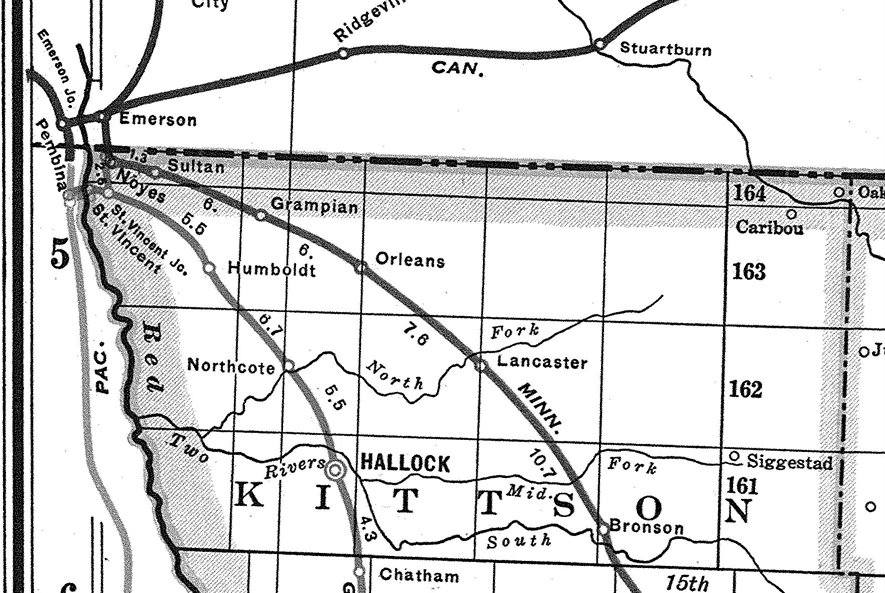
Click to see larger versionThe map* to the left here shows railroad lines into the St. Vincent area. I never thought too much about why the St. Vincent Junction was called that, other than assuming it was a nickname referring to the junction of the two highways, one branching off to the town of St. Vincent. I was mistaken, however; it was actually left over from the early days of the railroad in reference to the line going north to the border, and the junction off of it branching west into St. Vincent (and once planned - but never completed - to go across the river into Pembina...)

Growing up, I don't recall ever hearing of the towns Sultan and Grampian, but on this map, they are just a few miles from St. Vincent. I had heard of, and been by and through Orleans, just a ghost town even when I was growing up, but never those other two. I asked my Mom when visiting her last week about Sultan, and she said oh she knew about it. I asked why I never did, and she said there was no reason to, that it "never took off". From her comment, and this map showing both towns on a railroad line, I'm going to assume these two settlements had hopes to take off as towns due to the railroad, but for whatever reasons never did.

* The map is from the Great Northern Railroad archives, thanks to a railroad buff who shared it with me recently...

Sunday, February 19, 2006

Breadcrumbs

In my eternal quest to find out St. Vincent history, I surf the Internet in hopes of finding hitherto unknown bits of town history. It's hard-going when you're researching such a small - and dare I say it - obscure, town as St. Vincent is. But it's not impossible. It just takes a very persistent and stubborn person. Well, that describes me pretty well, so we should make great progress.

That said, I've been coming across small mentions of St. Vincent all over the place...
...Thomas HEARD was born about 1864. He died 14 Aug 1885 in St. Vincent, Minnesota.

...He had at least two brothers Adolf Bereznicki born in 1870 died in St. Paul, MN July 26, 1913. Adolf came into the US via Canada in May of 1895 through
St. Vincent, MN.

...James Wesley born 18 Jul 1881,
St. Vincent, Minnesota died 25 Apr 1961, Winnipeg, Manitoba, Canada

...Several mentions of Sylvesters, Balderston, and Ashes from
St. Vincent

...Several interesting references to the "
St. Vincent line", meaning the railroad line built north to St. Vincent...

Wednesday, February 15, 2006

A Stranger's Glimpse of St. Vincent

Andy Filer has many passions. One of his passions is taking photos of out-of-the-way (and some not-so) places.

Many of his photos are of things and places that many of us pass by and don't notice. But Andy thinks we should. And I quite agree.

The old St. Anne's Catholic Church
One place he has documented is...St. Vincent* - Can you identify the building in this photo? I can. If you're stumped, hover your cursor over the image to reveal the answer...

* Be sure to click the right-arrow on the first page to continue viewing all 24 photos of St. Vincent, including shots of the old jail...

In Appreciation of Small Towns

I wanted to leave my small town to be independent. But I've realized that needing other people isn't dependency, it's community. Being part of a community is realistic, useful and good. Unlike people in larger places, small-town residents know that when "somebody has to pay," that somebody is likely themselves.
The above quote is from an essay written by Aubrey Streit, from a town called Tipton, Kansas - a town a lot like St. Vincent.

While I never wanted to leave as badly as Aubrey did, I ironically had to in the end. Her words speak for me, and to me, and I think they just might for you, too...

Friday, February 10, 2006

Sense of Place: Icons


What makes our sense of place so strong, especially the places of our past? Part of it is the people that passed through our lives while we were there, for good or ill. Some of it comes from particular events during the time we were there. But it also involves things that we saw, we used, sometimes even cherished.

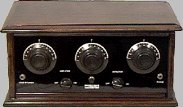
My Grandma Fitzpatrick had a mysterious wooden box in her upstairs that I came across during those Sunday afternoons when the grown-ups had eaten too much roast beef and mashed potatoes, and were now napping or chatting downstairs. After looking through Grandpa's old books with the gold-embossed-letters on their covers in the little closet, and rocking in the little armless rocker, I would open the wooden box and once again try and figure out what is was. It was empty, but I instinctively felt it shouldn't be. The hinge was long, metal, flat and slatted, sliding along a knob on the inside. The box had been painted, but I could see evidence that it had been beautiful once underneath. On the front were several groups of holes, some small, some as large as a dime in diameter. I eventually found out with my insistent questioning that it had once been a radio, but now was used to store things...or it once was.

I never forgot it, and when my Grandma broke up housekeeping years later, I asked to have that little box. More years went by, and by then I was a young married woman. In my parents' driveway one summer, I determined to strip the old paint off to see what was underneath. My hard work revealed a beautiful grained wood, solid all around, with a black enamel paint on the front. Ever since I have used it to store lap blankets, afghans, and doilies in.

Recently, I did a little research and found out the history of the little radio. It is a Freshman Masterpiece, built circa 1926. I've been told they were a very common brand, built for the masses, the Ford Model-T of radios. Battery-operated, they are collected and rebuilt by afficiados to this day. I don't have the ambition to do quite that, but I just might look for the knobs and set it up to look like it works...

The seemingly mundane items of a time long ago don't fade from our minds.

You Know You're From a Small Town When...

I hate to say it, but most of these make sense to me...!

You know you're from a small town when...

...The "road hog" in front of you on Main Street is a farmer's combine.

...The local phone book has only one yellow page.

...You leave your jacket on the back of the chair in the cafe, and when you go back the next day, it's still there, on the same chair.

...You don't signal turns because everyone knows where you're going, anyway.

...You call a wrong number and they supply you with the correct one.

...Everyone knows all the news before it's published; they just read the hometown paper to see whether the publisher got it right.

...There's no place to go that you shouldn't.

...A "Night on the Town" takes only 5 minutes.

...You have to name six surrounding towns to explain to people where you're from.

...Headline news is who grew the biggest vegetable this year.

...There is no point in high-school reunions because everyone knows what everyone else is doing anyway.

...You can name everyone you graduated with.

...You know what 4-H is.

...You ever went to parties at a pasture, barn, or in the middle of a dirt road.

...It was cool to date someone from the neighboring town.

...You had senior skip day.

...You don't give directions by street names or references (turn by Nelson's house, go two blocks to the Anderson's turn left and it's four houses left of the football field).

...You decide to walk somewhere for exercise and 5 people pull over and ask if you need a ride.

...Your teachers call you by your older siblings names.

...Your teachers remember when they taught your parents.

...You can charge at all the local stores.

...The closest McDonald's is 75 miles away.

...So is the closest mall.

...It is normal to see an old man riding through town on a riding lawn mower.

...Everyone who played sports had to play on every type of team, or there wouldn't be enough people to have a team.

...You actually get these jokes and pass them on to other friends from a small town.

Thursday, February 09, 2006

Memories of a House

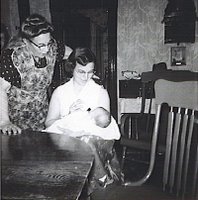
Click to see larger version - Grandma, Mom, and Me
Today, a man contacted me about this blog. He said, "...I am a Canadian residing in Winnipeg, Manitoba. Approximately 3 years ago I purchased a home in St. Vincent which I think is your grandparents' home. Several people say I am living in the 'old Fitzpatrick birthing home', also many people mention that they were born in my home. The style of the home has changed somewhat from the posted picture in that it now has 2 'mud rooms' on the east side of the home. I am in the process of replacing the siding and should be finished by mid summer..."

He ended by saying if I had any information about the house, he would appreciate hearing from me.

At first I thought he was talking about my own parents' home, which was the old Fitzpatrick Maternity Home, but the more I thought about it, the more I realized from another thing he said about the new school in town being 'kitty-corner' from the house must mean he's talking about my grandparents' second home, their home on the main street. So I replied to him explaining that, and said...
In that case, I will say that your house used to be much more lovely than it is now, or I should say the last time I saw it in 1998 (maybe it has improved since then...) There was a stained glass windown in the front parlor room, and a frosted glass window in the back porch inside door. There were hardwood floors, and outside there was a lot of classic Victorian gingerboard along the roof peaks. A small winding staircase led to the upstairs. In the kitchen there were built-in tilt-outward cabinet 'drawers' for putting in large sacks of flour. The front porch used to be where my grandfather had a small bed and would take naps in the summer afternoons. Through the porch was the front room, and off of it was a bathroom/sewing room. The front room had a buffet and china hutch, an old oak round table and chairs, a stove with a kettle on it with a rocking chair by it, a wall clock, and a small table with a radio on it. In the back porch my grandma kept her laundry supplies and wringer washer, and a slop bucket for peelings, etc., what people today call a compost. She would use it on her garden. The house always had a smell to it, a pleasant but unique smell, I think from all the cooking. She made everything from scratch, including baked bread. I spent many days with her there, sipping tea, eating brown sugar on toast, poached eggs on toast, listening to her gossip with her friends, help her make lazy daisy cake, hang clothes, put together carpentry projects in her sheds that are no longer there, that used to be in the backyard on the east side of the property line, one end being an outhouse, the rest her tool sheds, storage, etc. She built a homemade wheelbarrow for herself out of wood and an old bike wheel, and let me help her make a smaller version for myself. Her self-sufficiency always impressed me, and she was fun to be around. As she got even older and diabetes took her strength and her leg and she was in a wheelchair, on some very special nights when living with us in our living room when we were alone, she taught me cats-in-the-cradle with string, transferring it from her hand to mine, making mistakes sometimes as we tried to backtrack and find our way and laughing ourselves silly. I have never forgotten that night, nor the times I helped her get dressed, or watched my Mom help her go to the bathroom, or seeing her in the nursing home before she died. She wasn't the first person I knew who died, but she was the first person I really KNEW who died, and whose funeral I attended. I cried so hard, and missed her so much, and knew I was going to not only miss her but wished I had had more time to know her as a person and ask all those questions you don't think of until later...until too late...
Tuesday, February 07, 2006

St. Vincent Pastimes

Click to see bigger version Once upon a time, curling was a big thing in St. Vincent. My grandfather, Al Fitzpatrick, was a player and supporter of the local curling club. The rink was located kitty-corner from my grandparents' home uptown. It was also right by the town pump*, which you can see in this photograph. I did a bit of research on curling, and found out that around 1880, the same time period where there was a lot of homesteading in our region, that 'curling fever' swept (pun intended) across Canada and parts of the United States. Curling clubs sprung up all over. Many homesteaders to St. Vincent were from Prince Edward Island, which had a strong curling tradition. I'm sure that's a large part of why the rink was built. Emerson, which is right across the border from St. Vincent, continues to have a thriving curling club. In fact, some of the best curlers in the world have come out of Manitoba (an attorney from Winnipeg made an amazing play some calling it the best play they've ever seen, at the end of a match not long ago...) I just found out that the Mens' and Womens' U.S Olympic Curling Team is based out of Bemidji, Minnesota. They're right now at the 2006 Winter Olympics playing the best in the world. It's interesting to read how curling was (and still is) a large part of communities, keeping neighbors close and giving them something positive to do during the long, cold, dark days and nights of a northern winter... * My grandma showed me how to prime the pump, and then how to lift the arm up and down to get the water going; There were times when the water in the cisterns would run low, and she'd send me to fetch water down the street...

Thursday, February 02, 2006

Murder Hits Town


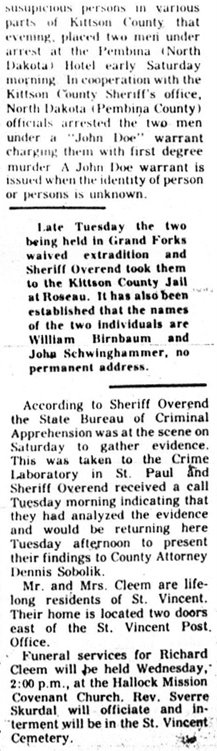
On February 28, 1975, a friend of my grandmother's was shot multiple times and left for dead. She lived to tell the tale, but her husband was not so lucky...

Richard and Esther Cleem were attacked by two men from the twin cities, one of whom was an estranged boyfriend of their daughter Marlys.

I remember that night very well because of it. My sister and her husband were visiting my parents. We were playing board games and visiting in the living room after supper. It was a Friday night, still cold out in Late February. My grandmother had just passed away a couple of months before, just a day shy of her 87th birthday.

The next morning, Dad brought home the news from the post office. We were all in shock. Murder? In St. Vincent? This was a town where many still left their doors unlocked - my parents were NOT among those people...my Mom didn't share others' optomistic outlook on human nature. Gossip in town was that if you drove by the Cleem house, you could still see blood on the curtains of a window facing the street. We later had to drive by their home that day. The gossip was true.

We later learned from Mrs. Cleem herself, that she had to play dead after being shot point-blank in the head, laying on the floor, while her husband tried to fend off the two men with a hammer. She always seemed so brave to me when she told the story. She was shot multiple times in the end, but that shot to the head had to stay her constant companion, a reminder of that night, until the day she died; it was lodged in a spot that was too dangerous to operate, the doctors said, and probably wouldn't hurt to leave alone, so they did...

A Trip to St. Vincent


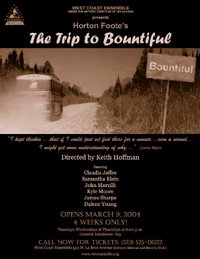
Several years ago I saw a film called A Trip to Bountiful. Before I even saw the film, based on the trailer alone, I knew it would touch me deeply. I knew because it was about something I understood all too well - about how place can be so strong in your life, it is almost like a person, a close friend, memories all wrapped up in one.

A Trip to Bountiful tells the story of an old woman in ill health that feels a strong pull to see her hometown one more time before she dies. She succeeds after many obstacles, only to find that her town has greatly changed from what she remembers; it a ghost of what it once was, as she is herself. However, her memories are powerful, and the trip was worth the effort.

That's how I feel about this project about St. Vincent. My memories of my hometown are complex, vivid, and meaningful to me, and I hope they can be to others...