Showing posts sorted by date for query hallock fair. Sort by relevance Show all posts

Saturday, March 14, 2020

St. Vincent Union Industrial Association Fairs

In Minnesota fairs are older than the state itself, having "made their appearance ... in the early 1850's," just at the zenith of the golden age of such institutions in the United States. Compared with later exhibitions the early fairs were primitive indeed, yet they more than justified their existence. They gave the isolated pioneer farmer a chance to meet his fellows, to have a good time; and by showing him late developments in machinery, fine livestock, and new techniques in farming, they gave him an incentive to improve his own farming. - From a talk called, "Early Minnesota Agricultural Societies & Fairs," presented at the Minnesota Historical Society's annual convention, held July 26, 1941.

Walter John Strickland Traill

The first day of the St. Vincent Union Industrial Association Fair was favored with good weather.  

The native pony race was won by Jim, Shylock second, Kate third.  The trotting race was won by Julia, Dan second, Topsey third.  

The judges were Walter J.S. Traill, C.C. Law, and D. Livingstone (The St. Paul Daily Globe, October 10, 1889).


1918 Fair Results-War Gardens
1906 Fair Dates - Always late
Fall, for these local fairs . . .


...and these early fairs, are what were the seeds of our county fairs of today, including the Kittson County Fair in Hallock!


Thursday, November 28, 2019

Water Cooler V: Aunt Mildred's "Books"

In this edition of the "Water Cooler":  A wonderful visit among old friends and neighbors brings up some interesting recollections and memories - plus a tantalizing clue about Aunt Mildred's "books" that could provide a treasure trove of local Humboldt history!  Read on...
Darlene Liedle Daugherty What are you doing up? 
Cleo Bee Jones Same ol' same ol'...it gets old, doesn't it?  
John Nelson Home on the prairie. Homesick! 
Geo Howry Did you attend classes in the Elevator or the grain storage buildings? 
Cleo Bee Jones Actually, George it was in Selmer Locken's restaurant! I studied Buddy Holly's music... 
Bernie Marek I think my dad went to school there. 
Cleo Bee Jones Bernie, what is your Dad's name ? 
Keith Finney George, I later studied at the elevator with Punky. 
Bob Bockwitz Selmer's restaurant goes back a couple years... 
Michael Rustad Selmer - Selmer and Sandra Locken. The old bank building made a pretty good restaurant. I wonder why they tore it down as it was a brick building. And when was Selmer's restaurant torn down? Who remembers the It Cafe? Dotty Boatz had an amusing story about Bob going for lunch there until he discovered one of the kids pounding out hamburger patties with their feet! I remember that the Voits ran the It cafe and conceived of it as a dinner supper club with music. It missed the mark. I wonder what years that Ward and Ruby Finney had the restaurant. The Voits had it in the mid-sixties. Does anyone know what year Mayme's Fairview Grocery Store closed? The building stood for a decade of so after the closing. 
Cleo Bee Jones Keith, we are waiting for you to tell us... 
Bob Bockwitz Yes, Keith, we're waiting... 
Harry, when he worked for the Great Northern 
Bob Bockwitz The years back then all seem to turn to mush in my head, but I would say that the It Café would have been open through '63 and '64. Run by Kenny and Jean Voit. Kenny helped my dad for a short period of time. My dad and Harold Borg would take the football team there for hamburgers. Ward and Ruby would have been in there about '60-'61. Years may be a little off, but would be pretty close, based on 1964, when I graduated. Ruby had a pin-ball machine with a corner broken out of the glass. On the wall next to the machine hung a 'tool' made out of a coat hanger. The tool was bent just right to reach through the hole in the glass to give yourself a couple of games to start with. Ruby (bless her heart) thought it was cute, and never took away the 'tool'. I remember, too, Warren Reese. Warren had lost his legs and as we went to school in the morning, we would pick him up and carry him into the café. These conversations trigger a lot of memories. 
Bob Bockwitz I think Mayme would have closed at the very tail end of the sixties...? 
Cleo Bee Jones I recall Warren Reese when he had the little tiny restaurant in Pembina, the best malts ever, way before your time...! It was across from the Immigration bldg. Just a tiny little hole in the wall ! I wonder what happened to her [Aunt Mildred] "books", journals, as with Viola gone, too. 
Bob Bockwitz You got me there. I wasn't even aware he had a café. All I really remember of him is carrying him in and out of the café in Humboldt. I have a book that I acquired after Mom got killed. She had written almost everything about the family in it. Mostly family, though, and not so much about the community at large. I'll have to dig it out again and read through it to see what tidbits I can find. I know Ruby is mentioned because they were such close friends. 
Cleo Bee Jones I am trying to recall if he was son of Sid and Hattie Reese? Was Lorraine his sister...my story about her, I was singing at the Golden Nugget in Vegas and got a note that said, Do a song for the gal from across the "big ditch"...it was from her, as she and her husband had known I was there and come over to Vegas from LA (I think it was) to see me. I loved it. She was friends with Virginia and the family and I thought she was beautiful... 
Bob Bockwitz I think you're right. For some reason I don't recall Lorraine, though. Rodney is at the lake, so I can't ask him. I really need to get him talking some time and take notes. 
Cleo Bee Jones It was always sort of a joke, about Aunt Mildred's "books" as she must have stayed awake 24 hrs a day, to know everybody's moves in Humboldt, but I thought the world of her, even until she was quite up in age, as she really liked my late hubby...I know I have talked about this before, but worth another stab at it...after an appearance at Hallock Fair she got right up on the stage to visit with him. I was just so surprised and loved it. Quite a gal!! 
Michael Rustad Thanks everyone. Now this is one of the really useful and brilliant forms of communication on Facebook. 
Bob Bockwitz I know. I can look in Mom's book and see what day in 1954 she got a new sewing machine, or the day I got my hand in the lawn mower. Unfortunately, she didn't write too much about out in the community, even though she loved the community so much. 
Keith Finney I think Mildred knew when the Pope Pooped. She wrote everything down. 
Trish Short Lewis This has turned into another Water Cooler post, Michael...!

Thursday, February 02, 2017

StVHS Sports: 1927/28

Vintage St. Vincent High School pennant from 1920s

[Guest article by Michael Rustad, originally from nearby Humboldt, MN]

In the summer of 1999, my daughter Erica and I visited the town of St. Vincent.

There is no longer a bridge connecting the central business districts of Pembina, North Dakota and St. Vincent. The old bridge connecting the towns that I remember as a child has long been dismantled. The places that I remember in St. Vincent have long since closed. Short's Cafe, Sylvester's Store, the Curling Rink, St. Ann's Catholic Church, and the St. Vincent Fairgrounds. The curling rink is now neglected and in state of decay. The Church is a private residence. The St. Vincent School, too, is in a state of benign neglect. The school is in disrepair and the fire escape slide detached.

It was difficult for me to explain to my daughter that St. Vincent was once a bustling community. We attended catechism each summer in the basement of St. Ann's Catholic Church. We had a large number of ball games in the yard outside the church which is now overgrown and marred by abandoned cars. When my sister and I visited the Kittson County Museum in Lake Bronson, I was amazed to find some high school yearbooks [called Borderlines] from St. Vincent High School. St. Vincent High School closed in the late 1930s and never reopened. Instead, it eventually consolidated its school district with Humboldt from 1957 to 1991.
[Note from Trish:  In-between StVHS closing and St. Vincent consolidating with Humboldt, students had the choice of attending Pembina High School, or other schools in Kittson County like Hallock...]
It was an unexpected joy to find yearbooks from the St. Vincent High School from the 1920s. This was a yearbook from a small town in NW Minnesota prior to the Depression. High school life in St. Vincent was marked by lots of school spirit judging from the many activities. St. Vincent fielded a football team, basketball team, hockey team, track team and baseball team in [school year] 1927/28.

"If you could walk or run, you were in the starting line-up."

Monday, July 14, 2014

Water Cooler IV: Short's Cafe Memories

Circa the late 1940s/early 1950s @ the Short's Cafe...

'The food is not Stranger and we are never Short on customers'

Not long ago, Cleo Bee Jones' photo taken of Short's Cafe not long before it was torn down, triggered a thread on Facebook; in this thread, people shared their memories of Short's Cafe in St. Vincent...

Cleo Bee Jones I took this picture [NOTE:  See Cleo's photo at bottom of this post] of Short's Cafe when I was in the area singing at the Hallock Fair one year...

Deborah Kopylov It's strange to see this old place and that sidewalk knowing that years ago I walked that sidewalk and went into that Cafe that had so much life!!

Trish Short Lewis ‎Deb, I know what you mean. It sure brings home the passage of time as it relates to one's own life...

Eliza "Liza" Stranger Short
James McC Ah, yes...I have many memories of this building. Known affectionately as simply "Ma Short's".

Margie L. White I had my first orange soda float at Ma Short's. What a treat that was!

Cleo Bee Jones I always feel nostalgic when I see this pic, taken the night before I last sang at the Hallock fair...I was at my Aunt Ruby's and walked down by there with my camera in hand and glad that I did.

Trish Short Lewis I'm very glad you did it also, Cleo. It's just a memory now...

Saturday, May 11, 2013

Mike Rustad: County Fair Memories


Ah, the perceptions of youth!  In this reminiscence, Mike Rustad takes us back to the Kittson County Fair of a generation ago.  If you're like me, it will resonate strongly with your own memories of that time and place...

I looked forward to the the Kittson County Fair each summer. I enjoyed the rides as well as the carnival. My brother Tony and I collected pop bottles to save for the Fair. We would frequently have 4-H exhibits at the Fair. I remember once we were on a Tilt-a-Whirl (or similar ride) and Tony got sick on the ride. The operator of the ride was a crude man with a number of tattoos including something like "Born Loser." In any case, he would not let us leave until we cleaned up the ride. Since Tony was in no condition to help, it was left up to me. As farm boys, we were somewhat intimidated by the carnival workers. It was quite common for the carnival games to be rigged. I think that we would lose only a $1 or so on these games but they were cheap tuition. I think that the Fair illustrated the seedy side of society as well as the best.

The Fair was like the Tale of Two Cities: the best of times and the worst of times. One of the worst moments was experienced by my Mother. In an essay she wrote for the Scribe Tribe1, she recounted how she placed her glasses case dutifully beside the hole.The case was cylinder shape and began rolling toward the hole because apparently the toilet was not level. In her haste to grab it, the clasp came open. Her glasses and keys went down the the dark smelly abyss. She was embarrassed but decided to take action. She found the Fair Manager and asked him for a flashlight and a shovel. The Manager asked her what she wanted them for. She was stopped numerous times by friends asking what she was doing with the shovel and flashlight. She dragged the odorous privy for a long time without success. For years after the episode, she was asked about how she got home without her glasses and car keys. For my Mother, this was the worst of times. 
The Fair was also the best of times. The lights of the rides were beautiful. For many years the Fair was not complete without a tremendous thunder storm and sometimes funnel clouds in the area. Later, a tornado destroyed the Fair Grandstand only a short time after it was filled to capacity. The severe weather conditions and the lights brought an indescribable excitement to the Fair. The 4-H exhibit hall was a favorite place. I always took time to look at every exhibit. I always wondered how I could never get beyond a red ribbon for my vegetables and insect collection. There were a number of local merchants who had exhibits. One of the highlights of the Fair was when the car dealer would give away a car and also bicycles. I never won but the anticipation of winning such a prize was greater than Publisher's Clearing House. 
My favorite place to eat at the fair was the Larson Family Stand which made the best hamburgers and generally had the best food at the Fair. Joyce Baldwin from Humboldt was a Larson and so many of the Baldwin kids helped out at the "Larson" food stand. Each of the 4-H clubs had special exhibits which depicted our activities for the year. I belonged to the "Stick-To-It" Club which was one of the oldest Kittson County Clubs. We had very good adult supervision. The Gatheridges, Baldwins, Bahrs, Wieses, Diamonds, Clows and many other families were active in the club. I remember that the older kids in the club were very helpful to the younger ones in exhibiting their products. Dennis Diamond was one of those older kids who was always helpful to Scott Clow and I who also showed sheep. Another memory I have is a 4-H parade through Hallock. A very pretty young lady asked me to help control her very large and unruly 4-H calf. I managed to keep the calf from stampeding through the streets of Hallock, but still received only a white ribbon. I can still remember the smell of those hamburgers at the Larson family stand. I hope that other former Kittson County residents will contribute their memories of the Fair and of their "Wonder Years." 
1 - The Scribe Tribe began as a continuing education course in 1966.  The writing class morphed into a club with meetings in homes. These were more than social events - everyone in the club felt a great social pressure to produce writing. It was Dotty Boatz who first suggested that a writing course taught at Humboldt-St. Vincent High School continue on as a club and she was one of the most active members. The Scribe Tribe proved to be a huge success, and Gloria Swanson and Virginia Ott ended up writing a very interesting book on Fred Jones, who was an innovative handyman and inventor who lived in Hallock for many years. The title of the book was Man With a Million Ideas: Fred Jones, Genius/Inventor.

Thursday, April 04, 2013

Mrs. Rasche & the St. Vincent March

Example of another March
written by Mrs. Rasche

[Source:  Library of Congress]


I put to you, dear Reader, a St. Vincent MYSTERY to solve!

Published in the St. Vincent New Era in 1890, is the following news:
Mrs. Rasche, the celebrated Musical composer done St. Vincent the honor of composing a march, entitled "The St. Vincent March" as a souvenir of the Fair of 18901, and done the editor of the ERA the honor of dedicating it to him for which favors St. Vincent and us are enthusiastically grateful.
As you can imagine, to read that an actual musical composition was written for and about St. Vincent is an exciting and unexpected discovery in my ongoing research about my hometown.  Who was this Mrs. Rasche?  Why did she feel compelled to write the piece for this event?  Was the 'Fair of 1890' a special fair moreso than other years?  It is possible that she was just helping the town by being so civic-minded.  It was still trying to grow.  All we have is speculation - I would like to find out the story behind the story!2


What we have found out so far:

Sunday, February 24, 2013

Past Resident Memories: John Stranger

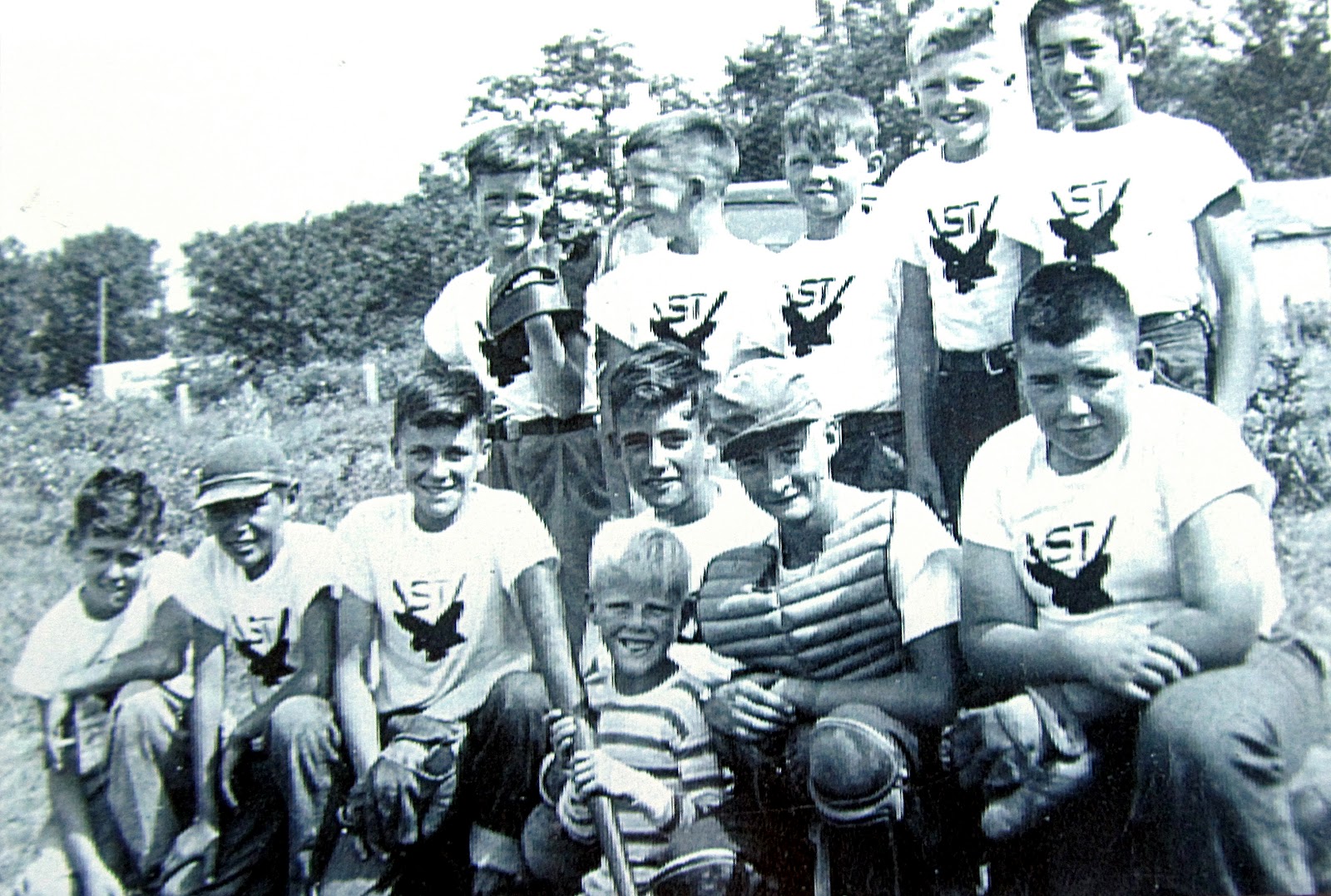
John Stranger - Back row, middle


A MEMOIR OF A LIFE, FOR BETTER OR WORSE
By John A. Stranger

CHAPTER ONE
Beginnings

This all begins in a small town in Minnesota during the 40's when growing up was a struggle without all the things a boy wants and dreams about. Outdoor toilets and dressing behind the oil burner turned up full blast where my brother (4 yrs. Younger) and I learned to dress very fast during the cold Minnesota winters.

My brother was a great kid even though we would have our brotherly confrontations. We had a younger sister too and she learned to hold her own with us boys. Our parents were very strict on almost everything that they thought was for our best interests even though we tried to disagree with our parents at times but trying to obey seemed better than a beating, (most we probably had coming).

Sunday, March 04, 2012

Interview: Beth Lapp

Elizabeth Lapp in 1948
[Courtesy:  Digital Archive, UMC
Thanks to Kristine Baldwin Ohmann, who facilitated our get together, I interviewed one of the oldest living natives (and a resident) of St. Vincent last weekend.

Elizabeth Lapp, better known as Beth, was raised in St. Vincent.  Her parents, Richard (Dick) and Lillian Lapp, met in 1926 when her mother came to town to teach at the school. Dick's parents were early settlers of St. Vincent, arriving in 1879 from Canada.

I share with you here the interview in its entirety, as it happened.  As you will read, there are a lot of clues for further stories, which I intend to explore in future posts...

1. Her earliest memory is of getting ill and vomiting on her workbook at school. In those days, you only got one workbook to use for your schoolwork, so she was mortified. She was sitting near chalkboard at the time. Her teacher was Miss Penovich.

2. Some of her other teachers were: Elaine Bergh, Gunda Hanson, Mrs. Isley, and Mrs. Monte(gue) Clinton.

3. The year she had Mrs. Clinton, “we didn’t learn anything”. Math and Science were "sacrificed for art". All she remembers is Mrs. Clinton having the class place chairs facing west and looking out towards Christ Church and drawing what they saw…

4. When it came time to go to high school, students during her time had three choices: Hallock, Pembina, or Crookston. Hallock and Pembina were public school (free) while Crookston was a boarding school and charged tuition. This was during the 1940’s and into the 1950’s.

Northwest School of Agriculture Crookston MN
[Photo Courtesy Digital Archive, UMC]
5. Crookston was called the ‘Ag School’. It's actual name was the Northwest School of Agriculture.  Several area natives attended it, including Beth and her siblings.

Wednesday, December 14, 2011

News from the Past: St. Vincent New Era

Rev. Beer did his best to nurture the small church in St. Vincent;
He later went on to start missions in far off Alaska...
March 28, 1890 News Snippets

There has been a butter famine at St. Vincent lately...Water is accumulating on the sides of the Red River...The carpenters are altering part of the station to make it into a residence for Agent Grasse and family...Rector Beer gave a dinner party on Monday evening to several friends who met Professor Hazen before his departure for Washington.
________________

June 28, 1890 News

As neither Hallock, Northcote, Humboldt, or Pembina is celebrating the glorious 4th, the people of St. Vincent determined to do so. Kennedy on the South and St. Vincent on the North ends of the county will take care of all their neighbors and in friendly rivalry will endeavor to surpass each other in a hearty welcome to all visits, and will extend a "Highland" welcome to their friends on that day.

The St. Vincent Council appropriated a liberal sum and a most excellent committee has charge of the days sports, whose names are a guarantee that fair treatment will be accorded to all competitors and that nothing will be left undone to make the day a pleasant holiday.

The merchants and citizens intend to decorate the front of their stores and residences with trees, flowers and bunting, thus adding to the natural beauty of the loveliest village in the Northwest, and at night the two large rooms of the District School House will be used to dance in.
________________

July 25, 1890 News

Mayor E.M. Nixon and other influential Pembina citizens are proposing to build a pontoon bridge across the Red River and make it a free bridge. It is a good scheme and should be encouraged.

First Bridge:  Pontoon Bridge looking east towards St. Vincent...
________________

December 26, 1930 Ads

"The Unholy Three" - Hear Lon Chaney Talk, also two reel comedy at the Grand Theatre, Hallock, Thursday and Saturday, Jan 1-3, Admission 15, 25, and 40 cents.

If you don't happen to have the cash to send in on your subscription, remember we will take chickens, turkeys, pork, beef, eggs, butter, or stove wood in exchange. These articles cost money and they are as good as cash to us, but don't forget it - Let's hear from you, at once.

Thursday, September 01, 2011

Triggered Memories

I received an email from Michael Rustad saying my recent post about P.N. Tri brought back some memories of his own, and that he hoped those reading the posts here will share with me any such triggered memories they may have.  That's always been one of my hopes, that people reading these memories and histories, will share their own memories and histories of this little corner of the world.
PN Tri was a major figure in the history of Humboldt and St. Vincent.  I did not know that he was the first advisor to the Humboldt Stick to It Club. 
"Incoming!"
I belonged to the Stick to It Club and it was one of the best 4H clubs in N.W. Minnesota.  We had great leadership.  Marian Anderson from Humboldt won the state 4H dress making competition and was crowned at the State Farm.  Dennis Diamond was a consistent State Farm prize winner.  We had so many innovative parent and teacher advisors over the years.  Earl and Beatrice Bahr helped us immensely when they built our equivalent of the Diamond of Dreams on their farm.  Earl mowed a field so we could practice for our 4H softball team.  The year was 1965 and Humboldt's Stick to It 4H club was a powerhouse softball team.  It was boys and girls who played.  Dee Dee Diamond played on that team on the girl's side.  My brother Tony and I were the stars of the team.  We were the home run hitters, the ringers of the team.  Tony and I practiced softball daily.  We would pitch to each other and invented a game.  A home run was when we hit it over the barn with a towering drive.  A double was a hit into the chicken wire.  The chickens soon learned that they were to go in the barn when we played. We never hit a single chicken despite many hits into the chicken's yard.

Monday, August 08, 2011

Memories of a Humboldt Native


Anthony "Tony" Merck
Humboldt Depot agent
This reminicense by Margaret Matthew Panzer is full of memories and names of old Humboldt in the way a poem about the town was.  As you will read, there was a lot of community and fellowship as people strove to make a good life for themselves and their families, but there were also hard times (such as during the Depression)...
...My parent's farm was a little over a mile south along Highway 75 and we often walked to town and even to church on Sunday morning when the weather was pleasant.

Though my dad had a hitching post in our yard the only time I really remember a sleigh ride was on Thanksgiving when we went cross country to Len Sylvester's farm to enjoy the day. Lots of good food and crowding around her pot belly stove, playing the piano and working on the Charleston steps were all fun.

We did ride in a school bus in nice weather and a large sled during the winter weather.

Humboldt had been built on both sides of the main highway. East of the highway was really only about four large blocks. There seemed to be wide spaces between homes as some blocks had a home only on the corner.

Sunday, July 31, 2011

Fading Away

Population 6...plus two big dogs
[Photo: Ghosts of Minnesota]
There are towns even smaller than St. Vincent, but not many.

One of them is Tenney, Minnesota.

Tenney recently dissolved, meaning they are no longer a town.  I can't help but realize that it's only a matter of time before St. Vincent has to face that decision.

When I was growing up, St. Vincent had around 200 people.  It was already in its descendency, a shadow of what it once was.  But there were hints of its glory days, such as the sidewalks - some sections had been maintained well, others were disappearing under encroaching soil and grass.  We still had a general store, a gas station (two, when counting the Junction), a post office, a school, and four churches (St. Anne's Catholic Church, Valley Community Church - later known as St. Vincent Evangelical Free Church - Christ Church, and the Plymouth Brethren Church.  We also still held an annual fall event, the St. Vincent Fair (which was at one time, vying to be the county fair.  Despite Hallock prevailing, St. Vincent continued their fair tradition for many years, and people from around the area continued to enter their produce, livestock, hand work, and baked goods in friendly (but deadly serious) competition!

But I digress.  The point here is, all of that is long gone.  It echos in my mind how my mother and grandmother used to talk wistfully about what the town used to be like, all the life of the town now gone, they said - businesses, families, parks, public concerts and socials.  They pointed out here was where a saloon was, there was where the blacksmith's shop was.  Across the road by that alley - which was actually the old railroad track bed - was where the depot used to be.  On a trip with my father to the nuisance ground, my mother told me that was where the park used to be, and there was a gazebo there, where town brass bands would play on Sunday afternoons.  The fair itself used to be down by the river once, too, but later was held in the downtown.  Exhibits were in the Quonset, near the old temporary holding pens once used by the railroad for livestock, now used for sheep, hogs, etc. at fair time.

Now there are only around 60 souls.  Every block has vacancies, empty space where once stood homes and businesses, where circumstances have, like a cancer, dictated surgical removals.  Natives like myself can walk the streets, seeing and hearing what once was.  Like ghosts bearing witness, it is all too real.  The poignancy is very bittersweet.  I once saw a movie that hit all too close to home, and it made me think how my hometown was headed in that same direction.

Most people don't face a death in the family involving their hometown, but that is how it feels to me.  St. Vincent has never just been where I'm from, it's my family.  All those souls from the past, that I grew up with, related by blood or by just being neighbors, were not merely faces and names to me, but family.  I miss them all, and their memories will never fade from my mind as long as I am alive.  This blog is testimony to them as much as I am able to make it...

Sunday, May 22, 2011

Mike's Memories: Town Ball

After the First World War, Manitoba became a preferred destination for barnstorming  ball teams from the United States. All professionals, these American teams would roll through towns and villages throughout the province playing local amateur and semi-pro squads and often, the barnstormers got themselves whupped.

From:  Home Run

My earliest memories were going to baseball games on hot summer evenings. My home town of Humboldt, Minnesota had first rate baseball teams in the 1920s and 1930s. The entire town would follow the town ball team.

The early teams featured the Diamond brothers: Levi, Herb, and Ikey. Lomas Matthews was another legendary track star and baseball player who hailed from Humboldt. Happy Chandler, later to become the baseball commissioner and Senator from Kentucky played one summer for Humboldt.

Another early legendary player from the Humboldt team was Cal Farley who, like most of the other ball players on the 1910 team, was also interested in track and wrestling and went on to form Cal Farley's Boys Ranch in Texas. The U.S. Government honored him by printing a U.S. stamp named for him. The 1920 team also shows many of the players.

During the late 1940s and early 1950s, Humboldt had an excellent travelling team.

My Dad played first base and my Uncle Burton Turner was a pitcher. Burton's father, Ernest Turner, was a legendary pitcher. Many of the stories of early Humboldt baseball are well documented on this web site.

Who was the greatest player in Kittson County History? Some might say Ernie Turner, Happy Chandler, the Diamond boys, or Clarence Beck. [Note from Trish:  And don't forget Eli Gooselaw...] We don't have videos and it is impossible to compare players across generations. My candidate for player of the Millennium for the County is Humboldt's own native son, Scott Matthew.

Monday, March 14, 2011

Letter to Rusty


The letter below was received by Alfred "Rusty" Rustad while he was in the service during WWII. It was written by a local representative of the Red Cross; the introduction is from an article that featured the letter, which appeared in the Kittson County Enterprise a few years ago. It paints a unique picture of his hometown area around Humboldt, capturing the people and events of that time...
Another View
by Rev. Hugh Bell
It's been almost one year since my last "View" so when I received a copy of this enclosed letter I thought it a most opportune time to catch up on correspondence in the Enterprise.
The enclosed letter was sent to Alfred Rustad, Jr. "Rusty" 60 years ago this month. For those of us old enough to remember WWII, we remember a time when just about everyone was in the same boat. It was a time of sacrifice and unbelievable hardship. It was also a time of great family support and great national support. Something that perhaps is lacking in the most recent of our wars including the present day battle in Iraq and Afghanistan. WWII was a time when the whole country pulled together for a common good. Today it seems as tho more energy is put into political rhetoric and profit seeking than into freedom in the Middle East. If we could just stop blaming others for our problems, wouldn't it be a wonderful world. Enough sermon, now to Rusty's letter.

Friday, August 08, 2008

Fair Times


The prizes awarded in the open classes at the St. Vincent Fair were recently announced. Percheron Stallion first place went to Sam Johnson, Humboldt and second to Fred McIllraith, Northcote. In Native Ponies, under 14 hands, Malcolm Sugden, Hallock took first and second and L. McGovern, St. Vincent took third.

From the Kittson County Enterprise (October 1932)

Thursday, June 19, 2008

Hamilton Fair Loses Carnival

Pembina County Fair - Hamilton, ND
Photo by:  Bruce Wendt
When I was growing up in St. Vincent, we attended the Kittson County Fair in Hallock, and the St. Vincent fair itself in the fall, but we also looked forward to the Hamilton fair, with its harness racing. My Dad and I would attend the races together and have a grand old time cheering them on, Dad taking the opportunity of sharing about his father having seen the great Dan Patch in his time.

Now things are winding down, sadly. Populations grow smaller in the rural areas, and the results are that the fairs are slowly fading...

Hamilton, N.D. -- In the heyday of the Pembina County Fair, about two dozen carnival rides filled up the fairground midway. The Ferris Wheel. The Tilt-A-Whirl. The Octopus.

Neil Fleming saw it all in his 55 years as fair organizer: from food to farm animals, clown shows, girlie shows, freak shows.

"It was really something," he reminisces.

The aroma of funnel cakes, the barnyard odor of fattened farm animals, the resplendent beauty of fancy quilts will still exist at the three-day fair July 10-12. But for the first time in 115 years, there will be no carnival rides on the quarter-mile-long midway.

Sunday, January 13, 2008

An 1890 Traveller's View

In the last two decades of the 19th century, St. Vincent and it's neighbors were growing by leaps and bounds. Even from as far away as New York City, people could see that amazing things were happening on the developing frontiers of our country; they were coming of age.

From a New York Times archive article comes this excerpt, of a man traveling through our area in 1890...
At the Kittson County Fair held at Hallock Oct. 3, there were cabbage heads and cauliflowers which measured 22 inches in diameter, beets and turnips which weighed 20 pounds apiece, and potatoes a foot long. Eight-rowed white corn was shown which ripened on the stand, and savory peppers, large and pungent. Creameries are established at prominent points, and cheese and butter are produced in considerable quantities. A good deal of attention is paid to beef and horse stock. There are some flocks of sheep. The exhibit of fine stallions exceeded any similar collection on record elsewhere.

It is cheering to note the hopefulness which pervades the Red River Valley at this time. It seems to be the reflex of a like feeling which possesses the whole Northwest. There is no doubt that the entire region is on the threshold of another great advance. The promise is in the air. A remarkable business year is anticipated for 1891.

Monday, November 26, 2007

The Indomitable Wallaces


Over a year ago, I posted a profile on Dr. Ada Wallace. My grandmother was one of many people's lives she and her husband touched in their lives' work. I asked at that time, that if anyone knew her and could tell me more about her, to please get in touch with me. Recently, someone did just that, and an amazing story it is; please note that our area is only part of the story, but I think you'll find it's well worth reading it in its entirety...

The Indomitable Wallaces

An autobiography of Doctors Ada and Harry Wallace as told to Beth Thornton during the spring of 1981

Published by Ryerson United Church
Vancouver, British Columbia
1981


What a pair! Marching together through the 20's and 30's and 40's and 50's and 60's, steadfastly pursuing their mutual goal of expressing in actions their concern for service and social justice for all persons under their care - especially the underprivileged. And all this by the grace of God and with a fine sense of humour.

Harry was born on February 16, 1890, in Ballymena, Northern Ireland, where he attended the public school until the age of 13. He was then invited by a town's lawyer to become his law clerk - a tribute to Harry's sound character and specialized handwriting. At this point Harry's "Double life" began! For six years he not only worked at County Court activities by day but studied at the Academy by night. Then there followed several years at Castle Wellan in charge of a branch law office, then a term at Waterford City as Session Clerk for a firm of lawyers, and as County Court Clerk as well.

Here in Waterford Harry prepared for the Courts, every three months, debt cases which involved clients many of whom were poor and liable to imprisonment for non-payment of debts. This work was distasteful to Harry, as Southern Ireland was debt-ridden at that time. Inevitably, the day came when one client was to be sent to jail for non-payment of debts which in this case had been contracted by a teenage son. Harry was so disturbed at this prospect for his poverty-stricken client that he went out for a walk during which he met the new minister at the Waterford Presbyterian Church. The minister, a former college professor, mentioned to Harry that he had just received a letter from the Presbyterian Church in Canada asking him to recommend a suitable young man as a student for the mission field in Canada. Would Harry be interested? After considering the matter for a few days, Harry accepted the proposition and was duly accepted as a student for the Presbyterian ministry on the Canadian mission fields.

Subsequently, in the spring of 1911, at the age of 21, Harry Wallace, deep Irish brogue and all, boarded the steamship "Lake Manitoba" in Belfast Harbour bound for St. John, New Brunswick. After passing through Immigration Offices in St. John, he took the train to Winnipeg, the wheels on the rails singing a monotonous litany, "For ever and ever, for ever and ever, for ever and ever...," and Harry mused on the fact that his boat passage and train fare together had cost the Presbyterian Church all of forty dollars. At the Winnipeg office of the Presbyterian Church Harry learned that he had been assigned to the mission fields of Saskatchewan - specifically, the Dirt Hills area beyond Estevan. A stranger in a strange land, fresh from his years in law offices in Ireland, Harry became missionary-at-large to the settlers in Southern Saskatchewan. A long, hard year of purchasing his own conveyance (buggy, cutter, two Indian ponies - all debited to his account by the Home Mission Secretary of the Presbytery), finding his own lodgings (sometimes a deserted cabin), procuring his own food (sometimes a prairie chicken), buying his own "suitable" clothing. Heat waves, prairie tempests, food poisoning, blizzards. But the villages and schoolhouses were located, and good Presbyterian sermons delivered.

Fortified now with funds towards tuition at Manitoba College of Arts and Theology, Harry resumed his "Double life", a busy mix of mission fields in summer, study at the College in winter. Summer after summer for seven years Harry served as missionary and preacher at Prairie Grove, Manitoba, at Elmwood-Transcona at Springfield, Hedley, and at Middle River, Minnesota. Highlights of those winters at Manitoba and Wesley Colleges were many and varied. In 1913, Harry won a Gold Medal for Oratory offered by University of Manitoba and all Colleges participating. He assisted in the organizing in Winnipeg of Associated Charities (still actively functioning) meeting personally with all parents of families needing that assistance. He served on the Board of Regents for several years during the uniting of Wesley College and Manitoba College of Arts and Theology under the new name of "United Colleges," and being an alumnus of both Colleges was especially effective in forging strong alumni ties. On one memorable occasion on campus, Harry attended a Theologs' party for Medicos during which he was introduced to a serene brown-eyed medical student, Miss Ada Wilson from Gladstone, Manitoba. In April 1919, Harry graduated from the Manitoba College of Theology. The first charge to which Harry was assigned after graduation was the Presbyterian Church at Kenton, Manitoba, where he served for two years. Then in 1921, he received a call from the Presbyterian Church at The Pas, Manitoba, and was advised by Presbytery to accept for the need was urgent and the north country was opening up. Harry took up the challenge, went North, and plunged into his work in a frontier Church. Soon he was resuming studies as well, resulting in a Bachelor of Divinity degree from St. Andrews College, University of Saskatchewan, in 1925. During his second year at The Pas, Harry began his "triple" life! In August 1922, he married Ada Wilson, M.D., the daughter of Magnus and Ellen Wilson of Gladstone.

Ada, daughter of a resourceful, creative brick - maker - cum - landowner - cum - horticulturist father born in the Orkneys, and an artistic, meticulous, musical mother, had attended the Glasdstone school as a girl. There she had studies at the foot of her favourite painting, "The Doctor," yearning to be a physician some day and save lives, too. At home, Ada had read the Wilsons' big Doctor Book from cover to cover. During summer holidays she had often gone to stay with friends at a nearby lake, and from afar had worshipped their family doctor whenever he and his wife had visited at the lake, too. At home, Ada had been her father's helper, and had loved to nurture their apples and strawberries, and had even tried her hand at brick-making as well. In the house, she had helped her mother, and had learned the mysteries of art and music and hardanger (an intricate Scandinavian embroidery). But by the time her senior years at school arrived, Ada had made up her mind to study Medicine although her parents would have preferred that she chose a life at home with them, and avoid the hardships of study and practise. But Ada had prevailed. She had applied for entrance to the Manitoba Medical College and had been accepted. To her delight, she found herself registered for 3 years of Science followed by 5 years of Medicine. Until her final year at College, no other woman was registered in Ada's class along with the 30 male medical students. The young Ada, destined to one of the first lady graduates of the Manitoba Medical College, experienced no discrimination because of her sex or age, and participated fully in all study sessions and all laboratory sessions throughout the 8 years at the College. During her final year at Medicine, Ada, along with two male medical students from her class, was invited to intern at Misericordia Hospital in Winnipeg at the same time continuing and successfully completing her studies at the College. In May 1922, Ada graduated from the Manitoba Medical College complete with a beautiful bouquet of her father's special tulips from Gladstone.

After the Wallaces' honeymoon at Herb Lake, Manitoba, during which Dr. Ada was called out on three cases, the bride and groom arrived in The Pas to being their four decades of devoted service in the West to parishioners, patients, family and communities. Teamwork all the way.

There was plenty to do in The Pas, where may an adventurer lost heart at finding no gold or silver, and became a social and moral problem. Harry and Ada, too, were busy assisting and advising these persons, as well as protecting the youth of The Pas from unwholesome influences. This early social service work for the Church, says Ada, was fitting her for her work later on as a country doctor. Harry organized Associated Charities for needy families in The Pas, just as he had done in Winnipeg. In 1921, he joined the Masonic Lodge at The Pas, and began a lifelong service to the Masonic Order. In his spare time he wrote articles for several Sunday School periodicals, and established friendships with surveyors, bush-pilots, trappers, teachers, geologists, and undertakers. Above all, he preached and served his Church.

In Harry's personal diary are many stories of people of the Northern Frontier in the early 1920's including this account of a funeral which he conducted: "Accidents on lakes, rivers, in mines and lumber camps made necessary many trips to the cemetery. The only suitable ground for internment was a sand and gravel mound about three miles from town. There were two ways of approach. You could walk dry-shod along the railway track, or risk getting your feet wet on the muskeg trail through the bush. The local hearse consisted of a democrat pulled by a single horse. As that was the only vehicle in town, the minister had the privilege of sitting on the spring seat with the driver, and holding on to the casket as the democrat bounced over stumps and logs. Mourners and friends walked some distance behind. Strange things sometimes happened on these unpleasant journeys. Indeed, on one occasion I lost the corpse. I was engaged in conversation with the driver and failed to attend to my duties. When we came to within half a mile of the graveyard, I looked back to see if the mourners and friends had kept pace with us, but they were not in sight. I then thought of the casket and found myself looking down into an empty vehicle. The tail board of the democrat was gone and the casket had fallen out! As I ran back over the trail, the driver unhitched his horse in order to turn around. At each bend in the trail I expected to meet the mourners carrying the casket. Then suddenly I saw it lying by the side of the road where it must have fallen. I picked up one end of it and dragged it around the bend onto the soft muskeg. The driver appeared on the run and between us we got the casket placed in the democrat just as the first group of mourners appeared in sight. No questions were asked, and I did not feel it expedient to reveal what had taken place..."

The "Diamond Queen" was a noted character that most visitors to The Pas in the 1920's wished to meet. Harry writes about the day when Ada and the "Queen" met each other: "The 'Diamond Queen' was purported to be one of the three famous May sisters, actresses of London, England. In her younger days she had toured South Africa with a road show, and had been greeted on one occasion with a shower of diamonds, hence the scintillating nature of the name which had stuck to her through the years. The 'Queen' and her husband Gilbert Le Croix, kept a stopping place at Mile 81 on the Hudson Bay Railway. She was very polite, and when sober almost timid. A few glasses of liquor, however, turned her into a boisterous female ready to fight anyone against whom she had a prejudice. During out honeymoon trip to Herb Lake I told my wife about some of the escapades of the 'Diamond Queen' and Ada expressed a desire to meet her. We arrived at the stopping place at Mile 81 around noon, and the 'Queen' received us most graciously. Indeed, my wife was so impressed by her ladylike manner that she doubted the truth of my stories. Later in the day a prospector presented the 'Queen' with a bottle of whiskey. What a transformation took place. Ada and I were preparing to portage across to Herb Lake when the 'Queen' rushed out of the door with the cash box under her arm. She shouted to me, 'Here, hold this until I knock the hell out of so-and-so!' And the man in question beat a hasty retreat with the 'Queen' in hot pursuit. He was no match for the 'Queen'. He reappeared with a black eye..."

In 1925 came Church Union at which time the Wallaces, at the request of the Settlement Committee, left The Pas to serve the former Methodist and Presbyterian Churches at Belmont, Manitoba. Harry's six years at Belmont passed swiftly as he organized the building of a brand new United Church, coordinated both groups of young people into a Young People's Union also a Dramatic Society (Harry played the part of the Private Secretary one evening in a production of "The Private Secretary"), and preached in outlying schoolhouses.

The Wallaces' 1922 model Ford finally had to be replaced, which pleased their garage man. I his diary Harry sets down the reasons for this: "It had been the garage man's task each Sunday morning during the winters to start the engine within a blow torch underneath the oil pan. If the engine refused to go at the first swing, he would take time off to turn the air blue with his language. One Sunday his blasphemy was extremely loud, and I suggested that he put on the 'soft pedal' as folks were passing on their way to Church. He turned to me angrily and demanded 'What would you expect me to do - sing hymns?!'"

The Depression Years were settling over the prairies as Harry accepted a call to Knox United Church in Russell, Manitoba, in 1932. By now the Wallaces were proud parents of two daughters, Isabel and Kathleen, and one son, Gordon. And by now Harry had received a Master of Arts degree in 1930. Still pursuing their service and social justice goals, Ada and Harry moved into their seven busy years of compassionate stewardship and service in and around their new Church and community. Everywhere communities were felling the pinch of poverty; some districts north of Russell had suffered five crop failures in succession. Harry was appointed Chairman of the local Relief Commission, using the large Manse as headquarters. Ada and Harry helped personally in the distribution of "relief" clothing and fruit and vegetables - freight-car-loads of gifts from United Churches in Eastern Canada. The Town Council controlled the flow of money to be distributed for other necessary groceries and clothing for the needy, and at one troublesome confrontation between the unemployed and Council when "relief money" was about to be cut off, Harry produced a more equitable schedule of distribution which was acceptable to both the recipients and Council. A Fall Carnival which Harry named "Vanity Fair" was organized by the Relief Commission to raise extra money for the needy. "Vanity Fair" has now become an institution in Russell and is sponsored by the local Elks.

And now the pace accelerates! In 1939, Harry, Ada, and family moved to a new charge, the United Church in Emerson, Manitoba, and here the War years were soon upon them. Emerson at this time was a chief Port of Entry to and from the United States, bordering on Minnesota and North Dakota. Harry and Ada soon found themselves deeply involved with not only the people of Emerson but also with the people of Pembina, ND and St. Vincent, MN; with tourists from railway, highway, and river, with Customs and Immigration officials, sometimes with soldiers and airmen in transit.

There were six doctors resident within an 1-mile radius of Emerson when the Wallaces first arrived but within several months two had died and the others had enlisted in the fall of 1939, so the number dwindled to one - Dr. Ada! The Wallaces family was scattering: Isabel enlisted with the Wrens, Kathleen attended boarding school in Winnipeg, and Gordon enlisted in the Navy. Dr. Ada found patients arriving at the Manse door in need of medical help, and soon she and Harry decided that this was her long-awaited opportunity to practise medicine full-time. With the consent of the Church Board, Dr. Ada opened her first medical office in the Manse on the first floor. Harry's study was one storey up. Dr. Ada's patients arrived on the veranda or in the Manse living room in increasing numbers, and she served them in her office or else in their homes, by day and by night. She travelled to her patients by car, truck, tractor, boat, buggy, sled, passenger train, freight train, stoneboat, Red River ferry, and even on foot! Dr. Ada never refused to answer a call at any hour, summer or winter, fair weather or foul, and all this over a wide area which included Emerson, St. Vincent, Pembina, and the two rural municipalities of Franklin and Montcalm, as well as Roseau Indian Reservation with its 300 families. The nearest hospital was 30 miles away. Hired help was scarce or frequently non-existent, but Harry willingly helped his wife, often driving her in their one car on winter nights, often assisting her in her office with her patients, keeping records, consulting, assisting at inquests where his law experience was of great help and when four copies of each case had to be made out for the Coroner. Sometimes a patient's visit to the medical office would end up in the minister's study. Their partnership meant "preaching" and "practising". Their motto was "We get you coming and going!"

Over their ten years in Emerson, Harry's work was preaching to and serving two large congregations - the United Church in Emerson and the Presbyterian Church in Pembina, ND His pastoral calls, weddings, baptisms, funeral services, social service work in the community, his dedicated service to the Masonic Order, all continued unabated. Added to this, of course, was his frequent assistance to Dr. Ada. In 1946, the United Colleges *University of Winnipeg) granted Harry an honorary Doctor of Divinity degree for distinguished service.

Very soon after opening her medical office Dr. Ada was appointed Medical Health Officer for Emerson, Pembina, St. Vincent, and the two rural municipalities mentioned; also Medical Health Officer for the Department of Indian Affairs for the 300 Indian families on the Roseau Reservation; also Medical Representative for the Department of Immigration and Customs at the Port of Emerson; and Medical Representative CNR Emerson Division. Along with all these responsibilities and her work as a family doctor to scores of residents - urban and rural - Dr. Ada was appointed in 1942 to the Office of Coroner of the South-East District, after special legislation was passed by the Manitoba Legislature to allow her to do so! She has the distinction of being the first woman in the Province of Manitoba to take over this semi-legal Office of Coroner.

Dr. Harry says of Dr. Ada, "I can recall scores of occasions when her condition seemed worse than that of the patients. But she seemed to thrive on hard work and sacrifice, for during the whole of the ten years she practised in Emerson she never had a serious illness." On month, he estimated, Dr. Ada travelled 1400 miles and served 250 patients. About 50% of her medical work was on the American side of the border. In order to facilitate travel back and forth each day, a special border permit was given to her by the US authorities so that there was no delay night or day. In fact, Immigration officials took messages for Dr. Ada and usually knew where to locate her in an emergency. The Governor of North Dakota made provision for all the gasoline that Dr. Ada required in that State.

Dr. Ada's diary is especially revealing of the difficulties (and rewards) of carrying out her duties as Family Doctor, Medical Health Officer, and Coroner in those War Years. She writes of one worrisome trip: "On winter's day I received a call from the Indian Agent at the Roseau Reserve asking me to locate a sick Indian child at Neche, ND, some twenty miles distant from my office. I located the family in a shack at the Ball Park. The door consisted of a couple of bags. The two year old child was ill with pneumonia. I wrapped her in my fur robe and returned to the highway enroute to St. Boniface Hospital, Winnipeg, where most of the Indians were hospitalized. This would add another seventy miles of travel. On my way to Winnipeg through Emerson, I called in at my office and found another message from the Indian Agent saying there was a very sick child at the Roseau Reservation as well. I promised to go back and examine the little one, and subsequently decided to take this child with me, also. Fortunately for all, my husband was the driver of the car, for on the journey I was obligated to pick up one of them, then the other, to help restore breathing. A doctor and nurses were waiting for me on our arrival at the hospital at 2:00am. The children were able to return to the Reserve in three weeks time. Our round trip on 175 miles had not been in vain. Indian women usually waited until the confinement was about to take place before asking the Indian Agent to notify me, some twelve miles distant. Pre-natal or post-natal care meant little or nothing to them. The first notification I would receive was when the child was on the way. Several children were born on the back seat of my car. On one occasion the Ferry-man paused in midstream to turn the ferry light on my car late at night while I cared for a mother and delivered a new babe. Another confinement took place on the busy highway at noon. I parked my car on the side of the highway and set to work, while tourists sped quickly on their way."

Dr. Ada describes a different but no less memorable call: "It was impossible to secure the services of another doctor or a nurse during war time. The majority of my confinement cases were in the homes. A neighbour would be called in to help. I would instruct her in the use of the anaesthetic, for example. One case I recall was that of a woman who lived in a caboose during the summer. When winter approached, they decided to rent the caboose and move it into town. The caboose was propped up on four blocks of wood about 18 inches from the ground and was banked with snow for warmth. A week prior to her confinement I was called in and immediately suggested her removal to hospital. Both husband and wife refused. They had made up their minds that the baby would be born in their on-roomed caboose and that was that. Three previous children had died in childbirth and they were sure that this one would meet the same fate. I tried to assure her that the child id not have to die. My efforts were in van. When I arrived for the confinement, the local priest was already established behind a curtain in a corner of the room. A neighbour was called in to help me administer the anaesthetic. The expectant mother lay on a set of springs propped up on blocks of wood. A piece of wire was attached to the upper part of the springs and fastened to the wall for additional support. In a moment of excitement the neighbour leaned against the springs. At the most critical moment the supports under the springs gave way. The would-be nurse and mother and baby lay in a heap on the floor. The priest rushed from behind the screen and began to look for his Crucifix which had been placed in the hand of the expectant mother. The husband heard the noise from outside the caboose, and knew from experience what had happened. He came in with four large blocks of wood in his arms, and soon had the springs in their accustomed place. Fortunately, no one was injured. I picked up the mother and the new-born baby from the floor. The husband turned to me and said, "Doc, it's hell to be poor!" I was tempted to reply, "It's sometimes hell to be a doctor." In spite of its rough and tumble entrance into the world, the baby lived an was the joy and pride of his parents."

Dr. Ada's duties as Coroner called for investigations at the rate of 10 to 20 per year. Here is her description of one such autopsy: "My most unpleasant experience as Coroner was in performing a post-mortem in a barn in order to escape the burning sun. The temperature was around 80 degrees. The body had been found, buried in a manure pile for several weeks. Murder was suspected. Of the two young Police Officers present, one had to be assisted out of the stable, and the other very wisely assumed duty as close to the door as possible. When I had finished the post-mortem, I handed to the officers a bullet found in the brain of the deceased. They lost no time in returning to their detachment."

In her memoirs, Dr. Ada writes of an "experience" one stormy night in December 1947, when Dr. Harry drove her to answer a call to a sick child in Pembina, ND about 5 miles across the border. Snow was swirling across the highway. On both sides the ditches were level with snow. Several cars had been abandoned on the road. The temperature was low: "Each of us travelled with head out of the car window in order to see any car that might be stalled in the snow banks. With great difficulty we arrived at the entrance to the town. The patient's home was on the outskirts along a road that was completely blocked. We left our car as close to the edge of the highway as possible and set out on foot - a distance of a quarter of a mile. We walked along in silence shielding our faces from the storm and drifting snow. I turned my back to the storm and spoke to my husband; there was no answer. I retraced my steps and called again. There was a faint answer from a distance. He had failed to notice a slight bend in the road and was on his way to the local cemetery. He took off the belt of his overcoat, and we held onto that for the balance of the journey. Although the call was supposed to be urgent, the parents did not expect to see me in the storm. I found the child quite ill with pneumonia, and stayed until there were signs of improvement. The father accompanied us with a lantern back to the highway. He was very apologetic and said, "Doc, you have looked after my family for a long time and I have never paid any bills. Tomorrow I will see that you are paid." But 'tomorrow' never came. The return journey home was uneventful."

But the acceleration of activities for the Wallaces reached its peak in the spring of 1948. For fifty years floods had come and gone without devastation. In 1948 it happened! The Red River was in flood again; the water rose slowly and inexorably up and over the banks, up and into the towns. Main streets in Pembina and in Emerson were soon three to four feet deep in flood water. Storekeepers placed their wares high up on shelves; residents moved to the up storeys of their homes. Boats arrived from the Provincial Red Cross office in Winnipeg and were assigned to all areas of Emerson. A resident could hail a passing boat, and enter it from his door or upstairs window, whichever was more convenient. The Mounted Police provided a power boat for Dr. Ada's use; the US Army provided an amphibian for her five-mile voyages to Main Street in Pembina on American calls. Dr. Harry and Dr. Ada wore hip waders for days, as did numerous other residents. On the flood waters floated bodies of dead animals, boards, manure, barrels, and sewage. The chief danger was an outbreak of typhoid fever. Dr. Ada went everywhere inoculating victims of the flood. On one banner day, Dr. Ada, with the help of one nurse and several High School students, inoculated 1000 persons. For 10 days she had little more than 12 hours sleep. Dr. Harry supervised the building of a raft using a couple of oil drums and the side of a piano box. It was dubbed the "Queen Mary", and proved often useful to both the Wallaces. As the flood water gradually receded, Dr. Ada assisted in plans for fumigation and disinfecting of the flooded areas. She was named "Flood Heroine" by the Associated Press.

Dr. Ada was eulogized by Gordon Sinclair in the Winnipeg Free Press on Tuesday, April 27, 1948:
SHE DARES FLOODS TO HELP THE SICK

Lone Emerson Doctor lauded for her work

EMERSON, Apr 27. A grey-haired woman doctor has disproved for us any theories of the female being the weaker sex. If there is one person deserving to be singled out of the scores who have aided in the salvage of this water-ravished town it is Dr. Ada Wallace. The only doctor in a 30-mile radius, she has worked night and day on an international basis since the flood broke ten days ago. Monday afternoon after completing 75 typhoid inoculations for townspeople in a two-hour period, she took time out to outline the work of a country doctor during a flood. Dr. Wallace was called from her home during a heavy rainstorm last Saturday night, to rush aid to a seriously ill woman across the river in West Emerson. A 4-mile trip by auto and boat was required to reach the home of Mrs. Hunter Storms. The return trip was a race against time. Dr. Wallace won, and the woman was lifted aboard a Winnipeg-bound freight train to receive emergency treatment in a city hospital. Another trip made since the floods began took the Doctor to the farm home of George Johnston. Minutes after stepping out of a boat into hip-deep water, she had diagnosed measles for two of Mr. Johnston's children. A third emergency call took Dr. Wallace to Pembina ND, five miles from here. During the trip she was initiated into the intricacies of the U.S Army 'Duck", an amphibious vessel. "It was a lot of fun," the doctor smiled. "We had quite a ride in it." Treatment by remote control is another of Dr. Wallace's specialties. She prescribed treatment for John Kohut, will with pneumonia five miles from town. The messenger took the prescription and instructions back Sunday, and Monday the sick man was improving. Dr. Wallace was planning yet another mission, the transporting of the town "handy-man" to the Hallock, Minnesota hospital.
And now the Second World War was over, and many doctors and ministers were returning home to Canada. The Wallaces both yearned for a warmer climate, bade farewell to Emerson, and spent a winter in Florida. The following May 1949, they moved to British Columbia, where Dr. Harry had been appointed by the Superintendent of Home Missions to a term as pastor of the North Kamloops United Church, and as well, of the North Thompson Mission Field whose parishioners were strung out along a 160-mile trail from Kamloops to Blue River. Together the Wallaces undertook a week's "survey" of the latter area, a hazardous car-and-tent trip over a rough, narrow, gravel road that jutted like a rocky shelf halfway up the mountains, with the North Thompson River foaming far, far below! Dr. Harry and R. Ada met Scottish people at Barriere - some worked at the power plant there; scheduled services in a large Community Hall at Little Fort; Church at Bi4ch Island (and visited a hermit who claimed to live there happily for $6 a year); used a schoolhouse for meetings at Avola; and chose quarters in the temporarily empty Red Cross Hospital at Blue River. Thereafter, once a month Dr. Harry, and usually Dr. Ada, held services, conducted Sunday Schools, and made pastoral visits in each of these isolated congregations, travelling by car-and-tent until October. In winter Dr. Harry continued his monthly services to the five settlements, travelling by freight or passenger trains, alert for possible landslides. For the remaining 3/4 of each month, Dr. Harry devoted his energies to serving the congregation of North Kamloops United Church.

Dr. Harry's one-year term in the Thompson River Valley ended in the summer of 1950, following which he and Dr. Ada drove to Montreal. From there they sailed to Liverpool to explore by car Northern Ireland, Eire, England and Scotland from Land's End to the Orkney's. On their return in November, Dr. Ada and Dr. Harry settled in Vancouver near their daughter, Kathleen. Dr. Harry continued his service in the Masonic Lodge, and in June 1964, was appointed Grand Chaplain of the Masonic Order for BC and the Yukon. From 1951 to 1961 he served at Ryerson United Church as Associate Minister. In 1974, a biography of Dr. Ada was published in a prestigious Canadian book, "The Indomitable Lady Doctors", by Carlotta Hacker. On his 90th birthday in 1980, Dr. Harry's name was enrolled on the Honour Roll of the United Church of Canada.

"We must never let the traffic gradually smother with noise and fog the flowering of the spirit." - Stephen Spender

"I am happy to have served as a Country Doctor." - Ada Wilson Wallace, M.D.

"Life is still for us 'not a goblet to be drained, but a measure to be filled...'" - Harry B. Wallace, D.D.

Dr. Harry and Dr. Ada Wallace, the Ryerson Church family salutes you! God bless you both...