St. Vincent was a booming town then with a population of about five hundred. It almost died...because of a man named Deacon.
At one time the Great Northern Railway wrote a letter to the Mayor of St. Vincent, William Deacon, telling him that they would move all the buildings in the town 2 miles east and make the border port there instead of having it in Noyes. Deacon wrote back and said that he couldn't find anyone who was interested in moving without asking a soul. Because it no longer had the railroad it all but died out.
Today St. Vincent is just a small village with a mere population of 150 and has only one store, one gas station, and a post office. It seems a shame that a town that could have grown quite extensively like St. Vincent was destroyed to almost a ghost town because of the decision of one man.
Monday, November 28, 2005
Mr. Deacon's Legacy
According to oral history taken from Richard Lapp in the 1960's - an early 'town father' (along with my own grandfather, Sheldon Albert Fitzpatrick...) - St. Vincent's boom may have bust thanks to one man...
St. Vincent Boom Times, Part II
From what was popularly known as 'historical essays', written mostly by high school students throughout Kittson County over a period of many years, comes this piece about St. Vincent's better days...
St. Vincent
by Barbara Bostrom
Today, cities have taken the place of the many small towns across the country. In the cities a person may live for years in the same house and never know the names of his next door neighbors. There are very few small towns left. Even St. Vincent, Minnesota, the oldest town in Kittson County, is dying. There are approximately 170 people still left in St. Vincent, most of them old people. There are few evidences of the type of town St. Vincent once was.
The Great Northern Railroad brought most of the people here. The first people came as traders, because of the Red River. That was in the 1870's. They used to cart the furs up the river on barges. But since the fort was built at Pembina, North Dakota, most of the fur traders, and nearly all the other residents of this northern area, lived there. Part of the reason they would want to live in or near the fort was as protection against Indians. Especially after Fenian's Raid in the 1870's, people usually preferred to live by the fort. When the Sioux Indians were forced out of the state, the danger of Indian attack was reduced to nearly nothing. But they were not far away. Around l880, the talk of the town was Chief Sitting Bull's camp across the Canadian border in Emerson Manitoba.
Pembina was the "big town" when St. Vincent was born. Pembina, along with the rest of the valley, gained attention in both the United States and Canada, "owing to the so called rebellion in Manitoba under Louis Riel and O'Donhue, of Fenian fame, and many who were on their way to Fort Garry that year... were forced to make an unwilling sojourn at Pembina, waiting for the submission of the rebellion in order to go on to their destination. The quelling of the insurrection in June by British troops restored the tranquility and the noise attached to the whole affair seemed to have drawn the attention of the outside world and caused quite a stream of emigration into the valley."
Fort Pembina was built in 1870 and abandoned in 1897. At the time the fort was built Hills, Griggs & Company, of the Red River Steamboat Company, opened an extensive general store which usually carried $100,000 worth of merchandise. Henry MoKinney opened a saw mill in 1871 near the junction of the Red and Pembina Rivers, opposite St. Vincent. Nathan Myrick of St. Paul, opened a trading post near Ft. Pembina.
Saint Vincent is the oldest town in the county. The first meeting of the township board was held on May 15, 1880. R.W. Lowery, G.A. Hurd, F.M. McLaughlin, L.A. Nobels and F.M. Head were the township's first officers. Hardly a year later it was reorganized as a village, on April 16, 188l. The first president was James L. Fisk, possibly the son of the Hon. Charles J. Fisk, who was an associate justice )f the supreme court of North Dakota; recorder, J. W. Morrison; assessor, John A. Vanstrom, who afterward served as register of deeds, and later was elected sheriff.
In 1910 St. Vincent had a population of about four hundred. It is located in the northwestern part of the county, directly opposite Pembina, North Dakota. It was the terminal between the Great Northern and Canadian Pacific Railways, and also a port of entry for the purpose of collection of customs duties. Near Lake Stella, on the eastern side of town about a mile from the Red River, there had been a roundhouse, for trains, which burned down in 1905. There was the train depot in the middle of town. In the west end of the building was the customs office. From 1900 to 1905 J.A. Noyes was the head customs officer there. In 1905 he succeeded in having the customs office moved from St. Vincent to the Canadian border across from Emerson, Manitoba, where the town of Noyes is now.
There were three hotels in the St. Vincent of those days. the Thedore, the Ontario House, and the Northern Hotel. The Thedore was in the west end of town, on the main street. The Ontario House was owned and operated by the Ryan family. Mr. Ryan managed the hotel, but when he died, one of his daughters, Elly O'Connor, took over. The Northern Hotel was north of the railroad tracks that ran through town just south of what is now Highway 171, and it was owned by the Great Northern Railroad.
Until 1925 there was a black smith shop about a block east of the Northern Hotel, and earlier there was another in the west end of town.
There were four stores: Nelson Greene's Store, which sold nearly everything under the sun; a large store west of the Ontario House which sold mostly candy, and was owned and operated by a Mr. John Reynolds; and another store in the west end of town. This store contained the post office, which was run by Richard Lapp's father.
There were two beer distributing companies, one next to the tracks in the west end of town, and one a block from the other company, also next to the tracks. The first was Hyland's Low Start Lagger, the latter company was a Hamms Beer distributor.
Next to the Ontario. House was the Catholic church. It was purchased from John Reynolds and made into a church.
There was also an Episcopal church and a Presbyterian church in town. The Episcopal church was the first church built in the territory, and the lumber was all hauled in from eastern portions of the territory by oxen cart. It still stands today, on the "outskirts" of town, north of the railroad tracks. There was also a Methodist church in St. Vincent.
Between the train depot and the Hylan beer distributor, was the St. Vincent fire hall; which still stands today. It is a small, wooden frame structure with a bell tower in the southeast corner. St. Vincent had two fire engines, and a carriage that, I believe, carried fire hose.
The school was built in 1903. It is a two-story, square, white frame building which originally held grades 1-12, but now has classes for only kindergarten, and second through fourth grades.
It looked like St. Vincent was blessed with everything a good town needs: easy transportation, jobs, and good soil, and water. But somewhere they lost whatever it was they had had. For St. Vincent is no longer a little town with a lot of growing to do-- but now St. Vincent has little to look forward to except a slow death. In 1909 these words were written:
"Today we have abundant evidence that we are standing at the threshold of a new dominion that is to arise on this plateau of North America...
With unshackled hands, free thought and liberty of conscience, the people of the valley of the Upper Mississippi and Red River of the North may add much to the luster of the Great Republic, born on the 4th of July, 1776. Let us pursue no narrow policy. Let us welcome the Dane, the Swede, the Norwegian, the Russian, the German, and all newcomers.:"
Somewhere along the line we forgot how to use this potential, and now we are paying for it. We will probably never regain our way of life and the promises it showed, but this area will always be rich with the memories of the bright past.
St. Vincent Boom Times, Part I

By George B. Elliott
No. 5
The Northwestern Farmer and Breeder
20 September 1886
"The Valley of Eden" had its Tapley "who was always jolly under difficulties, but it was left to the Red River Valley to have a man who was "the same" no matter whose lot was "criss-cornered," or whose stake was pulled up. Uncle John Stewart is a type of a New Englander not often found in frost-bound latitudes. In the palmy days of '74 Uncle John was proprietor of the Exchange Hotel, Winnipeg, in which city he still has many warm friends.
The same fatality which drove many thousands to California in '49 induced Uncle John to erect the Pacific Hotel in what was then thought to be the coming Frisco of the Northwest - St. Vincent.
A man was found who could demonstrate to a certainty that what Helena was to Montana so would be St. Vincent to Minnesota. The Gamaliel who instilled this enthusiasm into the hearts of even old timers was "Colonel" Fiske, who on the completion of the St. Paul & Manitoba road to the International boundary line, was placed in charge of the town to "boom it or bust."
The road was completed early in the fall of 1878, and the scale of the boom which followed, though not such as occurred in the "Valley of Eden," was nevertheless the sliding variety.
Uncle John Stewart went into the middle of a poplar brush and cut out two lots on which he erected his Pacific Hotel. Jim White, who subsequently ran Huron City "for all it was worth," had declared that in '71 he had paddled all over St. Vincent in a dugout and shot ducks where the depot was located. Mac Cavileer corroborated this statement and produced a doubled barrel shotgun in order to relieve any one of any unnecessary doubts. Daniel Brawley, whose name must always be identified with that of St. Vincent, emphatically maintained that St. Vincent was "booming." Even when cross questioned by a citizen of Pembina, who invariably objected to the great future which was the alleged destiny of St. Vincent, Brawley would remark that it was "booming nevertheless."
The railway people, however, played sad pranks with St. Vincent. They scattered the place all over like sage brush on an Arizona cattle range. They put the depot in one place, they ran a spur down to the river, and the inhabitants were informed that sometime in the near future they would build a jetty at the end of the spur, and Mr. William Moorhead, of Pembina, waggishly observed that they would eventually extend the jetty across the river and thus have a bridge. Then by way of variety the same railway company located their engine house about half a mile from the town. Then half way to Emerson they built another depot - a kind of an opposition establishment - and then about half a mile further east, in another direction, they built a section house. They scattered their buildings around promiscuously, expecting to see the town fill up in a hurry, but the town never filled up. It was attacked early - - in the first stage of its career, and it never rallied. Col. Fiske had build a ditch to drain a swamp which covered half the neighborhood, but the swamp after bestowing a portion of its contents into the ditch refused to part with the major portion of its contents. Still those who located at St. Vincent were there to stay; they had stout hearts, and it was not their fault if the place did not come up to the original anticipations.
There is no western town without its redeeming features, and when railway magnates induce people to locate at their terminal towns, they should stay with the people and not leave them to their fate. "Conductor, throw this town overboard, we've got to build another further on."
Nothing shocks your staid man from the East, more than the odd fashion the Western people have of living in tents and shacks, and then pulling up stakes and going off further west. The eastern man's momentum has been of the slow description; he cannot move fast at first, even if you kick him; his joins are stiff, and how can you expect him to move with the celerity of a western rustler? When he locates it is like the dump of a pile-driver, he makes an impression on the soil and there wants to remain and conduct matters in the old fashioned way, but the western man cannot allow such foggyism, and the eastern individual soon discovers that he must do likewise or be "a bump on a log." If he has snap he does "likewise;" if has not he remains as a surveyor's mark, sure to be found around the same old spot many years afterward.
The life incident to a new town in the west is real and earnest. Such activity as might have been observed about St. Vincent in the palmy days of its career was of the western type. Like Moorhead to Fargo, it defied its neighbor across the river, but the old inhabitants of Pembina shook their heads ominously. Mr. Moorhead would vary the occasional solemnity by observing that "he did not think it was fair to attack a place because it was hard to see." But when Col. Fiske undertook to interrupt the ferry and thus cut off communication with Pembina, Mr. Moorhead remarked that it was a "territorial offense" to interrupt communication across a navigable stream, and so Col Fiske was foiled, pending the question as to which side of the river was the stronger. It was not long before the people of the territorial town found that even a territory has rights, and so they continued to vindicate them.
For a long time St. Vincent bore the unequal struggle, first against the railway company then against Pembina; the latter, of course, being its natural rival. But between the contending forces from a thriving, ambitious town it was "flattened out" until natural growth would assist it. It was not without its virtues, and like many a railway terminus, its promoters were promised a great deal and the promises were not kept.
The price of lots went down from considerable to nothing. The town site company expended a good deal of money in making improvements "but the west side always" seems to have a withering effect on the right bank of the Red.
One of the incidents connected with the early history of St. Vincent was the celebration of the arrival of the first train. That was a glorious occasion! There was no dearth of champagne on the occasion either. There was a happy time for it really meant through trains to Winnipeg from the far East.. Many of the chief actors in that scene are gone - - among the number poor Brawley, "the member for St. Vincent" who certainly believed that some day his town would rival St. Paul.
The illustration shows the Pacific Hotel with Uncle John Stewart at the door, in his good, old fashioned way.
Many an interesting anecdote "Uncle John" is able to tell, for he has handled the ribbons in his time as a stage, and he can tell his story with a dry humor that is inimitable. A warm heart and a kind and hospitable landlord is "Uncle John" to all.
Thursday, November 17, 2005
The River
The native Cree called it Miscousipi, meaning 'Red Water River.'
The Red River of the North has provided a focal point up and down the Red River Valley.
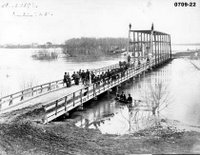 The River is the thing that separates St. Vincent from Pembina, and also the thing they share. It brought people to them, took goods away, and flooded.
As long as there have been records, and surely even before, the Red River of the North has flooded on a regular basis. A few years may go by without a major flood, but not one year goes by when those living by the river don't watch with apprehension as the snows melt and the spring rains come down, hoping that the waters stay within their banks.
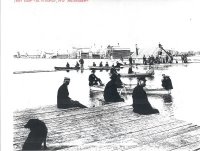 A recent report suggests that indicators in the natural record (sediment, tree rings, etc.) can help us understand the climatic environment and probable flooding patterns of the Red River's past.
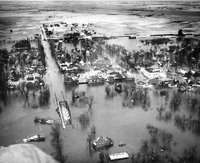 This photo shows St. Vincent and Pembina from the air during the infamous 1950 flood. My sister Betty was born just as waters started to recede. There's another photo of my mother in a small boat with my sister Sharon, getting helped from it by my Dad, with my Grandpa looking on; they are on main street, looking towards the river, the rest of the town under water...
The Red River of the North has provided a focal point up and down the Red River Valley.
 The River is the thing that separates St. Vincent from Pembina, and also the thing they share. It brought people to them, took goods away, and flooded.
As long as there have been records, and surely even before, the Red River of the North has flooded on a regular basis. A few years may go by without a major flood, but not one year goes by when those living by the river don't watch with apprehension as the snows melt and the spring rains come down, hoping that the waters stay within their banks.
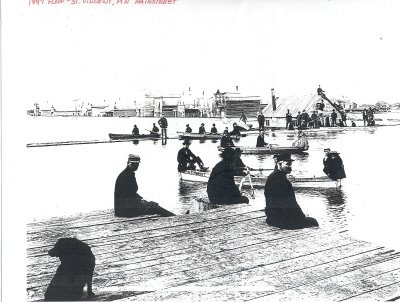 A recent report suggests that indicators in the natural record (sediment, tree rings, etc.) can help us understand the climatic environment and probable flooding patterns of the Red River's past.
 "...data suggest that [the] climate has been much more variable in the past and that these past climatic changes have substantially increased or decreased the frequency and magnitude of local flooding...research confirms historical accounts that suggest that [the region] was much wetter in the 19th century."
 This photo shows St. Vincent and Pembina from the air during the infamous 1950 flood. My sister Betty was born just as waters started to recede. There's another photo of my mother in a small boat with my sister Sharon, getting helped from it by my Dad, with my Grandpa looking on; they are on main street, looking towards the river, the rest of the town under water...
Tuesday, November 15, 2005
Inseparable
 When you mention the one, it's inevitable you think of the other. At least you do, if you lived there for long like I did. St. Vincent (Minnesota) and Pembina (North Dakota) are only separated in the modern mind. Once, before there were maps and borders, there was only the rivers winding through the land that would one day be the foundation of the homes and towns they would come to be.
While this blog will be mainly about St. Vincent, there will be mention from time to time of Pembina; the why of it goes without saying to natives, but to you who may be reading about our little corner of the world from afar, let it be known we are next door neighbors, friends, and many times family, and that's why...
St. Vincent Depot, circa 1910
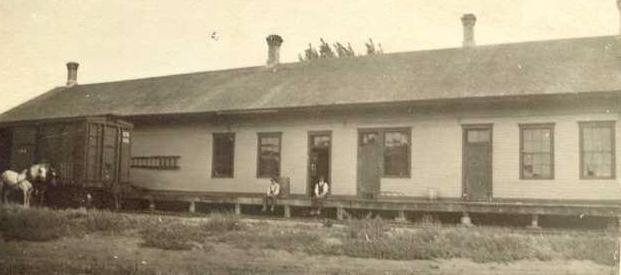 I don't really know when this photo was taken, but I have a rough idea. It shows my grandfather, Al Fitzpatrick, and his brother Dick, sitting on the loading dock by the St. Vincent depot. My great uncle Dick worked for the railroad, and my grandpa was still putzing around doing some drayman work for the town, so they ran into each other quite often. St. Vincent was, and is, a small town - some would say barely a village - but it had it's moments. I'll be tracking them down and posting them here. I hope you'll come back and join me...
NOTE: If you or someone you know have photos and/or stories about St. Vincent, please contact me; I'd like to share them here!
Thursday, November 10, 2005
Place Memory: My Own Lifetime
McCall's (Henniman's). Skogmo's. The Spot. Dick's Corner. The Hartz Store. The Tastee Freez. Coast-to-Coast hardware. Ice rink on the banks of the river, lights strung overhead. The dam. South Pembina. The airport. The museum. Crossing the Red, then the Pembina. Ukranian church dome. Old 81. Old Pembina with the vines growing up the side of the old Methodist Church. Ancestors' rocking chairs in the museum...the old museum that seemed like a treasure chest of old area artifacts. Many a summer was spent touring the row upon row of exhibits, taking in as much as possible. Imagination working overtime wondering who the people were that once owned that dress, that gun, that book. So MUCH stuff that each display area was a Fibber McGee open closet. Even the walls were covered with treasures all the way up to the ceiling. The Park nearby had a monument towards the back, almost hidden by the now older trees. The white pyramid-like steps led up in the center to a pillar. Names and a dedication, barely legible, told of a war to end all wars, and the local boys that wouldn't be coming home again. I would climb that monument thinking it was magical, touch the white stone, rough and hot in the summer sun. Who were these people who were just names now, I wondered as a child. I was in awe of someone who would sacrifice so much.
Friday, October 07, 2005
Man Freezes Feet

Last Wednesday morning, a young man apparently about twenty-five years of age walked into Short Bros.' drug store, seated himself by the stove, and asked for Dr. Harris. He commenced to unbuckle his shoes and pull off his stockings. Dr. Harris came in and at once saw what was the matter - the stranger had his feet badly frozen. He was at once conducted to the Pembina House where a room was engaged and the doctor began to examine his feet, both of which were found to be frozen from the toes to the instep, as solid as two chunks of ice water, until they were thoroughly thawed out. The young man gives his name as Emil Carlson, that he left Hallock Minn. the evening before for Emerson, Man., riding a part of the way. After dark he got lost and wandered on the prairie all night. His parents live in Brooklyn, N.Y., but has had lived in Hallock for some time. Dr. Harris thinks he can save his feet, except some of his toes which have to be amputated.- From the March 7, 1890 edition of the St. Vincent New Era
Thursday, October 06, 2005
1912
 St. Vincent was a bustling little town in 1912. It had several hotels, saloons, groceries, a furniture store, livery, blacksmith, druggist shop, churches, gas station, courthouse, and railway depot. There was even a park with a gazebo near the river, where brass bands played on Sundays. Every summer, there was a fair held.
Wednesday, October 05, 2005
Capturing the Past
I have decided to document my hometown in a very concrete way. I've created a place blog for it. I want to discover and share why my town came into existence, and the people who were there at the beginning, and even those that were there before the town, if possible. Because there were people there before the town.
I'm finding out that my little village, never a big town, has a very colorful past. I've discovered in my life that most places and individuals are far more fascinating that most of us give them credit for. I'm challenged to convey my hometown in as vivacious a manner, or moreso, than Mr. Keillor does his 'Lake Wobegon".
St. Vincent, MN 56755 (a zip code that doesn't exist anymore) was and is a very real place. I will show everyone why it was, and why it was and is special to me...
I'm finding out that my little village, never a big town, has a very colorful past. I've discovered in my life that most places and individuals are far more fascinating that most of us give them credit for. I'm challenged to convey my hometown in as vivacious a manner, or moreso, than Mr. Keillor does his 'Lake Wobegon".
St. Vincent, MN 56755 (a zip code that doesn't exist anymore) was and is a very real place. I will show everyone why it was, and why it was and is special to me...
Subscribe to:
Posts (Atom)