Showing posts with label early settlers. Show all posts

Tuesday, March 30, 2021

Reid: Bonanza Farmer & St. Vincent Booster


"...With the rapid movement of railroad building into the northern part of the valley, the opening of large farms continued unabated. By 1885 nearly all of the original large farms had been established. The J. J. Hill farm of nearly a township [in size], in Kittson county, is probably the nearest to the International boundary. The Reid farm in the same county is another in point."  [Note: ...and in fact, it was Reid farm that was the nearest to the boundary!]

- Collections of the State Historical Society of North Dakota, Volume III, Tribune, State Printers and Binders, 1910, Page 581
Why did Robert Gillispie Reid invest in land, let alone so much land - 10 sections - in our area?  I did a bit of digging.  Robert married Harriet Duff in 1865 after they met on onboard a ship heading to New Zealand.  Twenty years later, Harriet's relative, David Duff and his family, emigrated from Scotland, finding their way to St. Vincent.  David worked at Reid farm as the foreman (he was kicked in the chest by a horse towards the end of his life; it didn't kill him, but he never fully recovered his health, passing away in 1892 - He was 45 years old...)  Right around that time is when Robert bought up the 10 sections in St. Vincent Township.  I think he did it as an astute investment, with an eye to helping  family.  Upon Robert's death in 1908, it was found that in his will, he had left a quarter section of Reid Farm to David's son, his nephew John Duff.  


https://www.kittsonarea.com/2021/02/12/historical-photo-leads-to-interesting-local-farm-history/ https://www.kittsonarea.com/2021/02/12/historical-photo-leads-to-interesting-local-farm-history/
The 10 sections of land that Sir Robert Reid bought  in 1885  became known as  "Reid Farm".  Along with J.J. Hill's Northcote and Humboldt farms, it was one of Kittson County's early 'bonanza farms', and employed many local people.   

The first manager of Reid Farm was Captain Donaldson.  Then David McCleary.  Next, Walter J.S. Traill managed the farm for Reid.1  The last managers were brothers John & George Lohrs.


The 1901 Townships Map (see below)  showed Reid owning 10 sections in St. Vincent Township, bought originally on June 25, 1885 and owned by Reid until his death - in 1909 the estate divested itself of the rest of the property not given to John Duff.


At Right:  Reid Hall, named in honor of
Sir Robert, was St. Vincent's town hall.
[Seen here during fair time, to house exhibitions...]


1 - SourcesKittson County Recorder (original handwritten land deed - excerpt regarding partnership between Reid and Traill, above), and 1901 St. Vincent Township Map.

Monday, July 09, 2018

PROFILE: Captain John A. Vanstrum

I present to you, one of St. Vincent's early pioneers - John A. Vanstrum. A veteran of the Civil War, he became very civic-minded, serving the town and later Kittson County, in many positions. One of his longest-held was as Sheriff.  Serving at roughly the same time, he was Sheriff Charley Brown's counterpart across the river!

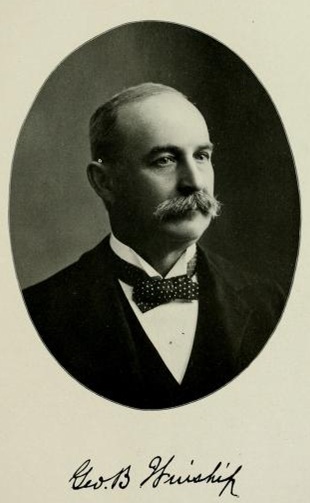
Captain John A. Vanstrum, register of deeds for Kittson county for the past decade, a pioneer citizen of the great northwest and a valiant soldier of the Civil War, is now a resident of Hallock, Minnesota, where he enjoys the esteem and confidence of a wide circle of friends and admirers. His portrait [seen here on right], will be appreciated by his host of friends. Captain Vanstrum was born in the province Gustaf and Elizabeth Vanstrum. The parents died in Sweden, their native land. Captain Vanstrum received but a limited education in his boyhood, having to assist his father in a paper mill from his tenth to his sixteenth year. On June 22, 1855, in company with about two hundred emigrants, he left his native land, sailing from Gutenberg on the vessel Ann Washburn, commanded by Captain Winchell. The vessel was heavily laden with Swedish iron for Boston merchants. He arrived in Boston harbor August 6, 1855, and proceeded to Chicago, thence to Batavia, Illinois, where he spent the winter of 1855-6, working for his board and attending school. In September, 1856, he went to Minnesota, via Dunleith, now East Dubuque, Illinois, thence up the Mississippi river, and located at Redwing. Minnesota, where he engaged as clerk in a store.

At the breaking out of the Civil war Captain Vanstrum was residing at Redwing, Minnesota. He immediately offered his services and assisted the late Colonel H. Mattson in recruiting Company D, Third Minnesota Volunteer Infantry, and was mustered into service in October, 1861 at Fort Snelling. The Captain went to Chisago county, Minnesota. where he raised some thirty volunteers (Swedish) for Company D. These men he transported in wagons all the way from what was then known as Center City via Taylor's Falls, Marine Mills and Stillwater, through St. Paul to Fort Snelling, where they arrived October 18, 1861, and on the following day were mustered into service. Captain Vanstrum was appointed sergeant of Company D in October 1861, was promoted to second lieutenant March 30, 1862, first lieutenant May 30. 1862, and Captain of Company D August 2. 1862. He re-enlisted with the same company as a veteran, under the veteran enlistment act, at Little Rock, Arkansas, early in January, 1864. He was honorably discharged with his regiment at Fort Snelling September 17, 1865. His record in war, as it has continued to be, is that of a brave and fearless defender of the Union and the old flag. In 1879 Captain Vanstrum went to Kittson county, Minnesota, and located at St. Vincent, where he was postmaster from 1879 until 1885. In the latter year he resigned his office and during that period the post office at St. Vincent was of more than ordinary importance. It was the international exchange office for all registered mail matter passing between the United States and the northwest Canadian provinces. All registered letters are re-registered at the St. Vincent office. From 1879 to 1885 this office ranked third in volume of registered mail from Minnesota.

Captain Vanstrum was sheriff of Kittson county from the date of its organization, April 8, 1879, to January, 1889, and is at present register of deeds of said county, having held that position continuously since the fall of 1891. Politically the Captain is an uncompromising Republican. He is a member of the I.O.O.F., and is one of the representative men and pioneers of the northwest. (International Order of Odd Fellows)

Source:  Collections of the State Historical Society of North Dakota, Vol. IV (1913)

Saturday, January 21, 2017

Ephraim Clow: Professional Pedestrian

I have been one acquainted with the night.
I have walked out in rain — and back in rain.
I have outwalked the furthest city light.... 
~Robert Frost

Ephraim Clow was a cousin of mine on my grandmother's maternal line.  Family oral history said he was a long distance runner and had run in the Boston Marathon and won.  I had to find out if this was true or not.

I first found out that the Boston Marathon began in 1897.  Ephraim was born in 1854.  In 1897, he would have been 43.  Above-average age to be doing a marathon.  So I wondered, could this be a situation where the family oral history had a nugget of truth, but it wasn't quite how it was remembered?  In fact, it was.

First, I checked to see if Ephraim had ever been in Boston.  I found that he had.
Ambrose Clow, and his brothers, Charles, George, and Ephraim, went to Boston to seek their fortune. Around 1878-1880, he received word that land was available in Minnesota. Charles was sent to check out the territory. What he saw (in Kittson County) pleased him so he advised his brothers to join him in this new venture. Ambrose brought his new wife, Mathilda Crewye, who was also born on Prince Edward Island. Ambrose had a house built in Humboldt where he and his wife lived the rest of their lives. They had a son, George Victor, who was born 19 Nov 1880.  
 - From George Clow family lineage on Red River Valley website
A racing Pedestrian, being avidly
observed by spectators mid-race
I found out that during the early 1880s, Ephraim was a competitor in pedestrian  races, or "go-as-you-please" races. I've found him mentioned in newspaper articles during the right time period, and in Boston.  I had found my cousin.  And I had confirmed that the family oral history was true - just a bit wrong in the details!

To find out more about what race walking was like in its 'Golden Age', check out this podcast that features the author of the book - Pedestrianism: When Watching People Walk Was America's Favorite Spectator Sport – Matthew Algeo.

A passage from the book mentions Ephraim, alleges a possible scandal he may have been part of:
Early on the morning of the final day of the race, the Boston Globe reported, “...an utterly unexpected and exciting incident occurred...” - Ephraim Clow of Boston, who had been backed heavily to secure second place, and who stood third on the score-sheet, with every prospect in his favor, as he was undoubtedly the freshest man on the track, suddenly left the track and went to his room. Inquiries were at once made as to the reason for his action. He gave various excuses, all of a flimsy character.  
I could find nothing else about the matter, or how it was resolved.

Ephraim eventually came to Kittson County as his brothers had done. He and his family settled in the Humboldt, Minnesota area, where Ephraim farmed for some years.  By the time of the 1910 and 1920 censuses, the family is living in St. Vincent. Evidently they moved there from their farm, in their later years.


This article mentions Ephraim Clow in the middle of the final paragraph; he is
included among those with the best records in the O'Leary International Belt,
held in the old Madison Square Garden in New York City, in January 1881...

[Source:  New York Tribune, May 23, 1881 - chroniclingamerica.loc.gov]

Wednesday, September 09, 2015

Obituary: William H. Moorhead


Apprentice Carpenter. Land Agent. Indian Trader. Trading Post Clerk. Buffalo Hunter. Undertaker. Farmer. Tavern Keeper.

Below is the obituary of an extraordinary man, one of our area's true pioneers.  I have left all the spelling as it appeared in the original article of the newspaper just as I found them, to give you a flavor of how common it was.  Some of the errors may have been due to misspellings or incorrect typesetting, but just as often there was no consistent agreed-upon spelling conventions for some words - Sometimes they just had to make their best guess!

PIONEER DEAD
William H. Moorhead Died Yesterday Morning at His Home In Pembina.
HAD BEEN ILL SIX MONTHS
And Underwent a Surgical Operation Here About Two Weeks Ago
Mr. Moorhead was One of the leading Characters in the Early Settlement of the Valley and was a Typical Frontiersman —"High Water Bill" was the Name by which He was Best Known— The Funeral Occurs Tomorrow.
Pembina, N.D., July 3.—(Herald Special)— William H. Moorhead, better known during later years as "High Water Bill," died at his home in this city this morning, after an illness extending more or less over the past six months. This sobriquet he gained by his numerous prophecies as to just how high the water in the Red river would rise each year, and, be it said, his predictions were usually not far astray. As an incident in this line - it is said that this spring, before the snow melted, as he was lying in his bed on the lower floor of his house talking "high water" to a visitor, he reached down about half way on one of his bed posts and said. "You'll see the water up to this spot when the snow melts," and his prediction was verified. He refused to be carried upstairs until the water came in on the floor.
Floods had been known to fill the Red River Valley with snowmelt runoff. The earliest pioneers remembered the flood of 1861. That spring, the Red River Valley was under so much water that it was called the “largest body of fresh water in the world” – for a few weeks, anyway.   -   North Dakota Studies, FLOODS
Wm. H. Moorhead was born in Freeport, Pa., Sept. 26, 1832. He left Pittsburgh where he received a common school education, April 1, 1852, and arrived in St. Paul, a month later, where he worked at his trade—that of a carpenter—for two years.

The summer of '54 and the following winter he spent at Sauk Rapids trading with the Winnebagos, when they were removed to Blue Earth county. He then returned to St. Paul and organized a company to lay out paper townsites in northern Minnesota and Red River Valley.

In August, '57, he came to Pembina in company with Joe Rolette to build a store building for a trading post for St. Paul parties. He completed the building and remained as clerk to February, '58, when he made a trip to St. Paul with a dog train, not seeing a single house between the two points. He returned to Pembina soon after, having some fearful blizzard experiences on the way.

On June 8th of the same year he left Pembina on a buffalo hunt and returned in August with 15 Red river carts laden with furs, hides and Pemican.

After the high water of '61 which was the flood, according to his tell, he moved out to Walhalla. Here he lived on very friendly terms with the Indians until hostilities broke out which ended in the Minnesota massacre and because he refused to sell ammunition to the hostiles, he had to leave. He moved near Devils Lake and pursued his trading.

In 1862 he married Lizzie Rivier, who with her five children still survives him. About this time he moved to Pembina, where he has since resided.

Source:  Google Books
Mr. Moorhead has long enjoyed the distinction of being the second oldest white settler in the valley. Hon. Chas. Cavileer, of this city, being the oldest having come in 1841. When the Historical society of North Dakota was created in 1895, Gov. Allin appointed Mr. Moorhead a member of it and he has collected considerable information for it since.

Mr. Moorhead was a typical frontiersman and a general favorite. The history of the Red River Valley would be far from complete without an interesting reference to a man who was known far and wide for his genial good nature, and interesting stories of the pioneer's life in the northwest.

Mr. Moorhead has been a member for years of Pembina lodge No. 2, A. F. and A. M., and the funeral, which will take place Monday afternoon at 4 o'clock, will be under the auspices of that order.

[July 04, 1897, Grand Forks Herald]

Monday, March 02, 2015

PROFILE: Dr. Alexander B. Campbell

Dr. Campbell was a versatile man, with credentials as a Dentist as 
well as a Physician, from the Eclectic Medical Institute of Cincinnati
[Source:  Google Books]

Alexander B. Campbell, Surgeon was a local physician living in St. Vincent from approximately 1880 onward.  

Tuesday, August 02, 2011

A Bad End

After all he did for the town, he ended his days sadly...
Daniel F. Brawley was an early settler to St. Vincent.  He was involved in many aspects of building the town early on.

The above news blurb appeared in a Manitoba newspaper in the late 1800's, sharing news of the sad end to Mr. Brawley...

Thursday, March 03, 2011

Pembina vs. Fargo

Competition for political and economic power between the emerging territorial cities was common in the early days, even between Pembina and Fargo...
The first active politics, in the way of a spirited clashing of interests, occurred in 1872, when old Pembina and youthful Fargo locked horns, as it were, in a contest for supremacy. A term of the United States court was held at Pembina in June, presided over by Judge French1, and in order to secure the necessary jurymen almost the entire northern part of the territory was thoroughly combed. After exhausting the Pembina and St. Joe settlements, drafts were made at Grand Forks, Goose River, Elm River, Fargo, and Richville. Every available man was utilized for the grand and petit panels, and the work of subpoenaing them was no small task. 
Jud LaMoure was deputy United States Marshal, and upon him devolved the selection and notification of the jurors. During this process, when LaMoure visited every settlement in the northern section, it developed that the deputy marshal had something else on his program besides the business of subpoenaing jurors. The first to scent the alleged "darkey in the wood pile" was the coterie of live-wires at Fargo, led by S. G. Roberts, G. I. Keeney, John Haggart, Captain Egbert, and others. 

Saturday, February 19, 2011

Immigration Chaos


From a traveler's observation of an immigrant train arriving in St. Vincent comes this account...
It was a dull rainy evening when we bade farewell to Pembina, and were ferried across the shallow muddy river to St. Vincent. I suppose it is called the Red River because the water is of a whitey-brown color. At the railway station confusion reigned. A large party of immigrants had just arrived with through tickets by the steamboat line to Winnipeg. But owing to the lowness of the water, and an accident which occurred a few weeks before, there was no boat ready to go down the river. The party must go on by rail, and the officers of the branch line from St. Vincent to St. Boniface, opposite Winnipeg, refused to make any allowance for the steamboat tickets. Despair ruled in the crowded, murky car into which we were packed. Many of the poor immigrants could ill afford the additional cost. We had to pay $3.25 for riding over sixty-five miles of wretched track at the rate of ten miles an hour. The road-bed is so rough that when they run at higher speed, the engine bell is rung by the oscillation.

Long after midnight we were landed in the mud at St. Boniface. Here we fell into the hands of the custom-house Philistines. Never have I seen courtesy and intelligence so successfully concealed under the veil of rude stupidity...
From: Harper's Magazine (May 1880)

Monday, January 24, 2011

Highwater Bill "on hand"


William H. Moorhead was a colorful character that was involved in many events of local historical significance.  I have written about him before, as well as shared a story written about our area that featured him in it.  In the course of my research, his name has come up over and over again in accounts of history relating to my hometown area.

The above article was reprinted many years ago, showing photographs featuring "Highwater Bill" in them, during the 1893 flood.  Click on it to see an enlarged version, easier to read...

Tuesday, December 28, 2010

In Their Own Words: Charles Cavileer

Source:  State Historical Society of North Dakota
[Click to enlarge...]
THE OLD-TIME POST OFFICE AT PEMBINA
By Charles Cavileer

Cavileer
I came here (Pembina) in 1851, in company with N.W. Kittson and others. After being here a few days Mr. Kittson asked me to act as assistant postmaster, he having been appointed postmaster some time in 1849. Joseph R. Brown was contractor to carry the mail from Pembina, Wisconsin Territory1, to Crow Wing in the same territory, via Thieving River, at its mouth at Red Lake River, thence by land and canoe to Red Lake Village, making short portages, thence making short portages between small lakes to Cass Lake and then by the same order of travel to Leach Lake and so on to Crow Lake and to the end of the route at Crow Wing Village, which was the headquarters of the North-West Fur Company for all that section of the country claimed by the Chippewas from Crow Wing to Pembina northwest and northeast to Sandy Lake, and Fond du Lac.

The contract was a go-as-you-please, on foot, horse back, cart or canoe, anyway-to-get-there affair. The contract price for carrying it was $1,100 a year. Kittson, being postmaster, could not act as sub-agent. He appointed me as assistant postmaster, and I ran the machine until some time in 1853 or '54. I did all the business of the office, made the quarterly returns and deposit of funds due the department, attending to every detail of the office, which at that time was no child's play as every letter and package had to be tied up in wrappers, waybilled and addressed to its destination. St. Paul packages contained nearly all of Minnesota, Chicago, Detroit and east and west exchange.

An example of an 1868 letter with U.S. postage
sent from Red River to St. Paul via Pembina
.
Source: The Minnesota Territory in Postmarks

Letter rates of postage ran 6 1/4, 12 1/2, 18 3/4, to 25 cents, according to distance, from 6 1/4 for short distances to 25 for 500 miles and over. Every letter and package had to be wrapped and addressed. Even single letters had to be wrapped and addressed to their proper offices. All wrappers had to be saved and used as long as they would hold together and an address could be put on without showing another.

But when it came to making out the quarterly reports the dance had just commenced. Every letter received and dispatched must be returned from the records kept on bills for that purpose, and it made a package about the size of a family Bible, and the footing up of columns with the amounts running from 6 1/4, 12 1/2, 18 3/4 to 25, was a corker. And right here let me tell you, with a feeling of pride, that I never had a quarterly return come back to me for correction.

Let me give you a sketch of the business at that early day, and the hardships and tricks of some of our carriers.

Monday, November 01, 2010

1870 Fort Pembina Census

The images below are from the 1870 Fort Pembina census. There are several familiar names in the census - Joseph Rolette, Norman Kittson, William Moorhead, Nelson E. Nelson, and even Charley Brown (although for some strange reason it has him listed as coming from Germany - sure, it could be another Charley Brown, but somehow, I doubt it very much...) That mystery aside, it's a fascinating window into the diversity of individuals making up the fort, from the ethnicities to the types of support personnel helping to assist, work with, and care for the soldiers (housekeepers, sutters, doctors, hunters, translators, scouts, etc.)

Tuesday, October 05, 2010

BOOK: Minnesota's Last Frontier

In what appears to be a self-published work, J.W. Durham1 wrote about his experiences in northwest Minnesota in the late 1800's. While most of those experiences were further east of St. Vincent in Roseau County (part of which was once included in Kittson County), there were some recollections of individuals with a connection to my hometown area, of which I share below.  Please note that the language is of its time and style, and some of the content would be considered inappropriate and even offensive to modern ears - please read with a historical frame of mind to give it proper context...

Saturday, July 17, 2010

Profile: Pierre Bottineau

I keep finding intersections between where I grew up, and other places in my home state of Minnesota, including where I just moved to (I now live only a few miles from one of the main Red River oxcart trails...) Also, many of the men and women who show up in the historical record crisscrossed the entire region over and over in their daily lives - guiding, exploring, surveying, and conducting business - again, some traveling or living near where I now live myself.

One such man - whom I have written about before - was Pierre Bottineau...
In 1856, Pierre was guide for the expedition led by Colonel F. Smith from Fort Snelling to explore the mouth of the Sheyenne River, the southern tip of Devil's Lake and the region around Pembina for the best sites for military posts. This would have been in anticipation of and just the year prior to Major Seton coming up in November of 1857.

In June of 1860, Pierre accompanied a military expedition with Gov. Ramsey to Pembina to conclude treaties with the Northern Minnesota Chippewas. On his return, he guided an expedition led by Commissioners Cullen and Bailey to the Red River to hold council with the Chippewa of the Red Lake and Red River Lands in MN

Regarding the 1863 Treaty with the Chippewa-Red Lake and Pembina Bands, Oct 2, 1863, 13 Stats., 667, Ratified Mar 1, 1864, Proclaimed May 5, 1864, Indian Affairs: Laws and Treaties. Vol. II - aka the Old Crossing Treaty - Pierre Bottineau signed his mark as a witness to the treaty made and concluded at the Old Crossing of Red Lake River, MN, on Oct 2, 1863, between the US, by their commissioners, Alexander Ramsey and Ashley C. Morrill, agent for the Chippewa Indians, and the Red Lake and Pembina bands of Chippewas; by their chiefs, head-men, and warriors.
Pierre, called the "Kit Carson of the Northwest", was a man who truly got around, doing a lot in the time he had. He had been involved in many of the major events that created our state. He died in 1895 at age 78, and is buried just west of Red Lake Falls, MN which is only about 20 miles southeast of where I live now.

The memorial below was created in honor of Bottineau for "...his years of distinguished service as a founding father and civic leader." I find it very ironic that he is honored now which is exceedingly appropriate; however, in an obituary written at the time of his death, there were definite mixed messages - on the one hand it praised him, but on the other hand insulted his ethnicity (Metis)...
No one in the northwest ever passed a life of more romantic adventures, thrilling experiences, hairbreath escapes and accidents--- generally by flood and field. He travelled over nearly every square mile of the northwest and knew the country as thoroughly as a farmer knows his lands.

He spoke every language in the region from French, English, Sioux, Chippewa, Cree, Mandan, and Winnibago. Experiences in all the particulars of frontier and savage life, he was equally proficient as a hunter, trapper, boatman, guide, and businessman. He could build a house, fashion a boat or plow a field with equal facility. Fully six feet tall and straight as a grenadier with clean piercing black eyes, he was of attractive appearance, despite swarthy complexion due to his Indian blood. He was naturally of manly instincts and gentlemanly deportment, polite, agreeable and of a kindly disposition, always true to his word and his fellowman.
Pierre Bottineau Memorial at St. Joseph Cemetery

NOTE: Much of the above information is from a timeline provided by a descendant of Pierre Bottineau. An amazing collection of historical information on an individual, I was quite impressed!

Wednesday, June 02, 2010

Gamble Boys

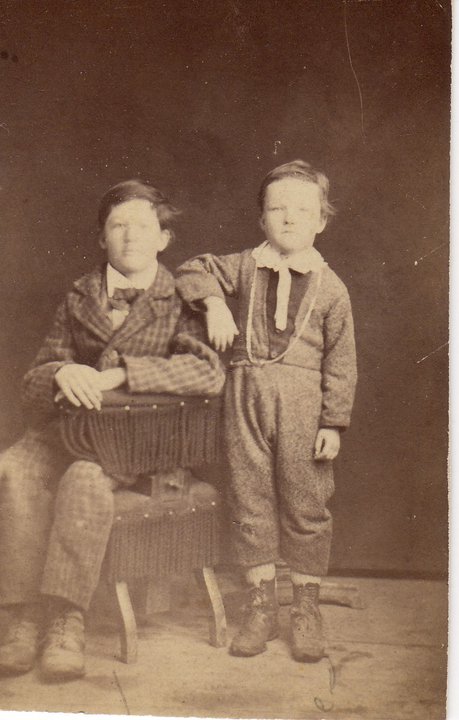
From Lori Kohut Bianco, Gamble descendant: Alexander Gamble Jr & William Neill Gamble. My guess is this was one of the photos mentioned in the letters, which they had taken after they arrived in Emerson/St. Vincent & sent back to Beaverton in the late 1870s -- the ages appear to be about right.
I will be attending this year's reunion at the end of next month, and visiting many local sites including my family's old homestead, the cemetery, and if time permits, some friends including Hetty Walker, Chuck's wife...

Tuesday, January 05, 2010

Another Contact

I received the photos and information below nearly a year ago. I didn't post it until now because I was going to try and research the names the reader provided. I still haven't had the time to do that, but I fully intend to. In the meantime, I figured why hide the information? Perhaps one of you reading this knows this family and can respond. Feel free to comment here or contact me directly...


Hi there,

I saw the St. Vincent memories site. That is pretty cool and interesting. I love that site. I like looking at old pictures and hearing about the stories. I was wondering since you know quite a bit about North Dakota and its history. I was wondering if you know much on families there. I am trying to do genealogy on my dad's side of the family. I keep coming up with road blocks. My dad was raised by his great aunt in Canada and his brothers were put in an orphanage after their mother passed away from childbirth. My grandfather decided not to raise them and probably never know why. My father died a few years ago and i am trying to find info out. He didn't know much information. I have some information. I found out my dad's mother's side were native American Indians. His father's side was french Canadian. My dad's mom side has been published in books by Gail Morin. My grandmother was Marie Blanche Campbell or 'Pearl'. She was born June 16, 1903 in Leroy, North Dakota. Her parents were Charles Campbell (he was born April 19, 1880 in Leroy, North Dakota baptized at St. Joseph - his parents were James Campbell (parents were William Campbell and Eliza Ross) and Isabelle Delorme (daughter of Joseph Delorme and Isabelle Gourneau) and Marie Veronique Ritchot (she was born March 16, 1877 in Leroy North Dakota - her parents were Raphael Ritchot and Isabelle Gladu). My grandmother was married August 25, 1922 in Walhalla North Dakota at St. Boniface Catholic church. She married Charles V. Dumas (born February 28, 1891 in St. Rock, Quebec, Canada - his parents were Charles Dumas and Rosalie Dumas (1st cousins) - I freaked out when I found out....Charles V. Dumas is the son of Joseph Dumas (son of Francois Dumas and Mary Marthe Cartier) and Esther Allaire (daughter of Olivier Allaire and Catherine Leduc). Rosalie Dumas is daughter of Treffle Dumas (same as Joseph's) and Rosalie Bresse (daughter of Charles Bresse and Mary Rocheleau).

My grandparents had several children - all boys - now all deceased. My cousin, me, and my brother are left from my grandparents. My parents had me later in life. My brother is old enough to be my dad. He is almost 20 years older than me. My parents didn't think they could have kids in their late 40's and I come along and surprised them. I was wondering if there are old newspapers articles from Walhalla area on any of these family members I am particularly looking for the Campbell side. The only thing that I do know is that my grandfather told my aunt that he descended from Scottish lines because they had accents. Genealogists that I have contacted can't seem to find out where the family comes from. the other family is documented. I find it strange that the Campbells can't be found. It seems like someone is really not wanting to me to find out and I don't know why. I was hoping maybe that you might know or maybe give a direction where i could look. I appreciate any advice. Hope to hear from you soon. Have a great day and weekend.

Thank you,
Trisha Dumas

Friday, November 20, 2009

Time of Change

Between 1812 and 1823 the Selkirk settlers/Red River Settlement used Pembina as a seasonal (in winter) residence. In the early 1820's concerns were expressed over the relationship of Pembina to the international boundary. Talk surfaced about abandoning fur trade, Fort Daer (Selkirk settlers), and the mission efforts; it was felt it would prevent conflict with the United Stated and encourage local populations to pursue farming instead of hunting. In the spring of 1823, HBC left and the missionary Dumoulin left, and the settlers' Fort Daer was closed. That same year the Long Expedition arrived in August. By 1826 trade for HBC was carried out by private traders.

Saturday, November 07, 2009

Great American Desert

From: Democracy in America By Alexis de Tocqueville
The concept of the Great American Desert had long been familiar to Americans and indeed it controlled much of the directions of the growth of the nation for a major part of the nineteenth century. So we have to dip back a little bit before the Civil War to see how this geographical concept, this geographical myth, came into being, and how it influenced the growth, the thoughts, the attitudes, of the American people as they moved westward.

In 1819, the federal government of the United States decided that it needed a good amount of information for the territory that lay beyond the Mississippi River, westward to the Rocky mountains. They hired an explorer, a map-maker named Stephen H. Long to take a journey to map this terrain, to keep a journal, to inform the federal government about what at the time was a vast unknown territory to all Americans. And so Long set out in 1819 traveling westward from what is now the border of Nebraska, traveled through Iowa to the front of the Rocky Mountain ranges, then traveled south and back through what eventually would become Oklahoma and Arkansas. He drew a massive map as well as a series of subsidiary maps and wrote a major report for the federal government, a report that was published along with its maps in 1821. Over the area that today we know as the Great Plains, Stephen H. Long simply printed in giant letters, the words "The Great American Desert." And in his journals and in his reports which accompanied his map, Long wrote that in his opinion, "I do not hesitate in saying that the entire area is almost wholly unfit for cultivation. And of course it's uninhabitable by a people depending upon agriculture for their existence." Buffalo, wild game, goats might live there, but not people. It was indeed on the map that finally reached the public in 1823--it was the Great American Desert.

Consequently, there was very sparse settlement in the area beyond the Mississippi River in the 1840s and the 1850s--isolated pioneer homesteads here and there, but not settlers pouring in vast numbers until the late 1850s and the early years of the 1860s. In the years immediately following the end of the Civil War, traffic into the trans-Mississippi West picked up dramatically by the hundreds, then by the thousands, then by the hundreds of thousands. Settlers poured into the Great Plains moving westward. As the population increased in the Great Plains trans Mississippi West area, many people came to recognize that the old myth of the Great American Desert was no longer true. If indeed it had been true, they needed a way to combat the myth. People eager on boosting settlement and attracting business and getting railroad connections wanted the rest of the nation to believe that the so called Great American Desert was not a desert at all. So they built a counter myth. Now they began to call the Great Plains in the late 1860s and the 1870s "The Garden," the Garden of the West, an agricultural paradise in which there was space enough, and time enough for people to achieve their wildest dreams. A new kind of booster literature appeared portraying the entire Great American Desert area, the entire Great Plains area as an agrarian heaven, an idyllic spot.
From American History 102: Which Old West and Whose?
Power believed that the only way to overcome the tradition that Dakota was the Great American Desert was to actively promote the region in the farm periodicals of America and Europe of that day.
From Bonanza Farming in the Red River Valley

Saturday, October 31, 2009

In Memoriam: Charles Walker


Son. Husband. Father. World War II Veteran. Bush Pilot. Politician. Author. Local Historian (and descendant of some of the area's earliest pioneers...) An icon of my home town area has passed from us. I received word today from a reader of this blog that a good friend of mine had died. Charles Harris Walker lived a long and fascinating life. I got to know him towards the end of it, and wish I had known him much longer, but cherished the time I did have. We communicated mostly by email, but also in person during visits back home. We shared a passion for local history, one he had had long before I even existed, but I only learned of in recent years. He was there in the background of my life for many years and I didn't realize we shared this love of history. I was younger, and so was he, and we were at different stages of our lives. It's funny how you can be around people, even know them to a limited degree, but not REALLY know them, and then suddenly at some point it's like you finally open your eyes and see them for who they really are...or rather who they were all the time but you were too blind or ignorant to see it before. 


I've been serializing his books - Sheriff Charley Brown, and Bordertowns here on this blog, in fact Bordertowns is still in-progress. Bordertowns has just been published. I shall sorely miss his knowledge, his sense of humor, and just who he was as a person. He was a special man.

Wednesday, September 23, 2009

Smithsonian First Postal Object

The man standing to the left of the open door is Charles Turner Cavileer. One of the two women to the right of
the door is probably 
his wife, Isabel; the other woman and the tall man may be two of his five living children.
A history of the region published during the elder Cavileer’s lifetime called him “the father of Pembina” and “the oldest living settler of that locality,” adding that “he was a regular correspondent to the Smithsonian Institute.” It is likely, then, that the postmaster sent the photograph to us from his own post office. It was received in 1882, making it the first postal object added to the Smithsonian’s collection.

From Object of the Month, National Postal Museum, Smithsonian Institution

Wednesday, May 20, 2009

Bordertowns: Chapter 3

I dare you, dear readers, to read just the first paragraph below, and not tell me that Chuck Walker is a master storyteller. He knows his subject, and his descriptions bring the time period, places, and people of our region alive. Chuck can write a mean love scene, too...*wink*

I proudly present Chapter 3 of Chuck Walker's Bordertowns...
The distance from Fisher's Landing to the Red River across country was only twelve miles, but by the twisty river the distance was nearly forty. As the river was sinuous, the International seemed to crash from one bank to the other, pausing for minutes to reverse engines, and then proceeding forward. Trees grew to the edge of the bank, scraping stanchions along the deck, leaving broken branches and leaves lying everywhere. Never did the boat go forward for more than a few minutes before contacting the bank, swinging crossways, and sometimes sticking fast. Maggy expressed her feeling pointedly.

"Pat! The captain must have the patience of a saint to absorb this punishment. Will traveling on the Red River be as bad?"

"Naw! We should be out of this river and into the other late this afternoon. The Red's supposed to be a good-sized river, wide enough for a boat with barges."

Long before dark they reached the much larger Red River and proceeded a short distance downstream before tying up. They secured alongside barges loaded with steel rails destined for the new Canadian Pacific Railroad to run between Emerson and Selkirk, in Canada. The barges had been loaded at the rail-end in Moorhead, and then floated downriver over the rapids to Grand Forks. The remainder of that day was spent securing a barge to each side of the boat and loading a supply of cordwood for the boat's boilers.

Ian struck up a conversation with one of the Norwegian crewmen to find they were paid $35 per month. They numbered twenty-two deck hands: The captain, the pilot and other officers. In addition to their work of loading and unloading cargo, each man was required to carry aboard one cord of wood each day, for the boat burned twenty-two cords in the two boilers every working day. Upon a casual inspection of the cargo at the bow of the boat, he noted consignments for the soldiers' fort at Pembina. Stacked high behind this were barrels, boxes and crates of machinery for Emerson, Manitoba. Even further back were massive piles of freight destined for the Hudson's Bay Company and other trade stores at Fort Garry. All had been arranged in convenient groups to facilitate easy unloading at succeeding ports of call. Being a deck hand is not the job for me, Ian thought. Too boring, and what do the men do when winter comes?

Supper that evening was served in the narrow central passageway that ran through the center of the hurricane deck. Maggy deemed it more of a hallway, but it was carpeted and along each wall stood several ornately decorated chairs for the patrons. These were interspaced so that beside each chair was the door to a stateroom. After the meal the dining tables were removed and the long corridor again became a sitting room. The ceiling was high, bridged across with slightly curved beams. A row of narrow skylights extended on either side for the full length of the long corridor. Decorative ropes with huge tassels hung below the coal oil lamps spaced along the ceiling. Here and there were small tables that could be moved at the passengers' convenience.

Their first-class tickets entitled them to three staterooms, which Maggy scorned as broom closets. "Pat, there's barely room to stand, let alone dress. You'll have to take the upper bunk. Two could never fit in these narrow beds."

"Not to worry, Maggy. At least they're nearly three feet wide." Running his hand over the upper bunk, he suddenly laughed. "Wonder how Ian will make out. These beds are not even six feet long." He turned to Maggy; she was smiling too, thinking of Ian's well over six-foot height.

Near midnight ominous claps of thunder became audible, gradually growing closer. Pulsing breezes that rapidly turned to a gale accompanied the sound. The slow sound of raindrops pit-patting on the small window rapidly changed to a steady drumming. Finally a tumult assaulted the roof above.

"What's happening?" Pat awoke with a start.

"It's pouring outside . . . nothing to worry about."

As he dozed off, Patrick thought of his earlier conversation with the captain, of the man's mention that the river was getting mighty low for navigation. He thought of the old saying: "It's an ill wind that blows no good."

The next morning it was still raining and the river had risen appreciably. At 5:30 a.m. they cast off for the Canadian border. Although it continued to drizzle, the wind subsided and the passengers could walk on the covered, exterior hurricane deck without getting wet.

The interior salon, which ran the entire length of the hurricane deck, remained crowded because of the inclement weather. Time played upon Maggy's mind as she noted and chafed at Mary's absence. She brought it to Pat's attention. "She's spending too much time with that boy. I don't want her getting involved at her age."

"Not to worry! The lad is going on to Fort Garry. They'll probably never see each other again."

"I wish I was as sure as you." Maggy was not mollified.

Mary was confused, for golden dreams were invading her mind. The strange feeling of response to Robert had begun in Duluth. Now, standing at the rail, she felt a tingling sensation, for he had put his arm around her waist and was holding her gently. Her sensation was a feeling of bliss and peace. She wanted to be loved and felt that her life was just now beginning. Unwanted warning thoughts came, perhaps orchestrated by her mother over the past years: Let your mind be superior to what your body says! Be strong! Men are weak but won't admit it! Casting unwanted advice from her mind, she raised her face to his. He drew her body tightly to him and kissed her tenderly. For seconds she was captivated, then she pulled away, almost breathless. But wasn't this what she wanted? Hadn't she wondered when this would happen? He was still holding her in a close embrace. Why was she pulling away?

Slowly she thrust loose, her sanity returning. "Oh, Robert, I'm only sixteen. You mustn't even think of loving me." Warning bells rang in her mind and she knew she must fight the feeling in her heart.

As Robert released her, he realized he was committing himself to this young girl. She appealed to his protective instinct and aroused his sense of responsibility. Now he believed he had pushed too hard and frightened her.

Grasping her shoulders gently, he said tersely, "Someday in the future you'll be my wife. I'll wait for you to grow up and mature. We'll be happy together, you'll see! Now, I've got to make my way in the world and build a future for us, but I'll be back. It may take some time, but I will be back." Pulling her warm body close, he kissed her again. She found herself clinging to him fiercely, returning his kiss with fervor.

Late in the afternoon as they approached Fort Pembina, three long echoing blasts of the ship's whistle brought nearly everyone to the outside deck. As they cleared the last bend, the passengers could see a group of soldiers walking down the hill on the west side of the river. When the boat nudged into the shore, wagons from the fort arrived to carry the cargo up the hill. Little could be seen of the fort itself except rooftops of stables on the high bank. The actual unloading at the fort took less than thirty minutes. Then the whistle sounded twice and the boat backed away amid a hissing and puffing of its engines. Minutes later they barely cleared under a telegraph wire that extended across the Red River near the settlement of Pembina.

On the west side of the river a ferry hugged the shore. It was apparent they had just lowered the cable crossing the river, enabling the International to proceed. Passing the mouth of the Pembina River, they swung into the west bank to unload goods at Pembina.

The stop here was brief, and after pulling back into the channel, the crew was kept busy moving cargo forward to the bow of the boat. Soon, just as the ship's whistle again sounded three deep blasts, Ian overheard one of the crew members remark, "We're just crossing into Canada. Emerson is around the next bend." Hearing the comment, he hurried to harness their team of horses.

Emerson had no dock, but the east bank was corduroyed with logs. A road angled down from the crest, leading to a widened, leveled-off space. As the boat swung in to tie-up, spectators came down the hill. With the giant paddle wheel still churning slowly under power to hold the bow of the boat firmly to the shore, the crew began to cast off lines to the barges. The downriver barge was tied ashore and the current swung it snugly to the bank. A team of horses was required to swing the other barge upstream, clear of the boat. These steel rails were to be unloaded for the Emerson end of the new railroad.

Simultaneously with the removal of the barges, the boarding ramp was lowered to the shore and the passengers began to disembark. Maggy and Mike watched apprehensively from shore as preparations were made aboard to move the team and wagon. Robert Douglas had come ashore and was standing to the side, conversing with Mary. For moments it seemed the horses were too frightened to cross the hurriedly placed plank ramp. Their terror forced Ian to jump from the wagon to grasp the bridle of one horse. Patrick reached the opposite horse quickly, and with soothing words the animals were coaxed step by step across the hazardous ramp to the shore.

"Judas! I'm glad that's over!" Ian sounded relieved. "Good thing there were two of us. One man couldn't have done it alone. Lordy, the horses were nervous."

Patrick wiped his forehead with his sleeve. "Let's get the family together and hunt up a place for the night."

Just as Ian climbed to the wagon seat, a well-dressed man approached Patrick. "Sir, my name is Thomas Carney. I watched you two manage that wild team. That was bully work!"

"They weren't wild, just nervous. They're young horses." Ian was quick to defend the team.

"Just so. May I ask if you are here as businessmen, or as settlers?"

Patrick noted the man's grey whiskers and balding head before answering. "I'm Patrick McLaren, and this is my son Ian. We're from Orillia, Ontario; we're looking for farmland."

Carney looked pleased. "We've plenty of land. Why don't you camp on the edge of town tonight? The campground is just up the hill and to the south. You can look up the government land agent in the morning; his name is Newcombe. It's too late to do anything tonight." Then he suggested, "Or would you rather stay at Hutchison's Hotel? It's not much, but they have food."

"No, I think we'll camp out. We have plenty of grub and can graze the horses. We'll probably see you again." Patrick was anxious to get his camp set for the night.

"See you later!" Carney raised his hand, and then turned to join other passengers.

It was evident to Maggy that many of the townspeople met the steamboats for the novelty. They apparently judged the financial status of each arrival by their clothes, equipment and furniture. She overheard comments to that effect made by the townspeople, especially the women.

While Ian drove the wagon slowly up the hill, his father and Mike followed on foot. Mary had tarried behind with Robert Douglas. Maggy turned impatiently, just in time to catch the two in an emotional embrace. Pretending not to notice, she turned her head. Moments later she heard Mary's hurried steps as she endeavored to catch up. Casting a quick glance at her daughter, she saw the tears and stricken look on her face.

Upon reaching the crest of the embankment, they noted several tents pitched on the open prairie to the south. "We'll camp there for tonight." Patrick pointed to the field. Ian nodded, and turning the team, selected an area far removed from the nearest tent. Unloading, they made hurried preparations for their camp.

Nightfall settled soon after they completed supper, and darkness found them all seated comfortably around their small campfire. All seemed too excited to seek their beds. "I wish Gramps was here with his fiddle. It'd seem a lot more like home." Mary sounded wistful and a bit homesick.

"Perhaps they'll come in another year or two. This is our home now." Maggy seemed unshakable. Then, turning to Patrick, she asked, "What are your plans for tomorrow?"

"I'll see the Canadian land agent first thing, and then check with the man representing the Minnesota land. We'll have to find out about a school, also about a church."

"Mary and I can see to the school and church. You and Ian look to the land." Pausing, Maggy looked up at the stars. "It's such a beautiful evening; it's cleared so perfectly that the Big Dipper stands out. Suddenly Patrick heard a distinct slap, then her voice again, "Darned mosquitoes!"

After an early breakfast Patrick took his family on a walking tour through the streets of Emerson. They were amazed to find the town, founded only three years ago, almost as large as Orillia. Every desirable type of store was available: a land titles office, a registry office, even a Masonic and an Orange Lodge. Most of the families lived in tents, but here and there were houses of log or frame construction. Several homes were in various stages of building.

Leaving the men, Maggy and Mary looked for, and found four active churches: a Methodist, Anglican, Baptist and Presbyterian. The latter, they were told, was still in the process of being formed. They also found the schoolhouse, and Maggy introduced herself. The schoolmaster, George Baldwin, was ecstatic to learn of Mary's advanced schooling and of her interest in mathematics. He questioned her at length to determine her qualifications, and then said, "You'll be a welcome addition to our one-man school staff, as I need an assistant. In fact, it's quite possible you may be able to teach in a school of your own in the near future. We're crowded, but will make room for you and your brother." Turning to Maggy, he said, "Alas, your youngest is just too young. Perhaps next year."

Patrick and Ian entered the Registry Office and were greeted by a jovial, florid faced man. "Come in! Come in! What's your pleasure?" The man seemed overeager. "My name is Bill Nash. If you're looking for a place to build, I'm your man!"

Patrick cast a wary glance at the man, suspecting chicanery. Finally he said, "We're looking for information about farm land. Can you help us?"

"That's no problem. First of all you are entitled to a free lot, courtesy of Mr. Carney and Mr. Fairbanks; they founded this town. If you're looking for work, the railroad is hiring anyone and everyone for grading, no questions asked." Then he said optimistically, "I guess you can find work anywhere. There's a dearth of labor."

"I'd be interested in that free lot, but all we have at present is a tent."

"It's all most of the newcomers have. Some don't even have that." Nash broke into a smile.

"We're farmers; we're looking for land."

"Then you need to see the titles agent, George Newcombe. His office is next door. He sold over 150,000 acres of government land last year, and is having a great run this season."

"What's land going for?"

"Well, the Hudson's Bay Company is asking twelve dollars per acre for their land, but the government wants only eight. I believe you can get terms from either."

Both father and son looked disappointed.

Ian spoke up. "I understood two quarter sections of land were available just for the filing fee, and homesteading."

"That's true, but that's land across the border in Minnesota. We can't match those prices."

"Then that's where we'll have to go; our finances are limited." Patrick turned to leave.

Nash looked crestfallen. "We'll hate to lose you; but before you leave, pick a lot from this plat sheet. I'll assign it to you free of charge. Perhaps you'll change your mind. You say you have a tent for your family, so you'll need a temporary spot. Also, we have a school for any children you may have."

"Sounds good," said Patrick. "A place along the border would suit us best, somewhere near our camping spot."

"There's lots of room. How about here, just east of the camp?" Nash slid his finger along the map. "I'll put you down for this one, just north of the boundary. It's #7, and staked on all four corners."

"Thanks! We'll find it."

Turning to leave, they heard Nash's final words. "Ask for Alexander Turner -- he's the land agent in St. Vincent."

Returning to their camp, they spent the remaining time until noon striking their tent and moving to the new lot assigned to them.

After a brief lunch, Patrick, Ian and Jerold drove south on the trail to enter the state of Minnesota. The grass along the dirt trail to St. Vincent was alive with prairie chickens and grouse. Interspersed between trees and brush were occasional patches of grass. At times birds ran along the path ahead of the horses before breaking into flight.

"Pa, we'll never starve here. Why, just look at the deer tracks." Ian marveled aloud.

"Look at those big tracks in the dried mud," Jerold added. They can't be made by cattle."

"Those are moose tracks, son," Patrick observed. "This land once belonged to the Indians. No wonder they didn't want to give it up."

Jerold interjected, "But Pa wasn't it bought from them in '63, by treaty?"

"Yup, and that's why they had to establish Fort Pembina. The Indians and Métis sold out and each got scrip for 160 acres. Trouble was, they sold the scrip for little or nothing to the traders, and then they wouldn't leave the land. In fact, they caused so much trouble with the settlers that the military had to be called to boot them out. I've heard they're still raising a ruckus with settlers in the Pembina hills, west of here. Oh, there were other reasons to bring in the soldiers: the Sioux began raiding close by in '68, and then Riel aroused the half-breeds in '70."

"Pa, why do they call the breeds Métis at times?" Jerold was puzzled.

Patrick mused thoughtfully. "Son, Métis is the French word for breeds of French-Indian mix. The English still call them half-breeds or breeds. Reflectively, he added, "Come to think of it, the word Métis sounds better."

Angling onto St. Vincent's main thoroughfare, they observed a narrow lake to the south. Scores of ducks could be seen. The lake seemed to extend far out of sight behind huge trees.

On the right side of the road men were clearing brush and cutting timber, making way for the future railroad yard of the Saint Paul and Pacific. The road from Crookston to Emerson was to be completed by the year-end of '78 to connect with the Canadian Pacific Railway, now under construction between Emerson and Selkirk.

Nearing the river, they by-passed a tent camp, and then approached several buildings along the west side of the load.

"Look, Pa! There's a lumber yard," Jerold observed. Patrick was gazing in contemplation at two men setting fence posts on one side of the road. "Ian, stop and we'll speak with them."

The rumbling of the wagon drew the men's attention, and they both looked up expectantly.

"Beg pardon! Can you tell us where to find the land agent, Turner?"

The nearer man was lanky, clean-shaven, with a weathered face covered with wrinkles. He studied Patrick for moments before pointing toward his companion. "He's Turner, I'm Joe McCaffery.

Turner thrust back his hat and approached the wagon. He was tall and thin1, with a long goatee. "What's up?"

"I'm Patrick McLaren and these are my sons, Ian and Jerold. I hear tell you can put us onto some homestead land."

The land agent hesitated, as if in thought. Turning to his companion, he said, "Joe, we both need a rest. Hook up the horse. Damned if I'm going to ride in that wagon with them."

Turning back to Patrick, he smiled. "No insult intended, but you've only got one spring seat on that wagon. My buggy fits my rear end a lot better." Then he said reflectively, "The railroad is supposed to get all the odd-numbered sections for six miles on each side of the track, so that cuts the choice of land. Up to now they aren't selling -- guess they can't until they get the railroad in operation. What land I represent is all prime, with plenty of black loam. The quarters are scattered though, due to what has already been taken up. Do you understand the requirements? You get a quarter section by homesteading and a quarter by preemption."

As Patrick nodded, Turner added, "It'll take a few moments to get my map."

Upon his return he removed a pencil from a pocket to point out details on the sketch. "Now this section is nearby; these two are about two miles away; the rest are along the border." He glanced at Ian, "How old are you, son?"

Ian sensed disaster. "I'm nineteen."

"Too bad. You won't be eligible until you're twenty-one." Turning back to Patrick, he asked, "I assume you'll want land close to town."

Patrick nodded seriously, "Within reason."

Just then McCaffery returned with a single-seated Democrat, pulled by a large bay. Turner advised, "You and your boys follow us. We'll take a shortcut around the slough to section 12, then cut across to the other land. All of the quarters are well marked -- just surveyed this spring. If you can't find land to suit you by four o'clock, we'll try again tomorrow."

He tugged on the gold chain that hung across his vest, releasing his pocket watch. Glancing at it, he smiled. "I promised Johnny Kabernagle to meet him at his place in Pembina for supper and a game of billiards." Grinning, he added, "He fancies himself a pool shark, but I'll take his coin!" Then his manner changed, "We'll have to push hard this afternoon."

It took less than two hours for Patrick to pick two quarters of land, two adjoining quarters lying just southeast of town. Using a shovel from his wagon, he had tested the depth of the loam in several places. Nowhere could he find the depth of the rich, black topsoil less than 12 inches.

Turner sat quietly in his buggy as he watched his client dig. He seemed amused at Patrick's diligence. Finally he commented, "Mighty fine land, isn't it?"

Patrick grinned at Ian and Jerold. "Sure suits me." Turning to the agent he questioned, "That bush along the river -- is it included in this quarter?"

"Yup. Reckon there's about 25 acres of woodland. Plenty of trees to build a cabin, and for your firewood."

"No log cabin for us. We'll build a frame house when the time comes."

Ian felt depressed, almost wishing he had lied his age. Turner's final remarks brought expectations.

"Half of the settlers won't keep their land after proving up. They'll sell their improvements for a small amount, and then move on." He looked to Ian. "It'll be legal to pick it up by paying their price. Also, the railroad will be selling their grant land as soon as they get title. They don't care how old you are. Money talks! Further south of us, the St. Paul & Pacific2 has been selling on yearly payments, making it easier to buy. I don't expect they'll change that policy." He concluded, "I'll register these quarters and submit your application and fee of $15. You can pay me now and move onto the land at your convenience."

After accepting Patrick's registration fee, he laboriously made out a receipt, wetting the lead of his stub pencil repeatedly with his tongue. "Good thing you're paying the filing fee in hard coin. Most paper money is worthless around here." Tearing the receipt from the pad, he handed it to Patrick. "Don't lose the slip. It's your only proof of purchase until I can get it recorded. You'll have to come to the office soon to sign the papers."

"Can we cut our winter's wood from the river quarter?" asked Patrick.

"Sure, it's your land now. So long." He stepped up into his buggy, turning the horse back toward town.

It was late in the afternoon when they returned to Emerson. The return trip was enlivened by rapid and enthusiastic conversation. Jerold was the silent listener. The older men could hardly contain their jubilation at the ease with which the quarters had been acquired. They knew that the preemption quarter required a payment of $1.25 per acre, but they had thirty-three months to comply with that payment.

"We should break your ten acres as soon as possible," Ian suggested eagerly.

"Yup, but first we need to buy a plow, maybe even another team of horses or mules."

"Why don't we work for the railroad the rest of the summer?" Ian replied. "I heard mention that they need horses for grading the right-of-way. Why not buy another team and let the railroad pay for them? I've saved over 100 pounds sterling from the smithing; that's over $500 out here. I'll pay for the plow and team."

"Pa," Jerold broke in. "I can do the plowing if you'll get me a team. Then you can both start working right off."

Patrick and Ian exchanged amused glances for a moment; then both realized the wisdom of his offer. "You think you can handle it, son? It's no easy job." Patrick was thinking it just might work.

"Sure, Pa. I saw several plows at that Ashdown's Hardware, and one is a dandy. It's a St. Paul Star, a riding sulky, with a cutting coulter and a 12-inch breaking bottom. I think it has a three-horse evener, but maybe our team can handle it."

Patrick put his arm around Jerold's shoulder and smiled. "O. K., son, in for a penny, in for a pound." At that moment they arrived at the open gate at the border and turned to their corner lot. "We'll think it over and decide tomorrow." Patrick seemed complacent.

Mary approached the slowing wagon excitedly. "Oh, Pa, I have a job!" She seemed overjoyed and was dancing from one foot to the other. "Mr Baldwin, the schoolmaster, was here this afternoon. He said the school board will pay me eight dollars a month to help teach. I'm to instruct in arithmetic." She smiled proudly, "Why, I don't even have a certificate to teach yet!"

Maggy approached with a well-pleased look, "What do you think of your daughter now, Pat? Is she too young?"

He stepped down to the wagon hub, then dropped to the ground to clasp Mary in a hug. "Colleen, it's proud of you I am." Turning to Maggy, he exclaimed, "We'll all be working soon; we've finally gotten our land."

She looked at him incredulously.

"It's true! We came here to seek land and a new life. Now we've got the land and can move onto it whenever we want!"

Maggy stepped forward and grasped him in a joint hug with Mary. Ian and Jerold exchanged amused glances. Young Mike seemed puzzled by their enthusiasm.
______________

1 - NOTE from Trish: Knowing the Turner family as anyone from my area does, I can vouch for this description of a Turner...tall AND thin!

2 - The earliest predecessor railroad to the GN was the St. Paul & Pacific Railroad, which Hill purchased in the late 19th century. He formed the Great Northern Railroad in 1889 merging the StP&P with the St. Paul, Minneapolis & Manitoba Railway and Montana Central Railroad. - FROM Great Northern Railway (U.S.) history