One of the architects of settlement for our area - along with others like Lord Selkirk - James J. Hill was instrumental in how towns rose and fell, through the power of transportation that he held sway over...
Showing posts with label economic development. Show all posts
Showing posts with label economic development. Show all posts
Saturday, June 19, 2021
Sunday, June 09, 2019
"...reserved a right-of-way along the top of the river bank"
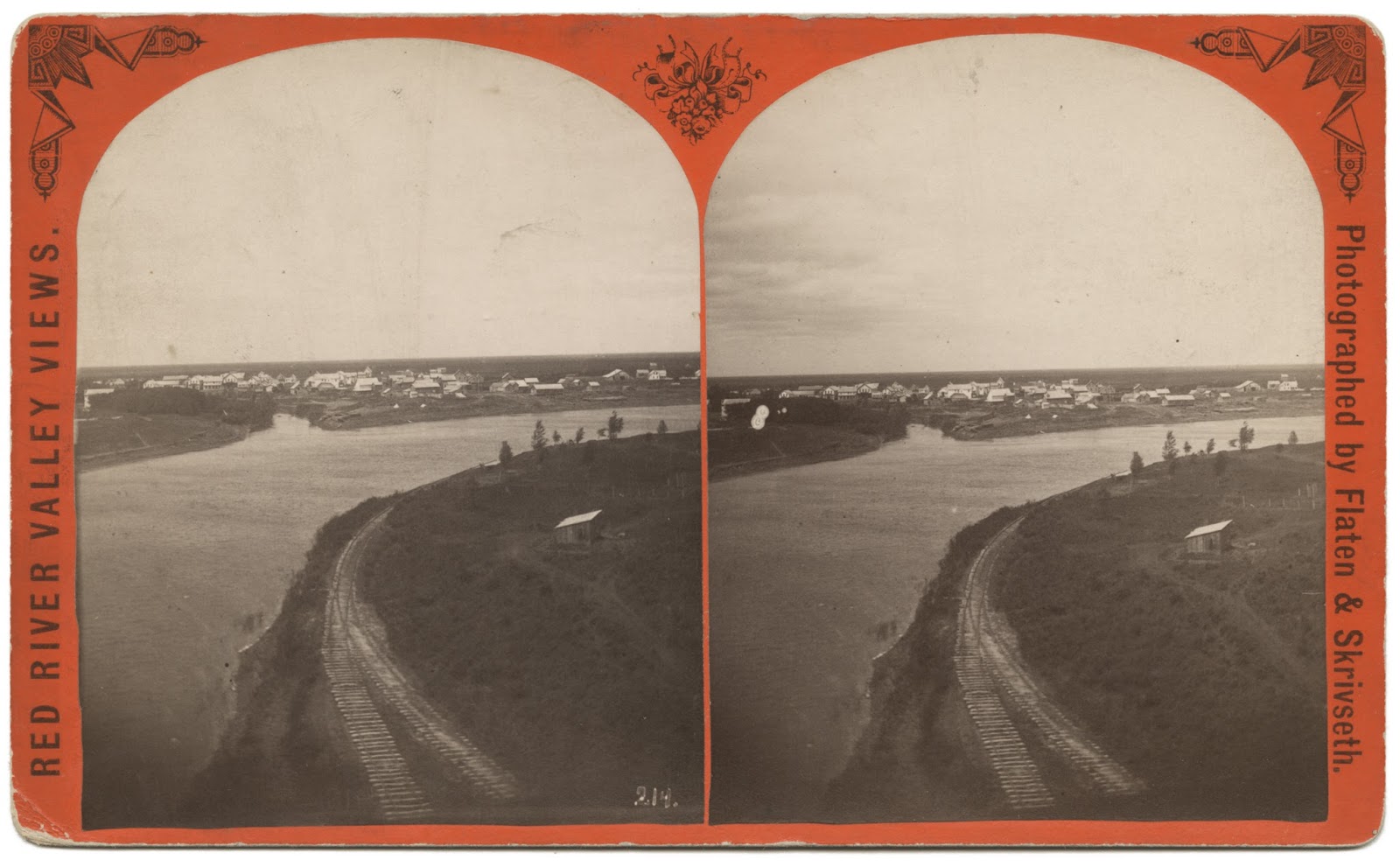 PHOTO INFO: A stereoview showing the railroad track along the eastern bank of the Red River in St. Vincent. This track is the continuation of the one coming in from the east into town from the "Y". This was laid down early on in anticipation of the main line going through town and over the river, but a rail bridge was never built.
Swan Anderson would get fan mail from people far and wide that had once lived in St. Vincent and the surrounding area, generated from his newspaper columns for the Enterprise, and even from his toll-free phone number into his home. Swan kept sharing history even when he was in the nursing home. And thank goodness he did.
Speaking of fan mail, let me share with you a letter Swan received from the LeMasuriers of Ontario, California; as many reading this may remember, the LeMasurier family lived in St. Vincent at one time. This letter shares some more history about St. Vincent and the railroads. Please note that the story told in the letter is second-hand, being told to the LeMasurier family by George (aka "Shorty") and Bessie Cowan. That does not make it any less true, but I wanted to be sure everyone knows the chain of how the story came to us.
Read on...
Before the turn of the century and when the railroad from Winnipeg east wasn't finished, St. Vincent was a booming railroad town. The round house was out by Lake Stella and had a turntable to turn the engines around. The long depot in St. Vincent housed the Customs and Immigration offices. There was also a Signal House. In 1901 William LeMasurier bought it and moved it to his farm north of St. Vincent. He and his bride, the former Maggie Easter, started housekeeping there in 1902. The land north of St. Vincent and west of the Emerson road was all railroad land. Phillip LeMasurier bought some and later sold it to his sons, William and Arthur. John and George Cowan bought some, also Mose Parenteau and Austin Griffith. The railroad reserved a right-of-way along the top of the river bank. Bessie Cowan told me at one time the railroad had planned to build a bridge across the Red River on Shorty's land.
The Great Northern Hotel was a three-story building with a ballroom on the third floor. Bessie Cowan gave us a picture of it and we left it with the Pembina Museum when we left St. Vincent. When the hotel was torn down, the attached section that was the kitchen was bought by the Russells and made into their home. Later, Harold Easton bought it and finally Milton Gregoire bought it and tore it down, and built what is now known as the Nellie Blair house.
The land that the railroad bridge would have crossed into/from is located on this plat map in the northwest corner of Section 35, labeled George Cowan . . .
There was a strip of land from the Red River to the Emerson road, 137 acres in the Village of St. Vincent on its north side. Austin Griffith bought the 36 acres next to the Emerson road and Charlie LeMasurier bought the rest from Peter Monro. Harris remembers when Charlie had a lot cleared along the river. The man doing the work used oxen. Mrs. Morrow, who lived in St. Vincent, used to pick roots and would give Harris fifty cents to haul a load to town for her.

Friday, April 27, 2018
The Litchfield Brothers - "...Minnesota beckoned them in 1862"
 |
| Electus Backus Litchield "Flagrantly & monumentally impudent" |
In the course of his various "business enterprises", E.B. Litchfield is said to have bought many an elected official. Except for one: Populist Congressman Ignatius Donnelly of Minnesota. While Donnelly worked for all the railroads in Minnesota at one time or another, he refused to continue working for E.B. Litchfield and the First Division St.P&P RR.
While lobbying Congress to expand the St.P&P RR land grant to 10 sections (square miles) per mile of track built, E.B. needed the help of members of Congress. Railroads would sometimes hire sitting members of Congress (and other elected officials) to serve as their "legal counsel".
In 1868, Donnelly wrote to E.B. regarding his $1,000 "retainer" and position as legal counsel to the First Division: "The matter has given me no little uneasiness of conscience. I have been laboring under the fear and dread I might instinctively be willing to do more for your company as attorney than I would if I did not hold that relation to it." Donnelly even offered to return the $1,000 or perform some actual legal services for the money.
- Source: Ignatius Donnelly: Portrait of a Politician by Martin Ridge
Electus was just one of five Litchfield brothers, all involved in one way or another with the railroad business. Their main involvement: Investment.
Edwin Clark Litchfield was put in charge of the First Division. He agreed to finance the branch line from St. Paul to St. Cloud. To the Associates1, he was a greatly vexed investor, "a wary old bird". The Associates had trusted allies in Horace Thompson and Edmund Rice, who promised to "leave no stone unturned to bring about a reconciliation" between the contending parties. If they failed, the Associates had contingency plans "to handle, with or without gloves on," Litchfield, Becker, Farley, and anyone else who got in the way. They had not come this far only to lose the much-coveted land grant from St. Paul to the Canadian Border.
 |
| Source: Google Books |
1867 was the year the British North America Act granted Canadians their political independence. "Knowing that newly independent Canadians would soon embark on their own transcontinental railroad schemes, SP&P directors held a special stockholders meeting to map out ways to pull northern wheat-growing riches down a proposed Canadian Pacific Railroad (CPR) branch line from Winnipeg to the international border, through St. Vincent, and then down into St. Paul. On the strength of this scheme, the state legislature gladly renegotiated the land grants, rescheduling their completion for 1878."
The plan was for SP&P to construct a northern extension, connecting first with the NPR main line near Fargo, then with the proposed CPR branch line at St. Vincent.
 |
| Elisha Cleveland Litchfield One of the brothers who swooped in, bought up several railroads, and sold them for profit as fast as possible. . . |
Egbert Savage Litchfield (youngest brother) - Sent to St. Paul at one point to oversee and manage the brothers' investments in the railroad. In 1868, Egbert became James J. Hill's early partner. Soon, Hill began emerging as a businessman in his own right.
"The Litchfields' capital propped up the railroad's coffers and accelerated construction into the the state's already populated agricultural regions," and towards the Red River Valley (which the state legislature had recently approved a special act securing $3 million in bonds for railway construction projects...)
Trivia: NP used contractors to build the St. Vincent Extension.
To break it down to its simplest terms, the Litchfield brothers simply "went where the money was". [See the Brooklyn Historic Railway Association's incredible article about the slippery Litchfield Brothers, and their particular involvement with the building of the railroad that eventually included the St. Vincent Extension...]
Question: Where did all the money the Litchfields stole from Brooklyn go?
Answer: To an attempt to take over the lands and railroads of the northwestern United States (Minnesota) via federal railroad land grants and other financial tools, and then mortgage this wilderness property to unwary European investors (the Dutch) at vastly inflated sums.
No doubt E. B. Litchfield used his brother E. Darwin Litchfield, then a London banker, to launder the money hijacked from Brooklyn to acquire all the stock of the St. Paul & Pacific Railroad First Division, their new land and railroad speculation entity in Minnesota, which already owned 307,200 acres (480 square miles) of federal land grants. The Brooklyn loot was likely used as seed money to construct more track in Minnesota, thereby leveraging more massive federal land grants, which in turn enabled E. B. Litchfield to issue more St. Paul & Pacific securities in Holland with these land grants used as collateral.
Trivia: The construction of the St. Vincent extension was promptly put under contract, and large quantities of rails and fastenings for track were imported from England. These were of iron, weighing 30 pounds per linear yard, and went from Buffalo to Duluth by lake. Their cost at the latter point was reckoned at about 90 per ton. Construction proceeded with vigor, and, for the methods of those times, with rapidity, until shortly after the financial collapse in 1873. [Source: Minnesota Historical Society, James J. Hill Papers "The Great Northern Railway System"]
1 - The Associates were George Stephen, Donald Smith, James J. Hill, Norman Kittson, and E.S. Litchfield. Hill enlisted the support of Donald Smith and his equally wealthy cousin, George Stephen, of the Bank of Montreal, in getting control of the steamboat business on the Red River, the route to Winnipeg. Their syndicate, “George Stephens and Associates,” comprised Stephen and Smith, as the financiers, Norman Kittson, The Hudson’s Bay Company’s Minnesota agent, operating the steamboat line, and Hill, their St Paul freight forwarder. Once in control of steam navigation on the Red River, the Associates then went after the bankrupt St. Paul and Pacific Railroad which they intended to complete to the Red River and a connection with Kittson’s steamboats.
- From: STEEP AND CROOKED: THE MINING RAILROADS OF THE CANADIAN BORDER, by Bill Laux
Friday, August 08, 2014
News from the Past V: Brown & Moorhead
 |
| Pembina Pioneer Express masthead [Courtesy: Pembina County Historical Society] |
Northern Express – Drayton (R.H. Young, Editor; Weekly, published on Fridays - $2 per year)
December 9, 1881 Vol. 1 No. 1 is the first issue
(Becomes the Pioneer Express April 20, 1883 at Vol. 3 No. 38)
____________________
December 23, 1881 Vol. 1 No. 3
The train loaded with some $2,000 worth of goods which Ricard Bros. sent out from here the 7th to Turtle Mountains was captured by Indians and half-breeds at or near Pembina mountains. The Indians claim the land as their own, and say that no one has the right to cross it, and therefore appropriated the goods to their own use. Sheriff Brown of Pembina was out there yesterday and found most of the goods, but could not get them as they refused to give them up. They were too many for him, so he returned for help. We understand he has gone out today with a squad of soldiers from Fort Pembina. We will give full particulars tomorrow. – Independent (Emerson, Manitoba)
February 10, 1882 Vol. 1 No. 10
Announcement – We announce this week our intention to remove the Northern Express to Pembina, at which place the next issue will be published. (page 1)
February 24, 1882 Vol. 1 No. 12
Amongst many drawbacks and inconveniences incidental to the removal of our business and the enlargement of our paper we lay before our readers this week as good a paper as we can under the circumstances.
March 24, 1882 Vol. 1 No. 16
Townsite Auction Bill

[Indian Title to Dakota Lands – page 1]
The St. Vincent townsite company have sold their interest in that town to a Winnipeg syndicate. St. Vincent has invested $200 in a hook and ladder truck with other fire apparatus. This is a wise move which should be a reminder to this town of its duty in the promises. Of course when Pembina takes hold it will be on a larger scale.
March 31, 1882 Vol. 1 No. 17
Quite a number of our citizens went over to St. Vincent on Tuesday evening to attend the auction sale of town lots.
April 21, 1882 Vol 1. No. 20
The unmistakable double-toned whistle of the steamer Selkirk was heard on Tuesday evening for the first time this season. Passengers from various points on the river improved the opportunity of making a business trip to Town and taking in interesting features of the flood along the way.
The Selkirk has had a lively business the last two days carrying freight across from St. Vincent.
The ice made a new door into the engine room of the St.Vincent elevator last Sunday. At St. Vincent the situation is becoming somewhat unpleasant. Several of the streets are covered with water. Around the Northern Hotel it is nearly a foot deep, but the higher portion of town is dry yet.

April 28, 1882 Vol. 1 No. 21
Moorhead has had several bets at stake including a town lot and a suit of clothes, that the water would not rise to the level of his saloon floor. He has won the bets with just a quarter of an inch to spare.
Now we know how William Moorhead got his nickname, “High Water Bill”...!
Wednesday, October 09, 2013
St. Vincent Business Listing, 1879
 |
| Despite the seeming title discrepancy, this is the same, correct gazetteer... |
ST. VINCENT [From Minnesota, North and South Dakota and Montana gazetteer and business directory (1879)]
This growing town of 500 inhabitants is the state terminus of the St. Paul, Minneapolis, and Manitoba Railway, and also of the St. Vincent branch of the Canadian Pacific Railway. It is situated in the extreme northwestern point of Kittson county and of the State alike. The Red River of the North, is 390 miles from St. Paul, and the seat of the county of Kittson. A regular line of steamers make daily trips on the Red river from St. Vincent to Winnipeg, Manitoba, carrying passengers and freight and making connection with the arrival and departure of trains. St. Vincent has a steam elevator of 90,000 bushels capacity, a bank, a brewery, a brickyard, a hotel, a newspaper named the Herald, three general stores and a district school, while a church is being erected...Daily mail over the St. P., M. & M. and Canadian Pacific railways. D. F. Brawley, postmaster.
BUSINESS DIRECTORY
Brawley D F, brickmaker.
 |
| John A. Vanstrum First Sheriff of Kittson County |
Flynn & O'Keefe, General Store.
Gooding C J, railroad agent.
Head Felix G, justice of the peace.
Head Felix G, Publisher St Vincent Herald.
Lowery Robert W, general store.
Nobles L, express agent.
O'Keefe Wm M, register of deeds.
Provouchoe John, saloon.
Raywood George & Co, St Vincent Brewery1.
Red Wing Mill Co, grain elevator.
Rich J H, cashier St. Vincent Bank and manager, Elevator Co.
St Vincent Bank, J H Rich cashier.
Shepard J W, lumber and building material.
Stewart John W, proprietor Pacific Hotel.
Vanstrum John A, Sheriff Kittson County.
Vanstrum John A, real estate agent.
Winter J B, general store.
__________________________________
1 - Later, George Raywood and Charles Thorson opened the North Arm Brewery in South Vancouver; after that, in 1900, George built the Cedar Cottage Brewery on Gibson Creek in Southeast Vancouver.
Friday, October 28, 2011
St. Vincent Over the Years: Demographics
 |
| St. Vincent 1900 Census - William Ash, Enumerator [Click to enlarge] |
Census Population Counts:
1880 - 489
1890 - 507
1900 - 256
1910 - 328
1920 - 343
1930 - 304
1940 - 327
1950 - 272
1960 - 217
1970 - 177
1980 - 141
1990 - 116
I don't remember where I ran across the census figures for St. Vincent through the years, but since then I have often wondered why the dramatic decrease in population from 1890 to 1900, compared to other fluctuations up or down? It definitely wasn't because of crop failures; according to this source record from the time, things were going well in that department:
Having heard that crops were poor outside the Red River valley and that many would leave as soon as threshing was over, 1 walked and drove through Pembina, Walsh, Cavalier and Towner counties, North Dakota, and Kittson county, Minnesota, but found that generally the farmers in that vicinity were not suffering, and that their yield was so much better for 1890 than in preceding years that most of them would remain. - From Sessional Papers of the Parliament of the Dominion of Canada, Vol. 4.After that, there are changes both up and down fairly steady for a half century, then when 1960 hits, the steady decline began.
According to Rural Depopulation, the region in which St. Vincent is located - the Great Plains - has been experiencing depopulation "...more prevalent and more severe" than in any other region in the United States. In fact, the Great Plains is "...home to 304 of the country's 662 depopulating rural counties." On top of that, "...populations in rural counties in the Great Plains are significantly smaller than populations in...other depopulating regions, and the population density (people per square mile) is substantially less." That last statistic is the most disheartening, because low population makes viability of more and more small communities impossible.
Whatever the cause, the Great Plains of which we are a part, has been at a crossroads for a long time. People living here recognized this, and have been working hard to find new ways to keep their communities alive and healthy. Are we headed towards becoming the American Outback? Only time will tell...
Wednesday, March 23, 2011
St. Vincent for Sale
 |
| From Daily globe (St. Paul, Minn.) April 16, 1882 Source: Library of Congress' Chronicling America |
From: Manitoba Historical Society“Gentlemen, I can’t go away from St. Pauland believe that you are all paupers. Twenty dollars for such a lot as that, two blocks from the shop reserves, and a corner lot, too; just the place for starting a saloon! Do I hear thirty? Going at thirty. Do I hear thirty-five? Remember, this sale is without reserve. Hitch on while the boom is on, and you will be wearing seal-skins and diamonds next year. Thirty dollars! Thirty dollars! Thirty dollars! Five do you say? Just in time; why I met a young man on the train the other day, and he showed me his bank book with a credit of $18,000, and he said he had $45,000 worth of real estate. He came to Winnipeg in a cattle car, and was returning in a Pullman. Made a little stake shingling roofs, caught on and there you are. Gentlemen, this double row of lots clear outside the town was bought by Winnipeggers yesterday at $250 per lot (whereupon he proceeded to sell a block in St. Vincent’s centre at prices ranging for $33 to $56 per lot). Hitch on to the boom boys, while she is moving. Telegraph to Sheppard, the town clerk in St. Vincent, or any one else there, and if he don’t say lots such as I am offering you are selling to-day at from $250 to $300, I'll open the wine for the house, provided there’s enough wine in town to fill such a thirsty crowd. Now pick your block; I’ll sell in any one of them not already purchased.”
James Sarsfield Coolican,
Auctioneer of St. Vincent

Saturday, March 12, 2011

Thursday, March 03, 2011
Pembina vs. Fargo
Competition for political and economic power between the emerging territorial cities was common in the early days, even between Pembina and Fargo...
The first active politics, in the way of a spirited clashing of interests, occurred in 1872, when old Pembina and youthful Fargo locked horns, as it were, in a contest for supremacy. A term of the United States court was held at Pembina in June, presided over by Judge French1, and in order to secure the necessary jurymen almost the entire northern part of the territory was thoroughly combed. After exhausting the Pembina and St. Joe settlements, drafts were made at Grand Forks, Goose River, Elm River, Fargo, and Richville. Every available man was utilized for the grand and petit panels, and the work of subpoenaing them was no small task.
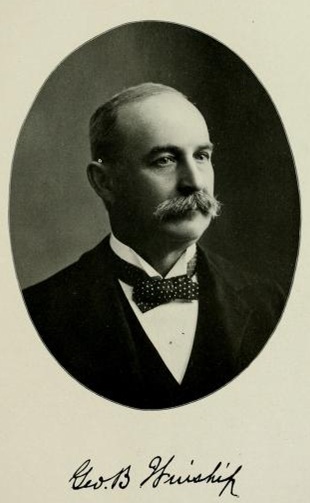
Jud LaMoure was deputy United States Marshal, and upon him devolved the selection and notification of the jurors. During this process, when LaMoure visited every settlement in the northern section, it developed that the deputy marshal had something else on his program besides the business of subpoenaing jurors. The first to scent the alleged "darkey in the wood pile" was the coterie of live-wires at Fargo, led by S. G. Roberts, G. I. Keeney, John Haggart, Captain Egbert, and others.
Sunday, November 28, 2010
County Seat Battle
 |
| Old Kittson County Courthouse - I must say, it has a lot more style than the current courthouse building...too bad it couldn't have been saved. Architecturally it was described as "...a three-story brick building above a high battered-stone basement with Romanesque tower; unusual half-timbered attic story gables; large chimneys on each side above medieval corbelled cornice brick." It was once described as "...one of the finest county capitols in the northern half of Minnesota." First 100 Years of Minnesota Bar Association |
Kittson County was organized February 25, 1879. The first county commissioners, who were appointed by Governor Pillsbury, designated Hallock as the temporary county seat. However, in 1891, a group of citizens from St. Vincent, circulated a petition to move the county seat to St. Vincent, with a promise to build an $8,000 courthouse. The petition was dismissed by the county commissioners because of the "unauthorization of the circulation of the petition" and that they had no jurisdiction for this matter.
From the NWRDC's History of Kittson County
But the whole story is a bit more interesting than that...
Monday, June 21, 2010
CentrePort Revisited
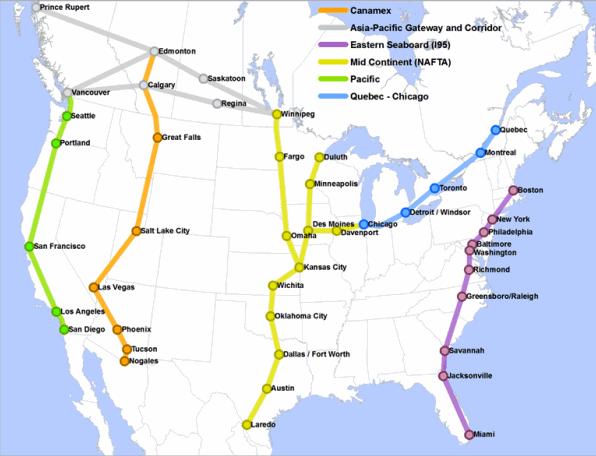
...milestones include the start of the first stage of development for the four-lane divided expressway known as CentrePort Canada Way and upgrades to Highway 75. These improvements will provide better, more efficient highway access to CentrePort Canada and nearby assets including Winnipeg’s James Armstrong Richardson International Airport and the Canadian Pacific Weston Rail intermodal facility, and ensure that trade moves more effectively across Canada and into the Asia Pacific Gateway, as well as south through the Emerson border crossing, and into the United States and Mexico.
Monday, May 03, 2010
Interapolis: City That Never Was

That post drew responses that revealed to me that there was a proposed 'twin' to Huron City, a town that never was, called Interapolis...
Map from View from Inside the Portcullis: A History of Emerson Customs and General Area, by Elmer McClelland (1992)
A. W. Stiles, connected with the U. S. Land Office in Washington, D.C., walked up the street to take in Hallock the other day while the train stopped. Mr. Stiles is one of the pioneers of this country. He ran the first sutler store at Fort Pembina, establishing it in 1871, the year the fort was built. He also started the townsite of Interapolis, located between St. Vincent and Emerson, in this county, but which never amounted to much. [From Kittson County Enterprise, July 1894]Since receiving a copy of the above-referenced book recently from Elmer McClelland (cousin of James McClelland, friend of this blog), I have since come to find out that the term I had coined for the town was already coined by him, i.e., the 'city that never was'...great minds think alike, I guess! Anyways, Elmer's piece from the book has this to say about Interapolis:
This town or city site was actually planned, with certain streets and avenues named. It was to have been on the east side of the Red River immediately south of the International Boundary - south of Emerson, Manitoba and due west of Noyes, Minnesota. Its name was listed as "Interapolis". To pinpoint exactly its mythical location, glance off to the south as you leave Emerson on Highway 75 and proceed westerly towards the Highway 75 bridge. The town or city that never materialized would have been about 200 yards to the south - at least, its most northwesterly corner would have appeared there, if all had gone as planned. This writer gained photocopies of the planned city from the Hallock, Minnesota deeds office. These copies show that Mr. & Mrs. Albert Stiles filed the plan on September 9, 1882. The office land description is as follows: North half of the South East Section 26 - Township 164, Range 51, in St. Vincent Township of Kittson County, Minnesota, U.S.A.I can attest to that last statement. When I was growing up, I had horses as a teenager. At that time, Harvey Le Mesurier's old place was being lived in by Reuben and Gloria Ohmann and their family, and I was best friends with their daughter Kathy. The place was north of my parents, who lived in one of the most northern points of St. Vincent, by about a mile. Right north of the Ohmanns was where Interapolis would have been. Kathy and I used to ride our horses there quite often, and I always noticed it was a very isolated area, peaceful, with one of the only true hills around, believe it or not, quite a dip for our flat-as-a-pancake area, which was fun to run up and down on at a canter!
Mr. Stiles had arrived in the area to become sutler at Fort Pembina and probably envisioned great possibilities for his new city. The plan covered 62 blocks and the streets and avenues were named: International Avenue, Stiles Avenue, Manitoba Avenue, Missouri Avenue, Irvine Avenue, Pennsylvania Avenue, River Street, Wilson Street, West Lynne Street, and First to Fifth Streets. There was also a proposed ferry and steamboat landing site on the Red River.
Alas, not a building was ever to grace this proposed town. The plan remains in the Hallock deeds office and the land is used as prime agricultural land at this writing.
Wednesday, December 30, 2009
Brain Drain
This is what has been happening to my hometown and all such hometowns for many years now. As the video says at the end, it does NOT have to be this way, and those with the most at stake, the residents of these towns, have GOT to wake up and take back responsibility and action for what's going on...
Friday, June 12, 2009
CentrePort Canada
 It's coming, and it has serious regional economic implications even to smaller communities like Pembina/Emerson/St. Vincent...
CentrePort Canada will be an inland port, a gateway "... centrally and strategically located at the heart of North America to connect businesses to world markets." It's part of an ambitious, overall strategy linking the northern Hemisphere for economic gain via the Arctic Bridge. In turn, it connects to the United States/Mexico corridor via Highway 75 through Emerson/Pembina, "...one of the busiest border crossings in Western Canada, which handles approximately three-quarters of Manitoba's trucking exports to the two other NAFTA countries."

Subscribe to:
Posts (Atom)