Showing posts with label humor. Show all posts

Wednesday, January 27, 2016

"Teddy" the Bear

"I remember the bear quite well - it was the talk of the town [Humboldt], it used to ride in the car with them. My dad told me of one time when they were going somewhere in the car, it got its collar hung up on the turning signal lever and almost ripped it off...
- Donald Reese
"Teddy" the bear...
He called her his "playmate".

Bob Bockwitz - whose family had the famous Humboldt bear - shares:
"The bear was one of three orphaned cubs that were adopted by individuals. (Things were a little different in those days) The two people in the picture are my dad Virgil, and my brother Rodney. When dad brought Teddy home (yes, for want of a better name, we called her Teddy) she was about the size of a football and snuggled into his jacket. She was bottle raised, and lived in the house until, as she got pretty good sized, my mother said 'OUT!' In most respects she was similar to having a dog. She rode with Dad in the pickup, and loved attention. She grew to be quite an attraction in the area and was a regular at meetings of what in those days was known as the 'Conservation Club'. She was still fairly young when this picture was taken, and did get considerably larger than shown here. There are so many stories that it would be impossible to tell them all. Some are hilarious. The question was asked what happened to her. That is best left unanswered. I will say that in a manner of speaking, she is still with us. It really amazing that her picture sparked so much interest."
Virgil Bockwitz (his son Rodney behind him...) with "Teddy"

Bob also shared:
"Only once did she ever get out of her cage and go 'visiting'. It's not known where her adventure took her, but it is known where she decided that she was tired and wanted to go to sleep. It happened to be about 5:00 in the morning when she found herself outside a trailer house inhabited by an unnamed individual who had probably returned home shortly before and was apparently sound asleep when the bear joined him on the bed. It's not know how long she was there before the gentleman woke up, but what IS known is that at some point they both realized something was not right. The gentleman ended up in the yard and the bear was headed for the safety of home. I'm sure that only those who are my age or older would have any recollection of that "adventure", but it's the type of story that can't be made up. What has been really interesting over the years, is hearing the various renditions of this story, as told by old-timers."

Friday, August 02, 2013

Guest Post: Gopher v. Man

I'm pretty sure you can trace the historic failings of the University of Minnesota sports teams to their choice of name:  Gophers.  In Minnesota lingo, at some point the teams started being called the "Goofers".  I think the football team last won the Big 10 championship and got to go to the Rose Bowl in about 1963, and I'm pretty sure they lost.  Basketball, baseball, wrestling, swimming, soccer -- quick, name me one national title the U of M teams have won in the last fifty or sixty years, even when they had Dave Winfield on both the basketball team and the football team ... .  
I thought so.
I'm pretty sure the Goofers could win a Foosball championship if the NCAA sanctioned it.  Those long winter nights, indoor activities fueled by camaraderie and beer, have definitely produced some bad-ass Foosball players.  Hit me with your best shot.
Gophers are not really vermin, but they are pests. They don't spread disease to humans, but they still wreak havoc.  They build these complex subterranean family homes, and spread the dirt in piles all over fields, gardens, and lawns.  They're kinda small, have nubby little tails, front feet with nails on the paws for scratching and digging, and goofy little curved yellow teeth that curl out of their lips -- also, I guess, for digging holes and tunnels and tearing up roots and destroying gardens.  One of their admirable qualities is industriousness, which is why they are also a bane.
Cute?  Do not be fooled!
Here is a picture of a gopher, in case you've never seen one up close. Notice the whiskers, the little beady eyes, the small pinned-back ears, and the yellow teeth.  Ugh.  Somebody ought to teach this guy some dental hygiene.  I've seen meth addicts with better teeth than that.

My dad hated Gophers.  Not as much as he hated Dick Cheney, but still, when he was creating his picture of the perfect hell for Dick Cheney I'm pretty sure there were gophers in there to torment the guy.

Sunday, March 17, 2013

Mystery Woman

These two photos were taken in the same general area of St. Vincent, around the same general time period (early 1900s). There appears to be one or more areas used for pasture and/or gardening/orchards in the central part of town just off of the main road. In both photographs, you can see the St. Vincent School in the background. The photo below features my grandmother and great grandmother (both Fitzpatrick). The photo above is a mystery on who it is. I have scanned it large, so if you want to try identifying the woman, click on it to see it full-screen. I'd appreciate any assistance you can give on who she is - even guesses are welcome!

NOTE: A working theory I have about these is, they may have been taken on the same day, by the same person. They both feature women working, and both feature a bit of humour. The mystery woman looks like she was trying to say don't take my picture by leaning back with her hand in front. Regarding the broom - one thing they sometimes used old, worn-down brooms like this one appears to be, was to use outdoors for things like brushing dirt off shoes and boots. Maybe she was trying to do that when the paparazzi caught her!

Sunday, February 24, 2013

Past Resident Memories: John Stranger

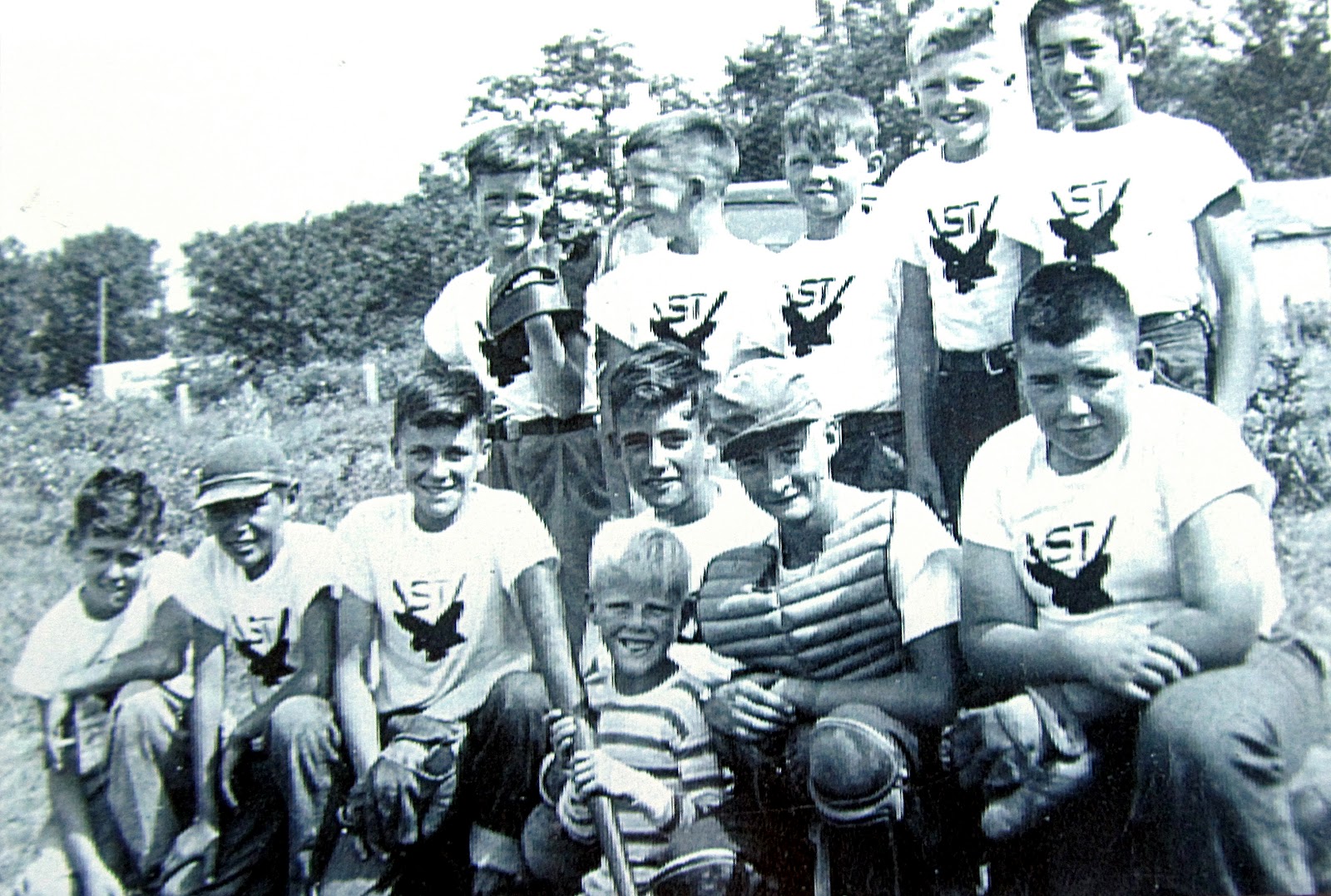
John Stranger - Back row, middle


A MEMOIR OF A LIFE, FOR BETTER OR WORSE
By John A. Stranger

CHAPTER ONE
Beginnings

This all begins in a small town in Minnesota during the 40's when growing up was a struggle without all the things a boy wants and dreams about. Outdoor toilets and dressing behind the oil burner turned up full blast where my brother (4 yrs. Younger) and I learned to dress very fast during the cold Minnesota winters.

My brother was a great kid even though we would have our brotherly confrontations. We had a younger sister too and she learned to hold her own with us boys. Our parents were very strict on almost everything that they thought was for our best interests even though we tried to disagree with our parents at times but trying to obey seemed better than a beating, (most we probably had coming).

Saturday, April 21, 2012

An Arduous Journey


I've been reading this book about Enos Stutsman titled Attorney for the Frontier. Ever since I came across "Stuts", as his contemporary friends called him, I've been fascinated by the man.  To my knowledge,  Attorney for the Frontier is the only book ever written about him, and it includes an entire chapter about his time in Pembina, his last home base.

Below is a letter he wrote to his supervisors.  As a past federal government employee myself, I am well-acquainted with the paperwork involved whenever you go away from the office.  Reports must be filed!  Read below on what this particular early government employee went through just to get from Point A to Point B; you'll note he has a pretty wry sense of humor, which I guess you had to have when encountering such difficulties.  All in all, if you take the time, you'll discover it's quite illuminating, and an enjoyable read...

Thursday, June 09, 2011

Tall Tale


The story featured in the article at left, found in a newspaper archive from the early 20th century, sounds like a tall tale if I ever heard one. I think some bored journalist from the east coast picked the most obscure town out west he could locate on a map and decided to spin a story to tickle his readers' fancies.

At any rate, it provides a good chuckle.1 Like the math text book that used St. Vincent in a word problem, it's fun to see my hometown mentioned in such ways.

Now if anyone reading this can provide proof otherwise, that I would love to hear about!

1 - I think that humor was the point of the article - a pull of the leg, a poke in the ribs, a twinkle of any eye...

Thursday, March 03, 2011

Pembina vs. Fargo

Competition for political and economic power between the emerging territorial cities was common in the early days, even between Pembina and Fargo...
The first active politics, in the way of a spirited clashing of interests, occurred in 1872, when old Pembina and youthful Fargo locked horns, as it were, in a contest for supremacy. A term of the United States court was held at Pembina in June, presided over by Judge French1, and in order to secure the necessary jurymen almost the entire northern part of the territory was thoroughly combed. After exhausting the Pembina and St. Joe settlements, drafts were made at Grand Forks, Goose River, Elm River, Fargo, and Richville. Every available man was utilized for the grand and petit panels, and the work of subpoenaing them was no small task. 
Jud LaMoure was deputy United States Marshal, and upon him devolved the selection and notification of the jurors. During this process, when LaMoure visited every settlement in the northern section, it developed that the deputy marshal had something else on his program besides the business of subpoenaing jurors. The first to scent the alleged "darkey in the wood pile" was the coterie of live-wires at Fargo, led by S. G. Roberts, G. I. Keeney, John Haggart, Captain Egbert, and others. 

Tuesday, February 22, 2011

Sibling Rivalry

From W.P. Davies Newspaper Columns,
 Chester Fritz Library Digital Collections.
I don't know if the story above is talking about this July 4th, or another one during the time period both towns had Independence Day celebrations.  But I was amused to find this recount of a 'friendly competition' between St. Vincent and Pembina in their youth.

Thursday, September 16, 2010

Oh, Canada!

There are many humorous stories circulating online, but only a few that I find truly amusing. I received such a one this morning from my friend James McClelland from Emerson, Manitoba, entitled "Oh, Canada!"

While humor is not the normal domain of this blog, I am making an exception in this case and sharing some of the piece with you since it's geographically-related and specific. Anyone from my hometown area, or further north, will appreciate it, and those that are not, will learn a thing or two...

TOP REASONS TO LIVE IN MANITOBA

1. You wake up one morning to find that you suddenly have a beachfront property.
2. Hundreds of huge, horribly frigid lakes.
3. Nothing compares to a wicked Winnipeg winter.
4. You can be an Easterner or a Westerner depending on your mood.
5. You can pass the time watching trucks and barns float by.

The Official Canadian Temperature Conversion Chart

50° Fahrenheit (10° C)
• Californians shiver uncontrollably.
• Canadians plant gardens.

35° Fahrenheit (1.6° C)
• Italian Cars won't start
• Canadians drive with the windows down

32° Fahrenheit (0° C)
• American water freezes
• Canadian water gets thicker.

0° Fahrenheit (-17.9° C)
• New York City landlords finally turn on the heat.
• Canadians have the last cookout of the season.

-60° Fahrenheit (-51° C)
• Santa Claus abandons the North Pole.
• Canadian Girl Guides sell cookies door-to-door.

-109.9° Fahrenheit (-78.5° C)
• Carbon dioxide freezes makes dry ice.
• Canadians pull down their earflaps.

-173° Fahrenheit (-114° C)
• Ethyl alcohol freezes.
• Canadians get frustrated when they can't thaw the keg

-459.67° Fahrenheit (-273.15° C)
• Absolute zero; all atomic motion stops.
• Canadians start saying "cold, eh?"

-500° Fahrenheit (-295° C)
• Hell freezes over.
• The Ottawa Senators win the Stanley Cup

Sunday, September 05, 2010

YouTube Local History: Pembina Depot

The video above was brought to my attention by Bill Ash the other day. In the interim, Bill found out from Clarence Bingham the scoop on the last few seconds of the film showing a depot, which turned out to be the old Pembina Depot, in its glory days!

Clarence also had this to say about Olaf Hanson, whose family (including Olaf) are shown earlier in the film:
Olaf Hanson was a Customs Inspector at Pembina during the 1950s. The depot in the video is the old Great Northern depot in Pembina. Olaf had a penchant for getting in trouble with the passengers he inspected by trying to joke with them. Unfortunately, travelers were not in a joking mood when crossing the border. To make matters worse the Collector of Customs office was just a couple of miles down the road in Pembina, so they would stop and complain. My desk in the headquarters office was close to the Collector's , so I could not help but hear some of those tirades. One day Olaf inspected a young man and woman at the Pembina Border station. He ascertained they were not married while establishing their citizenship, then when he was inspecting their car/suitcase, he jokingly inquired if it was appropriate that their underwear was comingled in the suitcase. They did not appreciate his attempt at humor and stopped at the Headquarters to lodge a complaint. The Collector - John O'Keefe - subsequently had Olaf in and threatened to transfer him to Hannah, N.D., where he would not encounter so many travelers. I don't recall if the transfer was in fact ever carried out.

When we lived in Pembina the GN depot was repainted. The B&B crew came to town - about 1958/59 - and in a few days painted the depot and associated buildings that God awful brownish/mustard yellow color the GN used in those days. A year or two later the section crew chief in Pembina repainted his house and by some mysterious circumstance the color was the same as the depot.
Bill Ash has this to share about Clarence:
Clarence "Bing" Bingham is a first cousin of my mother...He grew up in Wisconsin but got a job at the Railway Express office in Noyes, MN in the early 50's and soon after took a position with US Customs at Pembina and Noyes. He is retired now and is living in the state of Oregon.

Saturday, August 21, 2010

July 4th Parade

July 4, 1890 Parade down main street in Pembina, ND (courtesy of State Archives of North Dakota collection)
I have written about the Pembina July 4th celebrations of old here before. But I never knew St. Vincent also at one time had its own Independence Day festivities.1

Below is a recounting of the 4th of July celebrations in St. Vincent in 1909, as recounted by one J. A. Noyes2, Deputy Collector of Customs, for the St. Vincent New Era...
Where the parade began...
The Parade
(Kindly reported by Deputy Collector Noyes)

The Fourth of July parade as a part of St. Vincent's big celebration was a pronounced success. It was composed of various beautiful floats, several bands of calithumpians3, a number of beautifully decorated carriages and exhibits of farm machinery.

The procession formed at the school house and was led by Mr. President of the day W.J. Mason accompanied by Hon. Mr. Blethen, the Orator. These were followed by the Pembina band which dispensed patriotic music during the entire parade.


The Goddess of Liberty appeared next in the person of Miss Laura Billes being drawn by her Shetland pony hitched to the pony trap. This feature deserves special notice, as the pony harness, trap and the Goddess were all draped in white, the emblem of purity and presented a beautiful appearance.

The Columbia float came next. This contained Columbia, represented by Miss Margurette Cowan, who was surrounded by forty-nine young ladies and girls, dressed in white, each carrying a flag representing the states and territories. The flat was draped in white and drawn by four white horses, driven by Mr. A. Darrach.

Yes, this is a photo of the actual St. Vincent
Bank; written on the windows are the words,
"Farm Loans, Insurance, Real Estate..."

- Photo courtesy of the Gamble Family
Immediately following this came the float of the St. Vincent Bank, this consisted of a raised platform on a wagon beautifully draped with the colors of the day, carrying fifteen little girls dressed in white and laden with wreaths of wild roses; this was one of the beauty spots of the parade.

One feature of the calithumpians that attracted a great deal of attention was a dark complexioned couple, Frankie Buekly and Irvine Hanson, being drawn by a pony hitched to an outlandish low wheeled cart elaborately draped with wisps of hay and appropriate material. Frankie is deserving of much credit as we are informed the idea was his as well as the work of building and decorating the cart.

Mr.  was represented by Charles Kimberly, appearing in clown's costume, pushing a cart appropriately trimmed in green, and containing his little brother suitably dressed for the occasion.

Another pretty feature was six little boys, Harold Taylor, Jay Benuett, Sammy Lapp, Allen Gamble, Harvey Hanson, and Omen Dean, hitched to a finely decorated cart and driven by little Innis Taylor, followed by George Gillespie, Leo and Elmer Arnes, and Dicky Lapp as a body guard.

The colored band4 was another very laughable feature. This band consisting of Gordie Edkins, Dan and George Gooselaw and Roy Russell, under the able leadership of Percy Edkins will no doubt be heard from again.

Other featured of the celebration will be given next week.
Alas, I do not have access to the rest of the story; to my knowledge editions of the St. Vincent New Era for 1909 are not available, even on microfilm. But I'm thankful we could at least hear about this much; it opens a window into another time, a different way of life, and even some different ways of thinking (not all of them positive...) Thank you, Maggie!
___________________

1
- Recently, I attended the Gamble Family Reunion, where one of the family gave me a copy of the "Maggie Book". I had seen it once before a couple of years ago when I met this Gamble descendant, Alice Jablonski; Alice had the book with her and let me take a quick peek. I could tell even from a glance that it was a treasure trove of information, consisting of clippings, mainly newspapers such as early St. Vincent New Era articles, concerning stories about family members but also area events. During the reunion Alice handed me a manila envelope of various items she wanted me to have, including a high-quality photocopy (many pages in color) of the Maggie Book. I was thrilled! This post came as a result of one of those newsclippings.

2 - J. A. Noyes, the first Deputy Collector of Customs at the U. S./Canadian port of entry at Noyes, MN (named for him)

NOTE: The officers of the Custom House worked for the Collector of Customs. The Collector was assisted by the Deputy Collector, who was mainly responsible for the record keeping in the port.

3 - Calathumpian: Huge, spectacular event or performance. (Canadian archaic) Example: That was one calathumpian parade!

4 - "Colored Band", aka a marching band (often in black-face) performing minstrel type songs, now a relic of a time when racial stereotyping was acceptable entertainment.

Thursday, April 15, 2010

Journeying from St. Vincent to Winnipeg

A pretty amusing and sometimes outright laugh-out-loud account of the 'thrilling' journey by steamboat from St. Vincent to Winnipeg...

For sake of saving your eyes, I have transcribed some of the article in an excerpt below, but also have attached a scan of the original article...
If the English statesmen who have been recently eulogizing the agricultural resources of Canada before the discontented farmers of Great Britain had ever visited the British Provinces here, so as to enabled to draw their conclusions from actual observation instead of deriving their impressions from the perusal of the rose-colored pictures presented in the publications of Canadian land agents, which are now being extensively circulated in Europe to influence emigration to Canada, there might have been a good deal more wisdom in some of the agricultural speeches lately delivered in England. If the most loyal Englishman had the privilege of being dragged along the bottom of the Red River of the North in a flat-bottomed boat for upward of 100 miles through the British possessions, as I have been on my way to Winnipeg, the capital of the Province of Manitoba, if his faith in the carrying capacity of the waters of a river which is represented as one of the principal outlets for Canadian products was not shaken, his nervous system would at least be badly shattered. The incessant jarring of the boat with the rocks or boulders along the bed of the river, the crawling pace at which it pursues its tortuous course, together with the delightful state of uncertainty in which you are placed as to whether it will take a day or a week to reach your destination - and uncertainty which the appearance of the stranded wreck of one of the Red River steamboats mingles with gloomy forebodings of shipwrecks and disasters - all this would have cooled down the fervor of the most enthusiastic Briton.

We left St. Vincent, which is situated on the boundary-line between the United States and Canada, at 6 o'clock in the afternoon by the steam-boat Minnesota, and did not reach Winnipeg until 1 o'clock the following day, although the distance along the river is not much over 100 miles. Owing to the uncertainty of navigation upon the Red River of the North, there is hardly any such thing as a regular time-table to govern the movements of the steam-boats running upon its muddy waters. If you happen to be in time at any of the regular places of landing you are taken on board. Should you find that the boat has started when you arrive, you can readily overtake it by walking at a brisk pace, and by holding up your finger - as you would hail the conductor of the Third-avenue car in New-York - the obliging Captain will accommodate you with a berth. At several points along the river I have seen a plank put out upon a mud bank to take up a passenger who signaled from the shore. The navigation of the river is a very difficult undertaking owing to the serpentine course which it pursues, and the almost total absence of any kind of landmark along the shores. During the whole of our journey from St. Vincent to Winnipeg we did not get a glimpse of the country through which we were passing, the bed of the river is so far below the surface of the broad prairies on either side, while the banks present such a never-ending sameness of thick brushwood, and the myriad bends, which are seldom more than 40 rods apart, appear so like each other, that, except where the rude hut of a half-breed Canadian here and there comes within view, there seems to be no means of distinguishing between any two points along the river. This difficulty is increased by the shallowness of the water. Although our flat-bottomed boat drew only 30 inches of water, it was scraping along the river bed nearly all the way.

Having arrived here by this route, of course you will return to St. Vincent by the Pembina branch of the Canadian Pacific Railroad, which is now in operation from this place to that station, where it connects with the St. Paul, Minneapolis, and Manitoba Railroad, in the hope of avoiding the vexatious delays of the Red River steam-boats. In this, however, you will be mistaken. The train leaves St. Boniface, which is on the outskirts of the town, at 4:30 A.M. You leave instructions with the hotel clerk to have you called up in time in the morning, and, although you may not have retired before 11 o'clock, you will be wakened up in all haste shortly before 1 o'clock, and informed that the omnibus is waiting to take you to the station. You naturally ask the conductor why he calls at the hotel fully three hours before the train starts, when 20 minutes would have been sufficient, and he replies, without the slightest concsciousness of any impropriety, that he happened to get up "a litte too early himself," and he though it better to call up his passengers also. After sitting about an hour in the omnibus occupying yourself with speculations as to the contents of the mail-bags from the Post Office piled in the centre, it is set in motion, but not to convey you to the depot. The conductor has first to call at all the other hotels, as well as at every private residence from which there is a passenger for the train; and as he halts in front of several houses in town you will hear the mistress given him positive orders to "wait an hour," that her husband would not get up yet awhile. Finally, all the passengers have been collected, and they are landed about 4 o'clock at St. Boniface, where, after sheltering themselves for three-quarters of an hour as best they can among the boxes on the platform or in the small frame building which forms the ticket office, waiting-room, and storehouse of the Canadian Pacific Railroad, the engine having been wooded up, the train starts at length, and you traverse a boundless waste of prairie land on your way to the American frontier. Such has been the experience of a gentleman who traveled recently from here to St. Vincent by the Canadian Pacific...

[Source: New York Times archives, original publishing date of October 20, 1879]

Wednesday, June 10, 2009

Surveillance Bush


OK, so I'm slow to the party. I only now discovered a Canadian sitcom called Corner Gas (and ironically the show's series finale was in April...) It is SO Canadian I'm not sure some Canadians would get half the jokes. But I love it! I have been laughing myself silly...I especially loved the 'surveillance bush' in the first episode...!

Wullerton (SPIT) (gee, sounds familiar...)

Sunday, May 10, 2009

Mark Twain: Passing Through

Twain having breakfast during his 1895 World Tour, in the good old U.S. of A.Mark Twain, due to financial problems, undertook a world tour in 1895. The tour began in America, and after an initial stop in Cleveland, proceeded to Minnesota, by way of the upper peninsula of Michigan.

It was not easy for lecture-hall and opera-house audiences of the nineteenth century, conditioned to expect formal and usually oratorical lectures, to become accustomed to the Mark Twain manner. Frequently, Twain walked nonchalantly onto the stage, hands in pockets, as if he had wandered in from the street and appeared surprised to find himself facing an audience. Unlike the loud, haranguing, even hell-fire-and-brimstone voice of the average circuit speaker, Twain's voice was quiet. He spoke slowly, in a drawl described abroad as "Yankee." He did not hide himself behind the lectern but strolled about the stage from time to time. Though he had his talk memorized, he delivered it as if it were coming to him on the spot. It took an audience a while to become attuned to this peculiar sort of lecture. Perhaps in fear of misunderstanding among audiences, Major Pond was reluctant to call Twain's performances lectures. A Winnipeg advertisement promised "Two 90-Minutes Chat and Character Sketches;" advertising in most American towns called them simply "talks," and the Australian manager Smythe advertised them as "At Homes," hoping, no doubt, to prepare audiences for Twain's informal delivery.

From a July 30, 1895 Grand Forks Herald interview, Twain had this to say about the Red River Valley: "This country of yours out here astonished me beyond all imagination. Never in my life have I seen such fields of grain extending in all directions to the horizon. This country appears to me to be as it were a mighty ocean; my conception of it is the same as that of a man who has never seen the ocean before, he sees nothing but water as far as the eye can reach; here I see nothing but oceans of wheat fields. Why, it is simply miraculous."

From the July 26, 1895 Crookston Daily Times: "The people along the Fosston line have caught the contagion, and are not to be outdone by the towns on the St. Vincent line who secured a special train to take their people home after the performance. The Fosston people have also arranged for an excursion rate and for transportation home after the performance. Through the courtesy of Supt. Jenks, the Fosston Flyer, which leaves here at 6 o'clock will be held until 11 o'clock Monday evening. This insures a large attendance from Fosston way, and already telegrams are pouring in for seats. There is now no question that the opera house will be packed with the largest and best audience ever assembled in Crookston."

Although the entire program presented in Crookston's Grand Opera House is not known, the Polk County Journal reported that Twain, after doing six unnamed selections, "announced that he would give a few extracts from the 'Diary of Adam,' something new to this audience, and which in our opinion is the drollest of all his writings. This kept the audience in a continual uproar from start to finish and put them in excellent humor for 'The Golden Arm,' which wound up the entertainment."

When the lecture concluded at 10:30 P.M.. Twain reportedly was so pleased with his audience — all those people from miles away, from towns along the St. Vincent and Fosston lines of the Great Northern, including such places as Hallock, Warren, Mcintosh, and Mentor — that he "...stepped down off the stage and was introduced to all who desired to grasp him by the hand."

- From Mark Twain in the Red River Valley of the North, by Norton D. Kinghorn [This article is based on a speech Mr. Kinghorn gave in 1975; at that time, he was an associate professor of English at the University of North Dakota, Grand Forks...]

NOTE:

This post came about thanks to William Ash, who wrote me to say, "...I thought this article from the Minnesota Historical Society would really interest you. It appears that the writer Mark Twain or Samuel L. Clemens was in the Red River Valley of the North in July 1895. He was in or gave speeches in Grand Forks, ND, Winnipeg, MB and Crookston, MN among many other towns and cities on his world wide speaking tour.

It appears that he was traveling by train in July 1895 and if he didn't travel thru St. Vincent, MN ( the article doesn't really say if he was in St. Vincent, MN or ever got off the train in St. Vincent, MN) but I think it is very probable that he traveled very close to St. Vincent, MN or thru St. Vincent, MN on his travels from Winnipeg, MB to Crookston, MN since you now as well as I do where the Great Northern Railroad or even the Northern Pacific Railroad tracks were..."

At the rate he is going on story suggestions/submissions, I'll have to make him a staff member here soon! Thanks, Bill!

Wednesday, April 29, 2009

"...and now, for something completely different!"

From Willie Block’s “25 Things I Hate About the Red River”
1. It floods.

2. It does not obey the 100-year flood rule. Like at all.

3. It’s not all that Red.

4. It has to be different and flow North. Even when you’re not conforming you’re conforming, you ass.

5. It connects us to Grand Forks . . . city rivalry BURN.

6. It does not have a single cool marine animal in it. No giant squids, no whales, no sharks, nothing but stupid cat fish.

7. It is a deceptive jerk who pretends to be pretty and scenic to lure home owners to building near by and then boom, flood. Like a Venus fly trap but not cool.

8. Making me sandbag never gets anyone or anything any points.

9. A little known fact. The more curves a river has the older it is. Obviously this one is a young little shit. Explains the screaming temper tantrums for attention. Punk.

10. Has probably killed, like, 12 dudes, 6 chicks, and probably a couple of kids. Not cool dude, not cool.

11. Is a breeding ground for the-biggest-f***-up-God-ever-made-bug, better known as the mosquito. That’s like providing refuge for a terrorist.

12. The Red River is most likely working with Al Qaeda.

13. Has absolutely no sense of timing. Never takes into consideration the plans of other people outside of its self. Sort of like a rock star except the Red River is not a rock star. It’s more like a large dumb body of water. And it isn’t even that large. Just long and stupid.

14. You cannot drink it (actually, it would probably taste better than the shite that’s coming out of the faucet these days).

15. Provides a habitat for cute animals.

16. Besides the winter storms, it’s the only way we ever get on the national news. What about our fantastic urban sprawl?

17. Is a direct cause of global warming. Actually, that’s a lie, but I’m gonna run with it.

18. Is not as rad as the Mississippi.

19. Cannot be used to determine how long to wait before you open your eyes and go hunting for the hidden. “One Red River, two Red River, three Red River” See? Just doesn’t work.

20. You can’t take it shopping or to the movies. It would probably text throughout a movie anyways. Like I said, “This River is RUDE.”

21. Cannot be seen from space. [Note from Trish - WRONG!]

22. Probably talks about you behind your back. “Will thinks he’s all that and the bees knees, but this one time I saw him walking home and he walked right into a tree branch. Dumb ass.” Well, at least I don’t have a bladder problem, River.

23. It will drown you and feel no remorse. None whatsoever. Probably brags about it to the other rivers at the annual “Rivers That Kill Humans” conference.

24. Unlike the Nile—which produced a bad ass culture of Pharaohs, books of the dead and large pyramid houses—it created a bunch of stubborn dudes and babes that don’t know when the getting out is good. “By my cold dead hands.” The river laughs at this and goes “Yes, well, is there any other way?”

25. It is an inanimate object that you CANNOT PUNCH IN THE FACE.
Not my normal posting, but it's VERY funny (to me at least!) so I'm sharing with all of you...

Wednesday, March 12, 2008

News from the Past: Chickens Gone Wild

From the May 23, 1890 issue of the St. Vincent New Era:
Dr. Campbell has a heavy acount to answer for, and the husbands in St. Vincent has it in for him.

Two years ago, with his characteristic breezy enthusiasm, the Dr. started a poultry boom in this vicinity, and took a lot of prizes at the Fall show. Last year the fad travelled from Scotston farm to the east side of St. Vincent, Mrs. H.W. Grasse becoming a victim, raised several hundred chickens and took a lot of prizes.

This spring, the epidemic is raging in uncontrollable fury at the West end, and a citizen only need to look up to see a lady in one direction or another persuading, with a broom, some reluctant hen to take her nest, whilst the falsehoods their husbands are expected to disseminate would stagger a hardened horse trader. Mrs. Jensen this date is a little ahead on the chicken count with a record in the neighborhood of 70, so Mr. Jensen says.