Showing posts with label businesses. Show all posts

Wednesday, January 12, 2022

St. Vincent Grain Warehouses & Elevators


On Adams Avenue, in St. Vincent, Minnesota, W.J.S. Traill co-owned a frame grain warehouse with the firm of G.S. Barnes & Co. (The St. Paul Daily Globe, June 14, 1879)

Another grain company that had an elevator in St. Vincent in 1879 - listed in that year's Business Directory - was the Red Wing Mill Co.  

Also, the Red River Valley Elevator Co., and the Pembina Elevator Co. had grain warehouses in St. Vincent in the 1880s.

In 1917, the Co-operative Manager & Farmer wrote about St. Vincent, Minnesota:  "A 65% dividend was declared at the annual meeting of the Farmers' Elevator Company.  The Manager was given a bonus amounting to $180.  About $2,000 was placed in the sinking fund."


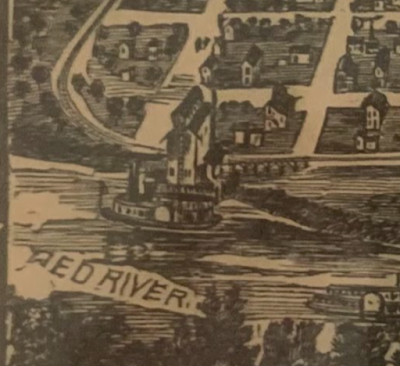
1888 St. Vincent map (west end), showing grain elevator on riverbank

The next year, in 1918, incorporation articles were filed for the new St. Vincent Elevator Company, with capital stock of $50,000; the incorporators were William N. Gamble, William Ash, W.E. Ford, John Duff, and Otto Thorson.  
"The St. Vincent Elevator Company, a new farmers' organization, of St. Vincent Township, has bought the elevator and mill business of the St. Anthony & Dakota Elevator Company, which also includes the coal sheds, two dwellings, and two coal sheds at Sultan, the first station east of here on the Soo Line.

"The elevator, in addition to handling grain, will handle  lumber and building material, also coal and seeds.  Mr. Harry Ward Davis is the new manager."

It is evident from the news article at left, together with the other information earlier in this post, that the local farmers eventually realized they had to organize their own elevator to get the best prices they could for their grain.  Their legacy is still going strong over a century later, with the Humboldt-St. Vincent Elevator Association...

Thursday, November 28, 2019

Water Cooler V: Aunt Mildred's "Books"

In this edition of the "Water Cooler":  A wonderful visit among old friends and neighbors brings up some interesting recollections and memories - plus a tantalizing clue about Aunt Mildred's "books" that could provide a treasure trove of local Humboldt history!  Read on...
Darlene Liedle Daugherty What are you doing up? 
Cleo Bee Jones Same ol' same ol'...it gets old, doesn't it?  
John Nelson Home on the prairie. Homesick! 
Geo Howry Did you attend classes in the Elevator or the grain storage buildings? 
Cleo Bee Jones Actually, George it was in Selmer Locken's restaurant! I studied Buddy Holly's music... 
Bernie Marek I think my dad went to school there. 
Cleo Bee Jones Bernie, what is your Dad's name ? 
Keith Finney George, I later studied at the elevator with Punky. 
Bob Bockwitz Selmer's restaurant goes back a couple years... 
Michael Rustad Selmer - Selmer and Sandra Locken. The old bank building made a pretty good restaurant. I wonder why they tore it down as it was a brick building. And when was Selmer's restaurant torn down? Who remembers the It Cafe? Dotty Boatz had an amusing story about Bob going for lunch there until he discovered one of the kids pounding out hamburger patties with their feet! I remember that the Voits ran the It cafe and conceived of it as a dinner supper club with music. It missed the mark. I wonder what years that Ward and Ruby Finney had the restaurant. The Voits had it in the mid-sixties. Does anyone know what year Mayme's Fairview Grocery Store closed? The building stood for a decade of so after the closing. 
Cleo Bee Jones Keith, we are waiting for you to tell us... 
Bob Bockwitz Yes, Keith, we're waiting... 
Harry, when he worked for the Great Northern 
Bob Bockwitz The years back then all seem to turn to mush in my head, but I would say that the It Café would have been open through '63 and '64. Run by Kenny and Jean Voit. Kenny helped my dad for a short period of time. My dad and Harold Borg would take the football team there for hamburgers. Ward and Ruby would have been in there about '60-'61. Years may be a little off, but would be pretty close, based on 1964, when I graduated. Ruby had a pin-ball machine with a corner broken out of the glass. On the wall next to the machine hung a 'tool' made out of a coat hanger. The tool was bent just right to reach through the hole in the glass to give yourself a couple of games to start with. Ruby (bless her heart) thought it was cute, and never took away the 'tool'. I remember, too, Warren Reese. Warren had lost his legs and as we went to school in the morning, we would pick him up and carry him into the café. These conversations trigger a lot of memories. 
Bob Bockwitz I think Mayme would have closed at the very tail end of the sixties...? 
Cleo Bee Jones I recall Warren Reese when he had the little tiny restaurant in Pembina, the best malts ever, way before your time...! It was across from the Immigration bldg. Just a tiny little hole in the wall ! I wonder what happened to her [Aunt Mildred] "books", journals, as with Viola gone, too. 
Bob Bockwitz You got me there. I wasn't even aware he had a café. All I really remember of him is carrying him in and out of the café in Humboldt. I have a book that I acquired after Mom got killed. She had written almost everything about the family in it. Mostly family, though, and not so much about the community at large. I'll have to dig it out again and read through it to see what tidbits I can find. I know Ruby is mentioned because they were such close friends. 
Cleo Bee Jones I am trying to recall if he was son of Sid and Hattie Reese? Was Lorraine his sister...my story about her, I was singing at the Golden Nugget in Vegas and got a note that said, Do a song for the gal from across the "big ditch"...it was from her, as she and her husband had known I was there and come over to Vegas from LA (I think it was) to see me. I loved it. She was friends with Virginia and the family and I thought she was beautiful... 
Bob Bockwitz I think you're right. For some reason I don't recall Lorraine, though. Rodney is at the lake, so I can't ask him. I really need to get him talking some time and take notes. 
Cleo Bee Jones It was always sort of a joke, about Aunt Mildred's "books" as she must have stayed awake 24 hrs a day, to know everybody's moves in Humboldt, but I thought the world of her, even until she was quite up in age, as she really liked my late hubby...I know I have talked about this before, but worth another stab at it...after an appearance at Hallock Fair she got right up on the stage to visit with him. I was just so surprised and loved it. Quite a gal!! 
Michael Rustad Thanks everyone. Now this is one of the really useful and brilliant forms of communication on Facebook. 
Bob Bockwitz I know. I can look in Mom's book and see what day in 1954 she got a new sewing machine, or the day I got my hand in the lawn mower. Unfortunately, she didn't write too much about out in the community, even though she loved the community so much. 
Keith Finney I think Mildred knew when the Pope Pooped. She wrote everything down. 
Trish Short Lewis This has turned into another Water Cooler post, Michael...!

Monday, November 18, 2019

Junction Drive Inn


These are photographs from the Larson Family Collection. Before there was an Interstate Drive-In (just west of the old KCND-TV building in Pembina), the Larson family started their drive-in business on the Minnesota side, at the (St. Vincent) Junction.

It was a much smaller affair, but much loved in its time. So much so, they had to build a larger one. It was right around the time that I-29 was being built, and the Larson family wisely thought it might be a great location for the new Drive-In. My older sisters Sharon and Betty Short were among the many young ladies who worked there in high school as waitresses...

Sunday, January 20, 2019

In the News: Winchester House (Geroux Hotel)


THE PRIDE OF OLD PEMBINA. 
The Most Elegant Hostelry in Dakota, North of the Columbia at Fargo.
Special to the Globe. 
PEMBINA, N. D., April 21. – One of the most superb and popular hotels in North Dakota is the Winchester House, of Pembina. It is prominently located in the heart of the city, at the corner of Cavalier and Roulette streets, and has a frontage of fifty feet on Cavalier street and sixty feet on Roulette street. It is built with white Crookston brick, and is three stories high. It is at present one of the most elegant and substantial hotel structures north of Fargo, North Dakota. Supplied and equipped with all the modern hotel improvements of metropolitan cities, it is highly prized by all our citizens and the traveling public. Built in the year 1882, at a cost of about twenty thousand dollars, it is a most fortunate investment for its present owner and proprietor. 
J. W. Winchester, after whom the house is named, is the owner and present proprietor of this most popular public resort. The management of this hotel has been given the personal care and attention of J. W. Winchester and his bright and popular wife. Mrs. Winchester has ever been distinguished as one of the most popular and entertaining of hotel matrons, and her popular parlor entertainments have always been most highly appreciated by all the patrons of this hotel and many invited friends, and to her own careful labor in the culinary department in preparation of meals this hotel owes much for its well-earned popularity for its table luxuries. So acceptable are the meals served in this house that the southbound Northern Pacific vestibule train often stops at Pembina sufficiently long enough to enable passengers to obtain their meals here in preference to those furnished by the dining car attached to these trains. This whole structure is occupied as a hotel, and the house can, with adjoining hotel accommodations, accommodate several hundred guests at a time in a most comfortable and acceptable manner.  
This hotel has been for years the “head center” of the political, social and festive activity of the northeast corner of Dakota. In and about this charming resort are clustered some of the most interesting memories of the past political history of this section. Here it was, in this hotel, that the late Jerry Tuohy, one of the most gifted Democratic leaders of his party, planned some of his most successful political conquests in this district, and here it is where, today, the present Republican leader, Jud LaMoure, sways his numerous political cohorts, and plans his most important political battles. Here, too, Jud often “flushes” with great success and raises the “downs” with less than a pair of “breakers.” This hotel is patronized by the very best class of boarders and travelers and for neatness and comfort this house enjoys a most envious reputation. Many of the county officers are remembered among its guests, and as a hotel bonanza for its owner is the Merchants’ hotel of Pembina and this entire section of the Red River Valley. 
Source:
The Saint Paul Daily Globe
Monday Morning, April 22, 1889
Volume XI, Number 112, Page 6
 __________________

From: Pembina and Turtle Mountain Ojibway (Chippewa) history: from the personal collections and writings of Charlie White Weasel


So as you can see, Charlie White Weasel's testimony concerning who built the Winchester House (originally the Geroux Hotel) and first ran it, confirms what Chuck Walker wrote in SHERIFF CHARLEY BROWN.

Also from the same source:
Lucien Geroux ... was then keeping a hotel in South Pembina, the same building, (improved) now being the one in which the county poor are being boarded and cared for, usually called our poor house. 

The large, 2-storey building just east of the Pembina Bridge, sitting in the area where the future Selkirk Park will be, is what I think is the building mentioned above (i.e., Lucien Geroux's first hotel, later repurposed and used as the Pembina Poor House...)

Friday, September 28, 2018

1907 St. Vincent Main Street

The carriage looks suspiciously like our 'Mystery Man' again!  Could it be?!
Source:  Digital Horizons, State Historical Society of North Dakota, via Pembina Historical Society
This shows the main street in St. Vincent, Minn. in 1907. Many buildings line the street and electric lines are visible. Notice the street is unpaved and there are wooden sidewalks present.

This street leads down to the river where it curves to the north for a short way, to where the ferry crossing is that takes people, wagons, etc. over to Pembina on the Red River. At the far end, where years later a bridge will be, you can make out buildings. Down in that area, at this time, is an elevator and a brewery, among other businesses.

St. Vincent Engine No. 1,  on display during the 155th Town Reunion in 2012
The firehall, its bell tower seen on the left (south side) of the street, is new, just built in 1903, housing a new fire engine, St. Vincent Engine No. 1! Directly behind the horse carriage on the right , behind the electric light post, is a short awning. That is the St. Vincent Bank. The larger awning to the right is over the entrance to the Nelson Green store. That same lot is where the Valley Community Church (later the St. Vincent EFC) was located.

Out of view, on the left, is the railway depot, platform, and tracks, which go south of the firehall running east/west. At one point, the tracks also went down to the river and curved around to the north, where the plans had been to build a railway bridge. Unfortunately, that never happened and that change significantly impacted St. Vincent's growth. Those tracks were later removed, and the rails into St. Vincent dead-ended in town. For over 70 years, St. Vincent had freight and passenger service as a sort of consolation prize, but it was ultimately doomed. For its first 30 years or so, it served an important role in bringing thousands - yes, thousands according to many newspaper articles - of settlers north and west, on the railroad. Most did not stay in our area, but only passed through.

In 1907, the town was already quieting down, but still a busy small town around 300 population. Right across the river, its counterpart and neighbor - and in the past, part of the same territory - was Pembina, around 600 or so at this time. So the 'twin city' area has a lively community of citizens, schools, churches, businesses, and surrounding farms. A great place to live, work, and raise families...

Monday, October 16, 2017

Pembina County at 150: Historical Automobile Dealers


Where Have All The Car Dealers Gone?
by Jim Benjaminson


Gregory Ford's announcement last week that they are giving up their Ford Motor Company franchise after 58 years of sales brings to a close a long history of Ford sales in Cavalier —stretching all the way back to 1906. As Gregory's fold their tent for new car sales, Pembina County is left with just two automobile retailers – Soeby Motors (also Ford dealers) in Walhalla and the recently opened Birchwood Motors (GM dealers) in Cavalier.

Several years ago, the late Maxine (Fiedler) Least approached me during the annual Pioneer Machinery Show at the Pembina County Museum and asked if I had ever compiled a list of the implement dealers that had done business in Pembina County. Maxine's father was one of the principals in Fiedler & Moe, a John Deere agency in Cavalier. I had to admit that I hadn't but since our conversation I've made it a practice to note the names of various automobile and implement dealers—a random collection of notes that is far from complete – but continues to grow. The automobile and farm equipment business has changed over these past 111 years. In the old days nearly every community had an “agent” selling the latest car or tractor of some sort. In memory of Maxine and all those who have been involved in selling cars, trucks, tractors and motorcycles here is an incomplete history.


Pembina County's first Ford agency was granted to James Lang of Cavalier in 1906. His appointment named him “agent for Pembina County”. The first Fords sold, three identical 14-horsepower Model N “Light Tourings” arrived by rail in Cavalier that March and were sold to merchants D. E. Schweitzer, Charles Burgess and banker Ed Stong. They were not, however, the first automobiles sold in Cavalier but were the seventh, eighth and ninth automobiles in the city. Two years later (the same year the Model T Ford debuted) Lang and business partner Thomas G. McConnell formed the “Cavalier Garage & Automobile Company”, doing business out of a large brick building on the corner of East Main and Division Streets. Their business announcement stated they would continue selling Fords and “other favorite autos” in addition to handling “auto fixtures and supplies” and “do all kinds of repairing” plus add an “auto livery business”.

James Lang has the distinction of placing the first ad for an automobile in the Cavalier Chronicle in the June 26, 1908 issue. Found on page 4 the ad featured a line drawing of two Ford runabouts – the ad ran for the next six issues without change. Lang also gets credit for placing the second automobile ad in the paper, beginning with the March 19, 1909 issue, advertising both a $500 Maxwell and an $850 Ford, this ad running for twelve weeks. Lang was a busy man as he, along with partner George Horn, started the Cavalier electric light plant. By 1916 the local Ford dealership was taken over by G. A. Westline and Peter Freschett. Two years later Westline and Freschett were out of the Ford business, being replaced by Akra's Thorwaldson Brothers who would run the business until the mid 1930's, Westline took on the Essex line in 1919 while Freschette later picked up Pontiac and Oakland.
Trivia [answers at bottom]
  • How many automobiles were in Cavalier in 1905?
  • What year did the new hotel in Glasston open? 
  • What year did Cavalier remove the hitching posts from Main Street?
Following the end of World War Two S & T Motors opened a Ford agency in Cavalier on September 18, 1946. Owned by Bob Tomlinson of Devils Lake and Clarence Smerud of Minneapolis, a new brick building was built to house their facilities. Tomlinson soon left the business which operated until 1958 when Mr. Smerud passed away unexpectedly. The agency was then sold to Oliver Gregory who took over the business April 1st, 1959. A new dealership facility was built on the south of edge of Cavalier, opening in 1962 where the business is still located.

Soeby Ford of Walhalla, which can proudly claim the distinction of being the oldest dealership in Pembina County traces its roots back to 1926 when C. K. Soeby acquired the Oakland and Pontiac car and International truck franchise. C. K. Soeby became a Ford dealer in 1930, passing the business along to his son Jack in 1948 who in turn passed it on to his sons in 1986. Another long time Walhalla dealer was A. O. Tetrault, whose Walhalla Motor Company held the Ford franchise in 1926, a year that would see a first in the delivery of new Fords when the first load of “completely built up” Ford cars arrived—previously dealers had to install items such as lights, wheels, tires and fenders before delivery could be made to a retail customer.

Harold Morrison and Freeman Levi built a new building “two blocks south of the post office” under the name of Cavalier Implement, selling Case farm equipment in May of 1944. By 1952 they added the Pontiac and Willys line of automobiles using the business name Cavalier Motor & Implement. Discontinuing selling farm equipment and moving to a new location on the west edge of Cavalier the new building was lost to fire Christmas Eve, 1959. Rebuilding on the same spot and re-named Cavalier Motors, it had the distinction of being named “Studebaker's newest dealer” in 1960. The business, which continued to sell Pontiac, was sold to Olson Motors in 1962. Down the street, Page Oil Company, which had been selling Oldsmobiles since 1941, took on the Rambler line in time to introduce the 1959 models.

Like S & T Motors several other dealerships were opened in Cavalier following WWII. Melsted-Olson Motors built a new brick building one block further south of the new S & T building, selling Chevrolet cars and trucks as well as Massey-Harris farm equipment. Kuball & Andrews, which had been in operation since before the war (Ole Andrews having been a Chrysler dealer since 1927), continued to sell Dodge and Plymouth cars in addition to Lehr's “Big Boy” tractors. Utilizing a Chrysler engine, Dodge truck 5-speed transmission and 2 speed differential, the “Big Boy” sold for $2,136 in 1948 and had a “road gear” good for 22 miles per hour. Letzring Motor & Implement which had previously sold Hudson and Terraplanes in Neche was also selling Chrysler products along with Allis-Chalmers tractors in Cavalier. Kuball's sold the Dodge-Plymouth agency to Erwin Herzog in May of 1956. Twenty years later Erwin sold the business to his son Tim, who later sold the business to Swanson Motors in September of 1999. Jack McPherson began selling Kaiser automobiles in 1950 and its companion compact car Henry J in 1952. A post war start-up company, Kaiser-Fraser dealers also included Andre Gratton at Walhalla and Hughes & Shaver at St. Thomas.


Auto and implement dealers weren't just centered in the larger towns of the county. Robert Halcrow, whose address was Nowesta, was an agent for the Lambert automobile in 1913; he is noted as having “brought a cow to town in a box wagon behind his auto”. It's claimed he made the eleven mile trip to town “in one hour and went home considerably faster”. In later years Halcrow Ford would be one of Drayton's leading automobile dealers. Drayton's early pioneer car dealer R. J. Moore began handling the E-M-F line in 1912 - named after the three principals of the company, Everitt, Metzger and Flanders - detractors claimed the initials stood for “Every Man's Failure” or “Every Morning Fixit”. It was later absorbed by Studebaker.

Over at Hamilton C. A. Morton's Auto Livery advertised they were agents for the Vulcan, Buick and Marathon brands and had “one 25-horsepower Marathon touring car used a little for demonstrating which will sell at a nice reduction." Any of the cars on hand could be bought “on one years time with first-class security at 7 percent interest.” By 1921 E. K. Evenson was selling Fords at both Hamilton and Neche. H. C. Thomson of Bowesmont was also selling the popular Ford line. George Paxman had been the Hamilton Ford agent as well as the Overland and Willys-Knight dealer. A disastrous fire July 7, 1918 destroyed the Paxman building but 5 new Overland cars were saved. At Hensel, H. J. Norman & Son were also selling Fords while Graham & Ross sold Republic trucks. In later years Frank Gillis would handle the International line in Hensel, eventually selling out to Art Anderson. Other International dealers included Glenn Morrison in Cavalier, and Neche Farm Equipment in that city.

Crystal's Bradley & Hunter were sales agent for the Racine, Wisconsin built Mitchell in 1912 while the Crystal Auto Company was selling Hudsons by the car load, adding the Studebaker line in 1917 and Essex, Overland and Willys Knight two years later. A man by the name of Bymaster later took over the Crystal Mitchell agency. G. G. Thompson of Pembina was also selling Mitchell's in 1912, with his territory carrying over to St. Vincent, Minnesota. By 1915 Thompson was a Maxwell dealer. At Mountain S. F. Steinolfson was selling Ford's while G. M. Benjaminson (his name was always misspelled as C. M. Benjaminson in newspaper ads) was selling Pontiac's and Oakland's in Gardar. Peter Freschette, earlier Cavalier's Ford dealer also took on the Pontiac-Oakland line in 1927.

As small town America dwindled several dealerships continued to run successful businesses. Louis Byron Motors sold Pontiacs after the war and were long-time Chrysler-Plymouth dealers in Mountain. Likewise, Dietrich Motors in Crystal sold DeSoto's and Plymouths while Christopher Motors at Pembina, which dated back to the 1920's sold Chevrolets well into the 1960's.

Among the more noted implement dealers have been Cavalier's Fiedler & Moe (John-Deere), Pembina's Meagher Brothers (Massey-Harris), Glenn Morrison (International Harvester), Hamilton's Frank White & Ernest Einarson (Minneapolis-Moline), and J. J. Myers, Mountain (Holt combines).

At least three Pembina County residents saw the demand for motorcycles, with B. S. Thorwaldson of Akra (a partner in Thorwaldson Brothers at Cavalier) selling the 11-horsepower Harley-Davidson Twin, Martin Brothers of Hamilton handling the Indian line (ride it to work and ride it for fun) and Svold's August Vivatson offering Wagner Motorcycles at prices ranging from $160 to $200.

There was always something special about going to “show day” - when the new models were introduced to the public. Coffee, doughnuts, trinkets, colorful brochures and new cars. What could be better? Sadly there's not as many places to go anymore.

Trivia answers

5

1904

1905

Sunday, January 18, 2015

Saloon Manslaughter: The Rest of the Story


It all started with a trade:  One hat, for one bottle of whiskey...

If there's one thing I've learned writing this blog, it's that history often reveals itself slowly, despite doing what you feel at the time is due diligence researching a subject.  New records become available that were not present the first time around. People come forward with information only they were privy to.  Etc.

Such is the case concerning a particular murder that occurred in St. Vincent in 1899.  The new records came in the form of old newspaper accounts now available through the Library of Congress.  The new information came from an old friend of this site, Jim Benjaminson, of the Pembina County Historical Society.

When you read the accounts below - along with the links to earlier posts on this subject - you will get something very rare for local history of a small town nature:  As complete a picture about the subject as could be expected.  A rare treat, indeed...
_______________

George Bates Murdered While Intoxicated
Wednesday morning (March 8, 1899) the news went mouth to mouth that George Bates had been found dead in his house. The details as they began to develop were highly sensational. Mr. Bates was addicted to excessive drinking. When under the influence of liquor he was apt to quarrel with his family. On Wednesday afternoon he had trouble of this kind. Later, he went to St. Vincent. What happened there is still somewhat contradictory at this writing. 
Wednesday morning, Mrs. George Bates came downstairs and found her husband lying on the floor with every evidence of having been severely pounded. She hastily summoned Register of Deeds Chisholm from the office nearby and upon examination it was found that Bates was dead. He had a hole in his skull near the right temple from the effects of a blow of some kind and his face was badly bruised and had been bleeding profusely. As nearly as the facts can be gotten at they are as follows:

Monday, July 14, 2014

Water Cooler IV: Short's Cafe Memories

Circa the late 1940s/early 1950s @ the Short's Cafe...

'The food is not Stranger and we are never Short on customers'

Not long ago, Cleo Bee Jones' photo taken of Short's Cafe not long before it was torn down, triggered a thread on Facebook; in this thread, people shared their memories of Short's Cafe in St. Vincent...

Cleo Bee Jones I took this picture [NOTE:  See Cleo's photo at bottom of this post] of Short's Cafe when I was in the area singing at the Hallock Fair one year...

Deborah Kopylov It's strange to see this old place and that sidewalk knowing that years ago I walked that sidewalk and went into that Cafe that had so much life!!

Trish Short Lewis ‎Deb, I know what you mean. It sure brings home the passage of time as it relates to one's own life...

Eliza "Liza" Stranger Short
James McC Ah, yes...I have many memories of this building. Known affectionately as simply "Ma Short's".

Margie L. White I had my first orange soda float at Ma Short's. What a treat that was!

Cleo Bee Jones I always feel nostalgic when I see this pic, taken the night before I last sang at the Hallock fair...I was at my Aunt Ruby's and walked down by there with my camera in hand and glad that I did.

Trish Short Lewis I'm very glad you did it also, Cleo. It's just a memory now...

Wednesday, October 09, 2013

St. Vincent Business Listing, 1879

Despite the seeming title discrepancy, 
this is the same, correct gazetteer...

ST. VINCENT [From Minnesota, North and South Dakota and Montana gazetteer and business directory (1879)]

This growing town of 500 inhabitants is the state terminus of the St. Paul, Minneapolis, and Manitoba Railway, and also of the St. Vincent branch of the Canadian Pacific Railway. It is situated in the extreme northwestern point of Kittson county and of the State alike. The Red River of the North, is 390 miles from St. Paul, and the seat of the county of Kittson. A regular line of steamers make daily trips on the Red river from St. Vincent to Winnipeg, Manitoba, carrying passengers and freight and making connection with the arrival and departure of trains. St. Vincent has a steam elevator of 90,000 bushels capacity, a bank, a brewery, a brickyard, a hotel, a newspaper named the Herald, three general stores and a district school, while a church is being erected...Daily mail over the St. P., M. & M. and Canadian Pacific railways. D. F. Brawley, postmaster.


BUSINESS DIRECTORY

Brawley D F, brickmaker.
John A. Vanstrum
First Sheriff of Kittson County
Buie John, livery and sale stable.
Flynn & O'Keefe, General Store.
Gooding C J, railroad agent.
Head Felix G, justice of the peace.
Head Felix G, Publisher St Vincent Herald.
Lowery Robert W, general store.
Nobles L, express agent.
O'Keefe Wm M, register of deeds.
Provouchoe John, saloon.
Raywood George & Co, St Vincent Brewery1.
Red Wing Mill Co, grain elevator.
Rich J H, cashier St. Vincent Bank and manager, Elevator Co.
St Vincent Bank, J H Rich cashier.
Shepard J W, lumber and building material.
Stewart John W, proprietor Pacific Hotel.
Vanstrum John A, Sheriff Kittson County.
Vanstrum John A, real estate agent.
Winter J B, general store.

__________________________________

1 - Later, George Raywood and Charles Thorson opened the North Arm Brewery in South Vancouver; after that, in 1900, George built the Cedar Cottage Brewery on Gibson Creek in Southeast Vancouver.

Sunday, May 05, 2013

Mystery: Progress...!

Although I have not obtained a photograph of the mysterious
Mrs. Rasche yet, I did come across one of her children in a
Maryland history book; The two young ladies sitting were born
in Kittson County.  
 [Source: Western Maryland Historical Library]

Recently, I challenged the readers of this blog to help solve a mystery.

While I waited for responses, I dug around online.  First I learned that a  Henry and Katherine Rasche -  mentioned in an old newspaper article as attending a Kittson County funeral - were not just visiting.  Although from Maryland, they had moved for a time and had lived in Kennedy, Minnesota.   I then found a name attached to some genealogy records, and contacted that person, only to learn that he was their grandson.  William Owen Treacy  shared that "...My grandmother, Katherine Rowan Rasche, did indeed live in Kittson County, Minnesota in the 1890s and she was a prolific music composer, poet and artist. I have a number of her compositions but sadly, no St.  Vincent March. She had a number of her compositions copyrighted and were published and sold nationally, so you may wish to try searching that avenue.  Also, you may wish to explore the local newspaper archives as i know that the local paper(s) frequently published articles about her and her works.  Lots of luck. Let me know if you meet with any success."

I had not received any responses to my solicitation on this blog, so my next step was to take my new information and post it on the St. Vincent Memories Facebook group page.  Marcy Johnson, responded, saying, "There was an Oakland Hotel in Kennedy with Mrs. McKee as the manager listed as one of the businesses in 1900. I found this in the Kennedy Centennial History book from 1989..."

Shortly after Marcy responded, William Treacy send me more information concerning his grandmother, including a biography he had written about her.  Within that biography, it mentions why they moved to Minnesota in the first place, and why they eventually returned:

Thursday, December 27, 2012

PROFILE: Lapp General Store


A new general store.  Short sales people on the street showing off the latest .22 rifles.  Wide new sidewalks all along Pacific Avenue's north side through the entire town.  Yep, St. Vincent was on a roll in 1912...
One of the best historical essays is all about the history of this store - HIGHLY recommended reading!
Lapp General Store circa 1912, brand spanking new!
[Lapp Family Photo Collection, Courtesy Beth Lapp]
Winnie & Dick Lapp packing heat in front of the family's store
[Lapp Family Photo Collection, Courtesy Beth Lapp]

Richard Lapp:  Ready, Aim...Fire?
[Lapp Family Photo Collection, Courtesy Beth Lapp]
Interior of General Store - Lapp Family Can be seen in back;
Click on photo to see larger version and greater detail

[Lapp Family Photo Collection, Courtesy Beth Lapp]

Sunday, December 09, 2012

Early Hallock "Bird's Eye View" Map

[Click to Enlarge and See Details]

This postcard shows a depiction of Hallock by an unknown artist, date also unknown.  From the lack of buildings, as well as the presence of the Hotel Hallock1, it is definitely an early rendition of the town.

It is fascinating to see more of the original layout, helping the viewer to see how the town developed.  It also leads to questions such as, why does the town have a mostly classic grid layout, yet there is one road on the north side of town coming at an angle?

The main street of the town is Atlantic Avenue.  If you look at the image enlarged, you'll see in the middle of that street, right after the 'Ave', a depiction of a wagon heading north.  Just above that, to the east, is a large, two-story building.  Could this be the same building that Bakken's Boots occupies today?  If so, it would make it one of the oldest buildings still in existence in Hallock.

In the image, to the far east on Hallock Avenue, is an
impressive, possibly brick building - the old Courthouse? 
In the middle of the town, between Pacific and Atlantic, is the railway depot.

1 - The Hotel Hallock was quite the swanky sportsman's retreat. Mr. Hallock built it to have running water/bathrooms on every floor, speaking tubes, a barbershop, gun rooms, kennel rooms for the guests' hunting dogs, etc.

Tuesday, July 17, 2012

A Peek into 1907 Pembina

Postcard:  Crossroads of Stutsman and Cavileer Streets 
[Photo Source:  Kris Kefgen1]
The image above shows part of  downtown old Pembina, circa 1907.  On the middle building's sign just to the right of the white awning, it says "Restaurant - Meals" on the top line, while on the bottom, it declares the proprietor to be A. D. Cavileer.  Along the side of the building are advertisements for some of the items to be found inside Mr. Cavileer's establishment - El Paterno cigars.  I especially like the building's unique "sky light".

A.D. Cavileer, son of
Charles Cavileer 
[Photo:  MSHS]
Across the street, to the north, is the elegant bank building - the Merchants Bank of Pembina.  I love the original windows with their arches and abundant glass, together with the beautiful lettering on some of the windows and their stylish window curtains.  The exposed iron supports add architectural beauty to the brick building, which soars over the humbler wooden buildings to its left.  The building still stands in Pembina to this day, although a bit worse for wear; today it is better known now as the Corner Bar and Grill.
___________________

1 - The postcards came from Kris Kefgen's grandfather, Lyman K. Raymond on his business travels through small towns in North Dakota, Minnesota, and Michigan. He worked for the Union Mattress Co. which was out of St. Paul, Minnesota...

Sunday, July 08, 2012

Memories: Alan E. Wilwand

As a youngster growing up in Pembina, I had a second town - St. Vincent.

Wallace & Matilda Cameron's
Home during 1950 flood

[Photo:  Turner Family Collection]
My grandparents, Wallace and Matilda Cameron lived there.  I was crossing that old Red River bridge whenever I got the chance.  I loved my grandparents.  Grandma made the greatest date-filled cookies!  The house where they lived was north of Short's Cafe.  The house is gone now, but the memories linger on.  My grandmother was a seamstress and speculator.  She gave me the deeds to about half of the places that she had bought in St. Vincent.  Who knows?  I may own half of the town!

After WW II, my Uncle Ralph (Ike) Cameron worked at Short's Cafe.  He would give me those double ice cream cones, one side vanilla and the other cohcolate or strawberry, heaping the helpings.  Ma Short was taking a big loss on ice cream with those!

If walls could talk:  the
St. Vincent jail today...
I remember so many things about St. Vincent.  My Grandfather was the town constable.  I believe the old jail is still standing.  He gave me the big lock and key for it.  He also gave me the pair of handcuffs that he used.  I donated his daily log that he carried in his breast pocket, to the Kittson County Museum in Lake Bronson.  That diary saved his life the time that he was shot.  I believe the museum also has one of my paintings that I did of the old fire hall.  I remember the fire hall well.  This is where he set up his office once in awhile.  The depot that was established in 1878 was close by.  My grandparents' big barn floated down the Red River in the flood of 1948.

Sunday, June 17, 2012

Profile: A.H. Anderson


Who was the man who photographed the 1897 Red River flood in St. Vincent?  The man who took the famous "High Water" series photographs?

His name was Andrew H. Anderson.

He was a farmer who happened to have an eye for photography. He apprenticed in Fergus Falls, Fosston, and Grand Forks before he began a photography business in Hallock in the1890s. 

He eventually sold his interest in his photography business to then partner William Hartvig so he could focus on farming.  But he returned to photography when he bought the studio of G. G. Shaker in Hallock in 1936.  

Born in 1867, he lived a long life in our area, passing away in 1960.  He chronicled many events and families in Kittson County!


Sunday, May 06, 2012

Hill Farms II


Threshing at the Walter Hill Farm in Northcote (1900);  this was
the year my grandmother began working in the farm's dairy.

[Click on photo to see large version]

J.J. Hill was a busy man with a wide variety of interests.  His business savvy was renowned, which brought him notoriety and admiration from a wide variety of people.  My grandmother and mother talked about him with tones of reverence when recounting his heavy influence on the region in which we lived.

Settlers in our little corner of northwestern Minnesota often found  stepping stones of employment thanks to Mr. Hill.  Elizabeth Fitzgerald, my grandmother, was one of them.  She wasn't able to have any schooling past third grade.  With 10 siblings at that time (eventually there would be 13), she was needed at home after that; eventually, in 1900, she found work on the Hill's Humboldt farm working in the dairy, among other responsibilities.  Such young women who did a variety of tasks were commonly called 'hired girls'.

Hill's interest in farming was tied directly to his building of the railroads.  Development of the surrounding land was their key to success.  Settlement was encouraged, but it was also necessary to supply motivation for settlers to come.  The land itself was rich with potential, but Hill was smart enough to know that he had to lead by example.  He started farms that were practical demonstrations of how it "could be done".  One of them was the Humboldt farm, its genesis in 1881, that became a bonanza farm, eventually splitting off 3,000 acres to create the Northcote division in 1910 (although it was part of the Humboldt farm prior to then...)

The Northcote division was created for his son, Walter, in hopes that it would give him focus.  The article below announces the completion of the mansion, as my grandmother called it.

WALTER HILL MANAGING 45,000-ACRE FARM 
Walter Jerome Hill, around the
time he took over the farm . . .
October 10, 1913 - Walter J. Hill, son of James J. Hill, has just completed a $50,000 residence on the 45,000-acre Hill farm in Hampden township, about seven miles west of Lancaster, between Hallock and Humboldt, in the extreme northwestern part of Minnesota.
Mr. Hill is now erecting a cow-barn 204 feet long and about 140 feet wide to hold 1,000 head of stock. The foundation pillars and floors are of reinforced concrete. The walls are of brick facing and double tile lining. The roof will be metal, supported on steel girders. The building will be equipped with a good ventilating system and with the most up-to-date devices in caring for stock. Adjoining this building will be two large silos and a feed house. In addition to these buildings, Mr. Hill has under construction at the present time an up-to-date blacksmith shop, cattle corral, and a complete hot and cold water system to all the buildings.

He is not putting in a vast sum of money in building for the fun of it. With him it is a business proposition. He is no idle guesser, but has spent some time in keen observation and cold-blooded figuring. He would not be a member of the Hill family if he didn't do this. He has it figured out that the big money for Kittson county farmers in the present as well as for the future lies in raising stock, making this a leading feature of the farming business.

It would do our Iowa, Illinois and Nebraska farmers and renters of high-priced land considerable good to see Mr. Hill's alfalfa, clover, timothy and fodder corn crop this year. It is absolutely necessary to raise these fodder crops to make stock raising a paying industry. This cannot be done in the dry, arid countries, and if the farmers of highpriced land can make money raising these crops to feed stock the farmers of Kittson county will get rich in a few years.

From Commercial West, Volume 24

Saturday, March 31, 2012

Daniel Franklin Brawley's Sad End


The last time we saw Daniel F. Brawley, he was conducting some rather underhanded business tactics against another resident named Nathan Myrick, over the Pembina/St. Vincent Ferry.

Below is a sort of time-line of Brawley's history in Minnesota.  It was created by Vince Godon on his fascinating website, Historical Minnesota Bricks. Vince is the son of Maurice Godon, a former resident of St. Vincent, who was featured in St. Vincent Memories in 2009.

Below, you'll read how he lived during changing times in Minnesota, as businessman, legislator, etc.  In the end, he died by his own hand, in St. Vincent, and is buried in the St. Vincent Cemetery...


Sunday, March 04, 2012

Interview: Beth Lapp

Elizabeth Lapp in 1948
[Courtesy:  Digital Archive, UMC
Thanks to Kristine Baldwin Ohmann, who facilitated our get together, I interviewed one of the oldest living natives (and a resident) of St. Vincent last weekend.

Elizabeth Lapp, better known as Beth, was raised in St. Vincent.  Her parents, Richard (Dick) and Lillian Lapp, met in 1926 when her mother came to town to teach at the school. Dick's parents were early settlers of St. Vincent, arriving in 1879 from Canada.

I share with you here the interview in its entirety, as it happened.  As you will read, there are a lot of clues for further stories, which I intend to explore in future posts...

1. Her earliest memory is of getting ill and vomiting on her workbook at school. In those days, you only got one workbook to use for your schoolwork, so she was mortified. She was sitting near chalkboard at the time. Her teacher was Miss Penovich.

2. Some of her other teachers were: Elaine Bergh, Gunda Hanson, Mrs. Isley, and Mrs. Monte(gue) Clinton.

3. The year she had Mrs. Clinton, “we didn’t learn anything”. Math and Science were "sacrificed for art". All she remembers is Mrs. Clinton having the class place chairs facing west and looking out towards Christ Church and drawing what they saw…

4. When it came time to go to high school, students during her time had three choices: Hallock, Pembina, or Crookston. Hallock and Pembina were public school (free) while Crookston was a boarding school and charged tuition. This was during the 1940’s and into the 1950’s.

Northwest School of Agriculture Crookston MN
[Photo Courtesy Digital Archive, UMC]
5. Crookston was called the ‘Ag School’. It's actual name was the Northwest School of Agriculture.  Several area natives attended it, including Beth and her siblings.

Thursday, September 08, 2011

Farmer's Store

Farmer's Store in Hallock (1910).  Note tea chest on left...
[Photo Credit:  Minnesota Historical Society

My Mom and I often shopped at the old Farmer's store in downtown Hallock in the 1960's and 1970's.  Even then, it was somewhat of a general store, having a dry goods area where we would sometimes buy fabric and notions for sewing projects.  It still had the wood floors, and the high tin ceiling...
The Kittson County Farmers Co-operative Mercantile Company of Hallock, Minnesota, was incorporated in 1904. The intent of the farmers who organized the company was to cooperatively own and operate “a general mercantile, trading, shipping, forwarding, and commission business; [to engage in] buying, selling, exchanging, and dealing in all kinds of farm produce, supplies, implements, machinery, and other articles of merchandise incidental or necessary in operating and conducting a general store; [and] to buy and sell as much real estate as is reasonably necessary in conducting its business.” The “Farmers Store,” as it was commonly known, began by purchasing the inventory, frame building, and adjacent lots of a general merchandise store owned by C.J. McCollom. 
In 1914 the store needed larger quarters, and a second public corporation, the Farmers Building Company, was formed to finance and manage a new building.  A two-story, brick structure was built in 1915 on the site of the original store.  The Kittson County Farmers Co-operative Mercantile Company rented space in the building from the Farmers Building Company, as did other businesses and individuals.1 
In 1956 the Kittson County Farmers Co-operative Mercantile Company and the Farmers Building Company merged to become the Farmers Store of Hallock, Inc., a privately owned corporation. 
Source: Minnesota State University Moorhead Archives
1 - After posting this, a reader mentioned that a great aunt lived in an apartment over the store for several years...

Monday, August 08, 2011

Memories of a Humboldt Native


Anthony "Tony" Merck
Humboldt Depot agent
This reminicense by Margaret Matthew Panzer is full of memories and names of old Humboldt in the way a poem about the town was.  As you will read, there was a lot of community and fellowship as people strove to make a good life for themselves and their families, but there were also hard times (such as during the Depression)...
...My parent's farm was a little over a mile south along Highway 75 and we often walked to town and even to church on Sunday morning when the weather was pleasant.

Though my dad had a hitching post in our yard the only time I really remember a sleigh ride was on Thanksgiving when we went cross country to Len Sylvester's farm to enjoy the day. Lots of good food and crowding around her pot belly stove, playing the piano and working on the Charleston steps were all fun.

We did ride in a school bus in nice weather and a large sled during the winter weather.

Humboldt had been built on both sides of the main highway. East of the highway was really only about four large blocks. There seemed to be wide spaces between homes as some blocks had a home only on the corner.