Showing posts with label politics. Show all posts

Monday, July 09, 2018

PROFILE: Captain John A. Vanstrum

I present to you, one of St. Vincent's early pioneers - John A. Vanstrum. A veteran of the Civil War, he became very civic-minded, serving the town and later Kittson County, in many positions. One of his longest-held was as Sheriff.  Serving at roughly the same time, he was Sheriff Charley Brown's counterpart across the river!

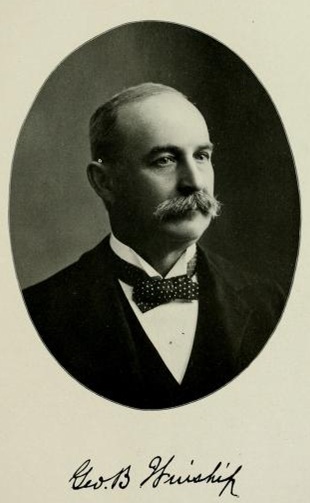
Captain John A. Vanstrum, register of deeds for Kittson county for the past decade, a pioneer citizen of the great northwest and a valiant soldier of the Civil War, is now a resident of Hallock, Minnesota, where he enjoys the esteem and confidence of a wide circle of friends and admirers. His portrait [seen here on right], will be appreciated by his host of friends. Captain Vanstrum was born in the province Gustaf and Elizabeth Vanstrum. The parents died in Sweden, their native land. Captain Vanstrum received but a limited education in his boyhood, having to assist his father in a paper mill from his tenth to his sixteenth year. On June 22, 1855, in company with about two hundred emigrants, he left his native land, sailing from Gutenberg on the vessel Ann Washburn, commanded by Captain Winchell. The vessel was heavily laden with Swedish iron for Boston merchants. He arrived in Boston harbor August 6, 1855, and proceeded to Chicago, thence to Batavia, Illinois, where he spent the winter of 1855-6, working for his board and attending school. In September, 1856, he went to Minnesota, via Dunleith, now East Dubuque, Illinois, thence up the Mississippi river, and located at Redwing. Minnesota, where he engaged as clerk in a store.

At the breaking out of the Civil war Captain Vanstrum was residing at Redwing, Minnesota. He immediately offered his services and assisted the late Colonel H. Mattson in recruiting Company D, Third Minnesota Volunteer Infantry, and was mustered into service in October, 1861 at Fort Snelling. The Captain went to Chisago county, Minnesota. where he raised some thirty volunteers (Swedish) for Company D. These men he transported in wagons all the way from what was then known as Center City via Taylor's Falls, Marine Mills and Stillwater, through St. Paul to Fort Snelling, where they arrived October 18, 1861, and on the following day were mustered into service. Captain Vanstrum was appointed sergeant of Company D in October 1861, was promoted to second lieutenant March 30, 1862, first lieutenant May 30. 1862, and Captain of Company D August 2. 1862. He re-enlisted with the same company as a veteran, under the veteran enlistment act, at Little Rock, Arkansas, early in January, 1864. He was honorably discharged with his regiment at Fort Snelling September 17, 1865. His record in war, as it has continued to be, is that of a brave and fearless defender of the Union and the old flag. In 1879 Captain Vanstrum went to Kittson county, Minnesota, and located at St. Vincent, where he was postmaster from 1879 until 1885. In the latter year he resigned his office and during that period the post office at St. Vincent was of more than ordinary importance. It was the international exchange office for all registered mail matter passing between the United States and the northwest Canadian provinces. All registered letters are re-registered at the St. Vincent office. From 1879 to 1885 this office ranked third in volume of registered mail from Minnesota.

Captain Vanstrum was sheriff of Kittson county from the date of its organization, April 8, 1879, to January, 1889, and is at present register of deeds of said county, having held that position continuously since the fall of 1891. Politically the Captain is an uncompromising Republican. He is a member of the I.O.O.F., and is one of the representative men and pioneers of the northwest. (International Order of Odd Fellows)

Source:  Collections of the State Historical Society of North Dakota, Vol. IV (1913)

Sunday, March 24, 2013

1857 Incorporation

As I have earlier hypothesized when discussing St. Vincent's earlier incorporation (the first of two), it appears I was right -  it was most definitely linked to Minnesota's "impending statehood"...
Impending statehood stirred speculative interest in the future of the area's northwestern reaches. That interest was reflected in the 1857 sessions of the legislature, where a remarkable number of acts benefiting the Red River area were passed.

Among the 49 towns incorporated during the extra session alone, seven were located in the valley. One of them, St. Vincent, was situated on the Red River just south of the international border. For it the legislature chartered a ferry and authorized the construction of a branch railroad1 as well as telegraph lines to terminate there. Although it was located on land that still belonged to the Ojibwe, a St. Paul firm sent Charles W. Iddings2 to St. Vincent in the summer of 1857 to survey the new town site along with that of Pembina on the opposite shore of the Red. By February 1858, the two towns had been platted with streets named for well-known fur traders and legislators.

- Minnesota's Boundary With Canada: Its Evolution Since 1783, by William E. Lass
Sewall & Iddings 1860 Map
[Copyrighted 1857]

1 - May 22, 1857, the Territory accepted the grant and conferred it upon the Minnesota and Pacific Railroad Company.  Breckenridge, at the mouth of the Sioux Wood River, and St. Vincent, on the Red River of the North, were designated as the western termini of the main and branch lines respectively (Law of Minnesota, Minnesota Territorial Legislature extra session 1857, p.3)  The Minnesota & Pacific Railroad Company was one of four such companies created to take advantage of the eventual  federal land grant act. It eventually reorganized as the St. Paul & Pacific Railroad Company, which in turn became part of James J. Hill's Great Northern Railway Company. 

2 - Charles W. Iddings was a surveyor living over the post office in St. Paul in 1856. After the Densmore expedition he was associated with Joseph S. Sewall of St. Paul, the engineer who built the Wabasha Street bridge. During this connection the two men published a map of Minnesota which is known as the Sewall and Iddings map of 1860.

Friday, May 18, 2012

Incorporated TWICE

1881 Charter heading...


ST. VINCENT Township, organized March 19, 1880, is opposite Pembina, N.Dak. Its name had been earlier given, before 1860, to a post of fur traders here, in honor of the renowned St. Vincent de Paul, founder of missions and hospitals in Paris...The city in sections 2 and 11, located on the site of an XY Fur Company trading post, was incorporated as a village on May 23, 1857, and again on March 8, 1881; it had a station of the Great Northern Railway in section 2, and at St. Vincent Junction in section 6; its post office began in 1878. 
- Minnesota Place Names: A Geographical Encyclopedia, by Ward Upham

Saturday, April 21, 2012

An Arduous Journey


I've been reading this book about Enos Stutsman titled Attorney for the Frontier. Ever since I came across "Stuts", as his contemporary friends called him, I've been fascinated by the man.  To my knowledge,  Attorney for the Frontier is the only book ever written about him, and it includes an entire chapter about his time in Pembina, his last home base.

Below is a letter he wrote to his supervisors.  As a past federal government employee myself, I am well-acquainted with the paperwork involved whenever you go away from the office.  Reports must be filed!  Read below on what this particular early government employee went through just to get from Point A to Point B; you'll note he has a pretty wry sense of humor, which I guess you had to have when encountering such difficulties.  All in all, if you take the time, you'll discover it's quite illuminating, and an enjoyable read...

Sunday, May 01, 2011

Louis Riel Poem

Photo of Riel (1878)
It was from the border town of St. Vincent, Minnesota, that on December 26, 1878, Riel gazed longingly at his Manitoba homeland and composed the following lines.  Since he was still purging the five-year exile imposed on him in Ottawa in 1875, he could not enter Canada.  Filled with anger by the thought that a recent influx of English-speaking Protestant settlers was now controlling his province, he contemplates mounting an armed invasion of Canada which, with providential support, would liberate his people.  Riel condemns the actions of Lisgar and Dufferin, governors general, whose terms overlapped that of Canada's first prime minister, John A. Macdonald.

Minnesota, Which I Now Entered (1878)
Minnesota, which I now entered,
Filled my heart with longing
For my home strung along its border.
I fell, sighting two cities, a bliss,
St. Paul and Minneapolis,
For eight or nine parents settled there.
I am moved almost to tears
As the train slowly draws near.
But the train moves on and the engine
Takes me to Breckenridge, to Crookston;
Then to St. Vincent from where, happy,
I contemplate my beloved country,
My sweet.
Manitoba,
Enticing as a loved one's charms,
Now held in the Orangemen's strong arms:
Manitoba,
For whom I have toiled unceasingly,
Your countenance inebriates me.
As if subdued by sweet catawba,
I reel.  Like Solomon to Sheeba
I am beckoned irresistibly.
For your glory my love must avail
And, God willing, my efforts prevail.

I have just returned from the Northeast.
While I waited, punished in exile,
Through the machinations of a Beast
Your innocent hearts have been reviled.
I, God willing, with renewed vigor
Will find ways to crush this enemy.
Friends on the banks of the Missouri
Will, with conviction as their armor,
Fight the native people's righteous fight
And, with me, armed by justice's might,
Fly swiftly on a northerly breeze
To help our Metis brothers resist.
Passions and fierceness I will enlist
And to great injustice match great fury.
They will attack Portage la Prairie
And destroy that wicked place entirely.
The river Boyne will be a bloodbath,
Red Assiniboine its aftermath.
Lisgar and Dufferin have bequeathed
Ignominy. Their men's legacy
Is betrayal. With revenge unsheathed
The Blackfoot will make Winnipeg pay.
Do not falter, worthy countrymen.
Oppose the English.  Respect your name.
John A., no better than a madman,
Ottawa will lose at its own game.
Spirit, be guided by Providence.
Do not too hastily take offence.
God moves his finger in mysterious ways.
By prudence, not by passion, be swayed.
All intentions are as scattered dust
When they contradict the divine plan.
If God tells me:  "Till the land," I must.
Or: "Make yourself stronger," this I can.
Or: "You must die," His will must be done.
Thus perhaps I am not intended
To help my people gain their freedom.
Let not my people be held ransom.
Let them thrive, let them be defended.

From:  Selected Poetry of Louis Riel

Tuesday, April 19, 2011

Rivalry & Politicking: Geography is Destiny

One of Dakota Territory's earliest territorial courts...
We first encountered the resistance to Pembina having serious territorial influence in 1872.  It's now 1873, and the resistance intensifies...
Three male members of one family were pioneers in many legal and political matters in North Dakota.

The patriarch, Alanson H. Barnes, held the first territorial district court hearing in Bismarck and established the judicial seat for the district court in Fargo. His son-in-law, Alfred D. Thomas, became the first U.S. District Court judge from North Dakota. Another son-in-law, Evan S. Thomas, became the second mayor of Fargo and came within three votes of becoming the first governor of North Dakota.

On Nov. 7, 1873, the acting governor of Dakota Territory, Oscar Whitney, reassigned Judge Barnes from Yankton to Pembina but, under federal orders, rescinded the order on Dec. 11. On Jan. 10, 1874, the Department of Interior reinstituted Whitney’s original proclamation.

Instead of going to Pembina, Barnes located the federal court for District 3 in Fargo. There was no courthouse in Fargo, so the trials were often held in business establishments.

In addition to court sessions in Fargo, Barnes held quarterly hearings in Bismarck. The first U.S. District Court to meet there began on June 18, 1874.
...

In December 1874, Alexander McHench, a Fargo legislator, successfully pushed a bill through the territorial Legislature that officially transferred the court from Pembina to Fargo.

Seal of the territory of Dakota

For major trials and appeals in Dakota Territory, Barnes traveled to Yankton to meet with the other two justices of the Supreme Court. He also had to travel to Deadwood to conduct trials in southwestern Dakota Territory.

Because of this, Barnes was a major proponent of dividing the territory into North and South Dakota. During a session of the Supreme Court in 1875 in Yankton, he stated: “The people of the northern Dakota want a division of the territory because they are so far removed from southern Dakota that they do not feel any identity of interest.”

Enos Stutsman, a noted lawyer and legislator of early Dakota days, started the separation movement, but died in 1874.

Source:  Fargo Forum

Wednesday, April 13, 2011

Geographic Trivia

From early on our area was unique,  geographically & politically
[Click to enlarge]
It is often thought that the title was secured by the U.S. at no cost. However, the territory of the original Louisiana Purchase west of the Red River Valley does extend north of the 49th parallel.

Annexed by Britain in exchange for its cession of the Red River Valley, the northernmost parts of the Louisiana Purchase are the only North American territory ever ceded by the United States to a foreign power.

The region was sparsely populated until Ojibwe claims to the most fertile portions of the valley were extinguished in the Treaty of Old Crossing (1863), after which it opened rapidly to agricultural development and settlement in the 1870s and 1880s. The area is one of several distinct regions of Minnesota.

From Red River Valley

Sunday, April 10, 2011

The Returns from Pembina


P
resident Cleveland once asked Bishop Whipple what would be the effect of making the Indians voters. Then Bishop Whipple told him that it had been tried, and after listening to the story, President Cleveland gave up the idea....


1876 was a very contested
election
in general... 


In Dakota territorial days a law was passed allowing Indians wearing civilized dress to vote. In the following election, when both sides were claiming the victory, some one said: "Wait until you hear from Pembina." In Pembina lived a large number of the Pembina tribe of Indians, and there also dwelt the local political boss, "Jud" La Moure, famed for his sealskin overcoat and his qualities as a political fighter. When the returns came in from Pembina, it was found that the members of the tribe had all been put into hickory shirts and trousers on election day, between sunrise and sunset, and after exercising the inalienable rights of citizenship, at the dictation of the local boss, they returned again to their blankets, having decided the territorial election.
From:  The Bourbon News (Paris, KY) November 12, 1901

Friday, April 01, 2011

Pembina: Unique

Masthead - The paper was started by Horace Greeley

The article below - part of a series on new states in the Union - was written by an east coast newspaper  journalist sent to report onsite.  It offers an interesting 'snapshot' view of one year in the life of the Pembina/St. Vincent area, in 1889.

At that time, it was a few years into the intense settlement period. The area had been opened up; gone were the old fur trading, mission, and exploration days. It was a time of rapid growth and change. Read about how it looked to an outsider...

Sunday, March 06, 2011

Troop Socials

A pass was regularly made out for a Non-Com and file to go to Pembina, Dakota, for the mail. Passes were also granted at intervals to exchange visits with the American troops in their new fort, which was built a mile south of the town and named Fort Pembina. Our fellows were well treated by the American soldiers and citizens, except by those who had fled from Fort Garry and were wintering in Pembina. Among these were Colonel Stutsman, Jimmy (McCarthy) from Cork1 (a cranky little Irish-American) and Bob O'Lone2. Stutsman and Jimmy resented the visits of the Volunteers to Pembina. Bob O'Lone a more genial character, and the United States Sheriff, John Lennon, a brother of the late Dennis Lennon, the well-known hotel proprietor in Winnipeg, were always ready to prevent interference with the Canadian soldiers. In December, 1870, Bob O'Lone was killed in a brawl at a half-breed dance on the Pembina River, and the redoubtable Jimmy from Cork suffered death the following summer in a fight with Indians.

Thursday, March 03, 2011

Pembina vs. Fargo

Competition for political and economic power between the emerging territorial cities was common in the early days, even between Pembina and Fargo...
The first active politics, in the way of a spirited clashing of interests, occurred in 1872, when old Pembina and youthful Fargo locked horns, as it were, in a contest for supremacy. A term of the United States court was held at Pembina in June, presided over by Judge French1, and in order to secure the necessary jurymen almost the entire northern part of the territory was thoroughly combed. After exhausting the Pembina and St. Joe settlements, drafts were made at Grand Forks, Goose River, Elm River, Fargo, and Richville. Every available man was utilized for the grand and petit panels, and the work of subpoenaing them was no small task. 
Jud LaMoure was deputy United States Marshal, and upon him devolved the selection and notification of the jurors. During this process, when LaMoure visited every settlement in the northern section, it developed that the deputy marshal had something else on his program besides the business of subpoenaing jurors. The first to scent the alleged "darkey in the wood pile" was the coterie of live-wires at Fargo, led by S. G. Roberts, G. I. Keeney, John Haggart, Captain Egbert, and others. 

Sunday, February 06, 2011

County Seat Battle II

Pembina County Courthouse, Pembina, ND
Although built in 1881 (as a sign reads near the roof line),
Pembina wasn't officially designated as the county seat
until 1897
 [Source:  State Historical Society of ND]

St. Vincent wasn't the only town to lose its standing as its county's 'seat' - Cavalier tried in 1894 to have the Pembina county seat moved from Pembina to Cavalier, putting it to a (failed) public vote.  But the fight was far from over.

Front Cover of Cavalier's booklet, published during 1910 debate
regarding having county seat changed from Pembina to their city

Source: State Archives of North Dakota  
Later, in 1910, the two towns launched a public debate issuing competing booklets espousing their arguments.  One of Cavalier's main points was that their city was more centrally-located.  After looking at their map below, it's hard to argue with that!


Let's take a closer look at Cavalier's arguments...

Sunday, April 05, 2009

Profile: Frank A. Wardwell

A native of Maine, born December 23, 1843, of American parentage, the career of Frank A. Wardwell of Pembina, has been an eventful one, and his reminiscences of adventures on land and sea, would make a chapter of interesting reading both for young and old.

After an academic and normal school education, he went to sea, at the age of seventeen, and was before the mast for seven years. Then he served three years in the United States Navy, and when he came ashore, bade farewell to the Atlantic coast, and cast his lot with the adventurous pioneers to whom the Red River Valley gave promise of an inland empire of inexhaustible resources and destined to become the home of a vast population whose prosperity and progress would challenge the admiration of the world.


This image of the first school house in
ND was located in Pembina -  (1876)
Photo Courtesy of:
State Historical Society of North Dakota
In June 1872 he came to the land of the Dakotas and took a homestead at Hawley. He remained there five years and braved all the hardships that fall In the lot of the pioneer whose faith in the future is often stronger than his strength to endure them. He went to Pembina to teach school being the first teacher in the first public school building erected in this state. This school house was built in Pembina in 1875. He has always made Pembina his home, for the past thirty-one years he has been the editor of the Pembina Pioneer Express, which was established in 1879. "Deacon Wardwell," as he was known to the newspaper fraternity, was one of the truly good men among the editors of the state. From 1881 to 1889 he was treasurer of Pembina county. He was married January 23, 1878, and from that union there were eleven children, four girls and seven boys, of whom four were inm the service of our country overseas.

Mr. Wardwell has ever been interested in the upbuilding of North Dakota and has wielded an influence for good in the community in which he has lived for so many years. He was much interested In the organization of the Historical Association of North Dakota and for a number of years has been director in the Association.

Source: 1919 North Dakota Blue Book

Wednesday, April 01, 2009

Profile: Jud LaMoure

Judson LaMoure was the Nestor of the public men of Dakota - [140] years ago he was a public official, serving as sub-agent to the Brule Sioux; 137 years ago, he made his first appearance in a Dakota legislature. His service in the legislature, was almost continuous from that time until his death, which occurred in March, 1918. He represented the Pembina district in the state senate, from the time of the creation of the state. He was one of the early pioneers, who experienced every phase of the development of this country, from the wilderness state, and he had a notable part in the shaping of the affairs of the territory and the state. His influence, which was considerable in the earliest territorial times, never waned, and he was known as one of the big men of the senate, and therefore of the state. Judson LaMoure was born in Freighsburgh, Quebec, March 27, 1839. His education was completed with two years in the Academy of native town, and he came to the American west when he was twenty years of age. When he arrived at Davenport, Iowa, March 2, 1859, he was very close to the confines of civilization, and he remained on the frontier until th march of progress carried civilization to the vanishing point on this continent. In 1860 he joined the rush of gold seekers to Pike's Peak, but did not find it the El Dorado he was looking for. In the fall of that year, he came into Dakota Territory and settled in Union county, and for years was engaged much of the time in the transportation business with H.D. Cooge and Company. He became familiar with the Indians and received an appointment as sub-agent, was stationed on the Missouri, at the mouth of the White Earth river. His career was at once adventurous and educational, and he became a man of influence. In 1870 he gave up his connection with the Indians and moved to Pembina county, where he opened a farm, and his ability presently called him to public life. His legislative career included a term in the territorial assembly in 1872 and in 1876 he was elected to the council. In 1889 he was elected to the state senate, and re-elected at every succeeding senate election until he retired from active political life at the close of the twelfth legislative assembly. In the Republican party, with which he affiliated, Senator LaMoure was always a power, and one of the big figures at all party gatherings and conventions. He was chairman for many years of the committee on appropriations and regarded as one of the best informed men in North Dakota affairs, and most influential in shaping legislative policy. Senator LaMoure went into the mercantile business in Pembina in 1878, and also had business interests in Neche. He was a thorough believer in adequate educational facilities for the children of the state, and was at all time watchful of the work of the common schools, and of the higher educational institutions. 

He was married to Miss Minnie Ella Nelson, December 3, 1874. They had six children. Mrs. LaMoure died at Nisswa, Minnesota, September 22, 1911; and Senator LaMoure died in Florida, March 16, 1918.
_________________________ 

In 1893, State Senator Judson Lamoure sponsored an appropriation bill for $500 through the North Dakota State Legislature to purchase and maintain the Pembina Metis Cemetery. Unfortunately, it was never implemented and the site fell into the hands of a private landowner. Source:  Ruth Swan's The History of the Pembina MĂ©tis Cemetery : Inter-Ethnic Perspectives on a Sacred Site 

In 1873, Judson LaMoure led a rescue party into a horrific blizzard to find and save a group of laundry women and small children accidentally left behind by George Armstrong Custer when the 7th Cavalry apparently got lost in a whiteout. Source: Yankton Daily Press (April 11, 1994)

Saturday, March 28, 2009

A Rose by Any Other Name...

Did you know that North Dakota was almost named Pembina? I didn't either. Read on...
There was a great deal of objection from influential quarters, including societies interested in philological subjects, and from various parts of the Union, to calling Dakota by any other name, and particularly to adding a prefix such as "North" and "South," and the same was true at home in Dakota. Either portion of the territory would have been delighted had the other half proposed or consented to select a new name, and let but one of the states be named "Dakota." This, however, could not have been agreed upon by Dakotans at that time. The southern half claimed the name by virtue of age and long use; and the north division insisted that its grain product had given world-fame to the name "Dakota," and it would retain it if only for a valuable "trade mark" already recognized the world around.

South Dakota, in its substantial and majority opinion, believed that the name of "Pembina" should be taken by the north, and North Dakotans shared in this opinion for some years after that portion of the territory was occupied by a civilized and industrious people. The early Legislatures, in memorializing Congress for a division of the territory, usually recommended Pembina, or some other cognomen, but never North Dakota, for the name, and there was no objection by the northern members, but on the contrary the name was left to their suggestion. All believed that Pembina was as widely known as Dakota, and they knew it was a century or more the elder. Before the Territory of Dakota was organized, the "Pembina country" was the title given to all or nearly all this portion of the Northwest. The Hudson Bay Company knew it as Pembina. The Canadians had no other name for it, and the early explorers of the United States War Department used it in referring to what is now a great part of the Dakotas. Nearly every intelligent person in the United States had heard of "Pembina," and knew where the Pembina region was situated, and that it covered a large area of the wilderness of the Northwest.

Under these circumstances it is somewhat remarkable that the name was not retained for the territory or state, for "Pembina wheat, No 1, hard," would have been as euphonious as "North Dakota wheat," of the same unapproachable quality, and would have added just as much value to the land, and been a more distinctive commercial asset than "North Dakota," for when one would speak of any Dakota product it became necessary to use the right adjective to indicate in which section it was produced. The Dakota Legislature at one time organized nearly a fourth of the territory into a county and named it "Pembina," and if we have a correct understanding of the location of the Indian tribes, a very small proportion of North Dakota was ever occupied by the Dakota Indians. The Chippewas held all the territory east of James River, and a large part of that west of the James was unoccupied except that held by the Mandans, Rees, and Gros Ventres who were not Dakotas but were undoubtedly the oldest settlers. Lewis and Clark found no Dakotas or Sioux in villages above the Cheyenne, and the reader has observed that the senators and representatives who made any examination of the nomenclature of the Indians in the Northwest favored "Pembina" as the name of Dakota's north state, and Senator Burrows was so wedded to that name and had such an exalted idea of its appropriateness, that he refused to report a bill for a new territorial organization in that region with any other name than "Pembina."

Senator Dawes, of Massachusetts, in December, 1888, presented in the Senate a memorial from the New England Historical and Genealogical Society, giving reasons why the states soon to be admitted, should have more distinctive nomenclature than that furnished by the words "north," "south," "east" or "west," and to accord with the theory upon which the Government had gone theretofore, that our political divisions should not be in any way identified with personality. On this basis the society asked that "North Dakota," when admitted, be called "Pembina," and Washington Territory, "Tacoma."

Other names for South Dakota were: "Minnises Wakpa," is the Dakota language for "Missouri River"; "Tinta-Maka," "Prairie land"; "Mazatinta," or "Maatinta," the land of the priarie; "Maga-Wakan," God's country; "Magatanka," big country; "Wah-ca-tin-ta," the "Prairie flower"; "Waz-yata," means "northern"; "okali," means "south," Itokali, "southern."
From History of Dakota Territory, by George Washington Kingsbury

Saturday, November 01, 2008

The Grifter


GORDON, Lord GORDON (alias Hon. Mr Herbert Hamilton, Lord Glencairn, George Gordon, George Herbert Gordon, John Herbert Charles Gordon), adventurer and swindler; b. 184?; d. 1 Aug. 1874, Headingley, Manitoba. One of the many colorful characters that passed through our area was an 'adventurer and swindler', to put it mildly. Pembina played an ironic role in preventing his extradition to American soil once he was finally apprehended for his crimes. But in the end, he took his own life... 
___________ 

By Bryan Eddington 

Elegant, terribly proud, and obviously a wealthy aristocrat, why shouldn't Lord Gordon Gordon be welcome in the homes of leading families in Fort Garry in 1872? Wasn't he a friend of dukes, owner of vast British estates, personal diplomat for Queen Victoria? 

Well, no. 

But a year earlier he had conned one of the sharpest, most suspicious minds in America -- Jay Gould, the Wizard of Wall Street. 

Lord Gordon seems to have been really Hubert Smith. A Scotsman near Fort Garry had known him in India and they talked about their service in a Highland regiment. 

Gordon's quiet life in Fort Garry lasted only until the summer of 1873. 

Then, an American who had met Lord Gordon in Minneapolis two years before recognized him. Knowing Gould had posted a reward of $25,000 for the bogus lord, he told Mayor George A. Brackett of Minneapolis. And Brackett told A.F. Roberts, who had lost money through Gordon in New York. 

Hurrying to Minneapolis, Roberts obtained a U.S. warrant for the arrest of Lord Gordon, and two Minneapolis policemen, Michael Hoy and Owen Keegan, sped north with it. 

On July 2, with help from Americans they had met in Fort Garry, Hoy and Keegan entered the house where Gordon was staying. Ignoring his lordly protests, they bound him and stealthily headed south. 

But the Manitoba attorney general, learning a kidnapping was under way, refused to recognize the American warrant and telegraphed customs at Pembina to stop the group. Everyone returned to Fort Garry, and it was the Americans who heard prison doors slam. One of them sent a message to Mayor Brackett: "I'm in a hell of a fix. Come at once." Brackett did so. 

Manitoba's lieutenant governor, Alexander Morris, wired the prime minister, Sir John A. Macdonald. The U.S. consul in Winnipeg wired acting Secretary of State Hamilton Fish in Washington. Preliminary hearings on kidnapping charges opened. Bail was refused. After two weeks of hearings, tensions escalated and both sides went to the newspapers. 

The judge publicly called the American warrant "dangerous to our national independence." 

The St. Paul Pioneer trumpeted: "Our people should make ready." The newspaper called for removing all obstacles in the way of Fenians who wanted to invade Manitoba.* Plans should be "swift, silent and terrible." The Minneapolis Tribune called the refusal to grant bail offensively hostile. The Chicago Tribune denounced it as a flagrant violation of judicial decency. 

The governor of Minnesota visited the British ambassador. Brackett talked with President Ulysses S. Grant. He also told Fish: "We have stood more than American citizens ought to stand." Fish demanded the prisoners be freed. The British government urged their release. Macdonald wired Fort Garry that the governor general wanted the prisoners out on bail. 

But in Manitoba, the lieutenant governor and judge dug in against America, England, and Ottawa. They refused to release any prisoners. 

It was early in 1871 that Lord Gordon had appeared in Minneapolis. He told Colonel John S. Loomis, land commissioner for the Northern Pacific Railway, that he could bring settlers. Loomis immediately invited him on a luxurious trip to survey the land the railway owned. One newspaper marvelled at the forty horses, twelve men to pitch tents, French cook, and waiters wearing white silk gloves. Of course, everyone called Gordon "My Lord." 

Loomis was convinced the Scottish aristocrat would invest $5 million and, during the three-month trek, they selected some 50,000 acres. Of course, one town was to be called Loomis. 

When Lord Gordon headed for New York to arrange for a hundred Highland immigrants, he carried a letter of introduction from Loomis to New York's wealthy elite. They, in turn, introduced him to stock manipulator Jay Gould. 

Gould was fighting railway magnate Cornelius Vanderbilt for control of the profitable Erie Railroad, and losing. Lord Gordon convinced Gould that he owned 60,000 Erie shares and controlled many more. He said he would back Gould in return for consideration, but added that he needed more than the financier's word. Gould handed over, in surety, railroad stock, bonds, and cash worth a reported one million dollars. Then Gordon invented a mistake in his arithmetic and Gould paid him another $40,000. 

When Gould asked for a receipt, Lord Gordon was outraged. Was the word of a British gentleman not enough? Gould left empty-handed. 

Only when Gould heard Lord Gordon had sold some of the Erie Railroad stock did Gould realize he'd been conned. He took Lord Gordon to court, but Gordon's friends, including A.F. Roberts, raised $37,000 bail. 

Gould's lawyer checked the aristocrat's family and found it fictitious, but when the trial resumed, Gordon was fleeing in lordly fashion across Canada to Fort Garry where, a year later, his kidnappers ended in jail. 

It wasn't until September 16, 1873 -- after the Minnesotans had been detained for two months -- that the political pressure brought about a plea bargain. Hoy, Keegan, and the other Americans pleaded guilty and were sentenced to twenty-four hours in the jail they had occupied since July 2. They were then released. International hostility faded. Fenians scrapped their invasion plans. 

But Gould still craved revenge, and Roberts wanted his bail money back. A Canadian warrant was issued for Gordon's arrest and extradition. When it was served in Fort Garry, Lord Gordon quietly packed his bags. He was about to leave when he asked police if he might return to his room to get a warmer coat. There he shot himself. 

Some may think this a miserable end for someone whose main crime was fleecing a man whose own misdealings had made him despised across North America. But the alternative was hard labour in an American prison, and Lord Gordon Gordon probably embraced a more noble end. 

* In October 1871, Fenians -- Irish Americans hoping to ransom Canadian territory gained in battle with London to secure Irish independence from Britain -- crossed the border from the U.S. and seized the Hudson's Bay Company post. They were followed by American troops and arrested.

Tuesday, May 06, 2008

First State Legislature: Joseph Rolette, Jr.

Joseph Rolette, Circa 1841
He was of French ancestry.

During his service in the Territorial Council of 1857 a bill passed that would move the capitol of Minnesota from St. Paul to St. Peter. Joe Rolette, the chair of the Enrolled Bills Committee at the time, took the bill after it had passed both bodies and went into hiding with it. His efforts prevented the change from occurring.

He died in Pembina, Dakota Territory.

BIOGRAPHICAL INFORMATION
Date of Birth: 10/23/1820
Date of Death (if known or applicable): 05/16/1871
Birth Place: Prairie Du Chien, Wisconsin
Birth County: Birth Country: United States
Other Names: Joe
Gender: Male Religion:
City of Residence (when first elected): Saint Vincent
Occupation (when first elected): Fur Trader, American Fur Company

EDUCATION
New York Schools; At Least Elementary School

OTHER GOVERNMENT SERVICE
Territorial Democratic Constitutional Convention 7th Council District, Minnesota Territory Elected 07/13/1857 to 08/29/1857
Legislative Session: 1st (1857-1859)
Body: Senate Elected: 10/13/1857 Term of Office: 12/2/1857 to 12/6/1859
District: 22 Residence: Saint Vincent
Counties Represented: Cass, Pembina (defunct), Todd
Occupation: Fur Trader, American Fur Company
Party: Democratic
Committees: Enrollment, Harbors, Towns and Counties (Chair)
Session Notes: He was sworn in on December 7, 1857 and subscribed to the oath of office on December 8, 1857. An 1858-59 session was not held due to the protracted session of 1857-58. (Minnesota Legislative Manual, 1872, p. 66) Thus, even though the first session was adjourned on August 12, 1858; the term end date for it is listed as the day before the second legislative session's start date.

[From the First Minnesota Legislature Collection]

Saturday, May 03, 2008

First State Legislature: John N. Chase


John N. Chase of St. Vincent, member of the First State Legislature.
Photographer: Hill, Kelley & Company
Photograph Collection, Ambrotype ca. 1858
Location no. por 23693 r1
[From the First Minnesota Legislature Collection]

Background: He was sworn in on December 3, 1857. An 1858-59 session was not held due to the protracted session of 1857-58. (Minnesota Legislative Manual, 1872, p. 66) Thus, even though the first session was adjourned on August 12, 1858; the term end date for it is listed as the day before the second legislative session's start date.


Legislative Trivia (related to the session in which John N. Chase served):

Three nicknames are used to refer to the state of Minnesota: the gopher state; land of 10,000 lakes; and the North Star state.

In February 1858, the new Minnesota Legislature introduced the "Five Million Loan" bill. The purpose of the bill was to provide money to build railroads in the state. A highly controversial proposal, the bill ultimately passed. During the public debate, a cartoon was circulated depicting the railroad tycoons as nine gophers with human heads pulling a Gopher Train. Minnesota’s nickname "the gopher state" came from this 1857 cartoon. A full description of the Five Million Loan may be found in William Watts Folwell, A History of Minnesota, Volume II (St. Paul: Minnesota Historical Society Press, 1961), pages 37-58. In fact, the nickname refers to the “striped gopher” which is not actually a gopher, but is a thirteen-lined ground squirrel.


Thursday, January 17, 2008

Profile: Charles Cavileer


Charles Cavileer, the "father of Pembina," Pembina County, North Dakota, is the oldest living settler of that locality, and has been prominently identified with the local business, political and official interests of the Northern Red River Valley since 1851. His name has been indissolubly connected with the prosperity and progress of Pembina, one of the most thriving and vigorous cities in the Northwest, and to him belongs the honor of laying the original town plat, supplementing it with an extensive addition as soon as the railroad communications, in 1878, decided the future properity of the embryo city.

Mr. Cavileer is a native of the State of Ohio, born in Springfield on the 6th day of March, 1818, and is the son of Charles and Rachel (Trease) Cavileer, natives of Maine and Pennsylvania, respectively. Our subject's boyhood days were spent in his native city, with the usual educational advantages of the common schools, until he had attained his seventeenth year, when he removed to Mount Carmel, Illinois, where he served an apprenticeship to the saddler's trade, until he was twenty-one. Then, until 1841, he served as a journeyman, and at the expiration of that time went to Red Rock, six miles below St. Paul, Minnesota, where he remained a short time, and the succeeding year traveled around about Duluth and Lake Superior, and then again returned to Red Rock, across the country, with no trail and only the sun as a guide. He then worked about one year on a farm near Red Rock, and in 1845 went to St. Paul, and opened the first harness shop in the State. In 1847 he sold out, and in the following year, in company with Dr. Dewey, established the first drug store in St. Paul and in Minnesota. They remained together for two years, when our subject sold out to the Doctor, and was appointed by Governor Ramsey as first Territorial Librarian, which position he held until 1851.

Charles Cavileer standing on downtown Pembina street, year unknown
We then reach the period from which our subject has been connected with the history of the Red River Valley. In that year he was appointed United States Revenue Collector of the customs1, and the duties of that office in those days, although not necessitating very close application of the Incumbent, were, nevertheless, of a rather varied nature. Besides being collector of customs he had to manage the post office arrangements, give some attention to signal service business, and, in fact, was representative of every branch of the United States civil service. These various duties Mr. Cavileer performed for four years, and at the expiration of that time he moved westward to St. Jo and engaged in fur trading, and afterward he moved to Fort Garry (now Winnipeg), where he was engaged in quite an extensive general merchandise business. In 1864 Mr. Cavileer returned to Pembina, and a regular post office being then established there, he received the appointment of postmaster, which he retained until. 1884, when he resigned in favor of his son, who is the present postmaster. In 1853, in addition to his official duties, he engaged in the fur trade in partnership with Commodore Kittson and W.H. Forbes, with whom he remained three years. At the expiration of that time, Forbes having drawn out, Kittson and Cavileer formed a partnership with the following gentlemen included in the firm, viz.: Kittson, Culver, Farrington, Sargeant and Cavileer. This continued for two years. In 1863 Mr. Cavileer engaged in haymaking for the Government, employing fifteen men and two machines.

Mr. Cavileer was united in marriage on the 13th of March, 1857, to Miss Isabell Murry, the daughter of Donald and Jane (Heron) Murry, and this union has been blessed with the following children - Edmund K., the present postmaster; William M., Albert D., Lula, Belle, and the oldest child, Sarah, who died at the age of four years. William married Jennie Bradshaw, and resides in Pembina. Edmund and William were at Kildnan, then Prince Rupert's Land, at the time of the Reil Insurrection, and helped Scott run bullets some time previous to his murder.

In the early days of his settlement in Pembina he was a regular correspondent to the Smithsonian Institute, Washington, District of Columbia. From his first settlement Mr. Cavileer has taken a deep interest in the progress of the district, and since the formation of the village no man has done more for the building up of the same. He is a public-spirited citizen, and one who is highly esteemed and respected by all who know him.

Mr. Cavileer is a stanch republican in politics. He voted for General Harrison in 1840, and now that North Dakota will soon become a State he may possibly live to vote for the grandson of the old General for a second term. It would be a strange coincidence if the only two votes he ever cast for President should be cast for the two General Harrisons.

[From: Red River Valley and Park Regions of Minnesota: Illustrated Album of Biography of the Famous Valley of the Red River of the North (1889)]


1 - Customs collectors were responsible for collecting duties; recording financial transactions; admeasuring and documenting merchant vessels; administering customhouses and, until 1852, lighthouses; collecting and accounting for funds for marine hospitals; and, until 1871, administering revenue cutters. Captains of vessels arriving at U.S. ports from abroad were required by an act of March 2, 1819 (3 Stat. 489), to submit a list of passengers to the collector of customs. Upon occasion the collector acted as the depository for federal funds and collected taxes for the Bureau of Internal Revenue.

Thursday, October 11, 2007

Profile: Enos Stutsman


Enos Stutsman - a Pembina pioneer - was one of those characters that people told tales about. Some of them were tall tales, but many of them were true...

He was friends with another major pioneer of Pembina, Charles Cavileer. His physical challenges did little to slow him down. In fact, most who knew him said they didn't really think about him as a "cripple", because his words and actions made more of an impression than his disability did.

Attorney of the Frontier, Stutsman practiced law, participated in politics, took a turn at journalism during the Metis Rebellion...not to mention dabbling in land speculation both as an agent and as a savvy investor.

To say Enos Stutsman was a colorful figure in our area's tapestry of individuals, is not an overstatement.


From Strange Empire: A Narrative of the Northwest By Joseph Kinsey Howard