Showing posts with label St. Vincent. Show all posts

Sunday, March 15, 2026

PROFILES: My Grandmother’s Friends

Left to right:  Mrs. Zaharia, Margaret 'Toots' Ryan, Florence Godon, Esther Cleem (Florence and Esther were Thiefault sisters...), and Alberta 'Pat' Fitzpatrick Baudette, and in front, my grandmother, Elizabeth Fitzgerald Fitzpatrick in the wheelchair...

All the women in this picture (with the exception of my Aunt Pat who just happened to be home visiting that day...) were part of a group of friends who regularly hung out with one another, on an almost daily basis.  Growing up in St. Vincent, I saw many of them myself daily, as we all went about our business.  Most of the time, they were busy keeping house, looking after their families.  But as they went about their days, they would often run into one another at stores or church, in their yards or on the street, or stop by and visit.  Years ago, there was no common desire to avoid people and self-isolate as is common today; quite the contrary - most people sought out opportunities to socialize, to catch up.  

Names that still conjure up well-remembered faces and voices:

  • Mrs. Zahara (a Ukrainian lady whose strong accent made me nod a lot without knowing a thing she was actually saying), 
  • Matilda Cameron (a well-regarded seamstress whose second husband Wallace Cameron was a famous town constable), 
  • Esther Cleem (who along with her husband were victims of a home invasion turned deadly), 
  • Mrs. Gardiner (whose family tragedies rivaled my own Aunt Lena’s), 
  • Florence Godon, whose husband Bill worked for many years with my Dad at the Noyes depot,
  • Toots Ryan (good friend and neighbor-across-the-alley of my grandmother),
  • Glenice Friebohle (good friend of my mother’s), 
  • Ena Scobbie (wife of first pastor I remember of St. Vincent Evangelical Free Church), and 
  • Cousins Hattie  Schwenzfeier, Annie Nordine, Mabel Steien, and Faye Lyberg.

They all loved to gab, to share news and gossip, and to have a good laugh.  In other words, they loved to visit!  They were never at a loss for words.  There were no awkward silences.  If anything, people spoke over top of one another at times, interjected at others, and at still other times, the room divided into two or three subgroups like modern-day ‘threads’, multiple simultaneous conversations, and later came back into one again.  

The one who was more often than not dropping by Grandma’s place, or she to her’s, was Toots Ryan.  Toots lived north of Grandma’s place, just out the back door, through the back yard, and across the alley.  As you’d approach Toot’s house, you would notice the steps were higher than most around town.  That’s because the house had been put up on a higher foundation, my guess to protect the home’s contents in case of flooding.  It was the only house like that in town, but I later thought that was pretty smart thinking.  But as a little girl, the time period I knew Toots well, it never crossed my mind - it was just the way it was.  Her steps were harder to get up than my Grandma’s, each one a bit taller than normal, so I’d have to lift my little legs especially higher and give an extra hrmph to lift myself up.  The top step was a length of railroad tie, then the highest step of all over the lintel into the house proper.  

The door led into the kitchen, which as I recalled had one length of counter along the west wall.  There was a sink like at home, but instead of a faucet and water turns for hot and cold, there was a hand pump, which brought up water up from a private well under the house.  I have a feeling there was probably more of these at one time, but to my knowledge it was the only one left in town by then, the early 1960s.  There was still a town hand pump just kitty-corner from the Ryan home, by the town pond and curling rink.  Knowing more now historically, I think the town pond and pump may have served multiple reasons - for watering animals, water for people, water for fighting fires.  Heck, Grandma would have me go fetch buckets of water for her, to water her garden during the summer, since drinking water for her cost her precious money; at that time, most of us had our water brought in by water trucks, costing x-amount much per 1,000 gallons, stored under the house in cisterns. Anyways, I always thought it was so interesting that Toots still pumped her water.  She had a big stove in her house, too, but I never noticed what kind it was.  

The only other room in the downstairs was her parlor.  The first time I saw the parlor was on a visit to Toots with my Mom; in the parlor were two chairs, and a piano.  I hadn’t started playing the piano yet, but we had one that I was always tinkling on at home, showing an interest in learning already.  So it wasn’t surprising at all that I headed straight for it the first time I saw hers.  It had a fascinating seat, not a bench like ours, but a stool.  I found out immediately that it could be adjusting in height, delightfully by spinning it to the right for up, or left for down.  The stool’s feet looked like the claws of an animal, and clutched within those claw were small, clear, crystal balls.  I opened the lid to the keys to see keys that had faint marbling and yellowing, which I later learned meant they were real ivory keys made from elephant tusks.  A few were missing, but most were still there.  The really cool part was when I began ‘playing’ the keys, I learned the piano was badly out-of-tune.  However, to me, that made is all the more special:  It reminded me of the pianos played in the old western movies on TV - in tune enough to make out familiar melodies, but enough out-of-tune to be an authentic saloon piano!  

Once I wore out my welcome on the piano, I jumped off to rejoin the women (my Mom and Toots, visiting…)  Toots was a shorter-than-average lady, who was almost as round as she was tall.  That day, I was probably about four years old.  I interjected into their conversation with the observation, “You’re really fat!”  There was sudden silence.  Then Toots erupted into what I can now only describe as jolly laughter.  My Mom directed a mortified, “Patricia Kaye!” Towards me.  Toots came to my rescue by saying, “Patricia Kaye, eh?  That used to be my favorite chewing gum!”  She got a kick out of my outburst.  I had no idea I had done anything wrong, stating the obvious.  Toots and I always got along famously after that early meeting - I would often run out my Grandma’s back door and run over to her house and into her house up those high stairs.  

But when Grandma had friends drop by, there was a lot of visiting…and always over tea and baked goods.  The visiting might start off slow and casual, and build up to stories filled with gales of laughter; or they might start out with an excited, “Have you heard…?”  Whether it was a neighbor, or a cousin coming from across the county, in those days, people would often just pop in, no call ahead - no one minded, in fact, it was an occasion to be excited about.  Out would come the teapots full of Red Rose tea, served up with bars, cookies, and sometimes even cake…but always plenty of tea!  If Mrs. Zahara was in attendance when I was there, I would avail her of her talents and beg her for a reading of the tea leaves. I wish I could recall at least one of those readings now…


Monday, November 11, 2024

Portrait: John Busha/Bushie/Boucher


John Boucher - Back row, on left (1855)

Provision was made in the ninth article of the treaty of October 2, 1863 (aka Old Crossing Treaty), with the Red Lake and Pembina bands of Chippewa for a reservation of 640 acres of land for the Chippewa chief  "Red Bear," to be located on the north side of the Pembina River. The agent reported that before he could make this selection, there was not a section of suitable land in one body remaining on the north side of the Pembina River for a long distance from its mouth, and he, therefore, made the selection on both sides of the river and reported it in that form. As this was not in accordance with the treaty, legislation by Congress was recommended in Office report of March 5, 1872, (H.R. Ex. Doc. 183,) authorizing the selection in this manner. Favorable action was not taken by Congress in the premises, and as such action is necessary in order to ensure to this chief the benefits contemplated by the treaty, Congress should be again be requested to legislate for his relief.

Boucher, John C. [*1868] ·P108.4d
Bushey, John [R.L. Scrip #331] ·
Bache, John [R.L. Scrip #331] ·
Pembina Annuity Roll, Mis co muh quah's Band, 1868:97 - 1 man, 1 woman $ 8 paid

National Archives, RG 75, Entry 363, "List of Persons to Whom Scrip was Issued under Red Lake & Pembina Treaties...", Halfbreed Scrip No. 331, issued April 15, 1874, under the authority of Secretarial Decision, June 12, 1872, delivered April 15, 1874, notation of alternate spelling "Bache"

National Archives, RG 75, Entry 364, "Treaty of April 12, 1864, Red Lake and Pembina Half-Breeds," Scrip Stubs, Number 331, dated April 15th, 1874, 160 Acres, delivered April 15th, 1874, issued to John Bushey (Bache), delivered to U.S. Indian Agent [Ebenezer] Douglass


Wednesday, December 21, 2022

Christmas Sunday School Memories

Shared by Lori Wood Goertzen:

This photo was a Christmas gift from my favorite Sunday school teacher, Clara Loer. 

Left to right: Debbie Dykhuis, Danny Hodgson, Marilyn Loge, Anita Calkins and myself.

This was taken on the front steps of the old St. Vincent Evangelical Free Church.

Tuesday, March 30, 2021

Reid: Bonanza Farmer & St. Vincent Booster


"...With the rapid movement of railroad building into the northern part of the valley, the opening of large farms continued unabated. By 1885 nearly all of the original large farms had been established. The J. J. Hill farm of nearly a township [in size], in Kittson county, is probably the nearest to the International boundary. The Reid farm in the same county is another in point."  [Note: ...and in fact, it was Reid farm that was the nearest to the boundary!]

- Collections of the State Historical Society of North Dakota, Volume III, Tribune, State Printers and Binders, 1910, Page 581
Why did Robert Gillispie Reid invest in land, let alone so much land - 10 sections - in our area?  I did a bit of digging.  Robert married Harriet Duff in 1865 after they met on onboard a ship heading to New Zealand.  Twenty years later, Harriet's relative, David Duff and his family, emigrated from Scotland, finding their way to St. Vincent.  David worked at Reid farm as the foreman (he was kicked in the chest by a horse towards the end of his life; it didn't kill him, but he never fully recovered his health, passing away in 1892 - He was 45 years old...)  Right around that time is when Robert bought up the 10 sections in St. Vincent Township.  I think he did it as an astute investment, with an eye to helping  family.  Upon Robert's death in 1908, it was found that in his will, he had left a quarter section of Reid Farm to David's son, his nephew John Duff.  


https://www.kittsonarea.com/2021/02/12/historical-photo-leads-to-interesting-local-farm-history/ https://www.kittsonarea.com/2021/02/12/historical-photo-leads-to-interesting-local-farm-history/
The 10 sections of land that Sir Robert Reid bought  in 1885  became known as  "Reid Farm".  Along with J.J. Hill's Northcote and Humboldt farms, it was one of Kittson County's early 'bonanza farms', and employed many local people.   

The first manager of Reid Farm was Captain Donaldson.  Then David McCleary.  Next, Walter J.S. Traill managed the farm for Reid.1  The last managers were brothers John & George Lohrs.


The 1901 Townships Map (see below)  showed Reid owning 10 sections in St. Vincent Township, bought originally on June 25, 1885 and owned by Reid until his death - in 1909 the estate divested itself of the rest of the property not given to John Duff.


At Right:  Reid Hall, named in honor of
Sir Robert, was St. Vincent's town hall.
[Seen here during fair time, to house exhibitions...]


1 - SourcesKittson County Recorder (original handwritten land deed - excerpt regarding partnership between Reid and Traill, above), and 1901 St. Vincent Township Map.

Thursday, March 26, 2020

John K. McCulloch, Champion Skater

John K. "Jack" McCulloch

Jack McCulloch came to Pembina to put on an exhibition skating, the year he turned professional.  It was the year after he won the World Amateur Speed Skating championship in Montreal, Quebec. 


Jack was a local and regional sports celebrity, followed by many in the four corners (and far beyond...) It was an exciting event for him to visit and put on a demonstration, and even race locals!  Pembina residents made sure everything was ready, especially the skating rink...


McCulloch visited Pembina on January 5, 1899.
[Source:  Pembina Express, December 29, 1898]


Pembina  is one of four towns known as the corners.  Of these four towns Pembina is in Dakota, St. Vincent in Minnesota, and West Lynne and Emerson in Manitoba.  Emerson and St. Vincent lie on the right bank and the other two on the left bank of the Red River.  A favorite evening drive is to make the circuit of the four corners crossing the bridge between Emerson and West Lynne and the ferry between St. Vincent and Pembina.

Saturday, March 14, 2020

St. Vincent Union Industrial Association Fairs

In Minnesota fairs are older than the state itself, having "made their appearance ... in the early 1850's," just at the zenith of the golden age of such institutions in the United States. Compared with later exhibitions the early fairs were primitive indeed, yet they more than justified their existence. They gave the isolated pioneer farmer a chance to meet his fellows, to have a good time; and by showing him late developments in machinery, fine livestock, and new techniques in farming, they gave him an incentive to improve his own farming. - From a talk called, "Early Minnesota Agricultural Societies & Fairs," presented at the Minnesota Historical Society's annual convention, held July 26, 1941.

Walter John Strickland Traill

The first day of the St. Vincent Union Industrial Association Fair was favored with good weather.  

The native pony race was won by Jim, Shylock second, Kate third.  The trotting race was won by Julia, Dan second, Topsey third.  

The judges were Walter J.S. Traill, C.C. Law, and D. Livingstone (The St. Paul Daily Globe, October 10, 1889).


1918 Fair Results-War Gardens
1906 Fair Dates - Always late
Fall, for these local fairs . . .


...and these early fairs, are what were the seeds of our county fairs of today, including the Kittson County Fair in Hallock!


Monday, November 18, 2019

Junction Drive Inn


These are photographs from the Larson Family Collection. Before there was an Interstate Drive-In (just west of the old KCND-TV building in Pembina), the Larson family started their drive-in business on the Minnesota side, at the (St. Vincent) Junction.

It was a much smaller affair, but much loved in its time. So much so, they had to build a larger one. It was right around the time that I-29 was being built, and the Larson family wisely thought it might be a great location for the new Drive-In. My older sisters Sharon and Betty Short were among the many young ladies who worked there in high school as waitresses...

Saturday, November 16, 2019

St. Vincent Murder Trial

Matters of jurisdiction happened quite often in our area, due to the fact that we are close to an international border, as well as two states side by side, separated only by a river.

As you'll read here, such was the situation in the case discussed below; the method used to resolve it was, shall we say...creative!

[NOTE:  Any new information is courtesy of Jim Benjaminson, Pembina County Historical Society]
_______________

George Bates Murdered While Intoxicated, at St. Vincent

Bismarck Weekly Tribune, March 24, 1899
Courtesy:  State Historical Society of ND and
the Library of Congress' Chronicling America
Wednesday morning (March 8, 1899) the news went mouth-to-mouth that George Bates had been found dead in his house. The details as they began to develop were highly sensational.

Mr. Bates was addicted to excessive drinking. When under the influence of liquor he was apt to quarrel with his family. On Wednesday afternoon he had trouble of this kind. Later, he went to St. Vincent. What happened there is still somewhat contradictory at this writing.

Wednesday morning Mrs. Geo. Bates came downstairs and found her husband lying on the floor with every evidence of having been severely pounded. She hastily summoned Register of Deeds Chisholm from the office nearby and upon examination it was found that Bates was dead. He had a hole in his skull near the right temple from the effects of a blow of some kind and his face was badly bruised and had been bleeding profusely. As nearly as the facts can be gotten at they are as follows: Last night at 11:30 two young men from St. Vincent, Minn., just across the river brought Bates home and deposited him on the floor. They then notified Marshal Moorhead, who went up to see Bates. He found him apparently sleeping off the effects of a booze and did not arouse the family. This morning as above stated he was found dead.

Bates’ collar and a piece of his shirt were missing and this morning they were found in front of a saloon in St. Vincent kept by John Smith. Smith denies any knowledge of the affair, except that several Pembina parties were in a row in front of his saloon last night, but he had a badly swollen right hand and fails to account for it. He has been placed under arrest to await the verdict of the coroner’s jury.

George H. Bates, the deceased, was a heavy set man, aged about 50 years. He leaves a wife and two grown daughters in this city and one son, who resides in Grand Forks, who are much respected by our citizens and have the sympathy of the community.

Mr. Bates was naturally a bright man and but for his unfortunate habits would have been a prominent man in the community. In past years he had occupied responsible positions and has been well off peculiarly. He was for some years a customs officer at St. Vincent.

John Smith, the saloon keeper, over whom hangs so dark a cloud, has an excellent family, consisting of a wife and three children, one of the latter being a young man of about twenty one years of age.

A further note – Later Smith was given a preliminary hearing and arraigned for manslaughter, to be tried at the next term of the criminal court at Hallock, Minn.

Reprinted from the Pioneer Express, in the St. Thomas Times - March 17, 1889, Vol. XVII No. 42


____________________

From the Neche Chronotype
April 1, 1899

The trial of John Smith, the St. Vincent saloon keeper, who is charged with having caused the death of George Bates at that place a short time since, and which was to have taken place this week, has been postponed owing to the serious illness of the defendant. It will be remembered that at the time of Smith’s arrest one of his hands was found to be badly lacerated, as a result of the row in which poor Bates received the injuries that cost him his life, so it is claimed, and blood poisoning having resulted, his recovery is thought to be extremely doubtful.

Sunday, June 09, 2019

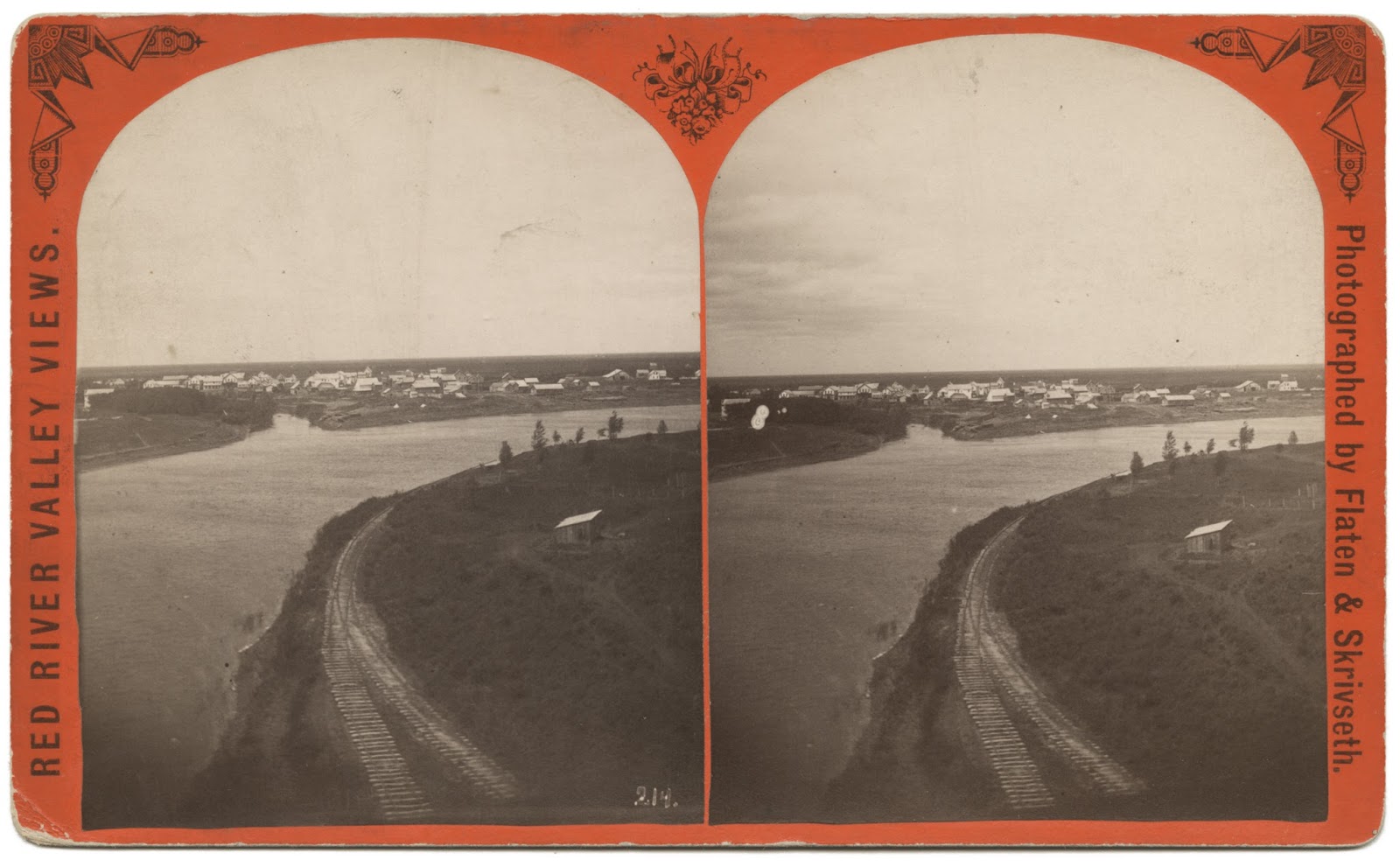
"...reserved a right-of-way along the top of the river bank"

PHOTO INFO: A stereoview showing the railroad track along the eastern bank of the Red River in St. Vincent.  This track is the continuation of the one coming in from the east into town from the "Y".  This was laid down early on in anticipation of the main line going through town and over the river, but a rail bridge was never built.

Swan Anderson would get fan mail from people far and wide that had once lived in St. Vincent and the surrounding area, generated from his newspaper columns for the Enterprise, and even from his toll-free phone number into his home. Swan kept sharing history even when he was in the nursing home. And thank goodness he did.

Speaking of fan mail, let me share with you a letter Swan received from the LeMasuriers of Ontario, California; as many reading this may remember, the LeMasurier family lived in St. Vincent at one time.  This letter shares some more history about St. Vincent and the railroads. Please note that the story told in the letter is second-hand, being told to the LeMasurier family by George (aka "Shorty") and Bessie Cowan. That does not make it any less true, but I wanted to be sure everyone knows the chain of how the story came to us.

Read on...

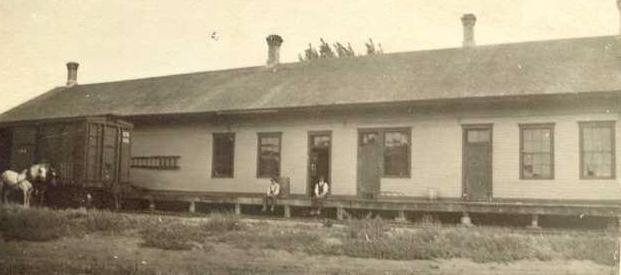
Before the turn of the century and when the railroad from Winnipeg east wasn't finished, St. Vincent was a booming railroad town. The round house was out by Lake Stella and had a turntable to turn the engines around. The long depot in St. Vincent housed the Customs and Immigration offices. There was also a Signal House. In 1901 William LeMasurier bought it and moved it to his farm north of St. Vincent. He and his bride, the former Maggie Easter, started housekeeping there in 1902. The land north of St. Vincent and west of the Emerson road was all railroad land. Phillip LeMasurier bought some and later sold it to his sons, William and Arthur. John and George Cowan bought some, also Mose Parenteau and Austin Griffith. The railroad reserved a right-of-way along the top of the river bank. Bessie Cowan told me at one time the railroad had planned to build a bridge across the Red River on Shorty's land.

The land that the railroad bridge would have crossed into/from is located on this plat map in the northwest corner of Section 35, labeled George Cowan . . .
The Great Northern Hotel was a three-story building with a ballroom on the third floor. Bessie Cowan gave us a picture of it and we left it with the Pembina Museum when we left St. Vincent. When the hotel was torn down, the attached section that was the kitchen was bought by the Russells and made into their home. Later, Harold Easton bought it and finally Milton Gregoire bought it and tore it down, and built what is now known as the Nellie Blair house.

There was a strip of land from the Red River to the Emerson road, 137 acres in the Village of St. Vincent on its north side. Austin Griffith bought the 36 acres next to the Emerson road and Charlie LeMasurier bought the rest from Peter Monro. Harris remembers when Charlie had a lot cleared along the river. The man doing the work used oxen. Mrs. Morrow, who lived in St. Vincent, used to pick roots and would give Harris fifty cents to haul a load to town for her.

Tuesday, May 14, 2019

Working on the St. Vincent Extension

Recently, I came across an online post by someone who mentioned that his grandfather had worked on the St. Vincent Extension line.  While the original line was finished in 1878, there were modifications to, as well as major maintenance of, thereafter.  It was a few years later, that his grandfather worked in our area.  I asked him if he had any stories or photographs of that time period, and he shared this with me...
This is my paternal grandparent's family -- Charles & Mary [Hendrickson] Torrin, Hilma the oldest, My father, Oscar in the back, with Maybelle behind Mary. The little girl in front, Luella, helps us date the picture; she was born in Roseau County, on the newly purchased farm, in 1901. She died of diphtheria in 1908, just weeks after her little sister was born. Charles was functionally blind from railroad work accidents, and was about 46 when he moved north and purchased the farm near Fox, between Badger and Roseau MN. 
St. Paul Daily Globe, November 29, 1893
My grandfather, Charles Torrin, was a line foreman laying track. In 1891, a sliver of steel flew up into his eye. A year later, he was back at work, and a similar event pierced his other eye, leaving him functionally blind. The family returned to Alexandria to recover. The event was noted in a St Paul paper at the time. 
The story only just begins here. After several years in Douglas county, at the age of 46 and blind, he bought a farm in Roseau Co, in 1901, and raised his family there until his death in 1929. 
His father, Oscar Torrin was born in St. Vincent in 1891 while his grandfather was working on the St. Vincent Extension.


Saturday, September 29, 2018

Union Family


Lena Cameron Mortimer was born into a farming family in St. Vincent, Minnesota.  She became a Socialist Party activist and married the Journeyman Tailors Union of America (JTUA) union leader, John Mortimer in Winnipeg in 1901.  They had several children before he drowned crossing the Red River near Emerson, Manitoba in an accident, in 1908.


LENA MORTIMER:  One Woman's Way of Thinking

As I passed out through the crowd as it was dispersing on Sunday evening after the meeting at which Comrades Pettipiece and Fitzgerald were speaking on the Woman question, I chanced to hear a few remarks from some of the men that had been present at the meeting which struck me as rather amusing.  One of the worthy bunch said in a rather sneering way:  "What!  Give the women a vote?  Not much, their place is stay at home and minding their business, let us men do all the voting." 
To me, of course, it was the same old yarn.  I have heard it so often that I cannot keep silent any longer.  Some of the men do not stop long enough to think just what a very important part a woman does fill in this life.  If we women are fit to be mothers of their children; fit to teach those same children in the schools, and fit to fill most every position in life, then by all that's good and holy we are able to stand shoulder to shoulder with our noble brothers and cast our vote along with them for the one great cause for which we are both fighting, the only cause that will benefit the working men and women of today. 
"Men say that we women do not have sense enough to vote the right way.  Ditto, my brother!  Could we possibly make it any worse than you have made it by your way of voting?"
Men say that we women do not have sense enough to vote the right way.  Ditto, my brother!  Could we possibly make it any worse than you have made it by your way of voting?  Give the woman a chance.  Let her once grasp the situation and see if she won't vote right.  Treat her as an equal and try to help her get hold of a few socialistic ideals.  Help her to see what it all means.  Give her as fair a chance as you would give a man and you will find out that she can grasp the truth just as quick as any man. 
I believe it is up to every woman in...any place on top of this old earth, to get busy, and dig down and find out for herself just where she is at and if some of the men turn up their noses at our feeble efforts, go to it with more heart than ever.  Prove to them that if given a chance we can at least use our vote to as good advantage as they have in the past.  We cannot make matters any worse than they are making them right now.  So go to it, my sisters.  Show them if we are fit to be mothers of the coming generation of Socialists we are fit to march to the ballot-box and vote the right way just as soon as you men give us a chance.  And fit to share equally with you all the comforts that Socialism will bring when the men as well as the women get into their heads sense enough to vote the right way to hasten its coming. 
[Source:  Lena Mortimer, "One Woman's Way of Thinking," Western Clarion (Vancouver, BC), 27 May 1911.]

Friday, September 28, 2018

1907 St. Vincent Main Street

The carriage looks suspiciously like our 'Mystery Man' again!  Could it be?!
Source:  Digital Horizons, State Historical Society of North Dakota, via Pembina Historical Society
This shows the main street in St. Vincent, Minn. in 1907. Many buildings line the street and electric lines are visible. Notice the street is unpaved and there are wooden sidewalks present.

This street leads down to the river where it curves to the north for a short way, to where the ferry crossing is that takes people, wagons, etc. over to Pembina on the Red River. At the far end, where years later a bridge will be, you can make out buildings. Down in that area, at this time, is an elevator and a brewery, among other businesses.

St. Vincent Engine No. 1,  on display during the 155th Town Reunion in 2012
The firehall, its bell tower seen on the left (south side) of the street, is new, just built in 1903, housing a new fire engine, St. Vincent Engine No. 1! Directly behind the horse carriage on the right , behind the electric light post, is a short awning. That is the St. Vincent Bank. The larger awning to the right is over the entrance to the Nelson Green store. That same lot is where the Valley Community Church (later the St. Vincent EFC) was located.

Out of view, on the left, is the railway depot, platform, and tracks, which go south of the firehall running east/west. At one point, the tracks also went down to the river and curved around to the north, where the plans had been to build a railway bridge. Unfortunately, that never happened and that change significantly impacted St. Vincent's growth. Those tracks were later removed, and the rails into St. Vincent dead-ended in town. For over 70 years, St. Vincent had freight and passenger service as a sort of consolation prize, but it was ultimately doomed. For its first 30 years or so, it served an important role in bringing thousands - yes, thousands according to many newspaper articles - of settlers north and west, on the railroad. Most did not stay in our area, but only passed through.

In 1907, the town was already quieting down, but still a busy small town around 300 population. Right across the river, its counterpart and neighbor - and in the past, part of the same territory - was Pembina, around 600 or so at this time. So the 'twin city' area has a lively community of citizens, schools, churches, businesses, and surrounding farms. A great place to live, work, and raise families...

Wednesday, August 01, 2018

Headlines: New Year 1908, Bullet Dance, & Ferry Franchise


Pioneer Express
January 3, 1908

The New Year was ushered in by the bells of the city echoing with those of St. Vincent and Emerson, assisted by about a half dozen locomotive whistles, at the roundhouses, proclaiming twelve o’clock. There are not many places on the American continent where two states can join hands with Great Britain and celebrate the dawn of a New Year.

* * * *

Pioneer Express
January 31, 1908

A One-Armed Joker

There was a grim, capital joker at Noyes, Minn., last Thursday night and the details of the affair were kept somewhat quiet by the victims, but at last have mostly leaked out. It seems that a one-armed man, who had lost his limb in the Boer War, was on the train coming south and not being provided with proper credentials, the U.S. immigration inspector had him put off the train at Emerson. The man then walked to Noyes, just across the line, and armed with a revolver and bowie knife held up the employees there about a half dozen in number. He amused himself by shooting out window glass and at other prominent targets. Mr. MacKay, the agent, slipped out and went to his residence and got a shotgun, but the man was onto his game and waylaid him as he came back and took the gun away. There are various stories of how he lined up the employees and made them practice military steps and formation, showing them how to step with pistol shots fired in the direction of their feet. He locked Mr. MacKay up in the private office. He also opened the money drawer in the safe and, observing the small amount there, said he did not need that as he had much more already and showed a couple of big rolls as proof. After keeping guard over the unfortunate crowd for about four hours, but taking nothing from them, he left, went back to Emerson, slept in a barn all night; next day he walked to Ridgeville and took the train from there for the east.

* * * * *

Pioneer Express
February 7, 1902

Meeting notes of the Pembina city council

W. G. Deacon, village recorder of St. Vincent and lessee of the Minnesota site of the ferry, was present and addressed the council on the subject of building a new ferry boat. The council spent considerable time in discussing the matter, and on motion of Alderman Miller, Messrs. Short, LaMoure and Price were appointed a committee to investigate the condition of the old boat and to find the approximate cost of a new boat and to look up any other matters in this connection and to report the same at a meeting of the council to be held on Monday, February 10th, next. F. A. Wardwell, Auditor

Same issue -

The City council are wrestling with the ferry problem. A new boat, has to be built which will cost anywhere from $350 to $600 according to plan. St. Vincent wanted this city to build half the boat, or if they build a boat for us to pay $100 a year rental. It would be preferable for the city not to have anything to do with the boat at all, but let the ferryman furnish his own boat. But nobody would build a boat on a one year franchise and there are many objections to letting it for five years, which would be the least term that anyone would take and build a boat. The fact that there are two ends to the ferry, one owned by St. Vincent and the other by Pembina, makes complications which must be provided for or make trouble. The St. Vincent people seem to be willing to act fairly, and it is probably the matter will be settled all right finally.

* * * * *

Pioneer Express
February 21, 1902

Bids For Ferry Franchise

Bids will be received by the City of Pembina for the running of a Ferry across the Red River, landing within the corporate limits of said city, as follows -

First-Bidders shall state the highest amount they will pay the city for the ferry franchise for the season of 1902, the city to furnish boats ad other necessary apparatus.

Or, Second – Bidders shall state the highest amount they will pay this City for the Ferry Franchise for a term of five years; such bidders also agreeing to furnish good and suitable boats and apparatus for that time at their own cost and expense.

Bids for the one year franchise and for the five year franchise to be in separate envelopes.

Bids for the one year franchise shall be for cash in advance on acceptance of bid by the city.

Bids for the five year franchise shall provide for two equal, annual payments each year, the first payment to be cash on acceptance of bid by the City Council and each other payment to be cash in advance, July 15th, and April 15th, respectively each year.

Each bid must be accompanied by a certified check payable to J. M. Chisholm, Mayor, or by cash, to the amount of twenty-five dollars, to be forfeited to the City of Pembina if the bidder refuses or neglects to give suitable bond for the carrying out of the contract and franchise, if his bid be accepted – otherwise said moneys to be returned to bidders.

Bids should be sealed and endorses “Bids for Ferry Franchise” addressed to the undersigned and delivered to him, or placed in the post office at Pembina on or before 6 o’clock p.m., Feby.24th, 1902

The City Council reserves the right to reject any or all bids.

By order of City Council
F. A. Wardwell, Auditor

Monday, July 09, 2018

PROFILE: Captain John A. Vanstrum

I present to you, one of St. Vincent's early pioneers - John A. Vanstrum. A veteran of the Civil War, he became very civic-minded, serving the town and later Kittson County, in many positions. One of his longest-held was as Sheriff.  Serving at roughly the same time, he was Sheriff Charley Brown's counterpart across the river!

Captain John A. Vanstrum, register of deeds for Kittson county for the past decade, a pioneer citizen of the great northwest and a valiant soldier of the Civil War, is now a resident of Hallock, Minnesota, where he enjoys the esteem and confidence of a wide circle of friends and admirers. His portrait [seen here on right], will be appreciated by his host of friends. Captain Vanstrum was born in the province Gustaf and Elizabeth Vanstrum. The parents died in Sweden, their native land. Captain Vanstrum received but a limited education in his boyhood, having to assist his father in a paper mill from his tenth to his sixteenth year. On June 22, 1855, in company with about two hundred emigrants, he left his native land, sailing from Gutenberg on the vessel Ann Washburn, commanded by Captain Winchell. The vessel was heavily laden with Swedish iron for Boston merchants. He arrived in Boston harbor August 6, 1855, and proceeded to Chicago, thence to Batavia, Illinois, where he spent the winter of 1855-6, working for his board and attending school. In September, 1856, he went to Minnesota, via Dunleith, now East Dubuque, Illinois, thence up the Mississippi river, and located at Redwing. Minnesota, where he engaged as clerk in a store.

At the breaking out of the Civil war Captain Vanstrum was residing at Redwing, Minnesota. He immediately offered his services and assisted the late Colonel H. Mattson in recruiting Company D, Third Minnesota Volunteer Infantry, and was mustered into service in October, 1861 at Fort Snelling. The Captain went to Chisago county, Minnesota. where he raised some thirty volunteers (Swedish) for Company D. These men he transported in wagons all the way from what was then known as Center City via Taylor's Falls, Marine Mills and Stillwater, through St. Paul to Fort Snelling, where they arrived October 18, 1861, and on the following day were mustered into service. Captain Vanstrum was appointed sergeant of Company D in October 1861, was promoted to second lieutenant March 30, 1862, first lieutenant May 30. 1862, and Captain of Company D August 2. 1862. He re-enlisted with the same company as a veteran, under the veteran enlistment act, at Little Rock, Arkansas, early in January, 1864. He was honorably discharged with his regiment at Fort Snelling September 17, 1865. His record in war, as it has continued to be, is that of a brave and fearless defender of the Union and the old flag. In 1879 Captain Vanstrum went to Kittson county, Minnesota, and located at St. Vincent, where he was postmaster from 1879 until 1885. In the latter year he resigned his office and during that period the post office at St. Vincent was of more than ordinary importance. It was the international exchange office for all registered mail matter passing between the United States and the northwest Canadian provinces. All registered letters are re-registered at the St. Vincent office. From 1879 to 1885 this office ranked third in volume of registered mail from Minnesota.

Captain Vanstrum was sheriff of Kittson county from the date of its organization, April 8, 1879, to January, 1889, and is at present register of deeds of said county, having held that position continuously since the fall of 1891. Politically the Captain is an uncompromising Republican. He is a member of the I.O.O.F., and is one of the representative men and pioneers of the northwest. (International Order of Odd Fellows)

Source:  Collections of the State Historical Society of North Dakota, Vol. IV (1913)

Thursday, July 05, 2018

History of the Kittson County Bench & Bar

"The term was finished in two and a half days, and the balance of last day, awaiting the arrival of the train south, was spent fishing by the court and attorneys, after each catching his own frogs for bait. To the younger members of the bar it was rather an amusing circumstance to see Judge Stearns, then well up in years and of a very dignified and patriarchal appearance, lay aside his judicial dignity and pursue the diminutive amphibians with an agility which surprised them all."
And such were the salad days of early Kittson County law!

To learn more about it, read on...
_______________________

Bench and Bar of Kittson County
By Peter H. Konzen

Foreword by
Douglas A. Hedin, Editor
Minnesota Legal History Project (April 2008)

The article that follows is a highly personalized history of the bench and bar of Kittson County written by Peter Henry Konzen, a prominent attorney. After devoting two pages to early terms of the district court, Konzen announces that he will avoid “the monotony of legal routine” by describing two amusing trials—the prosecution of Kate Rafferty before Ozora P. Stearns, a legendary judge of northern Minnesota, in 1883, and a civil suit for damages for the killing of a dog, in which he represented the plaintiff, in 1888. Konzen’s client was awarded an amount somewhat less than he sought.

In the style of most county legal histories of this period (it was published in 1909), Konzen includes biographical sketches of eight lawyers who practiced in the county, the longest being of himself. Apparently finding the opportunity irresistible, he wrote, Mr. Konzen is recognized as one of the ablest and most prominent attorneys north of Crookston, and during his residence at Hallock has amassed a snug little fortune, besides building up a professional and business reputation of which he may well be proud. He has helped in an eminent degree to shape the destiny of his city, and when the history of Kittson shall be written he will appear as one of its most conspicuous figures.

There is an ironical footnote to this flattering self-portrait. Konzen died on July 15, 1935, twenty-six years after the publication of his article on the county bench and bar. His death was headlined on the front page of the Kittson County Enterprise on July 17, 1935. The newspaper described not only Konzen’s final days but also, under the subheading “Biography,” his youth, education and early years in the county. Almost all of that “biography” was taken verbatim from Konzen’s earlier self-portrait. Thus Peter Henry Konzen was placed in the unusual position of writing much of his own obituary.

Passes To His Eternal Reward
Peter Konzen, Pioneer and Highly
Respected Citizen Passes Away
After Long and Useful Service
to City and Community

Peter H. Konzen
Today Hallock mourns the passing of one of her most outstanding venerable citizens and townsmen. Peter H. Konzen, who died at his home in this city on Monday, July 15th at the age of 78 years, one month and 18 days—he has gone his reward. Hallock never had a finer citizen and more devoted father.

Quiet, unpretentious, wonderfully human and amazingly competent, he represented the best that a city can expect from its citizens. His more than half a century of life in our city was a precious gift to his fellows. He had done much good and was ready day or night to serve the needs of anyone who called on him. He never made any fuss about living—he just lived, which is a priceless legacy to those of us who are inclined to philosophize.

He was a man of quiet, retiring disposition and minded his own business, both with reference to himself and others. In his youth, he was of good physique, but of late years had suffered afflictions incidental to advanced years, which at times confined him to his bed and home. About a week before his death he again became afflicted and gradually and slowly sank, growing weaker and weaker, with but little pain until about three days before his death when he became overcome with chills. At the last, however, death came peacefully and quietly, and while apparently in sleep, his breath came slower and slower, until the last. All of his family were at his bedside excepting a daughter, Mrs. F. V. King, who in a race with death across the continent failed to arrive in time to see her father alive. During his final illness he was watched over by members of his family and friends and a special nurse.

The funeral services were held from St. John’s Episcopal church Wednesday afternoon with Rev. S. J. Hedlund officiating. The cortege was the largest ever gathered in Hallock, which testified to the high esteem in which the deceased was held in the community. The active pallbearers were members of the Kittson County Bar Association of which the deceased, was a member. They were: A. D. Bornemann, Wm. L. Peterson, J. E. Sundberg, C. J. Hemmingson, John Matt Brendal, Lyman Brink. The honorary bearers were twenty pioneer citizens of the town. The district bar association also sent delegates to attend the funeral. These were: L. S. Miller, Martin O’Brien, Wm. P. Murphy, W. E. Rowe, F. A. Grady, Crookston; H. O. Chommie, C. M. Bishop, Theodore Quale, Thief River Falls; Judge B. B. Brett, W. O. Braggans, Oscar Knutson and Rasmus Hage, Warren.

The remains were laid to rest in the family lot at Greenwood cemetery, beside those of his wife who preceded him in death several years ago, and thus has passed away another of our old timers—they are passing away and soon only their memories will be left. May they all leave as pleasant recollections as does our friend and venerable townsman—God rest his gallant soul.

Biography

Peter H. Konzen was one of the pioneers of Kittson county, having located here in the spring of 1881, when a young man of 24 years. He was born on the 27th of May, 1857, in Chickasaw county, Iowa, on a farm now embracing the site of the village of Lowler. His parents emigrated from Germany in 1852 and the following year located on the farm upon which deceased was born. He was the third child of a family of five, all of whom have since passed away, excepting one, Mrs. Kate Buchholz living at Forest City, Ia. He was educated in the public schools of Lawler, afterwards attending an academy at Bradford in that county and completing his education at the University of Iowa City and at Boyleer’s Mercantile College at Keokuk, Iowa. His boyhood life was spent upon the farm until the age of 17 when he began teaching while completing his education.

In 1878 he began the study of law, first in the office of Judge H. H. Potter at New Hampton and afterwards under the direction of John R. Geeting, a gentlemen who later rose to considerable distinction as a criminal lawyer in the city of Chicago. Mr. Konzen first came to Minnesota in 1879 and entered the law office of a Mr. Parker at Sleepy Eye, where he remained until the fall of that year when he again returned to Iowa to enter the newspaper business, editing the Lowler Herald until the spring of 1881, when he sold out and returned to Minnesota and locating at Hallock, then a hamlet numbering not more than half a dozen buildings, where he opened a law office, and in the words of the immortal Horace Greely, “grew up with the country.”

In the fall of 1881 Mr. Konzen was elected superintendent of schools for Kittson County which position he held for several years, having been three times re-elected. He had since held various public offices, as County Attorney, president of the Kittson County Agriculture Society and in 1898 was the Republican nominee for member of the state legislature. Although defeated by the tide of populism at that time, he received a creditable vote and conducted a model campaign. In 1916 he was again the nominee for his party for member of the state legislature and this time was elected by a comfortable majority. Mr. Konzen was one of the most progressive and public-spirited citizens in Kittson county. He was for many years a member of the Hallock school board, and it was chiefly owing to his push and perseverance that this thriving little city can now boast of a high school second to none in the state. Mr. Konzen was elected mayor of Hallock in 1897 and held the office for a dozen or more consecutive years to the eminent satisfaction of her people. He had also served as a member of the state drainage board, probate judge and in his time had filled various town and village offices, so that he had helped in an eminent degree to shape the destiny of his beloved city and community.

During his early career in Hallock, he was associated in the law business with W. H. Alley, now deceased, and in 1901 Mr. Konzen and J. D. Henry formed a co-partnership for the purpose of conducting a real estate, loans, insurance and collection business in connection with the law business. Mr. Henry is not a lawyer but handled the insurance, loans, collection and real estate business of the firm and was very successful, especially in the sale of real estate. Konzen’s article appeared first on pages 944 to 951 of the second volume of History of the Red River Valley. It has been reformatted. Page breaks have been added. His spelling and punctuation have not been changed.

Bench and Bar of Kittson County
From:

IN
HISTORY
OF
THE RED RIVER
VALLEY
PAST AND PRESENT


Including an Account of the Counties, Cities, Towns
Villages of the Valley from the Time
of Their First Settlement and
Formation
BY VARIOUS WRITERS
IN TWO VOLUMES
VOLUME II
__________________

ILLUSTRATED
__________________

HERALD PRINTING COMPANY
GRAND FORKS
C. F. COOPER & COMPANY
CHICAGO
1909

Bench and Bar of Kittson County.
By P. H. Konzen.


Saturday, May 26, 2018

Memorial Day: Edkins Brothers

Percy's grave is in the
St. Vincent Cemetery
Sgt Major Percy John Edkins
U.S. Marine Corps
On May 18, 1917, the Selective Service Act was passed authorizing the President to increase temporarily the military establishment of the United States.  In 1917, all three Edkins brothers enlisted, trained, and went into the war.

Percy Edkins, born in St.Vincent, worked as an assistant cashier at St. Vincent's Farmers' & Merchants' State Bank at the time he enlisted in the Marine Corps.

Once he got home, Percy married a Gamble descendant  (Alexander Gamble's granddaughter), Alice Griffith.

Percy is listed as a cashier at the St. Vincent Bank; 
Roy DeFrance was the Local Draft Board's Registrar
At the bottom of this post is a page from a book listing all known Kittson County veterans; the book is held by the Kittson County Museum.  This particular page lists the Edkins brothers including their military record...

Friday, April 27, 2018

The Litchfield Brothers - "...Minnesota beckoned them in 1862"

Electus Backus Litchield
"Flagrantly & monumentally impudent"
How did the St. Vincent Extension (which was the rail line between east St. Cloud and St. Vincent) get made?  Well, it so happens that St. Vincent had its own version of "Hell on Wheels"... 

In the course of his various "business enterprises", E.B. Litchfield is said to have bought many an elected official. Except for one: Populist Congressman Ignatius Donnelly of Minnesota. While Donnelly worked for all the railroads in Minnesota at one time or another, he refused to continue working for E.B. Litchfield and the First Division St.P&P RR.

While lobbying Congress to expand the St.P&P RR land grant to 10 sections (square miles) per mile of track built, E.B. needed the help of members of Congress. Railroads would sometimes hire sitting members of Congress (and other elected officials) to serve as their "legal counsel".

In 1868, Donnelly wrote to E.B. regarding his $1,000 "retainer" and position as legal counsel to the First Division: "The matter has given me no little uneasiness of conscience. I have been laboring under the fear and dread I might instinctively be willing to do more for your company as attorney than I would if I did not hold that relation to it." Donnelly even offered to return the $1,000 or perform some actual legal services for the money.


Electus was just one of five Litchfield brothers, all involved in one way or another with the railroad business.  Their main involvement: Investment.

Edwin Clark Litchfield was put in charge of the First Division.  He agreed to finance the branch line from St. Paul to St. Cloud.  To the Associates1, he was a greatly vexed investor, "a wary old bird".  The Associates had trusted allies in Horace Thompson and Edmund Rice, who promised to "leave no stone unturned to bring about a reconciliation" between the contending parties.  If they failed, the Associates had contingency plans "to handle, with or without gloves on," Litchfield, Becker, Farley, and anyone else who got in the way.  They had not come this far only to lose the much-coveted land grant from St. Paul to the Canadian Border.

Source:  Google Books
A second act, one of the many "special acts" of the Minnesota legislature appropriating funds to further build out the railway lines, provided for another land-grant line - an extension branch from St. Cloud to Minnesota's northern border at the town of St. Vincent.

1867 was the year the British North America Act granted Canadians their political independence.  "Knowing that newly independent Canadians would soon embark on their own transcontinental railroad schemes, SP&P directors held a special stockholders meeting to map out ways to pull northern wheat-growing riches down a proposed Canadian Pacific Railroad (CPR) branch line from Winnipeg to the international border, through St. Vincent, and then down into St. Paul.  On the strength of this scheme, the state legislature gladly renegotiated the land grants, rescheduling their completion for 1878."

The plan was for SP&P to construct a northern extension, connecting first with the NPR main line near Fargo, then with the proposed CPR branch line at St. Vincent.

Elisha Cleveland Litchfield
One of the brothers who swooped in, bought up several
railroads,  and sold them for profit as fast as possible. . .
Erasmus Darwin Litchfield - genially called "the old rat"...was "ornery" and "obstreperous")

Egbert Savage Litchfield (youngest brother) - Sent to St. Paul at one point to oversee and manage the brothers' investments in the railroad.  In 1868, Egbert became James J. Hill's early partner.  Soon, Hill began emerging as a businessman in his own right.

"The Litchfields' capital propped up the railroad's coffers and accelerated construction into the the state's already populated agricultural regions," and towards the Red River Valley (which the state legislature had recently approved a special act securing $3 million in bonds for railway construction projects...)

TriviaNP used contractors to build the St. Vincent Extension.

To break it down to its simplest terms, the Litchfield brothers simply "went where the money was". [See the Brooklyn Historic Railway Association's incredible article about the slippery Litchfield Brothers, and their particular involvement with the building of the railroad that eventually included the St. Vincent Extension...]
Question: Where did all the money the Litchfields stole from Brooklyn go? 
Answer: To an attempt to take over the lands and railroads of the northwestern United States (Minnesota) via federal railroad land grants and other financial tools, and then mortgage this wilderness property to unwary European investors (the Dutch) at vastly inflated sums.
No doubt E. B. Litchfield used his brother E. Darwin Litchfield, then a London banker, to launder the money hijacked from Brooklyn to acquire all the stock of the St. Paul & Pacific Railroad First Division, their new land and railroad speculation entity in Minnesota, which already owned 307,200 acres (480 square miles) of federal land grants. The Brooklyn loot was likely used as seed money to construct more track in Minnesota, thereby leveraging more massive federal land grants, which in turn enabled E. B. Litchfield to issue more St. Paul & Pacific securities in Holland with these land grants used as collateral.
It should be noted, that the activities of the Litchfield brothers, as well as that of governmental officials, was quite the norm for the time period. In fact, "Robber Baron" business practices as well as "Urban Machine Politics" are considered to be two of the three "antecedents" of Organized Crime in the United States. (See Organized Crime by Howard Abadinsky, 1997, pg 39-69.)

Trivia: The construction of the St. Vincent extension was promptly put under contract, and large quantities of rails and fastenings for track were imported from England. These were of iron, weighing 30 pounds per linear yard, and went from Buffalo to Duluth by lake. Their cost at the latter point was reckoned at about 90 per ton. Construction proceeded with vigor, and, for the methods of those times, with rapidity, until shortly after the financial collapse in 1873. [Source:  Minnesota Historical Society, James J. Hill Papers "The Great Northern Railway System"]

1 - The Associates were George Stephen, Donald Smith, James J. Hill, Norman Kittson, and E.S. Litchfield. Hill enlisted the support of Donald Smith and his equally wealthy cousin, George Stephen, of the Bank of Montreal, in getting control of the steamboat business on the Red River, the route to Winnipeg. Their syndicate, “George Stephens and Associates,” comprised Stephen and Smith, as the financiers, Norman Kittson, The Hudson’s Bay Company’s Minnesota agent, operating the steamboat line, and Hill, their St Paul freight forwarder. Once in control of steam navigation on the Red River, the Associates then went after the bankrupt St. Paul and Pacific Railroad which they intended to complete to the Red River and a connection with Kittson’s steamboats.