Showing posts with label neighbors. Show all posts

Sunday, March 15, 2026

PROFILES: My Grandmother’s Friends

Left to right:  Mrs. Zaharia, Margaret 'Toots' Ryan, Florence Godon, Esther Cleem (Florence and Esther were Thiefault sisters...), and Alberta 'Pat' Fitzpatrick Baudette, and in front, my grandmother, Elizabeth Fitzgerald Fitzpatrick in the wheelchair...

All the women in this picture (with the exception of my Aunt Pat who just happened to be home visiting that day...) were part of a group of friends who regularly hung out with one another, on an almost daily basis.  Growing up in St. Vincent, I saw many of them myself daily, as we all went about our business.  Most of the time, they were busy keeping house, looking after their families.  But as they went about their days, they would often run into one another at stores or church, in their yards or on the street, or stop by and visit.  Years ago, there was no common desire to avoid people and self-isolate as is common today; quite the contrary - most people sought out opportunities to socialize, to catch up.  

Names that still conjure up well-remembered faces and voices:

  • Mrs. Zahara (a Ukrainian lady whose strong accent made me nod a lot without knowing a thing she was actually saying), 
  • Matilda Cameron (a well-regarded seamstress whose second husband Wallace Cameron was a famous town constable), 
  • Esther Cleem (who along with her husband were victims of a home invasion turned deadly), 
  • Mrs. Gardiner (whose family tragedies rivaled my own Aunt Lena’s), 
  • Florence Godon, whose husband Bill worked for many years with my Dad at the Noyes depot,
  • Toots Ryan (good friend and neighbor-across-the-alley of my grandmother),
  • Glenice Friebohle (good friend of my mother’s), 
  • Ena Scobbie (wife of first pastor I remember of St. Vincent Evangelical Free Church), and 
  • Cousins Hattie  Schwenzfeier, Annie Nordine, Mabel Steien, and Faye Lyberg.

They all loved to gab, to share news and gossip, and to have a good laugh.  In other words, they loved to visit!  They were never at a loss for words.  There were no awkward silences.  If anything, people spoke over top of one another at times, interjected at others, and at still other times, the room divided into two or three subgroups like modern-day ‘threads’, multiple simultaneous conversations, and later came back into one again.  

The one who was more often than not dropping by Grandma’s place, or she to her’s, was Toots Ryan.  Toots lived north of Grandma’s place, just out the back door, through the back yard, and across the alley.  As you’d approach Toot’s house, you would notice the steps were higher than most around town.  That’s because the house had been put up on a higher foundation, my guess to protect the home’s contents in case of flooding.  It was the only house like that in town, but I later thought that was pretty smart thinking.  But as a little girl, the time period I knew Toots well, it never crossed my mind - it was just the way it was.  Her steps were harder to get up than my Grandma’s, each one a bit taller than normal, so I’d have to lift my little legs especially higher and give an extra hrmph to lift myself up.  The top step was a length of railroad tie, then the highest step of all over the lintel into the house proper.  

The door led into the kitchen, which as I recalled had one length of counter along the west wall.  There was a sink like at home, but instead of a faucet and water turns for hot and cold, there was a hand pump, which brought up water up from a private well under the house.  I have a feeling there was probably more of these at one time, but to my knowledge it was the only one left in town by then, the early 1960s.  There was still a town hand pump just kitty-corner from the Ryan home, by the town pond and curling rink.  Knowing more now historically, I think the town pond and pump may have served multiple reasons - for watering animals, water for people, water for fighting fires.  Heck, Grandma would have me go fetch buckets of water for her, to water her garden during the summer, since drinking water for her cost her precious money; at that time, most of us had our water brought in by water trucks, costing x-amount much per 1,000 gallons, stored under the house in cisterns. Anyways, I always thought it was so interesting that Toots still pumped her water.  She had a big stove in her house, too, but I never noticed what kind it was.  

The only other room in the downstairs was her parlor.  The first time I saw the parlor was on a visit to Toots with my Mom; in the parlor were two chairs, and a piano.  I hadn’t started playing the piano yet, but we had one that I was always tinkling on at home, showing an interest in learning already.  So it wasn’t surprising at all that I headed straight for it the first time I saw hers.  It had a fascinating seat, not a bench like ours, but a stool.  I found out immediately that it could be adjusting in height, delightfully by spinning it to the right for up, or left for down.  The stool’s feet looked like the claws of an animal, and clutched within those claw were small, clear, crystal balls.  I opened the lid to the keys to see keys that had faint marbling and yellowing, which I later learned meant they were real ivory keys made from elephant tusks.  A few were missing, but most were still there.  The really cool part was when I began ‘playing’ the keys, I learned the piano was badly out-of-tune.  However, to me, that made is all the more special:  It reminded me of the pianos played in the old western movies on TV - in tune enough to make out familiar melodies, but enough out-of-tune to be an authentic saloon piano!  

Once I wore out my welcome on the piano, I jumped off to rejoin the women (my Mom and Toots, visiting…)  Toots was a shorter-than-average lady, who was almost as round as she was tall.  That day, I was probably about four years old.  I interjected into their conversation with the observation, “You’re really fat!”  There was sudden silence.  Then Toots erupted into what I can now only describe as jolly laughter.  My Mom directed a mortified, “Patricia Kaye!” Towards me.  Toots came to my rescue by saying, “Patricia Kaye, eh?  That used to be my favorite chewing gum!”  She got a kick out of my outburst.  I had no idea I had done anything wrong, stating the obvious.  Toots and I always got along famously after that early meeting - I would often run out my Grandma’s back door and run over to her house and into her house up those high stairs.  

But when Grandma had friends drop by, there was a lot of visiting…and always over tea and baked goods.  The visiting might start off slow and casual, and build up to stories filled with gales of laughter; or they might start out with an excited, “Have you heard…?”  Whether it was a neighbor, or a cousin coming from across the county, in those days, people would often just pop in, no call ahead - no one minded, in fact, it was an occasion to be excited about.  Out would come the teapots full of Red Rose tea, served up with bars, cookies, and sometimes even cake…but always plenty of tea!  If Mrs. Zahara was in attendance when I was there, I would avail her of her talents and beg her for a reading of the tea leaves. I wish I could recall at least one of those readings now…

Tuesday, July 07, 2020

NEW Book: Pembina County @ 150

https://drive.google.com/uc?export=view&id=1FGAe5IzVA-69YbhWI9F9a3pqa3-WRLNh

Jim Benjaminson shared today:  
Well, its getting closer to reality - "Sagas of Pembina County, 1867-2017" is at the printers.  A 148 page, fully indexed compilation of stories written for county newspapers in 2017-2018 with added material and historical photographs.  We'll let you know when it's ready!

Sunday, June 09, 2019

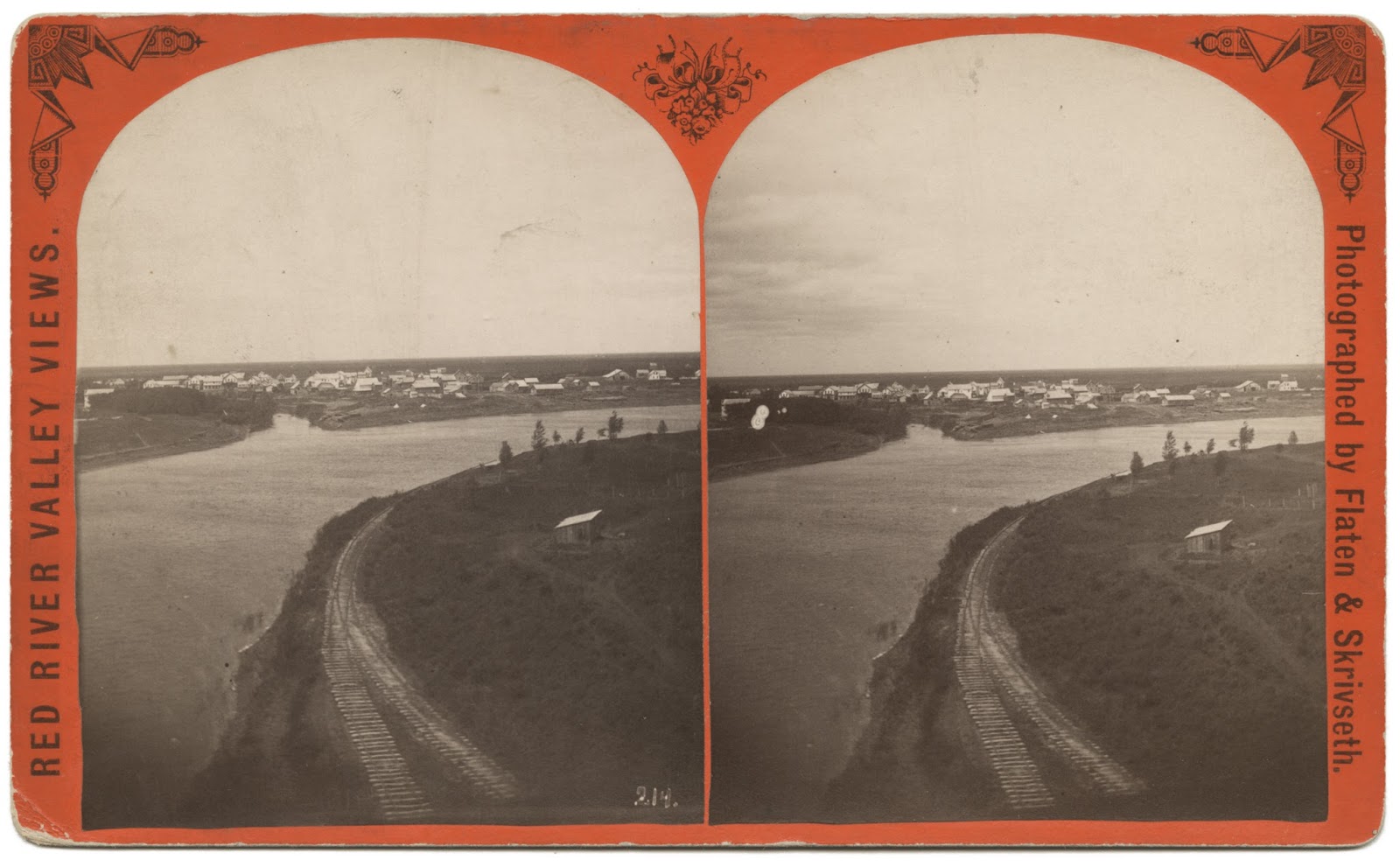
"...reserved a right-of-way along the top of the river bank"

PHOTO INFO: A stereoview showing the railroad track along the eastern bank of the Red River in St. Vincent.  This track is the continuation of the one coming in from the east into town from the "Y".  This was laid down early on in anticipation of the main line going through town and over the river, but a rail bridge was never built.

Swan Anderson would get fan mail from people far and wide that had once lived in St. Vincent and the surrounding area, generated from his newspaper columns for the Enterprise, and even from his toll-free phone number into his home. Swan kept sharing history even when he was in the nursing home. And thank goodness he did.

Speaking of fan mail, let me share with you a letter Swan received from the LeMasuriers of Ontario, California; as many reading this may remember, the LeMasurier family lived in St. Vincent at one time.  This letter shares some more history about St. Vincent and the railroads. Please note that the story told in the letter is second-hand, being told to the LeMasurier family by George (aka "Shorty") and Bessie Cowan. That does not make it any less true, but I wanted to be sure everyone knows the chain of how the story came to us.

Read on...

Before the turn of the century and when the railroad from Winnipeg east wasn't finished, St. Vincent was a booming railroad town. The round house was out by Lake Stella and had a turntable to turn the engines around. The long depot in St. Vincent housed the Customs and Immigration offices. There was also a Signal House. In 1901 William LeMasurier bought it and moved it to his farm north of St. Vincent. He and his bride, the former Maggie Easter, started housekeeping there in 1902. The land north of St. Vincent and west of the Emerson road was all railroad land. Phillip LeMasurier bought some and later sold it to his sons, William and Arthur. John and George Cowan bought some, also Mose Parenteau and Austin Griffith. The railroad reserved a right-of-way along the top of the river bank. Bessie Cowan told me at one time the railroad had planned to build a bridge across the Red River on Shorty's land.

The land that the railroad bridge would have crossed into/from is located on this plat map in the northwest corner of Section 35, labeled George Cowan . . .
The Great Northern Hotel was a three-story building with a ballroom on the third floor. Bessie Cowan gave us a picture of it and we left it with the Pembina Museum when we left St. Vincent. When the hotel was torn down, the attached section that was the kitchen was bought by the Russells and made into their home. Later, Harold Easton bought it and finally Milton Gregoire bought it and tore it down, and built what is now known as the Nellie Blair house.

There was a strip of land from the Red River to the Emerson road, 137 acres in the Village of St. Vincent on its north side. Austin Griffith bought the 36 acres next to the Emerson road and Charlie LeMasurier bought the rest from Peter Monro. Harris remembers when Charlie had a lot cleared along the river. The man doing the work used oxen. Mrs. Morrow, who lived in St. Vincent, used to pick roots and would give Harris fifty cents to haul a load to town for her.

Wednesday, April 24, 2019

Sociability Run: Jefferson Highway


[Note — General Manager McDougal of the Pershing Way [Association], who was for a short time Publicity Commissioner of the Jefferson Highway,  admits that he appropriated from the Jefferson many of the successful methods he is using on the Pershing. He also admits they are pretty good. 
We likewise are going to appropriate the story of his trip to Winnipeg, and in doing so likewise admit it is pretty good. That Manager [Herbert F.] McDougal has a microscopic eye, a retentive memory and a happy way of telling it is evidenced by what he saw and tells of his trip. 
Judging from his experience at the "Line", he should have borrowed the Jefferson's Rabbit Foot. 
Mr. McDougal's story will be read, with interest by the J. H. family, especially those who "made the trip" last July.  The following is an excerpt about the final leg of the run...]


AT Hallock the P. W. runs onto the Jefferson Highway marks and continues with them the rest of the way, going through Northcote, Humboldt, St. Vincent and Noyes to the International Boundary.

The Jefferson Highway touring group paused their sociability run 
in Emerson for "short" speeches and this group photograph...
Pro-lemonaders made another hit when Bronson was reached, where "most excellent lemonade was served" by the ladies. Decorations were mainly American and Canadian flags. Mayors Hodgson and Behrman spoke. The hotel menu at Hallock, a noon control, was a novelty, and uniquely distinctive over any other during the entire trip. Part of it was in French, and embraced dishes served especially in New Orleans. Banners and flags formed the principal decorative feature. Luncheon was served at the hotel and restaurants in the city. The Custom Houses of Noyes and Emerson were soon passed, owing to arrangements having been made beforehand. Short speeches were made by Governor Pleasant and Mayor Hodgson at Emerson.1
We had been sweeping along across the prairie, much of the time with no fences along the road, and came to a turn to the east along what, as memory recalls it, looked like the back side of a farm yard with perhaps an orchard bordered with forest trees in a sort of a scrubby growth. Straight ahead and eighty rods beyond was a dingy railroad station, and just before we reached it a turn to the right and north.

Before us loomed a signboard, high on stilts, announcing the "International Boundary," and there was a moment of bewilderment as we saw in one direction a road turning off to the station and in the other a pair of ruts curving around as entering the farm yard.

The original routing of the Jefferson Highway entered Canada directly from Noyes,
Minnesota into Emerson, Manitoba, Canada.   This is the approximate route the JH
followed. [Source:  Two Lane Traveler] NOTE:  The red line leading off 171 going
north was the 'Emerson Road' (dirt when I was growing up, now plowed under...)  
Over this seeming by-road was the remains of an arch1, placed there last July to welcome the Jefferson Highway tourists on their great sociability run, and the presence of the arch gave rise to the theory that this must be the entrance to the Dominion. Pursuing the tracks a bit further we were convinced that we really were on the highway into the neighboring nation, for at the side of the road was a glorified Keep Off the Grass Sign, bearing a solemn warning against going across the line without proper formalities.

The road took another turn and crossed a railroad track, which itself had crossed another track just previously. The one was the Soo, which ran along the margin of Canada, and the other was the Canadian Pacific, both heading for Winnipeg. All our pictures of an imposing entrance into Canada were dashed, as almost any country cross road is as pretentious. But still there was something picturesque about it and something that impressed itself upon the memory.

There are two railroad stations — one on the American side and one across in Canada, and at each immigration and customs officials, representing the two governments, are on guard. It looked as if it was a pretty simple thing, after all, getting into a foreign country, but it took just about an hour to do it, for a becapped official, swinging down the track to reach the switch tower and climb its dizzy steps to the bird-like house above, said that there was nothing to do but to report to the officials at the Emerson station, which took time and proved not to be the right thing, for we were first to go a mile or such a matter up town and be interviewed by the immigration official and get a card and then go across the street to where the Union Jack flew over the government building, and make our clearance at the customs office.

THE customs officials were polite, but inquisitive. They wanted to know how many in the party, what make of car, how many cylinders, its license number and factory number, whether it was equipped with windshield, top, speedometer and clock, and how much it cost, what baggage we carried and whether we had any camping equipment and how long we expected to tarry in Winnipeg.

Then a very nice old gentleman came down and rummaged through our suit cases in a formal and perfunctory way, withal rather thorough. But first there had come up the serious question as to the very typewriter on which this is being written. It is one of the folding sort and a constant companion. The G. M. would be lost without it, and the work of the organization would be hampered. It was rather important that it, too, make the trip into Winnipeg, for there would be the matter of correspondence and perhaps some magazine stuff.

But the officials were stern about it. They said that the wee machine was dutiable and that we had better put it in hock, so to speak, at the customs office to be picked up on our return, and to borrow a machine in Winnipeg. It looked as if the typewriter was to part company with the official car.

But the missus, waiting all this time down in the auto, said it didn't sound reasonable to her that a car and all that luggage could go in and a mere typewriter barred.

So we went back and argued that the typewriter was a tool of the trade and analogous to a monkey wrench in the tool box.

But these English are a fixed folk. They all had a look at the proposition, and turned it down; it wasn't regular. Then we offered to put up a cash bond, and finally succeeded in parting with $13 to that end, the money being in good American currency. Seeing the brand of money on deposit, a kind gentleman in the office suggested that we would be entitled to that sort back, as it was at a premium in Canada. So, on our return, we got $13.40 in Canadian currency, taking it across to the bank to be exchanged for American money. The rate of exchange had fluctuated during the walk across the street, however, and the bank demanded 50 cents instead of the 40 we had been paid.

And even at that we afterward discovered that we had a few Canadian bills in our script and had to give a discount on them.

BUT our troubles were not over yet. We discovered that our Canadian immigration permit, nor our clearance papers from the customs were sufficient; the becapped gentleman had deceived us. We had to go all the way back to the American side, to that little station of Noyes, to see a blue-eyed Irishman named Fahey in order to get a formidable document showing that Uncle Sam was willing to relinquish us for a few days.

That document had to be turned in to the Canadian customs officials, and then we were ready to go — all excepting the changing of a flat tire that had grown discouraged and depressed during all this formality. If we had known about the rest of that night that tire would have worried us.

But let us move on.

Over a bridge, combined wagon and railroad, under a viaduct we turned and then we were on the road to Winnipeg, sure enough. A little further and we were as good as in France, for, turning into a little village that proved to be Letellier, we grew uncertain of the way and stopped at a house to make inquiries if this were truly the way to Winnipeg.

The answer was "Oui, oui," which the doughboys all will recognize at once.

Turning just at the edge of that little village, which was mostly edge, we were at once in the old Hudson Bay Company's trail, a road 132 feet wide that goes in windings along the Red River of the North right into Winnipeg and becomes Main street, remaining 132 feet wide. That and Portage avenue, at right angles and of the same width, are boasted the widest streets in the world.

The boundary is sixty-eight miles from Winnipeg, and all the tedious details at Emerson, had taken time. It was 5 o'clock when we left Emerson, and that was Canadian time, the Canadians not having turned their watches ahead as the States had.

So we rather stepped forward a little on the gas, for there was a certain strangeness about the country that urged us to get along before dark covered the unknown roads. The trail at places was little more than sections of a fenced pasture, with ruts winding about between an endless row of telephone and telegraph poles. Winnipeg is paving out for miles and someday will have a concrete road to the border, no doubt, but nature still holds sway largely as yet there.

Jefferson Highway Sociability Run, NOLA to Winnipeg
L'Observateur (Reserve, Louisiana) · 28 Jun 1919
And we came into St. Jean Baptiste, a French town of 500 with only two English families in it. We sought to replenish our gas supply and pulled up at a garage and said "Five gallons." The tank filled up as we filled with astonishment. The answer was that we were getting British Imperial gallons, 277.274 cubic inches to the gallon, instead of our own United States gallons of 231 cubic inches. Five of our British cousin's gallons made six of our own, but we paid 40 cents for each and every gallon. 

They said in Winnipeg that American watches can be bought cheaper there than in the states, the protective tariff making it thus, but there was nothing like that about the gasoline, even Imperial gallons. 

Hunger was gnawing and we decided to have a bite to eat, much as we hated to waste daylight. So we asked for the eating place and were directed to a little wooden building that plainly was labeled "Public Hotel." 

Entering we found a dingy office that was a combination of a barber shop and bar. Prohibition had put the bar out of business, age had done for the barber chair, and the prospect was discouraging. But that was where appearances were deceptive, for, after a brief delay, we were led into a neat little dining room and |served with a supper as only the French served food. Bright-eyed French girls were jabbering French in the kitchen, and one of them went to the telephone and assaulted it with a flow of language that was beyond us. 

Then a husky chap went up to the instrument and bawled out a question. "What's the score?" he demanded. It seemed that Cincinnati had won. We felt quite at home for a minute. 

WE had been inquiring anxiously about the road conditions, and the official car had attracted considerable attention, so supper done, we stepped out of the dining room into the midst of a curious crowd that wanted to talk. The men all agreed that the best road lay across the Red River, and they grinned as they said that the largest city along the way was Winnipeg. Afterward we came to realize the point of the remark. Only one village intervened in all that fifty miles. The rest of the trip lay through a country where a house was a surprise and bachelor shanties were the rule. Mile after mile was along a fence-less road that ran at will and at angles, but it was a good road, except lonesome. In the distance we could see straw stacks burning in various places, and occasionally we passed an automobile, but mostly there were solid banks of second growth white birches.

If we had ever needed a bit of gas or some air pressure we'd have had quite a walk for it. And there was that flat spare on the rack!

It sounds a bit dreary, just to tell about it. but it really was a wonderful drive, with the air balmy and the night pleasant. Occasionally we would wonder whether we were on the right road, and would stop at a house to make inquiries. Always we were, although sometimes the children had to be called up to translate, the parents being French.

The engine worked to perfection, the tires held out and we had had a good supper, so on we sped, over bridges, through woods, out in the open. Finally we came to that sole village, passed it, got out into the wilds again and wondered. Then there appeared one of the blessed concrete roads that Winnipeg has built out for nine miles, and we felt as if we were nearing the goal.

But the lights of Winnipeg didn't settle all of our troubles. There was the matter of a hotel. A motorman, waiting to catch his car, offered advice. It wasn't any good, for every hotel he mentioned was full for the night. Finally, after we had tried one after the other, we were forced to put up at one that always will haunt our memories and make as firm in favor of strict hotel inspection laws.

The next morning we found room in a comfortable one...
____________

1 - "A very artistic arch-way had been erected at the border, but we had already been made to feel that we would be just as much at home in Canada as in Louisiana." [The Story of the Run, The Modern Highway, Vol 4, No. 7, August 1919, Pub. by the Jefferson Highway Association]

Thursday, July 06, 2017

Across the Alley: The Ryan Siblings

Andy and Toots Ryan (Andrew and Margaret Ryan, to be exact) were brother and sister.  They lived together in a small, tidy house in the middle of St. Vincent, across an alley just north of my grandparents' home.  Toots and Grandma were friends...

Andy worked for the Great Northern Railway; Toots kept house for her brother.

I remember often going over to visit at Toots' home with my grandma.  Sometimes I'd come on up our road to visit Grandma and if she wasn't home, I'd run across the alley, across the Ryan lawn, and up Toots' high, large steps.  Their house was on a very high foundation, probably made that way to avoid flood waters.  Their steps did not match what that foundation needed, and despite the high steps, the last one into the house was a doozy in itself, especially for a little girl.

I remember the inside of Toots' house very well, as well as I remembered Grandpa and Grandma's. When you went through their door, you were immediately in a small kitchen.  It had a stove and small old fridge one-step-above an icebox.  The sink and counters were on the west side of the kitchen, with a window over it.  The sink did not have a faucet, but rather had a hand pump that drew up the cistern water when you hand-pumped it.  The floors - like my grandmother's house - were covered with old-fashioned linoleum.

The door into the next room was on the far right (east) of the north wall.  That led into a parlor where there was a big chair in the northeast corner, that sat on a large, old, threadbare oriental rug.  When Toots wasn't in the kitchen, she would hold court in the living room, sitting in the chair, while Grandma would sit in a rocker nearby.  Her feet sometimes didn't reach the floor, because she was a small woman.  I remember her as seeming as round as she was tall, and having white hair.  She called me "PK", because my first and middle names' initials (Patricia Kaye) reminded her of PK Gum.

When I was very little, I remember being at Toots' house with both Grandma and Mom.  They were visiting as usual, and I think they were laughing over something.  I began to stare at Toots and really take her in.  It wasn't like I hadn't noticed her before, but something about the situation, the light coming in from the nearby window shining on her...I don't know...but I suddenly REALLY saw her. Her hair was fluffy white around her face, she was missing a tooth or two.  As she laughed her face lit up and made me smile, too even though I had no clue what the grownups were talking about.  She had a dress on, with a full apron, and as she laughed her whole body shook including her large belly.  She felt my eyes on her, and looked my way.  I suddenly blurted out, "YOU'RE FAT!"

The room went silent, and for a moment or two, you could hear a pin drop.  Then Toots began laughing, and said, "PK, so I am!"  I had no sense of it being wrong, but my Mom soon told me different.  I apologized, but Toots and Grandma both continued to find much amusement out of the situation.

There was also a very old piano in the northwest corner of the room, with a round stool that you could spin around to adjust the height of. Its four legs ended with cast iron claws that clutched glass balls. As you might imagine, I had a lot of fun sitting on it and spinning!

The piano was a dark walnut, and some of the keys were missing. But of the many keys that were still covered, they were covered with real ivory, and were so beautiful compared to the keys of modern pianos.  The seat was worn very smooth, evidence of many people who had sat upon the stool over the years.  One can imagine the many songs that were played, maybe even sung to, at that piano. Evenings where the piano brought music and joy into the Ryan home. Now, however, despite its beauty and history, it was a shadow of its former self, including the tuning. It sounded like a piano in an old western saloon, so out of tune, it had a sort of tune all its own.  As a little girl, the sound delighted me, and I loved playing little ditties I knew by heart.

My nickname's inspiration
The kitchen and parlor were the only rooms in the downstairs. However, in the southwest corner of the parlor were stairs that came out of the wall and projected into the living room.  There was a curtain that closed the opening where the stairs met the wall, but beyond that was open stairs, upon which were stacked books, and a plant or two.  There was just enough room to allow a person to get up the stairs. I never did get upstairs, although I was always curious.  I was too timid to just go up without asking, and never felt brave enough to ask.

There came a time, after my Grandma got more ill from her diabetes, that her friendship with Toots waned and we saw her less.  She was friends with the Friebohle family, through St. Anne's, who took her under their wing and helped her out to get to the store, or to the doctor.  I'm not sure what happened to Toots, except that she outlived her brother Andy, who has forever lived in my memory as a stout man in striped overalls and a trainman's hat, as he appeared every so often upon return home once upon a time.


Thursday, May 29, 2014

Water Cooler III: Further Down Memory Lane


This time, the water cooler chatter turned to our neighboring town - and good friends - Humboldt, MN.

Michael Rustad My Mother, Pat Carrigan Rustad, would have been 88 today. She died in 1989 at age 63.

Dan Ducharme So young

Cleo Bee Jones For sure, way too young

Donald Reese I think your dad was one of my closest friends.  I think he passed haway younger than that. I don't remember at what age...

Michael Rustad Dad passed away in 1986 at age 63.

Connie Lang Fowler I've already passed my mother's death by 16 years as well and all of the above died young as they say!

Maury Finney She and your Pop were super people!!! Great Humboldt memories!!

Michael Rustad Dad loved everyone in Humboldt. I remember him taking me to hear your Mom play the piano in the town hall. We actually had pretty vibrant town hall parties where everyone danced, roller-skated, played basketball. I think my Dad was just in love with Humboldt and everyone in the community. In all of his years, I never once ever heard him say anything remotely negative about anyone. Think the best of people was his watchword or his motto.

Cleo Bee Jones Sounds right...the more one thinks about it all, up there, the more one misses that way of life, my eyes leak so much when I remember all the people, friends, relatives, and just the life style and all...

Michael Rustad I was speaking last night with Aunt Norma and she told me that they would clear out the living room and have a house party with 50 or more. Everyone brought food and BYOB. She said she misses those house parties and where you can talk to your neighbor.

Maury Finney I really think when and where we grow up, we are so influenced by the community around us...Your mom and dad along with so many in Humboldt mentored a positive attitude and kindness. We were so fortunate to get our start there.

Donald Reese You're on-the-job education in a little community like Humboldt, including the surrounding farmers, really could be used for a foundation for your future,  I remember being interviewed at my workplace for an apprenticeship in maintenance job and was asked where I got my mechanic ability; my response was you don't grow up on a farm in Minnesota without knowing which end of the wrench to use. I got the job.

Tuesday, April 29, 2014

St. Vincent Inventor: William Thedorf

Drawing submitted for Patent
[Click to Enlarge]

My grandparents moved from the homestead to uptown mainstreet of the village, in their later years. They bought a very cute little home with many beautiful appointments - gingerbread woodwork on the steep roof peaks, cream-coloured narrow wood siding, with shingle-like wood siding from the eaves to the peaks, painted in a dark red. It was quite a pretty little house, with its large front sitting room window, including a stained glass pane; very striking with the afternoon sun shining through it. There were gorgeous, wide framing throughout the house around the doors, windows, as well as foot-tall mop boards, all of it stained and varnished, showing off the beautiful wood grain. It was all carved, too, especially the top finials. Each room had hanging brass light fixtures, with the old-style push-button wall switches. The front porch had a storm and screen door, as well as an inner door opening into the parlour, the top half which was plain glass. My grandmother had an old-style oil cloth roller shade there, to provide the option of privacy.

My grandmother told me of neighbors they once had named the Thedorf family - what they did and what they were like - all of which has receded in my mind now, sadly.  But I do remember that their home eventually burned down, well before my time.  Evidently it was also a very beautiful home.  From what I can tell, the oldest homes, including some of the most grand, were built near the river, then eastward.  It was a common way to build out a town in the late 19th and early 20th century in the Red River Valley, despite the fact they always faced flooding sooner or later.

This post is about a discovery I made today, about my grandparents' long-ago uptown neighbor. Unbeknownst to me, the Thedorfs had amongst them an innovative inventor!

Monday, January 27, 2014

Chewing the Fat @ the Virtual Water Cooler


Recently, on a social media site, a few individuals who grew up in or near Humboldt, MN were reminiscing...

Deacon Jim Hunt One of my fondest Humboldt memories was living across from the Tri Honey Apiary. Old P.N Tri would let us go in when they were loading the extractors and get gobs of wax and honey on our fingers to chew. It was delicious and fun for a small boy growing up in the 50's in the little Minnesota town.Still love that honey and think of the Tri family every time I taste it.
Keith Finney I have lots of fond memories of them and the honey as well. Only got stung once and PN put a gob of wet mud on it. My eye still swelled shut. Ha. Tony and I used to stop by his grandma's after school for peanut butter and honey snacks.
Deacon Jim Hunt Henrietta - Very kind old woman.
Michael Rustad I used to worry about the bees but never once got stung. I spoke with Helen Tri often in her last years and I learned that Humboldt honey was mail-ordered around the world. They had a large number of dedicated customers in Germany, Switzerland, and Austria to name just a few. We had our specialty food business right in Humboldt across from the Hunt house. And speaking of that house, it was huge! We had some really big houses in Humboldt and some really small ones too. The Boatz house, built by the Elevator Association, was tiny. Our house later occupied by my Grandparents and still later by Dick Gatheridge was a nice size. Does anyone remember Ree Schoenberger and their house. I think Bill Sylvester lived there before Ree and his wife.
Does anyone remember an incident when a massive tree was cut down near or at the Hunt's place by an unknown vandal. I wonder how that could have happened.

Sunday, December 15, 2013

The Mists of Time


A recent newspaper article reminded me of how quickly we can be forgotten.

I have often imagined the St. Vincent of the future as being a Brigadoon.  Every 100 years, it will come back for a time, rising amidst the mists along the Red River. Nothing left but memories, but memories so strong, they materialize.

I also have imagined the St. Vincent Cemetery residents as characters like in Our Town's third act, remembering for a time who they were, but slowly forgetting.  For a time, they hold conversations, remembering the past, looking onto the living, their comments both insightful and bittersweet.

And then there is me (Trip to Bountiful).  I cannot let go of the powerful memories that invade my dreams and daytime thoughts, that compel me to write about the places and people who were, and are now gone. But no, they are not gone.  They live in my memories.  They live in many of your memories reading this.  And for all we know, they live on past this life in a way we cannot yet comprehend.

Each one of us affects far more than we ever realize...

Sunday, May 05, 2013

Mystery: Progress...!

Although I have not obtained a photograph of the mysterious
Mrs. Rasche yet, I did come across one of her children in a
Maryland history book; The two young ladies sitting were born
in Kittson County.  
 [Source: Western Maryland Historical Library]

Recently, I challenged the readers of this blog to help solve a mystery.

While I waited for responses, I dug around online.  First I learned that a  Henry and Katherine Rasche -  mentioned in an old newspaper article as attending a Kittson County funeral - were not just visiting.  Although from Maryland, they had moved for a time and had lived in Kennedy, Minnesota.   I then found a name attached to some genealogy records, and contacted that person, only to learn that he was their grandson.  William Owen Treacy  shared that "...My grandmother, Katherine Rowan Rasche, did indeed live in Kittson County, Minnesota in the 1890s and she was a prolific music composer, poet and artist. I have a number of her compositions but sadly, no St.  Vincent March. She had a number of her compositions copyrighted and were published and sold nationally, so you may wish to try searching that avenue.  Also, you may wish to explore the local newspaper archives as i know that the local paper(s) frequently published articles about her and her works.  Lots of luck. Let me know if you meet with any success."

I had not received any responses to my solicitation on this blog, so my next step was to take my new information and post it on the St. Vincent Memories Facebook group page.  Marcy Johnson, responded, saying, "There was an Oakland Hotel in Kennedy with Mrs. McKee as the manager listed as one of the businesses in 1900. I found this in the Kennedy Centennial History book from 1989..."

Shortly after Marcy responded, William Treacy send me more information concerning his grandmother, including a biography he had written about her.  Within that biography, it mentions why they moved to Minnesota in the first place, and why they eventually returned:

Saturday, March 09, 2013

River Cities in Cahoots

Having had its own County Seat stolen - and for other more practical
reasons - St. Vincent came to the support of its neighbor across the river

St. Vincent Saloons To Help Pembina Fight

Red river bridges and St. Vincent beer couldn't 
stop the court house from coming to Cavalier...

Some time since, rumor was set afloat that the saloons of St. Vincent, Minn. -  which have for many years been receiving large profit on account of the Pembina county seat being located in Pembina -  would put up the money needed to aid Pembina in making her fight against county seat removal. Not much evidence was given this rumor at the outset, but later developments would seem to indicate that there is probably truth in the same.

In its issue of last Friday (June 3rd) the St. Vincent New Era says:
That excellent daily journal, the Grand Forks Herald, has printed lately some very interesting articles about the county seat fight now on between Cavalier and Pembina which are read and pondered over here.
In another place in the same issue of the New Era, the editor of that paper jumps into the county seat fight in Pembina’s interest as follows:
The county seat battle among our neighbors across the river, is not only interesting, but also something fierce. The Cavalier crowd have let it be known that they are long in finances, having, it is reported, 1,500 dollars subscribed, to be spent where it will do the most good, and have also let it be known that they are ridiculously short in common sense, by committing a blunder which in a county seat scrap as well as in politics, is worse than a crime, by bragging that three towns, settled almost exclusively by Icelanders, they are sure of 96 percent of the votes, and in another township, similarly settled every voter signed their petition except one, an absentee.
In gazing enraptured and abstractly at those four townships, the Cavalier blunderbuss schemers have overlooked a fact, that a majority of the citizens of Pembina county are either of French, German, Canadian, Scotch, Irish, English or U.S. birth, and when the Cavalier bunglers have rubbed it into the people of Pembina county, that they propose to rule that county by the vote of four Icelandic towns they may afterward mortgage their city for what it will being, add the proceeds to their “reptile fund, blow it all in, and then would not be within a rifle shot distance of beating Pembina, at the show down”.
Now what do you think of that for an exhibition of pure, unadulterated newspaper gall?

Sunday, February 24, 2013

Past Resident Memories: John Stranger

John Stranger - Back row, middle


A MEMOIR OF A LIFE, FOR BETTER OR WORSE
By John A. Stranger

CHAPTER ONE
Beginnings

This all begins in a small town in Minnesota during the 40's when growing up was a struggle without all the things a boy wants and dreams about. Outdoor toilets and dressing behind the oil burner turned up full blast where my brother (4 yrs. Younger) and I learned to dress very fast during the cold Minnesota winters.

My brother was a great kid even though we would have our brotherly confrontations. We had a younger sister too and she learned to hold her own with us boys. Our parents were very strict on almost everything that they thought was for our best interests even though we tried to disagree with our parents at times but trying to obey seemed better than a beating, (most we probably had coming).

Thursday, November 15, 2012

Thankful

Dan Ohmann made these to hand out as thank-yous at
this summer's town reunion, using the town's
actually official seal stamp/press...
As Thanksgiving approaches, I reflect back on this year's town reunion.  I'm so thankful that we were able to make it happen, and that all those who attended were able to make it.  It was a wonderful day, a time for so many to reconnect, to reacquaint themselves with old neighbors and friends.

Saturday, November 26, 2011

Line of Fire

Back in the day, just as now, lawmen worked together between Canada and America.  There was less red tape then, although that was there, too.  The excerpt below is about one of the early lawmen of our area, this time on the Canadian side of the 49th parallel.  He has been mentioned in passing before, in the story of Sheriff Charley Brown.  You could say he was Charley's counterpart over the line.

It's fun to learn more of his story, and the context.  We're very lucky to have this recounting - I have read that "virtually no documentation was preserved for the MPP"...
The North-West Mounted Police were not the only officers who made life difficult for bad men in the Canadian West. Even before the Mounties arrived on the prairies, the newly formed province of Manitoba organized a small, but effective, police force. The Manitoba Provincial Police began in 1870 with nineteen men. It was operated out of an old Winnipeg post office that was converted to a police station and courthouse. A log house behind the building was used for a jail. The force was poorly funded, so the officers had to provide their own firearms. They had no standard uniform. Within a few years, the department dwindled to a mere eight men. Some constables were dismissed for inappropriate behavior, such as public drunkenness, others resigned to seek better paying employment! 
In 1874, Richard Power, a twenty-three-year-old who had become an original member of the force at the age of nineteen, was made Head Constable - the equivalent of Chief of Police. The rapid decline in the force's number was only a part of the reason for this young man's promotion to such a position. Even before joining the MPP, he had allegedly served as a scout for the United States Cavalry. He was also a lieutenant in the Winnipeg militia. Power's contemporaries described him as "a fine looking man, magnificently proportioned, every inch a soldier with the courage that nothing could daunt. Power wore a Colt .45 with a nine-inch barrel, and a gunbelt that was always full of cartridges. Local newspapers called Power "a terror to evildoers." In A few short years, Power had shown himself to be a courageous and enthusiastic policeman. Some thought he might have been too enthusiastic. He had once been sharply reprimanded for shooting a Native during an arrest. 
By the time Power took command of the Manitoba Provincial Police, Winnipeg had been incorporated as a city and had its own police department. That left the rest of Manitoba under the eyes of Power and his tiny department. Power strategically placed men in the more populous settlements outside Winnipeg; towns like Selkirk and Kildonan. He kept a few men with him at his headquarters in Winnipeg. Most Manitoba communities had to depend on special constables - civilian volunteers - to keep the peace. If there was any real trouble, Power could send one of his constables out to see to the matter. The policing situation in rural Manitoba was not unlike that of rural Ontario and other points east. 
Manitoba, especially the country along the American border, was woefully under-policed, but the situation was same on the other side of the international line in the Dakota Territory. There was a sheriff in Pembina, just over the border, and another many miles away in Fargo. For those lawmen, just looking after their towns was a full-time job. They didn't have the resources, or manpower, to go chasing after the desperadoes who roamed the plains and hills of the Dakota country. Rustlers, gunmen, and other men on the dodge had only to keep out of the Sheriff's way to avoid arrest. With so much open country, that was not a hard thing to do. Moreover, American lawmen were often unwilling to apprehend fugitives wanted in Canada, unless there was a reward involved.

Monday, August 08, 2011

Memories of a Humboldt Native


Anthony "Tony" Merck
Humboldt Depot agent
This reminicense by Margaret Matthew Panzer is full of memories and names of old Humboldt in the way a poem about the town was.  As you will read, there was a lot of community and fellowship as people strove to make a good life for themselves and their families, but there were also hard times (such as during the Depression)...
...My parent's farm was a little over a mile south along Highway 75 and we often walked to town and even to church on Sunday morning when the weather was pleasant.

Though my dad had a hitching post in our yard the only time I really remember a sleigh ride was on Thanksgiving when we went cross country to Len Sylvester's farm to enjoy the day. Lots of good food and crowding around her pot belly stove, playing the piano and working on the Charleston steps were all fun.

We did ride in a school bus in nice weather and a large sled during the winter weather.

Humboldt had been built on both sides of the main highway. East of the highway was really only about four large blocks. There seemed to be wide spaces between homes as some blocks had a home only on the corner.

Sunday, July 31, 2011

Fading Away

Population 6...plus two big dogs
[Photo: Ghosts of Minnesota]
There are towns even smaller than St. Vincent, but not many.

One of them is Tenney, Minnesota.

Tenney recently dissolved, meaning they are no longer a town.  I can't help but realize that it's only a matter of time before St. Vincent has to face that decision.

When I was growing up, St. Vincent had around 200 people.  It was already in its descendency, a shadow of what it once was.  But there were hints of its glory days, such as the sidewalks - some sections had been maintained well, others were disappearing under encroaching soil and grass.  We still had a general store, a gas station (two, when counting the Junction), a post office, a school, and four churches (St. Anne's Catholic Church, Valley Community Church - later known as St. Vincent Evangelical Free Church - Christ Church, and the Plymouth Brethren Church.  We also still held an annual fall event, the St. Vincent Fair (which was at one time, vying to be the county fair.  Despite Hallock prevailing, St. Vincent continued their fair tradition for many years, and people from around the area continued to enter their produce, livestock, hand work, and baked goods in friendly (but deadly serious) competition!

But I digress.  The point here is, all of that is long gone.  It echos in my mind how my mother and grandmother used to talk wistfully about what the town used to be like, all the life of the town now gone, they said - businesses, families, parks, public concerts and socials.  They pointed out here was where a saloon was, there was where the blacksmith's shop was.  Across the road by that alley - which was actually the old railroad track bed - was where the depot used to be.  On a trip with my father to the nuisance ground, my mother told me that was where the park used to be, and there was a gazebo there, where town brass bands would play on Sunday afternoons.  The fair itself used to be down by the river once, too, but later was held in the downtown.  Exhibits were in the Quonset, near the old temporary holding pens once used by the railroad for livestock, now used for sheep, hogs, etc. at fair time.

Now there are only around 60 souls.  Every block has vacancies, empty space where once stood homes and businesses, where circumstances have, like a cancer, dictated surgical removals.  Natives like myself can walk the streets, seeing and hearing what once was.  Like ghosts bearing witness, it is all too real.  The poignancy is very bittersweet.  I once saw a movie that hit all too close to home, and it made me think how my hometown was headed in that same direction.

Most people don't face a death in the family involving their hometown, but that is how it feels to me.  St. Vincent has never just been where I'm from, it's my family.  All those souls from the past, that I grew up with, related by blood or by just being neighbors, were not merely faces and names to me, but family.  I miss them all, and their memories will never fade from my mind as long as I am alive.  This blog is testimony to them as much as I am able to make it...

Wednesday, July 06, 2011

Lending a Hand

rom around 1936 to 1956, Emerson obtained its power across the US / Canada border from a long 2400V distribution circuit originating from Pembina, ND (and which line passed through St. Vincent, MN and Noyes, MN on the way). This line was initially operated by the Interstate Power Company and was sold to the Otter Tail Power Company in 1944. In 1956, the Town of Emerson made arrangements to obtain its electrical needs from Manitoba Hydro and the cross-border distribution line was removed.

Source: Wikipedia

Further to the west, Interstate Power Company, a Delaware corporation, was authorized in 1936 to export power near St. Vincent, Minnesota, to Emerson, Manitoba.

From: "Foreign trade in gas and electricity in North America: A legal and historical study", by John Thomas Miller

Friday, June 03, 2011

Port-of-Entry: Emerson 1947

An image I found online for sale, of the Emerson port-of-entry, circa 1947
Locals would be waved through without stopping back then.  Even when I was growing up, they still did.

It's a different world now.  Technology has given and it hath taken away.  It has provided ways for very bad people to potentially do even worse things to innocent others.  In return it has given us countermeasures to fight against those ways.  In the meantime, we become prisoners of supposed safety...and there is less open and easy opportunities for neighborliness - at least of the frequent, in-person variety that deep and lasting bonds are made of.

Monday, April 25, 2011

Reminiscing

In photo (l to r): Uncle Charlie (Cresien) & Aunt Norma (Carrigan); a very young
Mike Rustad held by his father Alfred "Rusty" Rustad with his wife, Patricia
(Carrigan); and Aunt Virginia (Carrigan) with Uncle Al (Alfred Ducharme)
"This picture was taken right outside of our house in Humboldt.  We 
lived in town and my Dad worked on my Grandfather's farm.  We moved 
from Humboldt when I was 7 years old.  I was the first grandchild on 
both sides of the family - Rustad and Carrigan.  At about that age, 
I would entertain the residents of Grandma Carrigan's rest home in 
East Grand Forks, Minnesota.  I still seem to like the center stage!" 
- Mike Rustad
Michael Rustad - What I remember most is that there were no vacation days when you had cows. I was fairly young around 7 or 8 when I was given the responsibility to change the bedding for the cows and it was always dark when I had to open up the barn door--which was sometimes frozen! Did you find it a relief of sorts to move into the town when your parents ran the cafe? I envied the town kids--Lofbergs, Boatzes, etc.

Keith Finney 1 - Funny thing Mike. I used to go out to the Stewart's to help with chores. I remember Glen walking out to the farm north of Humboldt many days. That brings up a memory. Jay Hoglin and I had skiied out to Grandpa and Grandma Turner's farm one Sunday. We were hunting rabbits. We took supplies so we could melt snow and make some soup while we were out there. I remember it being a pretty nice winter day. It soon started to snow real hard so we started making our way back to Humboldt. We got back to Diamond's farm and started following the railroad track south. We had our hands full of skis, guns and supplies. We had the wind at our backs so we were staying warm. We had just passed the Stewart farm and still could not see the lights of Humboldt as it was storming so bad. Then the surprise! Bang! I bumped right into Ben2 who was walking the tracks out to his farm to do chores. It surprised us all and when we all regained our composure we went our merry ways. One thing I remember was Ben was wearing a mackinaw which was wide open. (not buttoned), He was only wearing one glove as he had one off to carry his Lucky Strike. He was a hardy man. We then made our way home to our worried families and a warm home. Just another day in Humboldt.

1 - Keith is my second cousin once removed - his grandmother Mary Fitzpatrick Finney was my grandfather Sheldon Albert Fitzpatrick's sister.

2 - Ben was the nickname for Glen Stewart; sometimes he was called Big Ben...

Monday, March 14, 2011

Letter to Rusty


The letter below was received by Alfred "Rusty" Rustad while he was in the service during WWII. It was written by a local representative of the Red Cross; the introduction is from an article that featured the letter, which appeared in the Kittson County Enterprise a few years ago. It paints a unique picture of his hometown area around Humboldt, capturing the people and events of that time...
Another View
by Rev. Hugh Bell
It's been almost one year since my last "View" so when I received a copy of this enclosed letter I thought it a most opportune time to catch up on correspondence in the Enterprise.
The enclosed letter was sent to Alfred Rustad, Jr. "Rusty" 60 years ago this month. For those of us old enough to remember WWII, we remember a time when just about everyone was in the same boat. It was a time of sacrifice and unbelievable hardship. It was also a time of great family support and great national support. Something that perhaps is lacking in the most recent of our wars including the present day battle in Iraq and Afghanistan. WWII was a time when the whole country pulled together for a common good. Today it seems as tho more energy is put into political rhetoric and profit seeking than into freedom in the Middle East. If we could just stop blaming others for our problems, wouldn't it be a wonderful world. Enough sermon, now to Rusty's letter.