Showing posts with label bridges. Show all posts

Sunday, June 09, 2019

"...reserved a right-of-way along the top of the river bank"

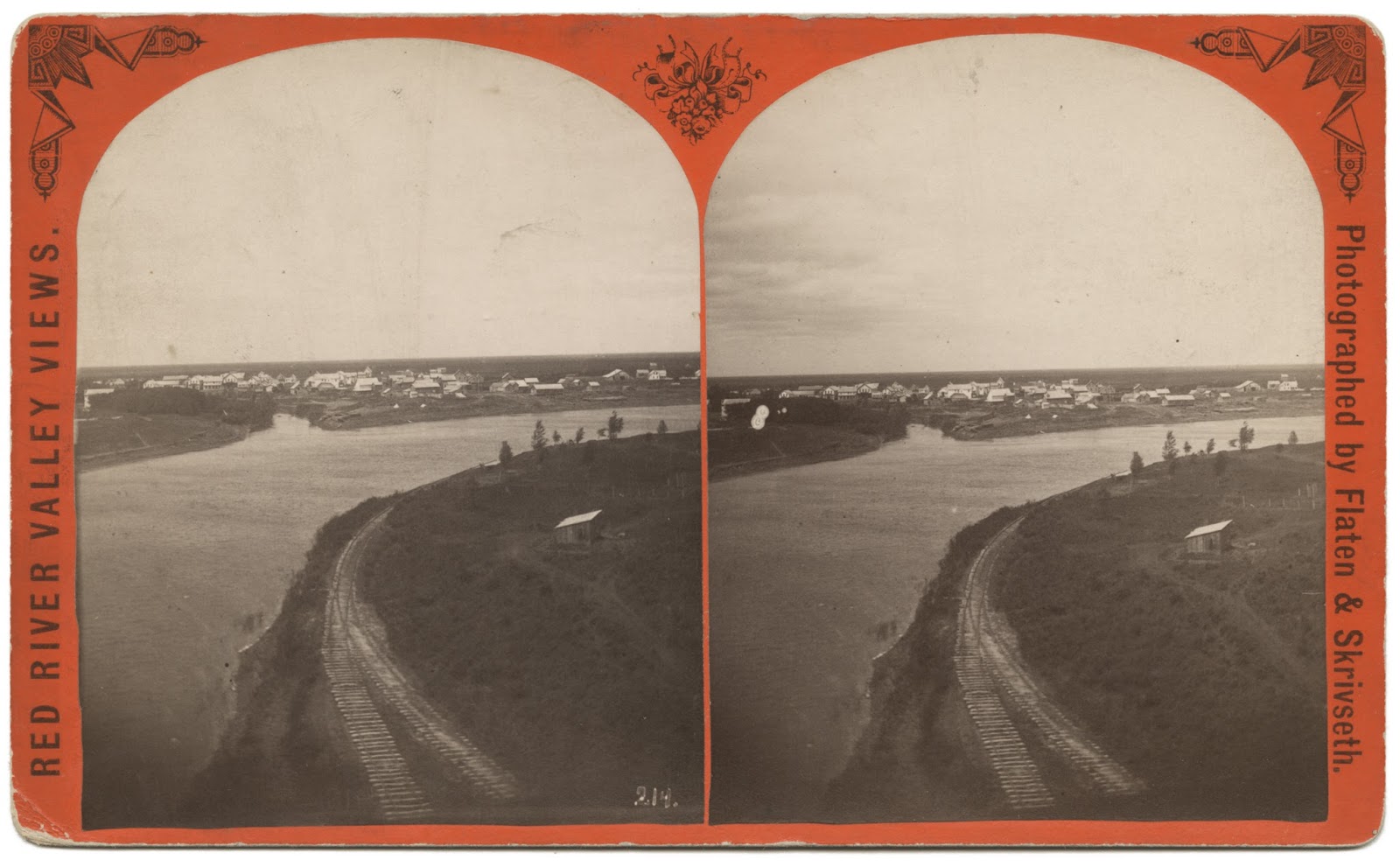
PHOTO INFO: A stereoview showing the railroad track along the eastern bank of the Red River in St. Vincent.  This track is the continuation of the one coming in from the east into town from the "Y".  This was laid down early on in anticipation of the main line going through town and over the river, but a rail bridge was never built.

Swan Anderson would get fan mail from people far and wide that had once lived in St. Vincent and the surrounding area, generated from his newspaper columns for the Enterprise, and even from his toll-free phone number into his home. Swan kept sharing history even when he was in the nursing home. And thank goodness he did.

Speaking of fan mail, let me share with you a letter Swan received from the LeMasuriers of Ontario, California; as many reading this may remember, the LeMasurier family lived in St. Vincent at one time.  This letter shares some more history about St. Vincent and the railroads. Please note that the story told in the letter is second-hand, being told to the LeMasurier family by George (aka "Shorty") and Bessie Cowan. That does not make it any less true, but I wanted to be sure everyone knows the chain of how the story came to us.

Read on...

Before the turn of the century and when the railroad from Winnipeg east wasn't finished, St. Vincent was a booming railroad town. The round house was out by Lake Stella and had a turntable to turn the engines around. The long depot in St. Vincent housed the Customs and Immigration offices. There was also a Signal House. In 1901 William LeMasurier bought it and moved it to his farm north of St. Vincent. He and his bride, the former Maggie Easter, started housekeeping there in 1902. The land north of St. Vincent and west of the Emerson road was all railroad land. Phillip LeMasurier bought some and later sold it to his sons, William and Arthur. John and George Cowan bought some, also Mose Parenteau and Austin Griffith. The railroad reserved a right-of-way along the top of the river bank. Bessie Cowan told me at one time the railroad had planned to build a bridge across the Red River on Shorty's land.

The land that the railroad bridge would have crossed into/from is located on this plat map in the northwest corner of Section 35, labeled George Cowan . . .
The Great Northern Hotel was a three-story building with a ballroom on the third floor. Bessie Cowan gave us a picture of it and we left it with the Pembina Museum when we left St. Vincent. When the hotel was torn down, the attached section that was the kitchen was bought by the Russells and made into their home. Later, Harold Easton bought it and finally Milton Gregoire bought it and tore it down, and built what is now known as the Nellie Blair house.

There was a strip of land from the Red River to the Emerson road, 137 acres in the Village of St. Vincent on its north side. Austin Griffith bought the 36 acres next to the Emerson road and Charlie LeMasurier bought the rest from Peter Monro. Harris remembers when Charlie had a lot cleared along the river. The man doing the work used oxen. Mrs. Morrow, who lived in St. Vincent, used to pick roots and would give Harris fifty cents to haul a load to town for her.

Tuesday, June 26, 2018

Pembina County at 150: Ferries & Bridges

Last year, Pembina County celebrated its Sesquicentennial.  In celebration of this, local historian Jim Benjaminson wrote an ongoing series of historical essays for the local newspaper entitled Pembina County at 150.  Jim has shared some of them with us here on St. Vincent Memories before.  Today we're sharing one on a subject we've been discussing on our Facebook page recently...


Ferries and Bridges

To the fur traders of the late 1700's and early 1800's the Red River and its tributaries were their “highways”. As permanent settlers began infiltrating the area establishing farms and communities, the rivers were at first an asset – but as more and more settlers took up permanent residence further away from the main streams, the rivers began to take on a new persona – they began to be more of a hindrance than anything. As trails became roads, crossing rivers and streams became a challenge and a chore. From 1859 on, as steam boats began to ply the Red the movement of goods was made considerably easier, despite the fact river travel consumed over 395 miles from Breckenridge to the International Border despite land routes that totaled under 200 miles. But river travel wasn't always dependable. For at least 5 months of the year, the river was frozen over and in other years, the water level was too low to allow passage of the steamers between river communities.

Amazing as it may seem, crossing the Red into Minnesota meant at least a day's journey to either Winnipeg or Grand Forks even as late as 1910. The pages of the early Pembina County Commissioners books are filled with requests from county residents “praying for funds” to establish either a road or a bridge crossing in various locations of the county. But there was at least one other option – establishment of a ferry service between the two states.

At least three ferry franchises were authorized by the County Commissioners over the years. One of the earliest references found in the Commission records is dated April 13, 1872 which granted D.F. Brawley a ten-year franchise for a ferry at Pembina, for which Brawley agreed to pay Pembina County $26 a year for the privilege; G.F. Keney was awarded the Grand Forks ferry franchise at $50 a year. Ten years later, on page 60 of commission records, Robert Tweedlie of Drayton was granted a three-year franchise, effective October 2, 1882 through October 2, 1885 paying a franchise fee of just $10 per year to the county – by late August of 1883 the Pioneer Express was running the following: “Wanted, a good man to run the Drayton Ferry”!

Apparently the Pembina franchise was worth considerably more than the Drayton franchise, as commission records show (on page 90) James Airth of Pembina agreed to pay Pembina County $75 per year for three-years, effective January 1, 1883 through January 1, 1886 – placing his ferry in service April 23, 1883.

Exactly when Pembina County relinquished issuing franchises in favor of the cities (and how the franchise was honored from the Minnesota side of the river) is unclear. D.F. Brawley, a St. Vincent resident had been awarded a ferry franchise which was revoked by the Minnesota Legislature in January of 1878. Brawley would be involved in other dealings with the government when he sued the military over a contract he held for supplying cord word to Fort Pembina (he lost the suit). At the Pembina Council meeting of April 1, 1889, tenders to operate the ferry between Pembina and St. Vincent were offered by P. L. Messareur [Note from Trish:  Could this be a misspelling of Philip Le Masurier's name?] for $160 for the year of 1889; Wilbur Kerns tendered an offer of $156 per year for three years while Alex Airth offered $169 per year for three years. The franchise was granted to Airth.

Although details are lacking, Pembina County jail records record that William O'Keefe was arrested and jailed January 19, 1881, as was James L. Fisk for “establishing, maintaining and running an illegal ferry in North Dakota”. The next day, January 20, J. Rich was also arrested and charged as was W. W. Nicholas on January 21st. Whether these men were interlopers from Minnesota or just trying to worm their way into the ferry business has not been discovered – nor has any court disposition! One has to question why they were arrested in January when there obviously was no ferry service!

Tuesday, June 12, 2007

Selkirk Historial Park

Early 1920s photo of WWI memorial (in background) and flower beds
In the background is the World War I memorial, on a raised step.  The inscription on this memorial states "Erected by the people of Pembina Township to the memory of those who made the supreme sacrifice for Our Country in the great World War" on one side. The other side has the names of two soldiers and the date of 1918. While it was erected in 1918, the dedication was not held until May 30, 1920 with Governor Lynn J. Frazier delivering the address. The memorial was moved from its original location in Selkirk Park to the Pembina State Museum in 1998 due to a flood control project. [Photo:  Robert Cameron Collection]
The [Pembina] Park has had many names - Selkirk Park, Selkirk Historical Park, Memorial Park, and Pembina State Park...