Showing posts with label disaster. Show all posts

Wednesday, October 13, 2021

Low Water: The Wreck of the Steamboat Dakota


Late this past summer, this was posted on the St. Vincent Memories Facebook page:
Looking to see if anyone might know or have any more info on the story that might be behind this. As you all know the mighty red is far from mighty right now but I still decided to take my boat down to check things out. Came across what looked to be an old sunken boat of some sort. Brought it up to my dad and he said that his grandparents (Bud and Jean Feick) had said that it was an old steamboat that used to run from Forks to Winnipeg in the late 1800s but had gotten hung up and then just left in the river. They had also said that long ago you were able to see one of the masts sticking out of the water once the red would get lower. It sits about 3½ miles south of Pembina. Obviously most is completely covered with mud and/or missing but you can see about 30ft worth of deck right now. These boards are way bigger than they look in the pictures...
There was much excitement in the group in reaction to the post.  Over 70 comments exploded the discussion:
Paul Maloney: What do the nails look like, if any survived? And I think remnants of the boiler would still be there if it was a steamboat.

Jake Cosley:  All the main nails used to hold the planks down are ¼x¼" square. There were a few large ½-⅝" round spikes used as well

Julie Lindegard: I will ask my dad Bob Cameron if he has any further info.  Dad recalled hearing that Humboldt kids (St. Vincent kids were too far away) would often swim in the river and get on the boat and jump off. I can imagine it provided hours of entertainment for kids! He said that the Bockwitz family found and retrieved the anchor. They contacted my dad to take it to the museum in Lake Bronson at least 30 years ago. That's where it is now. 


At RightEvidence of scorched and burned decking could still be seen, over 140 years later... 

Hetty Walker: Chuck always talked about the steamboat, that got hung up …that could be it

Janine Rustad: Talk to DeeDee Bakken---she used to say her dad knew exactly where it sunk 
Julie Lindegard: Yes dad mentioned it was near/in the area of the Giffen farm. 
Donald Burroughs: Does North Dakota have a historical society? Would be an opportunity to salvage some of the boat, those nails and boiler parts, paddle wheel hardware plus its coordinates to build a story around it.

Trish Short Lewis: They have already been contacted about this. State Historical Society of North Dakota's chief archaeologist, Andrew Clark.

Brandon Lee Legvold: Three (3) miles above Pembina it says which in Red River terms would be south of town so I would definitely say that is the hull of the Dakota that was found.

Trish Short Lewis: Since it’s only partially burned and witnesses say the ship burned, I think the idea of these being one of the two barges might be right. I reserve final judgment until we hear from DeeDee Bakken (hopefully) on what she recalls her father seeing… 
[Note from Trish: I later spoke with DeeDee and got some very interesting information from her!  Also, the pump in the photo at left, was found by her, and then taken and donated to the Kittson County History Center & Museum, where it is today, along with the Anchor found many years ago by Humboldt's Bockwitz family...]

 Brandon Lee Legvold: [The source of the quoted newspaper article, which is pictured above, is...] the Worthington (Minnesota) Advance. August 19, 1880. Which oddly enough is today. I found this on Chronicling America.

Trish Short Lewis: Full reference citation for article is The Worthington Advance. [volume] (Worthington, Minn.) 1874-1908, August 19, 1880, Image 1 Image provided by Minnesota Historical Society; Saint Paul, MN (Chronicling America)

Jim Benjaminson: Preservation of the site is paramount. 

On August 26th, I took
a field trip up to the wreck site south of Pembina.  The person who discovered the wreck - Jake Cosley - was kind enough to take me in his boat to the site, which was on the North Dakota side of the Red River of the North.  It was an adventurous ride out, the boat hitting bottom and getting stuck at one point, the water levels were that low (that was why the wreck was revealed in the first place...)  After a bit of creative  'jiggling', we broke free and were on our way again.  

It was pretty exciting to be at the site of a 140 year old wreck!  It became more and more apparent -  between the onsite examination of the wood, old hardware, and what could be ascertained on the construction - that this was remnants of one or both of the barges that the Dakota had been towing full of freight, and that the ship was likely down the river a ways on the Minnesota side near the old Giffen farm.  All the pieces fit, however - this had to be the wreck of the Dakota, it was the only thing that made sense from the evidence so far.

That said, a proper survey and investigation needs to be done.  And to that end, I contacted the State Historical Society of North Dakota's chief archaeologist, Andrew Clark.  Andrew was intrigued about the find, and expressed a desire to come in-person to evaluate the wreck.  However, as always, there is red tape.  Funding, authorizations needed, etc.  I had several conversations with him about what I saw, and he explained that at the very least, the location of the wreck needed to be updated.  There was erroneous information in some records that needed correction.  After my site visit, I was able to give him GPS coordinates of the wreck to update any official records out there.  I also notified the Minnesota Historical Society about the wreck's connection to Minnesota (the steamboat itself was likely within Minnesota jurisdiction).  

It is my hope that next summer the SHSND can make an on-site visit to document this important vestige of our region's transportation history. Andrew Clark shared this about a similar discovery made on the Missouri River last year; it would be amazing if they could do the same depth of investigation with the Dakota - it is a fascinating slice of our local history, for sure!

Part of the Dakota steamboat barge wreck as revealed during 
Summer 2021 low water on the Red River of the North . . .

Sunday, September 24, 2017

Grand Theatre Memories

Projector from Grand Theatre
[Kittson County Museum Collection]
The Grand Theatre was Hallock's (MN) movie palace.  I was recently contacted by a gentleman who once worked for the man who owned it1, as well as the local drive-in.  He had some interesting stories to share...

Jim Tureson, who worked for Bill Krumholz:

Sitting here thinking about days gone by and remembered an incident at the Grand Theatre. It was 1956.  We were showing a horror movie called The Creeping Unknown where this big glob would catch and kill people. Well, my Dad decided to make it more interesting. He ran some wires from the projection room down to the seating area and attached a buzzer to two seats! The wires were attached to a battery and when he pushed the button the seats would start to vibrate and buzz! Needless to say, at the worst possible time in the movie when people were screaming, we would hit the buzzer and watch someone fly out of their seat! I know, that was bad and we made sure there wasn't an elderly person sitting there. Joe gave us permission to do it and enjoyed the reactions also!

Projector from Grand Theatre.
[Kittson County Museum Collection]

Jim Tureson shared another story:

I'll tell you another Grand Theatre treasure. My older brother Larry was a protectionist in high school also; he graduated in 1960. One of our pet peeves was when one person showed up to watch the second show, we weren't able to go home early. This particular night a gentleman came in just in time for the second show and Larry wasn't happy. So he ran the show. When it ended, he turned on the lights, closed the curtain and was going to lock up when he saw that man still sitting in the front row, thinking he had fallen asleep. He went up and shook his shoulder, only to find out he was dead! Freaked him out to say the least!! So Larry was the only one in our family to run an entire show for a dead man.

Highway 75 Drive-In; go-cart track can be seen between screen and parking area.


July 12th, 1962. Joe Carriere and I were at the drive-in where I was going to paint the big screen. We rigged up a one-man "swing" with ropes over the screen tied off on Joe's big Oldsmobile. It worked like a pulley system - as Joe drove forward I would go higher. It had rained the night before and the grass was wet. I needed to go up higher so Joe started pulling me up, but as he was going, he got hung up on the wet grass around the go-cart track. He goosed the Oldsmobile, tires spinning, and then suddenly he hit the cement track! He took off rather fast and I went from 15 feet off the ground to 35 feet in seconds. When he finally stopped, I had almost wet my pants, the paint can went flying, and I'm screaming at Joe!

The day the Grand burned down in 1975...

Of course, he thought it was funny as hell, while I had thought I was going to die!


1 - Joseph and Rebecca Carriere owned and operated the Grand Theatre in Hallock from 1947 to 1975 when it was destroyed by fire. They also opened the Hallock Drive-In Theater in 1954 and operated it until 1985. The 1995 tornado took it down...

Friday, January 17, 2014

Monitor Steam Engine: EXPLOSION!

The steam engine has not yet been restored in this photograph and the
seat is visible. [An unrelated piece of machinery is in the background.]

In 1893, when steam was king down on the farm, an engine exploded, killing both man and animal.  This happened across the river from St. Vincent not far outside Pembina.

After the original incident, the damaged engine was buried on the spot of the accident - a field on the Frank Moris farm near Pembina. Seventy-four years later, the late Ben Fisher of Bowesmont, ND, dug up the steam engine in 1967 and restored it to its present condition.

After the restoration in 1967...

The engine is now owned by Dr. Roland Larter of Hallock, MN and is on loan to the Pembina County Historical Museum, Cavalier, N.D.

An excellent engraving of the Canton Monitor portable steam 
engine, made by C. Aultman & Company,  Canton, Ohio...


The Pembina engine is more accurately described as a Canton Monitor portable steam engine. Describing the Canton Monitor, an Album (aka industrial encyclopedia) published back during the 1890s says it is 'cheaper and better than any power operated by horses.' It continues . . .

Thursday, June 20, 2013

Historical Home: Up in Flames

June 6/7, 2013 Fire:  All that is left of a once stately home...
[Photo Credit:  Jamie Rustad Meagher]

All that is left now is a pile of bricks, supplied to the home's original builder by the Pembina Brick Company.  Made from Red River Valley clay, the bricks were a distinctive yellow, part of what made this once stately home so striking and special.

Charles & Isabella Cavileer sold the land the house was built on to James & Barbara Webb in May 1880.  The Webbs built the house, but the date it was completed is unknown.  It became the home to many families down through the years - Judge Edward Conmy & his family among them.


Another early image of the J.G. Webb home
[Photo Credit:  State Historical Society of North Dakota]

The photograph above was taken in the late 1800s. It shows the house's west side, facing Cavileer Street.  Not too far to the east (back) is the tree line and bank down to the Pembina River.


This photo shows the house from the north side.  In the mid 1890s, a bicycle craze swept the nation.

Around 1895/96, Pembina formed a cycling club1, whose members pose in this photo in front of the home.  The small building in the right rear of the house is likely a carriage house where a buggy was kept along with the horse that pulled it. A carriage house was the garage of the 19th century for those that could afford such things.

The only references I could find thus far, to James G. Webb - the likely original owner of the home - was one where he was once up for Postmaster in Pembina, but in less than a month, the position was rescinded.2 The Cavileer family continued in that role instead. The other reference was from a few years earlier in the 1880 U.S. Census, which listed him and his family living at the Winchester House hotel as 'boarders' at the time, and his profession as 'Merchant'. They bought the land that same year. By the time the house was built, the Webb family were evidently prosperous enough to not only build their own home, but to build one that made quite a statement.  It continued to be a point of pride in the town, to the day it burned down...


Webb Home Fire
[Images Courtesy of Jamie Rustad Meagher]
________________

1 - Cycling clubs sprang up in valley communities including St. Thomas, Forest River, Jamestown, Fargo, Elbow Lake (where women organized a “Bloomers Cycling Club”), Drayton, Larimore, Minto, Towner, Hillsboro, Pembina, Dickinson, Church’s Ferry, Park River, Grafton, Gilby, Epworth, Neche, Lakota, and Buffalo, North Dakota, as well as Crookston, Moorhead, and East Grand Forks, Minnesota, where members also ordered uniforms. [From The 1890s Bicycling Craze in the Red River Valley, by Dr. Ron Spreng, Minnesota Historical Society Minnesota History Quarterly, Summer 1995]

2 - See
James G. Webb's appointment as U.S. Postmaster at Pembina,
as well as the rescinding of that appointment a month later...


Sunday, June 17, 2012

Profile: A.H. Anderson


Who was the man who photographed the 1897 Red River flood in St. Vincent?  The man who took the famous "High Water" series photographs?

His name was Andrew H. Anderson.

He was a farmer who happened to have an eye for photography. He apprenticed in Fergus Falls, Fosston, and Grand Forks before he began a photography business in Hallock in the1890s. 

He eventually sold his interest in his photography business to then partner William Hartvig so he could focus on farming.  But he returned to photography when he bought the studio of G. G. Shaker in Hallock in 1936.  

Born in 1867, he lived a long life in our area, passing away in 1960.  He chronicled many events and families in Kittson County!


Friday, January 14, 2011

National Archives Portal: FORT PEMBINA

Company 876, 20th Infantry, U.S. Army, Fort Pembina, Dakota Territory
Source:  State Historical Society of North Dakota

Earlier this month, the U.S. National Archives announced a new Online Public Access search engine prototype. It holds great promise to make searching of our national archival records much easier.

I did some test searches, and came up with some interesting finds already. For instance, about Fort Pembina, I found this...
Originally called Fort George H. Thomas, this post was established on July 9, 1870, by Companies I and K, 20th U.S. Infantry, under the command of Capt. Loyd Wheaton. The post was located in northeastern North Dakota, on the west bank of the Red River, one mile south of Pembina city. The site was chosen as a result of two boards of officers ordered to select a site for a post by Gen. Winfield Scott Hancock, commanding general of the Department of Dakota. A reservation of 1,920 acres was declared by the President on October 4, 1870. The name of the post was changed to Fort Pembina in accordance with General Order 55, Department of Dakota, dated September 6, 1870. The post was established to render aid to the civil authorities in collecting fees at the customhouse and land office in Pembina. The post was abandoned September 26, 1895, in accordance with a letter from the Secretary of War, dated July 11, 1895, and pursuant to Special Order 109, Department of Dakota, dated July 15, 1895. The reservation was turned over to the Department of the Interior in accordance with War Department General Order 60, on December 5, 1895.
I had no idea that the fort had originally been named Fort George H. Thomas. I did a little digging and found out that a general by that name had died earlier that year in 1870, thus it was probably an attempt to name the fort in his honor. Why it didn't remain under that name, I haven't found that out yet. Probably a political choice of some sort...

Another fact I didn't realize, is that the Pembina Airport is on land that was part of what was once the 'military reservation' comprising Fort Pembina.


From May 27, 1895 St. Vincent New Era
Source:  New York Times (May 28, 1895)

[Click to enlarge]
A large part of the post was lost by fire on May 27, 1895 which led to its abandonment on August 15, 1895.  It was transferred to the Department of Interior on November 27, 1895, and sold at public auction in April 1902. Some of the lands went for as much as $20 an acre.

"During its time, the fort brought the one thing that was needed to the area - stability." - Major E. W. Davis, Headquarters of the Army, dated July 11, 1895, Fort Pembina Papers, State Historical Society of ND.


Soldiers present arms at Fort Pembina, DT (1870)
Source:  State Historical Society of North Dakota

Saturday, December 04, 2010

March 1941 Blizzard Revisited

Coverage of 1941 Blizzard in Minnesota & North Dakota
[WILMINGTON MORNING STAR, North Carolina, March 17, 1941]
Last year I wrote about the 'Ides of March' blizzard of 1941, sharing a story that a reader of this blog sent me of his memories of that event.

Now, in the course of my new job, a patron shared with me that a book had been written about the blizzard.  In the book, there are several references to local/regional stories of people touched by that storm, including the following two stories...

Friday, November 19, 2010

Civil Alert Siren


Town sirens were part of everyday life when I was growing up. We didn't question why a siren would go off at noon, 6pm, and 10pm. It just did.


Now, many years later, I was recently reminded by Emerson resident James McClelland...
I was out for my daily walk on a beautiful fall day. It was approaching noon and just at the precise moment the Emerson fire Siren gave its daily noontime blast.

The blast was no sooner over when I heard the wail of the City of Pembina's fire whistle, three miles distant. I had not been outside at noon for a while and had forgotten about the Pembina wail. Over the years it was clearly heard in Emerson as I recall three times daily. I am not sure if it still gives its three timely signals, but they were noon, six pm and ten pm. At the time Pembina City had a curfew ordinance and this was the warning for all youngsters under sixteen, to get home.

I grew up on a farm five miles north of the border and if the wind was blowing right the Pembina Fire Whistle could be easily heard.
I decided to research it, and found out that there was more to it than we realised...

Wednesday, August 11, 2010

Anatomy of a Town Tragedy - Revisited


Trivia: Slator served his time in same facility he had worked in

I wrote some time ago about a tragedy that hit not only my hometown, but my family.

I also wrote about how I was contacted by the grandson of the man responsible, and through that contact learned some valuable details behind what happened.

But all this time, I have never seen the man's face...until now.

When I was visiting up home recently, an old friend and classmate of mine gave me copies of several pages of a scrapbook her mother had kept of important memories to her family and her hometown area over a period of many years. Included in that scrapbook were many pages of news-clippings concerning my cousins' and uncle's tragic deaths. It was a tragedy that hit the area hard because so many people were involved between the two parts of it, either directly or indirectly. It was difficult for anyone to grasp losing your entire family within a three month period. A pall hung over the area for quite some time, and even to this day, people are moved by it just hearing about it all.

Friday, July 30, 2010

Past News: Tornado

Tornado over Hallock Fairgrounds, July 9, 1995 
[Photo by Glenn Browne]


Aftermath: Grandstand roof destroyed, but no one was hurt 
[Photo by Glenn Browne]

Wednesday, February 10, 2010

BORDERTOWNS: Chapter 16

It was just 4 a.m. when Mrs. Kemp, a cleaning woman, left her house and headed toward the Farmers Home Store. Her daily cleaning task had to be done by the store opening time of 8 a.m. Her meager pay for this morning task enabled her buy necessities that her husband's stevedore pay failed to cover. Feeling the early morning chill, she hugged her unbuttoned sweater closely about her. Although dawn was just breaking in the east, it was the flickering light from Mason's loft windows that caught her eye. The hayloft door facing her seemed closed, but the two glass windows left no doubt that the hay inside was on fire.

For seconds she stood transfixed, unbelieving; then she acted. Running across the street, she began pounding on the office door of the local attorney who lived upstairs. Within seconds he was at the open front window over his office, calling, "What do you want, woman?"

She shouted up at him excitedly, "It's Mrs. Kemp! Mason's barn is on fire; please wake others and get help. I'll try to find the sheriff and as many men as possible."

It seemed only moments before men appeared, many carrying water buckets. Suddenly the fire burst through the roof of the loft with a loud whoosh, almost an explosion. Flames and sparks rose high in the air, the yellow-red flames lighting up the grey-black smoke in scintillating colors. It was immediately apparent the flames had gotten so great a hold, and the fire spread so rapidly, that there was no possibility of saving the building. Sensing this, and shouting commands, the men began wetting down the adjoining buildings.

The crackle of the hungry fire was as loud as thunder and never ceasing. The onlookers stood horrified, knowing many horses were still inside, their piercing screams heard repeatedly. The heat close by was intense, almost unbearable.

Although the huge west doors were tightly closed, the bar had already been forced. Hastily the doors were swung wide in an effort to save the animals trapped inside. Apparently the fire had already broken through the loft floor, as vast clouds of smoke poured from the opening. Two men, perhaps encouraged by the shrieking of the terrified animals, braved the smoke and heat to enter the building. Finally they were forced to flee for their lives. They reappeared in the doorway, leading only three horses. One of the men was George Mason, the stable owner; the other man was Joe, his hostler.

Joe shouted to his boss, "Cripes! I untied nearly a dozen horses, but they wouldn't leave the barn. Suppose we can get back in for more?"

The query went unanswered; at that moment a thundering crash shook the ground, indicating the loft floor had collapsed on the remaining horses. The ball of fire that erupted from the doorway forced the two men back across the street.

At that moment the sheriff and Ned Cavalier arrived to join the group of men and boys gathered at a safe distance from the barn. Ned turned to Charley disgustedly. "There go my two horses, my buggy and robes, all up in smoke. What a kick in the ass!"

Brown was sick at heart. First his trotter had been cut up; now she was being burned alive. Inwardly, he thanked the Lord he had lent his riding horse to Sergeant Heidelburg last night. The overweight man had been complaining about having to walk back to the fort, because he had missed his ride. At least his gelding was safe. He turned as Mason approached. It was nearly full daylight now. The stable owner's face was black with soot and it was obvious he had suffered burns. His shirt hung in scorched tatters.

"Charley, the fire started in the loft and there was no wet hay there to cause spontaneous combustion. Someone set that fire! I don't allow sleeping in the loft and the back and front doors were closed and locked at 11 o'clock last night. We managed to save some small stuff from the office at the east end, and the three horses, but I think Booker's horse will have to be destroyed. It's in tough shape. Judas, there were 22 horses and a cow in there, according to my hostler. I've got $5000 insurance, but that won't cover even half of the loss." His distress was obvious to all.

They watched as the bulk of the hay in the loft burned with a fury and intensity that was almost unbelievable. When the roof was totally consumed, the loft ends of the barn slowly collapsed into the inferno.

"Who in his right mind could be so cruel to set a fire that would kill all those fine animals?" asked Charley, incredulously.

Cavalier added gloomily, "Lucky it happened early in the morning when there was no wind; otherwise we might have lost the entire business district."

Within an hour the building no longer existed. Fragments were allowed to burn themselves out. By noon only faint wisps of smoke rose from the heap of grey and black ashes. Little remained to indicate the size of the huge building.

Several of the more influential men of the town gathered at the Brown and Kabernagle store to discuss the disaster. Seemingly, no one could cast any light on the perpetrator.

Inwardly, Charley was convinced that the recent events were the work of Brogan and his cronies, caused by his shaming Brogan last winter. He questioned Mason at length as to any enemies he might have.

Mason was adamant. "As far as I know, I've never done dirt to anyone. Oh, I've had to dun some for their bills, but there were never any words exchanged. I've tried to run an honest stable, for the rental of horses and buggies. I just can't figure anyone who would do this to me. Now I've got to start over, and with darned little money." He studied the sheriff. "What can you do to catch the S.O.B.?"

Charley shook his head, and then looked up to the men who were watching. "You all know I check the downtown quite often around midnight, and it's not my job as sheriff. It seems lately that things happen in the small hours of the morning. So far the town has gotten by cheaply." He looked around at the businessmen. "How about the town putting on a night watchman? It's about time."

The owner of the Farmers' Home Store spoke up glumly, "I guess it's true, but I don't know where or how we'll raise the money to pay a man."
_____________________

Toward the end of July the wheat crop looked promising. Jerold was anxious to try out the new McCormick reaper his father had purchased in Pembina. Cyrus McCormick had finally perfected a mechanism that tied a knot in twine, thus enabling the machine to cut and tie the grain into bundles. When the machine was being assembled at the implement dealer's shop at Pembina, both Jerold and Knute were present and assisted the mechanic. The two boys were fascinated by the novel six-foot sliding sickle and the intricacies of the knotting mechanism.

When Jerold began cutting his father's wheat, he found the reaper required more power than he had anticipated. He was forced to remove the 3-horse hitch from the plow and hook it to the binder. Even then, he realized the need for a change of animals after a strenuous five-hour period. He estimated the machine was cutting slightly over one acre per hour, but by dark the following day he found he had cut over twenty acres. Before the week was out, he had completed Patrick's wheat and had moved to Ian's.

Knute was fast at stooking as he called it – stacking eight to ten bundles upright, one against another, with the wheat heads upright for drying. They estimated that it would take nearly a week for the kernels to harden and the straw to dry, before ready for threshing.

The Icelandic carpenter, Johannason, had contracted with Patrick, and completed two 1500-bushel wood granaries behind the barn. The barn itself held two 600-bushel feed bins built into one end. Patrick felt he now had nearly enough storage for half of their crop.

Rather than stack their wheat bundles in one huge stack and thresh them during the winter months as many farmers did, Patrick contracted with a thresher-man to have the job done in the field. A week after Jerold completed cutting the wheat and oats, the monstrous machine moved to the field shortly before dark. The huge straw-burning steamer was hitched to the separator, that to a cook car and finally to a bunk car. Following them into the field were eight teams with hayracks and two 150-gallon water wagons.

While Jerold and Knute watched wide-eyed, the contractor approached Patrick. "We'll start threshing at eight a.m. tomorrow morning; we should finish here early enough in the afternoon to move to your son's field. Hopefuly we will finish by dark.” He looked up at the clear sky and the reddening sunset. "I'm moving to Frank Webb's from there."

"Gosh, how many men work for you?" Jerold asked.

The thresher-man smiled. "Well, my engineer runs the steamer and he has a fireman, a tank man and the flunky to haul the straw to feed the engine. We trade off two of the hayracks for that purpose. Then there are six bundle wagons to pick up the shocks of grain, and two water wagons to keep the engine supplied. In addition, I have two field pitchers who help load the hayracks and two spike pitchers who assist in unloading the wagons at the separator." He turned to Patrick and pointed southwest. "We'll haul water from that small lake over there. It's cleaner and closer than the river." He gestured toward a long shed on wheels with a protruding smokestack. Wisps of grey-blue smoke were beginning to curl from the chimney. "That's our cook car; I see Willie is working on supper. The other car is the crew bunkhouse." He smiled proudly, "We're a self-sustained outfit."

While they watched, the engineer and flunky unhitched the separator from the trailing cars and pulled it some distance westward with the engine. Then, moving the huge steamer some distance from the separator, the driver carefully lined up the huge belt pulley of the engine with that of the threshing machine. The owner abruptly left them to assist another man who was attempting to remove a huge roll of belting from a box on the separator. The two men unrolled the belt, coupling the steamer to the thresher. After placing the belt on the pulleys, they produced shafting and with a sledge hammer anchored the separator to the ground, preventing its movement. The engineer slowly backed the steam engine, tightening the long drive belt until it just cleared the ground. When he started the drive pulley on the engine, the belt came alive, swinging like a sinuous snake. The threshing machine began emitting a cloud of dust, combined with a clanking, deep rumbling sound. After running the machine for nearly a minute, the engineer evidently deemed the belt alignment satisfactory. Driving the steam engine ahead, he slackened the drive belt and finally shut off the engine.

It was apparent the owner was also the separator man; he bustled around the threshing machine with a long-spouted oilcan.

"Why do you have that half-twist in the drive belt?"

Knute was curious.

The owner looked amused. "Son, if we didn't put that half-twist in the belt the machine would run backwards."

Jerold tried to cover Knute's embarrassment by asking, "How much water will you need? It's nearly a half mile to the lake."

"Maybe three or four tank loads for this field." He turned to Patrick. "You'll have to furnish at least two grain wagons; and if you're going to haul back to town, you'll need more. We don't stop when we get going. You pay by the hour and furnish all feed for our animals. As I said before, we start threshing at 8 a.m."

"I'll have two wagons here. l've arranged to borrow one from a neighbor. We'll pile the grain over on that high spot near the road." Patrick shook his head. "It's going to make extra work to handle the grain twice, but it can't be helped."

"At least you can take the last two loads home from this field. You'll have time while we move to your son's wheat."

By 6:30 the next morning Jerold and Knute were beside the threshing machine with their wagon boxes. Promptly at 8 a. m. the engineer opened the throttle and the field hands began tossing bundles onto the feeder of the huge machine. The owner stood on top of the machine, oiling here and there, stopping occasionally to cast a remark to the teamsters and spike pitchers who were unloading the bundles onto the feeder.

By 9 o'clock Patrick appeared in a buggy, accompanied by Maggy, Mary and Mike.

"It's a grand sight, Patrick!" Maggy exclaimed. "Just look at that black monster puffing and casting all that grey smoke and steam. Why, they've even got a water and straw wagon alongside it.

"Pat, imagine what your Father and Mother would say if they saw this huge outfit." She looked at him proudly. "We've come a long way in a short time."

"The man knows his business, Love. He just got this new machine. It's a Buffalo Pitts engine and thresher."

"What's that thing flipping every so often, dropping the grain into Jerold's wagon?"

"It measures the bushels, and it's got a mechanical counter. We'll know exactly how many bushels we have when they finish threshing."

Patrick clucked to the horse and shook the reins in an attempt to go closer to the noisy machine, but the horse began shying, attempting to turn away.

"Seen enough, Maggy?" asked Patrick.

She turned to Mary. "I've never seen anything like it. I wouldn't have missed it for the world, but we'd better get back. Kate will wake up hungry and Susan will want to get home."

When the threshing was completed the next evening, the contractor was paid off. That same evening at the supper table the family discussed the problem of moving the grain.

"One wagon isn't enough, Pa." Jerold complained. "We'll be at several days moving all the wheat and oats into the bins. If a heavy rain comes, we'll be in trouble."

"He's right, Pa," said Ian. "I'll buy a new running gear and grain box. I'll have to get another team of horses, too." He looked to Jerold. "I want to keep my job with the railroad; it's good for all winter. Can you find someone to haul for me? I might have to pay out all my wages for awhile, but I'll still have my job."

"How about Pete? Will he work?" Patrick knew good men were hard to find.

Ian nodded. "I'm going over to see Susan after supper. If Pete is home, I'll ask him. I don't think he's doing much, except fishing. The trouble is, there's no manual work involved in fishing and he sells the fish at a good price. He might turn me down."

Patrick grimaced. "Well, whatever we do, we've got to get the grain moved as soon as possible. Knute, can you handle the discing and plowing for awhile?"

"Sure, I will do that. But if you use two teams on the wagons, I will still need a change of animals."

"That does it!" Patrick exclaimed. "Ian, we've got to find heavy, draft animals. We've got the land, now to farm it!"

"Pa, our barn won't hold any more animals," Mary protested. "The cows take up nearly all of the room."

"Then we'll have to build a lean-to on the north wall. We're going after a big acreage of wheat next year." Patrick smiled in anticipation, thinking not so much of the dollar value, but of the satisfaction gained.

Maggy brought up a touchy subject. "Jerold, that badger of yours has got to go. Have you seen the damage it's done to the garden? There's a monstrous hole where it dug after a gopher. Also the darn thing has been digging and eating the potatoes."

Patrick looked at his son. "She's right, Jerold. The critter has a right to be in the wild."

"But he likes us, Pa. He won't leave."

"That's our fault; we've fed and spoiled him. Take the badger out on the prairie. It's not right to keep it any longer."

"I tried that this spring, but he came back home.”

"You've got to take him farther out. If you don't, someone will shoot him. Look at the trouble we had in Emerson. The neighbors were wild about the damage he did. He's got to go!"

Jerold reluctantly agreed. "I'll take him over east next Sunday, after church. I won't have him shot."

Since Ian's riding horse was available for Mary's use, she decided to make a split skirt. She consulted Susan, and they searched the stores together for a suitable material, finally settling on a grey Melton. The design and the way the skirt hung gave no indication that it was split. Mary knew society frowned on a woman riding astride, but she considered the investment in a side-saddle foolish. Ian already owned a western style stock saddle with a high cantle which gave her a firm seat and more control over the horse. When her mother remonstrated her, she answered, "If Kirby doesn't mind me riding astride, why should I worry about what other people think? Besides, I think a side-saddle is old-fashioned. Why, I've heard that out West, it's common to see girls and ladies riding astride."

Maggy gave in, but not without a final word. "Mary, you aren't living out West."

Mary didn't tell her mother that she had gotten the idea of the split skirt from Susan. Ian had mentioned the time Susan had surprised him with hers.

Sunday, January 17, 2010

FIRE!


The Humboldt Methodist Church burned down last night.

First reactions by former and current residents of the area...
"This is difficult to believe but the video clearly shows Humboldt's Methodist Church in blazes from a fire last night. It's a sad day for us all and a catastrophic loss for the community and for those of us who love Lost Humboldt..." - Mike Rustad

"I was told the Humboldt Methodist Church burned to the ground last night. Going up to Humboldt shortly so might have some photos of what is left tomorrow...First they burned my school to the ground and now the Methodist Church. What will be left of my youth if Pearls Inn burns to the ground? Humboldt will be a ghost town..." - William Ash

Cindy (Twamley) Ritteman remembers - and asks if I do - "...when your youth group came over and we made candy and had a good time running around Humboldt?" I sure do, Cindy, I sure do!
Thanks to Mike Rustad for letting me know about this. Thanks also to Bob Bockwitz for sharing video of the very sad event...

Photo by Lynda Johnson CasselsHymnal in the ashes of Humboldt Methodist Church [Photos by Lynda Johnson Cassels]

Saturday, December 19, 2009

Local History Video

An amazing film project put together by a guy with deep Fargo roots, it's the kind of 'local history' that I love, and would love to be able to put together about St. Vincent one of these days. Visually powerful, and deeply touching, it makes history come alive and become very personal...

Tuesday, May 12, 2009

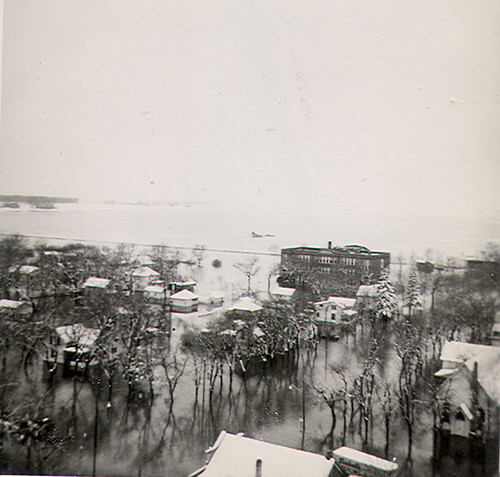
1950 Flood from the Water Tower

1950 Red River of the North FloodWilliam Ash shared, "I found these photos a few weeks ago and have just scanned them into my computer. The first five photos of the 1950 flood was taken by my mother Audrey Joyner who was working as a secretary at the US Customs District Headquarters building in downtown Pembina, ND during the 1950 spring flood. She climbed the Pembina water tower to take the photos.

"All the flood photos from 1950 that I sent you today were in a large brown envelope in my mother's former house on the farm in a dresser drawer in the attic. They belonged to my grandparents the Sheldon Joyner's which my mom collected after cleaning out her mother's house after her passing."

Thursday, December 18, 2008

Eighteen-Hundred-and-Froze-to-Death

Chief PegiusFor the beleaguered Red River colonists, who were having trouble becoming self-sufficient in a landscape harsh and alien to them, the summer of 1816 turned into the nadir of their New World experience. On June 19, simmering tensions between the Hudson's Bay Company and the North West Company exploded in a battle at Seven Oaks, which saw twenty-one men die and shattered the confidence of the Scottish settlers, who were caught in the hatred between the rival fur-trade companies and were targets of Métis animosity. Now the weather would not cooperate. Since their arrival near the forks of the Red and Assiniboine rivers in 1812, they had had trouble making the most of the region's fertility. The 1812 harvest, for instance, was so poor that they were forced to journey 100 kilometers south to the better-supplied post at Pembina under the friendly guidance of Peguis, chief of the Ojibway. In 1813, they again wintered in Pembina.

In 1816, Peguis came to their rescue once more. This time he took the struggling settlers to his village at Netley Creek, sixty kilometers north of present-day Winnipeg. They were not to know what global conditions were making their sojourn so fraught, but in 1819 HBC trader and Red River surveyor Peter Fidler observed:
Within these last 3 years the climate seems to be greatly changed the summers being so backward with very little rain & even snow in Winter much less than usual and the ground parched up that all kinds of grass is very thin & short & most all the small creeks that flowed with plentiful streams all summer have entirely dried up after the snow melted away in the spring.... Wheat, Barley, & potatoes have been cultivated here a few years back to a considerable extent last summer a considerable quantity was sown & planted of the kinds above mentioned but owing to the very dryness of the season not even a single stalk was reaped or potatoes taken up and here before when showery summers the wheat would produce above 40 Barley 45 and the potatoes 50 fold. Even all the smaller Kinds of vegetables failed from the same cause but the first week in August last clouds of Grasshoppers came & destroyed what little barley especially had escaped the drought.
The world the Selkirk settlers knew was a cooler one than our own. They were living in the Little Ice Age, the interval between the 1450 and 1850 when global temperatures were between 1.0 and 2.0[degrees]c cooler than they are now. Within that, the settlers were living in what some climatologists say was a cooling trend between 1809 and 1820. And in the middle of that came the 1815 eruption of Tambora. For settlers living on the edge of existence on the central North American plains, its effects were very nearly the last straw...

- From Volcano Weather: The Story of 1816, The Year Without a Summer by Henry Stommel and Elizabeth Stommel. Seven Seas Press, Newport, Rhode Island, 1983.

Friday, December 12, 2008

Bones


"I could see for miles and miles, and the prairie was black with them, and only here and there I could see spots of snow...there were simply millions upon millions of them." - Charles Cavileer (1851)

"We found immense herds of buffalo which appeared to touch the river and extend westward on the plans as far as the eye could reach. The meadows were alive with them." - Alexander Henry (1804)

"...buffalo bones were very thick on the prairie...early settlers collected the bones to be sold for cash. This money frequently proved to be a very important part of their first year's income. These bones were later made into carbon black used in sugar processing. Many merchants in the area accepted bones in payment for merchandise sold. Both the Northern Pacific and the Great Northern Railroads had facilities to handle the huge piles of bones which, in the early days of settlement, appeared in the railroad yards. At least one yard received over 100 wagon-loads of buffalo bones a day for several months." From Challenge of the Prairie, by Hiram M. Drache

Sunday, September 07, 2008

Ricard Bros vs US/Turtle Mountain Chippewa

...they got nothing from the Government and they took those goods in order save themselves from starvation.
Below is a fascinating case in the public record of a claim made by two brothers against the United States and the Turtle Mountain Chippewa. The case involves local (St. Vincent/Pembina) and area residents and locations. A little window, into the past...

NOTE: Source of this information are the William Michael O'Keefe papers (1859-1911), Minnesota Historical Society - O'Keefe ran a well-known, successful general store in St. Vincent during the time this case originally took place.

Statement of Claim.

The claimant, in his petition presented to the court on September 15, 1891, avers that he is a citizen of the United States and is a resident of York, North Dakota, and is the surviving partner of the firm of Ricard Brothers, comprising Theodore P. Ricard and Sceillem A. Ricard; that the following property belonging to members of said firm, who were at that date citizens of the United States, was taken or destroyed by Indians of a tribe or nation then in amity with the United States, the date, place, and tribe being particularly stated below:

In Olga, Pembina County, Dakota Territory, on or about the 28th of December, 1880, by Turtle Mountain band of Chippewa Indians,

(1) Clothing; hats and caps, gloves and mittens, dry goods, ginghams, prints, jeans, cotton, etc.,
(2) Hardware; nails, axes, tools, grind-stones, shelf goods, etc.,
(3) Groceries; sugar, pork, bacon, salt, canned, goods, coal oil, crackers, flour, etc.
Total worth $2,500.00

That no claim for said property was over made to the Commissioner of Indian Affairs; that no action was taken upon it in Congress or by any of the Departments; that he is the sole owner of the claim and the only person interested therein; that no assignment or transfer of any part of this claim, or interest therein has been made; that he is justly entitled to the amount herein claimed, after allowing all just credits and offsets, and he believes the facts as stated in his petition to be true.

Abstract of Evidence Under Rules

Deposition filed November 19, 1892

Theodore P. Richard: Age, 35 years; resident of York, North Dakota; merchant; I am the claimant in this case; I am a citizen of the United States; native born, born in Vermont; have lived in North Dakota 12 years, since June 1880 when I first came here I located at Pembina, Pembina County; I was clerk in the store of Flynn & O'Keefe of St. Vincent, Minn., for 18 months; I was a member of the firm of Richard Bros.; in the month of October, as near as I can remember, 1880, we first started our goods on the way to St. John, N.D. to establish a store there, under the name of Ricard Brothers, and two months after opening of said firm we had an invoice of goods on the road from St. Vincent, Minn., to St. John, N.D., and while in transit to St. John, at a place called Walhalla, N.D., the Indians stopped our train of goods and took the goods - consisting of general merchandise, such as dry goods, hats, caps, boots, shoes, hardware, tinware, groceries, etc.; all the goods I had in transit at that time from St. Vincent to St. John were taken by the Indians; I had ten loads, more or less; I know they consisted of a general stock such as I have mentioned and the goods were sold by myself individually to Ricard Brothers and I also packed and loaded the same; I sold them as clerk for Flynn & O'Keefe; I know the value was between $2,200 and $2,500, that is as near as I can remember and I feel confident that the freight and goods contained in said invoice was to the amount of $2,500; Theordore P. Ricard and Sceillem A. Ricard were the owners of the property at the time it was taken; I became the survivor of that firm as the senior member of Ricard Brothers and the money invested by the firm was invested by my brother and myself in purchasing the goods taken; my brother, Sceillem A. Ricard, left North Dakota in 1884, going to reside at Toledo, Ohio, where he met his death by an accident which occurred in the machines shops of Richard Brothers of that place and by his death I became the sole survivor of the firm and the owner of this claim; the Turtle Mountain band of Chippewa Indians took the property and they have themselves acknowledged it in my presence; I had the goods loaded at St. Vincent by my freighters under my superivison; they started in the direction of the Turtle Mountains; as soon as it became known to me to be a fact that the goods were taken, I procured the help of Chas. Brown, Deputy U.S. Marshal of Pembina, with a posse of men to go to the scene of the robbery and get the goods; they were replused by the Indians under the cover of guns and after Chas. Brown came back he made his affidavit before Major Collins of Pembina Fort, stating that the Indians had repulsed him under cover of guns; he procured an order from General Terry, Commander of the Northwest, to send out troops to obtain the goods and there being smallpox in that territory where the goods were taken, Major Collins made a report to General Terry stating that smallpox was in the distrct and the order was countermanded to be held until the quarantine was over; I continued in business there for a year or so; this is the only action I have taken to recover for the value of this claim; I do not know whether these Indians were under the supervision of any Indian agency at that time; they were full-blooded Indians; I have talked with them several times in regard to the matter in St. John and at Bellcourt in North Dakota; to my personal knowledge they were starving, for just before the robbery they came to me and had me write, or rather translate, for them before Major Collins at Fort Pembina, asking him to obtain relief for them from the Government; the articles taken were so many and of so many different varieties that it is impossible for me to fix the amount of each article, and the firm of whom the goods were bought, Flynn & O'Keefe, have since gone out of business and their whereabouts is unknown to me and I am unable to procure the books, but John C. Florence, the bookkeeper of this firm, now of Grand Forks, N.D., will testify as to the amount; the depredation occurred in the Pembina Mountains in the then Territory of North Dakota, near a place now called Walhalla.

Cross-Examination: At the time I obtained the goods I was living in St. Vincent, Minn.; the firm of Ricard Brothers was formed in October, 1880, at St. Vincent, Minn., and existed until 1884; the first bill of goods was obtained in December from Flynn & O'Keefe of St. Vincent, Minn.; it consisted of general merchandise, such as dry goods, clothing, hats, caps, boots, shoes, hardware, groceries, etc.; they were to be taken to St. John, now called, in the Turtle Mountains which was 115 miles straight across the country; we shipped the goods, about December 1 or 2, across the country to St. John by teams; we had ten teams I think, there might have been more; we shipped the goods in sleighs, no bob sleds, one horse to each sleigh; the sleigh boxes were about 10 feet long and I should judge they were about 3 feet wide; there was about 6 inches of snow on the ground I should judge when the goods were taken by the Indians on the Turtle Mountains; I did not see them taken by the Indians; I know the goods were loaded into sleighs to go to St. John, then Turtle Mountain, and that is the last I saw of them; the bills for these goods have become lost, it is hard for me to say when they were lost; they were last in charge of Chas. Brown, of Pembina, and were in his possession 3 years ago; they were given into his possession and have not been found since; they were given to him to show that it was a bona fide case that the goods were taken; giving him the bills would show that the goods were taken; I gave the bills to Gaffney & Kneeshaw, a firm of attorneys at Pembina because were trying to present the claim for this loss to the U.S., and I gave the bills into their hands as proof that the goods claimed for were really taken; I did not present this claim up to this time; they did not act upon it; they did not succeed in getting the claim admitted and I took it out of thei hands; I have no recollecton as to the exact amount of each of the different articles taken and have no means of ascretaining the exact amount of each kind of goods; by a notice sent from my brother I found out that we had lost the items of clothing mentioned; the exact amount of which I cann not fix; I can not state the amount of caps and hats; I do not know the number of pairs of gloves; I can not fix the amount of any particular items; I arrived at the total sum by the invoice, I remember the exactly amount of the total invoice; in my petition I stated that the loss amounted to $2,200, and in my complaint I claimed that the loss amounted $2,500; in my complain I made the amount for the goods and the freight also; in explaining this difference between the invoice for the goods and the amount claimed by me I wish to say that the difference between these two amounts is the amount I paid for freight on the goods; I did not pay cash for these goods at the time I bought them but have paid for them since then; the firm of Ricard was dissolved in the fall of 1883 or the spring of 1884, one of the two, I don't just remember now; it was mutually agreed between my brother and myself that if this claim was ever allowed, if we both survived we should each have an equal share; my brother is dead; I paid for these goods previous to my brother's death; I employed half-breeds to transport the goods; one was named Augustine Bellguard and his two sons, and Peter Peltier and his sons, and a party by the name of Boneau, his first name I do not remember; it might have been 8 or 10 days after the goods had started before I received a message from my brother, then on the Turtle Mountain, now called St. John, to the effect that the goods had been taken; we then sent Chas. Brown, U.S. Deputy Marshal, of Pembina after the goods; he did not recover the goods, he was repulsed by the Indians; I know that Mr. Brown went to the place with a posse of men and was repulsed, but I only know it by hearsay; I did nothing more to recover my property; I remained in St. Vincent about 16 months after that; we found out what band they belonged to; the exact name of some of those who took the property; I did not have them arrested because I did not think it would bring back the goods and besides that they threated to rob our store and I thought it would only cause further hostilities to have any of them arrested; there were not many whites in the country the time the goods were taken.

Direct Examination: I do not know the exact number of Indians in the Turtle Mountain band of Chippewa Indians staying in the Pembina Mountains at the time the goods were taken; I do not know about how many.

Theodore Bellguard: Age 67 years; resident of Turtle Moutain Indian Resevation, N.D.; I am acquainted with claimant and known him about 12 years; no relation; no intereste in claim; I know his property was taken by Indians; I saw them rob him of dry goods and croceries and other things; I can not tell the exact time it was, maybe 11 or 12 years ago and it was somewhere in the Pembina Mountains in North Dakota; I was there at the time; the Indians belonged to the Turtle Mountain band of Chippewa Indians; I can not tell how much goods were taken from claimant; they took them from little sleds outside of a house; there were about 10 sleds, maybe more, maybe less, so long ago I can not remember; they were small, on-horse sleds; they took the goods and divided them among the Indians; I was living where they took the goods; at Pembina Mountain, North Dakota, between St. Vincent and St. John; there were some print and calico and tobacco, raisins and sugar and differnet things, one cook stove, blankets and clothing; the goods beloned to Mr. Ricard; they were taken in the daytime; I don't know whether claimant ever did anything to recover the goods; the Turtle Mountain band of Chippewa Indians were starving at that time, they got nothing at all to eat; they got nothing from the Government and they took those good in order save themselves from starvation.

Cross-Examination: I was present and saw them take the goods; this was about 12 years ago; Mr. Poitras was with me at the time; I was standing right by, within 5 or 6 feet, when the goods were taken, I did not help take them; I know they were thieves, I know they were robbing; I was not one of those thieves, I never put my hand to them; they were pure Chippewa Indians; the half-breeds did not steal anything; the full-blooded Indians did the stealing; I am a half-breed and our tribe or nation of half-breeds never did any stealing or robbing at that time; I was there with the indians who took the goods; they were taken from what was called St. Joseph, now called Walhalla; about 12 years ago; do not know the month, I never marked the month; it was about 4 o'clock in the afternoon; it was in the fall about the first snow, I believe it was in December, I think it was about the middle of the month; the Indians of the Turtle Mountain took the property; the names of thee of them are: Carshune (meaning in English, Wolverine), Connette and Caushion, he was named after the Governor and is now dead; they were living on the Pembina Mountain, Dakota, and I was living there myself at the time among the Indians; I was there the time the goods were taken; Pembina Mountain is on the road between St. Vincent and St. John; among those who drove these wagon loads was my brother, he is now dead, of the others two of them are dead that I know, another of them is in Montana; I can not state the exact number of wagons, about 10, probably more or less; the goods were taken to my door after they were stolen; they came there to camp for the night; I did not get any of the goods; I do not know of any one but the Indians who got the goods, they were taken by the Indians and taken to their teepees or tents; they took them off the sleds and divided them there and took them away; the goods were in sleds; the drivers took the sleds and teams and brought them here; they had no fight with the Indians; there were about 15 or 20 Indians and about 7 or 8 men, boys, and 3 men driving; the drivers tied to prevent talk but they made no forcible resistence, - they made no trouble; the goods in the sleds belong to Mr. Ricard, I know it because the driver told me, I asked the driver whose goods those were and he told me they belonged to Mr. Ricard; the loads consisted of merchandise, there were calico and cotton and raisins, teas and sugar, groceries; I don't know as to the boots and shoes, but there were pants and caots and clothing; these goods were packed in boxes and bundles; the boxes were torn open in front of my house; some of them they carried away from my door on their backs and some on one of those jumpers1; there was a horse attached to the jumper and there was also a pair of oxen that they had and they loaded it to carry the goods away; they carried the goods about one half a mile; I don't know how long it took them to transport them from my house to this place, I did not mark the time; they were at it until late, after dark; they opened all the bundles and boxes before they took them away, they had to break the packages in order to divide them; they divided them among the 20 Indians; my mother belonged to the Assiniboine tribe of Indians and my father was a white man, - French; I am what is called a half-breed; I draw rations from the Government; I am at the Turtle Mountain Agency; John Waugh is the agent in charge, those goods were not on an Indian Reservation when they were taken; Pembina Mountain was Indian land, unceded land, but not on a reservation; I was not living on a servation because were living together, the Indians were living there and I was living with them; I cano not state when the reservation was formed, i might be ten years ago; the land where the goods were taken from is not an Indian reservation at this time, I never knew it to be named a reserfation; it was claim by the Indians as Indian Country and still is; when the goods were taken from the front of my house I did nothing and said nothing; I have talked it over casually with my people since; I have had no talk with Mr. Ricard about it; he knew the things were taken in front of my door; if my hat is in front of your door and somebody takes it why certainly I would hear of it; I suppose he heard of it.

Re-Direct Examination: These Indians who took the goods are now living; they live the other side of the Big Coolie; it is on the Turtle Mountain Reservation, now known as Bellcourt; those who were driving the sleds were half-breeds like myself.

Henry Potrat: Age, 67 years; live upon the Turtle Mountain Reservation; my eyesight is bad and so I have no occupation; I am a mixed-blood, being half Chippewa Indian and half white, the white blood being French; I know Theodore Ricard; I did not keep account of all the winters but it is quite a long while since I have known him; I am no relation to him; I know he has a claim for Indian depredations; I have no claim; have lived on the Turtle Mountain Reservation six years; before I moved there I lived at Pembina Mountain, N.D.; I knew of the depredation committed upon claimabnt's property; I was not present at the time the goods were taken, but I was called by the Indians and came on the next day and I observed the goods piled there, the goods they had taken from Mr. Ricard; the Indians were going to divide the goods; they were already piled there; I was not called to distribute the goods but only to witness the distribution of them and I saw the goods there; the goods were at Theordore Bellguard's place; I can name a few of the goods, - I did not see all the goods - calico, cotton and dry goods, clothing, pants, and coats and shoes, - I only name those I saw; I saw a great quantity of calico, - I can not say how much; the pile of clothing was big - I did not count them; when I saw the boots and shoes and other things they had been taken out of the original packages and were piled on the ground; I can not tell whether or not they were in boxes at first, - they are not when I saw them; it is impossible for me to say the quantity of shoes, but the pile was quite large; I saw tea, sugar and raisins, etc., there; I saw a large quantity there, - can not state now much; I did not notice any hats or caps; I saw some hardware, - I saw one cooking stove; I did not see all the goods; I saw pork or bacon there; I saw large quantitites of coal oil, crackers and flour and I saw a barrel of syrup; they said the goods belonged to Mr. Ricard; the drivers said so; the drivers were there the next day when I was there - they were half-breeds, - I did not count them; I don't know, but I suppose the Indians came and got the goods because they were in a starving condition - they wwanted something to eat; they were not getting any spport at that time from the Government; this happened close to the holidays, in the winter time; it was in the fall, as near as I can remember; I have sworn to state what I know, and tell without knowledge I can not; I tgell what I am positive of, what I saw; I can not remember the time; I agree with the witness just before me, Mr. Bellguard, about the time; he said it was eleven or twelve years ago, - I think it was about that time.

Cross-Examination: At the time of the depredation I was residing on Pembina Mountain, which was about two miles from the place where the goods were taken; the day before the goods were taken I was sleeping, - resting; an Indian came after me to tell me to come see the goods distributed, - I don't know his name now; he said "the head man of the tribe wants you to come and see the goods that have been taken"; I wnet on foot, - I started from home in the forenoon - I got there near noon, - that was on the day after the goods were taken; the goods were all stacked up inside of Mr. Bellguard's house; what happened at the time the goods were taken Bellguard saw; what happened the day after, I saw and he did not; he said the goods were taken into his house, and the goods were in his house when I got there; I got one shirt, - I don't know whether Mr. Bellguard got anything; after they were distributed into piles the Indians bundled up the goods and carried them away in the sleds, each one taking his own pile of goods; there was a pair of oxen, and about ten Indians or so took their share and loaded it into this ox team; they divided the syrup by buckets full; the Indians had some buckets; when they saw the barrel of they took the trouble to go after the pails and buckets; - I saw them do it; they were living there; they opened the barrel with an axe - broke the head in; they divided the sugar with pint cup, dividing it to one man say 100 cups,; the tea was also divided that way, - there was no written account kept among themselves; one shirt was not my share especially, but they gave it to me and I took it; I know nothing about what the drivers got; this was all divided up among the full-blooded Indians; I don't know that the half-bloods got anything; I did not see any after the division among the full-bloods, - the mixed-bloods might have received some as a present, - they might have had some of the goods, but I got my shirt right there and then; I was called to Bellguard's house to view the goods by the Indians, not to witness the division of the goods but to witness the goods that they had there, that is all, - to witness the goods that had been taken; I hold tribal relations; I am one of the councilmen, and the Indians having committed a wrong, they wanted me to witness, fearing some consequences, and depending upon me as one of the councilmen to see what had occurred; it is the custom among the Indians that the head men, braves, or councilmen be notified and acquainted of the fact; it is the custom among the Indians when they have committed any depredation, such as in the case of claimant's goods, that they notify the braves of the fact, - it matters not whether the braves get any goods or not, but it is their duty to notify the head men of what has occurred; the driver told me it was Mr. Ricar's shirt which they gave me; I did not pay claimant for the shirt, - it was mine, - they stole it and I had it given to me; I did not commit this depredation against his goods, and it was given to me and I accepted it as a present. I owed nothing, - I did not consider that I owed anything to Mr. Ricard; I do not talk or understand English; I am speaking to you through the aid of an interpreter, who is John Babtiste Bittneau; he is a Chippewa half-breed, by occupation he is a lawyer and he is said to reside in Minneapolis, Minn.; the Indians who were in possession of the goods which they dvidied at Bellguard's house were of the Turtle Mountain band of Chippewa Indians.

John G. FLorence: Age, 35 years; resident of Grand Forks, N.D.; merchant; the firm of Ricard Brothers was in existence in 1882, when I first became acquainted with them; the names of the members of the firm are Theodore P. Ricard and Sceillem A. Ricard; Sciellem A. Ricard is, as I understand, dead and has been for some years; Theordore P. Ricard, my brotherin-law, is a merchant and now resides at York, in Benso County, N.D. I first became acquainted with them at St. Vincent, Minnesota; I know that in 1882 I was employed by the firm of Flynn & O'Keefe and had access to their books; the books showed that Ricard Bros. previous to that time had purchased a bill of goods of Flynn & O'Keefe, consisting of dry goods, croceries, clothing, boots, shoes, and hardware; this bill amounted to in round numbers from $2,200 to $2,500 and was, as I understood, purchased by Ricard Bros. for the purpose of starting a store at St. John, N.D.; I can not give the amount of any particular kind of goods that were purchased at that time, but give the general total of the amount of goods purchased at that time and for the purpose I have mentioned, from the firm; I was in no manner interested in Ricard Bros.' business; have no interest in their claim and know only from hearsay that the goods I have mentioned were the ones that were stolen by the Indians and is embraced in Mr. Ricard's claim against the Government.

Cross-Examination: I don't know whether these goods were ever paid for; I know that while I was employed by the firm of Flynn & O'Keefe I saw certain charges on their books against Ricard Bros. which I think amounted from $2,200 to $2,500 and that is all of my own knowledge that I do know.

John Vandal: Age 45 years; resident of Bellcourt; farming and working on a reservation; have lived in Bellcourt 7 years; before that I lived in Walhalla, Cavalier County, on the Pembina Mountains, North Dakota; I know claimant; have known him for 10 years; I know he has a claim for Indian depredations; have no interest in this claim; I can not remember the exact date the goods were taken but I was present at the time they were taken; myself and an Indian named Anarkarsay were apointed delegates by the tribe to apply to the military post at Pembina for supplies; it was at a time of great sickness in the tribe and the Indians were without subsistence; on our way when we got to the Little Devil's Lake as it was then called, between Walhalla and Pembina, it being about 6 miles from Pembina, we met the team with the goods belonging to Mr. Ricard; we dined there at that place with them; the Indian, Anarkarsay then said to the teamsters, "take those goods up to our place and tell our folks to take it"; the route to their destination lay through that place, they had to go through that place, and as they passed there the Indians arrested the teams and took the goods; during our absence they had arrested the teams and taken the goods and held them until our return; I and the other Indians continued our route to Pembina to carry our mission; two days after we left them we returned to the place where the depredation had been committed, and we saw the goods there then on our return; the Indians then said, "we will divide these goods," and I was appointed to assist in the division of the goods among them; I told the Indians that it was wronging this man to take his goods, who was pursuing his livelihood and that they should not take his goods; I state what I know of it; they then said they had taken it and were going to divide it among themselves and the goods were divided and this was in the house of Theodore Bellguard; some of the things I can name, there was dry goods, such as calicoes, cotten and clothing, groceries and provisions consisting of pork, flour, bacon, and all kinds of groceries; I can not state the quantity, all I can say is that it consisted of about 10 loads of such merchandise as I have mentioned; I know they belonged to the Turtle Mountain band of Chippewa Indians who took the goods; I knew before the goods reached there and subsequently that the goods belonged to one Mr. Ricard; I think he is the same man who is the claimant in this case; the owner of these goods is there today; I can point him out (here witness points towards plaintiff); I know that the band of Indians who took these goods now reside at Bellcourt on the Turtle Mountain Reservation.

Cross-Examination: I heard that these good were taken from Mr. Ricard's house; myself, Henry Potrat, Theodore Bellguard, Carkascheau and his son and another Indian named Conette were present when the goods were divided; this was two days after we met them and we came back in two days; we met them at noon, they arrived at that place that day; I can not say at what time they arrived as we were going in an opposite direction; I can not say at what time they would have got there; I know they arrived that day; when I returned the goods were in the house of Theordore Bellguard, I know they were in his house; I can not state the exact number of piles the goods were divided into; they were divided among those who were present there; Mr. Potrat got a cooking stove; Mr. Bellguard got a share of dry goods and provisions; I got some syrup and some calico and a shirt; I tried to prevent the Indians from taking the man's goods but after they had taken them I took my share; I did not pay for them because the man ws not present; if he had asked me for payment for those goods I might possibly have paid him; when we returned Mr. Potrat was there in the house and he remained there until the goods were divided and taken away; I can not state that what Mr. Potrat said in regard to the goods being taken away from the house the next day is true or false; he might not have received anything else but a shirt but I did, while assiting in the division of the goods, place a stove there for him; it was in Mr. Bellguard's house the goods were taken and it was from the outside of his house that the Indians carried the goods away; it is a fact that he did receive some of the goods because I myself gave him some of them; we had heard beforehand that the goods belonged to Mr. Ricard.

Deposition filed September 24, 1906.

Theodore P. Ricard: Age, 56, resident of Emerado, North Dakota, and the claimant in the case; states that his brother Sceillem A. Ricard, was born in the village of Champlain, Vermont; he knows this because he is two years older than his brother; was present at the time of his birth and remembers that both his father and mother said that both he and his brother Sceillem were born in Champlain, Vermonth.

On Cross-examination he says that Sceillem A. Ricard and himself constituted the firm of Ricard Brothers, of which he is the surviving partner; that his brother Sceillem was born in 1858 in Champlain, Vermont, and that to the best of his recollection after leaving there he went to Toledo, Ohio, and remained there from 1861 to 1874; then he went to Waterville, in the State of Kansas, and remained there from 1874 to 1877; then he went from there to Dakota Territory and remained there from 1877 to 1884; in 1884 he left St. John, Dakota Territory, and went back to Toledo, Ohio, where he was killed in 1887 or 1888; he gives the names of Joseph N. Ricard, proprietor of Ricard Boiler and Engine Company, and Dr. William Alfred Ricard, of Toledo, Ohio, as two persons who could testify as to the date and place of Sceillem A. Ricard's birth; that he often heard his father and mother and older brothers state that his brother Sceillem A. was born in Champlain, Vermont, and that he was a native born citizen of the United States, and further that at the time of his birth, his father was a citizen of the United States.

Report of the War Department.

September 4, 1906, the court issued a call on the War Department for the following information:

1. Whether the records of the post of Fort Pembina, Dakota Territory, for December 1880, and January and February, 1881, contain any reference to a depredation alleged to have been committed on the property of Ricard Brothers by the Turtle Mountain Chippewa Indians, on or about December 28, 1880, and if so, a copy of all records relating to same.

2. Information as to whether the records of the headquarters of the Department of Dakota contain any information relative to the said depredation, and whether there is a record of an order issued by direction of Brigadier-General Terry directing troops to be sent to recover said property from the Indians, if possible, and if so a copy of such record and any information as to the result of such action.

Under date of October 19, there was filed a reply of the War Department, as follows:

"Respectfully referred to the Commanding General, Department of Dakota, St. Paul, Minnesota, for report, with the return of these papers, of any information afforded by the records of the Department relative to the matter referred to within.

"Nothing has been found of record in this office relative to the alleged depredation in December, 1880, nor has any record been found of an order issued by the Commanding General, Department of Dakota, directing troops to be sent to recover the property from the Indians.

"There is on file in this Department a letter dated Fort Pembina, Dakota, December 23, 1881, addressed to the Adjutant-General, Department of Dakota, in which the commanding officer of the post (Captain Edward Collins, 17th Infantry), reported that supplies were sent to the relief of the Indians at the Pembina Mountains. He also stated that, -

" 'Some time before the supplies were ordered these Indians took a trader's outfit, en route for Turtle Mountain, away from the drivers and distributed the goods among themselves. They appear to have acted under the impression that as the trader entered their (Indian) country to trade without a license and had been by them, as they considrered, regularly warned to keep off, they had the right to take the goods.

" 'A rival trading firm had, it is thought, something to do in the matter.

" 'The United States Commissioner has issued warrants and the marshal has applied to the post commander for assistance in making arrests as soon as the aquarantine is raised. Instructions in this matter are respectully requested from superior authority.'

"By order of the Secretary of War:
"F.L. Ainsworth,
"The Military Secretary."

Under date of October 24, 1906, the brigadier-general commanding the headquarters of Department of Dakota, filed the following reply:

"Respectfully returned to the Military Secretary, War Department. The records at these headquarters afford no information relative to the alleged depredation referred to within.

"The supplies sent to the relief of the Chippewa Indians at Pembina Mountains referred to in preceding endorsement were ordered by the President in a telegram from the War Department December 16, 1881, because said Indians were reported to be in a starving condition owing to smallpox quarantine.

"Nor do the records show any further information concnerning the taking by the Indians of a trader's oufit enroute for the Turtle Mountains than that contained in the communication quoted in the preceding endorsement.


Request for Findings of Fact.

The claimant, considering the facts hereinafter set forth to proven, and deeming them material to the due presentation of this case in the findings of fact, requests the court to find the same as follows:

1. The claimants, Theordore P. Ricard and Sceillem A. Ricard, at the date of the depredation hereinafter set forth, were citizens of the United States. (Brief of evidence, pp.2, 16, 17).

2. Indians of the Turtle Mountain Chippewa Tribe took property from the claimants in Pembina County, Dakota Territory (now North Dakota), of the aggregate value of $2,500. Said depredation was without just cause or provocation on the part of the owner or agent in charge, and none of the property has been returned or paid for. See references to proof in brief following.
3. The Indians by whom the property was taken were members of a tribe in amity with the United States at the date of the depredation.

Citizenship.

The claimant, Theodore P. Ricard, is, and his brother, Sceillem A. Ricard was, a native born citizen of the United States, having been born in the state of Vermont (pp. 2, 16, 17).

Taking of Property.

The claimant has no personal knowledge of the depredation. He knows that the property was loaded on sleighs and started in the direction of Turtle Mountain; that the taking of the property was reported to him and that he sent the Deputy Marshal to recover it, (p. 3) but that it was not recovered, and the depredation was reported to the Military Commander at Fort Pembina, North Dakota; that the Indians charged acknowledged in his presence the taking of the property (p. 3).

Theodore Bellguard, a half-breed says that he knows that the property was taken by the Indians; that he saw them rob the claimant and divide the property (pp. 7, 8).

Hentry Potrat knows of the depredation of the claimant's property; was not present at the time the goods were taken but was called in the next day to winess the distribution of the property (pp. 10, 11). He was one of the councilmen of the Indians, and they wanted him as a witness fearing some consequence (p. 12).

John Vandal was present at the time the claimant's goods were taken (p. 14); he assisted in the distribution of the goods among the Indians (p. 15).

Official Corrobration.

The report of the War Department, filed October 30, 1906 (p. 18) corroborates the claimant to this extent: It shows that these Indians took a trader's outfit from the drivers and distributed the goods among themselves. It also shows that under date of December 16, 1881, relief was given the Indians who were reported to be in a starving condition owing to smallpox quarantine. It appears that the court call was forwarded to the Headquarters of the Department of Dakota in conformity with paragrph 2 of the call, but there is nothing to indicate that it has been sent to Fort Pembina for report. Doubtless had it been forwarded to Fort Pembina, some additional information might have been found from the Post records. However, the case seems dully established without further information from the official records and there does not seem to be the least doubt that the depredation was committed on the claimant's property by the Turtle Mountain Chippewa Indians.

Quantity and Value.

Theodore P. Ricard testifies that the Indians took the goods consisting of general merchandise, dry goods, hats, caps, boots, shoes, hardware, tinware, groceries, etc., which he had purchased from Flynn & O'Keefe. The value was between $2,200 and $2,500 (p. 3). The articles taken were so many, and of so many different varieties that it is impossible to fix the amount of each article. The firm of whom the goods were bought have since gone out of business and their whereabouts are unknown, and he has been unable to procure the books (p. 4).

On cross-examination, he says that the goods were shipped by teams; ten teams, or there might have been more. The goods were in sleighs, not sleds, one horse to each sleigh; the sleigh boxes were about 10 feet long and 3 feet wide (p. 4). The bills for the goods are lost. They were last in charge of Charles Brown of Pembina. They were given to him to show that this was a bona fide case. Claimant says he can not fix the exact amount of caps, hats and gloves, but when he arrived at the total sum of the invoice he remembers the exact amount of same, i.e., $2,200 to which he has added the freight, bringing the amount up to $2,500 (p. 5). He calls as a witness John G. Florence, who was employed by Flynn & O'Keefe, and he says:

He had access to the firm's books, which showed that Ricard Brothers had purchased a bill of goods consisting of dry goods, groceries, clothing, boots, hardware, tinware, etc., amounting in round numbers to $2,200 to $2,500; that he knows that these goods were purchased by Ricard Brothers for the purpose of opening up a store, and it was reported that the Indians had taken the stock.

The eye-witnesses to the depredation do not attempt to fix quantities, but they testify as to the character of the property taken as follows:

Bellguard says: That he saw them rob the claimant of dry goods, groceries, and other things; there were about 10 sleds (p. 7). There were some prints, calico, tobacco, raisins, one cook stove, clothing, and different things (p. 7).

Potrat says: That the things were piled at Bellguard's place, and can name a few of the goods, but he did not see them all; calico, cotton, and dry goods, clothing, pants and coats and shoes; He saw a great quantity of calico, but he can not say how much; the pile of clothing was big; the pile of boots and shoes was large, and when he saw them they had been taken out of their original packages and were piled on the ground; the pile of shoes was quite large; he saw tea, sugar and raisins, etc., there in large quantitites; saw some hardware, - saw one cook stove; saw a large quantity of coal oil, crackers and flour and one barrel of syrup (p. 10, 11); the Indians divided the goods and carried them away on sleds, each one taking his own pile, except ten Indians who loaded their shares on an ox team. They divided the syrup by bucketfuls; they divided the sugar with pint cups, each man receiving about 100 cups; the tea was also divided in this way (p. 12).

This last statement gives some idea of the quantities that were being shipped. This property was divided among from 15 to 20 Indians (p. 8); as a pint is a pound, each Indian got about 100 pounds of sugar, making a total of from 1,500 to 2,000 pounds. The Indian Service paid $8.35 a hundred pounds for sugar in New York (Report of the Commissioner of Indian Affairs for 1880) - page 296), so that sugar was easily worth ten cents a pound in North Dakota; bids for delivery at Yankton, which was as far north as the place where this was taken, surgar was $10,74 a hundred pounds (ibid, p. 297).

It can be readily seen that in the claimant's ten sleighs $2,500 worth of miscellaneous merchandise could be readily transported, so that we see no reason, in view of the testimony in this case, why the court should not award judgement for the cost price of the goods, $2,200 plus the cost of the freight, $300.

George A. & William B. King,
Attorneys for Claimant.

William E. Harvey,
Counsel.
__________________

1 - A jumper is a sleigh made from green wood, cut in the forest for the occasion.