Showing posts with label crime. Show all posts

Saturday, November 16, 2019

St. Vincent Murder Trial

Matters of jurisdiction happened quite often in our area, due to the fact that we are close to an international border, as well as two states side by side, separated only by a river.

As you'll read here, such was the situation in the case discussed below; the method used to resolve it was, shall we say...creative!

[NOTE:  Any new information is courtesy of Jim Benjaminson, Pembina County Historical Society]
_______________

George Bates Murdered While Intoxicated, at St. Vincent

Bismarck Weekly Tribune, March 24, 1899
Courtesy:  State Historical Society of ND and
the Library of Congress' Chronicling America
Wednesday morning (March 8, 1899) the news went mouth-to-mouth that George Bates had been found dead in his house. The details as they began to develop were highly sensational.

Mr. Bates was addicted to excessive drinking. When under the influence of liquor he was apt to quarrel with his family. On Wednesday afternoon he had trouble of this kind. Later, he went to St. Vincent. What happened there is still somewhat contradictory at this writing.

Wednesday morning Mrs. Geo. Bates came downstairs and found her husband lying on the floor with every evidence of having been severely pounded. She hastily summoned Register of Deeds Chisholm from the office nearby and upon examination it was found that Bates was dead. He had a hole in his skull near the right temple from the effects of a blow of some kind and his face was badly bruised and had been bleeding profusely. As nearly as the facts can be gotten at they are as follows: Last night at 11:30 two young men from St. Vincent, Minn., just across the river brought Bates home and deposited him on the floor. They then notified Marshal Moorhead, who went up to see Bates. He found him apparently sleeping off the effects of a booze and did not arouse the family. This morning as above stated he was found dead.

Bates’ collar and a piece of his shirt were missing and this morning they were found in front of a saloon in St. Vincent kept by John Smith. Smith denies any knowledge of the affair, except that several Pembina parties were in a row in front of his saloon last night, but he had a badly swollen right hand and fails to account for it. He has been placed under arrest to await the verdict of the coroner’s jury.

George H. Bates, the deceased, was a heavy set man, aged about 50 years. He leaves a wife and two grown daughters in this city and one son, who resides in Grand Forks, who are much respected by our citizens and have the sympathy of the community.

Mr. Bates was naturally a bright man and but for his unfortunate habits would have been a prominent man in the community. In past years he had occupied responsible positions and has been well off peculiarly. He was for some years a customs officer at St. Vincent.

John Smith, the saloon keeper, over whom hangs so dark a cloud, has an excellent family, consisting of a wife and three children, one of the latter being a young man of about twenty one years of age.

A further note – Later Smith was given a preliminary hearing and arraigned for manslaughter, to be tried at the next term of the criminal court at Hallock, Minn.

Reprinted from the Pioneer Express, in the St. Thomas Times - March 17, 1889, Vol. XVII No. 42


____________________

From the Neche Chronotype
April 1, 1899

The trial of John Smith, the St. Vincent saloon keeper, who is charged with having caused the death of George Bates at that place a short time since, and which was to have taken place this week, has been postponed owing to the serious illness of the defendant. It will be remembered that at the time of Smith’s arrest one of his hands was found to be badly lacerated, as a result of the row in which poor Bates received the injuries that cost him his life, so it is claimed, and blood poisoning having resulted, his recovery is thought to be extremely doubtful.

Wednesday, February 15, 2017

James J. Barry, Pugilist

Louis Edgar Rogers, aka
Jim Barry, was born in
St. Vincent, Minnesota.

Jim Barry was a pugilist...and a mystery. His real name was Louis Edgar Rogers.  He seems to have left the US in December 1912 and returned in 1915. One document that was found - an application for a passport - showed he was in England at the time. Did he go to England to get treatment for his drug and alcohol problems? Then, a record showed he fought his old nemesis Sam Langford in Australia, most likely as part of a hopeful comeback? Or, was it an exhibition fight?  He has some more fights later but he lost them all. While in Panama, he was murdered at the age of 32. A short life of a promising young boxer - he was considered a capable, durable fighter in his prime - that took a wrong turn, that led to a sad end.

 
Barry lists St. Vincent, Minnesota 

as where he was born, on this 1915 
emergency passport application...
Louis was born on August 12, 188x (listed in various sources as 1885, 1886, and 1887) in St. Vincent, Minnesota.  In the 1900 US Census, Louis is listed as age 15 and going by Lue Rogers. Lue is a variant of the name Louis (English and French), and on the same census, Mary is listed as his mother, age 55 and widowed.  His father had been from Ireland, but his mother was French-Canadian.1 Very likely she would have called him Lue for short - or it could have been a simplified version of how Louis is pronounced in French.  

Barry's 1915 passport photo
According to the same census, Lue could neither read nor write. Nor could his mother.  It was not unusual for that time, but just like today, it limited job opportunities for a lifetime.  Lue was also listed as a 'Day Laborer', but that wouldn't last for long. Sometime during the next few years, probably sooner, Lue learned the art of boxing, left Drayton for the wider world, and became Jim Barry.


Sam Langford
Jim's start up the ranks of boxing are not known, but he eventually made a modest name for himself. He was characterized as a "hard-hitting white cowboy" ... who did not mind fighting the top black heavyweights of the Chitlin' Circuit. Although he did not beat Sam Langford--only to a draw, in their many fights--Barry did deck the Boston fighter on two occasions.

According to his May 1915 passport application, Barry was born in 1886 in St. Vincent, Minnesota, and called Drayton, North Dakota, his place of residence. He listed his occupations as "engineer and boxer" - what kind of engineer, we do not know, but if true, it was as a vocation between 'day laborer' and 'boxer'.

After returning from London, Barry went into treatment for cocaine addiction.  He was released from a New York hospital after taking the "Coke Cure" in July 2015.  The government was starting to crack down on cocaine and other drugs that had previously been unregulated. I think Barry had to get straight or risk losing chances to fight, or even get arrested.  So he was trying to straighten up. 

An article in the Pembina Pioneer Express for March 30, 1917, has this notation:

Monday, March 28, 2016

Six Shots in the Night


Huron City (1883 Plat Map) Source:  HistoricMapWorks.com
I've written about Huron City a few times here before; and of course Charles Walker wrote about it, making it come alive, in his books Sheriff Charley Brown, and Bordertowns.  This time, I'm sharing another essay about it written by Jim Benjaminson, that was recently featured in the Pembina Historical Society newsletter.

Huron City is long gone now, but once it was a lively conclave nestled along the border...
_______________

Since the earliest days of settlement in what would become Pembina County, many little communities sprang up over the years, many have totally disappeared. Communities such as Hyde Park, Bruce, and Tyner have all but disappeared – leaving behind only the graveyards holding the remains of those early pioneers. Other communities such as Svold, Hallson and Leyden still have a presence, if you know where to look.

During the course of the past years, I’ve given several presentations and each time I’ve asked those in attendance, “Do you know where Huron City was?” Only one person – Ken Gardner – ever raised his hand to reply in the affirmative. Although most of its history has been lost to time, Huron City played a role in Pembina County’s history – most of it, not for the better.

Huron City, Pembina County, Dakota Territory, was located in the extreme northeast corner of the county tucked against the International Boundary to the north, adjoining the Hudson’s Bay company town of West Lynn and the Red River to the east, about two miles north of Pembina.

Newspaper ad for the Half Way House hotel in Huron City
Located on property owned by James H. White, the town-site of Huron City was platted prior to a public auction held September 4, 1879. Advertisements promoting the land sale touted the fact Huron City would be the “terminus of the St. Paul, Minneapolis, and Manitoba Railroad and the Manitoba Southern Railroad”, as well as being located on the main wagon road from Winnipeg where a new “International Bridge” would be built, connecting the two railroads.

The fledgling city already boasted Jim White’s saloon. The saloon was unique in that the building actually straddled the border – a red line painted on the floor indicated whether you were on the Canadian side of the border or the U.S. It was here that a Texas train robber was employed as a bartender – an outlaw who would die in a shoot-out in the Pembina post office in November of 1878 while resisting arrest by a deputy U.S. Marshal, who also died as a result of the affair.

White offered “100 business and residential lots – with no use restrictions”. Sale terms included cash payment of 10% of the sale price the day of the sale, with an additional 40% due within one week. The remaining balance could be paid off within one year at “normal rates”. Paying cash for the entire amount the day of the sale got the buyer a 10% discount. The Pembina Pioneer reported sales were good.

Closeup of Huron City platted streets; note 'Wharf St' in NE part of map...
Unlike many of the previously mentioned neighborhood communities, Huron City was platted into lots and streets – Anna Street, Elizabeth Street, Matheson Street, Huron Street and May Street running at an angle (southwest to northeast) with cross streets of First Street, 2nd Street, Third, Fourth and Fifth Streets (only 2nd street was marked with a numerical number, others were spelled out in full) and Wharf Street – leading to the river and presumably a river boat landing.

Article in the October 20, 1892
edition of the
Winnipeg Tribune
In addition to White’s saloon, Dan Rogers was the proprietor of the International Hotel, which along with an attached residence, burned to the ground September 4, 1885. For the “sporting crowd”, there were also two houses of ill-repute, one run by Pearl Gould, the other by Nellie Dunn1. Both establishments closed their doors after an incident the night of October 19, 1892 when a party of men from Emerson attempted to enter Pearl Gould’s but were refused entry. Pearl and her “soiled doves” retreated to the safety of Nellie’s, where the same parties were also refused entry. During the ensuing fracas, an Emerson hotel keeper named John Wagner was shot and killed.

Nellie Dunn was arrested and brought before a Grand Jury at Pembina. Although there was some question as to whether Nellie had actually fired the fatal shot, the jury determined Wagner’s death was justifiable homicide due to threats he had made to harm Nellie. Following the not guilty verdict, Nellie, Pearl and the other “ladies of the evening” were advised it might be advisable for them to return to Canada. Local papers remarked that the Gould name was “more than familiar” to law enforcement in Pembina County.

Although little more is known about Huron City, it remains a unique experiment is establishing a thriving community. Within a few square miles of land encompassing what is now North Dakota, Minnesota, and Manitoba, seven communities were established - Pembina, Huron City, West Lynn, Emerson, St. Vincent, Noyes, and Interapolis. Six had established residences and businesses; five still exist.

Interapolis, Minnesota, which would have been directly across the Red River from Huron City, never materialized. Huron City, Pembina County, Dakota Territory is unique in that it was documented in Pembina County Atlas’ as late as 1909, long after it had faded away to nothing more than a fleeting memory.

1 - A sidelight to the Nellie Dunn story. After she was "invited" to leave the U.S., she ended up in Spokane, Washington, in February 1893; still plying her trade, where she "shot and killed her boyfriend". The locals weren't as understanding as Pembina -- they took Nellie out and lynched her.

UPDATE 13 August 2020 From fellow local historian and author, Jim Benjaminson, "...the story I did on Huron City - about Nellie Dunn being hung in Spokane, Washington is false. Nellie 'removed' to Winnipeg after the affair in Huron City and continued to work as a prostitute. The story of her hanging came from an eastern Canadian newspaper...I found Winnipeg papers that made mention of her after the date of the supposed hanging."

Sunday, January 18, 2015

Saloon Manslaughter: The Rest of the Story


It all started with a trade:  One hat, for one bottle of whiskey...

If there's one thing I've learned writing this blog, it's that history often reveals itself slowly, despite doing what you feel at the time is due diligence researching a subject.  New records become available that were not present the first time around. People come forward with information only they were privy to.  Etc.

Such is the case concerning a particular murder that occurred in St. Vincent in 1899.  The new records came in the form of old newspaper accounts now available through the Library of Congress.  The new information came from an old friend of this site, Jim Benjaminson, of the Pembina County Historical Society.

When you read the accounts below - along with the links to earlier posts on this subject - you will get something very rare for local history of a small town nature:  As complete a picture about the subject as could be expected.  A rare treat, indeed...
_______________

George Bates Murdered While Intoxicated
Wednesday morning (March 8, 1899) the news went mouth to mouth that George Bates had been found dead in his house. The details as they began to develop were highly sensational. Mr. Bates was addicted to excessive drinking. When under the influence of liquor he was apt to quarrel with his family. On Wednesday afternoon he had trouble of this kind. Later, he went to St. Vincent. What happened there is still somewhat contradictory at this writing. 
Wednesday morning, Mrs. George Bates came downstairs and found her husband lying on the floor with every evidence of having been severely pounded. She hastily summoned Register of Deeds Chisholm from the office nearby and upon examination it was found that Bates was dead. He had a hole in his skull near the right temple from the effects of a blow of some kind and his face was badly bruised and had been bleeding profusely. As nearly as the facts can be gotten at they are as follows:

Sunday, February 24, 2013

Past Resident Memories: John Stranger

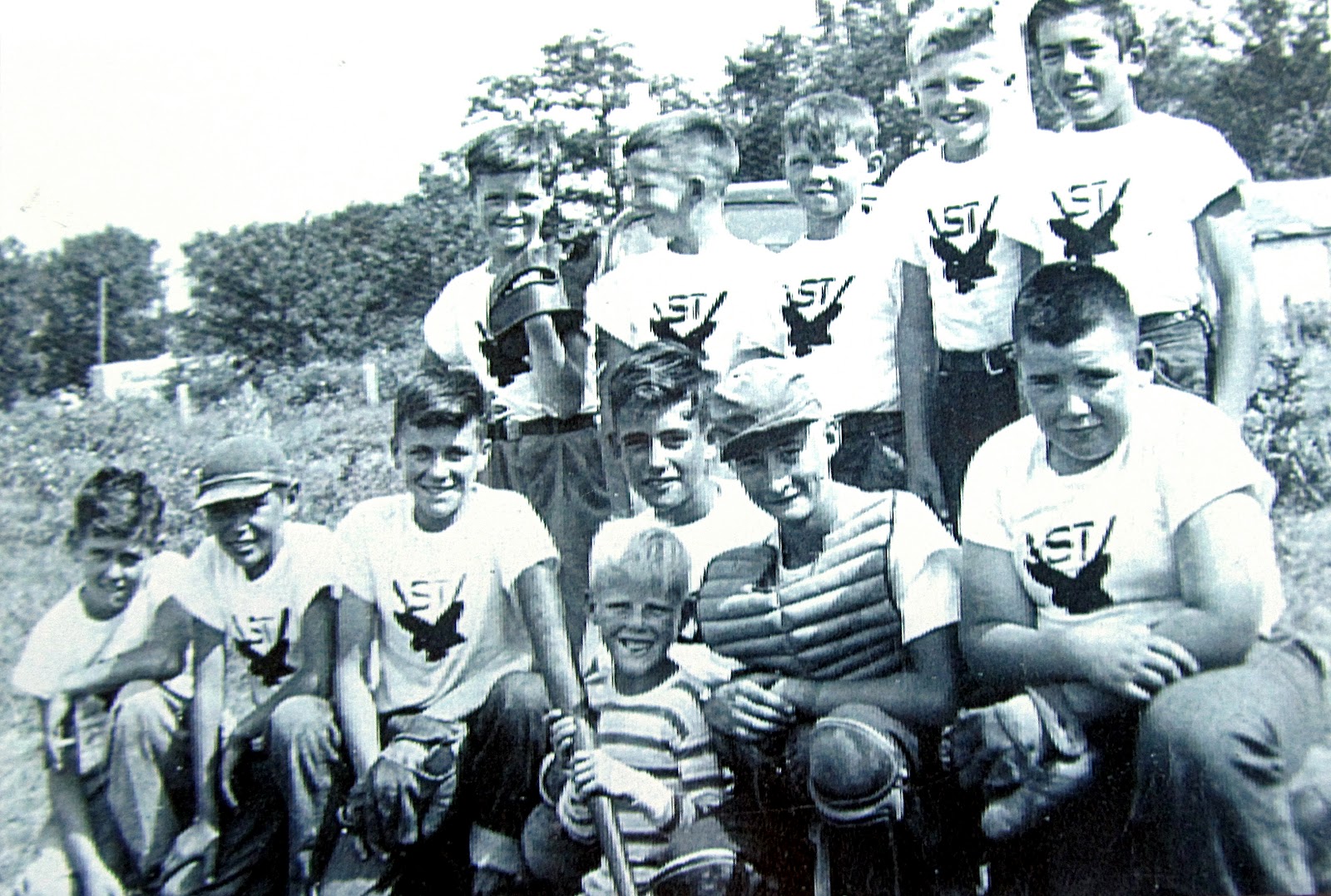
John Stranger - Back row, middle


A MEMOIR OF A LIFE, FOR BETTER OR WORSE
By John A. Stranger

CHAPTER ONE
Beginnings

This all begins in a small town in Minnesota during the 40's when growing up was a struggle without all the things a boy wants and dreams about. Outdoor toilets and dressing behind the oil burner turned up full blast where my brother (4 yrs. Younger) and I learned to dress very fast during the cold Minnesota winters.

My brother was a great kid even though we would have our brotherly confrontations. We had a younger sister too and she learned to hold her own with us boys. Our parents were very strict on almost everything that they thought was for our best interests even though we tried to disagree with our parents at times but trying to obey seemed better than a beating, (most we probably had coming).

Saturday, March 31, 2012

Daniel Franklin Brawley's Sad End


The last time we saw Daniel F. Brawley, he was conducting some rather underhanded business tactics against another resident named Nathan Myrick, over the Pembina/St. Vincent Ferry.

Below is a sort of time-line of Brawley's history in Minnesota.  It was created by Vince Godon on his fascinating website, Historical Minnesota Bricks. Vince is the son of Maurice Godon, a former resident of St. Vincent, who was featured in St. Vincent Memories in 2009.

Below, you'll read how he lived during changing times in Minnesota, as businessman, legislator, etc.  In the end, he died by his own hand, in St. Vincent, and is buried in the St. Vincent Cemetery...


Saturday, November 26, 2011

Line of Fire

Back in the day, just as now, lawmen worked together between Canada and America.  There was less red tape then, although that was there, too.  The excerpt below is about one of the early lawmen of our area, this time on the Canadian side of the 49th parallel.  He has been mentioned in passing before, in the story of Sheriff Charley Brown.  You could say he was Charley's counterpart over the line.

It's fun to learn more of his story, and the context.  We're very lucky to have this recounting - I have read that "virtually no documentation was preserved for the MPP"...
The North-West Mounted Police were not the only officers who made life difficult for bad men in the Canadian West. Even before the Mounties arrived on the prairies, the newly formed province of Manitoba organized a small, but effective, police force. The Manitoba Provincial Police began in 1870 with nineteen men. It was operated out of an old Winnipeg post office that was converted to a police station and courthouse. A log house behind the building was used for a jail. The force was poorly funded, so the officers had to provide their own firearms. They had no standard uniform. Within a few years, the department dwindled to a mere eight men. Some constables were dismissed for inappropriate behavior, such as public drunkenness, others resigned to seek better paying employment! 
In 1874, Richard Power, a twenty-three-year-old who had become an original member of the force at the age of nineteen, was made Head Constable - the equivalent of Chief of Police. The rapid decline in the force's number was only a part of the reason for this young man's promotion to such a position. Even before joining the MPP, he had allegedly served as a scout for the United States Cavalry. He was also a lieutenant in the Winnipeg militia. Power's contemporaries described him as "a fine looking man, magnificently proportioned, every inch a soldier with the courage that nothing could daunt. Power wore a Colt .45 with a nine-inch barrel, and a gunbelt that was always full of cartridges. Local newspapers called Power "a terror to evildoers." In A few short years, Power had shown himself to be a courageous and enthusiastic policeman. Some thought he might have been too enthusiastic. He had once been sharply reprimanded for shooting a Native during an arrest. 
By the time Power took command of the Manitoba Provincial Police, Winnipeg had been incorporated as a city and had its own police department. That left the rest of Manitoba under the eyes of Power and his tiny department. Power strategically placed men in the more populous settlements outside Winnipeg; towns like Selkirk and Kildonan. He kept a few men with him at his headquarters in Winnipeg. Most Manitoba communities had to depend on special constables - civilian volunteers - to keep the peace. If there was any real trouble, Power could send one of his constables out to see to the matter. The policing situation in rural Manitoba was not unlike that of rural Ontario and other points east. 
Manitoba, especially the country along the American border, was woefully under-policed, but the situation was same on the other side of the international line in the Dakota Territory. There was a sheriff in Pembina, just over the border, and another many miles away in Fargo. For those lawmen, just looking after their towns was a full-time job. They didn't have the resources, or manpower, to go chasing after the desperadoes who roamed the plains and hills of the Dakota country. Rustlers, gunmen, and other men on the dodge had only to keep out of the Sheriff's way to avoid arrest. With so much open country, that was not a hard thing to do. Moreover, American lawmen were often unwilling to apprehend fugitives wanted in Canada, unless there was a reward involved.

Tuesday, August 30, 2011

Justice in Old Pembina

The story I'm about to share has been shared here before.  While the first version was full of character (based on solid research), this one has  more background as well as details regarding the final showdown, written by one of our area's premier local historians...
An outlaw from an infamous gang.  A U.S. Marshall on his trail all the way from Texas.  Their paths meet in Pembina on a cold November day in 1878...

by
James Benjaminson
           
Sam Bass gang - Sam in back, on
left; in front, the Collins bros.
William is on left, Joel on right.
[circa 1877]
In the annals of western outlawry, certain names have been etched into the American psyche – names such as Jesse and Frank James, the Younger Brothers, Billy the Kid, Black Bart and Sam Bass, just to name a few.  For the most part, their villainous exploits took place in parts of the country far remote from rural North Dakota.  The closest any of them got to North Dakota was the James Gangs ill-fated attempt at robbing the bank in Northfield, Minnesota and the Bass gangs robbing of seven stage coaches in the Black Hills of South Dakota.  Still, the effect of one outlaw’s exploits rippled to the tiny town of Pembina, Dakota Territory in 1878.

Sam Bass was a young Texas outlaw who headquartered himself in Denton, Texas.  Teamed up with the outlaw Joel Collins and four others, the Bass gang staged the largest train robbery in U.S. history (at the time) when they held up the Union Pacific railroad at a tiny watering hole called Big Springs, Nebraska on the evening of September 18, 1877.  Although Bass was considered leader of the gang, law enforcement claimed Joel Collins was the brains of the outfit.  The gang rode into the stop over, made hostages of the station master and several others in the vicinity, cut the telegraph lines and waited.  When the train pulled in for water, one gang member swung himself into the cab of the locomotive and took the engineer and fireman hostage while the others headed for the baggage car.

When they rode off into the night, the gang had relieved the railroad of $60,000 in freshly minted 1877 twenty dollar gold pieces.  Dividing up the treasure, each man had 500 gold coins in his possession – about 35 pounds of gold per gang member.  The group split into three groups of two men, each heading in a different direction.   Word spread fast about the robbery and law enforcement swooped in on the area.  One of the gang members disappeared and was never heard of again (many assumed he had gone to Canada).  Joel Collins and his partner didn’t fare as well, being intercepted by a posse within days.  After a brief shoot-out, both outlaws were dead and $20,000 of the gold coins were recovered. 

Bass and his partner figured two lone riders would be suspicious so they acquired a buggy, stashed the coins under the seat and rode blissfully by the bands of law officers they encountered.  Returning to Denton, Bass enjoyed the high life, spending freely and enjoying a local sort of hero worship.  He had plenty of friends to warn him of approaching trouble and knowing the area like the back of his hand, he could easily hide from pursuers.  Living the high life the money soon ran out and Bass returned to his old ways.  Organizing a new gang, he returned to robbing trains.  Only this time he chose to hit the local railroads – his gang robbing four trains in quick succession within a 25 mile radius of his base of operation.  It was at this point the locals turned on him and his gang.  For seven weeks, the gang was pursued by a company of Texas Rangers, U.S. Marshals and local law enforcement, all to no avail (although an accomplice, “Arkansas” Johnson, was killed in a skirmish from which the rest of the gang escaped).

Bass’ downfall came at the hands of a spy that infiltrated the gang – and by gang member Jim Murphy who betrayed him in exchange for having charges dropped against himself and his father.  The fatal day came when the gang rode into Round Rock, Texas intent on robbing the local bank.  Laying in wait were the Texas Rangers and local law enforcement.  In a brief bloody shootout, one deputy sheriff was killed as was one of the outlaws.  Bass himself was wounded but managed to clamber onto to his horse and ride away.  The trailing posse found him the next day, lying under a tree, still alive but mortally wounded.  Death came to Sam Bass July 21, 1878 – it was his 27th birthday.

Of the participants in the April 10th train robbery at Mesquite, Texas, six of the eight robbers had either been killed or were in prison by the time of Bass’ death.  The robbery had netted each of the bandits the paltry sum of $23 each!  One of the gang – William Collins, was arrested days after the robbery and taken to Austin to stand trial.  He was moved to the jail in Dallas in June where a family friend posted a $15,000 bond to secure his appearance in court—a date he did not intend to keep.

A brother to outlaw Joel Collins who had participated in the earlier Big Springs train robbery, William Collins jumped bail and headed north, roaming across several states before eventually ending up in Pembina, Dakota Territory working as a bartender in Jim White’s saloon, a unique watering hole that straddled the border.  A red stripe painted on the floor designated which country a patron was in – the saloon on the U.S. side of the line, with the kitchen and sitting room on the Canadian side.  Known to the locals as William Gale, Collins befriended a local man, Robert Ewing, finally telling Ewing his real name and confiding he had a wife living in Dallas.  Gale/Collins asked Ewing to write her a letter, which apparently Ewing did.  One can only speculate but it is assumed authorities were watching her mail.  It wasn’t long before a deputy U.S. marshal arrived in Pembina looking for Collins.

Friday, May 13, 2011

Customs Stories III: Opium Smugglers


Smuggling contraband is a long tradition along borders, including the border area around St. Vincent...

Bold Opium Smugglers

Confiscated Opium...
St. Paul, Minn, Dec. 20, 1888 - A gang of daring smugglers has been engaged for some time in bringing opium into this state across the Northwestern border. The deputy collector at St. Vincent, Minn., acting on information from one of the gang who is under arrest, captured a wagon containing eight hundred pounds of the drug in the crude form just on the Dakota line. Detectives are in pursuit of the man to whom the opium was consigned. Opium smuggling on the extensive scale is being carried on, and such are the precautions against detections that it is almost impossible to stop it.

From: The Ithaca Democrat (December 1888)
Good thing, then, that Deputy Collector Nelson E. Nelson was on the job!

Thursday, April 28, 2011

News from the Past: Schoolhouse Takeover

St. Vincent School in its early days...
A lot of tramps took possession of the school house at St. Vincent, Minnesota, and after getting drunk used the school records for making a fire. It took all the town police officials and a number of citizens to lodge them in jail.

From: Manitoba Daily Free Press (Wednesday, 19 February 1890)

Sunday, April 10, 2011

The Returns from Pembina


P
resident Cleveland once asked Bishop Whipple what would be the effect of making the Indians voters. Then Bishop Whipple told him that it had been tried, and after listening to the story, President Cleveland gave up the idea....


1876 was a very contested
election
in general... 


In Dakota territorial days a law was passed allowing Indians wearing civilized dress to vote. In the following election, when both sides were claiming the victory, some one said: "Wait until you hear from Pembina." In Pembina lived a large number of the Pembina tribe of Indians, and there also dwelt the local political boss, "Jud" La Moure, famed for his sealskin overcoat and his qualities as a political fighter. When the returns came in from Pembina, it was found that the members of the tribe had all been put into hickory shirts and trousers on election day, between sunrise and sunset, and after exercising the inalienable rights of citizenship, at the dictation of the local boss, they returned again to their blankets, having decided the territorial election.
From:  The Bourbon News (Paris, KY) November 12, 1901

Saturday, March 26, 2011

Godon: The REST of the Story

Adz:  The murder weapon


Gilbert Godon has appeared in this blog before - the first time, as a character in a novel based on fact; the second time, referred to by a descendant relation when discussing our shared history in and around St. Vincent.


Now, I have found him referred to in a book of recollections by a soldier who served in our area; it fills out the tale we already knew about Gilbert.

It's always fascinating to find out more than just the bare facts...

Sunday, January 02, 2011

The Life of a Customs Official in Old Pembina

Joseph O. Lemay
[Photo courtesy: Manitoba
Historical Society]
Joseph Lemay, Esq. - Judge, postmaster and collector of United States customs at the frontier post of Pembina - filled a tolerably well paid office, but was exposed, in the execution of his duties, to an almost intolerable amount of abuse and obloquy at the hands of a class of men who cared as much about the obligations imposed by civilized laws as they respected Mr. Lemay for his professional knowledge of such. His own countrymen resident at Red River Settlement were supposed to give the collector, on the whole, more trouble than did the British colonists, while he revenged himself as far as possible by strictly adhering to the letter of his instructions as regards releases for loaded goods, and relaxed no charge which it was in his power legally to enforce against the enemy. It will readily be understood that much power which might be perfectly legally used, either to retard or facilitate the transmission of goods, was necessarily vested in the hands of such a person as Mr. Lemay.

So unpopular had that public servant become among a certain class that he stood in well-grounded fear of personal violence at the hands of its members as often as they entered an appearance with a fresh cargo of bonded merchandize at his head-quarters. When at St. Paul he met his persecutors, secure under the wing of an organized police force, he has been known to exhibit somewhat more than his wonted confidence in his communications with them, receiving in reply a plain intimation that he had better take care what he did or he would walk in a skinful of sore bones the first time his interlocutors should encounter him at Pembina. His visits to Red River Settlement occasionally proved disastrous. Those with whom it was his object to do business, treacherously concealing their designs under the cloak of hospitality, pressed on his acceptance the peculiarly stimulating beverages commonly used in the country, and occasionally reduced their visitor to a condition in which he found it prudent to avoid engaging in business. To do Mr. Lemay justice, however, the latter event was one very uncommon in his experience, as he was, I believe, a match, so far as ability lay in the consumption of spirits, more than competent to deal with any adversary he would be likely often to meet. Latterly, moreover, he prudently shielded himself against all such attempts under the plea of total abstinence.

Sometimes the war was carried on more openly. The collector called one day on a man, who he alleged had deceived him, and told him, " Sir, you are a liar!" He was immediately knocked down for his pains by a blow on the eye which rendered him a deplorable spectacle for a long time. He applied to several magistrates for satisfaction on account of the assault he had sustained, and justified the offensive expression he had used on the ground: "I called him a liar because he was a liar, and I could not call him anything else."

On another occasion he was knocked down with an axe handle in the course of a dispute with a settler, rising out of an alleged overcharge of two cents in his Pembina postage accounts.

Saturday, November 13, 2010

Manslaughter at Midnight

In March 1899, an altercation occurred late in the evening outside a St. Vincent saloon at closing time.  The end result caused the death of a man...all over a hat and some whiskey...

Friday, June 04, 2010

BORDERTOWNS: The Final Chapter

With this chapter, Dear Readers, BORDERTOWNS comes to a close.1 This was the last [complete] book written by Chuck Walker, and once again I have been very proud and honored to share Chuck's work with you here. His encyclopedic knowledge of my local area was amazing, and we're lucky he was so willing to share it throughout his life in many ways. I wish I had had more time with him, but am thankful for the time I did have...

Now enjoy the last chapter of BORDERTOWNS!


That same morning Joseph discovered his bottle missing and accosted Annette. She disclaimed any knowledge of the bottle, doubting he even had one, for he had been drunk the night before. Joseph began to rage, blaming Pete, cursing him wildly.

Annette objected sharply. "He's never stolen anything in this house. He's your own brother. In fact, he gives us money to help keep us going. If it wasn't for what Marguerite and I bring in, and what Pete gives me, we'd starve." She said vehemently, "You don't bring in one cent!"

Her attempt to shield herself from the sudden blow came too late; the swinging fist knocked her to the floor. She thanked the Lord that Marguerite was at work and not at home to witness her degradation. She had been able to hide most of his abuse over the past years, since he had been careful never to strike her in the presence of Pete or the girls.

"Keep your mouth shut, woman. I bought and paid for you years ago. What I do is my business."

Afraid to rise from the floor, she watched helplessly as he plundered her grocery money in the cupboard. Casting her a malevolent glance, he slammed the kitchen door violently as he left. Regaining her feet, she went to the window to see him heading for Smith's saloon on the corner.

After eating dinner at Mrs. Fisk's boardinghouse, Charley rode to the fort. The wagon, carrying Murphy’s body, had apparently just arrived, for a medical orderly was arguing with the driver.

"Leave the corpse in the wagon! Doc will examine it out here. He won't want the infirmary messed up. Besides, the body goes back to town after he looks it over."

Dr. Appel stepped out of the door just as Charley dismounted. He nodded toward the corpse. "Your project, Charley?"

The image above, an excerpt from the Medical Times & Register [18799-1880], shows how Chuck Walker got the little details down right in his historical novels...Appel was the post surgeon during the time period this story is set in...
"Yes. I'm pretty sure it's a man named Murphy – got himself run over by the early morning train. 'Sposed to have been sleeping on the tracks, but it looks more like murder to me."

"How so?"

Charley explained his suspicions of the accident.

The doctor looked the corpse over briefly, and then turned to his assistant. "Remove the clothes from the man, Fred. We'll have a closer look."

The orderly had a distasteful look on his face as he attempted to remove the blood soaked shirt from the corpse. Struggling to remove both shirt and trousers he finally reached into his pocket, extracting a knife. Cutting the tangled suspenders free, he was finally able to strip the body.

The doctor inserted a rectal thermometer, and then he examined the body in detail. Finally, he checked the torso, musing aloud, "My God! Look at the massive scar tissue on the side of his shoulder. He must have been in a severe accident -- and not too long ago either." He turned to Charley. "A doctor's curiosity, you might say."

Dr. Appel continued to speculate, "You know, you may be right. If this man had his neck on the rail, he wouldn't have the back of his head crushed. Look here!" He pointed at the severe indentation in Murphy's skull. "'Course if a chain or something hung from the train, it could account for this damage." He removed the rectal thermometer; he seemed puzzled. "There's another possibility. What time did the accident occur?"

"About dawn this morning."

Appel snorted in disgust, "Hell, this man has been dead for almost ten hours! He's already loosening up and he's lost nearly all body heat. You'd better take him to the cemetery and plant him quick. He'll ripen fast in this heat. I think a blow to the back of his head killed him, but it's only speculation."

"I kind of figured he was moved to the tracks," Charley said grimly. "Now I'll have to snoop around to find out what actually happened. He's no loss to anyone but himself, no family that I know of. Still, I have to try and ferret out the guilty party."

As the sheriff rode back to town his mind was in turmoil. Could the murderer be Ian or another of the McLaren family? What will I do then? Lordy, I hope not.

That same morning when Joseph Grant entered Smith's saloon for a drink, he expressed his feelings to the bartender. "That damned Pete! He stole the bottle I had behind the stove."

The barman smiled to himself; he knew Pete to be a periodic drunk. Stealing a man's bottle was a joke, for whiskey was considered an essential of life at the time.

The sheriff arranged to have Murphy buried that same afternoon, then spent the remainder of the day checking the saloons of Pembina and St. Vincent. The bartender of the Ryan Hotel in St. Vincent remembered a large, pale-faced man leaving his bar around midnight.

"Was he drunk?"

"Drunk, and mean as hell. He tried to pick a fight but everyone backed down. He was a miserable dog." The bartender grew inquisitive. "I thought his voice sounded familiar, but I couldn't place him."

"Did he buy a bottle of Old Crow?"

"I don't remember him buying any bottle. Hell, we don't sell that brand. Their drummer is a sharper; I don't do business with him." He looked at Charley suspiciously.

“Why the interest in Old Crow?"

"Found an empty near Murphy's body."

The look of surprise on the barman's face was evident when the name Murphy was mentioned. "Jeez! Was that Murphy? He sure fooled me!"

Charley reflected over the bottle. Shucks, even John and I sell that brand in our place, other saloons do too. Still, he sensed something missing when he returned to the jail. He carefully stood the empty bottle on the rear of his desk.
_________________

It was noon when Ben McCune sobered up enough to realize he was stone-broke. Every penny he had realized from the sale of his farm was gone. Even the money gained from selling the yoke and harness of his oxen had been spent. The saloons in St. Vincent gave no credit so McCune determined to go to Pembina. He stayed in St. Vincent just long enough to hear the news of the dead man. The information that the accident took place only a short distance from where he had slept, troubled him.

While crossing on the ferry to Pembina, he attempted to steal Trudo's bottle while the ferryman cranked the drum. The ferryman had allowed McCune free passage when he was broke, provided the ferryman was crossing with a paying passenger.

"Ben, you damned thief, you'll swim or wade from now on." Grasping the cringing McCune by the collar and belt, he threw him off the ferry. McCune momentarily appeared, spluttering and cursing, standing chest deep in the water.

Depressed, soaked, but now sober, he walked the remaining quarter mile to Pembina and sat down, leaning back against the wall of Bradshaw's Pembina House. His daydreaming brought to mind the dead man. Could it have been murder? The more he pondered, the more he was sure the man with the mule had something to do with it. Yes, there was the possibility of a reward there. Struggling to his feet, he turned toward the jail. The door was padlocked and the sheriff or deputies nowhere in sight. Stiffly, Ben sat on the upper step with his back against the door. He finally dozed off.

It was nearing the supper hour when Charley returned to the office and found McCune blocking the door. His hat was pulled down over his eyes and his mouth sagged open, exposing yellowed and crooked teeth. Nudging Ben with his foot and shaking his shoulder, Charley got the man awake and to his feet. McCune was crafty. "Know something about the murder, sheriff. Is there any reward?"

"Reward for what?"

"The murderer of the man found on the tracks."

"How do you know he was murdered?" Charley was amused, thinking, McCune's here to tap me for a drink or a bottle.

"Saw the man."

"What man?"

"The man hauling the body."

The sheriff looked at him grimly, then he thrust McCune roughly inside and onto a chair. "Tell me about it and don't leave out a single thing! You'd better not be lying!"

McCune's eyes scanned the room greedily. "Need a drink. Got any?"

Brown looked at him with disgust. Finally he slid open a drawer of his desk and produced a bottle and tin cup. Pouring an inch into the cup, he handed it to McCune. "Now tell me what you know, or I'll put you in jail and throw away the key."

McCune related what he could remember of the man leading the mule and the load on the mule's back. To make his story stronger, he insisted that the mule carried a body. He looked pleadingly at Charley as he placed the empty cup back on the desk.

Charley debated silently, there were few mules around St. Vincent and I can check the ferry to see if any were brought across the river. He knew mules to be poor swimmers so doubted any had been ridden across. That would almost eliminate anyone from Pembina being involved. Murphy had to have enemies, but Charley knew he also had friends, especially among the railroaders from Emerson. He remembered Brogan and Murphy and other workers had spent that past winter at Roseau Crossing where the girl was killed.

Pouring the remaining liquor from the bottle into the tin cup, Charley handed it back to McCune. "Drink that, and keep your mouth shut tight!"

McCune nodded as he gulped down the raw whiskey; it took both his hands to keep the cup from shaking.

"If you promise to keep this conversation to yourself, you can go to my store and tell John I said to give you a bottle of Old Crow. It's on me."

"Can't I have Scotch instead? It's better than Bourbon."

Charley felt a certain satisfaction. McCune sure wasn't a suspect.

The next morning the sheriff crossed to St. Vincent and began the search for mules. Stopping at each bar he inquired who owned the hybrid animals and who regularly bought Old Crow bourbon whiskey. From there he checked the stables at the hotels and the private liveries.

At Fri's Hotel the bartender mentioned that the only mules he knew of locally, outside of those kept at local livery stables, were those owned by the McLarens. "They have several," he said, "I believe old Pete keeps one of Ian's critters over in Grant's barn."

Charley knew Pete picked up spending money by doing odd jobs with the borrowed mule: water hauling, wood delivery and sundry chores. When the question of who favored Old Crow whiskey came up, the name of Joseph Grant was included. At Smith's saloon the bartender remembered the joke Pete had played on Joseph, by stealing his bottle.

"What day did Grant come in for another?"

"Yesterday."

Stepping from the hotel, Charley found his mind whirling. Things were beginning to fall into place. Oh hell! Damn it all! It's circumstantial, but I'll have to try a bluff.

Leading his horse he walked toward Grant's. As he approached the front of the house, he could hear the sounds of an axe being used. Behind the house he found Pete splitting wood blocks for the kitchen range. The fact that Pete at first glanced up to see him, then ignored his presence, convinced the sheriff of Pete's complicity.

"You know why I'm here, Pete?"

Pete looked at him long and hard, then slowly nodded.

"Why did you do it? Were you drunk?"

Pete resumed chopping.

"I'll have to put you in jail, you know."

The breed looked at him resignedly, and then forcefully buried the axe in the chopping block. Turning to Charley, he said, "I give no trouble." He extended his hands together in front of him, expecting irons.

Charley shook his head. "Don't need them. Come along with me and we'll talk it over."

While the sheriff rode, Pete walked alongside. He seemed morose and taciturn, refusing to discuss the matter, or even speak when Charley shot questions at him.

They crossed on the ferry, then on the piling bridge across the Pembina River. Charley noticed people glancing at them as he and Pete turned toward the jail. When inside the log building, Charley asked, "Why did you do it Pete? You must have had a good reason."

Pete's mind seemed miles away and Charley could get no answer. Finally he opened the cell door and stood to the side. Pete arose and walked in without a word. As the sheriff watched, he lay on the bunk and covered his eyes with his arm.
__________________

News of the murder and the capture of the suspect spread like wildfire after the sheriff went to the barbershop. He was forced to notify his part-time jailer, Captain Bob, that his services were required to guard the jail that evening. Charley knew Bob to be a nondescript person, a part-time barber who drank up every cent as fast as it came in. But to Charley's thinking, a jailer needed only two qualifications: he must work for one dollar a day, and he must be immediately available.

"Did Pete really kill Murphy, sheriff?"

"Yup, sure looks like it. He doesn't deny it but he won't tell me why he did it. There's probably a good reason. Maybe Murphy picked a fight with him. I've been told Murphy was looking for a fight in Ryan's saloon the night he was killed. It seems no one was anxious to take him on." He shook his head. "No loss to the community, but the case may cost the county some money. I want you to take the eight to six a.m. shift at the jail, tonight. I'll be there in the morning to relieve you."

Captain Bob was an important man that afternoon. He spread the news that the sheriff had Pete locked up for the murder of Murphy. Most people were complacent about the capture, but a few looked up the sheriff to congratulate him. The kudos left Charley with a feeling of guilt, knowing of Murphy's crime against Mary. He also knew the McLaren family would not like those facts brought to light. Few people of Pembina actually knew Pete as an individual; to most, he was just another no-account half-breed.
__________________

Pembina was quiet that Monday evening and the jailer, in an effort to avoid the stifling heat inside the jail, moved his chair just outside the door of the lockup.

It was past midnight when a man walked out of the darkness. He appeared to have been drinking heavily and carried a bottle of whiskey carelessly by the neck. After striking up a conversation with Bob, the man offered to share his bottle. At first Bob refused, knowing well he shouldn't drink on duty. After some conversation and further coaxing, the jailer succumbed to temptation. Within a half hour his head fell forward; he lost consciousness.

His visitor disappeared for a few moments, and then reappeared, accompanied by three other men. Picking up the sleeping jailer, they carried him into the jail and closed the door.

When the sheriff arrived the next morning, he found the outside door padlocked. Applying his key to the lock, he removed it and pushed open the heavy oak door. His jailer lay on the floor as if dead. The cell door was open and Pete was gone. The only apparent damage inside the cell was to the small window; the glass was shattered. When Charley attempted to awaken his assistant, he became concerned. The man acted as if drugged. Touching his carotid artery, he found that Bob's heartbeat was steady, but abnormally slow. His breathing was labored and he seemed to be in a deep sleep.

Leaving the jailer on the floor, Charley checked every detail of the cell. There was blood on several of the larger pieces of glass, an indication of possible foul play. He picked the few shards from the floor and disposed of them in the alley trash barrel. Although he had no evidence to support his theory, he knew instinctively that Pete had been taken from the jail by Murphy's cronies and was by now, probably dead.

It was noon before he could get a coherent word out of his jailer. It took threats of bodily harm to finally elicit the information from Captain Bob that he had yielded to temptation and had shared drinks with a stranger.

Charley felt frustrated. Now he had two suspected murders and only one corpse. He knew instinctively that the guilty ones had to be the railroad friends of Murphy and Brogan. He also knew they would have covered up any trace of their guilt. They certainly wouldn't have crossed the river on the Pembina or Emerson ferries. That would have been too obvious. They more than likely used a local rowboat. He would check the two ferries first though, just to be sure.

It had taken just three hours for the jailer's midnight visitors to dispose of Pete. Tired, but elated with their easy success, they walked the rest of the way to the border. Borrowing one of the many boats tied along the shore, they crossed to Emerson, and feeling safe, reviewed the night's work in quiet tones with a bottle of whisky. The laudanum-laced whiskey with which they had baited Captain Bob had done the job on the careless jailer. One of the men laughed, and said, "Murphy was a miserable bastard, but he was our bastard. No breed is getting away with killing a white man. No one will ever find the body either." He sneered, "They'll never be sure what happened to him."

That afternoon Annette had seen Pete and the sheriff conversing by the barn and wondered what they were discussing. She felt no alarm as Pete accompanied Charley toward the ferry, since there were no signs of hostility between them.

When Pete failed to appear after supper, she walked to Susan's house. While mentioning seeing Pete and the sheriff together, Susan's face contorted with fear. Early that afternoon a neighbor had brought the news of Murphy's corpse being found on the railroad tracks. At the time her whole body had seemed to freeze, and she felt a shortness of breath. Now she knew who her attacker was, and what Pete had done with the body. Did the sheriff suspect Pete? Should she see Charley and explain what had happened? What could she do? What should she do? Her first thought had been to tell Ian and her mother; yet, it might create more problems. Perhaps Pete had other business with Charley, as there were many nights he failed to come home. He had also impressed the need of secrecy upon her.

Ian was still in the field when her mother left for home. Susan knew from the look on the face of her mother that she sensed something was wrong.

Word of Pete's arrest for the murder of Murphy made the rounds of the saloons in St. Vincent late that afternoon, but the information never reached the Grant or McLaren families.

The sheriff's afternoon investigation at the two Emerson ferries was fruitless. The operators disclaimed any knowledge of railroad men crossing the river. Charley knew that both ferries closed down at dusk so the men must have used a rowboat as he had suspected. He doubted anyone from Pembina or the fort being involved as few outsiders were in town that weekend. It was on every other weekend when the railroaders were paid, that he deemed he was underpaid as a law officer.

When he returned to the jail late that afternoon, Charley found Ian's gelding tied to the iron hitch post. Since Ian was nowhere in sight, Charley rode to the livery, removed the saddle from his horse, then raised it to the crossbar. He was leading the animal to the corral just as Ian rode into view. While he removed the bridle, Ian said, "I hear you've got my hired man locked up for killing that bastard Murphy."

"Not any more." Charley shook his head dourly.

"What's that mean?"

"Come over to the office and let's talk. What I have to tell you won't set well, but damned if I know what to do about it."

It took only ten minutes for the sheriff to explain the events since Murphy's death. Ian was shocked. "You mean Pete actually killed Eck Murphy? That's hard to believe."

"Believe it! But for what reason?" Charley's shoulders rose questioningly. Looking Ian in the eye, he said, "I've other news for you. Murphy bore that scar you guessed at. He was the man who attacked your sister. I think he recognized her, too. Why else the attacks upon your family?"

Ian was momentarily speechless, and then exclaimed, "Thank God the S.O.B. is dead! Between he and Brogan they caused us a lot of grief." He shook his head. "I'll speak to Annette and the girls; someone must know what happened between Pete and Murphy. I'll say this, if Pete did kill Murphy as you say, he had a darned good reason."

"That's the heck of it! If we knew what happened, and it went to court, Pete would probably go free. Now, thanks to that stupid-ass Bob, he's more than likely dead."

"But why would Pete kill Murphy? Oh, I know he had no use for the man, but who did? As far as I know, there was no personal animosity between them." Ian shook his head in frustration.

"It's for sure something happened between them. It might take some time to find out what is, but eventually it'll come out. Murphy no doubt had it coming, but murder is still murder, regardless."

"You really think a group of men took Pete from the jail and killed him?"

"Ian, I'm almost positive that's what happened, and he's now dead. Ten to one it was those cronies of Murphy and Brogan. Do you remember any of the men that came into my bar that noon of the fight?"

"Not names, but I remember faces, at least two of them. We worked on the same crew when the roadbed was graded north of Emerson. That was in the fall of '77, just after we arrived here.

"By the way, some time back you mentioned that Jack Bell was going to get their names for you. Did he?"

"No. He's never mentioned it. Evidently he's been distracted by other work. Guess he's got enough trouble keeping those C.P.R. workers in line. 'Spose it's up to me to find them. With so many crews working north of Emerson, those men will never be around town in the daytime. But at night, that's when they'll gravitate to the saloons. Can you spare the time to go across the border after supper tonight?"

"Sure, if it will help find Pete. Why don't you meet me at my house after supper? Better yet, come and eat with us. You haven't seen the interior of our new house. After eating, we can ride over to Emerson and check the bars."

Rising from behind his desk, Charley said, "I’m ready for something to eat, then the trip to Canada tonight. I'll have to turn down your invitation to supper, though, 'cause I've got to see Bill Moorhead. I'll be at your place about seven. Somehow, I'm going to get to the bottom of this." He had a grim look on his face.

When Ian returned to St. Vincent, he was surprised to find the house quiet. Entering their bedroom he found Susan lying on the bed. She was fully clothed and had a damp cloth covering her forehead and eyes. She appeared to be asleep. Immediately concerned, he bent over her and called, "Susan . . . Susan!"

She suddenly sat up, wild-eyed, the damp cloth rolling to the bedspread. Tears began to stream down her cheeks. Anxiously Ian gathered her into his arms in an attempt to comfort her.

"Susan, calm down. Tell me what's wrong."

During the next minutes, amid a vale of tears and nervous shaking, she divulged the details of the attack upon her. "Pete saved me. Oh, Ian, he's my Father! He said so."

It took a few moments for her almost incoherent words to make sense; then Ian remembered her tenseness when she visited him that last night of his shift. "My God! Why didn't you tell me then? We could have straightened this out."

She sat back at arm length, imploring, "Please don't be angry with me." Her cheeks were ashen as she attempted to compose herself.

"I'm not angry, but I'll have to tell Charley." Realization came to him that this was not the time to tell her that her father was in all probability, dead. He smoothed back the long hair from her face. "Charley and I are leaving for Emerson after I have something to eat. I'll explain the happenings to him; I may be late in getting home." To ease her mind he added, "Pete's action was justified. I only wish the opportunity had been mine. Don't worry about a thing sweetheart. It will all straighten out." It was mind-boggling when he thought of the consequences that resulted from hiding the truth. Still, he couldn't second-guess Pete's decision to conceal the act. All that remained now was to find Pete, if alive. Or, if dead, find the men who murdered him.

When Charley arrived, Ian asked him to step into the kitchen. Susan, still sick in mind, had gone to her bed. Relating Susan's story, Ian grimly asked, "What do we do now?"

Charley shook his head disgustedly. "Damn that Pete! This is entirely his fault. If he had reported killing Murphy, it could have been settled."

Ian brooded, "Not necessarily. You know how some of the whites hate the breeds. They'd have found some way to punish or do away with him."

The sheriff pushed away from the table and stood his face taut with anger. "Let's go to Emerson and find out who took Pete from the jail."

Two of the saloons in Emerson were nearly devoid of patrons, but the final stop at the Gateway Hotel, yielded dividends. The bartender looked up briefly as they entered, then resumed washing glassware. Ian immediately nudged Charley. "There are two of Murphy and Brogan's friends seated with others at that far table."

At first the men at the table exchanged furtive glances as they recognized Ian and the sheriff. They pretended indifference, keeping their heads down and conferring in low tones. Ian caught the exchange of cagey smiles as one of them spoke up. "Out late on the wrong side of the line, sheriff?"

"Just looking for people who stay up late and wander to my side of the line," Charley challenged.

The tough turned to his friends at the table. "We wouldn't know anyone who would want to do that, do we, men?"

The hostility of the men at the table was obvious. One of the seated men remarked insinuatingly, "Hell no, sheriff. We're good little boys and stay home at night."

The derision on their faces was obvious. Ian realized his was a no-win situation that could turn ugly, seeing he and Charley were outnumbered. He thought it prudent to withdraw. Evidently Charley felt the same, for, turning away from the men, he ordered two beers from the bartender. Obviously ignored, the men at the table exchanged satisfied smirks.

Sipping his beer, Charley said in an undertone, "We've come to a dead end. We've found our men, I'm sure of it. Now it'll take some thinking and planning to bring them to justice."

On the way back to St. Vincent, Charley seemed optimistic. "I'll speak with some friends and we'll wait it out. Some evidence may turn up."

When Ian offered Charley a bed for the night, the sheriff shook his head. "I'll walk the river with my horse. It's so shallow now that the ferry is having problems. The operator has had to hire a shovel gang to keep the cross-channel open. If we don't get rain soon, the steamboats may have to tie up for the remainder of the season."

The next morning when Charley left his room to breakfast at Mrs. Fisk's, he met Ned Cavalier on the street. Ned had a whimsical look on his face. "Cripes, Charley, you're popular. You've got the whole Indian tribe from the north camp waiting at your jail."

"What for?"

"Reckon they want to know what you did with Pete."

"I'd like to know myself. Oh, well, I'll have to face them."

He judged that over fifty Indians turned to watch his approach. Recognizing their chief, Matawin, he asked. "What's this meeting about?"

"Where Pete?"

Beckoning Matawin to follow him inside, Charley thrust out a chair to him. He explained that Pete had been in the cell and had disappeared. Pointing out the broken window in which a few small shards remained, he said disgustedly, "I've got to fix that." He failed to mention that Captain Bob had been drugged and that the cell door was open when he arrived the next morning. Matawin stood, and then walked into the cell to appraise the window. The aperture was too small for a human to crawl through. Apparently satisfied, the Indian chief walked past the sheriff and out the door, joining the group standing outside. The Indians gathered around him while he spoke; then they began drifting back north toward their encampment.

Puzzled, the sheriff locked the outside jail door and began walking back to his store. Meeting Bill Moorhead, he asked, "What do you suppose those Indians wanted?" He explained that he had shown Matawin the cell with the broken window.

Moorhead looked serious. "Didn't you know Pete was a Midewewan? Matawin probably figured Pete changed himself into a bird and flew out the window. I know it sounds crazy, but it's a part of their beliefs."

"You're kidding me!"

"Nope. Go to their camp and ask them if you don't believe me."

Charley could see Bill was serious and not joking. "Oh, I believe you. You've lived with these Indians a lot longer than me. Still, it's hard to believe." He shook his head, realizing how little he knew of the Indian dogma.
_________________

Susan seemed unable to recover from the shock of losing her father. Day after day she moped, as if in a dream world. Ian was frantic to find something to bring her back to reality. Finally Maggy's visit brought some semblance of order to their household. She determined to disclose the secret of Mary's attack. After Susan heard the story, she sat transfixed, as if unbelieving.

"What a horrible experience to have undergone at her age! Oh, Maggy, it happened to me, too, and it would have been worse. I'm glad he's dead, but it won't bring back my Father. Ian tries to keep my hope up by saying he may still be alive, but in my heart I know those men who took him from the jail murdered him. Is there no justice for Indians and we mixed bloods? I've asked my Mother time and time again why they kept their secret from us, but she just looks at me silently and shakes her head. I know she misses Pete, for she sits alone in the kitchen, hour after hour, saying nothing."

"Perhaps the answer lies in the fact that the man your mother married couldn't give her children. You know, you should be thankful to have enjoyed your true father as long as you did. As you have said, he was always the one you girls looked up to as a father. You've said he was always kind to you through the years. He must have loved you both as well as your mother."

"Yes, looking back I remember how he helped with the cooking and work around the house. He was the one who cut and split the stove wood, hauled the ice, and kept us going. He was the one who took us on his lap when we were young. I know he had an occasional drinking problem, but now I realize the tension he must have been under, taking orders from his older brother. He must have constantly worried about being cast out of the house." She looked at Maggy questioningly, "What will mother do without my father to hold things together?"

"We'll take that as it comes. I suspect Ian will take up the slack. Your mother is Ian's responsibility now, and you'll both see her provided for. It's always a problem for older folks when they can no longer work. Someday, I hope things will be different. At least she has her job at the fort and Marguerite is still unmarried and working."
__________________

Almost a month after Pete's disappearance, a Mennonite farmer who lived west of Emerson sought out the sheriff. He had walked across the border from the north, in his quest for supplies. Reaching the jail late in the afternoon, he had difficulty in stating his purpose due to the language barrier.

"I find foot of dead man, dead Indian."

"Where?" asked the sheriff.

"Where I walk from." The farmer pointed north.

"When do you go home?"

"I buy, maybe some time."

"Come back to me then. I'll go with you to see."

Charley waited impatiently until the farmer returned an hour and a half later with his knapsack bulging with supplies. Hurriedly Charley tied the man's bag behind his saddle, and mounted his horse, trying to hasten the stolid Mennonite. Moving north toward the border they approached an uprooted tree where the man stopped and pointed at the ground. Charley knew they stood on the Vaughn homestead land. Slipping from the saddle he immediately saw part of a moccasin clad foot protruding from the ground. As no grass or weeds grew on the spot it was obvious the dirt fill was of recent origin. Charley surmised the recent rains had settled the fill, exposing the foot. A darn poor internment he thought; those railroaders were careless. Breaking part of a branch from the downed tree, he dug away enough dirt to satisfy himself that the body was truly Pete.

Returning to his horse, Charley untied the farmer's pack, and handed it to him. Thanking the Mennonite for leading him to the location of the dead man, he mounted his horse and returned to Pembina.

Just before dark that same evening, he returned with a shovel and completed the burial. All the way home he debated whether or not to divulge this recent turn of events, then decided it would serve no useful purpose. He realized that unless at least one of the guilty parties confessed to the murder of Pete, the culprits would in all probability never be punished.
_________________

It was Mike who finally brought Susan back to full reality. He appeared at the back door early on a Saturday morning carrying two wrapped fish lines and a small sack. Ian looked up from the breakfast table as the boy entered. "Plan on fishing today, Mike?"

"I want to, but can't unless you come with me. Mother won't let me go to the river alone 'cause I can't swim."

Ian looked to Susan. "I can't go with him today. I promised to help the boys move the teams and plows out east. Can you go with him? You like to fish."

She looked interested. "Have you dug up some worms for bait, Mike?"

His face lit up. "I'm after catfish -- got a bunch of frogs here." He held up the small sack. They could see the movement inside as the frogs struggled.

A smile came to Susan's face, the first Ian had seen in nearly a week. His hopes rose when he saw her perk up.

"Susan, you've been working too hard, almost from dawn until dusk. It's either been the house or garden. Take a break and go fishing with Mike."

A flash of color came to her face. "You know, you may be right. I thought hard work would make me forget, but it's just ground my troubles more into me." She turned to Mike.

"Sure, we'll go down to the Red River and I'll show you my favorite spot. How come you don't go swimming with Jerold and Knute?"

"Ah, they're always over at Olanders now, gawking at those two girls."

"Ian, why don't you take Mike swimming sometime?"

"Remember, you're the swimming champion." He smiled knowingly.

Susan almost blushed when she remembered the Sunday afternoon they spent south of the fort, the week before they were married. "It would be unseemly for me to teach him," she said softly, and then she turned to Mike. "Give me a few minutes to put on some old clothes."
_________________

Mary was as regular as a clock about writing home. A letter arrived nearly every week, telling about Army life and their new friends. She often enclosed letters she and Kirby received from the Ralstons. In June the letter that Maggy had fervently hoped for, arrived. Her wishes had been fulfilled. "Oh, Pat! Mary is expecting!"

His head lifted from the newspaper and he nodded sagely, "Guess it was bound to happen. How's Kirby doing? Does she say?"

Maggy's gaze appeared to be on the lamp flame, despite a flying miller that had somehow slipped into the house and was repeatedly attacking the hot chimney. For long moments she was silent, and then said dreamily, "At last our troubles seem to be over. Lordy, it's strange! Mary's troubles began with the railroad; then both of those horrible men met their fate due to the railroad."

"Yes, and this fall after harvest time, Ian and I are quitting the St. Paul and Pacific. We're going to be full time farmers."

Maggy marveled, "Just think, we've two grandchildren on the way, and soon it will be Jerold and Knute thinking of marriage. She turned to gaze at him fondly, "How many grandchildren do you suppose we'll have?"

He smiled as he reached for his pipe. "I hope many, and we're going to spoil every one of them!"

1 - Actually, there will be one further posting related to this book...Chuck wrote an epilogue, which I will be sharing soon...