Showing posts with label agriculture. Show all posts

Friday, September 16, 2022

Humboldt-St. Vincent Elevator Association: End of an Era


This week, it was announced that the Humboldt-St. Vincent Elevator Association was being dissolved and thus the closing of the elevator in Humboldt, St. Vincent's elevator having closed some years before.1 

St. Vincent Junction, with St. Vincent Elevator in the background (1948)

Upon hearing the news, Keith Finney, who had
began his long career at the Humboldt elevator, recalled:  
Some of you may remember Silas Mathews who lived south of Humboldt. One summer afternoon in 1973, Silas and I were sitting on the railing going up the south driveway. It was a very quiet day. When we were visiting, a tandem truck pulled into the elevator with a load of grain. I unloaded the truck and returned to visit with Silas. For those who are younger, there were not that many tandem trucks before this time. Silas was kind of amazed at the size of the truck. I could tell he was in deep thought when I sat down on the railing to resume our visit. He then said, "You know Keith, with all of these big tractors and big trucks, farmers will soon be hauling all their grain to Crookston. There won't be many small farmers like today. They won't need this elevator any longer.

That conversation with Silas never slipped my mind. I cherished every conversation I had with Silas. He passed away a couple years later...

In neighboring Emerson, a resident shared, "In the Emerson area in winter time, if you couldn’t see the St Vincent elevator, it was too stormy to be on the road!" 

_________________ 

1 - The St. Vincent elevator was demolished on May 22, 2007...

Wednesday, January 12, 2022

St. Vincent Grain Warehouses & Elevators


On Adams Avenue, in St. Vincent, Minnesota, W.J.S. Traill co-owned a frame grain warehouse with the firm of G.S. Barnes & Co. (The St. Paul Daily Globe, June 14, 1879)

Another grain company that had an elevator in St. Vincent in 1879 - listed in that year's Business Directory - was the Red Wing Mill Co.  

Also, the Red River Valley Elevator Co., and the Pembina Elevator Co. had grain warehouses in St. Vincent in the 1880s.

In 1917, the Co-operative Manager & Farmer wrote about St. Vincent, Minnesota:  "A 65% dividend was declared at the annual meeting of the Farmers' Elevator Company.  The Manager was given a bonus amounting to $180.  About $2,000 was placed in the sinking fund."


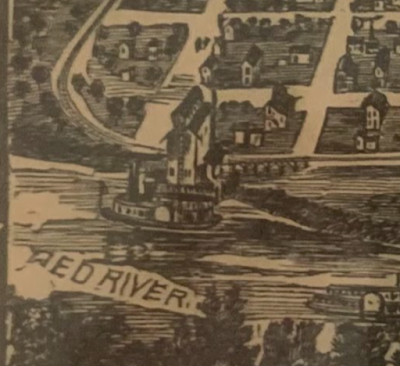
1888 St. Vincent map (west end), showing grain elevator on riverbank

The next year, in 1918, incorporation articles were filed for the new St. Vincent Elevator Company, with capital stock of $50,000; the incorporators were William N. Gamble, William Ash, W.E. Ford, John Duff, and Otto Thorson.  
"The St. Vincent Elevator Company, a new farmers' organization, of St. Vincent Township, has bought the elevator and mill business of the St. Anthony & Dakota Elevator Company, which also includes the coal sheds, two dwellings, and two coal sheds at Sultan, the first station east of here on the Soo Line.

"The elevator, in addition to handling grain, will handle  lumber and building material, also coal and seeds.  Mr. Harry Ward Davis is the new manager."

It is evident from the news article at left, together with the other information earlier in this post, that the local farmers eventually realized they had to organize their own elevator to get the best prices they could for their grain.  Their legacy is still going strong over a century later, with the Humboldt-St. Vincent Elevator Association...

Saturday, March 14, 2020

St. Vincent Union Industrial Association Fairs

In Minnesota fairs are older than the state itself, having "made their appearance ... in the early 1850's," just at the zenith of the golden age of such institutions in the United States. Compared with later exhibitions the early fairs were primitive indeed, yet they more than justified their existence. They gave the isolated pioneer farmer a chance to meet his fellows, to have a good time; and by showing him late developments in machinery, fine livestock, and new techniques in farming, they gave him an incentive to improve his own farming. - From a talk called, "Early Minnesota Agricultural Societies & Fairs," presented at the Minnesota Historical Society's annual convention, held July 26, 1941.

Walter John Strickland Traill

The first day of the St. Vincent Union Industrial Association Fair was favored with good weather.  

The native pony race was won by Jim, Shylock second, Kate third.  The trotting race was won by Julia, Dan second, Topsey third.  

The judges were Walter J.S. Traill, C.C. Law, and D. Livingstone (The St. Paul Daily Globe, October 10, 1889).


1918 Fair Results-War Gardens
1906 Fair Dates - Always late
Fall, for these local fairs . . .


...and these early fairs, are what were the seeds of our county fairs of today, including the Kittson County Fair in Hallock!


Friday, January 17, 2014

Monitor Steam Engine: EXPLOSION!

The steam engine has not yet been restored in this photograph and the
seat is visible. [An unrelated piece of machinery is in the background.]

In 1893, when steam was king down on the farm, an engine exploded, killing both man and animal.  This happened across the river from St. Vincent not far outside Pembina.

After the original incident, the damaged engine was buried on the spot of the accident - a field on the Frank Moris farm near Pembina. Seventy-four years later, the late Ben Fisher of Bowesmont, ND, dug up the steam engine in 1967 and restored it to its present condition.

After the restoration in 1967...

The engine is now owned by Dr. Roland Larter of Hallock, MN and is on loan to the Pembina County Historical Museum, Cavalier, N.D.

An excellent engraving of the Canton Monitor portable steam 
engine, made by C. Aultman & Company,  Canton, Ohio...


The Pembina engine is more accurately described as a Canton Monitor portable steam engine. Describing the Canton Monitor, an Album (aka industrial encyclopedia) published back during the 1890s says it is 'cheaper and better than any power operated by horses.' It continues . . .

Sunday, May 06, 2012

Hill Farms II


Threshing at the Walter Hill Farm in Northcote (1900);  this was
the year my grandmother began working in the farm's dairy.

[Click on photo to see large version]

J.J. Hill was a busy man with a wide variety of interests.  His business savvy was renowned, which brought him notoriety and admiration from a wide variety of people.  My grandmother and mother talked about him with tones of reverence when recounting his heavy influence on the region in which we lived.

Settlers in our little corner of northwestern Minnesota often found  stepping stones of employment thanks to Mr. Hill.  Elizabeth Fitzgerald, my grandmother, was one of them.  She wasn't able to have any schooling past third grade.  With 10 siblings at that time (eventually there would be 13), she was needed at home after that; eventually, in 1900, she found work on the Hill's Humboldt farm working in the dairy, among other responsibilities.  Such young women who did a variety of tasks were commonly called 'hired girls'.

Hill's interest in farming was tied directly to his building of the railroads.  Development of the surrounding land was their key to success.  Settlement was encouraged, but it was also necessary to supply motivation for settlers to come.  The land itself was rich with potential, but Hill was smart enough to know that he had to lead by example.  He started farms that were practical demonstrations of how it "could be done".  One of them was the Humboldt farm, its genesis in 1881, that became a bonanza farm, eventually splitting off 3,000 acres to create the Northcote division in 1910 (although it was part of the Humboldt farm prior to then...)

The Northcote division was created for his son, Walter, in hopes that it would give him focus.  The article below announces the completion of the mansion, as my grandmother called it.

WALTER HILL MANAGING 45,000-ACRE FARM 
Walter Jerome Hill, around the
time he took over the farm . . .
October 10, 1913 - Walter J. Hill, son of James J. Hill, has just completed a $50,000 residence on the 45,000-acre Hill farm in Hampden township, about seven miles west of Lancaster, between Hallock and Humboldt, in the extreme northwestern part of Minnesota.
Mr. Hill is now erecting a cow-barn 204 feet long and about 140 feet wide to hold 1,000 head of stock. The foundation pillars and floors are of reinforced concrete. The walls are of brick facing and double tile lining. The roof will be metal, supported on steel girders. The building will be equipped with a good ventilating system and with the most up-to-date devices in caring for stock. Adjoining this building will be two large silos and a feed house. In addition to these buildings, Mr. Hill has under construction at the present time an up-to-date blacksmith shop, cattle corral, and a complete hot and cold water system to all the buildings.

He is not putting in a vast sum of money in building for the fun of it. With him it is a business proposition. He is no idle guesser, but has spent some time in keen observation and cold-blooded figuring. He would not be a member of the Hill family if he didn't do this. He has it figured out that the big money for Kittson county farmers in the present as well as for the future lies in raising stock, making this a leading feature of the farming business.

It would do our Iowa, Illinois and Nebraska farmers and renters of high-priced land considerable good to see Mr. Hill's alfalfa, clover, timothy and fodder corn crop this year. It is absolutely necessary to raise these fodder crops to make stock raising a paying industry. This cannot be done in the dry, arid countries, and if the farmers of highpriced land can make money raising these crops to feed stock the farmers of Kittson county will get rich in a few years.

From Commercial West, Volume 24

Monday, January 23, 2012

Guest Essay: Harvest Memories

Alfred "Rusty" Rustad with the family's 'new' combine 
[Photo Courtesy:  Rustad Family Collection]

By Michael Rustad

As a child growing up in Northwest Minnesota, I remember that all of the town's activities centered around the harvest in late August, early September. Football practice often had to be scheduled in the wee hours of the morning to accommodate harvest season. My grandfather, Alfred Hagbart Sr. and my father, Rustee, farmed our quarter section and rented another quarter section of land from Bob Shantz. We were a rather primitive operation. Attempt the impossible. Achieve the possible. And, that was not easy in Minnesota.

Today:  The '35 Chevy truck awaits restoration 
[Photo Courtesy:  Rustad Family Collection]
Our farming operation did not have air-conditioned cabs and stereo systems incorporated in the combines. We had a 1935 Chevy truck that was started with a crank. It was an extremely difficult gear shift and several of the gears were stripped or in bad condition. The truck ran well because of my Dad's ability to over-haul the ancient engine. Our combine was a 1942 left-handed Allis-Chalmers combine. I could never get a clear understanding of why the combine was left-handed. One of the consequences was that the initial rows of fallen grain had to be moved by hand to enter the field. What idiot invented a left-handed combine? We had the only left-handed combine. This required my brother and I to move the rows, so the combine would not run over the fallen wheat and lost! This was my job. My grandmother Rustad often drove the truck and I often kept her company.

It was during the harvest that I developed severe breathing problems from the intense dust. The truck front-side windows were both broken so they would not roll up all the way. There was no way to prevent a cloud of dust from entering the truck. It was quite an unpleasant experience. I later learned that farmer's lung, the equivalent of asbestosis, killed many farmers. By the way, the grim reapers (as the lawyers called them), were dangerous too. There were unprotected and unguarded moving machinery ready to take off your favorite arm or leg. My friend, John Hunt, fell from a tractor and a plow shear created an injury. He plowed up a nest of hornets and fell off while fending off the hornets. He recovered but nearly lost his life. My next door neighbor Diane was also run over by a tractor and fortunately was not seriously harmed.

The truck loads of grain were generally augured into the grainery directly. I did not comprehend how dangerous these unguarded augers were until reading accounts of farm accidents later while studying product liability law. There were no warnings of the dangers of unguarded augers. The farmers of that area presumed that any damn fool did not go near the auger. Yet, year after year, the toll of farm accidents marched on.

I did not enjoy the harvest period very much as it was a period of high tension and excruciating long hours of work which largely fell on my Dad's shoulders. He would work a full day at the Post Office and rush home to work in the fields. I was not a gifted farm boy when it came to mechanics, machinery repair etc. I remember trying to help my Dad get the combine in shape for an upcoming harvest and negligently left a wrench inside. When the combine started the wrench broke every slat and caused us to lose a few day's time, which is precious during harvest. My Father was infinitely patient but was not pleased with me. But, he never again asked me to crawl into the inner bowels of the combine.

One of the family's old tractors is slowly being grown over now
[Photo Courtesy:  Rustad Family Collection]
Lunches in the field had to be grabbed on the run. I remember my Dad eating corn on the cob while driving the combine. He somehow managed to eat a half dozen ears of corn in the course of a lunch in the field and he simultaneously continued to operate the combine. He had a rotary motion when he ate the corn and never dropped an ear.

Gallons of coffee were consumed by the harvesting crew. My grandfather Rustad was a legendary coffee drinker and I remember him draining near a 1/2 gallon of coffee out of the jar in the field. That amount of coffee would have stopped the heart of most Americans, but he was a Norwegian-American.

I was always relieved by the end of harvest. I cannot recall many good harvests. It seemed like something came to ruin the harvest every year. There was "rust" that infected the wheat, hail, or too much or too little rain. My experience with farming convinced me to pay attention to my studies so I would never again choke from harvest dust.

I often wondered why some of the smaller farmers continued to farm long after it was [not that] profitable. I think that I finally understand why decades later. I believe that there must be something inherently satisfying about being your own boss and looking forward to a better crop next year.It is like being a Red Sox fan. Maybe, next year the Red Sox will win the World Series. However, there is always some natural disaster preventing success in the next year. In the days before corporate farming, there were many farms like the Rustad family farm. This meant that the towns of the Red River Valley were populated by young families with dreams of a better harvest next year. Today our land is out of the family and owned by one of the "big" operators. I knew from an early age that I needed an escape plan from the Great Northwest. When I left that area, I thought it looked best in the rear view mirror. Decades later, I seldom go back to the Great Northwest, Minnesota. Nevertheless, I acknowledge that it helped me develop my character and personality---and work ethic.

The combine in later years...
[Photo Courtesy:  Rustad Family Collection]

Monday, December 26, 2011

Market Day

Postcard:  Late 1800s Market Day in Hallock
(Photographer:  William Kelson - Minnesota Historical Society)

[Click to see large version of image...]

Saturday, November 19, 2011

Hill Farms

Co-Workers of my Grandpa Fitzpatrick at
Humboldt Hill Farm:  'Illegal' Canadians?
We often hear about illegal aliens working in America nowadays.  We normally think of them as coming from Mexico, South America, or even refugees that have entered the country illegally.

This problem is nothing new.  About a century ago, Kittson County Sheriffs faced the same problem, except the illegal aliens were coming from the north - Canada.  The irony of it is, manpower was in short supply in the local area, and these Canadian men were more than willing to work, yet the law sought to kick them out back to Canada.
In two cases involving Canadian employees on the Red River Valley estates, Hill tried and failed to leverage support from Minnesota's former governor, Senator Knut Nelson. The first problem began in 1913 when Walter Hill, at his father's insistence, hired a Canadian veterinarian recommended by Thomas Shaw and ran into problems with the Immigration Bureau.  In March 1914 James Hill wrote to Nelson, asking him to intervene, but with no success.  A similar conflict arose in 1915 on Hill's bonanza estate at Humboldt, which had remained primarily a productive wheat farm, raising extensive crops under hired management.  In 1915 problems emerged with the farm's traditional Canadian labor force when the sheriff arrived in the middle of harvest and "took away four...shockers."  They were charged as illegal aliens, but Hill's manager asserted that the men had been working on the farm without trouble for fifteen years. Hill again turned to Senator Nelson for help, but despite his protestations, the men were deported back to Canada.  Hill did not let the matter rest.  He asserted that immigration officials aimed to "make fees" by bothering "a number of poor men who...are trying to earn a living." The acting secretary of labor,  J.B. Densmore, corrected Hill, pointing out that the agents did not profit from arrests; he then closed the case and refused to make further inquiries.  Thus, by 1915 Hill's political influence had virtually vanished. Without the muscle of the railroad and with few federal connections, Hill found himself in the uncomfortable role of a private citizen...
From Profiting from the Plains: The Great Northern Railway By Claire Strom

Friday, August 26, 2011

Breadcrumbs of a Life: P.N. Tri

From 1920 "Farm Boys & Girls Leader".
Organized in 1919, it was the start of what
would be known as the the 4-H club of the
same name.  It's fun to read the origin of
the club, and the meaning of the name...

I was recently told that "...P.N. Tri was a world renowned beekeeper and featured in apiary magazines. They shipped honey all over the world!"Well, of course that meant I had to see what I could find out.

The online record is slim, but I did find one article where P.N. Tri was quoted as wintering his bees in a potato cellar!  Not much to go on, but interesting...

According to the Red River Valley website, P.N. Tri, or Peter Nicholas Tri, came to St. Vincent in 1915 to be Superintendent of Schools.

Later he worked at the Humboldt School, as you can see in the magazine article clipping at left.  In this 1920 article, the St. Vincent Fair is referred to as the 'county fair'.  I have never been clear if it was officially the county fair at one time or not, but this is one occasion where it appears it may have been...


1 - The little birdie's name was Michael Rustad...

Thursday, May 19, 2011

"A Stark Contrast"


Farmers in our area have had to, down through the years, wage battles on many fronts - weather, disease...and markets.
We are inclined to think that by this time the Canadians who, under the influence of the teachings of the liberal press, preferred to emigrate to Minnesota and Dakota rather than to Manitoba and the Canadian Northwest, will have had reson to curse alike their own fate, and the false teachers that led them to it.  The absurd stories about monopoly, about land laws, about high taxation, which served the purpose of the opposition, are certainly no panning out in the experience of the settlers.  Minnesota and Dakota farmers, teaming their wheat across the border, paying the Canadian duty of fifteen cents a bushell, and still making a profit of about four cents a bushell over what they could get on their own side of the line, is rather a startling condition of things.  We copied the other day from the St. Vincent Minnesota, New Era a paragraph describing the condition of things to be seen there daily of farmers, dsiguested with the local price of from twenty-seven to thirty-six cents a bushel, less, when the cost of threshing and twine is deducted, than the price of carrying it to market, teaming it across the border in order to get the profit, over and above the duty, which the Canadian price would give them.  We do not wonder that, as the New Era says, "all felt like cursing the county and getting out of it."1

By a letter received here last week, it appears that up to the 28th November no less than eight hundred and sixty-one bushels of wheat were imported at Emerson from across the border.  On that day No. 1 wheat was selling at St. Vincent at 37 cents a bushel, and at Emerson, just across the border on the Canadian side, at 56 cents; so that after paying the duty, the Minnesota farmer got four cents a bushel more for his wheat in Manitoba than he could get in his own state.  But the most gratifying feature is that this enormous adventage obtains not only on the immediate border but all along the line of the Canadian Pacific railway.  The price last week at Winnipeg and Portage la Prairie was sixty-one cents a bushel; on the Burnside and Brandon section it was fifty-nine cents.  From that point on to Fleming, it was fifty-seven cents, and from Fleming westward it was fifty-five cents.  So that even on the western section of the Canadian Pacific railway the Northwest farmers were receiving  eighteen cents a bushel more for their wheat than the Minnesota farmer was getting at St. Vincent.  These facts are the best answers to the "monopoly" cry which a year or two ago was sufficiently influential to drive many Canadians into Minnesota and Dakota, and we will be greatly surprised if they do not induce a large number of Canadians, now on the Americna side of the line, to transfer themselves to Manitoba and the Canadian Northwest, where, as we doubt not, they now heartily wish that they had gone in the first instance.

From: The Montreal Gazette, Monday, December 8, 1884
I found out there was a bit more going on than at first glance...
Manitoba was the centre of growth, and of growing grain production, in the West (of Canada) to the late 1890s.  But it was not until 1883 that Manitoba had a rail link to the East.  Up to that time, grain was shipped through St. Vincent, Minnesota, to the Great Lakes.  This indirect shipping was costly.  That year, the CPR completed its line to Thunder Bay (then Fort William/Port Arthur) Since the railway had the only direct access to the Great Lakes, "it was able to exercise a great deal of monopoly power and adopt a value-of-service pricing policy."  It set its grain rates at just below those through St. Vincent - Rates were higher than the actual costs justified.

From: Regina Leader-Post, January 22, 1982
That is what the "monopoly" reference mentioned earlier was referring to, and with some just reasoning in my opinion...
____________

1 - The full editorial was: "On Tuesday last we saw a sight upon our streets that with little variation may be witnessed here any day. A number of our best farmers were in town, men we have known since they settled here, and known them to be sober, hard-working, intelligent, honest men. They had their waggons loaded with wheat, and the prices they were offered ranged between 27 and 37 cents per bushel, mostly 27 cents. After taking out the cost of threshing and twine, they were paid less for their wheat than the railway charges are for drawing it to market. Some took their wheat to Traill's mill, and traded it off for flour. Some took it to Emerson, Manitoba, and paid the duty and sold it there, others took it home again, and a few, disheartened, sold their loads for what they could get, not what it was worth, and all felt like cursing the country and getting out of it." So much for Minnesota...


From: The North-West Agitation, The Toronto Mail (December 1884)

Monday, April 25, 2011

Reminiscing

In photo (l to r): Uncle Charlie (Cresien) & Aunt Norma (Carrigan); a very young
Mike Rustad held by his father Alfred "Rusty" Rustad with his wife, Patricia
(Carrigan); and Aunt Virginia (Carrigan) with Uncle Al (Alfred Ducharme)
"This picture was taken right outside of our house in Humboldt.  We 
lived in town and my Dad worked on my Grandfather's farm.  We moved 
from Humboldt when I was 7 years old.  I was the first grandchild on 
both sides of the family - Rustad and Carrigan.  At about that age, 
I would entertain the residents of Grandma Carrigan's rest home in 
East Grand Forks, Minnesota.  I still seem to like the center stage!" 
- Mike Rustad
Michael Rustad - What I remember most is that there were no vacation days when you had cows. I was fairly young around 7 or 8 when I was given the responsibility to change the bedding for the cows and it was always dark when I had to open up the barn door--which was sometimes frozen! Did you find it a relief of sorts to move into the town when your parents ran the cafe? I envied the town kids--Lofbergs, Boatzes, etc.

Keith Finney 1 - Funny thing Mike. I used to go out to the Stewart's to help with chores. I remember Glen walking out to the farm north of Humboldt many days. That brings up a memory. Jay Hoglin and I had skiied out to Grandpa and Grandma Turner's farm one Sunday. We were hunting rabbits. We took supplies so we could melt snow and make some soup while we were out there. I remember it being a pretty nice winter day. It soon started to snow real hard so we started making our way back to Humboldt. We got back to Diamond's farm and started following the railroad track south. We had our hands full of skis, guns and supplies. We had the wind at our backs so we were staying warm. We had just passed the Stewart farm and still could not see the lights of Humboldt as it was storming so bad. Then the surprise! Bang! I bumped right into Ben2 who was walking the tracks out to his farm to do chores. It surprised us all and when we all regained our composure we went our merry ways. One thing I remember was Ben was wearing a mackinaw which was wide open. (not buttoned), He was only wearing one glove as he had one off to carry his Lucky Strike. He was a hardy man. We then made our way home to our worried families and a warm home. Just another day in Humboldt.

1 - Keith is my second cousin once removed - his grandmother Mary Fitzpatrick Finney was my grandfather Sheldon Albert Fitzpatrick's sister.

2 - Ben was the nickname for Glen Stewart; sometimes he was called Big Ben...

Thursday, January 27, 2011

Prize-Winning Poultry!


I was exploring the Internet in search of local history once again, when I came across a fun bit of St. Vincent trivia in the form of an advertisement for...chickens!

I looked up Rev. James E. Kimberley, and found that he was an Episcopal minister.  As of 1906, he was listed in a church publication as being stationed in St. Vincent (at Christ Church).  The ad below shows that he was still there as of 1915.  He makes some astounding claims about his Buff Orpington chickens that made me smile!


The ad above is  from the January 1916 issue of the "Poultry Herald".

Later, I found the ad below in the January 1915 issue of the "Poultry Herald".

Thursday, September 02, 2010

Scientific Find in Kittson County (1892)

Found via Google Books,
aka "the researcher's friend"
The following excerpt highlights a pharmacological discovery by university scientists of an important plant (Northern Senega) in locations in northwest Minnesota, including Kittson County. 

The plant (general species, Senega - sometimes spelled Seneca) was originally identified into modern medicine, in the 18th century by a Scottish physican, whose attention was brought to it by the Seneca tribe in Pennsylvania. The plant had (and continues to have) important properties used in medical products to this day. It is also important in alternative medicine, as demonstrated at this Manitoba website showcasing local herbal remedies - all available to me in my backyard.

Trivia:  Metis (introduced to it by the Ojibwa) have long used Senega/Senega, aka Snakeroot, for it's medicinal properties.

I found it fascinating to run across this medical journal report of the find from 1892 (especially since the natives in our area are mentioned as using it mainly for subsistence purposes, not medicinal as tribes in other areas of the country had...)


THE AMERICAN
JOURNAL OF PHARMACY.
MARCH, 1892.

NORTHERN SENEGA.

By L. E. Sayre, University of Kansas.

The geographical distribution of senega has been a subject of a good deal of interest to the members of the pharmaceutical profession and the drug trade for a number of years. Chief among the contributors to our present knowledge of the drug in this particular have been Prof. J. M. Maisch and Prof. J. U. Lloyd, as will be seen by glancing over the back numbers of the American Journal of Pharmacy, the Proceedings of the American Pharmaceutical Association, and other pharmaceutical publications.

Reference has been made to senega growing in Wisconsin and Minnesota, but there has not been very definite information given, I believe, as to its collection or the exact district of country from which it is collected in these States. "Northern Senega" has been a current term meaning a variety of senega having certain physical characteristics very unlike the original Polygala Senega. Prof. Lloyd (Proc. Amer. Pharm. Asso., 1881), describing this variety1 — which he says is derived from the Northwest from the States of Wisconsin and Minnesota—says it is very large and fleshy, sometimes white, again rather dark brown, the knotty crown measuring often from two to three inches in diameter, even of the dried plant. The root just below the knotty head is (when dry) from the size of the little finger to that of the thumb of a man ; six to ten inches in length and generally destitute of keel; not so contorted and branched as the " Southern " senega.

Northern Seneca Root
harvested in Manitoba
L. L. Dyche, Professor of Zoology and Taxidermy, of the University of Kansas, some months ago made an extensive hunting tour in the Northwest, the main point of his operations being in that country lying near the Lake of the Woods. During this hunting expedition he had an excellent opportunity of studying the country, its products and its people. On his return he handed me a root which he thought might be of some interest to me. He said it was collected in very large quantities and seemed to be one of the staples of that country. The natives depending upon its collection as one of the means of subsistence, have made this quite an industry among them. There the squaws and the children dig the root while the " Braves " hunt the valuable fur-producing animals. Prof. Dyche says that he saw at the different trading posts in Marshall and Kittson Counties, in the storehouses, as much as a thousand pounds stacked up in one heap. At a little town, Rocksted, near Thief River Falls, the Indians come in from long tramps of forty miles or more and bring in the fur, skins and this snakeroot. Here they had an immense stock on hand. Since his return, Prof. Dyche has received a letter from a trader at Jadis2, Kittson County, stating that he has on hand a thousand pounds bagged up, waiting for a fair market price.

The root referred to is undoubtedly a good sample of senega. In length it varies from 4 to 8 inches; in diameter from 1/16 to 1/2 inch. Surrounding the root is a dark scar-covered head. This head in the case of younger roots is covered with immature pinkish leaf-covered stems. The characteristic keel of Southern senega is rarely present and the contour of the root is much less contorted. The color ranges from the light yellow of young roots to the dark brown of the older ones.

Near the head, prominent annulations are present. These continue with enlarging intervals of space for some distance down the root. Lengthwise the whole root is deeply wrinkled, while frequent warty enlargements occur. The branches are not numerous. In considerable quantities, the odor of gaultheria is quite prominent, as it is also in a cold aqueous infusion. The taste is very acrid.

Under the microscope the wood is found to be cylindrical, and the ingrowth of the inner bark on one side which produces the keel of the Southern variety is not apparent in a majority of cases. The wood is whitish, ligneous and occupies about y of the diameter of the root.

A sample of the drug was handed to Mr. McClung, one of the senior students, for the estimation of the polygalic acid. He used Quevenne's process, and obtained of the pure acid 35 per cent. Methyl salicylate was abundant, as shown by the ferric chloride test.

It would seem from the above that this specimen handed to me by Prof. Dyche represented a good sample of senega; its quality, equal to the average root of the market.

I have planted some of the roots, which seem to be full of vigor, and hope to be able at some future time to classify the plant.

1 — Northern senega, collected in the northwest United States, is considerably larger than the usual variety (western senega), and darker in colour; it is less contorted and shows the keel less distinctly, but it has a very acrid taste, and is undoubtedly a good senega. It is said to be derived from Poly gala Senega, var. latifolia.

2 - Jadis (named for Mr. Jadis, Kittson County Auditor) eventually was renamed Roseau - Kittson county included the western portion of what is now Roseau County until 1894 - From Kittson County History.

Friday, August 27, 2010

Mercy Wheat Campaign


I don't know details on how farmers around my hometown area (Kittson County and Pembina County) contributed to the efforts described as the Mercy Wheat Campaign, but it's likely they did. It was  characterized as involving the entire region known as the Red River Valley of the North, the farmers in it called to supply the over 155,000,000 bushels1 of wheat to war-torn Europe and Asia after WWII.

Mercy Wheat wasn't as secret as Ferry Command at the time, but in collective memory, it's almost as elusive.  And what is so impressive about this effort was, it was citizen-driven, not government-sponsored, implemented before the Marshall Plan...

In April 1946, Arnold Amundson of Climax, Minn., led a procession of 140 farmers to the local elevator as a national kickoff for Mercy Wheat, a program by the United Nations to deliver grain to war-starved Poland. Farmers were hanging onto on to their grain, so the government offered them a 30-cent-per-bushel bonus to deliver it. NYC Mayor and UNRRA Director Fiorello La Guardia encouraged farmers to grow even more wheat to feed the countries ravaged by the war.

- From Twentieth Century in Review, Fargo Forum
_______________________

1 - Trivia:  The Farmers Union Grain Terminal Association (GTA or FUGTA), a cooperative grain marketing organization of Midwestern farmers, began operations on June 1, 1938. Its origins, however, go back much farther into the nineteenth century with farmers' rebellions against low prices, mis-grading of grain, false weights, buyer collaboration, and excessive dockage and transportation costs, which resulted in their first attempts at cooperative action...The post-World War II era saw GTA make international news through its contribution of 16 million of the (ultimately) over 80 million bushels provided by the United States in the Mercy Wheat Campaign for war-ravaged Europe.

- From Minnesota Historical Society's GTA Corporation Records Collection

Saturday, November 07, 2009

Great American Desert

From: Democracy in America By Alexis de Tocqueville
The concept of the Great American Desert had long been familiar to Americans and indeed it controlled much of the directions of the growth of the nation for a major part of the nineteenth century. So we have to dip back a little bit before the Civil War to see how this geographical concept, this geographical myth, came into being, and how it influenced the growth, the thoughts, the attitudes, of the American people as they moved westward.

In 1819, the federal government of the United States decided that it needed a good amount of information for the territory that lay beyond the Mississippi River, westward to the Rocky mountains. They hired an explorer, a map-maker named Stephen H. Long to take a journey to map this terrain, to keep a journal, to inform the federal government about what at the time was a vast unknown territory to all Americans. And so Long set out in 1819 traveling westward from what is now the border of Nebraska, traveled through Iowa to the front of the Rocky Mountain ranges, then traveled south and back through what eventually would become Oklahoma and Arkansas. He drew a massive map as well as a series of subsidiary maps and wrote a major report for the federal government, a report that was published along with its maps in 1821. Over the area that today we know as the Great Plains, Stephen H. Long simply printed in giant letters, the words "The Great American Desert." And in his journals and in his reports which accompanied his map, Long wrote that in his opinion, "I do not hesitate in saying that the entire area is almost wholly unfit for cultivation. And of course it's uninhabitable by a people depending upon agriculture for their existence." Buffalo, wild game, goats might live there, but not people. It was indeed on the map that finally reached the public in 1823--it was the Great American Desert.

Consequently, there was very sparse settlement in the area beyond the Mississippi River in the 1840s and the 1850s--isolated pioneer homesteads here and there, but not settlers pouring in vast numbers until the late 1850s and the early years of the 1860s. In the years immediately following the end of the Civil War, traffic into the trans-Mississippi West picked up dramatically by the hundreds, then by the thousands, then by the hundreds of thousands. Settlers poured into the Great Plains moving westward. As the population increased in the Great Plains trans Mississippi West area, many people came to recognize that the old myth of the Great American Desert was no longer true. If indeed it had been true, they needed a way to combat the myth. People eager on boosting settlement and attracting business and getting railroad connections wanted the rest of the nation to believe that the so called Great American Desert was not a desert at all. So they built a counter myth. Now they began to call the Great Plains in the late 1860s and the 1870s "The Garden," the Garden of the West, an agricultural paradise in which there was space enough, and time enough for people to achieve their wildest dreams. A new kind of booster literature appeared portraying the entire Great American Desert area, the entire Great Plains area as an agrarian heaven, an idyllic spot.
From American History 102: Which Old West and Whose?
Power believed that the only way to overcome the tradition that Dakota was the Great American Desert was to actively promote the region in the farm periodicals of America and Europe of that day.
From Bonanza Farming in the Red River Valley

Saturday, July 11, 2009

First Farmers

In 1832, Anglican missionary William Cockran tried to convert Red River Natives to Christianity and a life of farming. The plan failed. Cockran concluded that Natives were ill-suited for farming. Today, archeological investigations have proved the Anglican missionary to have been wrong.
What they were wrong about was assuming (not for the first time, nor the last) that the aboriginal populations, since they were not currently farming, had never farmed. They were wrong...
Several thousand years before the arrival of European immigrants, many Native nations in North America had developed sophisticated farming methods. Four centuries before Europeans settled beside the Red River, Native people were agricultural pioneers in the valley.
The skills of these early farmers are attested to by recent archeological evidence...
The Native farmers...developed a strain of corn that could mature in the typical 100-day growing season near the present-day Canadian border with the United States Midwest. The adaptation of corn to the long-day, short-season environment of the Red River Valley - from the plant's original short-day, long-season climate in Central America - testifies to the selective plant breeding skills of these first farmers.
So what happened to the farming skills of the natives? Why didn't early European explorers observe farming being practiced by the natives they encountered?
500 years ago, during the so-called Little Ice Age, summers became much shorter and cooler. With this climatic change, the pendulum swung back to hunting, fishing and food-gathering as the primary ways to survive. The skills of agriculture fell into disuse and were virtually forgotten.
From Red River - First Farmers

Wednesday, December 06, 2006

Old St. Vincent Fair

A bountiful display of fair exhibits in Reid Hall (town hall)


The photo to the left is a result of a query that was published in a column this week. It was sent to me today by a resident of our area, who said in his accompanying email... 
Hi Trish: Just noticed in today's Kittson County Enterprise you were seeking photos of the St. Vincent Fair. My grandfather William S. Ash was a director of the St. Vincent Fair board I believe at one time. Among his photo albums was this photo. I can only remember as a kid being in the old St. Vincent Fair building once when the fair building was just east of the old grocery store or near the jail building to the best of my memory before they built the new fair building which is still standing in St. Vincent today. If I remember this photo is what I remember of the old fair building now gone. The back of the photo says "St. Vincent Fair". There isn't a date on the photo so your guess is as good as mine. William G. Ash