Showing posts with label Northcote. Show all posts

Monday, March 27, 2023

PROFILE: Walter Hill (as Known by Kittson County Locals...)


  • Trish: Walter talked James J. into getting the first car the family had in 1905, but managed to wreck it by 1907.

  • He got married in 1908, and he was put in charge of the Northcote farm in 1910, so I'll go with that...


    • Jim Benjaminson:

    • Time line - Walter got married in 1908, his wife is in the car. He wrecked the first car by 1907...(wonder what it was???)

    • So my guess-timate on the car at 1906-1908 wasn't too far off. I'll do a little research on the early Packard's to see if

    • I can determine an exact year.


  • Jim Benjaminson:

  • Searching information on Minnesota license plates - the plate has to be a multi-year 1912 plate which had dark letters on

  • a silver background. The plates were good for three years so was valid 1912-1913-1914. All the earlier plates had dark

  • background colors.


    • Steve Hannah:

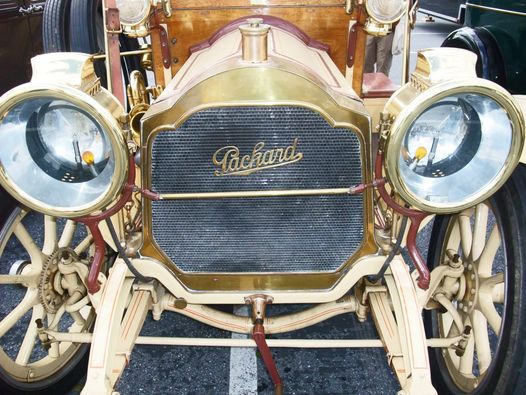
    • But is it a Packard? The radiator emblem was always Packard written at a slant. Everything else is very similar to

    • a Model 30 Runabout.

    • No photo description available.


    • Steve Hannah:

    • I will agree with a 1910-1911 Packard Model 30 Runabout. The only thing is the radiator emblem. Did Hill have

    • a Vanity emblem made? Money was no issue. I can't find a close match to that emblem shape.

    • May be an image of 6 people and outdoors


    • Steve Hannah:

    • Windshield, top, headlights removed.


    • Jim Benjaminson:

    • I was wondering if it might be an emblem for a fraternal order or auto club or ???? Front fender on the Hill car

    • seems a little flatter but that could have been a running change or model year change...


  • Steve Hannah:

  • Walter loved speed, it is said his interests were tilted away from farming toward race cars. I' trying to identify the steamer

  • but they all look alike. I counted around 50 horses though.


    • Jim Benjaminson:

    • This looks like it might be a source - I contacted the library as I couldn't get any access to the Motor Vehicle and

    • Driver License Registration Records, 1909-1921 Register of motor vehicles (1909-1914, with indexes), automobile

    • license applications (1921), chauffeur’s record (1909-1911), and motorcycle registration record (1909-ca. 1913).

    • MNHS call number: See the finding aid in the library (Secretary of State: Motor Vehicle Division).


    • Steve Hannah

    • There is so much I could find out if the Gale Library wasn't 300 miles away. Keep scanning folks!


  • Bernie: my Great Uncle George Hugill played base ball with Walter and said he would chase rabbits in a white

  • Stuz Bearcat. But that was 60 years later so maybe it was a Packard


  • Jim Benjaminson:

  • Does anybody know if early Minnesota license registrations exist for these years?

  • Jim Benjaminson:

  • Probably a 1912 model - later than I first thought.1912, not much if any difference. 60 HP but Hill had a mechanic who could make it


  • Bernie Streed: My Great Uncle George Hugill was a contemporary friend of Walter Hill. What a character. During a

  • winter storm he started telling me stories of how they would chase rabbits across plowed frozen fields with a white

  • Stuz Bearcat convertible. He also told me he would order hand made oak barrels from Italy. Then he would stock the

  • milking barns with long horn steers. They would lock horns in the narrow milking stalls. The barns were state of the art

  • for the day, built with tile walls and sloping floors so manure could be flushed down trenches in the floor into the river

  • below. Basically the bored millionaire would roll these oak barrels down the center of the barn agitating the long horn

  • steers so they would kick the barrels to pieces. He and George would do this for hours till the barrels were gone. The

  • whole farm was meant to get James J Hill's playboy youngest son out of St Paul to reform him.

Bernie:  These are my memories of Uncle George's visit. My mom, Amelia Streed, took her Aunt Amelia Diamond Hugill into town for an event at the Presbyterian church but they didn't want George to be alone in a storm so i sat with him. He started talking about his youth.. great stories. This was probably around 1968 or before. So I would have been in 8th grade maybe.

Trish: Walter Hill was a goer, or "someone vibrant for life." He hunted from his car, raced his draft horses in the streets of St. Vincent, and drank mightily. Before the fall harvest, he used to attach a hay-rack to the back of his car and go to Bronson, Minn., searching for labor. Men eager for jobs climbed onto the hay-rack and Hill drove them home in his usual manner. By the time he got back to the farm, there would be only one man left - the rest had jumped out along the way in fear for their lives.

Bernie: lol I can believe that. I know my Grandpa Bernhard Streed drove one of the steam tractors. He said he started in the dark of morning and made one swath to the Red River and back before sunset.

Keith Finney: I believe it was Byron or Marva that told me that he would go into Canada up by Tolstoi and get hired men. He would drive fast across the rough prairie and some would fall off on the way. Thus the illegal aliens that worked on the farm

Georgine Cleem Whalen: Thank you Trish for this wonderful information on Walter Hill and some of his escapades I see in one of the links that he passed in 1944 in the West which would have been during the time my Grandpa was working for him on the ranch he owned there in 1932. It became the Bishop Ranch in the 40's and I still remember them letting us swim in the pool as my mother worked for doc Bishop. It is not there anymore but they do have a street named Bishop place where this ranch set. I was wondering if Walter returned to Minnesota after my Grandpa Borgeson went to work for the shipyards along with his sons.

Trish this is how we 'Borgeson' family ended up in California. James Hill bought a horse ranch for Walter and my Grandpa Eric Borgeson went with him to work this ranch and property in 1932. The rest of the story is amazing how the whole family (13) left Mn. in a Franklin car and went west

I do not remember the name. I only remember after it became Bishop Ranch. I think my Mother said it was a horse ranch and her dad (Eric Borgeson) worked for Walter Hill and came to California in 1932. He sent for my grandma later and that's another wonderful story and they lived in the old red house there in Midway City, Ca. When my parents went to California in about 1942 sometime I was still the baby. We stayed at the old red house in the middle of a field just behind where the Hill place would have been. Shortly after my grandparents bought a place in Anaheim (this is where I lose track of Walter Hill about 1943/44) and my parents stayed at the old red house which was then bought my Hap Post who my dad worked for. We lived there till I was in high school when the property was sold by the Post Brothers. I digress here, the horse ranch that Walter Hill bought would be off Bolsa in Midway City, maybe considered Westminster at that time. I do remember this property as I got older. Walter Hill brought my grandpa a big old green rocking chair that is still in the family that all of us remember him rocking away in. Grandpa did change jobs at this time and I always wondered what happened to Walter Hill.


Going through picture albums and saw this paragraph in an article about midway city california and walter and james hill. I remember this hotel well on the cutoff there as our family knew the hokes well but never knew that walter hill had a hand in the start of that... From: “James J. Hill Banished his Errant Son to Kittson County” by Ruth Hammond - Walter Hill was a "a goer, or someone vibrant for life," Hanson said. He hunted from his car, raced his draft horses in the streets of St. Vincent, and drank mightily. Before the fall harvest, he used to attach a hay-rack to the back of his car and go to Bronson, Minn., searching for labor. Men eager for jobs climbed onto the hay-rack and Hill drove them home in his usual manner. "By the time he got back to the farm, there would be only one man left," Hanson said. The rest had jumped out along the way in fear for their lives.

Monday, April 13, 2015

Mansion on the Prairie

[Courtesy:  Kittson County History Center & Museum]
At the Zenith of its production years, the early elevated view seen above of the mansion and surrounding farm buildings - taken from the top of the farm's nearby grain elevator - comprised the 'Northcote Division' of the Humboldt bonanza farm.  At its height, J.J. Hill owned over 45,000 acres of Kittson County farm land, and had over half of it under cultivation at any given time. 
Elevated view looking over Northcote, Minn. bonanza farm.  Visible is a
large two-story brick house with hip roof, several barns, and a water tower.

[Source: Institute for Regional Studies, NDSU, Fargo, ND (2023.42.11)]
Swathing & Bundling during harvest, at the Hill Farm
[Source:  Minnesota Historical Society]
Hill's personal train, often used to travel to Northcote farm
[Source:  Minnesota Historical Society]

Until I track down interior photos of the Walter Hill home (hopefully in its prime, before modifications), my old school friend Dee Dee Giffen Bakken has graciously agreed to share her memories of inside the mansion:
I cleaned for Marva and Byron Hanson who owned the house [until 2004]. 
The front of the house as you come to it from the road is actually the back of the house. When Walter Hill lived there the road came to what is now the back close to the river and came around in a circular drive. That face of the house is the grand entrance with a fancy little roofed porch. 
You enter into an entry with the staircase facing going upstairs. to your left is the great room with a fireplace, a very large room. Behind that is a porch which was open in Walter's day but is now enclosed. To the north of it is an office and bathroom. To your right of the entrance is the dining room with a beautiful chandelier and wood paneling. 
Almost all of the woodwork in the house has unfortunately been painted as Marva told me there were many different varieties of wood used on the doors, paneling, trim and so on. I don't think the paneling in the dining room is painted, but don't remember for sure. 
Beyond the dining room to the east is a sun room which overlooks where the pool was. Going north from the dining room is a huge kitchen which in Walter's day was sectioned off with part of it being the butler's pantry where the food was prepared for serving. It is now a homey big kitchen with a table. 
To the west of the kitchen is an entry where guests come in now with beautiful old tile floors. The entry also has a door going to the hallway which leads to the bathroom, and an office to the north of the great room with some built in closets. The kitchen is now linoleum.  I don't know what it was before [possible wood flooring originally]. In the kitchen as well is a door that leads to a staircase upstairs; this was once a servant's staircase that now leads to a small sewing room and bathroom. Originally, this would have been a servant's bedroom. 
As you go up the grand staircase to the upstairs, you come to a landing which goes to your left then rises to the top floor. As you go to your left you can go northeast which goes  to the servants bedroom. Direct left is the master bedroom with a beautiful fireplace with tiles from either Belgium or Italy. Off this room to the east is a sun porch.  To the north is a huge walk-in closet. To the west is the master bath with a shower made of marble. It is walk-in and huge. There is a tub the size of a Buick and old fashioned toilet and pedestal sinks. The floor is white octagon tile. 
To the right of the staircase is a den or possible bedroom. I think it may have been the library. Down the hall at the end is a woman's bedroom with a fireplace with blue tiles of sailing ships (I think) that came again from either Belgium or Italy. I believe the library had a fireplace too. It's a large room with a walk-in closet. A door to the north leads to a sun porch that is shared by another large bedroom that has a huge bathroom that is attached to it. Again, there is a Buick sized tub and old sinks and white tiles. 
I don't remember how you get up to the attic from the upstairs, it's been a long time. But I was up there a few times and it is as big as the house. Marva told me the boys in Walter's family slept up there and there is a big space in the middle that they held dances in I think. There is a huge basement where they have a pool table from the old pool hall in Hallock here. (Of course I forget the name but I think it was Blado's Billards & Restaurant. It was in the basement of a building near where our business is today.) 
The window wells for the basement have squares of amethyst. Sadly, many people have chipped pieces out for souvenirs over the years. 
Marva's son Marvin was a Minnesota state senator.  In conjunction with his political activities, they held parties at the mansion; even Hubert Humphrey was once there for an event.
NOTE:  The Hanson family moved to the Hill farm in 1967 and their grand daughter Kate lives there part-time, to this day. Check here for more photographs and information about the farm itself...

The amethyst glass blocks are still over the basement window wells
at the Northcote Hill Mansion to this day, a very innovative design

A brief overview of the farm the mansion was part of:

The J.J. Hill Mansion was really Walter Hill's mansion (J.J.'s son) although J.J. Hill probably financed it. Northcote Hill farm was a subdivision off of the Humboldt Farm or Humboldt Division (subdivided in 1910). Before that, it was part of Humboldt Farm.

There is a dam on the Two Rivers, west of the house, downriver. It is small and old, and beginning to fall apart, but still working. By it on the north bank is a falling-down brick building, possibly a mill house.

Over the basement windows were coverings of concrete and glass with a brass sign labeling it as made by the American Luxfer Prism Co (Boston, New York, & Chicago)

UPDATE 10/5/2019:


Found in an old issue of a regional small press paper, "Our Northwest Corner"
recently, is the only interior photograph of the Northcote J.J. Hill mansion...
Recently discovered by collector Brandon Lee Legvold, this 1909 RPPC
shows what appears to be the same image as the one from NDSU shown
at the top of this post, although more complete and it has more clarity. 
Still not a perfect copy, but definitely better!  

Thursday, April 04, 2013

Mrs. Rasche & the St. Vincent March

Example of another March
written by Mrs. Rasche

[Source:  Library of Congress]


I put to you, dear Reader, a St. Vincent MYSTERY to solve!

Published in the St. Vincent New Era in 1890, is the following news:
Mrs. Rasche, the celebrated Musical composer done St. Vincent the honor of composing a march, entitled "The St. Vincent March" as a souvenir of the Fair of 18901, and done the editor of the ERA the honor of dedicating it to him for which favors St. Vincent and us are enthusiastically grateful.
As you can imagine, to read that an actual musical composition was written for and about St. Vincent is an exciting and unexpected discovery in my ongoing research about my hometown.  Who was this Mrs. Rasche?  Why did she feel compelled to write the piece for this event?  Was the 'Fair of 1890' a special fair moreso than other years?  It is possible that she was just helping the town by being so civic-minded.  It was still trying to grow.  All we have is speculation - I would like to find out the story behind the story!2


What we have found out so far:

Sunday, May 06, 2012

Hill Farms II


Threshing at the Walter Hill Farm in Northcote (1900);  this was
the year my grandmother began working in the farm's dairy.

[Click on photo to see large version]

J.J. Hill was a busy man with a wide variety of interests.  His business savvy was renowned, which brought him notoriety and admiration from a wide variety of people.  My grandmother and mother talked about him with tones of reverence when recounting his heavy influence on the region in which we lived.

Settlers in our little corner of northwestern Minnesota often found  stepping stones of employment thanks to Mr. Hill.  Elizabeth Fitzgerald, my grandmother, was one of them.  She wasn't able to have any schooling past third grade.  With 10 siblings at that time (eventually there would be 13), she was needed at home after that; eventually, in 1900, she found work on the Hill's Humboldt farm working in the dairy, among other responsibilities.  Such young women who did a variety of tasks were commonly called 'hired girls'.

Hill's interest in farming was tied directly to his building of the railroads.  Development of the surrounding land was their key to success.  Settlement was encouraged, but it was also necessary to supply motivation for settlers to come.  The land itself was rich with potential, but Hill was smart enough to know that he had to lead by example.  He started farms that were practical demonstrations of how it "could be done".  One of them was the Humboldt farm, its genesis in 1881, that became a bonanza farm, eventually splitting off 3,000 acres to create the Northcote division in 1910 (although it was part of the Humboldt farm prior to then...)

The Northcote division was created for his son, Walter, in hopes that it would give him focus.  The article below announces the completion of the mansion, as my grandmother called it.

WALTER HILL MANAGING 45,000-ACRE FARM 
Walter Jerome Hill, around the
time he took over the farm . . .
October 10, 1913 - Walter J. Hill, son of James J. Hill, has just completed a $50,000 residence on the 45,000-acre Hill farm in Hampden township, about seven miles west of Lancaster, between Hallock and Humboldt, in the extreme northwestern part of Minnesota.
Mr. Hill is now erecting a cow-barn 204 feet long and about 140 feet wide to hold 1,000 head of stock. The foundation pillars and floors are of reinforced concrete. The walls are of brick facing and double tile lining. The roof will be metal, supported on steel girders. The building will be equipped with a good ventilating system and with the most up-to-date devices in caring for stock. Adjoining this building will be two large silos and a feed house. In addition to these buildings, Mr. Hill has under construction at the present time an up-to-date blacksmith shop, cattle corral, and a complete hot and cold water system to all the buildings.

He is not putting in a vast sum of money in building for the fun of it. With him it is a business proposition. He is no idle guesser, but has spent some time in keen observation and cold-blooded figuring. He would not be a member of the Hill family if he didn't do this. He has it figured out that the big money for Kittson county farmers in the present as well as for the future lies in raising stock, making this a leading feature of the farming business.

It would do our Iowa, Illinois and Nebraska farmers and renters of high-priced land considerable good to see Mr. Hill's alfalfa, clover, timothy and fodder corn crop this year. It is absolutely necessary to raise these fodder crops to make stock raising a paying industry. This cannot be done in the dry, arid countries, and if the farmers of highpriced land can make money raising these crops to feed stock the farmers of Kittson county will get rich in a few years.

From Commercial West, Volume 24

Monday, August 02, 2010

Boots on the Ground Research

A glimpse of the Northcote J.J. Hill mansion is reflected in the Two
Rivers, that flows behind the house.   
[Photo Credit:  Bill Reynolds]
I spent the weekend back home in Kittson County at the Gamble Reunion (more about that in another post, soon...)  I did it in two day-trips both Friday and Saturday, with my boyfriend Bill.  The trip also entailed a lot of local history and genealogy research, as well as exploring of local history, boots-on-the-ground research in Northcote and St. Vincent.  First, Northcote...

The image above is of the Walter Hill mansion1 in Northcote, MN. His father, J.J. Hill, built it for his son, on the Northcote subdivision of the Humboldt Farm. Northcote became its own subdivision (existing before as part of Humboldt's division) in 1910. Several years before that, my own grandmother worked on the farm, as well as my great uncle, her future brother-in-law. Many area men and women worked on the farm, one of the great bonanza farms of its day.

We explored the grounds, coming across an old private bridge way back on the property that crossed the Two Rivers, opening up beyond the large old trees into a huge open yard, with what was once called "...the largest silos in the world."

Down by the river, back a ways through the trees, peeked a brick building right on the banks of the river, by an old dam.  There's no way of knowing, but it's quite possible it could have been a mill, considering it's location.  The dam still works, but it's obviously been neglected down through these many years.  The private bridge and dam, the handful of still visible-but-crumbling outbuildings, are all that remain of a once proud, large working farm.  It was called a 'demonstration farm', showing the world what a farm could do, if run on a large scale, efficiently, and with the most modern design around for its time.  Seeing such greatness in its twilight, faded and all but a ghost, is a very humbling experience.  I could almost swear I could hear the voices of long ago among the rustling of the leaves of the trees...

Walter Hill Farm (Northcote, MN) circa 1930s


1 - An old friend and classmate, Dee Dee Bakken (aka Delores Giffen) told me she used to work for the current owners of the time in the 1970's of the mansion, doing housekeeping. She was able to see the amazing interior, which despite many years past it's prime, still retained enough of it's former glory to dazzle. She talked of immense marble bathtubs you had to step up into, hardwood floors and large staircases, warm wood paneling, etc. I myself spied such things in my exploration - over the basement windows were coverings of concrete and glass with a brass sign labeling it as made by the American Luxfer Prism Co; a safe, seen through a door window at the bottom of a staircase, labeled in large gold-gilt script:

Mattson, MN
Cary Safe Co.
Buffalo, N.Y.
I have no idea if the "Mattson, MN" is named after Hans Mattson, but since we can't find any other explanation, it's as good a theory as any; I did find out there was/is a Mattson Township in Kittson County, but I would find it odd that a safe would be issued from a township and not a town...but who knows!

Thursday, April 23, 2009

J.J. Hill Farm in Northcote

My grandmother1 left home at an early age to make her way in the world. She had many older and younger siblings, and with so many mouths to feed, advancing her education just wasn't an option. One of her first jobs was working at the J.J. Hill farm in Northcote. She was a servant girl, helping where help was needed, whether it was the kitchen or the dairy barn.


I contacted the J.J. Hill Reference Library in St. Paul to see if they had any records from the Northcote farm that might reflect her employment there. They did have records from the approximate time period, and were even kind enough to look at other years surrounding the years I estimated she would have worked there, but to no avail. They did, however, explain that sometimes temporary or seasonal workers were not listed the same as regular workers, so she may not have been recorded by name.

One person who was listed by name, however, was my Great Uncle Dick, Richard Fitzpatrick. If you look closely at the page to the left, you'll see his name listed as having worked 11 days in October 1911, at $2 a day - a very respectable wage in those days!  He did not work at the Northcote farm, however, but instead worked on the Humboldt farm (Hill had two farms in our county...)

1 - You could tell she was a daughter of an Irish carpenter. I still have his carpenter's saw box, and use it to hold books I'm reading. It's dark with age, but still strong. His old saw is with me now, part of what I inherited from my parents after they broke up housekeeping in 2001. The wood on the handle has a soft glowing patina from many years of use. Great Grandpa Fitzgerald married a Prince Edward Island wealthy farmer's daughter, took her half-way across a continent to America, where they did whatever they had to, to make a living. All I know of him besides his carpentry is that he died drunk, run over by a train, ground to pieces and decapitated, 5 years after his wife died shortly after giving birth to their 14th child. R.I.P....

Friday, August 08, 2008

Fair Times


The prizes awarded in the open classes at the St. Vincent Fair were recently announced. Percheron Stallion first place went to Sam Johnson, Humboldt and second to Fred McIllraith, Northcote. In Native Ponies, under 14 hands, Malcolm Sugden, Hallock took first and second and L. McGovern, St. Vincent took third.

From the Kittson County Enterprise (October 1932)

Wednesday, March 07, 2007

WPA Tours of 1938: Noyes to Hallock


From WPA's Guide To Minnesota Tour 4 (1938) - Part of the Federal Writers Project, comes this:

Section a. CANADIAN BORDER (NOYES) to MOORHEAD, 176.6 m. US 75.

At 0 m. US 75 crosses the Canadian Border, 67 miles south of Winnipeg.

NOYES, 0.1 m. (792 alt., 64 pop.), is a small village and a United States port of entry, with an almost cosmopolitan air of bustle and excitement emanating from the U.S. Customs and Immigration Offices. The American and Canadian flags flying not far apart, the trim uniforms of the officials, and the constant commotion usual to international boundaries contrast with the quiet of this remote north-woods country. A large force of railroad officials is necessary to take care of incoming and outgoing passengers and freight on both the Soo Line and the Great Northern Ry. passing through Noyes.

At 7.2 m. is the junction (L) with US 59.

HUMBOLDT, 8.2 m. (793 alt., 139 pop.), originated as a "Jim Hill town." James J. Hill, the railroad builder, owned the town site and platted it. The present name, honoring the great German naturalist, Baron Alexander von Humboldt, was a tribute from Hill to the German people, many of whom had invested in railway bonds.

The land in this vicinity is typical Red River prairie, an open expanse of gently rolling fields, broken only by farmstead windbreaks. The soil is clay and sandy loam, adapted to diversified agriculture, and so fertile that descriptions of the farms sound like Paul Bunyan legends. Records show the yield has been as high as 45 bushels of wheat or 500 bushels of potatoes to the acre, and farmers here have plowed furrows straight ahead for 7 or 8 miles without a twist or turn.

NORTHCOTE, 15.4 m., although considered a village, is administered as part of Hampden Township. The village, named for Sir Henry Stafford Northcote, English statesman and financier [NOTE: Northcote had financial interests in James J. Hill's projects], was settled chiefly by Irish and Scottish Canadians.

The Florence Farm at Northcote (open to visitors), once owned by James J. Hill, consists of about 25,000 acres (15,000 under cultivation in 1937) and is one of the largest successfully operated grain farms in the United States. The farm residence alone, built by Walter Hill in 1912, cost $49,000. Among the other structures are a powerhouse large enough for a city of 1,500, two immense silos, and two grain elevators with capacities of 55,000 bushels and 25,000 bushels respectively. Of the 15 tractors in use, 9 are equipped with Diesel engines and 6 with 10-horse-power gasoline engines. In a recent year the planted acreage of this completely mechanized farm was 3,600 acres of wheat, 4,000 acres of flax, 500 acres of rye, 2,000 acres of barley, and approximately 1,500 acres of oats.

The country along the highway between Northcote and Hallock, more rolling than that along the northernmost portion of the route, is broken by the curving branches of Two Rivers, whose banks are lined by graceful elm and ash trees.

HALLOCK, 20.4 m. (820 alt., 869 pop.), seat of Kittson County and in the area abounding with game, was named for the journalist and editor, Charles W. Hallock (1834-1917), founder of Forest and Stream magazine. In 1880 Hallock, who was a great sportsman, erected in the newly founded town a $10,000 hotel with water on every floor, bathrooms, speaking tubes, a barber shop, kennel rooms, gun rooms, and other facilities unusual in the far Northwest at that time.

Honey from more than 3,000 colonies of bees is extracted centrifugally and shipped in carload lots, some of it to European markets. Pollen carried by the bees fertilizes the sweet clover seed, and important source of revenue to the local farmers...