Showing posts with label farming. Show all posts

Friday, September 16, 2022

Humboldt-St. Vincent Elevator Association: End of an Era


This week, it was announced that the Humboldt-St. Vincent Elevator Association was being dissolved and thus the closing of the elevator in Humboldt, St. Vincent's elevator having closed some years before.1 

St. Vincent Junction, with St. Vincent Elevator in the background (1948)

Upon hearing the news, Keith Finney, who had
began his long career at the Humboldt elevator, recalled:  
Some of you may remember Silas Mathews who lived south of Humboldt. One summer afternoon in 1973, Silas and I were sitting on the railing going up the south driveway. It was a very quiet day. When we were visiting, a tandem truck pulled into the elevator with a load of grain. I unloaded the truck and returned to visit with Silas. For those who are younger, there were not that many tandem trucks before this time. Silas was kind of amazed at the size of the truck. I could tell he was in deep thought when I sat down on the railing to resume our visit. He then said, "You know Keith, with all of these big tractors and big trucks, farmers will soon be hauling all their grain to Crookston. There won't be many small farmers like today. They won't need this elevator any longer.

That conversation with Silas never slipped my mind. I cherished every conversation I had with Silas. He passed away a couple years later...

In neighboring Emerson, a resident shared, "In the Emerson area in winter time, if you couldn’t see the St Vincent elevator, it was too stormy to be on the road!" 

_________________ 

1 - The St. Vincent elevator was demolished on May 22, 2007...

Wednesday, January 12, 2022

St. Vincent Grain Warehouses & Elevators


On Adams Avenue, in St. Vincent, Minnesota, W.J.S. Traill co-owned a frame grain warehouse with the firm of G.S. Barnes & Co. (The St. Paul Daily Globe, June 14, 1879)

Another grain company that had an elevator in St. Vincent in 1879 - listed in that year's Business Directory - was the Red Wing Mill Co.  

Also, the Red River Valley Elevator Co., and the Pembina Elevator Co. had grain warehouses in St. Vincent in the 1880s.

In 1917, the Co-operative Manager & Farmer wrote about St. Vincent, Minnesota:  "A 65% dividend was declared at the annual meeting of the Farmers' Elevator Company.  The Manager was given a bonus amounting to $180.  About $2,000 was placed in the sinking fund."


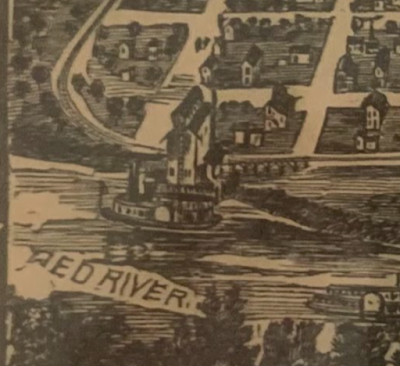
1888 St. Vincent map (west end), showing grain elevator on riverbank

The next year, in 1918, incorporation articles were filed for the new St. Vincent Elevator Company, with capital stock of $50,000; the incorporators were William N. Gamble, William Ash, W.E. Ford, John Duff, and Otto Thorson.  
"The St. Vincent Elevator Company, a new farmers' organization, of St. Vincent Township, has bought the elevator and mill business of the St. Anthony & Dakota Elevator Company, which also includes the coal sheds, two dwellings, and two coal sheds at Sultan, the first station east of here on the Soo Line.

"The elevator, in addition to handling grain, will handle  lumber and building material, also coal and seeds.  Mr. Harry Ward Davis is the new manager."

It is evident from the news article at left, together with the other information earlier in this post, that the local farmers eventually realized they had to organize their own elevator to get the best prices they could for their grain.  Their legacy is still going strong over a century later, with the Humboldt-St. Vincent Elevator Association...

Monday, April 13, 2015

Mansion on the Prairie

[Courtesy:  Kittson County History Center & Museum]
At the Zenith of its production years, the early elevated view seen above of the mansion and surrounding farm buildings - taken from the top of the farm's nearby grain elevator - comprised the 'Northcote Division' of the Humboldt bonanza farm.  At its height, J.J. Hill owned over 45,000 acres of Kittson County farm land, and had over half of it under cultivation at any given time. 
Elevated view looking over Northcote, Minn. bonanza farm.  Visible is a
large two-story brick house with hip roof, several barns, and a water tower.

[Source: Institute for Regional Studies, NDSU, Fargo, ND (2023.42.11)]
Swathing & Bundling during harvest, at the Hill Farm
[Source:  Minnesota Historical Society]
Hill's personal train, often used to travel to Northcote farm
[Source:  Minnesota Historical Society]

Until I track down interior photos of the Walter Hill home (hopefully in its prime, before modifications), my old school friend Dee Dee Giffen Bakken has graciously agreed to share her memories of inside the mansion:
I cleaned for Marva and Byron Hanson who owned the house [until 2004]. 
The front of the house as you come to it from the road is actually the back of the house. When Walter Hill lived there the road came to what is now the back close to the river and came around in a circular drive. That face of the house is the grand entrance with a fancy little roofed porch. 
You enter into an entry with the staircase facing going upstairs. to your left is the great room with a fireplace, a very large room. Behind that is a porch which was open in Walter's day but is now enclosed. To the north of it is an office and bathroom. To your right of the entrance is the dining room with a beautiful chandelier and wood paneling. 
Almost all of the woodwork in the house has unfortunately been painted as Marva told me there were many different varieties of wood used on the doors, paneling, trim and so on. I don't think the paneling in the dining room is painted, but don't remember for sure. 
Beyond the dining room to the east is a sun room which overlooks where the pool was. Going north from the dining room is a huge kitchen which in Walter's day was sectioned off with part of it being the butler's pantry where the food was prepared for serving. It is now a homey big kitchen with a table. 
To the west of the kitchen is an entry where guests come in now with beautiful old tile floors. The entry also has a door going to the hallway which leads to the bathroom, and an office to the north of the great room with some built in closets. The kitchen is now linoleum.  I don't know what it was before [possible wood flooring originally]. In the kitchen as well is a door that leads to a staircase upstairs; this was once a servant's staircase that now leads to a small sewing room and bathroom. Originally, this would have been a servant's bedroom. 
As you go up the grand staircase to the upstairs, you come to a landing which goes to your left then rises to the top floor. As you go to your left you can go northeast which goes  to the servants bedroom. Direct left is the master bedroom with a beautiful fireplace with tiles from either Belgium or Italy. Off this room to the east is a sun porch.  To the north is a huge walk-in closet. To the west is the master bath with a shower made of marble. It is walk-in and huge. There is a tub the size of a Buick and old fashioned toilet and pedestal sinks. The floor is white octagon tile. 
To the right of the staircase is a den or possible bedroom. I think it may have been the library. Down the hall at the end is a woman's bedroom with a fireplace with blue tiles of sailing ships (I think) that came again from either Belgium or Italy. I believe the library had a fireplace too. It's a large room with a walk-in closet. A door to the north leads to a sun porch that is shared by another large bedroom that has a huge bathroom that is attached to it. Again, there is a Buick sized tub and old sinks and white tiles. 
I don't remember how you get up to the attic from the upstairs, it's been a long time. But I was up there a few times and it is as big as the house. Marva told me the boys in Walter's family slept up there and there is a big space in the middle that they held dances in I think. There is a huge basement where they have a pool table from the old pool hall in Hallock here. (Of course I forget the name but I think it was Blado's Billards & Restaurant. It was in the basement of a building near where our business is today.) 
The window wells for the basement have squares of amethyst. Sadly, many people have chipped pieces out for souvenirs over the years. 
Marva's son Marvin was a Minnesota state senator.  In conjunction with his political activities, they held parties at the mansion; even Hubert Humphrey was once there for an event.
NOTE:  The Hanson family moved to the Hill farm in 1967 and their grand daughter Kate lives there part-time, to this day. Check here for more photographs and information about the farm itself...

The amethyst glass blocks are still over the basement window wells
at the Northcote Hill Mansion to this day, a very innovative design

A brief overview of the farm the mansion was part of:

The J.J. Hill Mansion was really Walter Hill's mansion (J.J.'s son) although J.J. Hill probably financed it. Northcote Hill farm was a subdivision off of the Humboldt Farm or Humboldt Division (subdivided in 1910). Before that, it was part of Humboldt Farm.

There is a dam on the Two Rivers, west of the house, downriver. It is small and old, and beginning to fall apart, but still working. By it on the north bank is a falling-down brick building, possibly a mill house.

Over the basement windows were coverings of concrete and glass with a brass sign labeling it as made by the American Luxfer Prism Co (Boston, New York, & Chicago)

UPDATE 10/5/2019:


Found in an old issue of a regional small press paper, "Our Northwest Corner"
recently, is the only interior photograph of the Northcote J.J. Hill mansion...
Recently discovered by collector Brandon Lee Legvold, this 1909 RPPC
shows what appears to be the same image as the one from NDSU shown
at the top of this post, although more complete and it has more clarity. 
Still not a perfect copy, but definitely better!  

Monday, March 02, 2015

PROFILE: Dr. Alexander B. Campbell

Dr. Campbell was a versatile man, with credentials as a Dentist as 
well as a Physician, from the Eclectic Medical Institute of Cincinnati
[Source:  Google Books]

Alexander B. Campbell, Surgeon was a local physician living in St. Vincent from approximately 1880 onward.  

Friday, August 02, 2013

Guest Post: Gopher v. Man

I'm pretty sure you can trace the historic failings of the University of Minnesota sports teams to their choice of name:  Gophers.  In Minnesota lingo, at some point the teams started being called the "Goofers".  I think the football team last won the Big 10 championship and got to go to the Rose Bowl in about 1963, and I'm pretty sure they lost.  Basketball, baseball, wrestling, swimming, soccer -- quick, name me one national title the U of M teams have won in the last fifty or sixty years, even when they had Dave Winfield on both the basketball team and the football team ... .  
I thought so.
I'm pretty sure the Goofers could win a Foosball championship if the NCAA sanctioned it.  Those long winter nights, indoor activities fueled by camaraderie and beer, have definitely produced some bad-ass Foosball players.  Hit me with your best shot.
Gophers are not really vermin, but they are pests. They don't spread disease to humans, but they still wreak havoc.  They build these complex subterranean family homes, and spread the dirt in piles all over fields, gardens, and lawns.  They're kinda small, have nubby little tails, front feet with nails on the paws for scratching and digging, and goofy little curved yellow teeth that curl out of their lips -- also, I guess, for digging holes and tunnels and tearing up roots and destroying gardens.  One of their admirable qualities is industriousness, which is why they are also a bane.
Cute?  Do not be fooled!
Here is a picture of a gopher, in case you've never seen one up close. Notice the whiskers, the little beady eyes, the small pinned-back ears, and the yellow teeth.  Ugh.  Somebody ought to teach this guy some dental hygiene.  I've seen meth addicts with better teeth than that.

My dad hated Gophers.  Not as much as he hated Dick Cheney, but still, when he was creating his picture of the perfect hell for Dick Cheney I'm pretty sure there were gophers in there to torment the guy.

Sunday, May 06, 2012

Hill Farms II


Threshing at the Walter Hill Farm in Northcote (1900);  this was
the year my grandmother began working in the farm's dairy.

[Click on photo to see large version]

J.J. Hill was a busy man with a wide variety of interests.  His business savvy was renowned, which brought him notoriety and admiration from a wide variety of people.  My grandmother and mother talked about him with tones of reverence when recounting his heavy influence on the region in which we lived.

Settlers in our little corner of northwestern Minnesota often found  stepping stones of employment thanks to Mr. Hill.  Elizabeth Fitzgerald, my grandmother, was one of them.  She wasn't able to have any schooling past third grade.  With 10 siblings at that time (eventually there would be 13), she was needed at home after that; eventually, in 1900, she found work on the Hill's Humboldt farm working in the dairy, among other responsibilities.  Such young women who did a variety of tasks were commonly called 'hired girls'.

Hill's interest in farming was tied directly to his building of the railroads.  Development of the surrounding land was their key to success.  Settlement was encouraged, but it was also necessary to supply motivation for settlers to come.  The land itself was rich with potential, but Hill was smart enough to know that he had to lead by example.  He started farms that were practical demonstrations of how it "could be done".  One of them was the Humboldt farm, its genesis in 1881, that became a bonanza farm, eventually splitting off 3,000 acres to create the Northcote division in 1910 (although it was part of the Humboldt farm prior to then...)

The Northcote division was created for his son, Walter, in hopes that it would give him focus.  The article below announces the completion of the mansion, as my grandmother called it.

WALTER HILL MANAGING 45,000-ACRE FARM 
Walter Jerome Hill, around the
time he took over the farm . . .
October 10, 1913 - Walter J. Hill, son of James J. Hill, has just completed a $50,000 residence on the 45,000-acre Hill farm in Hampden township, about seven miles west of Lancaster, between Hallock and Humboldt, in the extreme northwestern part of Minnesota.
Mr. Hill is now erecting a cow-barn 204 feet long and about 140 feet wide to hold 1,000 head of stock. The foundation pillars and floors are of reinforced concrete. The walls are of brick facing and double tile lining. The roof will be metal, supported on steel girders. The building will be equipped with a good ventilating system and with the most up-to-date devices in caring for stock. Adjoining this building will be two large silos and a feed house. In addition to these buildings, Mr. Hill has under construction at the present time an up-to-date blacksmith shop, cattle corral, and a complete hot and cold water system to all the buildings.

He is not putting in a vast sum of money in building for the fun of it. With him it is a business proposition. He is no idle guesser, but has spent some time in keen observation and cold-blooded figuring. He would not be a member of the Hill family if he didn't do this. He has it figured out that the big money for Kittson county farmers in the present as well as for the future lies in raising stock, making this a leading feature of the farming business.

It would do our Iowa, Illinois and Nebraska farmers and renters of high-priced land considerable good to see Mr. Hill's alfalfa, clover, timothy and fodder corn crop this year. It is absolutely necessary to raise these fodder crops to make stock raising a paying industry. This cannot be done in the dry, arid countries, and if the farmers of highpriced land can make money raising these crops to feed stock the farmers of Kittson county will get rich in a few years.

From Commercial West, Volume 24

Monday, January 23, 2012

Guest Essay: Harvest Memories

Alfred "Rusty" Rustad with the family's 'new' combine 
[Photo Courtesy:  Rustad Family Collection]

By Michael Rustad

As a child growing up in Northwest Minnesota, I remember that all of the town's activities centered around the harvest in late August, early September. Football practice often had to be scheduled in the wee hours of the morning to accommodate harvest season. My grandfather, Alfred Hagbart Sr. and my father, Rustee, farmed our quarter section and rented another quarter section of land from Bob Shantz. We were a rather primitive operation. Attempt the impossible. Achieve the possible. And, that was not easy in Minnesota.

Today:  The '35 Chevy truck awaits restoration 
[Photo Courtesy:  Rustad Family Collection]
Our farming operation did not have air-conditioned cabs and stereo systems incorporated in the combines. We had a 1935 Chevy truck that was started with a crank. It was an extremely difficult gear shift and several of the gears were stripped or in bad condition. The truck ran well because of my Dad's ability to over-haul the ancient engine. Our combine was a 1942 left-handed Allis-Chalmers combine. I could never get a clear understanding of why the combine was left-handed. One of the consequences was that the initial rows of fallen grain had to be moved by hand to enter the field. What idiot invented a left-handed combine? We had the only left-handed combine. This required my brother and I to move the rows, so the combine would not run over the fallen wheat and lost! This was my job. My grandmother Rustad often drove the truck and I often kept her company.

It was during the harvest that I developed severe breathing problems from the intense dust. The truck front-side windows were both broken so they would not roll up all the way. There was no way to prevent a cloud of dust from entering the truck. It was quite an unpleasant experience. I later learned that farmer's lung, the equivalent of asbestosis, killed many farmers. By the way, the grim reapers (as the lawyers called them), were dangerous too. There were unprotected and unguarded moving machinery ready to take off your favorite arm or leg. My friend, John Hunt, fell from a tractor and a plow shear created an injury. He plowed up a nest of hornets and fell off while fending off the hornets. He recovered but nearly lost his life. My next door neighbor Diane was also run over by a tractor and fortunately was not seriously harmed.

The truck loads of grain were generally augured into the grainery directly. I did not comprehend how dangerous these unguarded augers were until reading accounts of farm accidents later while studying product liability law. There were no warnings of the dangers of unguarded augers. The farmers of that area presumed that any damn fool did not go near the auger. Yet, year after year, the toll of farm accidents marched on.

I did not enjoy the harvest period very much as it was a period of high tension and excruciating long hours of work which largely fell on my Dad's shoulders. He would work a full day at the Post Office and rush home to work in the fields. I was not a gifted farm boy when it came to mechanics, machinery repair etc. I remember trying to help my Dad get the combine in shape for an upcoming harvest and negligently left a wrench inside. When the combine started the wrench broke every slat and caused us to lose a few day's time, which is precious during harvest. My Father was infinitely patient but was not pleased with me. But, he never again asked me to crawl into the inner bowels of the combine.

One of the family's old tractors is slowly being grown over now
[Photo Courtesy:  Rustad Family Collection]
Lunches in the field had to be grabbed on the run. I remember my Dad eating corn on the cob while driving the combine. He somehow managed to eat a half dozen ears of corn in the course of a lunch in the field and he simultaneously continued to operate the combine. He had a rotary motion when he ate the corn and never dropped an ear.

Gallons of coffee were consumed by the harvesting crew. My grandfather Rustad was a legendary coffee drinker and I remember him draining near a 1/2 gallon of coffee out of the jar in the field. That amount of coffee would have stopped the heart of most Americans, but he was a Norwegian-American.

I was always relieved by the end of harvest. I cannot recall many good harvests. It seemed like something came to ruin the harvest every year. There was "rust" that infected the wheat, hail, or too much or too little rain. My experience with farming convinced me to pay attention to my studies so I would never again choke from harvest dust.

I often wondered why some of the smaller farmers continued to farm long after it was [not that] profitable. I think that I finally understand why decades later. I believe that there must be something inherently satisfying about being your own boss and looking forward to a better crop next year.It is like being a Red Sox fan. Maybe, next year the Red Sox will win the World Series. However, there is always some natural disaster preventing success in the next year. In the days before corporate farming, there were many farms like the Rustad family farm. This meant that the towns of the Red River Valley were populated by young families with dreams of a better harvest next year. Today our land is out of the family and owned by one of the "big" operators. I knew from an early age that I needed an escape plan from the Great Northwest. When I left that area, I thought it looked best in the rear view mirror. Decades later, I seldom go back to the Great Northwest, Minnesota. Nevertheless, I acknowledge that it helped me develop my character and personality---and work ethic.

The combine in later years...
[Photo Courtesy:  Rustad Family Collection]

Monday, December 26, 2011

Market Day

Postcard:  Late 1800s Market Day in Hallock
(Photographer:  William Kelson - Minnesota Historical Society)

[Click to see large version of image...]

Thursday, May 19, 2011

"A Stark Contrast"


Farmers in our area have had to, down through the years, wage battles on many fronts - weather, disease...and markets.
We are inclined to think that by this time the Canadians who, under the influence of the teachings of the liberal press, preferred to emigrate to Minnesota and Dakota rather than to Manitoba and the Canadian Northwest, will have had reson to curse alike their own fate, and the false teachers that led them to it.  The absurd stories about monopoly, about land laws, about high taxation, which served the purpose of the opposition, are certainly no panning out in the experience of the settlers.  Minnesota and Dakota farmers, teaming their wheat across the border, paying the Canadian duty of fifteen cents a bushell, and still making a profit of about four cents a bushell over what they could get on their own side of the line, is rather a startling condition of things.  We copied the other day from the St. Vincent Minnesota, New Era a paragraph describing the condition of things to be seen there daily of farmers, dsiguested with the local price of from twenty-seven to thirty-six cents a bushel, less, when the cost of threshing and twine is deducted, than the price of carrying it to market, teaming it across the border in order to get the profit, over and above the duty, which the Canadian price would give them.  We do not wonder that, as the New Era says, "all felt like cursing the county and getting out of it."1

By a letter received here last week, it appears that up to the 28th November no less than eight hundred and sixty-one bushels of wheat were imported at Emerson from across the border.  On that day No. 1 wheat was selling at St. Vincent at 37 cents a bushel, and at Emerson, just across the border on the Canadian side, at 56 cents; so that after paying the duty, the Minnesota farmer got four cents a bushel more for his wheat in Manitoba than he could get in his own state.  But the most gratifying feature is that this enormous adventage obtains not only on the immediate border but all along the line of the Canadian Pacific railway.  The price last week at Winnipeg and Portage la Prairie was sixty-one cents a bushel; on the Burnside and Brandon section it was fifty-nine cents.  From that point on to Fleming, it was fifty-seven cents, and from Fleming westward it was fifty-five cents.  So that even on the western section of the Canadian Pacific railway the Northwest farmers were receiving  eighteen cents a bushel more for their wheat than the Minnesota farmer was getting at St. Vincent.  These facts are the best answers to the "monopoly" cry which a year or two ago was sufficiently influential to drive many Canadians into Minnesota and Dakota, and we will be greatly surprised if they do not induce a large number of Canadians, now on the Americna side of the line, to transfer themselves to Manitoba and the Canadian Northwest, where, as we doubt not, they now heartily wish that they had gone in the first instance.

From: The Montreal Gazette, Monday, December 8, 1884
I found out there was a bit more going on than at first glance...
Manitoba was the centre of growth, and of growing grain production, in the West (of Canada) to the late 1890s.  But it was not until 1883 that Manitoba had a rail link to the East.  Up to that time, grain was shipped through St. Vincent, Minnesota, to the Great Lakes.  This indirect shipping was costly.  That year, the CPR completed its line to Thunder Bay (then Fort William/Port Arthur) Since the railway had the only direct access to the Great Lakes, "it was able to exercise a great deal of monopoly power and adopt a value-of-service pricing policy."  It set its grain rates at just below those through St. Vincent - Rates were higher than the actual costs justified.

From: Regina Leader-Post, January 22, 1982
That is what the "monopoly" reference mentioned earlier was referring to, and with some just reasoning in my opinion...
____________

1 - The full editorial was: "On Tuesday last we saw a sight upon our streets that with little variation may be witnessed here any day. A number of our best farmers were in town, men we have known since they settled here, and known them to be sober, hard-working, intelligent, honest men. They had their waggons loaded with wheat, and the prices they were offered ranged between 27 and 37 cents per bushel, mostly 27 cents. After taking out the cost of threshing and twine, they were paid less for their wheat than the railway charges are for drawing it to market. Some took their wheat to Traill's mill, and traded it off for flour. Some took it to Emerson, Manitoba, and paid the duty and sold it there, others took it home again, and a few, disheartened, sold their loads for what they could get, not what it was worth, and all felt like cursing the country and getting out of it." So much for Minnesota...


From: The North-West Agitation, The Toronto Mail (December 1884)

Monday, April 25, 2011

Reminiscing

In photo (l to r): Uncle Charlie (Cresien) & Aunt Norma (Carrigan); a very young
Mike Rustad held by his father Alfred "Rusty" Rustad with his wife, Patricia
(Carrigan); and Aunt Virginia (Carrigan) with Uncle Al (Alfred Ducharme)
"This picture was taken right outside of our house in Humboldt.  We 
lived in town and my Dad worked on my Grandfather's farm.  We moved 
from Humboldt when I was 7 years old.  I was the first grandchild on 
both sides of the family - Rustad and Carrigan.  At about that age, 
I would entertain the residents of Grandma Carrigan's rest home in 
East Grand Forks, Minnesota.  I still seem to like the center stage!" 
- Mike Rustad
Michael Rustad - What I remember most is that there were no vacation days when you had cows. I was fairly young around 7 or 8 when I was given the responsibility to change the bedding for the cows and it was always dark when I had to open up the barn door--which was sometimes frozen! Did you find it a relief of sorts to move into the town when your parents ran the cafe? I envied the town kids--Lofbergs, Boatzes, etc.

Keith Finney 1 - Funny thing Mike. I used to go out to the Stewart's to help with chores. I remember Glen walking out to the farm north of Humboldt many days. That brings up a memory. Jay Hoglin and I had skiied out to Grandpa and Grandma Turner's farm one Sunday. We were hunting rabbits. We took supplies so we could melt snow and make some soup while we were out there. I remember it being a pretty nice winter day. It soon started to snow real hard so we started making our way back to Humboldt. We got back to Diamond's farm and started following the railroad track south. We had our hands full of skis, guns and supplies. We had the wind at our backs so we were staying warm. We had just passed the Stewart farm and still could not see the lights of Humboldt as it was storming so bad. Then the surprise! Bang! I bumped right into Ben2 who was walking the tracks out to his farm to do chores. It surprised us all and when we all regained our composure we went our merry ways. One thing I remember was Ben was wearing a mackinaw which was wide open. (not buttoned), He was only wearing one glove as he had one off to carry his Lucky Strike. He was a hardy man. We then made our way home to our worried families and a warm home. Just another day in Humboldt.

1 - Keith is my second cousin once removed - his grandmother Mary Fitzpatrick Finney was my grandfather Sheldon Albert Fitzpatrick's sister.

2 - Ben was the nickname for Glen Stewart; sometimes he was called Big Ben...

Thursday, March 10, 2011

Guest Post: Michael Rustad

Lyle Dexter, Michael Rustad, Jane Dexter, & Carolyn Wiese (in back)
watch videos in church during 2007 town centennial/school reunion

This is the first in a new series called "Guest Post: YOUR NAME HERE", which will feature essays by guest writers, recalling memories and/or reflections of our hometown area. If you are from Kittson County, Pembina County, or southern Manitoba, and have memories you'd like to share about our area, let me know.

The first writer is Michael Rustad, who is (to coin a phrase) the midwife of this blog...

Thursday, January 27, 2011

Prize-Winning Poultry!


I was exploring the Internet in search of local history once again, when I came across a fun bit of St. Vincent trivia in the form of an advertisement for...chickens!

I looked up Rev. James E. Kimberley, and found that he was an Episcopal minister.  As of 1906, he was listed in a church publication as being stationed in St. Vincent (at Christ Church).  The ad below shows that he was still there as of 1915.  He makes some astounding claims about his Buff Orpington chickens that made me smile!


The ad above is  from the January 1916 issue of the "Poultry Herald".

Later, I found the ad below in the January 1915 issue of the "Poultry Herald".

Wednesday, December 08, 2010

Scene of a Tragedy

Map showing Fitzpatrick farm where 1954 tragedy occurred
[©Google Maps, USA Farm Service Agency]
When hearing the story of the tragic spring and summer of 1954, I often wondered where the scene of the second of the two tragedies - the drowning of my uncle and my two cousins - took place.  As strange as it may sound, not once did anyone offer to show me where it happened (on the other hand, it was a very painful memory for my mother, who was very close to her brother...)  I know it happened on my family's farm (at that time owned and run by my uncle, but once my grandparent's homestead), but where the farm itself was, I had no idea.

Friday, August 27, 2010

Mercy Wheat Campaign


I don't know details on how farmers around my hometown area (Kittson County and Pembina County) contributed to the efforts described as the Mercy Wheat Campaign, but it's likely they did. It was  characterized as involving the entire region known as the Red River Valley of the North, the farmers in it called to supply the over 155,000,000 bushels1 of wheat to war-torn Europe and Asia after WWII.

Mercy Wheat wasn't as secret as Ferry Command at the time, but in collective memory, it's almost as elusive.  And what is so impressive about this effort was, it was citizen-driven, not government-sponsored, implemented before the Marshall Plan...

In April 1946, Arnold Amundson of Climax, Minn., led a procession of 140 farmers to the local elevator as a national kickoff for Mercy Wheat, a program by the United Nations to deliver grain to war-starved Poland. Farmers were hanging onto on to their grain, so the government offered them a 30-cent-per-bushel bonus to deliver it. NYC Mayor and UNRRA Director Fiorello La Guardia encouraged farmers to grow even more wheat to feed the countries ravaged by the war.

- From Twentieth Century in Review, Fargo Forum
_______________________

1 - Trivia:  The Farmers Union Grain Terminal Association (GTA or FUGTA), a cooperative grain marketing organization of Midwestern farmers, began operations on June 1, 1938. Its origins, however, go back much farther into the nineteenth century with farmers' rebellions against low prices, mis-grading of grain, false weights, buyer collaboration, and excessive dockage and transportation costs, which resulted in their first attempts at cooperative action...The post-World War II era saw GTA make international news through its contribution of 16 million of the (ultimately) over 80 million bushels provided by the United States in the Mercy Wheat Campaign for war-ravaged Europe.

- From Minnesota Historical Society's GTA Corporation Records Collection

Monday, August 02, 2010

Boots on the Ground Research

A glimpse of the Northcote J.J. Hill mansion is reflected in the Two
Rivers, that flows behind the house.   
[Photo Credit:  Bill Reynolds]
I spent the weekend back home in Kittson County at the Gamble Reunion (more about that in another post, soon...)  I did it in two day-trips both Friday and Saturday, with my boyfriend Bill.  The trip also entailed a lot of local history and genealogy research, as well as exploring of local history, boots-on-the-ground research in Northcote and St. Vincent.  First, Northcote...

The image above is of the Walter Hill mansion1 in Northcote, MN. His father, J.J. Hill, built it for his son, on the Northcote subdivision of the Humboldt Farm. Northcote became its own subdivision (existing before as part of Humboldt's division) in 1910. Several years before that, my own grandmother worked on the farm, as well as my great uncle, her future brother-in-law. Many area men and women worked on the farm, one of the great bonanza farms of its day.

We explored the grounds, coming across an old private bridge way back on the property that crossed the Two Rivers, opening up beyond the large old trees into a huge open yard, with what was once called "...the largest silos in the world."

Down by the river, back a ways through the trees, peeked a brick building right on the banks of the river, by an old dam.  There's no way of knowing, but it's quite possible it could have been a mill, considering it's location.  The dam still works, but it's obviously been neglected down through these many years.  The private bridge and dam, the handful of still visible-but-crumbling outbuildings, are all that remain of a once proud, large working farm.  It was called a 'demonstration farm', showing the world what a farm could do, if run on a large scale, efficiently, and with the most modern design around for its time.  Seeing such greatness in its twilight, faded and all but a ghost, is a very humbling experience.  I could almost swear I could hear the voices of long ago among the rustling of the leaves of the trees...

Walter Hill Farm (Northcote, MN) circa 1930s


1 - An old friend and classmate, Dee Dee Bakken (aka Delores Giffen) told me she used to work for the current owners of the time in the 1970's of the mansion, doing housekeeping. She was able to see the amazing interior, which despite many years past it's prime, still retained enough of it's former glory to dazzle. She talked of immense marble bathtubs you had to step up into, hardwood floors and large staircases, warm wood paneling, etc. I myself spied such things in my exploration - over the basement windows were coverings of concrete and glass with a brass sign labeling it as made by the American Luxfer Prism Co; a safe, seen through a door window at the bottom of a staircase, labeled in large gold-gilt script:

Mattson, MN
Cary Safe Co.
Buffalo, N.Y.
I have no idea if the "Mattson, MN" is named after Hans Mattson, but since we can't find any other explanation, it's as good a theory as any; I did find out there was/is a Mattson Township in Kittson County, but I would find it odd that a safe would be issued from a township and not a town...but who knows!

Wednesday, February 10, 2010

BORDERTOWNS: Chapter 16

It was just 4 a.m. when Mrs. Kemp, a cleaning woman, left her house and headed toward the Farmers Home Store. Her daily cleaning task had to be done by the store opening time of 8 a.m. Her meager pay for this morning task enabled her buy necessities that her husband's stevedore pay failed to cover. Feeling the early morning chill, she hugged her unbuttoned sweater closely about her. Although dawn was just breaking in the east, it was the flickering light from Mason's loft windows that caught her eye. The hayloft door facing her seemed closed, but the two glass windows left no doubt that the hay inside was on fire.

For seconds she stood transfixed, unbelieving; then she acted. Running across the street, she began pounding on the office door of the local attorney who lived upstairs. Within seconds he was at the open front window over his office, calling, "What do you want, woman?"

She shouted up at him excitedly, "It's Mrs. Kemp! Mason's barn is on fire; please wake others and get help. I'll try to find the sheriff and as many men as possible."

It seemed only moments before men appeared, many carrying water buckets. Suddenly the fire burst through the roof of the loft with a loud whoosh, almost an explosion. Flames and sparks rose high in the air, the yellow-red flames lighting up the grey-black smoke in scintillating colors. It was immediately apparent the flames had gotten so great a hold, and the fire spread so rapidly, that there was no possibility of saving the building. Sensing this, and shouting commands, the men began wetting down the adjoining buildings.

The crackle of the hungry fire was as loud as thunder and never ceasing. The onlookers stood horrified, knowing many horses were still inside, their piercing screams heard repeatedly. The heat close by was intense, almost unbearable.

Although the huge west doors were tightly closed, the bar had already been forced. Hastily the doors were swung wide in an effort to save the animals trapped inside. Apparently the fire had already broken through the loft floor, as vast clouds of smoke poured from the opening. Two men, perhaps encouraged by the shrieking of the terrified animals, braved the smoke and heat to enter the building. Finally they were forced to flee for their lives. They reappeared in the doorway, leading only three horses. One of the men was George Mason, the stable owner; the other man was Joe, his hostler.

Joe shouted to his boss, "Cripes! I untied nearly a dozen horses, but they wouldn't leave the barn. Suppose we can get back in for more?"

The query went unanswered; at that moment a thundering crash shook the ground, indicating the loft floor had collapsed on the remaining horses. The ball of fire that erupted from the doorway forced the two men back across the street.

At that moment the sheriff and Ned Cavalier arrived to join the group of men and boys gathered at a safe distance from the barn. Ned turned to Charley disgustedly. "There go my two horses, my buggy and robes, all up in smoke. What a kick in the ass!"

Brown was sick at heart. First his trotter had been cut up; now she was being burned alive. Inwardly, he thanked the Lord he had lent his riding horse to Sergeant Heidelburg last night. The overweight man had been complaining about having to walk back to the fort, because he had missed his ride. At least his gelding was safe. He turned as Mason approached. It was nearly full daylight now. The stable owner's face was black with soot and it was obvious he had suffered burns. His shirt hung in scorched tatters.

"Charley, the fire started in the loft and there was no wet hay there to cause spontaneous combustion. Someone set that fire! I don't allow sleeping in the loft and the back and front doors were closed and locked at 11 o'clock last night. We managed to save some small stuff from the office at the east end, and the three horses, but I think Booker's horse will have to be destroyed. It's in tough shape. Judas, there were 22 horses and a cow in there, according to my hostler. I've got $5000 insurance, but that won't cover even half of the loss." His distress was obvious to all.

They watched as the bulk of the hay in the loft burned with a fury and intensity that was almost unbelievable. When the roof was totally consumed, the loft ends of the barn slowly collapsed into the inferno.

"Who in his right mind could be so cruel to set a fire that would kill all those fine animals?" asked Charley, incredulously.

Cavalier added gloomily, "Lucky it happened early in the morning when there was no wind; otherwise we might have lost the entire business district."

Within an hour the building no longer existed. Fragments were allowed to burn themselves out. By noon only faint wisps of smoke rose from the heap of grey and black ashes. Little remained to indicate the size of the huge building.

Several of the more influential men of the town gathered at the Brown and Kabernagle store to discuss the disaster. Seemingly, no one could cast any light on the perpetrator.

Inwardly, Charley was convinced that the recent events were the work of Brogan and his cronies, caused by his shaming Brogan last winter. He questioned Mason at length as to any enemies he might have.

Mason was adamant. "As far as I know, I've never done dirt to anyone. Oh, I've had to dun some for their bills, but there were never any words exchanged. I've tried to run an honest stable, for the rental of horses and buggies. I just can't figure anyone who would do this to me. Now I've got to start over, and with darned little money." He studied the sheriff. "What can you do to catch the S.O.B.?"

Charley shook his head, and then looked up to the men who were watching. "You all know I check the downtown quite often around midnight, and it's not my job as sheriff. It seems lately that things happen in the small hours of the morning. So far the town has gotten by cheaply." He looked around at the businessmen. "How about the town putting on a night watchman? It's about time."

The owner of the Farmers' Home Store spoke up glumly, "I guess it's true, but I don't know where or how we'll raise the money to pay a man."
_____________________

Toward the end of July the wheat crop looked promising. Jerold was anxious to try out the new McCormick reaper his father had purchased in Pembina. Cyrus McCormick had finally perfected a mechanism that tied a knot in twine, thus enabling the machine to cut and tie the grain into bundles. When the machine was being assembled at the implement dealer's shop at Pembina, both Jerold and Knute were present and assisted the mechanic. The two boys were fascinated by the novel six-foot sliding sickle and the intricacies of the knotting mechanism.

When Jerold began cutting his father's wheat, he found the reaper required more power than he had anticipated. He was forced to remove the 3-horse hitch from the plow and hook it to the binder. Even then, he realized the need for a change of animals after a strenuous five-hour period. He estimated the machine was cutting slightly over one acre per hour, but by dark the following day he found he had cut over twenty acres. Before the week was out, he had completed Patrick's wheat and had moved to Ian's.

Knute was fast at stooking as he called it – stacking eight to ten bundles upright, one against another, with the wheat heads upright for drying. They estimated that it would take nearly a week for the kernels to harden and the straw to dry, before ready for threshing.

The Icelandic carpenter, Johannason, had contracted with Patrick, and completed two 1500-bushel wood granaries behind the barn. The barn itself held two 600-bushel feed bins built into one end. Patrick felt he now had nearly enough storage for half of their crop.

Rather than stack their wheat bundles in one huge stack and thresh them during the winter months as many farmers did, Patrick contracted with a thresher-man to have the job done in the field. A week after Jerold completed cutting the wheat and oats, the monstrous machine moved to the field shortly before dark. The huge straw-burning steamer was hitched to the separator, that to a cook car and finally to a bunk car. Following them into the field were eight teams with hayracks and two 150-gallon water wagons.

While Jerold and Knute watched wide-eyed, the contractor approached Patrick. "We'll start threshing at eight a.m. tomorrow morning; we should finish here early enough in the afternoon to move to your son's field. Hopefuly we will finish by dark.” He looked up at the clear sky and the reddening sunset. "I'm moving to Frank Webb's from there."

"Gosh, how many men work for you?" Jerold asked.

The thresher-man smiled. "Well, my engineer runs the steamer and he has a fireman, a tank man and the flunky to haul the straw to feed the engine. We trade off two of the hayracks for that purpose. Then there are six bundle wagons to pick up the shocks of grain, and two water wagons to keep the engine supplied. In addition, I have two field pitchers who help load the hayracks and two spike pitchers who assist in unloading the wagons at the separator." He turned to Patrick and pointed southwest. "We'll haul water from that small lake over there. It's cleaner and closer than the river." He gestured toward a long shed on wheels with a protruding smokestack. Wisps of grey-blue smoke were beginning to curl from the chimney. "That's our cook car; I see Willie is working on supper. The other car is the crew bunkhouse." He smiled proudly, "We're a self-sustained outfit."

While they watched, the engineer and flunky unhitched the separator from the trailing cars and pulled it some distance westward with the engine. Then, moving the huge steamer some distance from the separator, the driver carefully lined up the huge belt pulley of the engine with that of the threshing machine. The owner abruptly left them to assist another man who was attempting to remove a huge roll of belting from a box on the separator. The two men unrolled the belt, coupling the steamer to the thresher. After placing the belt on the pulleys, they produced shafting and with a sledge hammer anchored the separator to the ground, preventing its movement. The engineer slowly backed the steam engine, tightening the long drive belt until it just cleared the ground. When he started the drive pulley on the engine, the belt came alive, swinging like a sinuous snake. The threshing machine began emitting a cloud of dust, combined with a clanking, deep rumbling sound. After running the machine for nearly a minute, the engineer evidently deemed the belt alignment satisfactory. Driving the steam engine ahead, he slackened the drive belt and finally shut off the engine.

It was apparent the owner was also the separator man; he bustled around the threshing machine with a long-spouted oilcan.

"Why do you have that half-twist in the drive belt?"

Knute was curious.

The owner looked amused. "Son, if we didn't put that half-twist in the belt the machine would run backwards."

Jerold tried to cover Knute's embarrassment by asking, "How much water will you need? It's nearly a half mile to the lake."

"Maybe three or four tank loads for this field." He turned to Patrick. "You'll have to furnish at least two grain wagons; and if you're going to haul back to town, you'll need more. We don't stop when we get going. You pay by the hour and furnish all feed for our animals. As I said before, we start threshing at 8 a.m."

"I'll have two wagons here. l've arranged to borrow one from a neighbor. We'll pile the grain over on that high spot near the road." Patrick shook his head. "It's going to make extra work to handle the grain twice, but it can't be helped."

"At least you can take the last two loads home from this field. You'll have time while we move to your son's wheat."

By 6:30 the next morning Jerold and Knute were beside the threshing machine with their wagon boxes. Promptly at 8 a. m. the engineer opened the throttle and the field hands began tossing bundles onto the feeder of the huge machine. The owner stood on top of the machine, oiling here and there, stopping occasionally to cast a remark to the teamsters and spike pitchers who were unloading the bundles onto the feeder.

By 9 o'clock Patrick appeared in a buggy, accompanied by Maggy, Mary and Mike.

"It's a grand sight, Patrick!" Maggy exclaimed. "Just look at that black monster puffing and casting all that grey smoke and steam. Why, they've even got a water and straw wagon alongside it.

"Pat, imagine what your Father and Mother would say if they saw this huge outfit." She looked at him proudly. "We've come a long way in a short time."

"The man knows his business, Love. He just got this new machine. It's a Buffalo Pitts engine and thresher."

"What's that thing flipping every so often, dropping the grain into Jerold's wagon?"

"It measures the bushels, and it's got a mechanical counter. We'll know exactly how many bushels we have when they finish threshing."

Patrick clucked to the horse and shook the reins in an attempt to go closer to the noisy machine, but the horse began shying, attempting to turn away.

"Seen enough, Maggy?" asked Patrick.

She turned to Mary. "I've never seen anything like it. I wouldn't have missed it for the world, but we'd better get back. Kate will wake up hungry and Susan will want to get home."

When the threshing was completed the next evening, the contractor was paid off. That same evening at the supper table the family discussed the problem of moving the grain.

"One wagon isn't enough, Pa." Jerold complained. "We'll be at several days moving all the wheat and oats into the bins. If a heavy rain comes, we'll be in trouble."

"He's right, Pa," said Ian. "I'll buy a new running gear and grain box. I'll have to get another team of horses, too." He looked to Jerold. "I want to keep my job with the railroad; it's good for all winter. Can you find someone to haul for me? I might have to pay out all my wages for awhile, but I'll still have my job."

"How about Pete? Will he work?" Patrick knew good men were hard to find.

Ian nodded. "I'm going over to see Susan after supper. If Pete is home, I'll ask him. I don't think he's doing much, except fishing. The trouble is, there's no manual work involved in fishing and he sells the fish at a good price. He might turn me down."

Patrick grimaced. "Well, whatever we do, we've got to get the grain moved as soon as possible. Knute, can you handle the discing and plowing for awhile?"

"Sure, I will do that. But if you use two teams on the wagons, I will still need a change of animals."

"That does it!" Patrick exclaimed. "Ian, we've got to find heavy, draft animals. We've got the land, now to farm it!"

"Pa, our barn won't hold any more animals," Mary protested. "The cows take up nearly all of the room."

"Then we'll have to build a lean-to on the north wall. We're going after a big acreage of wheat next year." Patrick smiled in anticipation, thinking not so much of the dollar value, but of the satisfaction gained.

Maggy brought up a touchy subject. "Jerold, that badger of yours has got to go. Have you seen the damage it's done to the garden? There's a monstrous hole where it dug after a gopher. Also the darn thing has been digging and eating the potatoes."

Patrick looked at his son. "She's right, Jerold. The critter has a right to be in the wild."

"But he likes us, Pa. He won't leave."

"That's our fault; we've fed and spoiled him. Take the badger out on the prairie. It's not right to keep it any longer."

"I tried that this spring, but he came back home.”

"You've got to take him farther out. If you don't, someone will shoot him. Look at the trouble we had in Emerson. The neighbors were wild about the damage he did. He's got to go!"

Jerold reluctantly agreed. "I'll take him over east next Sunday, after church. I won't have him shot."

Since Ian's riding horse was available for Mary's use, she decided to make a split skirt. She consulted Susan, and they searched the stores together for a suitable material, finally settling on a grey Melton. The design and the way the skirt hung gave no indication that it was split. Mary knew society frowned on a woman riding astride, but she considered the investment in a side-saddle foolish. Ian already owned a western style stock saddle with a high cantle which gave her a firm seat and more control over the horse. When her mother remonstrated her, she answered, "If Kirby doesn't mind me riding astride, why should I worry about what other people think? Besides, I think a side-saddle is old-fashioned. Why, I've heard that out West, it's common to see girls and ladies riding astride."

Maggy gave in, but not without a final word. "Mary, you aren't living out West."

Mary didn't tell her mother that she had gotten the idea of the split skirt from Susan. Ian had mentioned the time Susan had surprised him with hers.