Showing posts with label photography. Show all posts

Wednesday, December 21, 2022

Christmas Sunday School Memories

Shared by Lori Wood Goertzen:

This photo was a Christmas gift from my favorite Sunday school teacher, Clara Loer. 

Left to right: Debbie Dykhuis, Danny Hodgson, Marilyn Loge, Anita Calkins and myself.

This was taken on the front steps of the old St. Vincent Evangelical Free Church.

Wednesday, October 13, 2021

Low Water: The Wreck of the Steamboat Dakota


Late this past summer, this was posted on the St. Vincent Memories Facebook page:
Looking to see if anyone might know or have any more info on the story that might be behind this. As you all know the mighty red is far from mighty right now but I still decided to take my boat down to check things out. Came across what looked to be an old sunken boat of some sort. Brought it up to my dad and he said that his grandparents (Bud and Jean Feick) had said that it was an old steamboat that used to run from Forks to Winnipeg in the late 1800s but had gotten hung up and then just left in the river. They had also said that long ago you were able to see one of the masts sticking out of the water once the red would get lower. It sits about 3½ miles south of Pembina. Obviously most is completely covered with mud and/or missing but you can see about 30ft worth of deck right now. These boards are way bigger than they look in the pictures...
There was much excitement in the group in reaction to the post.  Over 70 comments exploded the discussion:
Paul Maloney: What do the nails look like, if any survived? And I think remnants of the boiler would still be there if it was a steamboat.

Jake Cosley:  All the main nails used to hold the planks down are ¼x¼" square. There were a few large ½-⅝" round spikes used as well

Julie Lindegard: I will ask my dad Bob Cameron if he has any further info.  Dad recalled hearing that Humboldt kids (St. Vincent kids were too far away) would often swim in the river and get on the boat and jump off. I can imagine it provided hours of entertainment for kids! He said that the Bockwitz family found and retrieved the anchor. They contacted my dad to take it to the museum in Lake Bronson at least 30 years ago. That's where it is now. 


At RightEvidence of scorched and burned decking could still be seen, over 140 years later... 

Hetty Walker: Chuck always talked about the steamboat, that got hung up …that could be it

Janine Rustad: Talk to DeeDee Bakken---she used to say her dad knew exactly where it sunk 
Julie Lindegard: Yes dad mentioned it was near/in the area of the Giffen farm. 
Donald Burroughs: Does North Dakota have a historical society? Would be an opportunity to salvage some of the boat, those nails and boiler parts, paddle wheel hardware plus its coordinates to build a story around it.

Trish Short Lewis: They have already been contacted about this. State Historical Society of North Dakota's chief archaeologist, Andrew Clark.

Brandon Lee Legvold: Three (3) miles above Pembina it says which in Red River terms would be south of town so I would definitely say that is the hull of the Dakota that was found.

Trish Short Lewis: Since it’s only partially burned and witnesses say the ship burned, I think the idea of these being one of the two barges might be right. I reserve final judgment until we hear from DeeDee Bakken (hopefully) on what she recalls her father seeing… 
[Note from Trish: I later spoke with DeeDee and got some very interesting information from her!  Also, the pump in the photo at left, was found by her, and then taken and donated to the Kittson County History Center & Museum, where it is today, along with the Anchor found many years ago by Humboldt's Bockwitz family...]

 Brandon Lee Legvold: [The source of the quoted newspaper article, which is pictured above, is...] the Worthington (Minnesota) Advance. August 19, 1880. Which oddly enough is today. I found this on Chronicling America.

Trish Short Lewis: Full reference citation for article is The Worthington Advance. [volume] (Worthington, Minn.) 1874-1908, August 19, 1880, Image 1 Image provided by Minnesota Historical Society; Saint Paul, MN (Chronicling America)

Jim Benjaminson: Preservation of the site is paramount. 

On August 26th, I took
a field trip up to the wreck site south of Pembina.  The person who discovered the wreck - Jake Cosley - was kind enough to take me in his boat to the site, which was on the North Dakota side of the Red River of the North.  It was an adventurous ride out, the boat hitting bottom and getting stuck at one point, the water levels were that low (that was why the wreck was revealed in the first place...)  After a bit of creative  'jiggling', we broke free and were on our way again.  

It was pretty exciting to be at the site of a 140 year old wreck!  It became more and more apparent -  between the onsite examination of the wood, old hardware, and what could be ascertained on the construction - that this was remnants of one or both of the barges that the Dakota had been towing full of freight, and that the ship was likely down the river a ways on the Minnesota side near the old Giffen farm.  All the pieces fit, however - this had to be the wreck of the Dakota, it was the only thing that made sense from the evidence so far.

That said, a proper survey and investigation needs to be done.  And to that end, I contacted the State Historical Society of North Dakota's chief archaeologist, Andrew Clark.  Andrew was intrigued about the find, and expressed a desire to come in-person to evaluate the wreck.  However, as always, there is red tape.  Funding, authorizations needed, etc.  I had several conversations with him about what I saw, and he explained that at the very least, the location of the wreck needed to be updated.  There was erroneous information in some records that needed correction.  After my site visit, I was able to give him GPS coordinates of the wreck to update any official records out there.  I also notified the Minnesota Historical Society about the wreck's connection to Minnesota (the steamboat itself was likely within Minnesota jurisdiction).  

It is my hope that next summer the SHSND can make an on-site visit to document this important vestige of our region's transportation history. Andrew Clark shared this about a similar discovery made on the Missouri River last year; it would be amazing if they could do the same depth of investigation with the Dakota - it is a fascinating slice of our local history, for sure!

Part of the Dakota steamboat barge wreck as revealed during 
Summer 2021 low water on the Red River of the North . . .

Sunday, September 13, 2020

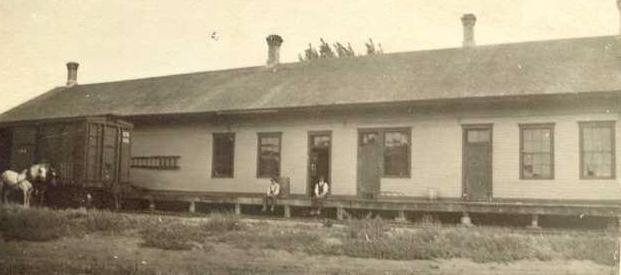
A Lifetime of a Depot: NOYES

Depot built 1906 (joint GN/SOO Depot) - 30' x 137' frame. 
Depot remodeled 1912. 
Burned 1921. 
Depot 30' x 138' rebuilt 1922.  
10' x 20' addition added 1924.
Remodeled 1943. 
North 32 feet of Depot removed in 1966 and Depot rebuilt 1967 (after 1966 flood) - platforms removed, landscaping built up to accommodate dike around town.

Torn down/demolished:  August 2020.


Monday, January 06, 2020

Dakota 38

Abraham Lincoln as the Puppetmaster of Death (of starvation, war, and executions)
Ledger Art by Travis Blackbird

by Prairie Rose Seminole
Remember the #Dakota38, hanged in Mankato, MN on Dec 26, 1862, under the orders of President Abraham Lincoln. It is the largest mass execution in U.S. history.

The hanging of 38 Dakota came at the culmination of the Dakota War, which started because of a treaty broken by Congress. 

The Dakota people were being starved to death.

“Let then eat grass or their own dung,” Andrew Myrick, a trader & store owner who withheld their rations.

Andrew Myrick was among the first to die. He was found with grass in his mouth.

The accused were subjected to sham trials held in English (a language foreign to them), and they had no legal representation. They were also not allowed to discuss the broken treaty, or treaty law. Many were innocent. They were hanged anyway, on a custom made scaffold, in front of a cheering mob.

Dakota women & children were forced to watch the hanging. One Dakota infant was reportedly snatched from the arms of a mother and killed on sight.

Around 1,700 Dakota, mostly women and children, were held as prisoners at Fort Snelling. Disease & death were rampant.

Chief Little Crow, a leader during the Dakota War, was later assassinated. His remains were mutilated by townspeople & displayed. They stuffed firecrackers in his nose & ears and lit them. Local doctors eventually took his body parts to study.

Two more Dakota leaders, Shakopee (Little Six) and Medicine Bottle, were later captured and executed.

After the hanging of the Dakota 38, the Dakota people were exiled from their stolen homelands in Minnesota. Banned from entering, unable to return to MN. The governor put a bounty on their scalps. The Dakota people were separated and sent to prison camps in other states where the women were raped by soldiers.

Following the U.S-Dakota War of 1862, the United States government hanged 38 Dakota men on December 26 in Mankato. It was the largest mass execution in United States history. A US military commission, tainted by racism and in violation of due process, hastily convicted two of the Dakota men of rape and all of them of murder in trials that lasted as little as five minutes. President Lincoln approved their executions. Here are the names and faces of some of the men known as the Dakota 38.
All things being ready, the first tap was given, when the poor wretches made such frantic efforts to grasp each other's hands, that it was agony to behold them. Each one shouted out his name, that his comrades might know he was there.  - From New York Times article, The Indian Executions

Thursday, December 12, 2019

Postscript to the U.S.-Dakota War

by Curt Brown [Minneapolis Star Tribune, November 8, 2015]

Shakopee, left, and Medicine Bottle were hanged three years
after the U.S.-Dakota War because military leaders wanted to
prove they finished the job.     
[Source:  Minnesota Historical Society]
They were the last two high-profile holdouts.

The bloody U.S.-Dakota War had been over for three years. Thirty-eight Dakota men had been hanged in Mankato. But white military and political leaders weren’t satisfied.

They felt they had to show, once and for all, that they’d handled the Indian problem and the frontier was back in business for immigrant settlers who could replenish the fledgling Minnesota economy.

So just after noon on Nov. 11, 1865, 425 soldiers marched in formation to surround a specially constructed double gallows at Fort Snelling.

More than 400 St. Paul citizens turned out 150 years ago to watch the hangings of two Dakota leaders: Medicine Bottle and Shakopee. They had eluded soldiers for years, escaping across the Canadian border to Manitoba with more than 500 Dakota refugees from the war.
John McKenzie was the man who drugged Little Six (aka Shakopee) and Medicine Bottle after the Sioux massacre and brought them in this condition from Manitoba and delivered them to Major E. A. C. Hatch. Knowing the frailty of Little Six, who was a different man from the old chief Little Six, his father, McKenzie left a bottle of drugged whisky with a woman at the house which he was accustomed to visit, knowing that his greedy appetite would ferret it out. The artifice succeeded, and Little Six and Medicine Bottle were tried and hung at Fort Snelling for killing Philander Prescott. - History Of The Minnesota Valley, Scott County History Archives, 1882
Their flight ended in January 1864, when Shakopee and Medicine Bottle stopped by the home of a white friend near Winnipeg’s Fort Garry. That "friend" - Canadian trader, John McKenzie - was secretly in cahoots with a U.S. Army major across the border in what would become Pembina, N.D.

McKenzie plied both Indian leaders with alcohol laced with drugs. Shakopee, then in his 50s, was dosed with chloroform and rendered unconscious. Medicine Bottle, in his mid-30s, struggled longer but several men subdued him. Both Dakota men were tied to dog sleds and taken to Pembina, then Fort Abercrombie, en route to Fort Snelling.

The Minnesota Legislature forked out $1,000 — big money in the 1860s — to McKenzie as a bounty. Trials were held and both men were convicted despite sketchy evidence that they had committed atrocities during the war. They were blamed in the death of Philander Prescott, 60, who had lived among the Dakota for more than 40 years. He was beheaded on the first day of the war as he fled toward Fort Ridgely.

“It would have been more creditable if some tangible evidence of their guilt had been obtained,” said an editorial in the St. Paul Pioneer Press, published the day before the hangings.

The newspaper said “no serious injustice will be done by the execution,” but warned of a dangerous precedent of “hanging without proving.” Saying the men were probably guilty of murder, the paper nevertheless pointed out that “no white man, tried by a jury of his peers, would be executed upon the testimony thus produced.”

President Abraham Lincoln had been assassinated seven months earlier. He had stepped in to reduce the number of Dakota men hanged in Mankato from 303 to 38.

One of Medicine Bottle’s descendants, Dakota researcher and filmmaker Sheldon Wolfchild, insists Lincoln would have halted the hangings. But the president’s successor, Andrew Johnson, quickly approved the executions of Medicine Bottle and Shakopee.

When Shakopee and Medicine Bottle were captured in Manitoba, a French Jesuit priest and missionary named Augustin Ravoux baptized them and administered their Last Rites, accompanying them up until their final moments on November 11, 1865.


Wolfchild, 68, lives in Morton, Minn., and has produced a film about the era that saw his ancestors swept from the area five generations ago.

After their hangings, some of the witnesses ran up and cut off pieces of the nooses for souvenirs. St. Paul photographer Joel Whitney snapped glass-plate images showing white caskets at the feet of the dangling men.

Wolfchild says rocks went in the caskets that were buried in a nearby cemetery, with onlookers thinking they had witnessed the interments of important Dakota figures.

Their bodies, instead, were taken away in a horse-drawn cart at the behest of two doctors with offices near 7th and Jackson Streets in St. Paul. Some accounts say the doctors dug up the bodies the next day.

Wolfchild says Shakopee’s body was preserved in a wooden whiskey barrel and sent to a Philadelphia medical school where a professor Pancoast used it in anatomy lessons. St. Paul doctors dissected Medicine Bottle’s body.

“Who is the savage here?” Wolfchild asks. “Running to the scaffold to get a piece of the rope? The bottom line is they had to dehumanize us to where we were little more than beasts so they could get rid of us.”

Wolfchild says that his grandfather five generations ago, Medicine Bottle, didn’t die instantly when his body dropped at the Fort Snelling gallows.

While Shakopee’s neck snapped immediately, he said, Medicine Bottle dangled for 10 minutes before dying.

“He was saying: ‘We don’t die like that. You cannot kill us with a rope,’ ” Wolfchild said. He’s trying to find any remains that might still exist of the two men, pointing to the Missing In Action banners popular since soldiers went missing in the Vietnam War.

“We feel the same way about our ancestors, they are missing in action and their bodies are in universities, museums and private homes,” he said, “waiting for proper burials so they can continue their journey to the spirit world.”

Scaffold:  Shakopee and Medicine Bottle, moments after the execution
[Photographer:  Joel Emmons Whitney - Source:  Minnesota Historical Society]

Monday, November 18, 2019

Junction Drive Inn


These are photographs from the Larson Family Collection. Before there was an Interstate Drive-In (just west of the old KCND-TV building in Pembina), the Larson family started their drive-in business on the Minnesota side, at the (St. Vincent) Junction.

It was a much smaller affair, but much loved in its time. So much so, they had to build a larger one. It was right around the time that I-29 was being built, and the Larson family wisely thought it might be a great location for the new Drive-In. My older sisters Sharon and Betty Short were among the many young ladies who worked there in high school as waitresses...

Friday, September 28, 2018

1907 St. Vincent Main Street

The carriage looks suspiciously like our 'Mystery Man' again!  Could it be?!
Source:  Digital Horizons, State Historical Society of North Dakota, via Pembina Historical Society
This shows the main street in St. Vincent, Minn. in 1907. Many buildings line the street and electric lines are visible. Notice the street is unpaved and there are wooden sidewalks present.

This street leads down to the river where it curves to the north for a short way, to where the ferry crossing is that takes people, wagons, etc. over to Pembina on the Red River. At the far end, where years later a bridge will be, you can make out buildings. Down in that area, at this time, is an elevator and a brewery, among other businesses.

St. Vincent Engine No. 1,  on display during the 155th Town Reunion in 2012
The firehall, its bell tower seen on the left (south side) of the street, is new, just built in 1903, housing a new fire engine, St. Vincent Engine No. 1! Directly behind the horse carriage on the right , behind the electric light post, is a short awning. That is the St. Vincent Bank. The larger awning to the right is over the entrance to the Nelson Green store. That same lot is where the Valley Community Church (later the St. Vincent EFC) was located.

Out of view, on the left, is the railway depot, platform, and tracks, which go south of the firehall running east/west. At one point, the tracks also went down to the river and curved around to the north, where the plans had been to build a railway bridge. Unfortunately, that never happened and that change significantly impacted St. Vincent's growth. Those tracks were later removed, and the rails into St. Vincent dead-ended in town. For over 70 years, St. Vincent had freight and passenger service as a sort of consolation prize, but it was ultimately doomed. For its first 30 years or so, it served an important role in bringing thousands - yes, thousands according to many newspaper articles - of settlers north and west, on the railroad. Most did not stay in our area, but only passed through.

In 1907, the town was already quieting down, but still a busy small town around 300 population. Right across the river, its counterpart and neighbor - and in the past, part of the same territory - was Pembina, around 600 or so at this time. So the 'twin city' area has a lively community of citizens, schools, churches, businesses, and surrounding farms. A great place to live, work, and raise families...

Thursday, January 25, 2018

The St. Vincent Depot Interviews

Photograph of St. Vincent depot, as described in the article below...
One of the great things about our readers is how they participate in discovering and sharing our local history.  

I was recently contacted by such a reader, who found an article written by Maribel Berg for the Scribe Tribe, published by the Kittson County Enterprise in 1976...


Sunday, September 24, 2017

Grand Theatre Memories

Projector from Grand Theatre
[Kittson County Museum Collection]
The Grand Theatre was Hallock's (MN) movie palace.  I was recently contacted by a gentleman who once worked for the man who owned it1, as well as the local drive-in.  He had some interesting stories to share...

Jim Tureson, who worked for Bill Krumholz:

Sitting here thinking about days gone by and remembered an incident at the Grand Theatre. It was 1956.  We were showing a horror movie called The Creeping Unknown where this big glob would catch and kill people. Well, my Dad decided to make it more interesting. He ran some wires from the projection room down to the seating area and attached a buzzer to two seats! The wires were attached to a battery and when he pushed the button the seats would start to vibrate and buzz! Needless to say, at the worst possible time in the movie when people were screaming, we would hit the buzzer and watch someone fly out of their seat! I know, that was bad and we made sure there wasn't an elderly person sitting there. Joe gave us permission to do it and enjoyed the reactions also!

Projector from Grand Theatre.
[Kittson County Museum Collection]

Jim Tureson shared another story:

I'll tell you another Grand Theatre treasure. My older brother Larry was a protectionist in high school also; he graduated in 1960. One of our pet peeves was when one person showed up to watch the second show, we weren't able to go home early. This particular night a gentleman came in just in time for the second show and Larry wasn't happy. So he ran the show. When it ended, he turned on the lights, closed the curtain and was going to lock up when he saw that man still sitting in the front row, thinking he had fallen asleep. He went up and shook his shoulder, only to find out he was dead! Freaked him out to say the least!! So Larry was the only one in our family to run an entire show for a dead man.

Highway 75 Drive-In; go-cart track can be seen between screen and parking area.


July 12th, 1962. Joe Carriere and I were at the drive-in where I was going to paint the big screen. We rigged up a one-man "swing" with ropes over the screen tied off on Joe's big Oldsmobile. It worked like a pulley system - as Joe drove forward I would go higher. It had rained the night before and the grass was wet. I needed to go up higher so Joe started pulling me up, but as he was going, he got hung up on the wet grass around the go-cart track. He goosed the Oldsmobile, tires spinning, and then suddenly he hit the cement track! He took off rather fast and I went from 15 feet off the ground to 35 feet in seconds. When he finally stopped, I had almost wet my pants, the paint can went flying, and I'm screaming at Joe!

The day the Grand burned down in 1975...

Of course, he thought it was funny as hell, while I had thought I was going to die!


1 - Joseph and Rebecca Carriere owned and operated the Grand Theatre in Hallock from 1947 to 1975 when it was destroyed by fire. They also opened the Hallock Drive-In Theater in 1954 and operated it until 1985. The 1995 tornado took it down...

Wednesday, February 15, 2017

James J. Barry, Pugilist

Louis Edgar Rogers, aka
Jim Barry, was born in
St. Vincent, Minnesota.

Jim Barry was a pugilist...and a mystery. His real name was Louis Edgar Rogers.  He seems to have left the US in December 1912 and returned in 1915. One document that was found - an application for a passport - showed he was in England at the time. Did he go to England to get treatment for his drug and alcohol problems? Then, a record showed he fought his old nemesis Sam Langford in Australia, most likely as part of a hopeful comeback? Or, was it an exhibition fight?  He has some more fights later but he lost them all. While in Panama, he was murdered at the age of 32. A short life of a promising young boxer - he was considered a capable, durable fighter in his prime - that took a wrong turn, that led to a sad end.

 
Barry lists St. Vincent, Minnesota 

as where he was born, on this 1915 
emergency passport application...
Louis was born on August 12, 188x (listed in various sources as 1885, 1886, and 1887) in St. Vincent, Minnesota.  In the 1900 US Census, Louis is listed as age 15 and going by Lue Rogers. Lue is a variant of the name Louis (English and French), and on the same census, Mary is listed as his mother, age 55 and widowed.  His father had been from Ireland, but his mother was French-Canadian.1 Very likely she would have called him Lue for short - or it could have been a simplified version of how Louis is pronounced in French.  

Barry's 1915 passport photo
According to the same census, Lue could neither read nor write. Nor could his mother.  It was not unusual for that time, but just like today, it limited job opportunities for a lifetime.  Lue was also listed as a 'Day Laborer', but that wouldn't last for long. Sometime during the next few years, probably sooner, Lue learned the art of boxing, left Drayton for the wider world, and became Jim Barry.


Sam Langford
Jim's start up the ranks of boxing are not known, but he eventually made a modest name for himself. He was characterized as a "hard-hitting white cowboy" ... who did not mind fighting the top black heavyweights of the Chitlin' Circuit. Although he did not beat Sam Langford--only to a draw, in their many fights--Barry did deck the Boston fighter on two occasions.

According to his May 1915 passport application, Barry was born in 1886 in St. Vincent, Minnesota, and called Drayton, North Dakota, his place of residence. He listed his occupations as "engineer and boxer" - what kind of engineer, we do not know, but if true, it was as a vocation between 'day laborer' and 'boxer'.

After returning from London, Barry went into treatment for cocaine addiction.  He was released from a New York hospital after taking the "Coke Cure" in July 2015.  The government was starting to crack down on cocaine and other drugs that had previously been unregulated. I think Barry had to get straight or risk losing chances to fight, or even get arrested.  So he was trying to straighten up. 

An article in the Pembina Pioneer Express for March 30, 1917, has this notation:

Wednesday, May 04, 2016

Field Trip: Manitoba Border Churches

At the St. Michael's Ukrainian Orthodox Church cemetery, May 4, 2016

While out in the field taking photographs with Troy Larson on Monday, I realized I had a golden opportunity to get a good shot of myself that wasn't a selfie. Troy was very kind and took a couple of shots of me.

I love them! That's me nowadays. No more glamorous makeup and clothes; nowadays my priorities are pain relief, physical strengthening, and comfortable clothes. And documenting family and local history as much and as well as I can, for as long as I can...

The entire cemetery is surrounded by an old growth oak grove...

Wednesday, January 27, 2016

"Teddy" the Bear

"I remember the bear quite well - it was the talk of the town [Humboldt], it used to ride in the car with them. My dad told me of one time when they were going somewhere in the car, it got its collar hung up on the turning signal lever and almost ripped it off...
- Donald Reese
"Teddy" the bear...
He called her his "playmate".

Bob Bockwitz - whose family had the famous Humboldt bear - shares:
"The bear was one of three orphaned cubs that were adopted by individuals. (Things were a little different in those days) The two people in the picture are my dad Virgil, and my brother Rodney. When dad brought Teddy home (yes, for want of a better name, we called her Teddy) she was about the size of a football and snuggled into his jacket. She was bottle raised, and lived in the house until, as she got pretty good sized, my mother said 'OUT!' In most respects she was similar to having a dog. She rode with Dad in the pickup, and loved attention. She grew to be quite an attraction in the area and was a regular at meetings of what in those days was known as the 'Conservation Club'. She was still fairly young when this picture was taken, and did get considerably larger than shown here. There are so many stories that it would be impossible to tell them all. Some are hilarious. The question was asked what happened to her. That is best left unanswered. I will say that in a manner of speaking, she is still with us. It really amazing that her picture sparked so much interest."
Virgil Bockwitz (his son Rodney behind him...) with "Teddy"

Bob also shared:
"Only once did she ever get out of her cage and go 'visiting'. It's not known where her adventure took her, but it is known where she decided that she was tired and wanted to go to sleep. It happened to be about 5:00 in the morning when she found herself outside a trailer house inhabited by an unnamed individual who had probably returned home shortly before and was apparently sound asleep when the bear joined him on the bed. It's not know how long she was there before the gentleman woke up, but what IS known is that at some point they both realized something was not right. The gentleman ended up in the yard and the bear was headed for the safety of home. I'm sure that only those who are my age or older would have any recollection of that "adventure", but it's the type of story that can't be made up. What has been really interesting over the years, is hearing the various renditions of this story, as told by old-timers."

Monday, November 09, 2015

Reclaiming an Abandoned Cemetery


On September 19th of this year, Kim McAllister Anderson and I took a trip up north, into Manitoba, Canada. Emerson, to be exact. Town of my birth, and much more. But that aside, we were on a mission: To locate, by rough map, an old almost-forgotten cemetery.

Thanks to Wayne Arnesy, former Mayor of Emerson, he and some other helpers reclaimed the old gravestones they could locate and now it is roughly maintained annually. It is in a grove of oak trees in the middle of a farmer's field, not far from a marsh-like slough. A trail leads to it, which can be traversed in a 4-wheel drive off-road vehicle. Or if you're up to it, hiked a half mile from the street that ends at the current cemetery - closer to town and on higher of ground to prevent flooding.

Sunday, June 14, 2015

1878 Photo of St. Vincent & Pembina


VERY large scan of an 1878 stereograph of St. Vincent and Pembina, taken from Minnesota side of the Red River of the North.

Note the two railroad tracks merging into one, going along the the high bank of the Red River of the North.  This is on what is the far west side of town, as the river curves north.  There is no slope or erosion as there is now, let alone river woods all up and down the banks as we're used to, today. And take a close look at Pembina in the background - Click on the image to open, then click on it again to maximize it, to see as much detail as possible.

This is the earliest known photograph of our St. Vincent and Pembina that I am aware of.  I am hoping to print this in the size of a stereograph and view it in one of my stereoscopes, in hopes that seeing it in 3-D might bring further clarity to the details...

Friday, May 08, 2015

Final Resting Places: Brown & Kabernagle

Sheriff Charley Brown's grave site is in the north section of the Pembina Cemetery;  his stone reads:
Charles J. Brown
Oct 4, 1884
Aged 39 years
Sgt. Co. I 20th U.S. Infantry

I took this photo when surveying for BillionGraves
Charley sadly had a short, yet amazing life...
Another smaller foot stone acknowledges his service 
as a soldier in the Civil War, but it doesn't attest to 
his time as a POW in Andersonville... 


Buried in the same section is Charley's business partner:

John Kabernagle
Born
Jan 8, 1853
Died
Dec 20, 1893
Aged
40 Yrs, 11 Mos,
& 17 Dys

It's sad that both John - friend and business partner to Charley
Brown - died young around the same age as Charley did...
Another old-timer that was well-known for his many services rendered the town - and his colorful character - is in the SW section of the cemetery:
Who Settled in Dakota 1867
Died July 9, 1897
63 yr 10 mo 17 d
One of our area's true pioneers - Land Agent, Indian 
Trader, Trading Post Clerk, Buffalo Hunter, 
Undertaker, Farmer, and Flood Prognosticator... 
Charley's grave is also marked with a G.A.R. star,
signifying him as a Union veteran of the Civil War. 

Monday, February 24, 2014

The “Birdman” of Hamilton

'Birdman' Beachey,  putting on flying show at the Hamilton Fair

[Reprinted with permission]

When Orville and Wilbur Wright first took to the air in 1903, no one could imagine the future aviation would hold for the world. For people living on the flat prairies of North Dakota it would be seven more years before anyone would witness the daring exploits of a “birdman” when Archibald “Arch” Hoxsey gave the first demonstration flight in the state at the Grand Forks fairground July 19, 1910.


First North Dakota flight at Grand Forks Fair, 1910

Hoxsey had met Orville Wright in March of ’10, when Orville opened a school for aspiring aviators in Montgomery, Alabama. It was here Hoxsey learned to fly and joined other pilots in the Wright Exhibition Team, a troupe of flyers scheduled to give flying exhibitions around the country. These flyers would be the first to fly the new Wright Brothers Model B aircraft. Hoxsey’s Grand Forks flight was witnessed by an estimated 10,000 people as he flew 2,500 feet in the air during his 22-minute flight. Hoxsey’s flying career—and his life, at age 26—came to an end that same December during an exhibition flight in Los Angeles when his plane plummeted from a height of 7,000 feet. Hoxsey could not only claim being the first aviator to fly in North Dakota but to also carrying the first (former) United States president when he took Theodore Roosevelt airborne two months earlier in St. Louis.

Residents of Pembina County who had not been present at the Grand Forks exhibition would have to wait an additional three years before the first recorded airplane flight took place in the county. Hillary Beachey—billed as the “World’s Greatest Aviator”—was booked to make an appearance at the 1913 Hamilton Fair. Ads in the Cavalier Chronicle reading “see the dizzy, death-defying aeroplane flights by daredevil aviators every afternoon” drew large crowds to the fairgrounds. After the fair, the Chronicle reported “the program of attractions was perhaps larger and better by far than that of any previous fair held in the county. Perhaps the chief among these were the several flights of Hillary Beachey in his Aero Plane.”

Tuesday, November 26, 2013

FOUND! Jerome Family Portrait

A lost family portrait is found!

Recently, Ed Merck posted an intriguing entry on the Kittson County Historical Society website:

A kind lady contacted me about a picture she found in a California antique mall. Fortunately, she found my website about the Jerome Family and offered me the picture for her cost. It is in excellent condition. What a find! Based on the apparent size of my Uncle Julius, the boy in the photo, I estimate the picture was taken around 1904-5. 


There are comments on the backside written by an unknown descendant of the Smith-Jerome families. I include them here:

Back Row:  Elizabeth Smith Burk (mom's sister), Anna Smith Irwin (Mother) 14 yrs., Angeline Jerome Parenteau (mom's aunt)(sitting), Marie (Mae) Smith (Panshab, Whiteside ) (Mom's sister), Roger Jerome (mom's uncle), James H Smith (mom's father) ((Hiram – Elizabeth Smith) mom's grandparents)(sitting), Martin Jerome (mom's uncle)
Front Row: Andre Jerome (mom's grandfather), Julius Jerome (Napoleon's son), Margaret Gooselaw (orig. spelling: Goselin) Jerome (mom's grandmother) (Her mother McKay King), Napoleon Jerome (mom's uncle) (his wife was Elizabeth Renville), Margaret Jerome Smith (Mrs. James Smith) (mom's mother)
This is the only picture I have of my grandfather Napoleon in his younger years. It shows him with the athletic appearance I pictured him having. I had heard stories when I was a kid about how he and his brothers raced across the Red River, swimming with their hands tied behind them. Andre had a homestead on each side of the Two Rivers where it joins the Red River, so I imagine that is where those races were held when they were young. Grandpa was a great 'buddy' to me when I was a kid when he would spend a few months a year in our home at Ada and Argyle. Unfortunately, I never knew Grandma.

Andre lived just North of Emerson on land given him by Hudson Bay Company, near the fort. In early census listings they were included in U. S. census because of confusion over border. That was before he was arrested and tried for treason against the Queen following the Fenian raid. Stories say he, and his brothers or sons were in the dray business and carried supplies for the raiders. He was imprisoned by the British in the 'Stone Fort' at Winnipeg; the trial ended in a hung jury so he was returned to prison for the winter, then tried again, and once again it ended with a hung jury. Following release, he moved to a homestead west of Hallock. 


At one time, Napoleon bought and lived on what had been Fort Pembina, which they called the 'fort farm' and my mother spent several of her younger years there. Amos (Napoleon's son) and his family lived in Pembina and some of his family lived in St. Vincent at one time or another...Joe Rolette's wife was Angelique Jerome, but I think they lived in Pembina (I'm not sure of that because Pembina County included much of what is now Kittson County...) Angeline Parenteau was a Jerome. Her son Mark became a noted artist. I accidentally met him when I was going through flying training in the Rio Grande Valley in 1957, so we became friends and I have a portrait he painted of me at that time. He spent winters there with his sister. I remember visiting him and his mother in St. Vincent when I was very young. At that time he was a teenager and I was impressed with the soap carvings he had whittled.


I just checked the 1857 census for St. Vincent, Pembina County, Minnesota. It lists several Jerome families including Andre, his father Martin, and some of Andre's brothers as well as Joe Rollette.