Showing posts with label border. Show all posts

Monday, February 20, 2023

The Last of the Fenian Raids


Before Pembina, there was Vermont...

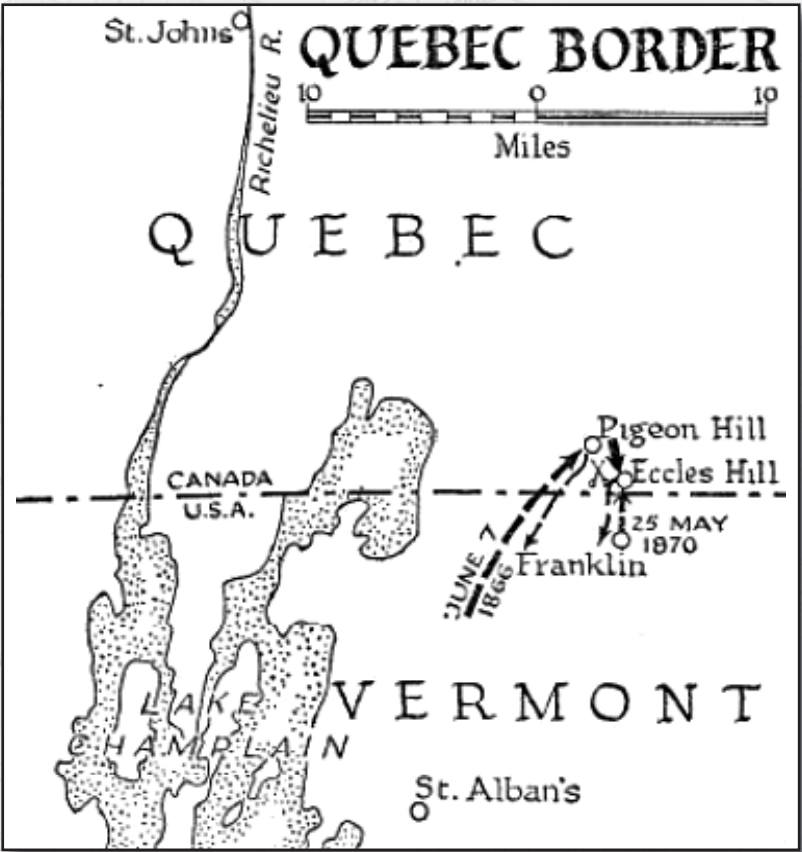
Soon after joining up in 1870, Private William James Kneeshaw, along with his brother, Sergeant Ebenezer Muir Kneeshaw, saw action during a Fenian raid on the Quebec/Vermont border.  Their unit - the 11th Battalion's Argenteuil Rangers - defeated the Fenian's attempt at invasion of Canada, once again; it was another of an ongoing string of incursions along the 45th parallel beginning in 1866.
 
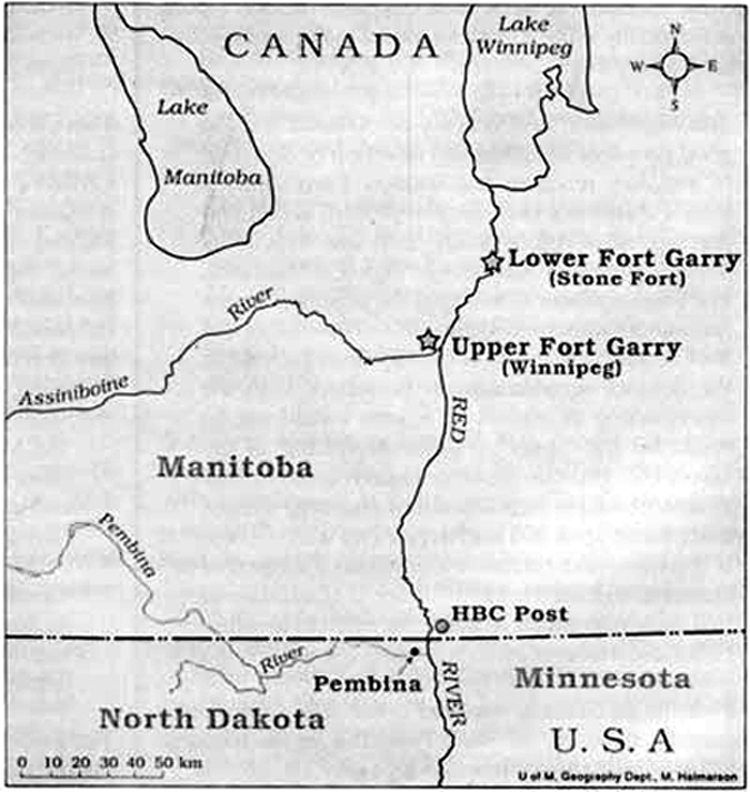
In 1871 John O'Neill and an odd character named W. B. O’Donoghue asked the Savage Wing Council to undertake another invasion of Canada across the Dakota Territory border. The Council, weary of Canadian adventures in general and O’Neill in particular, would have none of it. O'Neill's idea was turned down, but the Council promised to loan him arms and agreed they would not publicly denounce him and his raid. O'Neill resigned from the Fenians to lead the invasion, which was planned in Saint Paul, Minnesota, to invade Manitoba near Winnipeg. About 35 men, led by John O'Neill, William B. O'Donoghue, and John J. Donnelly, hoped to join forces with Louis Riel's Métis. 

On October 5, O'Neill's force managed to capture a Hudson's Bay Company post and a Canadian customs house which they believed to be just north of the international border. A U.S. survey team had determined the border was two miles further north, placing the Hudson's Bay post and the customs house both inside U.S. territory. O'Neill, J. J. Donnelly and ten others were taken prisoner near Pembina, Dakota Territory by U.S. soldiers led by  Captain Lloyd Wheaton.


The farcical raid was doomed from the very start. It actually took place inside the United States, and the Métis under Riel had signed a pact with the British just as the invasion began. Riel and his Métis captured O'Donoghue and gave him to U.S. authorities. In a somewhat muddled federal response, O'Neill was arrested twice - once in Dakota and once in Minnesota - but was released and never charged for "invading" U.S. territory. The men captured with him were released by the court as simply "dupes" of O'Neill and Donnelly.  It was John O'Neill's last hurrah.

And what happened to Vermont's W.J. and E.M. Kneeshaw?  Well, W.J. ironically emigrated to Pembina in 1873, not long after his militia service expired.  He became a lawyer, and eventually the well-known judge,
Judge William J. Kneeshaw.  His older brother E.M. (or as Ebenezer preferred to be called, Muir) eventually followed him to Pembina in 1880, initially farming for a bit, later becoming a surveyor. 

On a medal that Muir received:  On one side it has Victoria Regina et Imperatrix meaning, "Victoria, Queen and Empress", along with her raised image in profile.  On the other side it has a raised image of the Canadian flag (1870 version), with the Union Jack and Canadian coat of arms, with some greenery.  Around the edge of the coin, is stamped the rank and name of Sergeant E. M. Kneeshaw, as seen below.  On a bar, across the base of the ribbon, is stamped, Fenian Raid 1870...


Wednesday, April 24, 2019

Sociability Run: Jefferson Highway


[Note — General Manager McDougal of the Pershing Way [Association], who was for a short time Publicity Commissioner of the Jefferson Highway,  admits that he appropriated from the Jefferson many of the successful methods he is using on the Pershing. He also admits they are pretty good. 
We likewise are going to appropriate the story of his trip to Winnipeg, and in doing so likewise admit it is pretty good. That Manager [Herbert F.] McDougal has a microscopic eye, a retentive memory and a happy way of telling it is evidenced by what he saw and tells of his trip. 
Judging from his experience at the "Line", he should have borrowed the Jefferson's Rabbit Foot. 
Mr. McDougal's story will be read, with interest by the J. H. family, especially those who "made the trip" last July.  The following is an excerpt about the final leg of the run...]


AT Hallock the P. W. runs onto the Jefferson Highway marks and continues with them the rest of the way, going through Northcote, Humboldt, St. Vincent and Noyes to the International Boundary.

The Jefferson Highway touring group paused their sociability run 
in Emerson for "short" speeches and this group photograph...
Pro-lemonaders made another hit when Bronson was reached, where "most excellent lemonade was served" by the ladies. Decorations were mainly American and Canadian flags. Mayors Hodgson and Behrman spoke. The hotel menu at Hallock, a noon control, was a novelty, and uniquely distinctive over any other during the entire trip. Part of it was in French, and embraced dishes served especially in New Orleans. Banners and flags formed the principal decorative feature. Luncheon was served at the hotel and restaurants in the city. The Custom Houses of Noyes and Emerson were soon passed, owing to arrangements having been made beforehand. Short speeches were made by Governor Pleasant and Mayor Hodgson at Emerson.1
We had been sweeping along across the prairie, much of the time with no fences along the road, and came to a turn to the east along what, as memory recalls it, looked like the back side of a farm yard with perhaps an orchard bordered with forest trees in a sort of a scrubby growth. Straight ahead and eighty rods beyond was a dingy railroad station, and just before we reached it a turn to the right and north.

Before us loomed a signboard, high on stilts, announcing the "International Boundary," and there was a moment of bewilderment as we saw in one direction a road turning off to the station and in the other a pair of ruts curving around as entering the farm yard.

The original routing of the Jefferson Highway entered Canada directly from Noyes,
Minnesota into Emerson, Manitoba, Canada.   This is the approximate route the JH
followed. [Source:  Two Lane Traveler] NOTE:  The red line leading off 171 going
north was the 'Emerson Road' (dirt when I was growing up, now plowed under...)  
Over this seeming by-road was the remains of an arch1, placed there last July to welcome the Jefferson Highway tourists on their great sociability run, and the presence of the arch gave rise to the theory that this must be the entrance to the Dominion. Pursuing the tracks a bit further we were convinced that we really were on the highway into the neighboring nation, for at the side of the road was a glorified Keep Off the Grass Sign, bearing a solemn warning against going across the line without proper formalities.

The road took another turn and crossed a railroad track, which itself had crossed another track just previously. The one was the Soo, which ran along the margin of Canada, and the other was the Canadian Pacific, both heading for Winnipeg. All our pictures of an imposing entrance into Canada were dashed, as almost any country cross road is as pretentious. But still there was something picturesque about it and something that impressed itself upon the memory.

There are two railroad stations — one on the American side and one across in Canada, and at each immigration and customs officials, representing the two governments, are on guard. It looked as if it was a pretty simple thing, after all, getting into a foreign country, but it took just about an hour to do it, for a becapped official, swinging down the track to reach the switch tower and climb its dizzy steps to the bird-like house above, said that there was nothing to do but to report to the officials at the Emerson station, which took time and proved not to be the right thing, for we were first to go a mile or such a matter up town and be interviewed by the immigration official and get a card and then go across the street to where the Union Jack flew over the government building, and make our clearance at the customs office.

THE customs officials were polite, but inquisitive. They wanted to know how many in the party, what make of car, how many cylinders, its license number and factory number, whether it was equipped with windshield, top, speedometer and clock, and how much it cost, what baggage we carried and whether we had any camping equipment and how long we expected to tarry in Winnipeg.

Then a very nice old gentleman came down and rummaged through our suit cases in a formal and perfunctory way, withal rather thorough. But first there had come up the serious question as to the very typewriter on which this is being written. It is one of the folding sort and a constant companion. The G. M. would be lost without it, and the work of the organization would be hampered. It was rather important that it, too, make the trip into Winnipeg, for there would be the matter of correspondence and perhaps some magazine stuff.

But the officials were stern about it. They said that the wee machine was dutiable and that we had better put it in hock, so to speak, at the customs office to be picked up on our return, and to borrow a machine in Winnipeg. It looked as if the typewriter was to part company with the official car.

But the missus, waiting all this time down in the auto, said it didn't sound reasonable to her that a car and all that luggage could go in and a mere typewriter barred.

So we went back and argued that the typewriter was a tool of the trade and analogous to a monkey wrench in the tool box.

But these English are a fixed folk. They all had a look at the proposition, and turned it down; it wasn't regular. Then we offered to put up a cash bond, and finally succeeded in parting with $13 to that end, the money being in good American currency. Seeing the brand of money on deposit, a kind gentleman in the office suggested that we would be entitled to that sort back, as it was at a premium in Canada. So, on our return, we got $13.40 in Canadian currency, taking it across to the bank to be exchanged for American money. The rate of exchange had fluctuated during the walk across the street, however, and the bank demanded 50 cents instead of the 40 we had been paid.

And even at that we afterward discovered that we had a few Canadian bills in our script and had to give a discount on them.

BUT our troubles were not over yet. We discovered that our Canadian immigration permit, nor our clearance papers from the customs were sufficient; the becapped gentleman had deceived us. We had to go all the way back to the American side, to that little station of Noyes, to see a blue-eyed Irishman named Fahey in order to get a formidable document showing that Uncle Sam was willing to relinquish us for a few days.

That document had to be turned in to the Canadian customs officials, and then we were ready to go — all excepting the changing of a flat tire that had grown discouraged and depressed during all this formality. If we had known about the rest of that night that tire would have worried us.

But let us move on.

Over a bridge, combined wagon and railroad, under a viaduct we turned and then we were on the road to Winnipeg, sure enough. A little further and we were as good as in France, for, turning into a little village that proved to be Letellier, we grew uncertain of the way and stopped at a house to make inquiries if this were truly the way to Winnipeg.

The answer was "Oui, oui," which the doughboys all will recognize at once.

Turning just at the edge of that little village, which was mostly edge, we were at once in the old Hudson Bay Company's trail, a road 132 feet wide that goes in windings along the Red River of the North right into Winnipeg and becomes Main street, remaining 132 feet wide. That and Portage avenue, at right angles and of the same width, are boasted the widest streets in the world.

The boundary is sixty-eight miles from Winnipeg, and all the tedious details at Emerson, had taken time. It was 5 o'clock when we left Emerson, and that was Canadian time, the Canadians not having turned their watches ahead as the States had.

So we rather stepped forward a little on the gas, for there was a certain strangeness about the country that urged us to get along before dark covered the unknown roads. The trail at places was little more than sections of a fenced pasture, with ruts winding about between an endless row of telephone and telegraph poles. Winnipeg is paving out for miles and someday will have a concrete road to the border, no doubt, but nature still holds sway largely as yet there.

Jefferson Highway Sociability Run, NOLA to Winnipeg
L'Observateur (Reserve, Louisiana) · 28 Jun 1919
And we came into St. Jean Baptiste, a French town of 500 with only two English families in it. We sought to replenish our gas supply and pulled up at a garage and said "Five gallons." The tank filled up as we filled with astonishment. The answer was that we were getting British Imperial gallons, 277.274 cubic inches to the gallon, instead of our own United States gallons of 231 cubic inches. Five of our British cousin's gallons made six of our own, but we paid 40 cents for each and every gallon. 

They said in Winnipeg that American watches can be bought cheaper there than in the states, the protective tariff making it thus, but there was nothing like that about the gasoline, even Imperial gallons. 

Hunger was gnawing and we decided to have a bite to eat, much as we hated to waste daylight. So we asked for the eating place and were directed to a little wooden building that plainly was labeled "Public Hotel." 

Entering we found a dingy office that was a combination of a barber shop and bar. Prohibition had put the bar out of business, age had done for the barber chair, and the prospect was discouraging. But that was where appearances were deceptive, for, after a brief delay, we were led into a neat little dining room and |served with a supper as only the French served food. Bright-eyed French girls were jabbering French in the kitchen, and one of them went to the telephone and assaulted it with a flow of language that was beyond us. 

Then a husky chap went up to the instrument and bawled out a question. "What's the score?" he demanded. It seemed that Cincinnati had won. We felt quite at home for a minute. 

WE had been inquiring anxiously about the road conditions, and the official car had attracted considerable attention, so supper done, we stepped out of the dining room into the midst of a curious crowd that wanted to talk. The men all agreed that the best road lay across the Red River, and they grinned as they said that the largest city along the way was Winnipeg. Afterward we came to realize the point of the remark. Only one village intervened in all that fifty miles. The rest of the trip lay through a country where a house was a surprise and bachelor shanties were the rule. Mile after mile was along a fence-less road that ran at will and at angles, but it was a good road, except lonesome. In the distance we could see straw stacks burning in various places, and occasionally we passed an automobile, but mostly there were solid banks of second growth white birches.

If we had ever needed a bit of gas or some air pressure we'd have had quite a walk for it. And there was that flat spare on the rack!

It sounds a bit dreary, just to tell about it. but it really was a wonderful drive, with the air balmy and the night pleasant. Occasionally we would wonder whether we were on the right road, and would stop at a house to make inquiries. Always we were, although sometimes the children had to be called up to translate, the parents being French.

The engine worked to perfection, the tires held out and we had had a good supper, so on we sped, over bridges, through woods, out in the open. Finally we came to that sole village, passed it, got out into the wilds again and wondered. Then there appeared one of the blessed concrete roads that Winnipeg has built out for nine miles, and we felt as if we were nearing the goal.

But the lights of Winnipeg didn't settle all of our troubles. There was the matter of a hotel. A motorman, waiting to catch his car, offered advice. It wasn't any good, for every hotel he mentioned was full for the night. Finally, after we had tried one after the other, we were forced to put up at one that always will haunt our memories and make as firm in favor of strict hotel inspection laws.

The next morning we found room in a comfortable one...
____________

1 - "A very artistic arch-way had been erected at the border, but we had already been made to feel that we would be just as much at home in Canada as in Louisiana." [The Story of the Run, The Modern Highway, Vol 4, No. 7, August 1919, Pub. by the Jefferson Highway Association]

Thursday, March 16, 2017

Frederick A. Bailey: An NWMP 'Original'

Sgt. Fred Bailey
[Source:  RCMP Veterans Association,
Vancouver Division]

Let me introduce you to an ordinary man who happened to make a bit of local history by just doing what many in his day did - living life, making choices, taking risks.  

"This I believe is the diary of Frederick Bagley when he enlisted in the North-West Mounted Police as a trumpeteer at 15 years of age; They left Fort Dufferin in 1874 to secure the Medicine Line!" 
- J. Rempel

I will be sharing portions of that diary here on this blog at a later time. But for now, let us learn a bit about Sub-Constable Fred Bagley, Trumpeteer ...


According to a fascinating online biography (which I quote here in-full since so many such pages seem to disappear):
Fred Bagley’s musical talents and leadership provided a major contribution to the Force and to the communities he served in.

With regarding setting records, he was first in the following areas: 
a) being the youngest member to be sworn into the Force; 
b) first Trumpeteer in the Force; 
c) present to guard and witness the first person to be hung in the North-West Territories at Fort Saskatchewan; and 
d) first member to lead a musical performance before Royalty.

Wednesday, May 04, 2016

Field Trip: Manitoba Border Churches

At the St. Michael's Ukrainian Orthodox Church cemetery, May 4, 2016

While out in the field taking photographs with Troy Larson on Monday, I realized I had a golden opportunity to get a good shot of myself that wasn't a selfie. Troy was very kind and took a couple of shots of me.

I love them! That's me nowadays. No more glamorous makeup and clothes; nowadays my priorities are pain relief, physical strengthening, and comfortable clothes. And documenting family and local history as much and as well as I can, for as long as I can...

The entire cemetery is surrounded by an old growth oak grove...

Monday, March 28, 2016

Six Shots in the Night


Huron City (1883 Plat Map) Source:  HistoricMapWorks.com
I've written about Huron City a few times here before; and of course Charles Walker wrote about it, making it come alive, in his books Sheriff Charley Brown, and Bordertowns.  This time, I'm sharing another essay about it written by Jim Benjaminson, that was recently featured in the Pembina Historical Society newsletter.

Huron City is long gone now, but once it was a lively conclave nestled along the border...
_______________

Since the earliest days of settlement in what would become Pembina County, many little communities sprang up over the years, many have totally disappeared. Communities such as Hyde Park, Bruce, and Tyner have all but disappeared – leaving behind only the graveyards holding the remains of those early pioneers. Other communities such as Svold, Hallson and Leyden still have a presence, if you know where to look.

During the course of the past years, I’ve given several presentations and each time I’ve asked those in attendance, “Do you know where Huron City was?” Only one person – Ken Gardner – ever raised his hand to reply in the affirmative. Although most of its history has been lost to time, Huron City played a role in Pembina County’s history – most of it, not for the better.

Huron City, Pembina County, Dakota Territory, was located in the extreme northeast corner of the county tucked against the International Boundary to the north, adjoining the Hudson’s Bay company town of West Lynn and the Red River to the east, about two miles north of Pembina.

Newspaper ad for the Half Way House hotel in Huron City
Located on property owned by James H. White, the town-site of Huron City was platted prior to a public auction held September 4, 1879. Advertisements promoting the land sale touted the fact Huron City would be the “terminus of the St. Paul, Minneapolis, and Manitoba Railroad and the Manitoba Southern Railroad”, as well as being located on the main wagon road from Winnipeg where a new “International Bridge” would be built, connecting the two railroads.

The fledgling city already boasted Jim White’s saloon. The saloon was unique in that the building actually straddled the border – a red line painted on the floor indicated whether you were on the Canadian side of the border or the U.S. It was here that a Texas train robber was employed as a bartender – an outlaw who would die in a shoot-out in the Pembina post office in November of 1878 while resisting arrest by a deputy U.S. Marshal, who also died as a result of the affair.

White offered “100 business and residential lots – with no use restrictions”. Sale terms included cash payment of 10% of the sale price the day of the sale, with an additional 40% due within one week. The remaining balance could be paid off within one year at “normal rates”. Paying cash for the entire amount the day of the sale got the buyer a 10% discount. The Pembina Pioneer reported sales were good.

Closeup of Huron City platted streets; note 'Wharf St' in NE part of map...
Unlike many of the previously mentioned neighborhood communities, Huron City was platted into lots and streets – Anna Street, Elizabeth Street, Matheson Street, Huron Street and May Street running at an angle (southwest to northeast) with cross streets of First Street, 2nd Street, Third, Fourth and Fifth Streets (only 2nd street was marked with a numerical number, others were spelled out in full) and Wharf Street – leading to the river and presumably a river boat landing.

Article in the October 20, 1892
edition of the
Winnipeg Tribune
In addition to White’s saloon, Dan Rogers was the proprietor of the International Hotel, which along with an attached residence, burned to the ground September 4, 1885. For the “sporting crowd”, there were also two houses of ill-repute, one run by Pearl Gould, the other by Nellie Dunn1. Both establishments closed their doors after an incident the night of October 19, 1892 when a party of men from Emerson attempted to enter Pearl Gould’s but were refused entry. Pearl and her “soiled doves” retreated to the safety of Nellie’s, where the same parties were also refused entry. During the ensuing fracas, an Emerson hotel keeper named John Wagner was shot and killed.

Nellie Dunn was arrested and brought before a Grand Jury at Pembina. Although there was some question as to whether Nellie had actually fired the fatal shot, the jury determined Wagner’s death was justifiable homicide due to threats he had made to harm Nellie. Following the not guilty verdict, Nellie, Pearl and the other “ladies of the evening” were advised it might be advisable for them to return to Canada. Local papers remarked that the Gould name was “more than familiar” to law enforcement in Pembina County.

Although little more is known about Huron City, it remains a unique experiment is establishing a thriving community. Within a few square miles of land encompassing what is now North Dakota, Minnesota, and Manitoba, seven communities were established - Pembina, Huron City, West Lynn, Emerson, St. Vincent, Noyes, and Interapolis. Six had established residences and businesses; five still exist.

Interapolis, Minnesota, which would have been directly across the Red River from Huron City, never materialized. Huron City, Pembina County, Dakota Territory is unique in that it was documented in Pembina County Atlas’ as late as 1909, long after it had faded away to nothing more than a fleeting memory.

1 - A sidelight to the Nellie Dunn story. After she was "invited" to leave the U.S., she ended up in Spokane, Washington, in February 1893; still plying her trade, where she "shot and killed her boyfriend". The locals weren't as understanding as Pembina -- they took Nellie out and lynched her.

UPDATE 13 August 2020 From fellow local historian and author, Jim Benjaminson, "...the story I did on Huron City - about Nellie Dunn being hung in Spokane, Washington is false. Nellie 'removed' to Winnipeg after the affair in Huron City and continued to work as a prostitute. The story of her hanging came from an eastern Canadian newspaper...I found Winnipeg papers that made mention of her after the date of the supposed hanging."

Thursday, July 10, 2014

Noyes Customs Building Up for Auction

While nothing was really mentioned of the history of the depot, it was difficult, yet good to read this article about Noyes today.  A very sad article about Noyes generally, and the old Customs building specifically. There was a beginning, and this is the beginning of the end.

It will be interesting to see who buys it and what they do with it. I could see turning it either into a very interesting residence (granted, it would take a lot of internal remodeling with all that ugly government modernization they did over top of the original early 1930s classic look, i.e., the paneling and indoor/outdoor carpet...), or a Bed and Breakfast with a border theme.  Who knows - it could just end up being a storage shed. Obviously someone wants it for something. Bidding started in May at $5,000 and it's already up to $30,000 with 4 bidders so far, and three weeks to go despite what the article says; there is a notation on the listing that the time period for bids may be extended, which is evidently has been...

Chris Misson, chief Customs and Border Patrol officer, stands in front of
the former Customs and Immigration Station at Noyes, Minn. Wednesday.
The station, closed several years ago, is being sold on an online auction.

[Photo by Eric Hylden/Grand Forks Herald]

Old Noyes, Minn., border station for sale, reminder of closed crossing

By Kevin Bonham (Grand Forks Herald, July 10, 2014)

NOYES, Minn. — When Mary Delaquis first arrived at what then was the U.S. Customs and Immigration Station in Noyes as a customs inspector, her daily commute took her just across the international border to a motel in Emerson, Man., where she lived that first summer in 1984.

Customs and Immigration Station in Noyes as a customs inspector, her daily commute took her just across the international border to a motel in Emerson, Man., where she lived that first summer in 1984.

That wasn’t unusual.

The Noyes border station — located along U.S. Highway 75 but just a 15-minute drive from the Interstate 29 port of entry north of Pembina, N.D. — was more of a neighborhood crossroads than an international port of entry.

“We didn’t see a lot of commercial traffic at the port,” said Delaquis, now Pembina Area Port director for U.S. Customs and Border Protection’s Office of Field Operations.

“It was an opportunity for locals to use the facility, she said. “They could move more quickly through the border.”

Canadians living in Emerson, Letellier and other nearby Manitoba communities would cross the border to get their mail, buy gas or to buy groceries.

Noyes-area residents, in turn, would drive across cross to eat, have a couple of beers, or to take their families swimming at the pool in Emerson.

“We saw a real local flavor at the border crossing,” said Delaquis.

The Border Patrol building, now closed and up for online auction, is an empty reminder of the past activity.

Thursday, October 31, 2013

The Border

The little border town of Emerson, Manitoba, was a surreal place to be in April 1997.  Behind the permanent dike that had been doubled in height with the addition of a temporary structure of plywood and sandbags, Emerson was a dry island in the vast sea of the Red River, which had burst its banks.  All the inhabitants, with the exception of a few who had been left behind to fight the flood, had been evacuated.  The electric power still worked, so that at night the island of Emerson was ablaze in a strange white light.  Deer and hares and other smaller animals had gravitated to the town to escape the ice cold waters of the raging river.  They stood, frightened sentinels, in the white light of the ghost town. 
A remarkable crew made up of town employees, a detachment of troops from the Canadian Forces and local Mounties kept the town of Emerson itself dry and secure.  As the river rose to a critical level in late April, with no firm prediction on how high it would get, the struggle to maintain the wall around the town was in deadly earnest.  Coordinated out of the Emerson Town Hall, the beleaguered warriors filled sandbags and directed them to potential weak points on the perimeter.  So close is Emerson to the U.S. border, that a portion of the dike actually crossed into the small neighboring community of Noyes, Minnesota, protecting a U.S. Customs office and several nearby homes on U.S. soil.  As residents noted at the time, what they were calling the "Red Sea" did not make distinctions between one side of the border and the other.
[The writer returns five years later, and talks to survivors in both Emerson and Pembina of their ordeal during the 1997 flood, then goes to the border to travel to Grand Forks to interview survivors there...]
In the large new Canada Customs post at the border- built since the flood of '97 - I meet two tall, muscular customs officers who have recollections of the mayhem...When asked about the purpose of my trip to North Dakota by a U.S. Customs official with grey hair, I tell him I am going to Grand Forks to talk to people on the fifth anniversary of the flood of '97.  Not bothering to ask me for ID, he comments sardonically, "Why not go to Pembina?  They know at least as much about the flood as anyone in Grand Forks." 
I follow his advice and drive into the little town of Pembina, two minutes south of the border.  The town had been British territory before it was handed over the U.S. with the adoption of the forty-ninth parallel as the border across the Prairies in 1818.  On the east side of Pembina, there is a high earthen dike to protect the town from the Red River.  It is the same on the other side of the river in the tiny hamlet of St. Vincent Minnesota.  This April the Red is tame, but the dike is there for protection against future floods. 
On the main street of Pembina, I find an old preacher and his young disciple out trying to win converts.  I ask them if they were in town for the great flood of '97.  In reply, the old man hands me a pocket-sized pamphlet titled, "A Preacher of the Old School."  In our conversation, Mr. W. Seed and I are at cross-purposes.  He is trying to save my soul from a flood of biblical proportions while I am in search of memories of a mere earthly flood.  I manager to get Mr. Seed onto my line of inquiry, and he tells me of the long series of floods that have afflicted this community - in 1897, 1950, 1966, and 1979.  In 1997, he says, the dike held and the town was saved.
From:  The Border: Canada, the US and Dispatches From the 49th Parallel

Sunday, January 01, 2012

Port of St. Vincent: Welcome to America

Originally issued in 1888, this is an 1891 copy of a
Declaration of Intention
  [Courtesy:  Jim Benjaminson]

This Declaration of Intention certificate is for Magnus Benjaminson.  He emigrated from Iceland in 1886, and arrived in the United States via the Port of St. Vincent.

Many entered the United States via the Port of St. Vincent from Canada, and still more came across the young territory of Minnesota from the South by train, wagon, and even steamship. Some stayed, most left.  St. Vincent was a crossroads just like her sister city Pembina was before her.

New York had Ellis Island, Kittson County had St. Vincent!

Monday, June 06, 2011

Customs Stories IV: F.T. Bradley

One of the clearest copies of this photo that I've ever seen!
F.T. Bradley

In 1871, a customs house was opened on the west side of the Red River, and the first Collector of Customs, F. T. Bradley, (seen in above photo) was appointed. Bradley became an important figure in Emerson’s early years, becoming also a director of the Emerson and Northwestern Railroad and organizing the first Masonic Lodge of which he was Grand Master. By 1872, the customs building also served as a telegraph, express, and post office for what was known then as North Pembina and came later to be known as West Lynne. It was later discovered that this “Canadian” customs building was actually sitting on the American side of the boundary—and was hastily dragged north! The customs house, the first in Western Canada, is now located on the north side of Highway 75 on the west side of the river, along with Emerson’s first jail, also a well-preserved log building.

Source: Manitoba Historical Society, Tour of Emerson

This burial site on a small piece of property owned by the Town of Emerson (now part of the Municipality of Emerson-Franklin) is a considerable distance from the road, in the middle of a farm field. It contains the 1885 grave of Emerson customs official F. T. Bradley along with the ones of his wife Caroline, who died in 1879, and four of their sons. The wife and children had originally been buried in the Old Anglican Cemetery but were moved here in 1900. A single white monument for Caroline Bradley and their four sons is located in the centre of a 16-foot by 22-foot rectangular area delimited by a low concrete wall. A small concrete marker with Bradley’s name and the Masonic symbol is also located inside the rectangle, as is a small white stone marker bearing the initials C B.
In February 1884, Bradley was arrested on a charge of fraud and embezzlement of over $4,000, relating to a shipment of coal by the Canadian Pacific Railway, and was transported to Winnipeg for trial. He soon became too ill to appear in court, and died on 27 February 1884 without regaining consciousness at the Winnipeg home of his brother-in-law and physician Alfred Codd. His body was returned to Emerson for burial, but not in the local cemetery, instead in a 20- by 20-foot plot northeast of town.

Friday, June 03, 2011

Port-of-Entry: Emerson 1947

An image I found online for sale, of the Emerson port-of-entry, circa 1947
Locals would be waved through without stopping back then.  Even when I was growing up, they still did.

It's a different world now.  Technology has given and it hath taken away.  It has provided ways for very bad people to potentially do even worse things to innocent others.  In return it has given us countermeasures to fight against those ways.  In the meantime, we become prisoners of supposed safety...and there is less open and easy opportunities for neighborliness - at least of the frequent, in-person variety that deep and lasting bonds are made of.

Saturday, May 28, 2011

Setting the Record Straight

This appeared on the editorial pages of the Winnipeg Free Press recently...
In your editorial Radicals always in our midst (March 16), I was surprised to read in your editorial that in 1871 "the Irish rebel John J. O'Neill met Métis leaders in Manitoba to enlist support for an invasion of Canada in an effort to weaken British oppression in Ireland." I would respond: what Métis leaders?
I have researched this issue extensively. William O'Donoghue had recruited four Fenian leaders to come to Manitoba. The Fenian Brotherhood did not officially sanction this trip, but provided funds for 300 muskets. They had about 30 men with them when they crossed the Manitoba border and ransacked the HBC post at Emerson, which was called "Fort Pembina."

Friday, May 13, 2011

Customs Stories III: Opium Smugglers


Smuggling contraband is a long tradition along borders, including the border area around St. Vincent...

Bold Opium Smugglers

Confiscated Opium...
St. Paul, Minn, Dec. 20, 1888 - A gang of daring smugglers has been engaged for some time in bringing opium into this state across the Northwestern border. The deputy collector at St. Vincent, Minn., acting on information from one of the gang who is under arrest, captured a wagon containing eight hundred pounds of the drug in the crude form just on the Dakota line. Detectives are in pursuit of the man to whom the opium was consigned. Opium smuggling on the extensive scale is being carried on, and such are the precautions against detections that it is almost impossible to stop it.

From: The Ithaca Democrat (December 1888)
Good thing, then, that Deputy Collector Nelson E. Nelson was on the job!

Tuesday, May 10, 2011

St. Vincent: Port of Entry

H.R. Bill 814 makes St. Vincent's case

Did you know that at one time, St. Vincent was a port-of-entry?

After you read the original bill requesting that the town be made an official port (at left), you'll understand the logic; it actually makes sense for the time.

As of 1916, it was still a port. I'm not sure when it was discontinued, nor in what capacity it served as one.  Since the town wasn't right on the border itself (like Noyes) my guess is that it wasn't used for a crossing point, but functioned solely as a conduit for the border trade, or customs.

In 1883, it becomes reality - St. Vincent becomes a (sub)port-of-entry

I found out this much:  A deputy collector resided at St. Vincent during the time frame it was a port-of-entry.

With further research, I learned there was a Customs House in St. Vincent at some point, and not only was there a Deputy Collector of Customs, but at least two other positions there, also.

For example, in 1887, those on-duty were:  Adelard Guernon, Collector; Nelson E. Nelson, Deputy Collector; and Alfred F. Storey, Deputy Collector, Clerk & Inspector.

In 1887, there was no 'district of Dakota'; in fact, even the Pembina Customs was listed under the 'district' of Minnesota.  But between then and 1916, that changed...
The district of Dakota, to include all of the States of North and South Dakota and the county of Kittson in the State of Minnesota, with district headquarteres at Pembina, in which Pembina, Noyes, St. Vincent, Portal, St. John, Hannah, Neche, Ambrose, Souris, Walhalla, Sarles, Sherwood, Hansboro, Crosby, and Antler are ports of entry...

"The border crossing station at Noyes was established in 1905, after having been previously located in the nearby town of St. Vincent." - MN/DOT Historic Roadside Development

Wednesday, April 13, 2011

Geographic Trivia

From early on our area was unique,  geographically & politically
[Click to enlarge]
It is often thought that the title was secured by the U.S. at no cost. However, the territory of the original Louisiana Purchase west of the Red River Valley does extend north of the 49th parallel.

Annexed by Britain in exchange for its cession of the Red River Valley, the northernmost parts of the Louisiana Purchase are the only North American territory ever ceded by the United States to a foreign power.

The region was sparsely populated until Ojibwe claims to the most fertile portions of the valley were extinguished in the Treaty of Old Crossing (1863), after which it opened rapidly to agricultural development and settlement in the 1870s and 1880s. The area is one of several distinct regions of Minnesota.

From Red River Valley

Monday, April 04, 2011

Putting Faces to the Names


I have written about Les Eddington several times.  While doing research on another subject, I came across this rather dashing photo of him in uniform,  in the book Heritage '76: Pembina County, North Dakota Then & Now.

Monday, November 22, 2010

NWMP Arrive in Fort Dufferin

North West Mounted Police trooper from 1870s
[Artist:  R.J. Marrion - Canadian War Museum]

Fort Dufferin was originally established in 1873 by the North West Mounted Police (later the Royal Canadian Mounted Police) - this site was also used by the International Boundary Commission in its mapping of the International Boundary in 1874.

That same year, men were recruited for important efforts even further west, but to get them there, they had to come down into the United States, then back up into Canada (direct travel not yet being practical due to obstacles such as the Canadian Shield...)  The article below chronicles their adventures 'getting there', coming through Fargo, then Fort Dufferin (the modern day Emerson area...)

[A thank you to Jake Rempel of Halbstadt, Manitoba...]

Sunday, September 05, 2010

YouTube Local History: Pembina Depot

The video above was brought to my attention by Bill Ash the other day. In the interim, Bill found out from Clarence Bingham the scoop on the last few seconds of the film showing a depot, which turned out to be the old Pembina Depot, in its glory days!

Clarence also had this to say about Olaf Hanson, whose family (including Olaf) are shown earlier in the film:
Olaf Hanson was a Customs Inspector at Pembina during the 1950s. The depot in the video is the old Great Northern depot in Pembina. Olaf had a penchant for getting in trouble with the passengers he inspected by trying to joke with them. Unfortunately, travelers were not in a joking mood when crossing the border. To make matters worse the Collector of Customs office was just a couple of miles down the road in Pembina, so they would stop and complain. My desk in the headquarters office was close to the Collector's , so I could not help but hear some of those tirades. One day Olaf inspected a young man and woman at the Pembina Border station. He ascertained they were not married while establishing their citizenship, then when he was inspecting their car/suitcase, he jokingly inquired if it was appropriate that their underwear was comingled in the suitcase. They did not appreciate his attempt at humor and stopped at the Headquarters to lodge a complaint. The Collector - John O'Keefe - subsequently had Olaf in and threatened to transfer him to Hannah, N.D., where he would not encounter so many travelers. I don't recall if the transfer was in fact ever carried out.

When we lived in Pembina the GN depot was repainted. The B&B crew came to town - about 1958/59 - and in a few days painted the depot and associated buildings that God awful brownish/mustard yellow color the GN used in those days. A year or two later the section crew chief in Pembina repainted his house and by some mysterious circumstance the color was the same as the depot.
Bill Ash has this to share about Clarence:
Clarence "Bing" Bingham is a first cousin of my mother...He grew up in Wisconsin but got a job at the Railway Express office in Noyes, MN in the early 50's and soon after took a position with US Customs at Pembina and Noyes. He is retired now and is living in the state of Oregon.

Monday, June 21, 2010

CentrePort Revisited

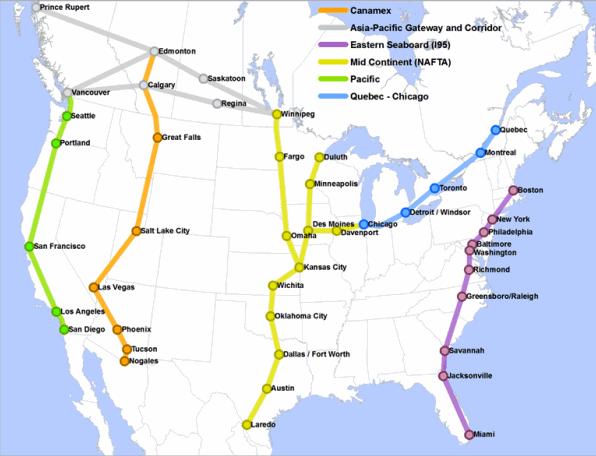
I reported on this about a year ago, and now we're finally seeing progress. Groundbreaking has begun on the major construction project - described as "the largest national infrastructure renewal effort in half a century" - that will come to be known as CentrePort.
...milestones include the start of the first stage of development for the four-lane divided expressway known as CentrePort Canada Way and upgrades to Highway 75. These improvements will provide better, more efficient highway access to CentrePort Canada and nearby assets including Winnipeg’s James Armstrong Richardson International Airport and the Canadian Pacific Weston Rail intermodal facility, and ensure that trade moves more effectively across Canada and into the Asia Pacific Gateway, as well as south through the Emerson border crossing, and into the United States and Mexico.

Saturday, April 24, 2010

Ephemera: Promotion of Progress


The image above is from an envelope I have in my possession. It is in the upper left-hand corner representing the return address of Charles Johnson of Pembina. I haven't been able to find out much about Mr. Johnson, but do see him listed in the Pembina County Pioneer Daughters Collection of the Elwyn B. Robinson Department of Special Collections, Chester Fritz Library, at UND.

To me, it shows the ambition of not only Mr. Johnson, but the dreams of the communities he represents themselves. At the time of the late 19th/early 20th century, things were changing fast, and hopes were high...

Wednesday, April 21, 2010

Huron City

Huron City - Location: 485950N by 0971400W - was a real place that no longer exists. I grew up just a stone's throw geographically-speaking from where it once stood and never knew. I discovered this place (and a few others) through my research for this blog, stumbling upon it quite by chance. It appears to have been the 'twin city' to Noyes, as Pembina is to St. Vincent, it being on the Dakota side of the Red River. The more I find out about my hometown area, the more I realize that much more land than I had any idea of, was at one time populated as camp, fort, mission, or town, then later went back to what eventually became farmland...
Heading north out of town, they approached Huron City at the International Boundary. In spite of land speculators' wild claims as to the town's grand future, only a few cabins and a small hotel were in existence. Charley knew that the hotel held the reputation of being the local brothel. Crossing the boundary line, they came to the road between West Lynne and Emerson. The hot, humid afternoon seemed to wrap the two men closely. - From BORDER TOWNS (Chapter 14), by Charles Harris Walker