Wednesday, December 21, 2022
Christmas Sunday School Memories
Friday, September 16, 2022
Humboldt-St. Vincent Elevator Association: End of an Era
This week, it was announced that the Humboldt-St. Vincent Elevator Association was being dissolved and thus the closing of the elevator in Humboldt, St. Vincent's elevator having closed some years before.1
Some of you may remember Silas Mathews who lived south of Humboldt. One summer afternoon in 1973, Silas and I were sitting on the railing going up the south driveway. It was a very quiet day. When we were visiting, a tandem truck pulled into the elevator with a load of grain. I unloaded the truck and returned to visit with Silas. For those who are younger, there were not that many tandem trucks before this time. Silas was kind of amazed at the size of the truck. I could tell he was in deep thought when I sat down on the railing to resume our visit. He then said, "You know Keith, with all of these big tractors and big trucks, farmers will soon be hauling all their grain to Crookston. There won't be many small farmers like today. They won't need this elevator any longer."That conversation with Silas never slipped my mind. I cherished every conversation I had with Silas. He passed away a couple years later...
In neighboring Emerson, a resident shared, "In the Emerson area in winter time, if you couldn’t see the St Vincent elevator, it was too stormy to be on the road!"
_________________
Wednesday, June 15, 2022
Fort Pembina Airport
- From Saga of Pembina County: 150 Years, by Jim Benjaminson ©2020
- Airport and Landing Fields in the United States, Bureau of Air Commerce (January 1, 1938)
Trivia: Buell Edwin Blake, who enlisted in the U.S. Navy in May 1937 right after graduating from high school. "He had a tattoo saying USN 1937-41...He was a Radioman2 3rd class at that time [during WWII]. Later went on to be an Air Traffic Controller in Pembina," said his son, Gary Blake.
[Buell would meet his future wife during this time - Jeanne Short, daughter of Gail & Eliza Short of Short's Cafe...]
2: Why did airliners of old require radio operators?
Wednesday, January 12, 2022
St. Vincent Grain Warehouses & Elevators
"The St. Vincent Elevator Company, a new farmers' organization, of St. Vincent Township, has bought the elevator and mill business of the St. Anthony & Dakota Elevator Company, which also includes the coal sheds, two dwellings, and two coal sheds at Sultan, the first station east of here on the Soo Line.
"The elevator, in addition to handling grain, will handle lumber and building material, also coal and seeds. Mr. Harry Ward Davis is the new manager."
It is evident from the news article at left, together with the other information earlier in this post, that the local farmers eventually realized they had to organize their own elevator to get the best prices they could for their grain. Their legacy is still going strong over a century later, with the Humboldt-St. Vincent Elevator Association...
Wednesday, October 13, 2021
Low Water: The Wreck of the Steamboat Dakota
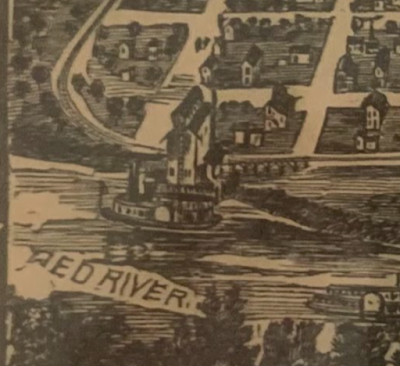
Looking to see if anyone might know or have any more info on the story that might be behind this. As you all know the mighty red is far from mighty right now but I still decided to take my boat down to check things out. Came across what looked to be an old sunken boat of some sort. Brought it up to my dad and he said that his grandparents (Bud and Jean Feick) had said that it was an old steamboat that used to run from Forks to Winnipeg in the late 1800s but had gotten hung up and then just left in the river. They had also said that long ago you were able to see one of the masts sticking out of the water once the red would get lower. It sits about 3½ miles south of Pembina. Obviously most is completely covered with mud and/or missing but you can see about 30ft worth of deck right now. These boards are way bigger than they look in the pictures...
Paul Maloney: What do the nails look like, if any survived? And I think remnants of the boiler would still be there if it was a steamboat.
Jake Cosley: All the main nails used to hold the planks down are ¼x¼" square. There were a few large ½-⅝" round spikes used as well
Julie Lindegard: I will ask my dad Bob Cameron if he has any further info. Dad recalled hearing that Humboldt kids (St. Vincent kids were too far away) would often swim in the river and get on the boat and jump off. I can imagine it provided hours of entertainment for kids! He said that the Bockwitz family found and retrieved the anchor. They contacted my dad to take it to the museum in Lake Bronson at least 30 years ago. That's where it is now.
At Right: Evidence of scorched and burned decking could still be seen, over 140 years later...
Hetty Walker: Chuck always talked about the steamboat, that got hung up …that could be it
Janine Rustad: Talk to DeeDee Bakken---she used to say her dad knew exactly where it sunk
Julie Lindegard: Yes dad mentioned it was near/in the area of the Giffen farm.
Donald Burroughs: Does North Dakota have a historical society? Would be an opportunity to salvage some of the boat, those nails and boiler parts, paddle wheel hardware plus its coordinates to build a story around it.
Trish Short Lewis: They have already been contacted about this. State Historical Society of North Dakota's chief archaeologist, Andrew Clark.
Brandon Lee Legvold: Three (3) miles above Pembina it says which in Red River terms would be south of town so I would definitely say that is the hull of the Dakota that was found.
Trish Short Lewis: Since it’s only partially burned and witnesses say the ship burned, I think the idea of these being one of the two barges might be right. I reserve final judgment until we hear from DeeDee Bakken (hopefully) on what she recalls her father seeing…
[Note from Trish: I later spoke with DeeDee and got some very interesting information from her! Also, the pump in the photo at left, was found by her, and then taken and donated to the Kittson County History Center & Museum, where it is today, along with the Anchor found many years ago by Humboldt's Bockwitz family...]Brandon Lee Legvold: [The source of the quoted newspaper article, which is pictured above, is...] the Worthington (Minnesota) Advance. August 19, 1880. Which oddly enough is today. I found this on Chronicling America.
Trish Short Lewis: Full reference citation for article is The Worthington Advance. [volume] (Worthington, Minn.) 1874-1908, August 19, 1880, Image 1 Image provided by Minnesota Historical Society; Saint Paul, MN (Chronicling America)
Jim Benjaminson: Preservation of the site is paramount.
Tuesday, August 10, 2021
Where was Fort Pembina?


Location of Fort Pembina: All of section 16, 17 and 18. Township one hundred and sixty three (63), North Range Number 51, West of the 5th Principal Meridian. Site selected for post is on section 16 immediately on the Red River of the North one and one fourth miles above (South) of the mouth of the Pembina River.
The post would be situated about two hundred yards from the Red River at low water. The location was chosen because it was the highest point near the Red River, having not flooded since 1851. Section seventeen was chosen because it could provide hay and pasturage, and section eighteen because it had the best stand of timber within five miles of the mouth of the Pembina.
Tuesday, July 20, 2021
PROFILE: Artist Marie Antionette Branchaud
![]() |
| Image Credit: North Dakota Memories Collection, North Dakota State Library |
A river with two boats runs along the foreground of the painting. In the center there is a green grass area with many trees. Along the back row is a line of stores. There are four buildings starting with the National City Bank on the left. Branchaud's general store, Hardware Store, and Pembina Post Office follow from left to right.
Antoinette was educated as a nurse. She married Andre (Tony) Schwob, a folk artist. She began painting memories of her life and her family's life in Pembina and Cavalier, North Dakota. Antoinette's paintings are well known in the folk art circles; her paintings hang in New York folk art galleries and are available on online auctions.
The paintings at the Pembina County Historical Museum were donated by Antoinette's niece Charlotte Vogel of New York City in 2001.
Saturday, June 19, 2021
The Empire Builder: J.J. Hill & the Great Northern Railway
Saturday, June 05, 2021
J.J. Hill Obituary
ST. PAUL, May 29--James J. Hill, builder of the "Northwest Empire," died at 9:30 A.M. today at his house, 240 Summit Avenue.
In his room, in the southeast corner on the second floor of the brownstone house, overlooking the city to which he came sixty years ago as a clerk, the end came. His age, 77 years, was a handicap in combating the hemorrhoidal infection, which dates from May 17.
At the bedside were the children, hastily summoned from homes throughout the nation, the only member of the immediate family not present being Mrs. Anson M. Beard of New York. Kneeling at the bed, her hands clasping the hand of the man whose wife and helpmate she had been since 1867, was Mrs. Hill. Nearby was the Rev. Thomas J. Gibbons, Vicar General of the Catholic Diocese of St. Paul, Mr. Hill having for years been on intimate terms with the clergy here, though not a member of the Church to which his wife belongs.
Dr. Hermann M. Biggs, who was called into consultation during the last illness of the financier, was the only physician present as the end approached. Drs. William F. and Charles H. Mayo had gone; there was no more they could do.
John J. Toomey, Mr. Hill's confidential business agent for many years, left the Hill residence twenty minutes after his chief died. Shortly afterward came Ralph Budd, assistant to Louis W. Hill, President of the Great Northern. Then came Louis W. Hill. The latter walked between the Rev. Father Gibbons and George A. MacPherson, intimate friend of the family. Grief, showing plainly in the faces of all the men, was most poignant in the face of the son, Louis, who will take up the generalship of the interests his father built and husbanded.
The funeral will be held at his Summit Avenue home at 2 P.M. Wednesday. Interment will be in a private mausoleum to be erected at North Oaks, long the summer home of the Empire Builder.
The general public will not have an opportunity formally to pay tributes to the leading citizen of the Northwest, but Mr. Hill's associates and the faithful employes who made possible his great achievements will be admitted to the house to view the body before the funeral services. The family statement includes a request that no flowers be sent. The Rev. Thomas J. Gibbons, vicar general of the Catholic diocese of St. Paul, who attended Mr. Hill during his last few hours, will officiate at the funeral.
The family statement was as follows:
Tuesday, May 25, 2021
A (Back)Story of a Drowning: John Mortimer, St. Vincent, & the Red River
John Thomas Mortimer – Portrait of a Radical
by Isabel Watson
When we were children, my Mother often talked about her childhood: her parents, her brothers, their home life. She had a fund of stories too about aunts and uncles, many of whom we had never met but whom we came to know through the many retellings. This is often the starting point for family history exploration. One detail frequently mentioned was that her father had farmed in Canada at one point in his life and one of his sons from his first marriage had died tragically by going through the ice on the Red River "near Winnipeg" (read: St. Vincent, Minnesota) and his body had not been recovered until the spring. We knew nothing more than that bare outline of a story. It was not until I began to research my Grandfather's life that I came to discover the full extent of the story of John Thomas Mortimer.
My Grandfather, James Mortimer, was born at the Home Farm, Kirkton of Tealing, in the rural hinterland of Dundee in 1841. He came from generations of farm workers, many of whom had had small-scale tenancies on the Glamis estate, especially at Upper Arniefoul. Although James's father Alexander had moved to nearby Tealing, then to Balbeuchley at Auchterhouse, James returned to Glamis to serve his apprenticeship as a blacksmith with Peter Anderson at the smiddy there. Perhaps looking for more lucrative employment after his time was served, he moved to Dundee to one of its many jute mills, Ladybank Mill, and in 1864 married Ann Russell, a steam loom weaver, in Lochee. They were to have six children before Ann's untimely death from cerebro-spinal meningitis in 1876.
The history of the company, A Sense of Security: 150 Years of Prudential, gives an idea of how field staff were recruited, being 'only capable men of thorough respectability, and of favourable appearance and address'. In his latter years, my Grandfather continued to demonstrate a lively mind and interest in a wide variety of subjects. It is likely that he had pursued evening class studies as a young man and was eager for self-improvement, thus fulfilling the requirement of being seen as capable.
In the Census of 1881, the family was living at 13 North Wellington Street, Dundee, with father working as an Insurance Agent and Helen established as wife and mother to the five children, all still at home, Maggie (13), Annie (11), John (10), Alexander (8) and William (6), all scholars. Between his initial appointment to the Prudential in 1876 and 1884, James held contracts of employment in Dundee and Forfar, then in February 1884 he was appointed to a position in Airdrie, Lanarkshire, where he was to remain for most of the rest of his life.
By the 1891 Census, James and Helen were living at 13 High Street in Airdrie and had only two of the family still living at home, Alexander aged 18, a schoolmaster, and William aged 16, a letter carrier. The daughters had moved out, perhaps into employment, and John was in lodgings in Glasgow at 113 McAslin Street (St. Rollox) and working as a tailor. His fellow-lodger in the home of John and Mary Mitchell was Peter McPherson, who would become his brother-in-law by marrying his sister Maggie.
A moment of serendipity
I need to digress at this point to explain how it was I came to learn of the Canadian part of the story. What follows is a moment of serendipity. I had joined the Tay Valley Family History Society and being distant from the Research Centre in Dundee, was delighted when an e-mailing group, Tay Valley Bridges, was set up to bring into contact the many members worldwide who were not able to visit Dundee regularly. On one memorable occasion, an online conversation was taking place which involved Winnipeg. On a whim, I posted a request to see if anyone could tell me how to go about tracing the death of a young man named Mortimer by drowning in the Red River, on some unknown date. Back came the reply from fellow-member Susan Bethune, who happened to have in her possession a copy of the Dictionary of Canadian Biography, with an entry about John Thomas Mortimer, tailor and Trade Union activist. And so his story unfolded.
It is by no means clear when John first went to Canada. He was registered as an American citizen in St. Vincent, Kittson County, Minnesota, on 11 June 1906, having 'landed at the port of St. Vincent on or about the month of November in the year eighteen hundred and ninety'. This information seems at least debatable.1 His entry in the 1891 Census in Glasgow is quite clear and credible. There would not be any obvious reason why, having made the journey to the USA or Canada, he should immediately return to employment in Glasgow. His connection with St. Vincent came about through his wife, Lena Cameron, of whom more later. The first mention of him living in Winnipeg is in 1895, when we find him listed as a tailor in the Henderson's Directory and resident at 326 McDermot Avenue, Winnipeg. along with Wm. Mortimer, described as an engineer. The brothers remained at that address for each year until 1898.
The year 1895 certainly does seem significant. My Grandfather James and his wife Helen also travelled to Canada in that year. James resigned from his employment with the Prudential in April 1895 and was awarded a gratuity of £30. He and Helen sailed from Glasgow on 25 April, occupying a second-class cabin on the SS Samaritan, and arrived in Montreal on 8 May. They would then have made their way overland to Winnipeg. Little is known of their time there. James had a farm near Brandon, north-west of Winnipeg, which he eventually sold to a James Fraser in 1897 before returning to Scotland. It was always related within the family that Helen was unwell and yearned to go back home to Scotland. Indeed she died in Airdrie in 1898 and is buried in the New Monkland Cemetery. Grandfather James subsequently married for a third time, to Isabella Ann Power, my Grandmother, and had a new young family of which my Mother was the only daughter.
John's involvement with the Trade Union movement in Winnipeg is well documented. John Hample, in his entry about John Thomas Mortimer in the Dictionary Of Canadian Biography, states: After September 1896 he began a rise to prominence in Winnipeg's working-class movement by helping to rebuild Local 70 of the Journeymen Tailors' Union of America (JTUA), affiliated with the American Federation of Labor (AFL).